

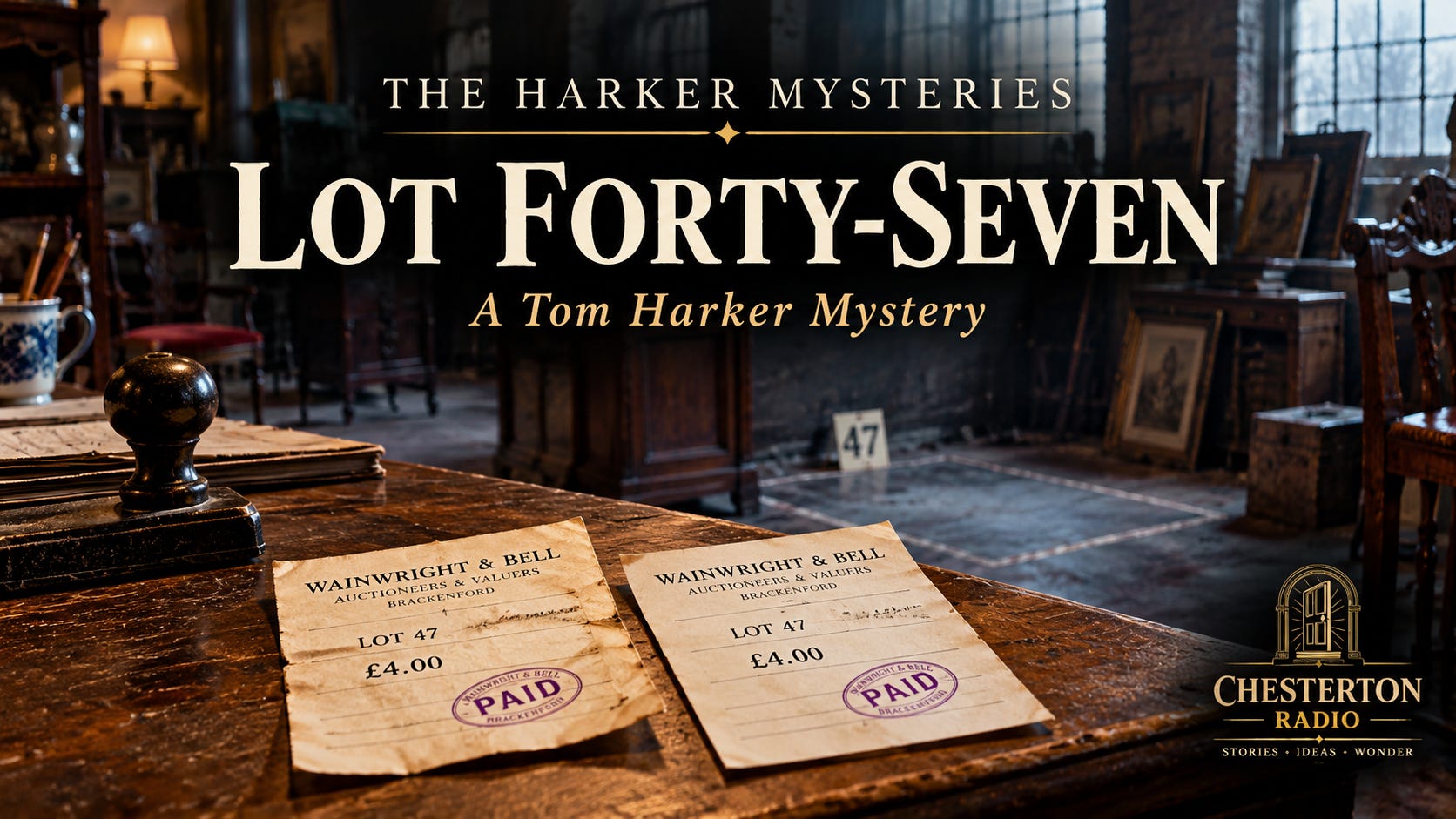
A new original mystery from Chesterton Radio.
Brackenford, England. November 1978.
Retired schoolmaster Harold Baines returns to the local auction house to collect a battered Victorian writing desk he bought for four pounds. The desk is gone. Another man has already collected it.
The problem is that the other man had a receipt.
So does Baines.
And both appear to be genuine.
For Detective Inspector Tom Harker, the question isn’t simply who stole Lot Forty-Seven. It’s why anyone would go to such trouble to steal something he could have bought for five pounds.
This is Lot Forty-Seven, the third original story in The Harker Mysteries.
If you enjoy intelligent, old-fashioned mysteries built around character, observation and ordinary police work rather than graphic violence, subscribe to Chesterton Radio. More original Harker mysteries—and other new stories in the tradition of classic radio drama—are on the way.
And now, the mystery begins.
CHAPTER 1
LOT FORTY-SEVEN
On Monday morning Harold Baines came back to Wainwright & Bell with a length of clothes-line, two old blankets and his receipt for four pounds.
The blankets were folded under his arm. The clothes-line was in his coat pocket. He had brought his son-in-law’s estate car and had put the rear seats down. In Mr Baines’s view, these arrangements settled every foreseeable difficulty connected with the collection of a Victorian writing desk.
The desk was not there.
George Prentice, who had been moving furniture at Wainwright & Bell for twenty-seven years and had developed the shoulders and disposition appropriate to the work, looked twice along the row beside the loading doors.
“Lot number?”
“Forty-seven.”
“Desk?”
“Cylinder desk. Walnut, or described as walnut. Four pounds.”
Prentice looked at him. “Four pounds?”
“That was the price.”
The auction room on a Monday morning had the appearance of a theatre after the audience had gone home. Chairs stood upside down on tables. A brass bedstead leaned against a side wall. Tea chests, framed prints and boxes of china waited under chalked numbers. The air was cold enough to preserve all of them indefinitely.
Prentice went to the collection ledger. His finger travelled down the page.
“Forty-seven. Baines. Four quid. Paid.”
“Precisely.”
“And collected.”
Mr Baines set the blankets on a chair. “No.”
“Says collected.”
“Then it is wrong.”
Prentice frowned at the book, then at the empty space where the desk ought to have been. Memory arrived reluctantly.
“Hang on. Saturday afternoon. Fellow came for it.”
“What fellow?”
“Your fellow, I thought.”
“I have no fellow.”
“He had the receipt.”
Baines took a folded slip from his wallet and placed it on the desk between them.
“So have I.”
Ten minutes later Mr Arthur Wainwright had been summoned from the front office. He was a narrow man with silver hair and the grave manner of somebody accustomed to telling bereaved families what their dining room furniture would fetch. Jean Bell, the cashier, came with him.
She examined Baines’s receipt.
“I wrote this,” she said.
“Good,” said Baines. “We have established that I exist.”
Prentice disappeared into the little office by the loading bay and returned with Saturday’s collection slips. He produced another receipt.
For a moment nobody spoke.
Wainwright put the two side by side.
Each bore the firm’s printed heading. Each said LOT 47. Each showed £4.00. Each carried the purple oval PAID stamp.
“That isn’t possible,” Jean Bell said.
“I have spent thirty-six years teaching boys that the impossible is generally a mistake in the working,” Baines said. “I should be interested to know whose.”
By half past ten PC Alan Briggs was standing beside the same desk, cap under his arm, listening to the story for the second time.
It did not sound like a CID matter. It did not sound much like a police matter at all. Four pounds had changed hands. A piece of old furniture had gone to the wrong person. Somewhere, presumably, there had been an error with a receipt.
Briggs asked Prentice to describe the man who had collected the desk.
“Older chap. Raincoat. Flat cap. Had a van outside.”
“What sort of van?”
“Grey. Or blue. Dirty, anyway.”
“Did you know him?”
“No.”
“Did he sign anything?”
Prentice pointed at the collection book. There was a scrawl beside forty-seven.
Briggs looked again at the receipts. One had been in Baines’s wallet since Saturday. The other had remained in the auction house files after Prentice accepted it at the loading door.
“Which one’s false?” he asked.
Jean Bell answered too quickly. “That one. It must be.”
“Why?”
“Because Mr Baines’s is the one I gave him.”
Briggs held the second slip to the window. Same paper. Same printing. Same purple stamp, slightly dry at the left edge.
“Where do you keep the stamp?”
“At my desk.”
“Locked?”
She hesitated. “The office is locked when we’re closed.”
That was not what he had asked.
He put both receipts into separate envelopes and wrote the details on them carefully.
Mr Baines watched.
“Will I get my desk back?”
“I don’t know yet, sir.”
“It isn’t the four pounds.”
Briggs believed him. It was plainly the four pounds as well, but not principally.
At the door he turned back to the cashier.
“Mrs Bell. You’re certain you only issued one receipt for Lot Forty-Seven?”
“Yes.”
“And you’re certain this is it?”
She touched Baines’s slip. “Yes.”
Briggs looked at the other one.
It was a very small thing to be bothered by. A piece of paper for a four-pound desk.
Briggs did not take the receipts away at once. Before he did anything else he asked Wainwright to show him exactly what happened when a buyer came to collect a lot. Wainwright disliked demonstrations of procedures he considered obvious, but he fetched an old sale receipt and walked him from the cashier’s desk to the loading bay. A buyer paid at the front, received the top copy, and showed it to Prentice or whichever porter was on the door. The porter checked the number against the chalk mark on the article, took the receipt, and marked the collection book. On a crowded Saturday afternoon there might be half a dozen buyers waiting with cars and vans in the lane.
“And nobody checks the name?” Briggs asked.
“Against what?” Wainwright said. “If a man has paid for a chair and has the receipt for the chair, George gives him the chair. We are not a bank.”
Baines, who had remained because he had no intention of leaving without either his desk or an explanation, said, “You appear to have discovered the disadvantage of that policy.”
Wainwright ignored him. Jean Bell did not. She gave Baines a look that suggested she had spent enough of the morning being blamed for other people’s furniture.
Briggs asked her to make out a fresh sample receipt. She did so. The pen pressed through the top sheet onto the carbon beneath. She stamped PAID in the oval box, once, firmly. Briggs laid the sample beside the two receipts for Lot 47. The same purple ink, the same printed paper, the same slightly uneven rule beneath the firm’s name. One of the two disputed slips had a faint smudge beside the four. Baines’s had a crease from his wallet.
“Could somebody buy blank forms?”
“Not ours,” Bell said.
“Could somebody take one?”
“Not unless they came behind my counter.”
“Does anyone?”
“Staff. Mr Wainwright. Dealers, sometimes, if Mr Wainwright calls them through. Saturday is busy.”
That answer made Wainwright turn toward her. “Jean.”
“It is busy,” she said. “That’s all I said.”
Briggs wrote it down. He was young enough to write down almost everything and experienced enough to know that people became uneasy when they saw their ordinary habits turned into sentences.
He went back to Prentice. The porter remembered the collector because the desk was awkward rather than because the man was memorable. They had tilted it through the loading door, one at either end. The man had known to lift from the solid side and not the cylinder. He had not asked what lot forty-seven was. He had simply pointed.
“You said older,” Briggs said. “How old?”
Prentice scratched his cheek. “Your age is young. Mr Wainwright’s age is old. Somewhere in between.”
“That’s a broad somewhere.”
“Raincoat makes a man look older. Cap too. He kept his head down because we were carrying the thing.”
“Voice?”
“Brackenford. Or near enough.”
“Did he call you George?”
Prentice thought. “No.”
“Did he call the desk anything?”
Another pause. “Said, ‘That’s mine.’”
Baines, listening from the office doorway, said, “It was not.”
Briggs asked about the van again. Prentice took him into the lane. A brick wall ran along one side, blackened by years of exhaust and rain. On Saturdays cars nosed in at angles while porters shouted and buyers argued over who had blocked whom. There was no reason for Prentice to remember a registration number. The van had been ordinary enough to disappear among ordinary vans.
Back inside, Briggs asked Baines why he had bought the desk. The retired schoolmaster straightened slightly.
“Because I wanted a desk.”
“That particular one?”
“It was four pounds. I am retired, Constable. Economy has become a hobby imposed upon me by the Treasury.”
“You knew it was from Mr Venn’s estate?”
For the first time Baines did not answer immediately. “I knew Mr Venn. Slightly. Brackenford is not London. One recognizes people’s things.”
“You recognized the desk?”
“I had seen it years ago. I did not buy it because of that.”
Briggs wrote that down too. Baines watched the pencil.
“You make everything sound suspicious when you write it,” he said.
“That’s why we use notebooks, sir.”
By the time Briggs left, the missing furniture mattered less to him than the paper. An ordinary thief could have carried a desk out of a back door. An ordinary mistake could have sent the wrong chair home with the wrong buyer. This was different. Somebody had stood in a public auction room, waited until the price was known, presented the exact piece of paper expected, and walked away with an object worth less than the blankets Baines had brought to protect it.
That was too much preparation for too little reward. Briggs could not have said what crime it suggested. He could only say that the arithmetic was wrong.
Before leaving, Briggs made one final circuit of the warehouse with Prentice. He asked the porter to point out every exit a customer could have used. There was the loading door, the front entrance and a narrow staff door into the yard. None required forcing on Saturday because all were open during collection. That fact disappointed the part of Briggs that wanted a recognizable theft. No lock had been picked. No window had been broken. The collector had succeeded by behaving exactly as a legitimate buyer behaved.
Prentice showed him the chalk marks used after a sale: a line through the lot number when paid, another mark when moved. Lot 47’s chalk number had been rubbed away when the desk left. Nothing about the physical system distinguished the false buyer from the real one.
“If Mr Baines had come Saturday?” Briggs asked.
“I’d have had two men waving receipts at me. Then we’d have sorted it.”
“But because he came Monday—”
“The desk had two days’ start.”
Briggs wrote that phrase down, then crossed it out because it sounded too clever for a report. Still, the thought remained. Whoever took Lot 47 had not defeated security. He had used the auction house’s confidence in its own routine.
But if Mrs Bell was right, somebody had collected the desk with a receipt the auction house had never issued.
And the receipt looked entirely genuine.
CHAPTER 2
FOUR POUNDS
Harker read Briggs’s report after lunch, which meant that Briggs had already survived the first test of whether the matter was worth anybody else’s time.
“Four pounds,” Harker said.
“Yes, sir.”
“For the desk.”
“Yes.”
“Not four hundred.”
“No, sir.”
Harker put the report down. “And you brought this to CID because?”
Briggs laid the two receipts on the blotter.
That improved matters slightly.
Harker was fifty-two and had spent long enough in police stations to know that important things did not announce themselves by price. Even so, he disliked mysteries that arrived before crimes.
He compared the slips. “Bell says she wrote Baines’s?”
“Yes. She says the other can’t have come from her desk.”
“Prentice says it did.”
“He says the man had it when he came to the loading door.”
“Who knew the lot number?”
“Anybody at the sale. It was in the catalogue.”
“Who knew it sold for four pounds?”
Briggs paused. “Anybody who heard the bidding.”
Harker nodded. “Better.”
They went to Wainwright & Bell in the Rover, which started on the second attempt and objected to the damp all the way down High Street.
Arthur Wainwright received them with the air of a man whose professional reputation had been injured by furniture.
“We don’t lose lots, Inspector.”
“You have this time.”
“Released in error.”
“To a man with a receipt.”
Wainwright’s mouth tightened. “So Mr Prentice says.”
The desk had been part of the estate of Edgar Venn, a retired solicitor who had died six weeks earlier. Harker asked to see the catalogue.
LOT 47. Victorian cylinder writing desk, walnut veneer, fitted interior, some damage. Estimate £5-£8.
“It didn’t reach the estimate,” Harker said.
“There was little interest.”
“Who bid?”
“Mr Baines. Perhaps one other opening bid. I can check the clerk’s sheet.”
“Please do.”
Harker walked through the warehouse. He stopped at the chalk rectangle on the floor where the desk had stood.
“How heavy?”
Prentice considered. “Two men easier. One man if he knew how.”
“The collector?”
“Helped me.”
“In a hurry?”
“No more than anybody collecting after a sale.”
“Did he ask whether anything was inside?”
“No.”
“Did he inspect it?”
“Not that I saw. Knew what he wanted.”
Back in the office, Harker turned the catalogue over.
“Suppose I wanted that desk,” he said to Wainwright. “Suppose I wanted it badly. What would I have had to do?”
“Bid.”
“Mr Baines paid four pounds.”
“Yes.”
“So five might have done it.”
Wainwright gave the faintest shrug. “Possibly.”
Harker looked at the second receipt again.
Someone had taken the trouble to acquire the right paper, the right lot number, the right price and the right stamp, then risked walking into a busy auction house to collect an object that had attracted almost no bidding.
Vale was waiting when Harker returned to the station.
“Pike wants to know why we’ve got a constable and a DI investigating a four-pound desk.”
“Tell him we’re economising.”
“He may not find that reassuring.”
Harker handed him the catalogue.
“Find out who was at the sale and whether anybody remembers the van. Merrick can have the paperwork.”
Vale glanced at Lot 47. “Antique?”
“Apparently not.”
“Then what’s in it?”
Harker looked at him.
“That’s already a theory.”
Vale smiled. “Sorry.”
Harker took back the catalogue.
Harker did not go straight back to the station after asking about the five pounds. He asked Wainwright for ten minutes in the sale room with no one explaining anything to him. Wainwright looked as though silence were an expensive service, but agreed.
The room was long and high, with iron roof trusses and windows too dirty to admit much November light. A rostrum stood at one end. The numbered lots had been arranged in rows and islands, with narrow passages between them. Harker walked from the place where Lot 47 had stood to Jean Bell’s counter, then from the counter to the loading door. It was not far. On a sale day a man could watch the bidding, hear the hammer, cross to the cashier’s side, and be in the lane within minutes.
He asked Wainwright to describe the Saturday crowd. Dealers. Farmers. Two young couples. A woman from the rectory buying china. A builder after ladders. Men who came every week and men who came because somebody had died. Nothing about the list sounded criminal.
“How many people knew Venn’s furniture was here?”
“Anyone who knew the collection came from Hatherley Road. We don’t generally print names for ordinary deceased estates.”
“Why not?”
“Because families prefer it. And because a wardrobe is not improved by belonging to a dead solicitor.”
Harker looked again at the empty chalk rectangle. “Who valued the desk?”
“I did. Five to eight pounds. I was optimistic.”
“Any chance it was secretly worth five hundred?”
Wainwright gave him a wounded look. “Inspector, I have made mistakes. I have never mistaken five hundred pounds for four.”
“That’s useful.”
“It is not flattering.”
At the station, Vale had already spread Saturday’s catalogue across a desk and was marking names beside lots. He had obtained the sale clerk’s rough sheet and a list of cheque payers. Cash buyers were harder. Foster stood at the window, reading the list upside down.
“Albert Shaw,” Foster said. “Furniture dealer. Knows every worm hole in the county.”
“He bid three,” Vale said. “If there’s an antique angle, he’s first in line.”
“There isn’t an antique angle yet,” Harker said.
“There will be if I keep saying it.”
Merrick came in carrying the receipt book in a brown evidence envelope. She set it down carefully. “Bell’s frightened.”
“Of us?”
“Of her employer. Different thing.”
Harker looked at her. “Why?”
“I don’t know yet. But she answers questions about the receipt book as though every answer costs money.”
Foster pulled a chair over. “Could the collector have copied Baines’s receipt?”
“Not before Baines had it,” Merrick said. “And Baines says it never left his possession.”
“Could Baines be lying?”
“Of course.”
“Good. I dislike cases where only one person can lie.”
Harker let them talk. Vale wanted the van. Merrick wanted the paper. Foster wanted to know who had known Edgar Venn. All were sensible lines. None explained the central extravagance: somebody had risked being recognized to steal an object that nobody else wanted.
Pike appeared before four, carrying a file of his own. “I am told we have now promoted the desk to a CID inquiry.”
“Temporarily.”
“Can furniture be temporarily criminal?”
“This piece is doing its best.”
Pike glanced at the catalogue. “Four pounds.”
“So everyone keeps telling me.”
“Because it is a persuasive number.”
Harker nodded. “That’s why I’m interested.”
Pike waited.
“If the desk had sold for four hundred,” Harker said, “I’d understand the theft. If it were a known antique, I’d understand the theft. If someone broke in at night and took three valuable lots, I’d understand the theft. But somebody prepared the right receipt for this one object and collected it in daylight. That is a lot of trouble for four pounds.”
“Unless it wasn’t worth four pounds.”
“Wainwright says it was. Shaw seems to agree.”
“Then perhaps something was in it.”
Harker looked at him. “That’s a theory too.”
Pike smiled. “I’m senior enough to be allowed one.”
After he left, Harker went through Briggs’s notes again. The collector had not inspected the desk. He had not asked whether anything remained in the drawers. He had known where it stood. That suggested prior knowledge, but prior knowledge of what? The object? Its owner? Something associated with it?
At half past five he telephoned Margaret to say he would be late.
“A murder?” she asked.
“A desk.”
There was a pause. “Should I ask?”
“Four pounds.”
“Then definitely not.”
He smiled after putting down the receiver. The absurdity helped. Cases became dangerous when policemen felt obliged to make them important. This one could still be a clerical muddle with a dishonest buyer at the end of it.
But before leaving he wrote one sentence at the top of a fresh sheet of paper: WHY NOT BID?
Underneath he wrote: FIVE POUNDS.
Then he put the sheet in the file and went home.
Harker also telephoned the divisional property office to ask how often low-value thefts involved forged receipts. The answer, after some amusement, was almost never. Shoplifters concealed goods. Fraudsters altered cheques. Men stealing furniture generally used vans and darkness. Nobody could recall a case in which someone counterfeited the paperwork for an object worth four pounds.
That did not make the present case unique. It made the method disproportionate.
He explained this to Briggs, who looked relieved that his instinct about the receipts had survived contact with CID.
“I thought I might be wasting your time, sir.”
“You still may be.”
Briggs’s face fell.
Harker added, “The trick is to waste it for a reason.”
The constable considered that and decided it was probably encouragement.
Harker sent him back to Wainwright & Bell for the names of anyone who had asked about Lot 47 before the sale. Briggs returned with two: Shaw, who inspected most furniture, and a man Wainwright could not identify who had asked Friday whether the Venn estate included a writing desk. Wainwright had answered yes but could not remember the man’s face. It was a thin recollection, yet it established that interest in the desk may have preceded Saturday’s bidding.
He had no theory yet. Only a question.
Why steal for four pounds what you could probably have bought for five?
CHAPTER 3
THE SALE
Saturday’s auction reconstructed itself slowly and with considerable disagreement.
By Tuesday morning Vale had six names, three descriptions of the weather and two incompatible accounts of where Lot 47 had stood before the sale. Harker regarded this as normal progress.
The sale clerk’s sheet showed Baines’s bid at four pounds. An opening bid at three had come from somewhere near the rear. Arthur Wainwright could not remember from whom.
“You sold two hundred and eleven lots,” Harker said. “I’m not asking you to perform miracles.”
“Thank you.”
“I’m asking who might.”
Albert Shaw was the obvious candidate. He dealt in old furniture from a shop in Market Lane and attended most Wainwright & Bell sales. Vale found him behind a walnut wardrobe, drinking tea from a mug with a chipped rim.
Shaw remembered the desk.
“Late Victorian. Veneer lifting on the left side. Cylinder stiff. Four pounds about right.”
“Did you bid?” Harker asked.
“Might have put three on it.”
“Why stop?”
“Because Mr Baines put four.”
“You couldn’t afford five?”
Shaw smiled. “I could afford five. Didn’t think it was worth five.”
That answer had the merit of being simple.
At the auction house Merrick sat with Jean Bell and the receipt books. Bell’s desk was a small island of order beneath pigeonholes full of invoices. The purple PAID stamp sat beside a red ink pad.
“Saturday, where was this?” Merrick asked.
“There.”
“All day?”
“Unless I was using it.”
“Who comes behind the desk?”
“Mr Wainwright. Mr Bell sometimes. George if he needs change.”
“Customers?”
“They shouldn’t.”
Merrick looked at her. “That’s not quite the same thing.”
Bell pressed her lips together.
The receipt book used carbon sets: customer copy above, office copy below. Lot number, purchaser and amount were written once. The office copy stayed in the book until the accounts were made up.
Merrick turned several pages. Saturday had been busy. Some entries were neat, others hurried. One had been crossed through. Another had the word VOID in blue pencil.
“What happens to spoiled sets?”
“Waste basket.”
“With both copies?”
“Usually.”
“Usually?”
Bell’s expression changed only a little.
Merrick did not press her yet.
At noon the three officers compared notes over tea in Harker’s office.
“Shaw says it was worth four quid,” Vale said.
“He bid three,” Harker said.
“So he wanted it a little.”
“Most people want most things a little at an auction. That’s the business model.”
Merrick described the receipt system.
“Could somebody have taken a blank?” Harker asked.
“Possibly. But they’d still need the stamp. And they’d need to know the final price.”
“So after the sale.”
“Or during it.”
Vale leaned back. “Inside job?”
“Another theory,” Harker said.
“You do make conversation difficult.”
Harker picked up the clerk’s sheet.
The collector had arrived at approximately three twenty, less than an hour after Lot 47 was sold.
Vale spent most of Tuesday discovering how little a room full of people could remember about an event they had all attended. Mrs Partridge from the rectory was certain the man beside Lot 47 wore a brown coat. A farmer from Little Mere was equally certain nobody in a brown coat had stood there because he himself had hung his brown coat over the back of a chair. A young couple remembered an argument over a mirror and nothing at all about the desk. One regular dealer recalled Shaw examining the cylinder before the sale and another said Shaw had examined everything because that was what dealers did.
Harker joined Vale for the second round of interviews, not because Vale needed help but because Harker wanted to hear how people described the sale when they were not being asked directly about a crime.
The auction had its own habits. Buyers stood in favored places. Dealers watched one another. Wainwright knew regular bidders by a lifted eyebrow. Jean Bell could hear the hammer from her desk and begin writing before a purchaser reached the counter. Prentice sometimes moved a paid lot toward the loading door before the buyer appeared if he recognized the name.
“So the system depends on knowing people,” Harker said.
“Most systems do,” Wainwright replied.
“And on paper when you don’t.”
“Yes.”
“Which means a stranger with the right paper becomes someone you know.”
Wainwright considered that and disliked it.
They reconstructed Lot 47 from the clerk’s sheet. Lot 46, a pair of bedside cabinets, had sold for nine pounds. Lot 47 opened at three. The bid came from the rear. Baines raised to four. Wainwright asked for five, got none, and dropped the hammer. Lot 48, a mahogany dining table with two leaves missing, brought twelve.
“How long?” Harker asked.
“For forty-seven? Thirty seconds. Perhaps less.”
“And after the hammer?”
“Mr Baines paid within ten minutes,” Bell said.
“You remember?”
“He complained that I had written ‘Bains’ without the e.”
Baines, when asked, said he had not complained. He had corrected.
“A complaint contains emotion, Inspector. I supplied orthography.”
“Did anyone stand near you at the cashier’s desk?”
“Half Brackenford. There was a queue.”
“Did anyone look at your receipt?”
“I did not conduct a survey.”
“Did you fold it immediately?”
Baines thought. “No. I put it in the catalogue while I paid for two other lots.”
That interested Harker. “Which lots?”
“A box of books and a standard lamp. The lamp was a mistake.”
“Why?”
“My daughter has seen it.”
Baines had remained in the room for nearly another hour. He had not collected the desk because his son-in-law’s estate car was unavailable until Monday. Anyone watching him could have known the desk would remain behind.
Vale later found the first useful fragment about the collector’s vehicle. A carpet fitter remembered a dirty grey Bedford van because it had blocked him for several minutes. He could not recall the registration, but he remembered a dent low on the nearside rear door. Vale began telephoning local garages and commercial yards, an exercise that produced many grey vans and several opinions about police priorities.
Meanwhile Merrick mapped the movement of the receipt. Baines’s customer copy had gone into his catalogue. The office carbon remained in Bell’s book. Yet the collector’s slip was also a customer copy, not an office carbon. It had the right stock and printing. That meant either a second set had existed or somebody had obtained unused or discarded stationery.
“How many receipt books do you use?” she asked Bell.
“One at the desk. A spare in the cupboard.”
“Locked?”
“The cupboard is.”
“Who has the key?”
“Mr Wainwright and me.”
“Any books missing?”
“No.”
Merrick counted them anyway.
At the station the accounts of the sale covered Harker’s desk. He made Vale tell the story from the collector’s point of view.
“He attends the sale,” Vale said. “He hears four pounds. He gets or already has a blank receipt. He fills it in, stamps it, waits until Baines is away from the cashier, and collects the desk.”
“Why wait?”
“So Baines doesn’t see him.”
“Why not bid?”
Vale sighed. “Five pounds.”
“Yes.”
“You like that five pounds.”
“I dislike it. It refuses to go away.”
Merrick tapped Bell’s receipt book. “There’s another thing. The collector came at three twenty. Lot 47 sold at about two thirty-five. He had less than an hour to prepare.”
“So he didn’t discover the desk’s importance after the sale,” Harker said.
“Unless somebody told him immediately.”
“Possible.”
Foster, who had been reading the catalogue, said, “Or he knew before the sale and didn’t want his name written next to it.”
Nobody answered for a moment.
That was closer to the shape of the thing. Not a man who wanted cheap furniture. A man who wanted a particular object without appearing to want it.
Harker closed the catalogue. “Find out who knew it was Venn’s. Not from the catalogue. From before.”
The sale had stopped being a room full of strangers. It had become a network of small recognitions, habits and local knowledge. In Brackenford, that could be much more useful than a name printed on a page.
The next morning Harker asked for the auction to be reconstructed physically. Wainwright objected that Wednesday was valuation day, but Harker only wanted six chairs and three members of staff. Baines stood where he remembered standing. Bell took her place behind the counter. Prentice waited at the loading door. Vale played the collector, with visible enjoyment until Harker told him to stop enjoying it.
They timed the movement. From the fall of the hammer to Bell’s desk: under a minute if the aisle was clear. From Bell’s desk to the waste basket: one step. From the counter to the loading bay: twenty-seven seconds without a crowd, perhaps two minutes with one. A man who knew what he was doing could create the appearance of legitimacy almost entirely from ordinary movement.
“You’re assuming he took the paper here,” Wainwright said.
“I’m seeing whether he could.”
“Could and did are not the same.”
“Exactly.”
That answer mollified Wainwright. Harker had noticed that respectable men became cooperative when reminded that possibilities were not accusations.
Baines watched Vale carry a sample receipt toward the loading door. “The fellow must have known I wasn’t collecting.”
Harker turned. “Why?”
“Otherwise he risks meeting me.”
It was obvious once said. Bell remembered Baines announcing that his transport would not be available until Monday. The queue at the counter had heard it. The thief’s opportunity had been created not only by the auction procedure but by one ordinary sentence spoken in public.
Harker added it to the chronology. The case was beginning to look less like a clever plan conceived in advance and more like a fearful man recognizing an opportunity and taking it. That distinction would matter. People improvising under pressure left different traces from professionals executing a design.
Whatever he had wanted, he had not gone home, heard a story about the desk and changed his mind.
He had wanted it already.
CHAPTER 4
MR. VENN’S DESK
Edgar Venn had lived at 18 Hatherley Road in a brick semi-detached house with a clipped privet hedge and a brass letter plate polished more often than the weather justified.
His niece Dorothy opened the door to Harker and Merrick.
She was forty-three, composed, and plainly tired of the administrative afterlife that follows a death.
“Uncle Edgar’s desk? I can’t imagine why anyone would steal it.”
“Neither can we,” Harker said. “That’s why we’re here.”
The front room still had pale rectangles on the wallpaper where pictures had been removed. Boxes stood along one wall, labelled BOOKS, KITCHEN and CHARITY.
Venn had retired from Latham, Pierce & Venn seven years earlier. He had never married. Dorothy was his nearest relative and executor.
“Was there anything in the desk when you cleared it?” Merrick asked.
“Stationery. Old pens. Bills. Nothing of value.”
“Letters?”
“I don’t think so.”
Harker watched her answer. She had looked at Merrick for every question until that one.
“Did your uncle keep cash in the house?”
“Everyone says old men keep cash in houses. Uncle Edgar kept twenty pounds in a kitchen tin and complained if it went below ten.”
“Business papers?”
“Most went to his old firm when he retired. There were boxes in the spare room. I gave those to Mr Pierce to sort.”
“Who knew the furniture was going to auction?”
“Anyone who saw the notice. Wainwright’s collected it last Wednesday.”
Harker asked about Venn’s death.
“He fell on the stairs,” Dorothy said. “The doctor said he’d probably become dizzy. He’d had trouble with his blood pressure.”
“Anyone with him?”
“No. Mrs Greaves next door found him the following morning.”
There was nothing in her manner to suggest she expected the question to matter, and Harker had no reason to make it matter.
As they left, Merrick stopped beside a waste-paper basket near the hall table. It contained torn wrapping paper and string. Nothing more.
In the Rover she said, “She lied about the letters.”
“Probably.”
“You saw it?”
“I saw her decide how to answer. That’s not the same thing.”
“Do we go back?”
“Not yet. People are allowed secrets. We only need the ones that belong to us.”
At the station Vale had traced the grey-or-blue van to nothing useful. Three similar vehicles had been in the lane behind Wainwright & Bell on Saturday afternoon. One belonged to a greengrocer, one to a carpet fitter, and one could not be identified.
Pike appeared at Harker’s door.
“How is the national emergency?”
“Still four pounds, sir.”
“Good. I was afraid inflation had reached it.”
Harker handed him the duplicate receipt.
Pike looked at it, then at Harker. “You think there’s something behind this.”
“I think somebody went to unnecessary trouble.”
“People do.”
“Yes. Usually for a reason.”
After Pike had gone, Merrick returned to the desk file.
“One thing,” she said. “Dorothy called it ‘the old bureau.’ Wainwright called it a desk. Baines called it a cylinder desk because that’s what the catalogue said.”
“And?”
Dorothy Venn did not invite them to sit the first time. On the second visit, when Harker returned with Merrick two days later, she did. That difference interested him more than any protest would have done.
The house had thinned since their previous call. Two boxes were gone from the hall. A pale square on the carpet showed where a small table had stood. Dorothy made tea because there was no longer any reason not to; the good cups had been packed and she used three mismatched mugs.
Harker asked about her uncle rather than the desk.
Edgar Venn had been methodical. He paid bills on Thursdays. He kept old Christmas cards too long and newspapers not long enough. He had practiced as a solicitor for more than forty years, mostly conveyancing, probate and the kind of disputes that began with hedges and ended with letters costing more than the hedge. He had not been rich. He had been careful.
“Did he have enemies?” Merrick asked.
Dorothy almost laughed. “Uncle Edgar? He had people who found his letters irritating. That isn’t the same thing.”
“Any clients who might have wanted old papers?”
“He retired seven years ago. Most files stayed with the firm.”
“Most?”
“Personal papers came home. Notes. Old correspondence. Things no one else wanted.”
Harker looked toward the stairs. “Where did he work?”
She took them to a small back room overlooking a wet garden. The writing desk had stood beneath the window. Its absence left marks in the carpet and two cleaner patches on the skirting board. A metal filing cabinet remained, empty except for a packet of drawing pins and a railway timetable from 1976.
“Who cleared the desk?”
“I did.”
“Alone?”
“Mostly. Mr Pierce from the firm helped with legal papers.”
“Drawers? Pigeonholes?”
“All of them.”
“Any compartments?”
Dorothy looked at him. “Compartments?”
“Old desks sometimes have them.”
“Not that I knew of.”
That answer was true as far as Harker could tell. He changed direction.
“You said there were no letters.”
“I said I didn’t think so.”
Merrick opened her notebook. “You were more definite about business papers.”
Dorothy set her mug down. “Is this about the desk or about my uncle?”
“At present,” Harker said, “we don’t know the difference.”
The sentence made her angry, but not in the way guilt usually made people angry. It was protective anger, directed toward a dead man’s privacy.
“There were letters,” she said. “Personal ones. I removed them. They have nothing to do with a stolen desk.”
“Where are they?”
“Safe.”
“Whose letters?”
“A woman’s. From years ago. She was married. Her husband is dead. She is still alive. I am not giving you her name because somebody stole a piece of furniture.”
Harker let the refusal sit. Merrick did too. Dorothy expected pressure and became less certain when none came.
“Did your uncle keep the letters in the desk?” Harker asked.
“Yes. In one of the small drawers.”
“So when you said nothing important was inside, you meant nothing you considered important to us.”
“Yes.”
“That’s different.”
“I know.”
Harker asked to see the letters without taking them. Dorothy went upstairs and returned with a packet tied in faded green ribbon. He did not read the contents. He checked dates, envelopes, and whether anything else had been stored with them. Most were from the early 1960s. None concerned property or business. The packet explained Dorothy’s lie and little else.
Before they left, Harker asked one more question. “Did your uncle ever speak as though he had unfinished business?”
Dorothy frowned. “Everyone has unfinished business at seventy-four.”
“Specific business. Something from his practice.”
She thought for a long time. “Last summer he said there were things a solicitor ought not carry into the grave. I thought he meant wills. He could be pompous when he wanted.”
“Did he name anyone?”
“No.”
“Did he seem afraid?”
“No. Annoyed, perhaps. With himself.”
Outside, Merrick pulled her coat closed against the rain. “So the letters are a dead end.”
“They’re a live end for Dorothy,” Harker said. “That’s why she lied.”
“And the remark about the grave?”
“Maybe something. Maybe an old man sounding like an old solicitor.”
At Latham, Pierce & Venn they found Mr Pierce, sixty-one, courteous and harassed. He confirmed that Venn’s active client files had remained with the firm on retirement. Venn had taken some personal notebooks and copies of old matters he found interesting.
“Interesting how?” Harker asked.
“Edgar could become attached to a conveyance the way other men become attached to a football result. Boundaries, covenants, rights of way. He remembered them.”
“Did he ever retain documents he should have returned?”
Pierce stiffened. “Not client originals.”
“Copies?”
“Possibly. In those days everyone kept copies of everything.”
Merrick asked for an index of Venn’s old files. Pierce said it would take time. The records were in boxes in a basement store and some predated the firm’s present numbering system.
“Take the time,” Harker said.
On the way back, Merrick said, “We now have a dead solicitor who kept old papers and a stolen desk that once held private letters.”
“Yes.”
“You’re thinking something was in it.”
“I’m thinking people put things in desks.”
“That’s not the same thing?”
“Not yet.”
He looked through the wet windscreen at Brackenford High Street. Somewhere between a dead man’s habits and a four-pound piece of furniture, somebody had found enough reason to manufacture a receipt. Harker still did not know what the reason was. But Edgar Venn had ceased to be merely the name of an estate in an auction catalogue.
Pierce later allowed Merrick to inspect Venn’s old office diary. The final years were mostly routine lunches and appointments, but the earlier books showed how deeply Venn had been woven into Brackenford business. Builders, farmers, shopkeepers, widows, council officers: his handwriting linked them across decades.
Cresswell’s name appeared frequently in 1958 and 1959, then less often. Several entries were simply “R.C. - Merefield.” Merrick copied the dates without interpretation.
One entry from 1961 read “R.C. dinner - show desk?” The last two words were uncertain; Venn’s handwriting collapsed when he wrote quickly. Merrick did not treat it as evidence of the secret compartment. She showed it to Harker as a curiosity.
“Could say ‘show deeds,’” he said.
“Could.”
“Keep it. Don’t love it.”
That became their rule for ambiguous details. Keep them, don’t love them. The investigation was beginning to produce enough suggestive material that discipline mattered more than discovery. A detective could build almost any story from twenty years of old papers if he permitted every unclear word to mean what he needed.
“Nothing yet.”
Harker nodded. Nothing yet was often where cases began.
CHAPTER 5
A SECOND RECEIPT
Jean Bell’s second interview lasted twelve minutes before she stopped trying to protect herself from the wrong accusation.
Merrick had spent the morning checking the receipt book against Saturday’s cash sheet. Three voided transactions did not match cleanly. The differences were small: fifty pence, a pound, once two pounds.
“I’m not saying you stole it,” Merrick said.
Bell stared at the desk. “I never took money.”
“I didn’t say you did.”
“Then what are you saying?”
“That your books have been made to balance after the event.”
Silence.
Merrick waited.
Bell finally opened a drawer and took out a bundle of discarded carbon sheets held with an elastic band.
“Sometimes a buyer changes lots at the desk. Or Mr Wainwright calls a number wrong. Or I write the wrong amount. If I’ve already torn the top copy out, I use another spoiled set to put it right.”
“Without recording the correction.”
“It saves a mess.”
“It creates one too.”
Bell’s face reddened. “Am I going to be charged?”
“Not for untidy bookkeeping. I need to know whether someone could get a genuine piece of your receipt paper from the waste.”
Bell looked toward the bin.
That was answer enough.
The PAID stamp was harder. It lived on the desk, but during a sale Bell moved constantly between the cashier’s window, the office safe and the telephone. Customers sometimes leaned over the counter. Dealers came behind it when Wainwright wanted a quick word.
“Saturday afternoon,” Merrick said, “could someone have used the stamp without you seeing?”
Bell’s reluctance was painful.
“Yes.”
Harker listened to Merrick’s report while turning the duplicate receipt between his fingers.
“So it isn’t forged,” Vale said. “Not exactly.”
“It’s manufactured from genuine parts,” Merrick said.
“Like a stolen car with proper number plates.”
“Not quite.”
“I was reaching for an analogy.”
Harker looked at the receipt. The collector needed a discarded set, the final sale price and a moment with the stamp. None was difficult for someone present at the sale.
“Who knew the desk came from Venn?” he asked.
“Catalogue says ‘property of a local deceased estate,’” Merrick said. “No name.”
“But dealers talk,” Vale said.
“And Wainwright’s staff knew.”
Harker put the receipt down.
The duplicate had stopped being impossible. That was useful, but it did not make the theft more sensible.
“Find Shaw again,” he told Vale. “And this time ask him what he saw when he looked at the desk. Not what he thought it was worth.”
Vale stood.
Merrick did not accept Jean Bell’s bundle of discarded carbons as the whole explanation. She spent the afternoon making the auction house reproduce its own Saturday.
Bell objected to the phrase.
“I’m not putting on another sale for you.”
“You don’t have to sell anything. I want to know where your hands are.”
“My hands?”
“When a lot is knocked down, what do you touch? In what order?”
Bell looked toward Wainwright for rescue. He had wisely gone to value a house in Merefield.
They began with a blank set. Merrick stood where a buyer would stand. Bell wrote the lot number, surname and price, took payment, tore off the customer copy, reached for the stamp, stamped both the receipt and the clerk’s payment slip, put the cash in the till, and turned to the next buyer. It took less than a minute when nothing went wrong.
Then Merrick made three imaginary buyers arrive together. One paid by cheque. One disputed the price. One wanted change from a ten-pound note. Bell became irritated because the exercise was deliberately foolish, which was precisely what Merrick wanted. Within two minutes the stamp had migrated to the edge of the desk, the receipt book lay open, and a spoiled set had gone into the basket beneath the counter.
“There,” Merrick said.
“There what?”
“Nothing. Continue.”
A telephone rang in the front office. Bell turned instinctively toward it.
Merrick looked at the open counter.
When Bell turned back she saw what Merrick had seen.
“Anyone could reach that stamp,” she said quietly.
“For three seconds.”
“Three seconds is enough.”
The harder question was the receipt itself. The duplicate for Lot 47 had been written in a hand that tried to be ordinary. It was not Bell’s. It did not need to be. The printed stock and stamp carried the authority.
Merrick sorted the discarded carbons by date. Bell had kept some because she reused them. Others went into the waste bin beside the counter and from there into a larger bin in the loading area. On sale days buyers sometimes stood beside it while waiting for porters.
“You told me customers didn’t come behind the counter,” Merrick said.
“They don’t.”
“They don’t need to.”
Bell rubbed her forehead. “Mr Wainwright will sack me.”
“For the receipt?”
“For the books.”
That was when the rest came out. Bell had been correcting small till discrepancies by reusing spoiled sheets rather than recording every error. Nothing suggested she had taken money. She had been hiding untidiness, not theft. But untidiness had created raw material for someone else.
Harker arrived near closing time. Merrick showed him the reconstructed path: discarded genuine customer sheet, final price known from the auction, PAID stamp briefly unattended, lot collected before the legitimate buyer returned.
“How does he know Baines won’t collect first?” Harker asked.
Bell answered. “He could hear Mr Baines say he was coming Monday.”
“When?”
“At the desk. He asked whether we’d hold the desk because his transport wasn’t available. I said yes.”
Merrick looked up. That detail had not been in Bell’s first statement.
“Who was nearby?”
“There was a queue. I don’t know. Mr Shaw may have been. Two men from the farm sale. Somebody buying a clock.”
“Could Cresswell have been there?” Harker asked, choosing the name from a preliminary list Pierce had supplied of Venn’s old clients.
Bell frowned. “Richard Cresswell? I don’t remember seeing him. He doesn’t come to many furniture sales.”
It was the first time Cresswell’s name had been spoken in connection with the auction and it produced no useful reaction.
Back at the station, Vale had better luck with the van. A garage owner remembered repairing a dented grey Bedford belonging to Cresswell Developments eighteen months earlier. Unfortunately, the company owned several vans and had sold two since then. The description proved only that such a vehicle existed.
“Cresswell,” Foster said. “He was building semis out Merefield way before half the present estate was there. Started small. Did well.”
“Venn acted for him,” Merrick said.
“Venn acted for half the town.”
Harker agreed. “Don’t promote him because he owns a grey van.”
Vale leaned against the filing cabinet. “What do we promote?”
“The receipt. Whoever made it was at the sale or had somebody there. He knew the final price. He knew Baines was leaving the desk. He knew how collection worked.”
“Inside job still possible,” Vale said.
“Possible.”
“Shaw possible.”
“Possible.”
“Baines himself? Insurance?”
“Four pounds.”
Vale sighed. “I knew you’d say that.”
Harker smiled. “Keep saying it until it becomes useful.”
Merrick took the duplicate receipt back. Under magnification the stamp showed the same dry patch on its left edge as Bell’s sample. That did not identify the hand that used it, but it removed one romantic possibility. Nobody had carved a counterfeit stamp. Nobody had printed special stationery. The trick had been cheap, quick and opportunistic.
That mattered. Elaborate crimes attracted attention. Simple crimes often survived because everyone assumed they required elaborate means.
The duplicate receipt was not evidence of a master forger. It was evidence of somebody who had watched an ordinary system closely enough to borrow its authority for less than a minute.
Merrick also checked whether the duplicate receipt could have been prepared away from the auction house. She borrowed a spoiled set, wrote on it with three different pens from Bell’s desk, and compared the pressure marks. The exercise proved almost nothing except that ordinary ballpoints were ordinary. She was pleased by the failure. It kept the evidence honest.
What did matter was sequence. The duplicate bore the PAID stamp over fresh writing. The stamp had been applied after the lot number and amount were entered. Whoever made it therefore had access to the stamp after knowing the sale price. A blank stolen days earlier would not have been enough unless the person returned Saturday.
Bell remembered one more detail after lunch. The stamp had fallen to the floor during a rush shortly after Lot 47 sold. A man on the customer side picked it up and set it on the counter. She could not identify him. Half a dozen people were there.
“Could he have stamped something then?” Merrick asked.
“Not while I was looking.”
“Were you looking the whole time?”
Bell closed her eyes. “No. I was counting change.”
Merrick did not treat the memory as proof. Memories improved suspiciously after people understood what the police wanted. She wrote it down as possible and moved on.
The value of the exercise was not identifying a hand. It was removing mystery from the mechanism. The second receipt had seemed impossible on Monday. By Wednesday it was merely difficult to attribute. Harker liked that progress. Impossible things made people invent elaborate explanations. Ordinary opportunities forced them back toward ordinary motives.
“You think he saw something.”
“I think he bid three pounds after inspecting a desk he says was worth four. That’s not suspicious. It’s arithmetic. But I’d like the rest of the arithmetic.”
CHAPTER 6
THE DEALER
Albert Shaw’s shop was narrow enough that Harker could touch furniture on both sides without stretching. Chairs hung from hooks above wardrobes. A grandfather clock stood stopped at eleven twelve. Shaw moved through the congestion without looking where he put his feet.
On the second interview he was less amused.
“I’ve told you. Four pounds was fair.”
“You also told us you barely looked at it,” Harker said.
“I look at everything. That’s my trade.”
“Then let’s try again.”
Shaw took a rag from his pocket and polished a mark from a small table while he talked. The desk was late Victorian, factory-made but respectable, walnut veneer over cheaper timber. The cylinder had warped. One drawer runner had been replaced. The fitted interior was incomplete. At auction, with transport and restoration, four pounds was not a bargain.
“Yet you bid three.”
“Because at three I might make something.”
“At five?”
“At five I own work.”
Harker asked what he had done when he inspected it.
Shaw stopped polishing.
“Opened drawers. Looked underneath. Same as any dealer.”
“Opened all the drawers?”
“Most.”
“Most is an interesting word.”
“Inspector, if you want a confession to buying bad furniture, I’ll sign one.”
Harker waited.
Shaw put down the rag. “There was a false back behind the pigeonholes.”
Vale, standing near the door, said nothing.
“A compartment?” Harker asked.
“A small one. Not unusual. Old writing desks sometimes have secret drawers or spring panels. This wasn’t particularly clever.”
“Did you open it?”
“No.”
“Why not?”
“Because Mr Wainwright was three yards away and the desk wasn’t mine.”
“But you knew it was there.”
“I suspected.”
“And bid three pounds.”
Shaw gave him a flat look. “Yes.”
“Hoping?”
“Everyone at an auction hopes. That’s why auctioneers have houses.”
It was a good answer, but Harker did not let him hide behind it. Shaw admitted he had intended to inspect the compartment if he bought the desk. He had found coins, letters, keys and once a sovereign in old furniture over the years. Usually he found dust.
“Why didn’t you tell us?”
“Because then you would ask exactly what you’re asking now.”
“Which is?”
“Whether I stole it.”
“Did you?”
“No. If I’d wanted it badly, I’d have bid five.”
The words landed harder because Shaw did not know they mattered.
Harker asked him to sketch the compartment. Shaw drew the fitted interior and marked a narrow panel behind two pigeonholes. A spring catch, he thought, accessible by pressing a molding. Anyone familiar with that desk might know it. Anyone knowledgeable about furniture might discover it.
“Would the compartment hold papers?”
“Folded, yes. Letters. Documents. Not a ledger unless it was small.”
“Money?”
“Notes, certainly.”
On the pavement outside, Vale said, “Now we have something worth stealing.”
“Something potentially worth stealing.”
“You don’t sound pleased.”
“The desk was collected less than an hour after the sale. Our man didn’t discover the compartment after buying it. He knew, or believed, before.”
“Shaw knew.”
“Yes.”
“And lied.”
“Yes.”
“And bid on it.”
“Three pounds.”
Vale looked at him. “You can make three pounds sound criminal.”
“I’m trying not to.”
They went back to Wainwright & Bell and asked Prentice whether the collector had opened the cylinder or checked the drawers before loading. He had not. The man had behaved like someone collecting a known object, not someone wondering whether a dealer had missed a treasure.
Merrick meanwhile revisited Dorothy. This time she asked specifically whether Edgar Venn had ever demonstrated a hidden compartment in the desk. Dorothy had never seen one. But she remembered her uncle joking about the desk when she was a child: “A solicitor must have somewhere to keep what clients think he knows.” She had taken it as one of his dry jokes.
“Who else would have known?” Merrick asked.
“Anyone he showed, I suppose. Uncle Edgar liked mechanisms. He had a trick cigarette box too.”
“Clients? Friends?”
“Possibly.”
That widened the field instead of narrowing it.
At the station Harker allowed the theory to form because refusing a reasonable theory merely to remain cautious was another kind of vanity. Somebody knew the desk had a concealed compartment. Somebody believed the compartment contained something worth more than the desk. That person could not or would not bid openly, so he manufactured a receipt and removed it.
It explained the trouble. It explained the haste. It explained why the object was specific.
Pike listened and said, “So what was inside?”
“We don’t know.”
“Money?”
“Perhaps.”
“Documents?”
“Perhaps.”
“Jewels?”
Harker looked at him.
“I wanted one glamorous possibility,” Pike said.
After he left, Harker wrote SECRET COMPARTMENT on the sheet beneath FIVE POUNDS. For the first time the case had an answer-shaped space in it.
That was useful. It was also dangerous. Once a space had a shape, people became very good at finding things that fitted.
Shaw agreed to return to Wainwright & Bell and demonstrate the compartment on a similar desk from another sale. He pressed a strip of molding, lifted a pigeonhole unit and exposed a narrow cavity behind it. The mechanism took seconds once known and several minutes when not.
“Venn’s was cruder,” he said. “But same principle.”
Harker tried without instruction and failed twice. Vale succeeded only after watching Shaw’s fingers.
“So a casual buyer might never find it,” Harker said.
“Quite likely.”
“But someone shown once might remember.”
“If he remembered where to press.”
That distinction strengthened the possibility of personal knowledge. The thief’s haste after the auction made more sense if he already knew not merely that old desks sometimes contained secrets but that Venn’s desk contained one.
Shaw, watching Harker write, said, “You still think I took it.”
“I think you had knowledge you didn’t tell us.”
“That’s not the same.”
“No. It isn’t.”
Shaw seemed almost disappointed by the fairness of the answer. Harker had found that suspects often preferred a clear accusation to uncertainty. An accusation could be fought. A patient question had nowhere convenient to strike.
Not who wanted the desk.
What did somebody think was inside it?
CHAPTER 7
WHAT WAS INSIDE
Edgar Venn had spent forty-one years dealing professionally with other people’s secrets.
That, Foster observed, did not narrow matters.
“Solicitors know who owes money, who owns land, who has another family and which brother isn’t speaking to which sister,” he said. “If you want a man with possible secrets, you’ve chosen the trade correctly.”
Foster had been sent through old local files because he remembered Brackenford before Merefield had become rows of semis and clipped hedges. Merrick worked through Venn’s remaining papers at Latham, Pierce & Venn.
The firm’s senior partner, Stephen Pierce, was seventy and still came in three mornings a week.
“Edgar was methodical,” he told her. “Painfully so. He retained things longer than necessary because he distrusted destruction done merely for tidiness.”
“Did he keep old client papers at home?”
“Some personal notebooks, perhaps. Not files he was obliged to return.”
Merrick asked whether anyone had recently requested old records.
Pierce thought.
“Mr Cresswell telephoned after Edgar died.”
“Richard Cresswell?”
“The builder. Developer now, I suppose. He asked whether we had retained papers from some early purchases. Nothing remarkable. People often discover they need old deeds after the solicitor who acted has died.”
“What did you tell him?”
“That we would look.”
The name meant little to Merrick until Foster came in with a newspaper cutting from 1959. CRESSWELL HOMES TO BEGIN MEREFIELD DEVELOPMENT.
“Started small,” Foster said. “Richard Cresswell and his father. Bought bits of farmland cheap before the council road went through. Did very well afterward.”
Harker read the cutting.
“Venn acted for them?”
“Pierce says yes on some purchases.”
Vale answered, listened, and covered the mouthpiece.
“Patrol found a desk. Or what’s left of one. Old workshop off Canal Road.”
Harker stood.
That list came slowly from Latham, Pierce & Venn. Old conveyancing files were indexed by property, not always by client. Company names changed. Partnerships dissolved. Merefield farmland became streets of houses whose residents had no idea which farmer once owned the ground beneath their kitchens.
Merrick and Foster spent an afternoon in the firm’s basement with Pierce. Dust coated the box lids. A portable electric heater clicked uselessly near the door.
Foster recognized names Merrick did not. “Cresswell Developments. He was Richard Cresswell and a borrowed lorry in those days.”
Pierce pulled a file. “Edgar acted on several purchases for him.”
Merrick opened it. Routine conveyances. Mortgages. Options on parcels of land. Nothing immediately criminal.
“How well did they know each other?”
Pierce shrugged. “Professional relationship. Perhaps more. Richard was always in and out of the office in the early years. Edgar admired people who built things.”
“Would Cresswell have been in Venn’s home?”
“I couldn’t say.”
Foster could. He remembered a local planning dinner in the late 1950s when young Cresswell and Venn had both been involved in a development association. It was not proof of friendship, but it made Cresswell’s later description of Venn as merely an old solicitor he had used once or twice less convincing.
Vale interviewed Cresswell at his modern office on Merefield Road. The building had smoked-glass doors and a reception area designed to make local success look metropolitan. Cresswell was forty-nine, neat, pleasant and busy.
“Edgar Venn? Of course I knew him. He did some legal work years ago.”
“How much?”
“A few conveyances. Early days.”
“Were you at Wainwright’s sale Saturday?”
“No.”
“Interested in antiques?”
“Not particularly. My wife buys things. I pay for them.”
Vale described the missing writing desk only as an old desk from Venn’s estate.
Cresswell said, “I can’t imagine why anyone would want that cylinder desk.”
Vale did not react. He finished the interview, thanked him, and wrote the phrase down in the car.
At the station he repeated it to Merrick.
“Cylinder desk?”
“Exactly.”
“Did you call it that?”
“No. Old desk.”
Merrick went to the Venn inventory. The auction catalogue called it a Victorian cylinder writing desk. Dorothy called it a bureau. Prentice called it the desk. Cresswell had supplied the catalogue term without being told.
Harker listened without excitement.
“He could have seen the catalogue.”
“He says he wasn’t at the sale,” Vale said.
“Catalogues circulate.”
“He could know the desk from Venn’s house.”
“Yes.”
“Which makes his ‘few conveyances’ less convincing.”
“Maybe.”
Vale smiled. “You do enjoy making clues smaller.”
“They last longer that way.”
The same evening Foster found a newspaper cutting in the local reference library about the opening of the first Merefield development in 1960. A much younger Cresswell stood beside two councillors and Edgar Venn. The caption described Venn as legal adviser to the development company.
That was more than a few conveyances.
Harker placed the cutting beside the duplicate receipt. Cresswell had minimized his relationship with Venn. He knew the exact kind of desk without being told. A company van broadly matched the vehicle description. None of it proved he had taken anything.
More importantly, Cresswell had not yet been connected to the secret compartment.
“We need the desk,” Harker said.
Vale laughed. “That would simplify a case about a missing desk.”
“Find where a man would take it if he didn’t want it seen.”
They checked Cresswell’s active yards first and found nothing. Then Foster remembered an old joinery workshop on Canal Road acquired during a redevelopment and left empty pending demolition. A caretaker said company vans still used the yard occasionally for storage.
By then it was dark. Rain had begun again. Vale arranged to meet the caretaker in the morning.
Harker went home with the theory now stronger than he liked. Venn had private papers. The desk had a hidden compartment. Cresswell had understated his connection to Venn and knew the desk more specifically than he should.
The facts were beginning to point.
Harker had learned over thirty years that pointing was not the same as arriving.
Vale checked Cresswell’s Saturday in more detail. Cresswell told his office he was inspecting a renovation site in the morning and had no scheduled appointments after lunch. The site foreman remembered him leaving shortly before one. Wainwright’s sale began at two. The times fitted, but fitting was not proof.
More useful was a petrol receipt from a garage near High Street at four ten, charged to Cresswell Developments. It did not identify the driver, but van six commonly used that account. The garage attendant remembered a grey Bedford with a man in a cap because the driver complained about the pump running slowly. He could not identify Cresswell from a photograph with confidence.
Harker refused an identification procedure based on such a weak memory. “If he can’t remember, he can’t remember. We don’t improve witnesses by wanting them to.”
Vale accepted the rebuke. The receipt remained useful only for geography and time.
The case continued to accumulate ordinary fragments. None shouted. Together they began to describe a route: sale room, loading lane, garage, Canal Road. Harker preferred that to a dramatic witness. Routes were difficult to flatter and had no desire to please the police.
“Lot Forty-Seven?”
“There’s still a chalked forty-seven underneath.”
CHAPTER 8
BROKEN WOOD
“Fingerprints?”
“We’ll take what we can,” Harker said, without enthusiasm. The wood had been handled at the auction, in Venn’s house and probably for decades before that. “But don’t build your weekend around them.”
A uniformed constable had found the desk after a caretaker reported the workshop door unsecured. There were tyre marks outside, blurred by rain. No useful tools had been left behind.
Merrick examined the compartment.
“If there was anything here, it’s gone.”
“Perhaps.”
“You don’t think so?”
“I think somebody believed there was.”
Vale looked at him. “Difference?”
Harker touched the torn edge of the pigeonhole frame.
“At the moment, no.”
The workshop changed the case more than the value of the desk ever could.
Nobody had gone to this trouble to acquire furniture. The desk had been consumed in the search for whatever it might contain.
They found an old delivery docket in a cupboard showing the premises had been used for storage by Cresswell Developments. It was three years out of date, but the connection was enough to make Harker uncomfortable with Cresswell’s description of Venn as a passing acquaintance.
Back at the station Pike read the report twice.
“Four-pound desk in a property belonging to Cresswell.”
“A company belonging to him.”
“You think he took it?”
“I think we need to know why Venn’s papers mattered to him.”
“And what was in the compartment.”
Harker looked at the photograph of the wrecked desk.
“Yes.”
The caretaker arrived at Canal Road twenty minutes late in a Morris with one headlamp dimmer than the other. His name was Wilkes, and he apologized twice before unlocking the corrugated gate.
“Nobody works here now,” he said. “Cresswell’s waiting on planning. Stores odd bits in the back sometimes. Doors, sinks, timber.”
The workshop smelled of wet brick, sawdust and old oil. Its windows had been painted white from the inside years earlier. Vale found the first piece of the desk beneath a tarpaulin near the rear wall: a curved section of walnut veneer split lengthwise.
He did not touch it.
“Sir.”
Harker came over. The cylinder lay ten feet away. Two drawers had been thrown into a packing crate. The main carcass had been levered apart with enough force to crack the frame. Whoever had done it had not been restoring furniture.
Shaw was brought to the workshop to identify the pieces. He stood over them with the professional unhappiness of a man looking at unnecessary damage.
“That’s it.”
“Show me the compartment,” Harker said.
Shaw fitted two broken pieces together on the floor. Behind the pigeonhole assembly was a narrow cavity no deeper than a man’s hand. The spring catch had been forced rather than operated. The back panel was splintered.
“Empty,” Vale said.
“Now,” Harker replied.
Scenes of destruction tempted policemen into imagining anger. Harker resisted it. The damage was purposeful. Drawers removed. Backs prised off. The cylinder taken apart. Even the base had been split along one joint. Somebody had searched every place paper might be concealed.
Merrick photographed the pieces before they were moved and began an inventory. A screw, two brass handles, scraps of green baize, one old nib, a dead spider. Nothing that explained the theft.
Wilkes said the workshop was usually locked. Three people had keys: himself, Cresswell’s works manager and the company office. Tradesmen sometimes collected stored materials with permission.
“When were you last here?” Harker asked.
“Friday afternoon.”
“And after that?”
“Tuesday morning. I opened for a plumber. Didn’t come to the back.”
“Any vehicles?”
Wilkes remembered seeing a company Bedford in the yard Sunday morning when he passed on his bicycle. He had assumed someone was collecting materials. Grey, dented rear door.
Vale’s eyes met Harker’s. It was the first time the van description had become more than a coincidence.
They found tire marks in mud but nothing distinctive. No useful fingerprints survived on the broken polished surfaces after handling, transport and damp. Harker was almost relieved. He did not want the case solved by a smudge on wood after the logic had become interesting.
Back at the station, the mood changed. Until then the desk might have been stolen because it was underpriced, because a dealer wanted it, because Baines had some private scheme, because Jean Bell had made a mistake she was hiding. Broken wood removed most of those possibilities.
Pike came down himself after hearing about the workshop.
“Cresswell property?”
“A company property,” Harker said.
“Difference?”
“Enough that I don’t want to arrest the managing director because somebody dumped furniture in one of his empty buildings.”
“But you like him for it.”
“I like questions around him.”
Pike looked at the photographs. “What was in the compartment?”
“That’s now the question.”
Merrick said, “Dorothy removed letters. Shaw knew the compartment existed. Baines hoped there might be old correspondence. Cresswell knew Venn better than he admits.”
“Everyone wanted papers,” Vale said.
“Not necessarily the same papers,” Harker replied.
He had them reconstruct the likely search. The thief collected the desk Saturday afternoon. The desk was in the workshop by Sunday. It was dismantled there or brought there already damaged. The search was thorough enough to imply certainty or fear. Yet if the thief had found what he wanted, why leave the wreckage on company property? Panic, perhaps. Or disappointment.
“Suppose he found nothing,” Merrick said.
That possibility changed the room.
Vale leaned forward. “Then he keeps looking.”
“Where?”
“Venn’s house. Firm. Dorothy.”
Harker shook his head. “No sign anyone has searched the house. No approach to Dorothy that we know of.”
“Maybe he found it.”
“Maybe.”
Merrick looked at the photograph of the opened compartment. “If papers were there, Dorothy could have removed them.”
“She says only letters.”
“She lied once.”
“For a reason we understand. That doesn’t make every answer a lie.”
Harker returned to Canal Road alone before dusk. He wanted to see the workshop without voices in it. The desk pieces had been bagged or tagged, leaving pale rectangles in the dust. He stood where the carcass had lain and looked at the marks on the floor. The person who broke it had worked under electric light. There were wood chips near a socket and a ring from a mug on the bench. Ordinary work done for an extraordinary reason.
A four-pound desk had become worthless twice: once when nobody bid five pounds, and again when somebody destroyed it to reach a space no larger than a book.
That should have simplified matters. Instead it gave Harker a new assumption almost too naturally.
Something had been hidden there.
Someone had taken it.
The first proposition felt so obvious that nobody in the room had asked whether it was true.
Vale spent the afternoon tracing everyone with legitimate access to Canal Road. The works manager had been in Leeds all weekend. Wilkes had attended his sister’s anniversary dinner Saturday and church Sunday, facts confirmed by more relatives than Vale wanted to meet. Two carpenters had keys months earlier but returned them when the site closed. The company office kept a spare on a board behind reception.
Receptionist Maureen Cole remembered Cresswell taking the Canal Road key Friday afternoon. He said he wanted to inspect stored doors before deciding whether they could be reused on a renovation. He returned it Monday morning.
“Did you think that unusual?” Vale asked.
“Mr Cresswell owns the building.”
“Did he often take the key?”
“Not himself. Usually Mr Dobson goes.”
That was better than a footprint and still not enough. Cresswell could inspect his own property. He could drive his own van. He could visit an auction. Each fact was innocent alone.
Harker insisted they preserve that innocence while building the sequence. He had seen cases damaged by investigators who converted every neutral act into evidence of guilt. The strength here would come from combination: the right van, the right key, the right knowledge, the right fear, the right timing.
At the broken desk, Shaw pointed out another detail. The secret panel had not been discovered accidentally during destruction. Someone had gone directly to the fitted interior first. The forcing marks around the catch predated the heavier damage to the carcass.
“He knew where to look,” Shaw said.
Harker studied the splintered molding. That moved the theory one step. The thief was not merely searching an old desk at random. He knew, before he began breaking it, that a concealed place existed.
The search of the workshop also produced a practical question: why leave the wreckage there? Vale thought it careless. Harker thought carelessness had to be measured against what the offender believed mattered. Once the compartment was empty, the desk ceased to be evidence in the offender’s mind and became rubbish. Canal Road was already full of discarded building material. A broken desk among doors, plasterboard and timber would not attract attention until police knew to look.
Wilkes confirmed that rubbish was removed irregularly, sometimes only when a skip was full. Had the investigation begun a week later, Lot 47 might have gone to landfill. That near miss did not solve anything, but it explained why Cresswell - if it was Cresswell - had not bothered with a more elaborate disposal.
“He isn’t hiding a body,” Harker told Vale. “He’s getting rid of a disappointment.”
That phrase stayed with Vale. It also changed how they looked at the damage. The first forcing marks were careful. The later destruction was rougher. Search had become frustration. Whoever did it began by opening a known compartment and ended by breaking furniture because the expected papers were not where memory said they should be.
That was the obvious question now.
It was also, though he did not yet know it, the wrong one.
CHAPTER 9
TWENTY YEARS EARLIER
The 1958 file did not arrive as a revelation. It arrived as three cardboard folders, one missing plan, two sets of correspondence and a clerk’s note saying the completion statement could not be found.
Merrick preferred it that way. Files that announced their importance usually belonged to cases already understood.
The land had been known as North Mere Field, forty-three acres divided among two owners. Cresswell’s early company had acquired options before a planning decision increased the value sharply. Nothing about that was necessarily improper. Developers bought land in hope. The difficulty lay in a narrow strip along the eastern boundary that controlled road access.
Venn had acted in the transfer. A second solicitor represented the elderly owner. The signatures were proper. The consideration was recorded. Yet one letter referred to a supplemental payment that did not appear in the completion account.
“Could be innocent,” Merrick said.
“Most things can,” Harker replied.
They traced the second solicitor to retirement in Derbyshire. Telephone calls produced his widow, then his former clerk, then a promise to look in an attic. In 1978, the past did not appear when summoned. It had to be persuaded out of boxes.
Foster supplied what paper could not. He remembered the Merefield controversy as a young constable: rumors that one farmer had sold too cheaply, arguments at council meetings, a councillor who later resigned for reasons officially unrelated. None had led to charges.
“Cresswell was twenty-nine,” Foster said. “Hungry. Always borrowing. If he had three houses going up, he owed money on four.”
“And Venn?”
“Respectable. Quiet. Not a man anyone put in rumors.”
“Which can mean innocent or careful.”
Foster nodded. “Usually both, until it doesn’t.”
Vale obtained Cresswell Developments’ old company records from Companies House by post and local archives. The business had nearly failed in 1958, then expanded rapidly after Merefield. Again, not proof. Success often looked suspicious when viewed backward.
Harker interviewed Cresswell a second time. This time he went with Merrick and brought no accusation.
Cresswell’s office overlooked a yard of new brick and stacked roof trusses. Framed photographs showed housing estates at various stages of completion. He offered coffee. Harker declined.
“You said Mr Venn did a few conveyances for you.”
“That’s right.”
Harker placed the newspaper cutting on the desk. Young Cresswell and Venn stood together beneath a banner announcing MEREFIELD - HOMES FOR BRACKENFORD’S FUTURE.
Cresswell smiled without amusement. “That was twenty years ago.”
“You seem to have known him rather better than ‘a few conveyances.’”
“Everyone knew everyone. It was a small scheme then.”
“Did you visit his house?”
“Possibly. I don’t remember.”
“Did you know his furniture?”
Cresswell’s gaze shifted only briefly. “No.”
“You called the missing item a cylinder desk.”
“Did I?”
“Yes.”
“Then I must have seen the catalogue.”
“You told Sergeant Vale you weren’t at the auction.”
“I wasn’t. Catalogues are not secret documents, Inspector.”
Perfectly true.
Harker asked about Canal Road. Cresswell said the workshop was used for storage and that several employees had access. He denied knowing the desk had been there.
“Would you mind if we check your vans?”
“If you have authority.”
“I’m asking.”
Cresswell considered, then agreed. Refusal would have meant little and looked worse.
Outside, Merrick said, “He had an answer for everything.”
“Most innocent people do too.”
“You believe him?”
“No. I believe his answers are possible.”
The old clerk in Derbyshire finally telephoned. She remembered the Merefield matter because Venn had written after completion asking for copies of two documents that were ordinarily not retained. She could not remember which documents. Her late employer had been annoyed.
Merrick found the corresponding letter in Venn’s file: a request for a side agreement and an earlier valuation. Both were absent.
“Why would he want them after completion?” Vale asked.
“Because he noticed something,” Merrick said.
They built the 1958 transaction slowly. A valuation had been altered downward before sale. A supplemental payment apparently went through a company connected to an intermediary. The access strip then transferred to Cresswell’s company at a price inconsistent with the main contract. It suggested fraud, perhaps involving someone on the seller’s side. The surviving papers were enough to raise questions, not answer them.
Most important, a note in Venn’s hand appeared on the inside cover: R.C. - discussed. Keep copies separately.
R.C. could mean Richard Cresswell. It could mean something else. Harker refused to let initials become a confession.
“If Venn kept copies,” Vale said, “they could be what was in the desk.”
“Yes.”
“And Cresswell knew.”
“Maybe.”
“And stole it.”
“Maybe.”
“You’re exhausting.”
Harker smiled. “That’s why they pay me.”
That evening he and Merrick went through Venn’s remaining papers again. No copy of the side agreement. No valuation. No note explaining what he intended to do with them. The absence began to feel significant.
The theory now had an attractive completeness. Venn discovered an old fraud, retained proof, hid it in the desk. Cresswell feared exposure, stole the desk, searched the compartment, and either recovered the documents or found them already gone.
It explained the past. It explained the receipt. It explained the workshop.
Harker disliked it for one reason only: it explained too much too soon.
The missing originals created a second problem. If Venn had retained them, where were they now? Harker refused to let that question swallow the theft inquiry, but he allowed Merrick to pursue it because the answer might establish Venn’s intentions.
Pierce remembered Venn borrowing the firm’s photocopier several weeks before his death. The machine was temperamental and expensive enough that staff recorded private copying. The ledger had not yet been checked. Merrick found an entry for eighteen pages charged to E.V.
“What did he copy?” she asked.
Pierce could not remember. A secretary might.
The secretary, Mrs Keating, remembered Venn standing beside the copier while sheets emerged warm and curled. He had brought an old envelope of papers. He had been unusually serious and had asked whether the office still kept large registered-post envelopes.
Merrick did not yet know what that meant. She wrote both facts separately and did not connect them in her report. Harker noticed.
“You have a thought.”
“A retired solicitor copies old papers and asks about registered post.”
“That’s two facts.”
“Yes.”
“Keep them that way until we have the third.”
The exchange became important later because it showed how easily the case could have been solved badly. Had they announced at once that Venn mailed the Merefield documents, they would have turned a possibility into a conclusion. Instead Merrick went looking for the postal record.
Meanwhile Foster found that Venn and Cresswell had belonged to the same civic luncheon club for twelve years. Their relationship had not ended with the 1958 transaction. Cresswell’s claim of distant professional acquaintance was becoming less a simplification and more a deliberate minimization.
Merrick drew the Merefield parcels on tracing paper over an old Ordnance Survey map. The disputed access strip looked absurdly small compared with the housing estate that later depended on it. Twenty years of houses, gardens and roads had grown from transactions involving a few lines on paper.
Foster stood over the map. “That’s why people forget what land deals are. They see the houses afterward and assume they were always meant to be there.”
The altered valuation had reduced the apparent worth of the strip before it passed through an intermediary. A later payment restored part of the difference, but not to the original owner. Cresswell’s company benefited when access became secure.
“Enough for fraud?” Vale asked.
“Enough for questions,” Harker said. “Don’t make us prosecutors in 1958.”
The distinction mattered. Their present inquiry did not require proving every element of the old scheme. It required establishing that Cresswell had a rational reason to fear Venn’s retained papers. The old file supplied that motive without needing to become a second mystery solved in full.
It did not yet explain how to prove any of it.
And good theories, Harker had learned, were often most dangerous when they explained nearly everything.
CHAPTER 10
THE WRONG QUESTION
For two days they looked for papers that nobody could describe.
Harker disliked the work because it had no edges.
Dorothy Venn remembered no packet connected with Merefield. Pierce remembered no recent conversation in which Venn mentioned Cresswell. Shaw had seen the secret compartment but swore it was closed when he inspected the desk.
“Could you tell whether it contained papers?” Harker asked.
“Not without opening it.”
“Could you tell whether it had been opened recently?”
“No.”
“Could somebody put papers in without leaving a mark?”
Shaw stared at him. “It’s a drawer, Inspector, not a bank vault.”
That afternoon Vale traced the unidentified van only as far as a vehicle sometimes used by Cresswell Developments for site errands. The registration description was uncertain, but a petrol receipt placed one company van near the town centre on Saturday.
Useful. Not enough.
Harker returned to Venn’s house alone.
Dorothy let him into the spare room where the last boxes remained.
“What exactly are you looking for?”
“That’s becoming the difficulty.”
He found old Christmas cards, insurance policies, expired guarantees, a programme from a legal dinner in 1966, and three notebooks of household expenditure. Venn had recorded coal deliveries to the penny.
“Methodical,” Harker said.
“Obsessive,” Dorothy replied.
“Did he post his own letters?”
“Usually. The box at the end of Hatherley Road.”
“Registered letters?”
“He’d go to the post office for those.”
Harker looked up. “Why registered?”
“He was a solicitor. He registered anything he thought somebody might later deny receiving.”
It was an ordinary remark. He wrote it down because ordinary remarks were sometimes useful later.
Back at the station he drew a line on a sheet of paper.
VENN HAS PAPERS.
VENN HIDES PAPERS IN DESK.
CRESSWELL STEALS DESK.
CRESSWELL FINDS PAPERS.
CRESSWELL DESTROYS DESK.
Vale read it over his shoulder.
“Seems right.”
“Which line do we know?”
Vale pointed. “Cresswell connection to the old deal. Desk in his workshop.”
“Those aren’t on the line.”
“All right. We know Venn had some old records.”
“Some.”
“We know there was a compartment.”
“Yes.”
“We know somebody searched it.”
“Yes.”
Harker tapped the second line.
“We don’t know this.”
“Not yet.”
For two days the investigation followed the wrong question with exemplary efficiency.
Harker did not know it was wrong. That was what made it useful later.
If documents had been hidden in the desk, somebody had removed them before Cresswell - assuming Cresswell was the collector - broke it apart. The possible opportunities were limited. Dorothy had cleared the house. Wainwright’s men had moved the furniture. Shaw had inspected the desk. Baines had handled it briefly before the sale. Auction staff had access afterward.
Merrick returned to Dorothy with the description of the 1958 papers. Dorothy became angry at once.
“I told you what I removed.”
“I’m asking whether you saw anything else.”
“No.”
“An agreement. Valuation. Old property papers.”
“No.”
“Did your uncle ever mention Richard Cresswell?”
“Of course. He built half Merefield.”
“Personally.”
Dorothy thought. “Once or twice. Not recently. Uncle Edgar said successful men often become certain their success proves they were right. I don’t know if he meant Cresswell.”
“Did he ever say he was keeping evidence against someone?”
“No. And if he had been blackmailing anyone, I would like you to stop implying it.”
Merrick had not used the word blackmail. Its arrival told her Dorothy had been thinking along the same line.
Shaw was easier and more irritating. He swore the compartment had been closed when he inspected the desk and that he had not opened it.
“How can you know it contained anything?” he demanded.
“We don’t.”
“Then you’re accusing me of stealing imaginary papers.”
“I’m asking.”
“Police ask in a very accusatory fashion.”
Vale traced the porters who had collected Venn’s furniture. Both remembered the desk because it was heavy. Neither opened it. One recalled a drawer sliding out on the van and being pushed back. Nothing fell from it.
Baines admitted more reluctantly that he had hoped to find old correspondence in the desk because Venn had once taught him in an adult education legal-history class and had been an entertaining letter writer.
“So you did buy it partly because it was Venn’s.”
“Partly. I also required a desk. Human motives are allowed to have more than one drawer, Inspector.”
Harker almost smiled. “Did you inspect the compartment?”
Baines looked genuinely surprised. “What compartment?”
That removed one suspicion and added another witness who had wanted papers for innocent reasons.
At the station the board accumulated arrows. Dorothy - access before auction. Shaw - knowledge of compartment. Cresswell - motive from 1958. Jean Bell - receipt mechanism. Baines - interest in Venn’s correspondence. The case became busier without becoming clearer.
Pike stood before the board and said, “You have built a conspiracy out of stationery.”
“Only one offender,” Harker said.
“Then why does everyone look guilty?”
“Because everyone has done something they don’t want to explain.”
“That is Brackenford, not evidence.”
“Yes, sir.”
The most troublesome possibility was that Venn had used the papers to pressure Cresswell. If so, there might be payments, letters or meetings. Vale checked bank records available through lawful inquiry and found nothing obvious. Cresswell’s finances were complex enough to hide small payments, but there was no reason yet to believe any existed.
Foster spoke with an elderly former council clerk who remembered Venn asking for copies of planning minutes in the early 1970s. The request could relate to Merefield. Or not.
Merrick found a notebook from Venn’s retirement years containing terse references: M. valuation; C. knows; P. copies? None was dated clearly. Initials could be people or properties.
“We’re making it fit,” Harker said.
Merrick looked up. “The documents?”
“Everything. We know there was a compartment. We know Venn kept papers. We know Cresswell had reason to fear old papers. So we’ve decided the papers were in the compartment.”
“Where else would they be?”
“That’s the question we’ve stopped asking.”
He sent her back to the firm’s records, not to search for the 1958 documents themselves but for any sign of what Venn had done during his final weeks. Telephone messages. Requests. Postage. Photocopying. Visits.
“You think he moved them?”
“I think we don’t know that he didn’t.”
Vale said, “If they weren’t in the desk, why steal it?”
Harker looked at the photograph of the broken panels.
That was the obstacle. The thief’s behavior seemed to prove the documents had been there. But behavior proved belief more readily than fact.
He was not ready to make that distinction yet.
Instead he wrote a question on the board beneath WHERE ARE THE PAPERS?
It was simpler:
WHO LAST SAW THEM?
Nobody had an answer.
By Thursday evening Harker was tired of the case in the useful way: tired enough to distrust his favorite explanation. He took the Venn file home but did not open it. Margaret was reading at the kitchen table.
“Still the desk?” she asked.
“Now it’s papers.”
“An improvement?”
“No. Desks stay where you put them. Papers don’t.”
She turned a page. “Then perhaps you should find out where somebody put them.”
It was not a deduction and Harker did not treat it as one. But the ordinary phrasing stayed with him. Not where the thief found them. Where Venn put them.
The next morning he told Merrick, “Start with Venn, not Cresswell. Last month of his life. Every errand we can establish.”
“That’s a lot of nothing.”
“Most days are. We only need the one that wasn’t.”
Harker tested the blackmail theory because it was the ugliest and therefore the one most likely to distort judgment if left untested. If Venn had demanded money, there should be some trace: unusual deposits, unexplained meetings, correspondence, or at least a witness who remembered tension.
They found none.
Venn’s accounts were modest. His pension and investments covered his expenses. There were no unexplained cash deposits. Cresswell’s company records showed no regular payments that pointed toward Venn. The two men had exchanged Christmas cards some years and not others. Whatever Venn knew, he did not appear to have monetized it.
“So he kept the papers for conscience,” Vale said.
“Or indecision,” Harker replied. “Conscience often takes a long time to become action.”
That mattered because it changed Cresswell’s possible fear. A blackmailer signals what he wants. A silent man with evidence is harder to predict. Cresswell could not know whether Venn intended exposure, destruction or continued silence.
Merrick revisited the date of Venn’s fall. There was no evidence anyone else had been in the house. The doctor remained satisfied with accidental death. Harker closed that line firmly.
“We are not turning an old man’s fall into murder because the story would be tidier,” he said.
Vale nodded. “Agreed.”
The discipline kept the case human-sized. Cresswell’s wrongdoing did not need another body to become serious. Fear of exposure was enough. The desk, receipt and destroyed compartment were already the behavior of a man who had lost proportion.
Merrick’s review of Venn’s final month produced a calendar of small errands. Chemist. Bank. Library. Former office. Post office. Lunch with Pierce. None looked dramatic. Harker made her keep all of them because the ordinary sequence mattered more than any one item.
“If we only record the suspicious days,” he said, “we manufacture a suspicious life.”
The calendar showed that Venn had gone to his old office twice in the week before his death. On the first visit he used the copier. On the second he collected an envelope and spoke privately with Pierce for ten minutes. Pierce remembered the conversation only vaguely: Venn asked whether old professional obligations ended merely because everyone involved preferred them forgotten.
“What did you tell him?” Harker asked.
“That professional obligations rarely end conveniently.”
“Did he mention Merefield?”
“No.”
“Cresswell?”
“No.”
It was not proof, but it gave Venn’s late actions a direction independent of the desk. The dead solicitor had been moving toward disclosure on his own timetable. Cresswell’s theft did not cause that decision and could not stop it. The tragedy of the crime, if one wanted to call it that, was how unnecessary it had been.
Harker folded the paper.
“Then find me something that says where Venn put the papers. Not where we think he put them.”
CHAPTER 11
REGISTERED POST
Merrick began with the obvious places and found nothing. Venn’s bank showed routine cheques. His doctor had seen him twice. The grocer delivered on Fridays. The library recorded two books returned and one renewed. None of it involved old conveyancing papers.
Then she stopped asking where Venn had gone and asked what services an elderly retired solicitor might still use through his former office.
Latham, Pierce & Venn kept a petty-cash book for postage, copying and registry fees. Retired partners occasionally asked secretaries to type letters or make copies. The entries were usually initials and amounts.
Three weeks before Venn died, an entry read: E.V. - photocopies 18pp - 72p.
Two days later: E.V. - registered envelope/postage - £1.14.
Merrick stared at the second line long enough for the office manager to ask whether something was wrong.
“Who handled this?”
The manager called an older secretary named Mrs Keating. She remembered Venn because he had insisted on paying the exact copying charge.
“What did he copy?” Merrick asked.
“Old legal papers. I didn’t read them. Conveyances, I think. A valuation. There was a letter with a company heading.”
“Cresswell?”
Mrs Keating frowned. “Could have been. I wouldn’t swear to it.”
“And the registered envelope?”
“He asked me for one. We kept the larger brown ones. He addressed it himself.”
“To whom?”
“I didn’t see.”
“Did he post it?”
“He took it with him.”
That was not enough. Merrick went to the main post office and asked about registered mail records. The clerk explained what was retained and for how long. After two hours and a telephone call to a regional office, they found an entry matching the date and approximate postage: E. Venn, sender; destination a solicitor in Nottingham named Henry Talbot.
Talbot was away from his office until afternoon.
Merrick telephoned Harker and told him only that she had found something worth waiting for.
“That phrase is cruel,” he said.
“You’ll survive.”
At three twenty Talbot returned the call. He had known Venn at law school and had corresponded with him occasionally. Yes, he had received a registered packet several weeks earlier. No, he had not opened all of it immediately because Venn’s covering letter instructed him to hold the enclosed copies unless Venn wrote again or died.
“Mr Venn is dead,” Merrick said.
There was a long pause.
“Then I think you had better come here.”
Harker and Merrick drove to Nottingham the next morning. The packet was in Talbot’s safe. He produced it with the reluctance of a solicitor who understood both confidentiality and the significance of police interest.
Venn’s covering letter was brief. He had enclosed copies concerning the 1958 Merefield transaction because he had come to believe the matter should be reviewed after his death. He named Cresswell and one deceased intermediary. He did not accuse in dramatic language. He set out dates, discrepancies and documents.
The copies included the missing valuation and side agreement.
Harker read the covering letter twice.
“Did he send originals?” Merrick asked.
“No,” Talbot said. “Copies only. He says originals were retained separately.”
“Where?”
“He doesn’t say.”
That kept the case from becoming too neat.
On the drive back, rain followed them for thirty miles. Merrick had the packet sealed in an evidence case at her feet.
“So the papers weren’t in the desk,” she said.
“These weren’t.”
“Copies, at least.”
“Yes.”
“Cresswell didn’t know.”
Harker watched the road. That sentence mattered.
Cresswell didn’t know.
They had been treating the destroyed desk as proof of contents. It proved no such thing. It proved only what the man destroying it believed.
“We’ve asked the wrong question,” Harker said.
“Where did the papers go?”
“Yes.”
“They went to Talbot.”
“Before the auction. Before Venn died. Before Dorothy cleared the house.”
Merrick saw it. “Then whoever took the desk was acting on old information.”
“Or an old assumption.”
The distinction simplified several things at once. The thief did not need to have seen papers in the compartment. He needed to know the compartment existed and to fear what Venn might have put there. He could search the desk, find nothing, and still be guilty of taking it for precisely that reason.
Back in Brackenford Harker erased WHERE ARE THE PAPERS? from the board.
Underneath, faint pencil remained.
Vale read the new line Harker wrote:
WERE THEY EVER THERE?
“That’s it?” Vale asked.
“That’s enough.”
They revisited the evidence without the hidden-paper assumption. Shaw’s knowledge of the compartment no longer gave him motive beyond curiosity. Dorothy’s letters remained private and irrelevant. Baines’s interest in correspondence remained nosiness. Jean Bell’s irregularities explained means, not purpose.
Cresswell was different. He had motive rooted in the old transaction. He knew Venn personally enough to know the desk. He minimized that relationship. A company van matched the collection vehicle. The desk was destroyed on company property. Most importantly, his actions made sense if he feared evidence rather than knew where it was.
“Why the desk?” Vale asked.
“Because Venn showed him the compartment,” Harker said.
“Do we know that?”
“No. We need him to tell us, or something close to it.”
Merrick said, “Talbot’s packet proves Cresswell was wrong. It doesn’t prove Cresswell stole the desk.”
Harker nodded. “Good.”
Vale laughed. “Only you could sound pleased that our best evidence doesn’t prove the crime.”
“It proves the theory is simpler. Now we need the ordinary parts. Van. Receipt. Workshop access. Knowledge of the sale.”
He looked at the duplicate receipt again. The case had begun with two pieces of paper that appeared equally genuine. It had wandered through a secret compartment and twenty-year-old fraud. Now another piece of paper - a registered-post record - had removed the assumption holding the complicated version together.
Harker preferred cases at that stage. Not solved. Reduced.
Talbot allowed them to read Venn’s covering letter in full. It was not dramatic. Venn wrote that he had “too long permitted uncertainty and professional embarrassment to excuse inaction.” He did not claim innocence for himself. He acknowledged that he had recognized irregularities after completion and had chosen silence when disclosure would have damaged clients, colleagues and a young business.
That admission complicated Harker’s view of the dead solicitor. Venn had not been a spotless guardian of truth waiting twenty years to act. He had been a man who compromised, regretted it and eventually tried to correct the record.
“He sounds ashamed,” Merrick said afterward.
“He should.”
“That makes him more believable.”
“Usually does.”
Talbot also produced the registered envelope. Venn had written the address in his own hand. The postmark was four days before his fall. There was no possible way the copies in Talbot’s safe had ever been inside Lot 47 at the auction.
On the return journey Merrick said, “We still don’t know where the originals are.”
“No.”
“Does it matter?”
“For the old fraud, perhaps. For the desk, less than we thought.”
The copies were enough to explain fear. More importantly, their movement before Venn’s death established a timeline independent of the theft. Cresswell’s search could not have been a response to actual knowledge of papers in the compartment. It was a response to memory: Venn, old evidence, an old desk with a hidden place.
Harker found that psychologically more convincing than the cleverer version. People did not always commit foolish acts because they knew too much. Sometimes they did it because they could not bear not knowing.
At the station Harker asked Merrick to tell the story without using Cresswell’s name. She did: an old solicitor copies documents, obtains registered postage, sends them away, dies, and weeks later someone searches his desk for those same documents.
“What does the searcher know?” Harker asked.
“That Venn kept evidence.”
“What does he not know?”
“That Venn sent copies away.”
“Anything else?”
Merrick thought. “He doesn’t know whether the originals were ever in the desk.”
“Neither do we.”
That was the cleanest version. The thief’s act revealed his fear but not the truth of the thing feared. Harker wrote BELIEF IS NOT KNOWLEDGE on a scrap of paper, looked at it, disliked the grandness, and threw it away.
Vale retrieved it from the bin. “That’s actually useful.”
“Then write it less pompously.”
Vale crossed out the sentence and wrote: HE THOUGHT THEY WERE THERE.
Harker nodded. “Better.”
The case had finally reached language simple enough to trust.
Harker looked at the question.
That was better.
CHAPTER 12
FIVE POUNDS
John Talbot arrived in Brackenford the following morning with a brown envelope in a locked case and the manner of a solicitor who had spent the train journey deciding exactly what he could properly disclose.
Venn’s covering letter solved that difficulty.
He had written that the enclosed copies concerned “the Merefield transactions of 1958” and should be passed to the appropriate authorities if Venn died before resolving the matter himself.
The papers showed enough to justify a formal fraud inquiry. They also showed something else.
Cresswell had reason to fear that Venn possessed them.
But no reason to know where Venn kept them.
Harker returned to Wainwright & Bell and stood where Lot 47 had stood.
The sale had been public. Cresswell could have bid. Anyone could.
Baines had paid four pounds.
Five pounds might have bought it.
Yet Cresswell had not bid five.
Because bidding was visible.
Shaw would remember. Wainwright might remember. The clerk might record him. If anyone later asked why Richard Cresswell had shown unusual interest in Edgar Venn’s worthless desk, there would be an answer waiting.
Stealing it after the sale was riskier in one sense and safer in another. The collector could be disguised by nothing more elaborate than an old coat, a cap and the assumptions of a busy porter. The receipt made the removal look routine.
“He didn’t know the papers were there,” Harker said when the team gathered in his office. “He was afraid they might be.”
Merrick nodded first.
Vale frowned. “So he destroys the desk and finds nothing.”
“Which explains why he couldn’t stop after taking it. If he’d known what was in the compartment, he’d have opened the compartment and gone. Instead he pulled the thing apart looking for somewhere else Venn might have hidden them.”
Foster tapped the old file. “And Venn had shown him the compartment once.”
“We need that from somewhere other than Cresswell,” Harker said.
The duplicate receipt fitted too. Bell’s discarded carbon set. The stamp left unattended. The final price known to anyone in the room.
The workshop belonged to Cresswell’s company. His van had been in town. He knew the precise type of desk before Harker described it. He had minimized his relationship with Venn. He had asked Pierce about old files after Venn died.
None of the facts alone was remarkable.
Together they formed a sequence with very little room left in it.
Harker put the auction catalogue, duplicate receipt and photocopies of the 1958 file into a folder.
Vale looked at the folder. “Going to bring him in?”
“No.”
“Why not?”
“Because I want to see his office.”
“What’s in his office?”
The reconstruction took most of Friday because Harker insisted they separate what they could prove from what they merely expected Cresswell had done.
Merrick made two columns on the board.
FACT.
INFERENCE.
Under FACT went the sale price, Baines’s delayed collection, the duplicate receipt, Bell’s accessible discarded stationery and stamp, the three-twenty collection, the van description, the workshop, the Venn-Cresswell files, Cresswell’s understatement of that relationship, his use of “cylinder desk,” and Venn’s registered packet.
Under INFERENCE went the dangerous things: Cresswell attended the sale; Cresswell took the receipt stock; Cresswell used the stamp; Cresswell personally collected the desk; Cresswell personally dismantled it.
“That’s rather a lot of inference,” Vale said.
“Then earn some facts.”
Vale did. A mechanic at Cresswell’s yard kept handwritten vehicle sheets because fuel disappeared otherwise. One grey Bedford, fleet number six, had been signed out Saturday at one forty by R. Cresswell and returned Monday morning. The mileage difference was fourteen miles. Cresswell’s home, Wainwright & Bell and Canal Road could fit within fourteen miles with room to spare.
“Why sign it out in his own name?” Vale asked.
“Because at one forty he wasn’t committing a crime,” Harker said. “He was borrowing his own van. People become suspicious after the decision, not before.”
Merrick found that Cresswell had bought two lots at Wainwright & Bell the previous year for a company office refurbishment. He therefore knew the basic collection procedure. More importantly, a dealer remembered seeing him near the cashier’s counter on Saturday, though not bidding. The dealer had not mentioned him earlier because nobody had asked about Cresswell by name.
“He lied about being there,” Vale said.
“Now we have something solid.”
Foster traced the old social connection. A photograph from a 1961 builders’ dinner showed Venn and Cresswell seated together. Another retired solicitor remembered Venn demonstrating the desk’s trick compartment after dinner one evening, with Cresswell present.
“Memory after seventeen years?” Merrick asked.
“Twenty,” Foster corrected.
“Even worse.”
“He remembers because Cresswell tried to open it and couldn’t. Venn laughed at him.”
Harker allowed the recollection as corroboration, not foundation.
Then they returned to the five pounds.
Vale still thought it was rhetorical. Harker did not.
“Suppose Cresswell bids,” he said. “What happens?”
“His name goes on the clerk’s sheet if Wainwright recognizes him. Bell writes his receipt. People see him buy Venn’s desk.”
“And later?”
“If the old fraud comes out, somebody remembers.”
“Exactly. Buying the desk is legal but creates a record connecting him to the one object he fears. Stealing it with a receipt is riskier in the moment but anonymous if it works.”
Merrick added, “And he doesn’t know Baines will buy at four until the hammer falls. If he bids through someone else, that person becomes a witness. If he bids himself, his name exists.”
“So he waits. He hears Baines say he’ll collect Monday. He gets a discarded receipt set. He knows the final price. He uses Bell’s stamp during the confusion. Then he changes his appearance enough to make Prentice remember an older man.”
Vale said, “Raincoat and cap.”
“Not a disguise in the theatrical sense. Just ordinary clothes that blur age.”
“Then the van.”
“Company van. Familiar enough that he drives it without thinking how useful records may become.”
“Desk to Canal Road.”
“Where he has access and privacy.”
“Breaks it apart. Finds nothing.”
Harker nodded.
“And spends the next two days wondering where the papers are,” Merrick said.
That final human detail interested Harker. Cresswell’s behavior after the theft had been shaped by failure. If he had recovered the papers, he might have destroyed the desk more carefully or removed the wreckage. Instead he left it in a disused workshop because the object ceased to matter the instant it disappointed him.
Pike came in while they were finishing.
“Are we arresting him?”
“Not yet.”
“Why?”
“Because I want to hear which part he chooses to lie about first.”
Pike looked at the board. “You have enough to interview under caution.”
“Yes. But I want one conversation before the machinery starts.”
“Careful.”
“Always.”
Pike raised an eyebrow but allowed it.
Harker gathered three items: the auction catalogue, the duplicate receipt, and a copy of the 1958 conveyancing material. Merrick added the vehicle sheet. Harker left it behind.
“Why?” she asked.
“Because if I show him everything, I learn nothing from what he thinks I don’t know.”
Vale smiled. “That sounds almost theatrical.”
“Then forget I said it.”
Before leaving, Harker looked once more at the board. The solution did not depend on a hidden fingerprint, a surprise witness or a confession. It depended on a man choosing theft when purchase would have been easier.
That choice had seemed absurd on Monday.
Now it was the most reasonable thing Cresswell could have done, once one accepted the fear that governed him.
Harker put on his coat.
“Where are you going?” Foster asked.
“To ask Mr Cresswell about five pounds.”
They rehearsed the chronology once without names. Harker found it useful to strip personalities from a case and see whether the actions still made sense.
A man fears old documents. He learns the owner has died. He learns the furniture is being sold. He knows one desk contains a hidden compartment. He goes to the auction to see whether the desk appears. It does. Another man buys it cheaply and announces he will not collect until Monday. The fearful man now has a weekend in which to act.
He cannot bid after the hammer. He does not want to approach the buyer. He sees discarded receipt paper and an accessible stamp. He knows the price. He makes a collection slip, alters his appearance only enough to be forgettable, borrows a van, and takes the desk to a private workshop. He opens the compartment. Empty. He destroys more of the desk searching for another hiding place. Still nothing.
“When you say it like that,” Vale said, “it sounds almost inevitable.”
“Nothing is inevitable before someone chooses it,” Harker said. “But after the choice, the steps are ordinary.”
Merrick pointed to the receipt. “This is the risky step.”
“Yes.”
“Why not follow Baines home and steal it later?”
“Because Baines isn’t taking it home until Monday, and by Monday Cresswell has had two nights to imagine Venn’s papers disappearing somewhere else. Fear prefers now.”
Foster added, “And if Baines finds the compartment first?”
“Exactly.”
That supplied urgency without melodrama. Cresswell did not need to be a criminal planner. He needed only to believe that a stranger had unknowingly bought the thing capable of ruining him.
Harker circled FIVE POUNDS on the board. The price was not merely a clue to motive. It showed the distortion fear had produced. A rational buyer would bid. A frightened man who could not afford to be connected with the desk would steal what he could easily afford.
Before leaving for Cresswell’s office, Harker made one last check with Baines. Had anyone approached him after the sale, offered to buy the desk, asked when he would collect it? No. That absence mattered. A person who merely wanted the desk had easier options than theft: offer Baines ten pounds, twenty, fifty. Nobody tried.
“I might have sold at twenty,” Baines admitted. “Though I would have resented it.”
“Why?”
“Because then I should suspect I had sold something worth forty.”
Harker smiled. “Auctions depend on that fear too.”
Cresswell had not negotiated because negotiation created a witness who would remember unusual interest in Venn’s desk. Once again, the ordinary alternative illuminated the extraordinary choice. Five pounds at the auction, or an offer to Baines afterward, would have been cheaper and safer for anyone who simply wanted furniture. Only secrecy made the false receipt rational.
Harker put on his coat.
“Mr Cresswell, I hope.”
CHAPTER 13
MR. CRESSWELL’S OFFICE
Cresswell received Harker without a solicitor because, at first, there was no formal interview to require one. He had the confidence of a man who had spent twenty years in rooms where other people wanted something from him.
“Inspector. More questions about old furniture?”
“One or two.”
Cresswell’s office was warm. Rain traced the windows. On the wall behind him hung an architect’s rendering of a new estate with young trees no builder would live long enough to see that size.
Harker put the auction catalogue on the desk.
“You told Sergeant Vale you weren’t at the sale.”
“I wasn’t bidding. I may have looked in. I don’t remember every place I stand on a Saturday.”
A narrower answer already.
“A dealer remembers you near the cashier.”
“Then I looked in. Is that an offense?”
“No.”
Harker placed the duplicate receipt beside the catalogue.
Cresswell glanced at it. “I’ve seen enough receipts to know what one looks like.”
“This one collected Venn’s desk.”
“So you’ve said.”
“It was made from Wainwright’s own stationery. The person who made it knew the final price and knew Mr Baines would not collect until Monday.”
“Then you should speak to someone at Wainwright’s.”
“We have.”
Cresswell folded his hands. “Inspector, if you are accusing me, perhaps we should do this properly.”
“I’m asking why you lied about being at the auction.”
“I didn’t lie. I said I wasn’t at the auction in the sense Sergeant Vale meant. I wasn’t buying. I stopped in.”
“Why?”
“Habit. Curiosity. I know Wainwright.”
“You don’t collect antiques.”
“One can enter a building without adopting its business model.”
Harker almost liked the answer.
He put down the copy of the 1958 file.
For the first time Cresswell did not speak immediately.
“North Mere Field,” Harker said.
“Ancient history.”
“Not to Edgar Venn.”
“Edgar worried at old matters. Solicitors do.”
“You told us he handled a few conveyances. He was legal adviser to the development company.”
“Twenty years ago. I was trying to build houses with no money. Everyone did three jobs.”
“He kept copies.”
Cresswell’s eyes moved to the file and away.
“Solicitors keep copies.”
“He thought there had been fraud.”
“Then he should have said so in 1958.”
“Perhaps he wasn’t certain then.”
“And now he’s dead.”
The sentence was ordinary. Harker let it remain ordinary.
“Did Venn ever show you his writing desk?”
“No.”
“The cylinder desk.”
A small pause.
“If you like.”
“You knew what kind it was before Sergeant Vale described it.”
“I told you. I must have seen the catalogue.”
“You also knew Venn well enough to attend dinners with him and visit his house.”
“That doesn’t mean I catalogued his furniture.”
“Did he show you the hidden compartment?”
Cresswell’s expression changed, not much. “No.”
Harker leaned back. “Mr Cresswell, you could have bought it for five pounds.”
Nothing dramatic happened. No glass fell. No face went white. Cresswell simply stopped moving.
Harker continued. “Mr Baines paid four. There was no serious bidding. If you wanted an old desk, five pounds would probably have bought it. Instead somebody made a false receipt from genuine auction-house paper, used the firm’s stamp, collected the desk under another man’s name, and took it to a workshop belonging to your company.”
“You have no evidence I took it there.”
“A company van was seen.”
“We own vans.”
“One was signed out to you.”
Cresswell looked at him. Harker had not placed the vehicle sheet on the desk. The information landed more cleanly spoken.
“I use company vehicles.”
“Fourteen miles Saturday to Monday.”
“Then I drove fourteen miles.”
“Where?”
“I don’t remember.”
“You remember a catalogue you may have glanced at well enough to call Venn’s furniture a cylinder desk, but not where you drove your own van?”
Cresswell’s mouth tightened.
Harker did not press. He changed subjects.
“The desk was broken apart. Every drawer removed. Every panel opened. The concealed compartment forced.”
“So whoever stole it found what he wanted.”
“Did he?”
Cresswell looked at him.
“That’s what we assumed,” Harker said. “That something was in the desk. Papers, perhaps. Old papers from 1958.”
“I wouldn’t know.”
“No. That’s the point. You wouldn’t.”
For the first time Cresswell seemed uncertain what answer was safe.
Harker took a folded copy of Venn’s covering letter from his pocket but did not hand it over.
“Venn copied the Merefield papers before he died. He sent them by registered post to another solicitor. They were gone before the desk reached Wainwright’s.”
Cresswell stared at the paper.
“You broke the desk for nothing,” Harker said.
The room became very quiet.
Cresswell stood and went to the window. “If you’re going to charge me, charge me.”
“We’ll get there.”
“Then stop telling stories.”
“I’m not. I’m telling you why the story you gave us doesn’t work. You barely knew Venn, yet you knew his desk. You weren’t at the auction, except now you were. You had no reason to want the desk, yet a van signed to you covered the distance needed to collect it and take it to Canal Road. The desk appears in your workshop and is searched for papers connected to a transaction you had reason to fear.”
Cresswell turned. “You can’t prove what was in my mind.”
“No.”
That answer surprised him.
Harker continued, “I don’t need to prove your thoughts to prove the theft. But your thoughts explain why a sensible man did something otherwise stupid.”
“Stupid?”
“You could have bought it for five pounds.”
There it was again, smaller the second time and harder to avoid.
Cresswell sat down.
He did not confess. He began to bargain with facts. Perhaps an employee used the van. Perhaps someone knew about Canal Road. Perhaps he had attended the sale but left early. Perhaps he had once seen the desk in Venn’s study. Each explanation surrendered part of the previous one.
Harker let him do it.
At last Cresswell said, “Venn enjoyed having something over people.”
“Did he?”
“He liked knowing.”
“Knowing what?”
Cresswell looked at the 1958 file.
That was as close as he came to answering.
When Harker rose, Cresswell said, “It was twenty years ago. Nobody lost a house. Nobody was ruined. Merefield got built.”
“That isn’t the same as nobody being cheated.”
“You weren’t there.”
“No. Venn was. That’s why he kept the papers.”
Cresswell looked tired now, older than the man Vale had first interviewed. “He should have left it buried.”
Harker buttoned his coat. “He tried leaving it alone for twenty years. Apparently he changed his mind.”
Outside, Vale waited in the car. “Well?”
“He didn’t confess.”
“Did you expect him to?”
“No.”
“Then what did we get?”
Harker looked back at the office window. Cresswell stood behind it, a dark shape against the light.
“A man who began by saying he wasn’t there and ended by explaining why Venn should have kept quiet.”
Vale started the engine.
The formal interview, solicitor and charges would come next. Those were procedures, important ones. But the mystery itself had ended in the office. Not with a confession. With the disappearance of every innocent explanation Cresswell had left himself.
CHAPTER 14
ONE DRAWER
The following week returned the case to paperwork, which Harker considered appropriate.
Cresswell was interviewed formally with a solicitor present. He admitted attending Wainwright & Bell but denied manufacturing the receipt. Confronted with the vehicle sheet and workshop evidence, he accepted that he had taken the van to Canal Road for unrelated reasons. He continued to deny the theft. The Crown would decide what could be proved and how the present offenses should be charged.
The older matter was more complicated. Venn’s packet went to officers and solicitors who understood company and property fraud better than Harker pretended to. Some participants were dead. Records were incomplete. Limitation, evidential and charging questions would take time. Harker made no prediction about the result.
What mattered for his case was simpler: Cresswell had feared those documents enough to expose himself trying to recover them.
Jean Bell kept her job. Arthur Wainwright called Harker afterward, not to thank him but to announce that Wainwright & Bell had purchased a locking drawer for the PAID stamp and a metal bin for spoiled receipts.
“Progress,” Harker said.
“Expense,” Wainwright replied.
“Often the same thing.”
Jean’s bookkeeping received a less cheerful reform. Merrick visited once more and found every voided receipt clipped to a correction slip. Bell showed her the new system with the pride of someone who had been forced to become virtuous in a very specific area.
“It takes twice as long.”
“Probably.”
“Mr Wainwright says that’s your fault.”
“Tell him I accept the honor.”
Dorothy Venn collected the private letters from the station herself. She held the packet in both hands.
“Will her name appear anywhere?”
“Not from us unless it becomes relevant,” Harker said. “At present it isn’t.”
“Thank you.”
She hesitated at the door. “Uncle Edgar should have dealt with the Merefield business years ago.”
“Probably.”
“Why didn’t he?”
Harker considered. “People are often braver about old mistakes when they become older than the people they were trying to protect.”
Dorothy looked at him. “That sounds almost wise.”
“Then don’t repeat it.”
Harold Baines remained the only person materially inconvenienced who had committed no impropriety beyond curiosity. Wainwright refunded his four pounds. Baines objected because he had bought a desk, not a refund.
Two Saturdays later Harker saw him at Wainwright & Bell while passing the High Street. Baines was examining a roll-top desk with suspicion.
“Another one?” Harker asked.
“Six pounds.”
“Expensive.”
“I am considering extravagance.”
“Any compartments?”
Baines gave him a severe look. “I have asked Mr Shaw to inspect it. In public.”
Albert Shaw, three feet away, said, “And I’ve charged him a shilling.”
“You have not.”
“I was thinking of it.”
The ordinary life of the auction room had absorbed the case quickly. Chairs still stood upside down on tables on Monday mornings. Farmers still argued about tools. Buyers still believed the lot they wanted was worth exactly one bid less than the auctioneer did. Lot 47 survived only as an empty line in an old catalogue and a story Prentice would improve each time he told it.
At the station, Vale wanted to know whether Harker had known Cresswell was responsible from the beginning.
“No.”
“From the workshop?”
“No.”
“From the 1958 file?”
“I thought he was likely. That’s different.”
Merrick said, “When did you know?”
Harker looked at her. “When you found the registered post.”
“Because the papers weren’t in the desk.”
“Because we’d mistaken his certainty for ours. He behaved as if they were there, so we assumed they were.”
Foster nodded. “Fear looks a lot like knowledge from the outside.”
“Yes.”
Pike, passing the open door, heard the last line. “Are we finished philosophizing over four pounds?”
“Nearly, sir.”
“Good. I have a burglary worth thirty.”
Vale waited until Pike had gone. “Promotion.”
Harker closed the file.
The case had begun because Briggs disliked two receipts that could not both be right. That small irritation had been enough. No intuition beyond it. No flash of genius. A piece of paper, a cheap desk, a price that made no sense, and people telling truths with small private lies folded inside them.
He preferred it that way.
On Friday evening Harker came home before seven for the first time in several days. Margaret was at the kitchen table with the local paper folded to the auction notices.
“You’re not buying furniture,” he said.
“I haven’t said anything.”
“You’re reading Wainwright’s advertisement.”
“I read all the advertisements. It reminds me how many things other people own that I don’t want.”
She turned the paper toward him and pointed to a small photograph in the household sale notice. A narrow side table stood beside a fireplace.
“That would fit in the hall.”
Harker looked at it.
“Three pounds,” Margaret said.
“Estimate?”
“Two to three.”
“Dangerous.”
“Why?”
“Does it have any compartments?”
Margaret looked at him over the paper.
“It has a drawer.”
“One?”
“As far as I know.”
Harker considered this.
“Leave it.”
Margaret turned the page.
More Mysteries from Chesterton Radio
Thank you for reading Lot Forty-Seven, the third story in The Harker Mysteries.
Chesterton Radio is becoming more than a home for the great stories and radio dramas of the past. We’re also creating new mysteries, stories, dramas, essays and programs in that tradition—work made for people who still enjoy a good story, memorable characters, intelligent conversation and a little mystery.
If you enjoyed spending some time in Brackenford with Tom Harker, please subscribe. It’s the simplest way to make sure you don’t miss the next case.
And if you’d like to help us create more original work like this, consider becoming a paid subscriber. Your support helps make possible the writing, production and continued growth of Chesterton Radio.
Free subscribers are always welcome. Paid subscribers help keep the door open.
Thank you for reading—and welcome to Chesterton Radio.