

There are many things a modern man believes he can outrun.
He believes he can outrun his childhood, outrun his conscience, outrun his debts, outrun his doubts, and — if he drives fast enough — outrun Death.
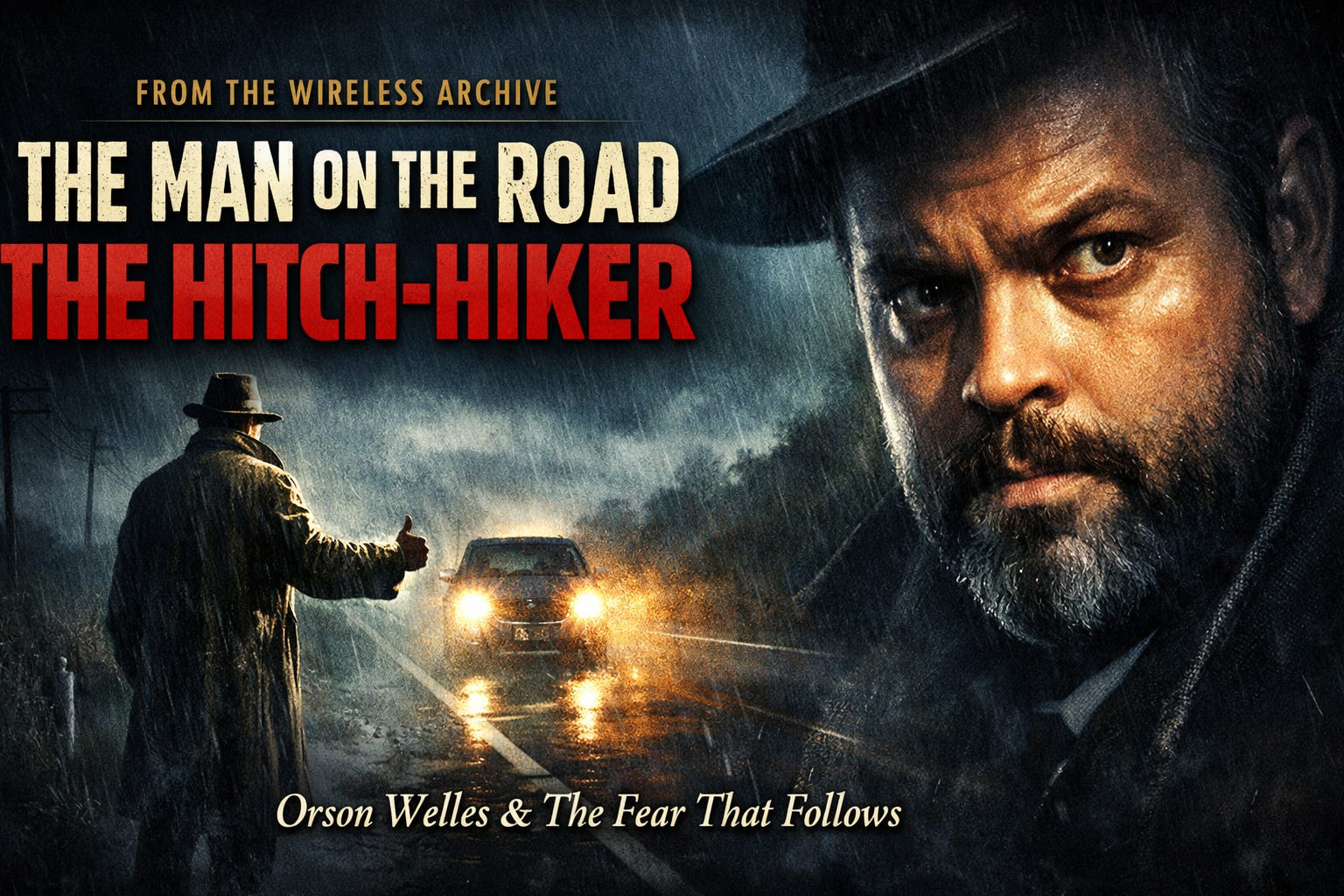
On this week’s Wireless Archive, we revisit The Hitch-Hiker, performed by Orson Welles and the company of the Mercury Theatre on the Air.
You may listen here:
But I warn you — this is not merely a ghost story. It is something more troubling. It is a theological one.
The Story We Think We’re Hearing
A man drives west.
He leaves Brooklyn in the rain. He sees a hitch-hiker on the bridge. The figure is unremarkable — soaked, patient, anonymous.
Then he sees him again.
And again.
And again.
Across states, deserts, highways. Always ahead of him. Always waiting.
The premise, crafted by Lucille Fletcher, is devilishly simple. Nothing explodes. Nothing howls. No chains rattle in the night. There is only repetition — that most dreadful of patterns — and the quiet certainty that something is terribly wrong.
The man drives faster.
But speed, as Chesterton once observed of modernity, does not tell us where we are going — it only ensures we arrive there sooner.
The Modern Illusion
The horror of The Hitch-Hiker is not that Death exists.
The horror is that the driver believes he can pass it.
He treats mortality as though it were a slow pedestrian on the shoulder of the road. Something to overtake. Something to leave behind in the dust of gasoline and progress.
But the man on the road is not being overtaken.
He is waiting.
The genius of Welles’s performance is restraint. There is no melodrama, only tightening realization. The voice grows not louder, but smaller. And in that shrinking space, terror grows.
Behind it all hums the unsettling music of Bernard Herrmann — sparse, suspended, almost mathematical in its inevitability. Herrmann does not frighten us. He counts us down.
The Great American Road
America loves the open road.
We have built myths upon it — westward expansion, reinvention, self-discovery. The road promises escape.
But Fletcher’s story quietly undermines this myth.
The road is not freedom.
It is judgment.
It is not an exit.
It is a corridor.
The driver believes the continent is vast enough to hide him. But geography does not save a man from metaphysics. The desert does not swallow what eternity intends to keep.
In the final revelation — which I shall not spoil for those who have not yet listened — the story turns not upon surprise, but upon recognition. The truth has been present from the first mile marker.
The hitch-hiker was never ahead of him.
He was already with him.
Why This Story Endures
The Hitch-Hiker was later adapted for The Twilight Zone, proving that its terror belongs not to one era, but to the human condition itself.
But radio does it best.
Radio leaves us alone in the dark.
And that is precisely where modern man does not wish to be.
For in the silence between sound effects, he hears what the driver hears — the possibility that he has misunderstood his own story.
A Chestertonian Turn
Chesterton would not have denied Death. He would have laughed at the idea that one could escape it by horsepower.
But he would have insisted on one further thing:
Death is not the final traveler.
In The Hitch-Hiker, the figure on the roadside is ambiguous — dreadful, patient, inescapable. Yet Christianity dares to say something even more startling: that the final companion on the road is not Death, but Someone who has already passed through it.
The terror of the story lies in inevitability.
The hope of the Gospel lies in victory.
The driver fears he has been followed.
The Christian believes he has been led.
Why We Return to the Wireless Archive
We feature plays like this each Monday because the old broadcasts understand something our age often forgets: that the imagination is not an escape from reality but a preparation for it.
Radio drama, at its best, confronts the ultimate questions without apology.
Who are we?
Where are we going?
And what waits for us when the road ends?
🎙️ You can listen to The Hitch-Hiker on the Chesterton Radio YouTube channel here:
If you believe stories like this deserve to remain alive — not buried in archives but walking beside us on the road — consider joining the Chesterton Radio Listener Club on Substack.
Chesterton Radio is listener supported.
And like the traveler on the highway, we continue forward — mile after mile — because someone is listening.
Until next Monday,
This has been From The Wireless Archive.