

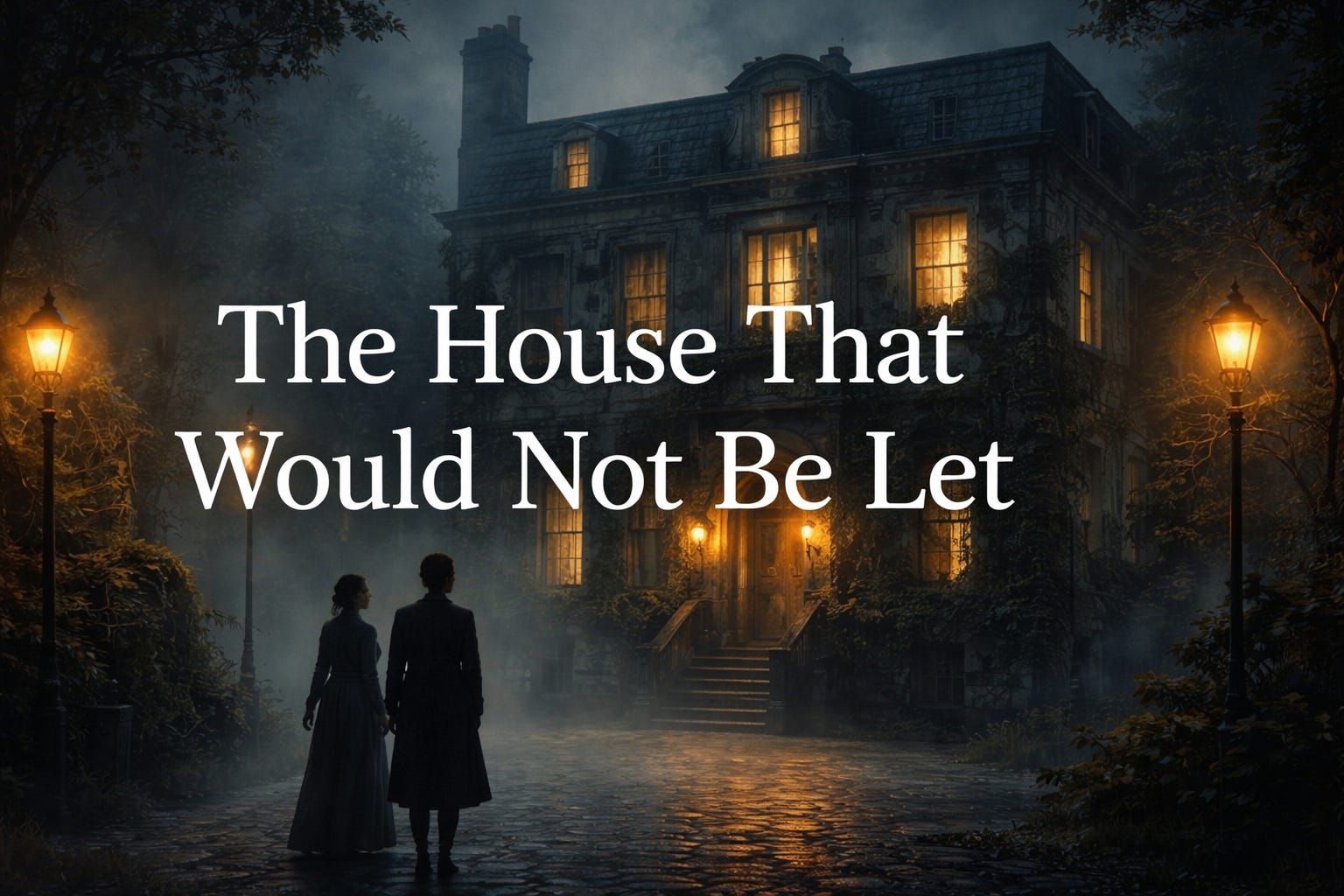
The House That Would Not Be Let
The Play’s the Thing – Project 5064
There are houses that are empty because no one will live in them.
And there are houses that are empty because too many stories live inside them already.
Few Victorian collaborations are as curious — or as quietly enchanting — as A House to Let, that joint Christmas experiment of Charles Dickens, Wilkie Collins, Elizabeth Gaskell, and Adelaide Anne Procter. It is less a single story than a corridor of rooms, each furnished by a different imagination. And yet somehow, as if by a trick of candlelight and conscience, it coheres.
The BBC’s rendering — now available on Chesterton Radio — preserves that curious unity. The tone shifts slightly from chamber to chamber, as one might expect when passing from Dickens’ bustling sentiment to Collins’ shadowed intrigue. Yet the house stands. It stands because it is built upon a very Victorian conviction: that mystery is not a defect in reality, but its proper architecture.
Recently, a listener left us a comment that struck me more deeply than a critic’s essay ever could:
“I wish we could follow this group of characters to find out more about their lives.”
There is no higher praise for a story than that it refuses to end.
A Collaboration That Should Not Work — But Does
Victorian authors were not known for restraint, nor for uniformity of tone. Dickens could not help being Dickens any more than a cathedral can help being Gothic. Collins carried suspense like a concealed dagger. Gaskell wrote with domestic clarity and moral steadiness. Procter, poetic and devotional, added a certain tremor of inwardness.
And yet in A House to Let, they achieve something quietly miraculous:
They create the illusion of a shared moral universe.
The mystery of the vacant house becomes less about plot mechanics and more about spiritual vacancy — about loneliness, secrecy, misunderstanding, and the strange way in which human lives intersect like beams beneath a roof.
This is why the play lingers.
Not because of sensational twists.
But because we are left feeling that the characters continue somewhere offstage — that they have breakfasts and regrets and future decisions still unfolding beyond the curtain.
That is the mark of living literature.
The House as a Metaphor
Dickens understood something about buildings that modern storytellers sometimes forget: a house is never merely a structure. It is a moral container.
The unused house in this tale is unsettling not because it is haunted, but because it is uninhabited. An empty house is a symbol of potential unrealized — of warmth withheld — of hospitality postponed.
In a way, the entire story asks a simple question:
Who belongs here?
And that question is not architectural. It is human.
Why It Still Resonates
There is something almost Chestertonian about this collaboration — not stylistically, perhaps, but philosophically. It suggests that reality is a communal enterprise. That stories, like houses, are stronger when many hands raise the beams.
And perhaps this is why our listener’s comment matters.
When someone says, “I wish we could follow these characters further,” they are not asking for content.
They are confessing attachment.
And attachment is the seed of tradition.
Should the House Be Reopened?
Here at Chesterton Radio, we curate the great wireless rooms of the past — but we are also building a few new ones.
It would not be entirely improper, I think, to revisit this house someday. To open a door that Dickens left slightly ajar. To imagine what became of those who once stood uncertainly upon its threshold.
For now, we invite you to step inside the original.
🎧 You may listen to the BBC production of A House to Let on Chesterton Radio here:
You can listen directly in your browser — no app required — or through the YouTube app on any device.
And if you find yourself wishing the story had not ended…
You are not alone.
The Play’s the Thing
This ongoing series explores the great radio dramas of the past — not merely as entertainment, but as moral architecture. We revisit them, examine their beams and staircases, and occasionally linger in their attics.
If you value this kind of reflection — and the preservation of these wireless treasures — consider supporting Chesterton Radio:
🎙 Join the Chesterton Radio Listener Club on Substack
🎭 Become a patron on Patreon
☕ Or simply share the story with a friend
Chesterton once wrote that “we make our friends; we make our enemies; but God makes our next-door neighbour.”
In literature, as in life, we inherit our neighbors.
Sometimes, they live in a house that has not yet been let.
—
Chesterton Radio
Where Old Stories Live Again