

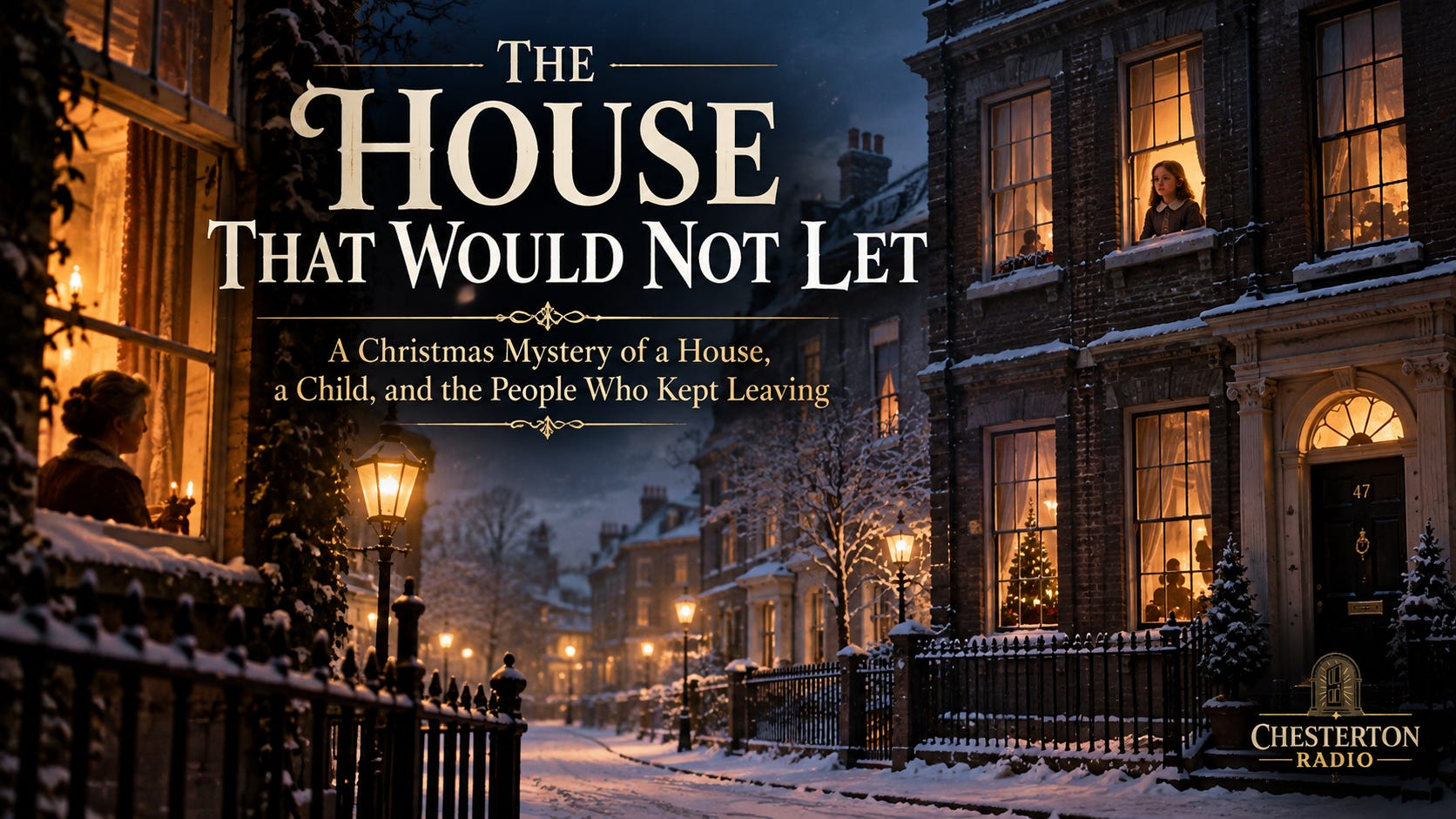
Introduction
In 1858, Charles Dickens gathered Wilkie Collins, Elizabeth Gaskell, and Adelaide Anne Procter around a wonderfully simple idea: a woman notices an apparently empty house across the way and becomes determined to discover why it stands unoccupied.
The result was A House to Let, one of the collaborative Christmas stories published in Dickens’s Household Words. Its mystery opened the door to several lives, several sorrows, and the peculiarly Victorian realization that a house may conceal far more than its windows reveal.
But suppose that were not the last such house.
Years have passed.
Sophonisba is older. Trottle remains practical. Jarber remains gloriously incapable of encountering a simple explanation when a complicated one might possibly be invented.
And then another board appears:
THIS HOUSE TO LET.
There is nothing obviously wrong with the house. Families move in. Fires are lit. Curtains appear at the windows. Children play in the rooms.
Then, one by one, the families leave.
Yet one person never does.
A little girl appears at an upstairs window before each new family arrives—and remains there after each family has gone.
Her name is Clara Vale.
She is not a ghost.
She is not imprisoned.
She is not the secret heiress of Jarber’s increasingly elaborate theories.
Indeed, everyone concerned with Clara appears to have behaved quite properly.
And that may be the most troubling thing of all.
The House That Would Not Let returns to the world and characters of A House to Let for a new Christmas mystery about houses and homes, promises and obligations—and the difference between providing for a child and belonging to one another.
The mystery begins, as such mysteries often do, with someone looking through a window.
This time, however, the answer will require someone to cross the street.
Listen to the original Dickens Mystery here. Then enjoy our sequel - The House that Would Not Let.
Sequel to A House to Let
PART I
THE HOUSE THAT WOULD NOT LET
There are houses which announce themselves to the world by brass plates; houses which make themselves known by balconies; houses which have a positive genius for bow-windows; houses which retreat behind walls and trees with all the reserve of persons of property; and houses which, having nothing particular to say for themselves, nevertheless contrive to say it very loudly.
But of all the methods by which a house may attract the attention of a reasonable person who has no business whatever with it, I know none more effective than a board bearing the words:
THIS HOUSE TO LET.
I had learned this before.
Indeed, I had learned it so thoroughly that I might have been expected to pass the remainder of my days without looking twice at such a board. There had been a time when a house to let had exercised over me a fascination which I am now prepared to call unwholesome, chiefly because I have reached that age at which we give grave names to the follies we still secretly enjoy. A house with its blinds down had once been sufficient to set my imagination furnishing every room, peopling every chamber, inventing calamities for every staircase, and supplying the vacant premises with a family history much more interesting than any family could reasonably be expected to endure.
Experience should have cured me.
Experience rarely does.
It was in December, and London had been wet for so many consecutive days that the rain seemed no longer to fall from the sky, but to belong permanently to the atmosphere. The pavements shone black under the lamps. Wheels passed with a continual soft grinding through the mud. Umbrellas went by my window like large melancholy mushrooms. Men appeared to have been born damp and to regard dryness as an extravagance of the aristocracy.
I had drawn my chair near the fire and had made every preparation for not looking out of the window.
This, I have found, is generally the first step toward looking out of it.
A coal shifted in the grate. I corrected it.
The clock ticked.
The rain tapped.
A cab stopped somewhere beyond my sight, and because it was no concern of mine I immediately wondered where.
Presently I looked.
Across the street and somewhat to the left stood a house I had observed a hundred times without observing it at all. It was one of a row of respectable houses which seemed to have been built by a man determined that no architectural indiscretion should ever be charged against him. It had four floors above the basement, a black door, iron railings, a fanlight, six front windows, and absolutely no opinion upon any subject.
Yet that afternoon it had acquired one.
A board projected above the railings.
THIS HOUSE TO LET.
I turned away.
I took up my book.
I read three lines.
I looked again.
There is nothing remarkable in an empty London house. London contains enough of them to cure the most ardent imagination, just as it contains enough lawyers to discourage litigation and enough physicians to make one value health. But something in the appearance of this particular house displeased me.
Not frightened me.
I insist upon the distinction.
It displeased me because it looked neither neglected nor properly empty.
The steps were clean.
The brass knocker had been polished.
There were curtains at two of the upper windows.
A faint light showed for a moment behind one of them and disappeared.
I decided that a caretaker lived there.
Having thus disposed of the matter, I continued to watch the house for another quarter of an hour.
It was at this point that Jarber entered.
Jarber had retained, through advancing years and repeated collisions with fact, an enthusiasm for the improbable which would have been admirable in a poet and was exhausting in a friend. Time had touched him, certainly. There was more silver in his hair, more deliberation in the removal of his gloves, and a tendency to settle himself into a chair with noises formerly associated with much older gentlemen. But his eye remained bright wherever a mystery might reasonably—or unreasonably—be suspected.
He followed my gaze.
Then he looked at me.
Then at the house.
Then at me again.
“Sophonisba,” said Jarber.
“No.”
“I have not said anything.”
“You were about to.”
“I was about to observe that Providence occasionally exhibits a delicacy of arrangement which—”
“No.”
Jarber came nearer the window.
“Is it possible,” he said, “that you do not know?”
“Know what?”
He pointed.
“That house.”
“It is a house.”
Jarber gave me the patient smile with which an informed person encourages a child.
“It is the house.”
This was so exactly the sort of remark I had determined not to hear that I returned to my chair.
“You will have to do better than that.”
“My dear Sophonisba, three families.”
“What of them?”
“In four years.”
“London contains houses which have had thirty.”
“Not like these.”
“Were they unusually shaped?”
“They left.”
“I have sometimes known tenants to do so.”
“Suddenly.”
“Landlords have sometimes known them to do that too.”
“Without explanation.”
“Landlords have certainly known that.”
Jarber lowered his voice.
“One of them left furniture behind.”
I confess that this interested me a little.
I concealed the fact.
“Bad furniture?”
“Excellent furniture.”
“Then perhaps the landlord was the gainer.”
“A pianoforte.”
“That is not always a gain.”
“A dining table.”
“Possibly too large.”
“Six chairs.”
“Jarber, if you are going to inventory the property, I shall ring for tea.”
He sat opposite me and drew off his second glove with solemnity.
“Another tenant dismissed two servants in a single week.”
“A proceeding which might prove sanity rather than madness.”
“The cook first.”
“A strong point in his favor.”
“And the housemaid two days later.”
“Perhaps she cooked.”
Jarber frowned at my levity.
“There are circumstances,” he said, “which resist facetiousness.”
“Not many.”
“This house is one of them.”
He leaned toward me.
“A physician lived there.”
“Then I withdraw my objection. Nothing could be more ominous.”
“A respectable physician.”
“That makes it worse.”
“A man of standing. Patients in Harley Street. Consulting practice. No debts. No scandal. Married. Two daughters. He occupied that house for less than five months.”
“And?”
“And left it.”
“Physicians move.”
“He refused afterward to speak of it.”
“To whom?”
“To me.”
“That proves nothing whatever.”
“It proves,” said Jarber, “that he refused to speak of it.”
“It may prove that he knew you.”
Jarber was wounded, but only briefly. Mystery restored him.
“You may laugh. There are other facts.”
“I had feared there might be.”
“One tenant heard footsteps at night.”
“So have I.”
“When no one was on the stairs.”
“How was that established?”
Jarber ignored me.
“Another complained that doors were opened after they had been shut.”
“An inconvenience common to doors.”
“A maid declared she saw a face at an upper window after the family had gone out.”
“A caretaker.”
“There was no caretaker.”
“You told me nothing of that.”
“I am telling you now.”
“Then who cleans the steps?”
Jarber paused.
It was a small question, but it offended the grandeur of his narrative.
“I have not yet ascertained.”
“Then ascertain it.”
He looked again toward the house.
“You admit there is something unusual.”
“I admit that somebody cleans the steps.”
At that moment Trottle entered with the tea.
Trottle had aged in the manner of certain reliable pieces of furniture: not by becoming weaker, but by acquiring an appearance of having always been exactly as old as he presently was. His hair had thinned without surrendering. His face had collected several additional lines, all apparently caused by observing the foolishness of other people and finding it consistent. His movements remained deliberate. His judgments remained inconveniently sound.
Jarber turned upon him.
“Trottle, what do you know of the house opposite?”
Trottle set down the tray.
“Which house, sir?”
“The empty house.”
“There are two empty houses opposite.”
“The one with the board.”
“They both have boards, sir.”
Jarber went to the window and pointed.
“That one.”
Trottle looked.
“Number forty-seven, sir.”
“You know it?”
“I know which one it is.”
“Three tenants in four years.”
“So I have heard.”
“Furniture abandoned.”
“A table and some chairs, sir.”
Jarber looked triumphantly at me.
“A pianoforte,” he added.
“That was removed later, sir.”
Jarber’s triumph suffered a minor collapse.
“By whom?”
“The people who owned it, I believe.”
“And the physician?”
“Dr. Latham.”
“You see!” cried Jarber.
Trottle looked at him.
“Yes, sir.”
“He left after five months.”
“Nearly six.”
“And refuses to discuss the house.”
“I shouldn’t know about that, sir.”
“He refused to discuss it with me.”
Trottle considered this.
“That may not have been the house, sir.”
I was obliged to put down my cup.
Jarber regarded us both with the expression of a prophet persecuted by his own household.
“There are times,” he said, “when I wonder why I bring information into this room.”
“Because you cannot keep it out of any room,” I replied.
But when Jarber had gone, and Trottle was carrying away the tea things, I stopped him.
“Trottle.”
“Yes, ma’am?”
“Who does clean the steps at number forty-seven?”
Trottle glanced toward the window.
“Mrs. Rudge, I believe.”
“Who is Mrs. Rudge?”
“She looks after the house.”
“A caretaker?”
“Not exactly, ma’am.”
“What exactly?”
Trottle shifted two cups upon the tray, though they required no shifting.
“I couldn’t say exactly.”
That answer, coming from Trottle, was more interesting than all Jarber’s facts together.
“You don’t know?”
“I haven’t inquired.”
“Would it be difficult?”
“No, ma’am.”
I looked at him.
Trottle looked at me.
“Don’t,” I said.
“No, ma’am.”
He went out.
For the remainder of that evening I did not look at number forty-seven more than six times.
During the following week the weather improved sufficiently to permit London to exchange rain for fog.
Number forty-seven remained empty.
I became familiar, against my intention, with its habits.
At half past seven each morning smoke rose from one chimney.
At approximately nine Mrs. Rudge—whom I identified as a square little woman in black—came down the steps with a basket.
On Tuesdays a tradesman’s boy delivered bread.
On Fridays a man brought coal.
Once, a butcher’s boy descended to the basement area and emerged without his parcel.
These circumstances established beyond dispute that somebody lived in the house.
Yet the lower rooms remained dark.
The drawing-room curtains were never opened.
The brass plate beside the door bore no name.
Only one upper curtain moved with any regularity.
I began to resent the curtain.
A curtain has no right to behave mysteriously. Its legitimate occupations are opening, closing, fading in sunlight, collecting dust, and being replaced when a lady discovers that a neighboring lady has purchased better ones. To move a little and then stop whenever one happens to look at it is conduct approaching insolence.
On the fourth afternoon I saw the child.
Only for a moment.
She stood at the third-floor window with one hand resting against the glass.
She was perhaps ten years old.
Dark hair.
A pale face.
A plain dress.
Nothing more.
I had barely registered her presence before she stepped back and disappeared.
I felt foolishly relieved.
There was the explanation.
Mrs. Rudge had a daughter, or niece, or granddaughter. The child lived with her. The mystery had become domestic and therefore harmless.
I mentioned this to Jarber when he called the next morning.
“Girl?” he said.
“Yes.”
“What girl?”
“The caretaker’s child, I suppose.”
Jarber became alert.
“You suppose.”
“I have no reason to suppose otherwise.”
“Dark hair?”
“Yes.”
“Approximately ten?”
“Perhaps.”
“Pale?”
“It is December.”
“Third-floor window?”
I looked at him.
“You know about her.”
Jarber rose.
“My dear Sophonisba, I know nothing about her.”
“You have just described her.”
“You described her.”
“I said nothing about the window.”
“You said you saw her.”
“At the third-floor window, yes. I had forgotten.”
“Precisely.”
“There is nothing precise about it.”
Jarber began walking about the room.
“A child in an empty house.”
“A child with a caretaker.”
“Is Mrs. Rudge her mother?”
“I don’t know.”
“Grandmother?”
“I don’t know.”
“Guardian?”
“I don’t know.”
“Then what is she?”
“A child, Jarber. Children existed before mysteries.”
“Some mysteries,” he said darkly, “begin as children.”
I rang for Trottle.
Jarber objected.
“You cannot investigate in that manner.”
“What manner?”
“By simply asking.”
“It has advantages.”
Trottle appeared.
“Trottle, does Mrs. Rudge at number forty-seven have a daughter?”
“No, ma’am.”
“A granddaughter?”
“Not that I know of.”
“A niece?”
“I couldn’t say.”
Jarber folded his arms.
“And the girl?”
Trottle looked from Jarber to me.
“What girl, sir?”
Jarber exhaled with satisfaction.
“There.”
“There where?” I asked.
“The first wall.”
“Trottle has not built a wall. He has asked what girl.”
I explained.
Trottle listened.
“I haven’t seen her, ma’am.”
“But there is a child in the house.”
“I couldn’t say.”
Jarber came forward.
“Would it be difficult to ascertain?”
Trottle’s eye met mine.
“No, sir.”
“Then ascertain it.”
“No,” I said.
Trottle waited.
Jarber stared at me.
I looked toward number forty-seven.
“No,” I repeated. “We have done this before.”
Jarber protested that no two houses could possibly present the same problem, particularly when the first had been on the opposite side and this one was somewhat to the left; but I remained firm.
A child lived with a caretaker.
That was all.
And for nearly three weeks I was entirely correct.
Then the tenants came.
They arrived on a Thursday morning with two vans, a cab, three children, one dog, four men, innumerable boxes, and a quantity of furniture which appeared determined to enter the house simultaneously.
An empty house undergoing occupation is one of the most cheerful spectacles a street can offer. Curtains appear where blank glass has been. Fires send smoke from chimneys which have forgotten their business. Beds stand absurdly upon pavements. Chairs are carried upside down. Carpets expose their undersides to respectable society. Men shout from windows. Women discover that indispensable objects have been placed at the bottom of inaccessible boxes. Children are forbidden to touch everything and therefore touch everything twice.
Number forty-seven submitted to life noisily.
The family, as I gradually assembled them from glimpses, consisted of a father of energetic habits, a mother whose bonnet seemed permanently endangered by events, two boys, and—so I initially believed—the girl I had already seen.
The boys were unmistakably brothers.
They possessed that peculiar fraternity which consists in fighting continuously against one another while instantly combining against the rest of mankind.
Before noon one had climbed upon the area railings, the other had disappeared into a packing crate, and both had been threatened with consequences so severe that no civilized government could have carried them out.
The dog was yellow, enthusiastic, and without visible judgment.
Jarber arrived while a wardrobe was being raised through an upper window.
“Ah,” he said. “Occupation.”
“Clearly.”
“Or concealment under the appearance of occupation.”
“Go home, Jarber.”
He remained.
We watched.
I am ashamed to say we watched for some time.
The girl appeared shortly after three.
She stood just inside the front door while two men carried a chest past her. One of the boys rushed down the steps, nearly collided with her, shouted something, and continued into the street.
She smiled.
But she did not follow him.
Presently the mother came into the hall and spoke to her. The girl moved aside immediately.
There was something in the movement I noticed without understanding.
Not fear.
Not obedience exactly.
Rather the practiced instinct of somebody accustomed to discovering where other people wished her to stand.
“Older sister,” said Jarber.
“Obviously.”
“Not much resemblance.”
“Children frequently disappoint observers in that respect.”
“Hair different.”
“Jarber.”
“Shape of the face entirely—”
“Jarber.”
He subsided.
The family settled.
Within days the house changed character completely.
Lights burned in the drawing room.
The mother appeared at the windows arranging curtains.
The boys established some form of military campaign extending from the basement to the top floor.
The yellow dog became acquainted with every horse in the street and objected personally to most of them.
Once I heard a piano.
Once I saw the father return carrying a parcel so large that both boys descended upon him before he reached the door.
And sometimes I saw the girl.
She was often with them.
But never quite of them.
I cannot explain more precisely what I mean.
At first I attributed the impression to my knowing she had been in the house before their arrival. Had I seen her for the first time among the family, I might never have distinguished her.
She sat beside the boys at the drawing-room window one afternoon while they constructed something from paper.
She walked out with the mother twice.
She carried books.
She held the dog’s collar while a delivery was made.
Once the younger boy seized her hand and dragged her laughing down the hall.
There was affection there.
I was certain of it.
Yet occasionally a door would open and the family would pour through it while Clara—as I later learned to call her—would remain behind for one second, looking after them.
That second troubled me.
Children should not stand outside their own happiness and examine it.
One evening, a little before Christmas, I saw the family gathered around a table.
I could not see what they were doing.
Paper chains, perhaps.
Something red hung between the windows.
The boys were animated.
The father appeared to be attempting some operation with scissors which the mother distrusted.
The girl stood beside them.
For a moment she laughed.
Then she turned toward the window.
Toward me.
I moved back instinctively, ashamed of having been discovered.
When I looked again, she was gone.
After that I closed my curtain earlier.
Christmas passed.
The house remained occupied.
I began to think Jarber’s reputation for it had been exaggerated.
January came cold and hard.
The pavement whitened.
The yellow dog learned that ice was unreliable.
The boys returned repeatedly to the same discovery.
The father left every morning at eight.
The mother acquired a new hat.
Ordinary life, which is the strongest enemy mystery possesses, established itself at number forty-seven.
Then, one Monday morning, a van arrived.
I thought nothing of it until a second came behind.
Men began carrying furniture out.
Not in.
I watched for five minutes before sending for Trottle.
“Are they moving?”
“It appears so, ma’am.”
“Why?”
“I couldn’t say.”
“They have been there scarcely two months.”
“Yes, ma’am.”
“Did you hear anything?”
“No, ma’am.”
Jarber, who had somehow developed the supernatural faculty of appearing whenever number forty-seven did anything interesting, arrived before noon.
“I knew it.”
“You knew nothing.”
“Exactly as before.”
“Nothing is exactly as before.”
“They are leaving.”
“That much I grant you.”
“Suddenly.”
“We don’t know that.”
“Furniture.”
“Families generally take it.”
“The dog.”
“I should hope so.”
The dog was at that moment resisting removal with all four legs while one of the boys attempted to persuade him into a cab.
The scene was not sinister.
That made it stranger.
No one appeared frightened.
No one hurried.
The father supervised the men.
The mother checked packages.
The boys were excited by the move.
Yet the mother repeatedly looked back toward the house.
Once she went inside after everyone else had come out.
She remained there several minutes.
When she emerged, her face was composed, but she held a handkerchief in her hand.
“Something happened,” Jarber whispered.
“Something always happens. It is the principal occupation of life.”
The last trunk was loaded.
The boys climbed into the cab.
The dog followed after a final disagreement.
The father spoke briefly to Mrs. Rudge at the door.
Then the mother came down the steps.
She stopped.
Turned.
Looked upward.
I followed her gaze.
The girl stood at the third-floor window.
She was not wearing a coat.
The mother raised one hand.
The girl raised hers.
Neither moved for several seconds.
Then the father touched his wife’s arm.
She entered the cab.
It drove away.
I remained at the window.
Jarber said nothing.
The girl disappeared.
By evening number forty-seven was dark again.
That night I slept badly.
I told myself it was absurd.
Children stay behind for all sorts of reasons.
She was Mrs. Rudge’s niece.
Her granddaughter.
A ward.
A pupil.
A dependent.
A hundred ordinary explanations stood ready to be employed, and I employed each of them in turn until all had become equally unsatisfactory.
The following afternoon I did not look at the house.
At four o’clock I was still not looking.
At a quarter past four the lamps were lit.
At half past four I moved my chair.
At twenty minutes to five I crossed to the window.
Number forty-seven stood dark.
The board had not yet been restored.
A little snow had begun to fall.
The drawing-room windows were blank.
The room which had held the piano was empty.
The red decoration between the windows had been removed, but a small piece remained caught near the curtain rod.
I looked upward.
The third-floor curtain moved.
The girl appeared.
She stood exactly where I had first seen her before the family came.
One hand rested against the glass.
She looked down at the empty street.
Not after the cab.
Not now.
There had been no cab for more than a day.
She merely looked.
And I understood, with a sensation I did not like at all, that I had been asking the wrong question.
I had wondered why the family had left the girl.
But they had not left their girl.
They had left the girl.
The distinction kept me at the window until darkness swallowed her.
When Trottle came in to attend to the fire, I spoke without turning.
“Trottle.”
“Yes, ma’am?”
“The child at number forty-seven.”
“Yes, ma’am.”
“You know about her now.”
A pause.
“I have made one or two inquiries.”
I turned.
“Has she been left behind?”
Trottle looked toward the opposite house.
“No, ma’am.”
“Then what has happened?”
“Nothing has happened to her, so far as I can discover.”
“But the family has gone.”
“Yes, ma’am.”
“And she remains.”
“Yes.”
“Why?”
“I don’t know yet.”
I disliked the final word.
“Yet?”
Trottle adjusted the coal with the poker.
“You asked me before whether Mrs. Rudge had a daughter.”
“Yes.”
“She hasn’t.”
“Then who is the child?”
“I haven’t got that far.”
“But she lived with this family?”
Trottle shook his head.
“What do you mean?”
He replaced the poker.
“The people who left yesterday didn’t bring her into the house.”
“I know that. I saw her before they arrived.”
“Yes, ma’am.”
“Then she belongs to Mrs. Rudge?”
“No.”
“Trottle, she must belong to somebody.”
He did not answer.
A peculiar anger rose in me.
Not against Trottle.
Against the sentence itself.
She must belong to somebody.
It sounded reasonable.
It sounded civilized.
It sounded like the sort of thing upon which all respectable society must surely be agreed.
And yet the dark window across the street seemed to contradict me.
“How long has she been there?”
“I can’t say exactly.”
“Since before these tenants?”
“Yes.”
“How long before?”
“I’ve spoken to the grocer and to the woman who keeps the stationer’s shop at the corner.”
“And?”
“They both remember her.”
“From when?”
“The tenants before these.”
I stared at him.
“The physician?”
“Before Dr. Latham too, I believe.”
The room seemed suddenly very quiet.
The fire settled behind me.
Outside, the snow continued its slow descent past the lamps.
Across the street, the upper window remained dark.
I said:
“Trottle, do you mean that every family which has lived in that house has found the child already there?”
“I don’t know about every family, ma’am.”
“But this one?”
“Yes.”
“And the one before?”
“So I understand.”
“Then the child has not been left behind.”
“No, ma’am.”
Trottle looked once more toward number forty-seven.
“From what I can discover,” he said, “she was there before they came.”
END OF PART I
PART II
THE FAMILY WHO STAYED UNTIL CHRISTMAS
Trottle’s discoveries were seldom rapid, for the excellent reason that they were generally true.
Jarber, on the other hand, could discover six things before breakfast, three of which had never happened, two of which were impossible, and the sixth of which, by an injustice peculiar to Providence, would sometimes turn out to be correct.
By noon on the day following our conversation, Jarber had established to his own satisfaction that the child at number forty-seven was connected with a contested inheritance.
By two o’clock she had become the daughter of a gentleman who had died under suspicious circumstances in Malta.
At four she possessed a fortune.
At six the fortune had been embezzled.
Before dinner Jarber had restored most of it.
Trottle found the Bellows family.
“I beg your pardon?” I said.
“The Bellowses, ma’am.”
It was three days after the departure of the latest tenants. The board had returned to number forty-seven with what I thought indecent haste, as though the house had scarcely finished waving farewell before it began beckoning to strangers.
THIS HOUSE TO LET.
The girl had appeared twice at the upper window.
I had not seen her outdoors.
“Who are the Bellowses?”
“They lived there about three years ago.”
“With the child?”
“Yes, ma’am.”
“You have spoken to them?”
“To Mr. Bellows.”
“And?”
“He says his wife will tell you.”
“Me?”
“If you wish to hear it.”
I had not yet admitted that I wished to hear anything.
This difficulty was resolved by Jarber, who arrived at that moment and declared that we must go immediately.
“Go where?” I asked.
“To the Bellowses.”
“I have not said I am going.”
“Then you may say it in the cab.”
“There is no cab.”
“I shall obtain one.”
“Jarber.”
He had already gone.
Trottle watched the door close.
“Mr. Bellows did say,” he observed, “that his wife would prefer not to have a great many people.”
“We are not a great many people.”
“No, ma’am.”
“Jarber counts as several only conversationally.”
“Yes, ma’am.”
So it happened that before the afternoon was out I found myself being conveyed with Jarber and Trottle toward a part of London in which respectable poverty maintained a prolonged and exhausting engagement with appearances.
The houses diminished as we proceeded.
Porticoes disappeared first, then fanlights, then brass knockers of any ambition. Curtains became more practical. Steps narrowed. Children’s faces multiplied at windows. Shops crept between houses as if trade had discovered that gentility could no longer afford to keep it at a distance.
The Bellowses lived above a stationer’s shop in a street which seemed to sell everything except space.
Mr. Bellows received us.
He was a thin, pleasant man whose coat had been brushed into a state beyond which brushing could offer no further improvement. His manner contained that excessive courtesy sometimes found in men who have spent much of their lives apologizing to the world for not being richer.
“My wife is expecting you,” he said.
Then, seeing Jarber, he added with less certainty:
“And this gentleman?”
“Mr. Jarber,” I said.
Jarber bowed.
“I am engaged in certain inquiries concerning number forty-seven.”
Mr. Bellows looked at Trottle.
Trottle looked at the floor.
“I understood,” said Mr. Bellows carefully, “that the lady wished to know about Clara.”
“Precisely,” said Jarber.
Mr. Bellows did not appear reassured.
We were shown upstairs into a room containing too much furniture for its dimensions and too much life for its furniture. A boy was doing arithmetic at one end of the table. A younger girl was cutting paper at the other. Near the fire sat Mrs. Bellows, sewing.
She was a woman of perhaps forty, though trouble had made several unauthorized additions to the account. Her face was plain, capable, and kind. She possessed the expression of a woman who had spent years stretching meals, stockings, wages, patience, and hope without admitting that any of them had worn thin.
She rose when we entered.
Her eyes rested on me.
“You’ve seen Clara?”
“Yes.”
“Is she well?”
The question came so quickly that it answered one of mine.
“I believe so.”
“You’ve spoken to her?”
“No.”
Mrs. Bellows resumed her seat.
“Then you don’t know.”
There was no accusation in the words.
That made them worse.
Mr. Bellows drew up chairs.
The boy with the arithmetic looked at us openly until his father told him to continue his sums, whereupon he looked at us covertly with greater concentration.
Mrs. Bellows folded the garment she had been mending.
“What do you want to know?”
I considered.
“Why is she there?”
Mrs. Bellows gave a short laugh without amusement.
“If you find that out, perhaps you’ll tell me.”
Jarber leaned forward.
“Madam, were there circumstances of a confidential nature connected with the child’s parentage?”
Mrs. Bellows looked at him.
“Her what?”
“Her parentage.”
“She had parents, I suppose.”
“Precisely.”
Jarber waited.
Mrs. Bellows waited longer.
I intervened.
“Perhaps you could tell us how you first met her.”
That she could do.
And so she did.
The Bellowses had come to number forty-seven in September, three years earlier, because Mr. Bellows had lost money.
Not dramatically.
There had been no bankruptcy, no absconding partner, no forged signature, no event sufficiently theatrical to interest Jarber.
Mr. Bellows had simply lost money in the ordinary manner: a business which had once paid well began to pay badly, an investment which had been considered safe discovered otherwise, two clients failed, an illness cost more than expected, and the sum of these respectable misfortunes produced a result indistinguishable from catastrophe.
“We weren’t ruined,” Mrs. Bellows told us. “Ruined people are very fortunate in books. Everybody knows they’re ruined. Relations come. Creditors meet. Lawyers write letters. Something is done. We were only getting poorer.”
Mr. Bellows looked mildly injured.
“We were never in actual distress, Mary.”
“No, dear. We merely stopped buying things.”
The boy at the table grinned.
His father noticed.
“Your arithmetic, Thomas.”
Thomas returned instantly to insolvency of another kind.
They had been living in a larger house. They could no longer afford it. Smaller houses, however, possessed the unfortunate habit of costing nearly as much as one expected them not to.
Then Mr. Bellows saw the advertisement for number forty-seven.
The rent was astonishingly low.
He visited the agent twice.
He inspected the house.
He returned home enthusiastic.
Mrs. Bellows distrusted it immediately.
“I said there must be drains.”
“There were no drains,” said her husband.
“There were drains, Henry.”
“I mean nothing wrong with them.”
“There must be something.”
“There was.”
Mrs. Bellows looked at us.
“The child.”
The lease, she explained, contained a condition.
The principal rooms of the house were offered to the tenant in the ordinary way, together with the kitchens, basement, yard, and most of the bedrooms. But a small room on the third floor, together with certain rights of access and domestic provision, was reserved.
Reserved for whom?
The agent had been vague.
“A beneficiary.”
Mrs. Bellows disliked the word on sight.
“What sort of beneficiary?”
“A young person.”
“What sort of young person?”
“A female young person.”
“How young?”
The agent consulted papers.
Nine.
“Whose child?”
That, apparently, was not relevant to the tenancy.
“Everything about a child is relevant if the child is to live in my house,” Mrs. Bellows had replied.
The agent corrected her.
Technically, it was not her house.
This did not improve negotiations.
Mr. Bellows, however, saw practical advantages.
The rent was nearly one-third below what they had expected to pay.
The reserved room was small.
The child was under the supervision of a housekeeper, Mrs. Rudge, whose wages did not fall upon the tenant.
Certain provisions for the child’s food and education were separately paid.
The arrangement, though unusual, was entirely proper.
That phrase—entirely proper—has covered a multitude of arrangements which humanity might have improved by making slightly improper.
Mrs. Bellows refused.
Then she calculated their expenses.
She accepted.
“We told ourselves,” she said, “that it was no different from having a lodger.”
“Except that she was nine,” said Mr. Bellows.
“Yes.”
“And didn’t pay.”
“Her people paid indirectly.”
“I never understood how.”
“You weren’t meant to.”
Mr. Bellows accepted this as just.
They signed the lease.
On the first morning of October, the Bellows family moved into number forty-seven.
Clara was waiting for them.
Mrs. Bellows remembered the first sight of her with uncomfortable exactness.
The furniture vans had arrived late.
One bedstead was missing its screws.
A chest containing kitchen things had been sent to another address.
Thomas had cut his finger.
The younger Bellows child—then a little boy named Edward—had become convinced that his wooden horse was lost and was expressing grief with the stamina peculiar to six-year-olds.
Mrs. Bellows entered the hall carrying three parcels and discovered a small girl standing against the wall.
Not in the way.
That was what she remembered.
In a house into which an entire family was moving, everybody was in the way.
The men were in the way.
The children were in the way.
Mr. Bellows was particularly in the way because he attempted to assist the men.
But Clara had already discovered the only place in the hall where nobody needed to pass.
She stood there.
Mrs. Rudge introduced her.
“This is Miss Clara Vale.”
Mrs. Bellows put down the parcels.
“Good morning, Clara.”
“Good morning, ma’am.”
“You live here?”
“Yes, ma’am.”
The answer irritated her.
Not because of the child.
Because it made the absurdity real.
A clause in a lease was one thing.
A nine-year-old girl was another.
Mrs. Bellows looked toward the staircase.
“And where is your room?”
Clara pointed upward.
“Over the stairs.”
“Do you take your meals with Mrs. Rudge?”
“Sometimes.”
“Where otherwise?”
Clara seemed puzzled by the question.
“Where they are.”
“Where who are?”
“The people.”
Mrs. Bellows told us that she had never forgotten the phrase.
Not the family.
Not the tenants.
The people.
“Have there been many people?” she asked.
“Yes, ma’am.”
“How many?”
Clara thought.
“I don’t know.”
Then she asked:
“How long have you taken the house for?”
“Three years, if it suits us.”
Clara nodded.
“That’s a long time.”
There was no excitement in her voice.
No relief.
Only information received and stored.
Mrs. Bellows felt, she told us, a sudden desire to dislike her.
I must have shown surprise.
“Don’t make me kinder than I was,” she said. “I had three children, too little money, a husband working himself ill, half my furniture on the pavement, and a strange child already established in the cheapest house we could find. I resented her.”
Mr. Bellows said quietly:
“You never treated her badly.”
“That isn’t the same thing.”
For the first weeks Clara remained largely upstairs.
Mrs. Rudge managed her meals.
A woman came twice a week to give lessons.
Clara passed through the family rooms politely when necessary and disappeared whenever they filled.
Mrs. Bellows preferred it.
Then ordinary life began interfering with the arrangement.
Edward lost a button.
Clara found it.
Thomas needed a ruler.
Clara knew which drawer contained one left by a previous tenant.
The youngest Bellows girl, Annie, woke frightened one night and wandered into the corridor.
Clara took her back to bed.
Mrs. Bellows discovered them together.
“Thank you, Clara.”
“She was looking for you.”
“I was downstairs.”
“I know.”
“How?”
“The third stair creaks when you go past it.”
It was the first indication that Clara knew the house not as a child knows a home, but as a sailor knows a ship.
She knew which window admitted rain from the east.
Which chimney smoked in a north wind.
Which door required lifting before it would latch.
Where afternoon sunlight reached the floor in November.
Which cupboard had once contained jam.
Which wall concealed a bell-wire that no longer worked.
“Who told you all these things?” Mrs. Bellows asked once.
“Nobody.”
“Then how do you know?”
“I’ve been here.”
There was nothing to say to that.
By November Clara had begun appearing at breakfast.
No decision produced this development.
Annie invited her once.
Edward invited her again.
On the third occasion Mrs. Bellows placed another cup on the table before Clara entered.
After that the cup remained.
Mrs. Rudge objected mildly.
“The trustees make provision for Miss Clara’s board, ma’am.”
“I am not charging anybody for toast.”
“I only mention it because arrangements—”
“I dislike arrangements.”
Mrs. Rudge considered this an eccentricity.
Clara ate toast.
At this point Jarber interrupted.
“Trustees?”
Mrs. Bellows looked annoyed.
“Yes.”
“What trustees?”
“The trustees.”
“Names?”
“I don’t know.”
“Solicitors?”
“I suppose.”
“Did they visit?”
“One gentleman did.”
Jarber took out a notebook.
I stopped him.
“We can return to the trustees.”
“We may not be able to return to them if they disappear.”
“They have survived three years without your assistance.”
Jarber reluctantly put away the notebook.
Mrs. Bellows continued.
The first real change came with a book.
Mr. Bellows had retained from better circumstances a small collection of volumes which financial necessity had not yet persuaded him to sell.
Every evening he read aloud.
He read badly.
His wife told us this.
He protested.
“You swallow punctuation.”
“I observe punctuation.”
“You observe it privately.”
Mr. Bellows appealed to me.
I declined jurisdiction.
At number forty-seven the family gathered near the drawing-room fire after supper, and Mr. Bellows read while Mrs. Bellows sewed and the children engaged in activities increasingly unrelated to the text.
One evening Clara stopped in the doorway.
Mr. Bellows was reading The Vicar of Wakefield.
“Do you want something?” Mrs. Bellows asked.
“No, ma’am.”
Clara remained.
“Then come in.”
She entered and sat on the chair nearest the door.
The next evening she came again.
By the end of the week the chair nearest the door had somehow moved closer to the fire.
No one mentioned this.
The house changed around her by degrees so small that nobody could say when the change occurred.
Clara began helping Annie with reading.
She mended one of Edward’s paper soldiers after he tore it.
Thomas, who was twelve and therefore regarded girls as an inferior but occasionally useful species, discovered that Clara could keep score accurately in games.
Mrs. Bellows sent her on errands.
Mr. Bellows brought home a book he thought she might like.
Mrs. Rudge ceased setting a separate supper.
Then December came.
With December came Christmas.
The Bellows family had very little money that year.
This fact was known to Mr. and Mrs. Bellows and successfully concealed from nobody else.
Children possess a remarkable instinct for family finance. They may not understand pounds, shillings, debts, interest, rent, or credit, but they can detect the absence of money from the tone in which a parent says, “We’ll see.”
There was much “We’ll see” at number forty-seven.
Would there be oranges?
We’ll see.
Could they have crackers?
We’ll see.
Might Father bring home a goose?
We’ll see.
Could they make a tree?
That required no money.
Therefore they did.
It was not much of a tree.
Thomas and Edward acquired it through negotiations with a greengrocer whose precise terms were never disclosed. It leaned decidedly to one side and possessed an area near the top where branches had apparently been omitted during manufacture.
The children adored it.
Clara stood in the doorway when it was brought in.
“A tree,” she said.
Edward, who had not yet learned to distrust obvious statements, replied:
“Yes.”
“Here?”
“Where else?”
Clara looked at Mrs. Bellows.
“In this room?”
“If we can make it stand.”
Clara approached the tree slowly.
“Have you not had one before?” Mrs. Bellows asked.
“Yes.”
“Last year?”
“No.”
“The year before?”
Clara considered.
“I think the Mortimers had one.”
“Who are the Mortimers?”
“The people before Dr. Latham.”
Mrs. Bellows stopped tying string.
“You remember all the families?”
“Yes.”
Clara touched one branch.
“Do they all have Christmas here?”
“Everyone has Christmas somewhere.”
“No,” said Clara.
Nothing more.
She began helping Annie make paper chains.
Mrs. Bellows told us that this was the first time she understood something she had previously only noticed.
Clara did not expect happiness to repeat itself.
If something pleasant occurred, she enjoyed it.
But she did not convert it into expectation.
The Bellows children did.
That is one of the great extravagances of childhood.
A child who has had one happy Christmas assumes Christmas itself is a machine constructed for the reproduction of happiness.
Clara knew otherwise.
She decorated the tree beautifully.
She expected nothing from it.
On Christmas Eve, Mr. Bellows returned late carrying a goose so small that his wife accused it of having died in infancy.
“It was the largest within the budget.”
“Then the budget should be ashamed.”
The children surrounded him.
Clara remained by the table.
Mr. Bellows produced packages.
One for Thomas.
One for Edward.
One for Annie.
Then another.
“Clara.”
She looked up.
“For me?”
“If your name remains Clara.”
She did not take it.
Mr. Bellows held it out.
“What is it?”
“That would seem to be the purpose of wrapping it.”
She accepted the parcel.
Inside was a small red-covered book.
Nothing expensive.
Nothing rare.
Her name had been written inside.
Clara Vale, from H. and M. Bellows, Christmas.
She read the inscription.
Then closed the book.
“Thank you.”
Mrs. Bellows said:
“You may sound happier than that without offending us.”
Clara looked alarmed.
“I am happy.”
“I know.”
That night, after the children had gone upstairs, Mrs. Bellows found the book on the table.
She took it to Clara’s room.
The room was smaller than she had imagined.
A narrow bed.
A washstand.
A chair.
A shelf with several books.
A small wooden box stood beneath the bed.
Clara was kneeling beside it.
The red book lay inside.
Mrs. Bellows stopped.
“Why have you put it away?”
Clara looked up.
“To keep it.”
“Books keep better on shelves.”
Clara hesitated.
Then removed the book.
Mrs. Bellows noticed other objects inside the box.
A ribbon.
A little china dog with one ear missing.
Two letters tied together.
A dried flower.
A wooden horse.
“Those are yours?”
“Yes.”
“Why keep them in a box?”
Clara looked at her as though there might be several answers and she was selecting the safest.
“So they are ready.”
“Ready for what?”
Clara did not answer.
Mrs. Bellows did not ask again.
Not then.
She placed the red book on the shelf.
Christmas morning came.
For perhaps the first time in several years, Clara behaved like an ordinary child.
Mrs. Bellows remembered that more clearly than anything else.
She laughed too loudly.
She ate too much.
She disputed with Thomas over a game.
She put a paper crown on Mrs. Rudge, who submitted as though enduring a minor medical procedure.
She ran down the stairs.
She forgot to move out of people’s way.
At dinner Mr. Bellows proposed a toast to better fortunes.
Thomas proposed one to the goose.
Edward proposed one to the dog belonging to a neighbor.
Annie proposed one to Christmas.
Then Clara raised her glass of water.
“To next Christmas.”
There was a moment of silence.
Mrs. Bellows smiled.
“To next Christmas.”
They all repeated it.
Clara smiled too.
Mrs. Bellows stopped speaking.
The room above the stationer’s shop had become very still.
“That,” she said at last, “was the mistake.”
In February, Mr. Bellows received an offer of employment in Liverpool.
It was not merely a better position.
It was rescue.
The salary was nearly twice what he had been earning. There were prospects. Security. A possibility of clearing debts.
He came home with the letter in his pocket and walked around number forty-seven for twenty minutes before telling his wife.
She read it twice.
“When do they want you?”
“April.”
“We’ll go.”
“Yes.”
They laughed.
They cried.
They calculated.
They told the children.
Thomas shouted.
Edward wanted to know whether Liverpool contained ships.
Annie asked whether they could take the tree.
Then Mrs. Bellows saw Clara.
She was standing beside the door.
Not in the way.
Again.
Mrs. Bellows said:
“You’ll come with us, of course.”
Mr. Bellows looked at her.
Clara did not.
Mrs. Bellows repeated:
“You’ll come with us.”
Clara’s eyes went to Mr. Bellows.
He smiled uncertainly.
“We’ll have to speak to whoever makes the arrangements.”
“They won’t let me.”
The words were quiet.
Mrs. Bellows disliked them immediately.
“Who won’t?”
“The trustees.”
“Nonsense.”
Clara said nothing.
Mrs. Bellows went downstairs to Mrs. Rudge.
Mrs. Rudge confirmed it.
Miss Vale’s residence was established at number forty-seven.
“But we can take her.”
“No, ma’am.”
“Why not?”
“I couldn’t authorize it.”
“I didn’t ask you to.”
“The trustees would have to.”
“Then they shall.”
Mrs. Bellows wrote.
The answer came from a solicitor.
It was courteous.
It expressed appreciation.
It acknowledged the kindness the Bellows family had shown Miss Vale.
It explained that the terms governing the child’s residence could not be altered merely for the convenience of departing tenants.
Mrs. Bellows wrote again.
The second letter was less courteous.
The second answer was more so.
Mr. Bellows visited the solicitor.
He returned angry.
This was unusual enough to frighten the children.
“What did he say?” his wife asked.
“That everything is properly provided for.”
“I didn’t ask whether it was proper.”
“I know.”
“Did you tell him we want Clara?”
“Yes.”
“And?”
“We aren’t relations.”
“We know that.”
“We have no legal claim.”
“We don’t want a claim. We want the child.”
Mr. Bellows sat down.
“There is money settled for her support. Her residence is specified. Mrs. Rudge is approved. Her schooling is paid. Medical attendance is provided.”
Mrs. Bellows stared at him.
“Then she has everything.”
“So the solicitor says.”
“Except anybody.”
Mr. Bellows rubbed his forehead.
“We could consult someone else.”
They did.
Another solicitor examined what papers were available and found nothing obviously unlawful.
Clara was fed.
Clothed.
Educated.
Supervised.
Housed.
No court, he believed, would interfere merely because another family had become fond of her.
Mrs. Bellows objected to the word merely.
The law remained unmoved.
For the next six weeks the Bellows household existed in two contradictory states.
It prepared joyfully to begin a better life.
It grieved over the child who could not join it.
Boxes appeared.
The children discussed Liverpool.
Mr. Bellows traveled north to arrange matters.
Mrs. Bellows sorted possessions.
Clara helped.
That was the worst of it.
She knew how to pack.
She knew which things should be wrapped separately.
She knew that books must not be packed beneath heavy objects.
She knew how to mark boxes.
She knew where string was kept.
Mrs. Bellows watched her one afternoon folding paper around a framed photograph.
“Stop.”
Clara looked up.
“You needn’t help.”
“I don’t mind.”
“I mind.”
Clara set down the paper.
Mrs. Bellows immediately regretted the sharpness.
“Come here.”
Clara came.
“Are you angry with us?”
“No.”
“You ought to be.”
“Why?”
“For leaving.”
Clara looked genuinely puzzled.
“You have to go.”
“We could stay.”
“No.”
It was said with such certainty that Mrs. Bellows almost laughed.
“You’re ten years old.”
“Nine.”
“Then you’re much too young to tell me where I must live.”
“Mr. Bellows has the new work.”
“Yes.”
“And Thomas says there are ships.”
“There are.”
“And Annie is to have a garden.”
“If we can afford the house we’ve seen.”
Clara nodded.
“You have to go.”
Mrs. Bellows took her by the shoulders.
“We wanted you to come.”
“I know.”
“Do you?”
“Yes.”
“Then why aren’t you angry?”
Clara thought for a long time.
“Would it make you stay?”
Mrs. Bellows released her.
“No.”
“Then I don’t see.”
There are answers against which argument is impossible because the person giving them has already surrendered something the questioner still possesses.
Mrs. Bellows turned away.
On the final morning, the vans came.
The Bellows children treated departure as children generally do: as a festival temporarily inconvenienced by adults shouting about luggage.
Thomas had lost his cap.
Annie had packed something which should not have been packed.
Edward had acquired a whistle.
Mrs. Bellows threatened the whistle with immediate destruction.
Mr. Bellows counted trunks repeatedly and obtained a different total each time.
Clara stood in the hall.
She wore the same plain dress she had worn when they arrived.
Mrs. Rudge stood behind her.
Mrs. Bellows came downstairs carrying a final parcel.
She stopped.
For several seconds neither spoke.
Then Annie ran back into the house and threw both arms around Clara.
“You’ll come and see us.”
Clara held her.
“Yes.”
“At Christmas.”
“Yes.”
“Next Christmas.”
Clara’s face changed.
Only slightly.
Mrs. Bellows saw it.
Annie did not.
“You promise?”
Mrs. Bellows intervened.
“Annie, the cab is waiting.”
Annie kissed Clara and ran outside.
Thomas shook Clara’s hand with the solemn embarrassment of a boy approaching adolescence.
“Goodbye.”
“Goodbye.”
Edward remained.
He had been crying and denying it.
Clara went to the little wooden box which had been brought downstairs with some of her things.
She opened it.
Mrs. Bellows recognized the contents.
The ribbon.
The china dog.
The letters.
The dried flower.
The red Christmas book.
Clara reached inside and took out the wooden horse.
It was a crude little toy, painted brown, one wheel slightly larger than the other.
She held it toward Edward.
“For you.”
He stared.
“Why?”
“You like it.”
“It’s yours.”
“Yes.”
“Then why give it to me?”
Clara shrugged.
Edward took it.
Then, because he was six and had not yet learned to hide the important questions beneath unimportant words, he asked:
“Don’t you want it?”
Clara looked at the horse in his hands.
“I don’t keep things people may want back.”
Mrs. Bellows made a sound.
Not quite a sob.
Not quite a word.
She knelt and pulled Clara against her.
For the first time, Clara resisted.
Only for an instant.
Then she put her arms around Mrs. Bellows.
“You listen to me,” Mrs. Bellows whispered. “You listen. We are not giving you back.”
Clara said nothing.
“We are going because we must.”
“I know.”
“We will write.”
“Yes.”
“We will come.”
Clara did not answer.
Mrs. Bellows drew back.
“We will.”
Clara smiled.
It was a kind smile.
That was what Mrs. Bellows remembered.
A child of nine comforting a grown woman for making a promise the child did not believe.
Then Mr. Bellows called from outside.
They left.
Mrs. Bellows stopped speaking.
The stationer’s shop below us had become busy, and we could hear the bell above its door ringing whenever a customer entered.
No one in our room moved.
At last Jarber asked, very quietly for Jarber:
“Did you go back?”
Mrs. Bellows looked at him.
“Once.”
“What happened?”
“Nothing happened.”
“When?”
“The next Christmas.”
I felt something tighten in me.
“You kept your promise.”
“We tried.”
She folded and unfolded a corner of the garment in her lap.
“We went to London. Henry had business here. I wrote to the solicitor and said we wished to take Clara for Christmas Day.”
“And?”
“Permission wasn’t given.”
Jarber sat upright.
“On what grounds?”
Mrs. Bellows smiled bitterly.
“Arrangements.”
Mr. Bellows spoke.
“We went to the house anyway.”
“You saw her?”
“No.”
Mrs. Bellows looked toward the window.
“Mrs. Rudge said Clara was out.”
“Was she?”
“I don’t know.”
“Did you leave anything?”
“The children had brought presents.”
Mrs. Bellows paused.
“We left them.”
“Did Clara receive them?”
“I don’t know.”
No one spoke for a moment.
Then Thomas, who had apparently abandoned arithmetic some time ago, rose from the table.
He was older now than the boy I had watched through the window at number forty-seven.
He crossed to a shelf.
From behind several books he took a small wooden horse.
One wheel was larger than the other.
He put it on the table before us.
“My brother wouldn’t let us throw it away,” he said.
Mrs. Bellows looked at the toy.
“Edward still asks about her.”
“Where is he?” I asked.
“At school.”
Thomas touched the horse with one finger.
“He says when he’s grown up he’ll go and fetch her.”
Nobody smiled.
Children are permitted to make promises adults know cannot be kept.
Adults call this innocence.
Sometimes it is merely courage without information.
We left the Bellowses near dusk.
Jarber descended the stairs without offering a theory.
This was sufficiently extraordinary that I did not disturb him.
In the street, the lamps had been lit.
The stationer’s window glowed behind us.
Trottle walked beside me.
After several minutes Jarber said:
“There is something very wrong here.”
“Yes.”
“Legally wrong.”
“I don’t know.”
“Then morally.”
“That seems clearer.”
“Some person is preventing that child from leaving.”
Trottle spoke.
“Perhaps.”
Jarber stopped walking.
“Perhaps?”
“We don’t know enough yet, sir.”
“We know that the Bellowses offered to take her.”
“Yes.”
“And permission was refused.”
“Yes.”
“Therefore someone refused it.”
“Yes.”
“Then there is our villain.”
Trottle looked at him.
“Is there, sir?”
“Obviously.”
“Which one?”
Jarber opened his mouth.
Closed it.
Trottle continued walking.
I fell into step beside him.
“Trottle.”
“Yes, ma’am?”
“Why was the rent so low?”
“I wondered that too.”
“And?”
“I haven’t found out.”
“The child’s support is paid separately?”
“So Mr. Bellows says.”
“By whom?”
“I don’t know.”
“Her schooling?”
“Paid.”
“Her food?”
“Paid.”
“Mrs. Rudge?”
“Paid.”
“By whom?”
“I don’t know yet.”
Again that word.
Yet.
We had reached the corner from which our own street could be seen.
At its far end number forty-seven waited in the winter darkness.
The TO LET board showed pale beneath a lamp.
One upper window contained a light.
I stopped.
“Everybody seems to provide something for her.”
Trottle followed my gaze.
“Yes, ma’am.”
“Money. Food. Lessons. A room. A woman to look after the house.”
“Yes.”
“Then why does it seem as though she has nothing?”
Trottle did not answer immediately.
Jarber had gone ahead and was already staring toward number forty-seven as though expecting the guilty party to reveal himself at a window.
Trottle said:
“Perhaps because those aren’t the same thing.”
“As what?”
He looked at me.
“As having somebody.”
Across the street, the upper light went out.
For the first time I ceased wondering why people left number forty-seven.
I began to wonder what it meant to be the one person who could not.
END OF PART II
PART III
MR. JARBER’S MOST EXTRAORDINARY DISCOVERY
There are persons who, having once been proved wrong, acquire caution.
Jarber was not one of them.
To prove Jarber wrong was merely to remove one theory from a field in which an inexhaustible crop of others immediately sprang up. Indeed, contradiction appeared to have much the same effect upon his imagination that rain has upon mushrooms. One went to bed having cleared the ground and rose in the morning to find it covered.
The Bellows family had disturbed him.
For nearly two days he admitted as much by saying very little.
On the third he disappeared.
On the fourth he sent me a note.
It consisted of four words.
I HAVE FOUND HER OUT.
I read this twice.
Then I gave it to Trottle.
He read it once.
“Well?” I said.
“Mr. Jarber appears to have found her out, ma’am.”
“Do you believe him?”
Trottle returned the note.
“I believe he has found something.”
This was so precisely my own fear that I resolved to think no more about it.
At eleven the following morning Jarber arrived carrying a leather portfolio of such dimensions that it appeared capable of containing the title-deeds of London.
He refused tea.
This alarmed me.
Jarber never refused tea except when excitement had placed him temporarily beyond the reach of ordinary nourishment.
“Sophonisba,” he said, laying the portfolio upon my table, “we have been deceived.”
“By whom?”
“Everybody.”
“That must have required considerable organization.”
“You jest.”
“I am preparing myself.”
Jarber unfastened the portfolio.
Inside were papers.
There were papers folded lengthwise, papers folded crosswise, papers tied with ribbon, papers secured with string, papers copied in Jarber’s hand, papers copied in other hands, newspaper cuttings, memoranda, envelopes, two maps, one bill of sale, and a document so large that when opened it displaced a vase of flowers.
I rescued the vase.
Jarber did not notice.
“Where is Trottle?”
“Occupied.”
“Send for him.”
“Why?”
“I wish him to hear this.”
This surprised me.
Jarber generally preferred Trottle to hear his discoveries only after they had been fortified against objection.
“You are confident?”
Jarber looked almost hurt.
“My dear Sophonisba, confidence is what one feels before possessing evidence. I have passed beyond confidence.”
“To what?”
“Proof.”
I rang.
Trottle entered.
Jarber indicated a chair.
Trottle remained standing.
“You had better sit,” said Jarber.
“Thank you, sir.”
“You may find what I have to say somewhat startling.”
“I’ll stand, sir.”
Jarber accepted this.
He placed both hands upon the portfolio.
“Before I begin, I should like to make one thing perfectly clear. I have approached this matter without prejudice.”
Trottle looked at me.
I looked at Trottle.
Jarber continued.
“I have allowed no preconceived theory to influence me.”
“Which theory?” I asked.
“Any theory.”
“What became of the Maltese gentleman?”
Jarber frowned.
“There was no Maltese gentleman.”
“The embezzled fortune?”
“Premature.”
“The murder?”
“Entirely speculative.”
“The disguised aristocrat?”
“I never said aristocrat.”
“You said duchess.”
“I said there were circumstances under which a connection with a ducal family could not be excluded.”
Trottle coughed.
Jarber turned.
“Have you something to say?”
“No, sir.”
“Then we shall proceed.”
He selected the first paper.
“The history of number forty-seven begins considerably earlier than any of us supposed.”
“All houses do,” I said.
Jarber ignored me.
“In the year eighteen hundred and twenty-nine the property was purchased by a gentleman named Abel March.”
“Ah,” I said.
Jarber looked pleased.
“You recognize the significance?”
“None whatever. But Abel March is an excellent beginning.”
“He was a merchant.”
“What did he sell?”
“That is immaterial.”
“Then why mention that he was a merchant?”
“Because it establishes his position.”
“Does not what he sold assist in establishing it?”
Jarber consulted a paper.
“Possibly indigo.”
“Possibly?”
“And spices.”
“Together?”
“Among other commodities.”
Trottle shifted slightly.
Jarber heard him.
“You doubt the existence of Mr. March?”
“No, sir.”
“Good.”
Jarber continued.
Abel March, merchant—whether of indigo, spices, or other commodities which Jarber considered beneath the dignity of the narrative—had purchased number forty-seven and lived there for seventeen years.
He had married twice.
His first wife had died.
His second wife had also died.
“Suspiciously?” Jarber asked.
“You are telling us,” I replied.
“No. Naturally.”
“I am glad nature has been cleared.”
Abel March had one son by the first marriage and two daughters by the second.
The son entered the business.
One daughter married a clergyman.
The other—
Jarber paused.
“The other vanished.”
Trottle looked up.
I confess that I did too.
“Vanished?”
“Completely.”
“When?”
“In eighteen hundred and forty-one.”
“How?”
“That is precisely the point.”
“You said she vanished.”
“She ceased to appear in the records.”
“That is not the same thing.”
Jarber regarded me with pity.
“My dear Sophonisba, people who continue to exist generally have the courtesy to leave records.”
“Most people I know leave bills.”
“Exactly.”
“Did she die?”
“No death has been discovered.”
“Marry?”
“No marriage.”
“Go abroad?”
“No passenger record.”
“Then perhaps the record is incomplete.”
Jarber drew himself up.
“It is possible to explain every mystery by saying that the evidence has been lost.”
“It is also possible for evidence to be lost.”
“That attitude would destroy the detective arts.”
“I am not certain they would notice.”
Jarber proceeded.
Abel March died.
The son inherited the business.
The house passed, not to the son, but to another person.
“Why?”
Jarber leaned forward.
“Because the will had been altered.”
There are phrases which become dramatic merely by being spoken slowly.
Jarber possessed a large collection of them.
“Altered before he signed it?” I asked.
Jarber’s expression changed.
“Before he signed it, yes.”
“Then it was his will.”
“It was an altered will.”
“Most wills are altered before they are signed.”
“This one was altered substantially.”
“By Mr. March?”
“On legal advice.”
“Then I fail to be shocked.”
“You are anticipating.”
“I am attempting to.”
Jarber removed another paper.
Under the altered will, number forty-seven passed to a nephew named Septimus March, who occupied it for only eleven months before selling it to a company.
“What company?”
Jarber consulted his notes.
“The Imperial Anglo-Colonial Commercial Advancement Association.”
I stared at him.
“Was there room on the stationery?”
“Barely.”
“What did it advance?”
“Capital.”
“To whom?”
“That is obscure.”
“Did the capital come back?”
“Apparently not.”
“Then perhaps it advanced too far.”
Trottle coughed again.
This time I knew perfectly well why.
The Imperial Anglo-Colonial Commercial Advancement Association had possessed offices in the City, three directors of impressive address, a secretary of less impressive address, a prospectus of exceptional beauty, and very little money.
It purchased several properties.
Number forty-seven was among them.
Within two years the company failed.
One director went bankrupt.
Another died.
The third—
Jarber stopped again.
“Went to Australia.”
I waited.
“That is all?”
“Is that not enough?”
“For Australia?”
“For suspicion.”
“Jarber, thousands of people have gone to Australia.”
“Precisely.”
“I don’t see the force of ‘precisely.’”
“Neither did the creditors.”
The director’s name was Percival Smeeth.
He had departed England shortly before the company’s collapse.
Jarber had discovered that Smeeth had once visited number forty-seven after midnight.
“How?”
“A cabman.”
“Still living?”
“No.”
“Then how did you speak to him?”
“I did not.”
“Who did?”
“A gentleman who knew the cabman.”
“Still living?”
“No.”
“Jarber.”
“The statement is contained in a letter.”
“Written by whom?”
“The gentleman.”
“To whom?”
“His brother.”
“Why?”
Jarber hesitated.
“He mentions the incident.”
“Why?”
“They were discussing horses.”
I put down my cup.
“Of course.”
“The cabman had a gray mare.”
“Naturally.”
“The mare shied outside number forty-seven.”
“At Mr. Smeeth?”
“At something.”
“What?”
“The letter does not say.”
“Then we have a dead cabman, reported by a dead gentleman in a letter about a gray mare, who shied at something outside the house while a company director went inside.”
“At midnight.”
“I had not forgotten the midnight.”
Jarber looked at Trottle.
“You understand the significance?”
“No, sir.”
Jarber appeared disappointed.
Neither did I.
But I had begun to enjoy myself.
The company’s failure placed number forty-seven in the hands of creditors.
From the creditors it passed to a mortgagee.
From the mortgagee it passed to a gentleman named Pounce.
From Mr. Pounce it passed to Mrs. Pounce.
Mrs. Pounce left it to her sister.
Her sister married a Mr. Vale.
Jarber stopped.
Trottle stopped looking at the carpet.
I noticed this.
“Vale?” I said.
Jarber smiled.
“Ah.”
“Clara’s name.”
“Precisely.”
“Who was Mr. Vale?”
“We are coming to him.”
“Why not come to him now?”
“Because facts must be presented in order.”
“I thought we had begun with an indigo merchant.”
“Everything connects.”
“That is what worries me.”
Jarber spread another document upon the table.
“Elias Vale.”
Trottle spoke for the first time.
“Elias, sir?”
Jarber looked up.
“You know the name?”
“No, sir.”
“But you have heard it?”
“I asked if you said Elias.”
“I did.”
Trottle nodded.
“Thank you, sir.”
This was all.
Jarber regarded him suspiciously.
“What do you know about Elias Vale?”
“Nothing yet, sir.”
“Yet?”
“No, sir.”
Jarber looked at me.
I concealed a smile.
There are few pleasures more modest and more complete than seeing another person afflicted by one’s own irritation.
“Elias Vale,” Jarber resumed, “was a merchant.”
“Indigo?”
“No.”
“Spices?”
“No.”
“Then we are progressing.”
“He had interests in shipping.”
“Ah.”
“And insurance.”
“Less picturesque.”
“And property.”
“More profitable.”
“Among the properties he acquired—”
“Number forty-seven.”
Jarber sat back.
“You see it.”
“I saw it coming.”
Elias Vale had become sole owner of number forty-seven some thirty years before our inquiry.
He did not immediately live there.
For several years it was rented.
Then, after the death of his wife, he took possession himself.
He was, according to Jarber’s sources, a difficult man.
This information had been obtained from a clerk who had worked for a solicitor who had represented a cousin who had once disputed an account with him.
I considered the evidence conclusive.
“He was proud,” said Jarber.
“According to the clerk?”
“According to several sources.”
“Name another.”
“A tradesman described him as exacting.”
“What sort of tradesman?”
“A tailor.”
“That proves nothing except that he wanted his clothes to fit.”
“He refused an account.”
“That may prove they did not.”
Jarber waved this aside.
More importantly, Elias Vale had one daughter.
“Margaret,” he said.
The name quieted us.
“Clara’s mother?” I asked.
Jarber lowered his voice.
“I believe so.”
Trottle said nothing.
Jarber searched among his papers and produced a copied entry.
“Margaret Anne Vale. Born at number forty-seven.”
“What happened to her?”
“She married.”
“Whom?”
Jarber selected another paper.
And for the first time that morning, his magnificent certainty faltered.
“That,” he said, “is complicated.”
“Good.”
“You find complication reassuring?”
“In your investigations, extremely.”
Margaret Vale had married a man named George Mercer.
Or possibly George Merrett.
Or, according to another record, George Merrick.
Jarber had discovered all three.
“This,” he said, “is significant.”
“Why?”
“Three names.”
“Or one badly written name.”
“Do you imagine official records are careless?”
Trottle and I both looked at him.
Jarber reconsidered.
“Carelessness cannot be excluded.”
The marriage had not pleased Elias Vale.
This much appeared certain.
Margaret disappeared from the usual family notices.
Elias altered his will.
Correspondence passed between solicitors.
One letter had been returned unopened.
Another had gone abroad.
A third was missing.
“Where did it go abroad?” I asked.
Jarber paused.
“India.”
I waited.
“Not Malta?”
“No.”
“Australia?”
“No.”
“Pity.”
“There is also an Australian connection.”
“I knew there would be.”
Jarber ignored me.
A younger brother of Margaret’s husband—or perhaps a cousin—had emigrated there.
“And disappeared,” I said.
Jarber stared.
“How did you know?”
“Instinct.”
He shuffled his papers.
“The gentleman’s later movements cannot presently be traced.”
“Then we have reached two vanished persons and one emigrated director.”
“Three.”
“Three vanished persons?”
“Two vanished. One disappeared.”
I considered the distinction too delicate for me.
Trottle said:
“Was Miss Margaret disinherited, sir?”
Jarber looked almost offended.
“I was about to come to that.”
“Beg pardon, sir.”
“She was not.”
Trottle waited.
Jarber waited too.
Then he added:
“Entirely.”
I leaned back.
“There it is.”
“There what is?”
“The word upon which the next hour depends.”
Jarber stood.
He had reached the part of his case for which the preceding genealogy, insolvency, emigration, equine alarm, and commercial collapse had apparently been no more than an overture.
“Elias Vale,” he said, “quarreled with his daughter.”
“Yes.”
“He altered his will.”
“Yes.”
“He retained the house.”
“Yes.”
“He continued to receive communications concerning Margaret.”
“Apparently.”
“And then—”
Jarber pointed dramatically toward number forty-seven.
“—a room was sealed.”
Trottle blinked.
I confess I felt a small stirring of the old curiosity.
“A room?”
“On the third floor.”
The stirring increased.
“Which room?”
“That has not been established.”
“Clara’s?”
“Possibly.”
“Why was it sealed?”
Jarber lowered his voice.
“Nobody knows.”
This was excellent.
For a moment even Trottle seemed interested.
Jarber opened a small notebook.
“The information comes from a workman named Dobbs, now retired, who was apprenticed to a carpenter employed at the property. He remembers being sent with his master to number forty-seven after Mr. Vale had ceased living there regularly. One room was ordered shut. The lock was changed. The door was secured.”
“Bricked up?” I asked.
“No.”
“Nailed?”
“No.”
“Then in what sense sealed?”
“The key was retained.”
“By whom?”
“The solicitor.”
Trottle’s interest diminished.
Jarber hurried on.
“The workman was instructed that the room was not to be entered without written authority.”
“Which is not quite the same as sealing it.”
“It was forbidden.”
“Perhaps it contained papers.”
“Precisely.”
“Or furniture.”
“Possibly.”
“Or nothing.”
Jarber stared at me.
“One does not secure nothing.”
“Banks do it every day.”
Trottle’s mouth moved.
I believe he smiled.
Jarber closed the notebook.
“You are both determined to resist the obvious.”
“What is obvious?”
“That the room contained something connected with Margaret Vale.”
“Why?”
“Because the room was closed after the quarrel.”
“How long after?”
Jarber looked at the notebook again.
“Approximately seven years.”
I sighed.
He became defensive.
“Seven years is not a long period in family affairs.”
“It is an unusually long afternoon.”
“I said nothing about an afternoon.”
“No. That is why I mentioned it.”
Jarber began gathering the papers.
I stopped him.
“You have not yet found Clara out.”
He froze.
“I beg your pardon?”
“Your note.”
“What of it?”
“You wrote that you had found her out.”
“I have.”
“So far you have found an indigo merchant, a failed company, a frightened horse, Australia, three Georges, a missing letter, and a locked door.”
“They converge.”
“Upon what?”
Jarber placed both palms on the table.
“Money.”
Trottle looked up again.
Jarber saw him.
“Yes, Trottle. Money.”
“How much, sir?”
Jarber’s face changed slightly.
“The precise sum has not yet been established.”
“Then how do you know there is money?”
“Because it is being paid.”
That silenced us.
Jarber smiled.
At last he had something.
The payment, he explained, was made four times a year.
He had discovered it almost by accident.
This statement, coming from Jarber, required interpretation. Jarber’s accidents generally involved several days of purposeful inquiry followed by the discovery of something he had not been looking for.
He had gone to the office of the agents who let number forty-seven.
There he had learned very little.
The house was owned by trustees.
Which trustees?
The agent declined to say.
For whom?
The agent declined to say.
Under what trust?
The agent declined to say.
Jarber, who considered refusal an admission expressed in another form, emerged convinced that the agent had practically confessed to everything.
He then visited the office of a solicitor whose name appeared upon an old conveyance.
The solicitor had died.
His son had died.
The firm survived.
A clerk remembered the property.
He could reveal nothing confidential.
Jarber explained that he sought no confidential information.
He merely wished to know why a child had been kept in a London house for years while successive tenants came and went around her.
The clerk became even less communicative.
This, according to Jarber, proved the existence of a secret.
According to Trottle, it proved the clerk was a clerk.
Jarber then did what he described as “watching the channels of administration.”
“What does that mean?” I asked.
“I observed.”
“What?”
“Persons entering and leaving.”
“You stood outside the solicitor’s office?”
“Not continuously.”
“How long?”
“That is irrelevant.”
“How cold was it?”
“Extremely.”
I began to understand why he had sneezed twice upon arrival.
His observation produced results.
A gentleman from the solicitor’s office visited number forty-seven.
Not once.
Repeatedly.
“How repeatedly?” asked Trottle.
“Quarterly.”
Trottle’s eyebrows rose.
Jarber saw it and glowed.
“Ah! You perceive it.”
“I perceive he goes four times a year, sir.”
“Exactly.”
“What does he do?”
“He carries an envelope.”
“Into the house?”
“Yes.”
“Does he bring it out?”
“No.”
“Have you seen inside it?”
Jarber looked offended.
“Certainly not.”
“Then we don’t know it’s money.”
Jarber had prepared for this.
“The butcher is paid.”
I stared at him.
“The butcher?”
“Regularly.”
“That is generally considered desirable.”
“The baker is paid.”
“A pattern emerges.”
“The coal merchant is paid.”
“Jarber, are you suggesting that solvency is suspicious?”
“The payments continue when there is no tenant.”
That was different.
He knew it.
We knew it.
For once he allowed the fact to stand without decoration.
Number forty-seven cost money when empty.
Mrs. Rudge remained.
Clara remained.
Food was delivered.
Coal was delivered.
Repairs were made.
A tutor—or, more accurately, a succession of tutors—came to the house.
The bills did not go to Mrs. Rudge.
They did not go to the tenant.
They went elsewhere.
And they were paid.
“From the trust?” I asked.
Jarber spread his hands.
“What else?”
Trottle spoke.
“Could be an allowance.”
“Paid by whom?”
“I don’t know, sir.”
“A relative?”
“I don’t know.”
“A guardian?”
“I don’t know.”
“An estate?”
“I don’t know.”
Jarber smiled triumphantly.
“Then we agree.”
“No, sir.”
Jarber’s smile disappeared.
“How can we not agree when you have no alternative explanation?”
“Not having another answer doesn’t make yours right, sir.”
Jarber turned to me.
“You employ this man.”
“For many reasons.”
Trottle continued:
“Have you found the trustees’ names, sir?”
Jarber hesitated.
“Not all.”
“One?”
“Two.”
“Who are they?”
“A solicitor and a banker.”
“For whose benefit is the trust?”
“That is confidential.”
“Then you don’t know.”
Jarber’s fingers tightened around the edge of the table.
“I know enough.”
Trottle nodded.
“Yes, sir.”
It was the manner in which he said it.
Jarber sat down.
His second piece of evidence was more personal.
Clara possessed silver.
Not much.
One object.
A small silver cup.
Jarber had not seen it himself, but a woman who had formerly assisted Mrs. Rudge had.
The cup was old.
It bore initials.
“What initials?” I asked.
“E.V.”
Elias Vale.
Even Trottle did not immediately object.
Jarber drew the initials upon a sheet of paper.
“There.”
“They might belong to Elias Vale,” I said.
“They do.”
“They might belong to somebody else.”
“Who?”
“Elizabeth Vane.”
“Who is Elizabeth Vane?”
“I have no idea.”
“Then why introduce her?”
“To demonstrate the weakness of initials.”
Jarber was displeased.
“The cup came from the house.”
“Then Elias Vale is likely enough.”
“Precisely.”
“But Clara’s initials are C.V.”
“Precisely.”
“You cannot say precisely to everything.”
“Why not, when everything is precise?”
Trottle asked:
“Did Mr. Vale have the cup made, sir?”
“I don’t know.”
“Was it his?”
“I don’t know.”
“Was it left to Clara?”
“I don’t know.”
“Then all we know is that a girl named Vale has a silver cup marked Vale.”
Jarber struck the table.
“No! We know considerably more.”
He began pacing.
We knew Elias Vale had owned number forty-seven.
We knew his daughter Margaret had quarreled with him.
We knew his will had been altered.
We knew there had been correspondence.
We knew a room had been secured.
We knew a trust now controlled the house.
We knew money was paid quarterly.
We knew Clara Vale lived there.
We knew she received food, clothing, education, medical attention, and the services of Mrs. Rudge without payment by the tenants.
We knew she possessed an object marked with her grandfather’s initials.
We knew the rent was kept artificially low.
We knew the trustees refused to permit the Bellowses to take her away.
And we knew—
Jarber stopped.
“That Clara Vale is the rightful owner of number forty-seven.”
He said it with such conviction that for a moment the conclusion seemed less a deduction than a memory we had somehow forgotten.
I looked at Trottle.
Trottle looked at Jarber.
Jarber looked at us both.
“Well?”
I said:
“It is possible.”
Jarber closed his eyes briefly.
For him this was the equivalent of a public ovation.
“Possible!”
“I said possible.”
“From you, Sophonisba, I accept the word as others might accept certainty.”
“You will do nothing of the kind.”
He turned to Trottle.
“And you?”
Trottle considered.
“Could be, sir.”
Jarber nearly embraced him.
Trottle prevented this by remaining Trottle.
“Could be!” Jarber repeated. “There! At last! Reason enters the room.”
“I said it could be.”
“What objection remains?”
“I don’t understand why she has the little bedroom.”
Jarber stopped.
It was not a dramatic objection.
That was its strength.
“I beg your pardon?”
“If the house is hers.”
“Legally hers.”
“Yes, sir.”
“Her enjoyment may be restricted during minority.”
“Why?”
“Trust provisions.”
“Have you seen them?”
“No.”
“Then perhaps.”
“Precisely.”
Trottle shook his head.
“Perhaps, sir.”
Jarber’s impatience returned.
“What are you driving at?”
“Nothing, sir.”
“You are always driving at something.”
“No, sir.”
“Then explain yourself.”
Trottle glanced at me.
I nodded.
“If Miss Clara owns the house,” he said, “why do the tenants have all of it except one room?”
“Because the trustees rent it.”
“For her benefit?”
“Obviously.”
“And Mrs. Rudge?”
“Employed for her benefit.”
“The lessons?”
“For her benefit.”
“The food?”
“For her benefit.”
“The repairs?”
“For her benefit.”
“The quarterly money?”
“For her benefit.”
Jarber spread his hands.
“You are making my case.”
“Maybe, sir.”
“Then what is the difficulty?”
Trottle paused.
“Why is every benefit arranged so that Miss Clara has as little of the house as possible?”
Jarber stared.
Trottle went on.
“If she owns it, why doesn’t she have the drawing room?”
“She is a child.”
“The dining room?”
“She hardly requires a dining room.”
“The garden?”
“She presumably uses it.”
“The best bedroom?”
“Trottle!”
“Or any bedroom except the smallest one over the stairs?”
Jarber recovered himself.
“You confuse ownership with occupation.”
“Perhaps, sir.”
“The trustees have an obligation to preserve the estate.”
“Perhaps.”
“To produce income.”
“Perhaps.”
“To manage the property prudently.”
“Perhaps.”
“Stop saying perhaps!”
“Yes, sir.”
Jarber walked to the window.
Across the street number forty-seven stood behind its board.
No new tenant had yet appeared.
The afternoon had become gray.
One of the upper curtains was visible.
Jarber looked at it.
Then he said, less confidently:
“She may not own it outright.”
“No, sir.”
“She may have a future interest.”
“Yes, sir.”
“A life interest.”
“Could be.”
“A beneficial interest under trust.”
“Could be.”
“Then the essence of my conclusion remains correct.”
Trottle said nothing.
“What?” Jarber demanded. “No objection?”
“No, sir.”
Jarber turned.
Trottle added:
“I don’t know what your conclusion is now.”
I laughed.
Jarber did not.
The investigation might have ended there for the day had not Mrs. Rudge crossed the street.
I saw her from the window.
She carried a folded paper.
“Trottle.”
He looked.
“She is coming here.”
Jarber turned so quickly that his coat caught the corner of the portfolio.
Several papers fell.
He gathered them with haste.
“Do not mention my inquiries.”
“You have spent the morning mentioning them.”
“To her.”
“I had not intended to.”
Mrs. Rudge knocked.
Trottle went downstairs.
Jarber attempted to arrange his papers into an innocent-looking pile.
There are few objects less innocent in appearance than a hurriedly arranged pile of documents.
“What does she want?” he whispered.
“I cannot possibly know.”
“She may have observed me.”
“Standing outside the solicitor’s?”
“I was discreet.”
“You were wearing that coat?”
“What is wrong with my coat?”
“Nothing, if concealment was not the object.”
Footsteps sounded on the stairs.
Mrs. Rudge entered.
She was exactly as she appeared from my window: square, black-clad, practical, and furnished with a face upon which surprise had evidently been discouraged from an early age.
She looked at me.
Then Jarber.
Then the papers.
Then Trottle.
“Mrs. Sophonisba?”
“Yes.”
She held out the folded sheet.
“This was delivered for you by mistake.”
I took it.
It was a circular from a charitable society addressed to a woman two doors away.
“This is not for me.”
“No, ma’am.”
“Then why bring it here?”
“Because Mr. Trottle asked me yesterday whether I ever had occasion to call at this house.”
Trottle’s face remained entirely composed.
Mrs. Rudge continued:
“I said I had not.”
“Yes,” said Trottle.
“So now I have.”
She turned to go.
Jarber could not endure it.
“Mrs. Rudge.”
She stopped.
“You have been connected with number forty-seven for some years.”
“Yes, sir.”
“In a position of trust.”
“I keep the house.”
“And care for Miss Vale.”
“I see that she is looked after.”
The phrase struck me.
Not I look after her.
I see that she is looked after.
Jarber heard only confirmation.
“Exactly. And you are remunerated from funds administered on Miss Vale’s behalf?”
Mrs. Rudge looked at him.
“I am paid my wages.”
“By trustees.”
“By the solicitors.”
“For the trustees.”
“I suppose so.”
Jarber brightened.
“Miss Vale is therefore the beneficiary.”
“I wouldn’t know the legal words.”
“Does she own the house?”
Mrs. Rudge’s expression did not change.
“I couldn’t say.”
“Surely after all these years—”
“I keep it clean.”
Jarber tried another direction.
“Did Elias Vale own it?”
For the first time Mrs. Rudge reacted.
Not greatly.
Her eyes moved toward him.
“Where did you hear that name?”
Jarber stood straighter.
“Then you know it.”
“I asked where you heard it.”
“Mr. Vale was Clara’s grandfather.”
Mrs. Rudge looked at Trottle.
Trottle had not moved.
Then at me.
Finally she said:
“Yes.”
There it was.
The first firm fact Jarber had produced all day.
I felt his triumph before I saw it.
“Elias Vale,” he said, “owned number forty-seven.”
“Yes.”
“And Clara is his granddaughter.”
“Yes.”
“And the house is held under arrangements created by him.”
Mrs. Rudge’s mouth tightened.
“I don’t know what arrangements.”
“But the solicitors do.”
“They have the papers.”
“Have you seen them?”
“No.”
“Has Clara?”
Mrs. Rudge stared at him.
“She is a child.”
“Children may be beneficiaries.”
“I don’t discuss business with her.”
“Does she know who owns the house?”
“I don’t know.”
Jarber seemed genuinely astonished.
“You have never told her?”
“It isn’t my place.”
Four words.
They entered the room quietly and remained.
It isn’t my place.
I looked at Trottle.
He was watching Mrs. Rudge.
Not accusingly.
That would have been easier.
Jarber asked:
“Whose place is it?”
Mrs. Rudge frowned.
“The solicitors, I suppose.”
“Have they told her?”
“I couldn’t say.”
“The trustees?”
“I’ve never seen them together.”
“Her guardian?”
A pause.
Mrs. Rudge’s face changed.
Only slightly.
Trottle saw it.
“So she has a guardian?” Jarber demanded.
“I didn’t say that.”
“Who is responsible for her?”
Mrs. Rudge looked almost offended.
“She is properly provided for.”
“That was not my question.”
“She has everything she requires.”
“Except an answer.”
Mrs. Rudge stiffened.
I intervened.
“Is Clara well?”
Mrs. Rudge turned to me.
“Yes, ma’am.”
“Is she lonely?”
The question seemed to puzzle her more than all Jarber’s inquiries.
“Lonely?”
“Yes.”
“She has her lessons.”
“That wasn’t what I asked.”
“She reads.”
“Mrs. Rudge.”
“She has been accustomed to the house.”
Again.
A sentence which answered everything except the question.
“May I see her?”
Jarber looked at me.
Trottle looked at me.
Mrs. Rudge did neither.
“No, ma’am.”
The refusal was immediate.
“Why?”
“I don’t think it would be wise.”
“Whose opinion is that?”
“Mine.”
“Why?”
Mrs. Rudge looked toward the window.
For a moment I thought she might say something more.
Instead she said:
“Families come.”
“Yes.”
“They make much of her.”
I waited.
“They mean well.”
“Yes.”
“They leave.”
There was no bitterness in Mrs. Rudge’s voice.
That made it sound less like judgment and more like weather.
“She knows you have been asking about her,” Mrs. Rudge continued.
My heart sank.
“How?”
“Children know when grown people whisper.”
Jarber glanced guiltily at his portfolio.
“Did it upset her?”
“No.”
“Then—”
“She asked how long you had taken your house for.”
I said nothing.
Mrs. Rudge inclined her head.
“Good afternoon, ma’am.”
Trottle escorted her downstairs.
Jarber remained by the table.
Neither of us spoke until the front door closed.
Then he said:
“Interesting woman.”
I turned on him.
“Is that all?”
“No.”
He began gathering his papers.
“Her reaction to Elias Vale was decisive.”
“Jarber.”
“She confirmed the relationship.”
“Jarber.”
“She confirmed the solicitors.”
“Did you hear nothing else?”
He stopped.
“Of course I did.”
“What?”
He looked uncomfortable.
“That the child is discouraged from forming attachments.”
“No.”
“Then what?”
I repeated Mrs. Rudge’s words.
“It isn’t my place.”
Jarber frowned.
“I fail to see—”
“Precisely.”
I went to the window.
Number forty-seven seemed different.
Not because we knew much more about it.
We did not.
But a name had entered it.
Elias Vale.
Until then the house had seemed to be an arrangement without an author.
Now there had been a man.
A man had owned it.
A man had written something.
A man had caused solicitors to keep papers, trustees to administer money, agents to reduce rent, Mrs. Rudge to receive wages, and Clara Vale to sleep in the little room over the stairs.
Whether he had intended all this was another matter.
Perhaps that was the matter.
Trottle returned.
Jarber had recovered his spirits.
“I believe,” he announced, “that we may now regard the principal point as established.”
Trottle sat down.
“What point, sir?”
“That Clara is an heiress.”
“Mrs. Rudge didn’t say so.”
“She did not need to.”
“No, sir.”
“The house belonged to her grandfather.”
“Yes.”
“It is controlled by trustees.”
“Seems so.”
“Funds are expended upon Clara.”
“Yes.”
“The connection is incontrovertible.”
“Yes.”
“Therefore—”
“No, sir.”
Jarber stared.
“What?”
“You’ve connected Miss Clara to Mr. Vale.”
“Yes!”
“And Mr. Vale to the house.”
“Yes!”
“And the house to a trust.”
“Yes!”
“But you haven’t connected the trust to ownership by Miss Clara.”
Jarber opened his mouth.
Trottle continued.
“She might own the house.”
“Exactly!”
“She might have a right to live there.”
Jarber stopped.
“She might receive income from it.”
“Yes.”
“She might receive income from something else that pays expenses on the house.”
“Yes.”
“The trustees might own it for somebody else.”
Jarber’s face darkened.
“Who?”
“I don’t know.”
“Then why invent this unknown person?”
“I didn’t, sir.”
“You just did.”
“No. I said we don’t know.”
Jarber paced once across the room.
“Pedantry.”
“Could be.”
“Obstruction.”
“Could be.”
“Jealousy.”
Trottle looked genuinely surprised.
“Of what, sir?”
Jarber found no satisfactory answer.
He returned to the table.
“Very well. What do you propose?”
“I’d like to know what Elias Vale actually wrote.”
“In his will?”
“Yes.”
Jarber tapped the papers.
“I have attempted to obtain it.”
“And?”
“The relevant instrument is not readily accessible.”
“Then I’ll try.”
Jarber laughed.
Not kindly.
“My dear Trottle, I have spent three days among agents, clerks, directories, conveyances, registries, retired tradesmen, and the surviving correspondence of persons dead for twenty years. If you imagine that you can simply walk somewhere and ask for the document—”
“I don’t, sir.”
Jarber stopped.
Trottle rose.
“I thought I’d ask who the solicitors are first.”
“I know who they are.”
“Yes, sir.”
“Then why ask?”
“To see if you have the right ones.”
Jarber’s face was a study.
Trottle turned to me.
“If you have no objection, ma’am, I might go out for an hour.”
“Go.”
He bowed.
At the door he paused.
“Mr. Jarber.”
“What?”
“You said there was a gentleman who went to Australia.”
Jarber’s dignity returned instantly.
“Percival Smeeth.”
“No. The other one.”
Jarber searched his memory.
“The relation of Margaret Vale’s husband?”
“Yes, sir.”
“What of him?”
“What was his name?”
Jarber consulted three pages.
“Nathaniel Grey.”
Trottle repeated it.
“Nathaniel Grey.”
“Yes.”
“Thank you, sir.”
“Why?”
“No reason yet.”
He left.
Jarber looked at the closed door.
Then at me.
“There. You see?”
“What?”
“He has taken my evidence.”
“You gave it to him.”
“He will now proceed to use it without acknowledgment.”
“Toward what?”
“I don’t know.”
“Then how do you know he will use it?”
Jarber sat down heavily.
“There are times when that man is almost impossible to reason with.”
I poured him tea.
This time he accepted it.
Trottle was gone more than an hour.
Jarber spent the interval rearranging his documents and improving his theory.
By the time Trottle returned, Clara had progressed from probable heiress to “a young lady of considerable expectations,” although the expectations themselves remained undiscovered.
Trottle entered carrying nothing.
This disappointed Jarber.
“You have no documents.”
“No, sir.”
“No copies?”
“No.”
“No extracts?”
“No.”
“Then I take it your expedition was unsuccessful.”
“No, sir.”
Jarber put down his cup.
“What did you discover?”
“That you had the right solicitors.”
Jarber leaned back triumphantly.
“Of course.”
“And Elias Vale was Clara’s grandfather.”
“Already established.”
“And he owned number forty-seven.”
“Already established.”
“And there is a trust.”
“Already established.”
Jarber looked at me.
“You see? An hour spent to arrive precisely where I began.”
Trottle continued:
“But it isn’t clear that Miss Clara owns the house.”
Jarber’s triumph expired.
“What is clear?”
“Nothing much.”
“Then why are you pleased?”
Trottle was not visibly pleased.
That was one of his gifts.
“The clerk remembered something.”
“What?”
“A phrase.”
Jarber became attentive.
“What phrase?”
“He wasn’t certain.”
“What phrase?”
Trottle looked at me.
“Something about a right of residence.”
Jarber frowned.
“Whose?”
“Miss Clara’s, I suppose.”
“You suppose?”
“The clerk wouldn’t say more.”
Jarber seized upon it.
“A right of residence! There! What is a right of residence if not ownership in another form?”
Trottle considered.
“The right to live somewhere, sir.”
“Exactly!”
“Not necessarily the right to own it.”
Jarber’s enthusiasm faltered again.
Trottle continued:
“I asked whether Miss Clara was required to live there.”
“And?”
“He wouldn’t answer.”
Jarber waved this aside.
“Legal caution.”
“Maybe.”
“What else?”
“I asked who her guardian was.”
I leaned forward.
“And?”
“He said that wasn’t a simple question.”
Jarber smiled.
“Ha!”
I looked at him.
“Why ‘ha’?”
“Because complicated guardianship is the natural companion of complicated inheritance.”
“Or complicated incompetence.”
Trottle almost smiled.
“Did he give you a name?” I asked.
“No, ma’am.”
“Nathaniel Grey?”
“No.”
“Did you ask?”
“Yes.”
Jarber leaned toward him.
“And?”
“The clerk knew the name.”
Silence.
Even Jarber did not immediately fill it.
“How?” he asked.
“He wouldn’t say.”
“But he knew it?”
“Yes, sir.”
“Then Grey is connected.”
“Looks that way.”
Jarber stood.
I could almost see a new theory assembling itself inside him.
Grey.
Australia.
Margaret.
The trust.
The altered will.
The locked room.
Clara.
I raised one hand.
“No.”
Jarber looked offended.
“I have said nothing.”
“You were about to.”
“I was merely considering—”
“No.”
Trottle’s eyes met mine.
For an instant I remembered another room, another house, another investigation, and Jarber years earlier protesting that what Trottle could do, Jarber could do also.
Age had changed many things.
Not enough.
“What next?” I asked Trottle.
“The will.”
“Can you get it?”
“I don’t know.”
“Try.”
“Yes, ma’am.”
Jarber gathered his papers.
“I shall also try.”
“Of course you will.”
“And Grey.”
Trottle looked at him.
“What about him?”
“I shall find him.”
“If he’s in Australia?”
“He may have returned.”
“If he’s alive?”
“Precisely.”
Trottle said nothing.
Jarber tied the portfolio.
At the door he stopped.
“Sophonisba.”
“Yes?”
“When this is finished, I hope you will remember one thing.”
“What?”
“Who discovered Elias Vale.”
Trottle answered before I could.
“You did, sir.”
Jarber looked at him suspiciously.
There was nothing in Trottle’s face.
“Thank you.”
“Not at all, sir.”
Jarber departed.
That evening snow began again.
Not heavily.
A few flakes drifted through the lamplight and disappeared against the pavement.
I sat near the window.
For once I made no pretence of not watching.
A light appeared on the third floor of number forty-seven.
The curtain moved.
Clara came to the glass.
She did not know that we had spent the day turning her into an heiress.
She did not know that Abel March had traded in possible indigo, that Percival Smeeth had gone to Australia, that a gray mare had shied outside her grandfather’s house, that Margaret Vale had quarreled with her father, that a room had been locked, that solicitors possessed papers, or that Jarber had arranged all these facts into a structure so magnificent that only truth was capable of damaging it.
She was ten years old.
She stood at a window.
Behind her was a room smaller than the others because the others were needed by people who paid rent.
I thought of Jarber’s declaration.
She is the rightful owner of the house.
Perhaps she was.
Perhaps she was not.
For the first time it seemed to me almost beside the point.
If the house belonged to Clara, she had remarkably little of it.
If it did not belong to Clara, the house had remarkably much of her.
The curtain fell back.
She disappeared.
Trottle entered quietly.
“Ma’am.”
“Yes?”
“I’ve remembered something Mrs. Bellows said.”
“What?”
“When they asked to take Clara with them, the solicitor told them her residence was established at number forty-seven.”
“Yes.”
“Mr. Jarber says she owns the house.”
“Yes.”
“The clerk says she has a right of residence.”
“Yes.”
“And Mrs. Rudge says the arrangements came from Elias Vale.”
I turned from the window.
“What are you thinking?”
Trottle looked across at the house.
“I think Mr. Jarber found the right man.”
“Elias?”
“Yes, ma’am.”
“But the wrong mystery?”
Trottle considered.
“Maybe not the wrong one.”
He reached for the curtain.
“Only the wrong question.”
“What is the right question?”
Trottle drew the curtain closed.
“Not whether the house belongs to Miss Clara.”
He turned toward me.
“Whether Miss Clara belongs to the house.”
END OF PART III
PART IV
THE WOMAN WHO HEARD CRYING
It is one of the peculiarities of grief that those who have carried it longest are not always those who understand it best.
A man may live beside sorrow for twenty years and know less of its nature than a child who has met it yesterday. He may feed it, clothe it, give it the best chair by the fire, take it walking, introduce it to his friends, and grow so accustomed to its company that he no longer remembers which of them first invited the other.
Mrs. Hester Mallow had lived with grief for fourteen years.
By her own account, they had become quite respectable together.
Trottle found her.
Jarber objected to this description.
“I had already identified the woman.”
“You had identified a widow,” I said.
“Precisely.”
“There are several in London.”
“Not connected with number forty-seven.”
“How did you know she was connected with it?”
Jarber hesitated.
“Her name appeared in certain documents.”
“What documents?”
“A directory.”
“That is not generally considered a secret document.”
“It may become one when properly interpreted.”
Trottle said nothing.
Jarber turned to him.
“And how did you find her?”
“Mrs. Rudge told me where she lived, sir.”
Jarber stared.
“You asked Mrs. Rudge?”
“Yes, sir.”
“And she told you?”
“Yes.”
“Without resistance?”
“She said Mrs. Mallow had lived at number forty-seven and might be willing to speak about it.”
Jarber looked genuinely injured.
“There are moments when excessive simplicity borders upon dishonesty.”
Trottle considered this.
“Yes, sir.”
Mrs. Mallow lived in a narrow house near Regent’s Park, in a street where every residence had been designed to resemble its neighbor and every inhabitant had subsequently spent considerable money attempting to prevent it.
Her house differed from the others chiefly in being quieter.
Even before the door opened, one had the impression that noise had been informed it was not welcome.
The maid who admitted us was elderly.
The hall was dim.
The carpet was thick.
A clock ticked somewhere beyond sight with the slow authority of a person who knew precisely how much time remained and did not intend to discuss it.
We were shown into a drawing room.
There are rooms which have been preserved.
There are rooms which have been maintained.
And there are rooms which have been forgiven nothing.
Mrs. Mallow’s drawing room belonged to the last class.
Nothing was worn.
Nothing was misplaced.
Nothing appeared to have been moved accidentally in years.
Two porcelain figures stood upon the mantel, each at precisely the same distance from the clock.
A vase contained flowers which looked as though they had been instructed not to fade.
Books stood upright.
Curtains fell without a wrinkle.
Even the fire burned with restraint.
Jarber looked about him.
I saw his imagination begin to furnish the room with secrets.
I gave him a look.
He sat down.
Mrs. Mallow entered.
She was a tall woman, thin without frailty, dressed in gray.
Her hair had gone almost entirely white, though her face did not seem old enough for it. She had the curious stillness of people who have long ago discovered that movement may disturb things best left undisturbed.
She greeted me.
Then Trottle.
Then Jarber.
Jarber bowed.
“Madam, I am—”
“I know who you are.”
This disconcerted him.
“You do?”
“Mrs. Rudge mentioned you.”
I thought this excellent.
Jarber did not.
Mrs. Mallow sat opposite us.
“You wish to ask about the house.”
“Yes,” I said.
“No.”
The answer surprised me.
“I beg your pardon?”
“You wish to ask about Clara.”
There was no point denying it.
“Yes.”
Mrs. Mallow folded her hands.
“Is she still there?”
“Yes.”
Her eyes closed.
Only for a moment.
When they opened, nothing had changed except that I no longer thought the room merely quiet.
“How old is she now?”
“Ten, I believe.”
Mrs. Mallow looked toward the fire.
“Then it has been two years.”
“You knew her well?”
She did not answer immediately.
At last she said:
“I knew her badly.”
Jarber shifted.
I felt rather than saw him become attentive.
Mrs. Mallow noticed.
“You may put away your notebook, Mr. Jarber.”
Jarber’s hand stopped halfway to his coat.
“I assure you—”
“I am not going to tell you a mystery.”
He lowered his hand.
“That remains to be seen.”
“Jarber.”
Mrs. Mallow almost smiled.
It was the first sign that she had once been accustomed to doing so.
“There was no ghost,” she said.
Jarber’s face altered.
“I did not suggest—”
“Yes, you did.”
“I have not spoken.”
“You have the expression of a man preparing to ask about one.”
Trottle looked at the carpet.
Mrs. Mallow continued.
“There was no ghost. There was no crime. Nobody was murdered. Nobody was hidden behind a wall. Nobody walked through a locked door.”
Jarber seemed disappointed by the efficiency with which she was destroying several possibilities he had not yet proposed.
“There was crying,” she said.
And the room changed.
Not visibly.
Nothing moved.
The porcelain figures remained.
The clock ticked.
The fire settled.
But the sentence remained between us.
“Whose?” I asked.
Mrs. Mallow looked at me.
“At first I did not know.”
She had taken number forty-seven two years before the Bellows family.
She was already a widow.
Her husband had been dead six years.
She had no financial difficulty.
No children lived with her.
She required less house than number forty-seven provided and knew it perfectly well.
“Then why did you take it?” I asked.
Mrs. Mallow looked around her present drawing room.
“Because it was large.”
That answer seemed to require explanation.
She gave none.
Jarber supplied one.
“You wished for space.”
“Yes.”
“For entertaining?”
“No.”
“Guests?”
“No.”
“Servants?”
“I had two.”
“Then—”
“I wanted rooms I did not have to use.”
Jarber stopped.
I understood before he did.
There are times when empty rooms are oppressive.
There are other times when they are necessary.
Mrs. Mallow had required several.
The rent at number forty-seven was unexpectedly modest.
The agent explained the unusual condition.
A child occupied one upstairs room.
A housekeeper attended to certain domestic arrangements.
The tenant would not be responsible for the child’s expenses.
Mrs. Mallow asked few questions.
“I thought it convenient.”
“Convenient?” I said.
“I had no wish for a child.”
The words were plain.
She did not soften them.
“I had already had one.”
Jarber’s eyes lifted.
Mrs. Mallow continued:
“My daughter’s name was Lucy.”
No one spoke.
“She died when she was twelve.”
The clock ticked.
Mrs. Mallow looked toward it, though I do not think she saw it.
“Fourteen years ago.”
I had been wrong about her age.
Or rather, grief had been right.
“She was ill?”
“Three weeks.”
“I am sorry.”
“Yes.”
There is no reply to that yes.
It was neither gratitude nor dismissal.
It merely acknowledged that sorrow was present and required no introduction.
Mrs. Mallow had remained in the family house for several years after Lucy’s death.
Her husband had wished to move.
She refused.
Then her husband died.
After that she moved repeatedly.
“I discovered,” she said, “that I could leave a house more easily than a room.”
I looked at her.
She continued before I could ask.
“When we left the first house, I took Lucy’s room with me.”
Jarber frowned.
“The furniture?”
“All of it.”
The bed.
The washstand.
The small writing desk.
The curtains.
The pictures.
A shelf of books.
A little chair.
A music box which no longer played.
The wallpaper could not be taken, so Mrs. Mallow had a piece removed and carried it to a paper merchant, who matched it as closely as possible.
In the second house she recreated the room.
When she moved again, she recreated it again.
When she took number forty-seven, she chose one of its bedrooms and recreated it there.
“Why?” I asked quietly.
Mrs. Mallow’s eyes came to mine.
“Because it was hers.”
“But she was not there.”
“No.”
The answer came sharply.
Then softened.
“No. She was not.”
Jarber did not write anything.
I respected him for it.
Mrs. Mallow first saw Clara on the day she moved in.
Clara was then about eight.
Mrs. Rudge introduced her.
“This is Miss Vale.”
Mrs. Mallow had looked at the child.
The child had looked back.
Nothing happened.
That is important.
There was no immediate recognition.
No sentimental shock.
No resemblance so striking that Mrs. Mallow caught her breath.
Clara was dark.
Lucy had been fair.
Clara was thin.
Lucy had been round-faced.
Lucy had laughed readily.
Clara did not.
“I did not like her,” Mrs. Mallow said.
The honesty startled me.
“Why not?”
“She watched.”
“What?”
“Everything.”
Children do.
“No. Children look. Clara watched.”
Mrs. Mallow had been unpacking a box in the drawing room.
Clara stood in the doorway.
Not entering.
Not leaving.
Watching.
Mrs. Mallow asked what she wanted.
“Nothing, ma’am.”
“Then why are you standing there?”
“I was seeing where you put things.”
“Why?”
“So I shall know.”
“Know what?”
“Where they are.”
Mrs. Mallow disliked the answer.
It suggested possession without ownership.
Knowledge without invitation.
The child knew where the bell-pulls stuck.
Which cupboard door required lifting before it would close.
Which chimney smoked in an east wind.
Which stair complained at night.
Where the afternoon sun reached the landing in winter.
Which bedroom had once contained a blue carpet.
Which family had broken the knob from the dining-room door.
She knew the house as old servants know houses.
But she was not a servant.
She knew it as children know homes.
But it was never permitted to become quite hers.
Mrs. Mallow avoided her.
For several weeks this proved easy.
Clara had lessons in the morning.
She read in the afternoon.
She took meals sometimes with Mrs. Rudge and sometimes alone.
When invited to dine downstairs, she came.
When not invited, she did not ask.
Mrs. Mallow began to find this irritating.
“I thought she was sulking.”
“Was she?” I asked.
“No.”
That appeared to trouble Mrs. Mallow even now.
“If she had sulked I might have understood her.”
Instead Clara accepted arrangements as weather accepts roofs.
Then came the crying.
The first night Mrs. Mallow heard it, she woke shortly after two.
She was certain of the hour because the clock on the landing struck while she lay awake.
Two strokes.
Then silence.
Then—
Crying.
Very faint.
Not the crying of a frightened child.
Not loud enough.
Not the angry weeping which expects discovery.
This was muffled.
Deliberately.
Someone was trying not to be heard.
Mrs. Mallow sat up.
The sound stopped.
She waited.
Nothing.
She rang for her maid.
The maid came frightened and half dressed.
“Did you hear that?”
“Hear what, ma’am?”
“Someone crying.”
“No, ma’am.”
They searched.
The landing was empty.
Clara’s door was closed.
Mrs. Rudge’s room was quiet.
The servants below had heard nothing.
Mrs. Mallow returned to bed.
The next morning she asked Mrs. Rudge whether Clara had been unwell.
“No, ma’am.”
“Did she cry in the night?”
“Not that I know.”
Mrs. Mallow accepted this.
Two nights later she heard it again.
This time the sound seemed to come from the passage.
She opened her door.
Nothing.
She walked to the stairs.
The house was dark.
Then the crying came again.
Behind her.
She turned.
There was no one.
Jarber shifted in his chair.
Mrs. Mallow looked at him.
“No ghost, Mr. Jarber.”
“I said nothing.”
“You were about to.”
I almost laughed.
Jarber glared at me.
Mrs. Mallow continued.
The sound ceased.
The following morning she questioned the servants.
Neither had heard it.
Mrs. Rudge had not heard it.
Clara said she had slept.
“Did you believe her?” I asked.
“No.”
“Why?”
Mrs. Mallow looked at her hands.
“Because I had been a mother.”
There are forms of knowledge which survive their object.
She heard the crying again the next week.
Then not for ten days.
Then twice in one night.
It moved.
Or seemed to.
Sometimes near the stairs.
Sometimes above.
Once from the room Mrs. Mallow had preserved for Lucy.
That frightened her.
I do not mean that it startled her.
I mean frightened.
The distinction matters.
For years she had kept that room inviolate.
The servants dusted it under instruction.
Nothing was rearranged.
The drawers contained Lucy’s ribbons.
A pair of slippers remained beneath the bed.
Two books lay upon the table.
A dried flower rested inside one of them.
The room was not locked.
It did not need to be.
Nobody entered unnecessarily.
Then, one night, Mrs. Mallow heard crying from inside it.
She stood outside the door.
Her hand would not turn the knob.
“I thought,” she said, “that Lucy had come back.”
Jarber inhaled.
Mrs. Mallow looked at him.
“For perhaps three seconds.”
Jarber exhaled.
“Three seconds is a long time.”
“Yes.”
She opened the door.
The room was empty.
The moon made a pale rectangle upon the carpet.
The bed was untouched.
The curtains hung still.
The little chair stood beside the desk.
Nothing moved.
Yet Mrs. Mallow remained there until morning.
She sat upon the edge of Lucy’s bed.
And for the first time in years she cried herself.
The next afternoon she found Clara on the landing.
The child carried a book.
Mrs. Mallow stopped her.
“Were you in my room last night?”
Clara looked puzzled.
“Which room?”
“The room at the back.”
Clara knew immediately.
“No, ma’am.”
“Have you ever been in it?”
“Yes.”
Mrs. Mallow stiffened.
“When?”
“Before you came.”
That answer was intolerable.
Not because Clara had done wrong.
Because it reminded Mrs. Mallow that the room existed before Lucy’s furniture entered it.
It had belonged to other people.
It would belong to others afterward.
The room she had declared sacred was merely a room in a rented house.
“Do not go in there again.”
“No, ma’am.”
Clara moved to pass.
Mrs. Mallow stopped her.
“Did you cry last night?”
Clara became very still.
“No, ma’am.”
“You are not telling me the truth.”
Clara’s face changed.
Only slightly.
“I am sorry.”
“You were crying.”
“Yes, ma’am.”
“Why?”
No answer.
“Were you frightened?”
“No.”
“Did somebody hurt you?”
“No.”
“Did Mrs. Rudge scold you?”
“No.”
“Then why?”
Clara held the book more tightly.
Mrs. Mallow waited.
At last the child said:
“I had a letter.”
“What letter?”
“A letter for me.”
“From whom?”
“It was about Miss Pryor.”
“Who is Miss Pryor?”
“My teacher.”
Mrs. Mallow remembered.
Not the current tutor.
An earlier one.
Miss Anne Pryor had taught Clara for nearly two years.
Then she had left London to care for a sick sister.
Clara had spoken of her once.
Only once.
“What about Miss Pryor?”
“She died.”
Mrs. Mallow’s anger disappeared.
“When?”
“Last week.”
“Who told you?”
“Her sister.”
“Why did nobody tell me?”
Clara looked genuinely confused.
“It wasn’t for you.”
The words were not rude.
That made them terrible.
Mrs. Mallow sat upon the nearest chair.
“Come here.”
Clara remained where she was.
“Clara.”
The child approached.
Mrs. Mallow took her hand.
It was cold.
“You should have told somebody.”
“I told Mrs. Rudge.”
“And?”
“She said she was sorry.”
“Nothing else?”
Clara thought.
“She said Miss Pryor had been ill.”
Mrs. Mallow felt something inside her rise in protest.
“That is all?”
“Yes, ma’am.”
“Did you love Miss Pryor?”
Clara’s eyes dropped.
“I liked her very much.”
Children who have been repeatedly separated from people learn caution even in their verbs.
Mrs. Mallow understood that.
Or believed she did.
She drew Clara nearer.
This time the child did not resist.
“Why were you crying outside my room?”
“I wasn’t.”
“But I heard you there.”
“I was on the stairs.”
“The sound came from the room.”
Clara considered.
“The house does that.”
Mrs. Mallow stared.
“Does what?”
“Carries things.”
“Sounds?”
“Yes.”
Clara pointed toward the landing.
“If Mrs. Rudge shuts the kitchen door hard, sometimes you hear it near the back bedroom.”
The ghost of number forty-seven was architectural.
Jarber looked disappointed even now.
Mrs. Mallow said:
“So I was frightened by a staircase.”
“Perhaps,” said Trottle.
Jarber frowned at him.
Mrs. Mallow did not.
“No. I was frightened by myself.”
After that afternoon, she began inviting Clara downstairs.
At first only for tea.
Then dinner.
Then walks.
The change was gradual enough that neither of them noticed when courtesy became habit.
Clara proved easier company than Mrs. Mallow expected.
She did not chatter.
She did not demand amusement.
She read well.
She sewed badly.
She disliked arithmetic but concealed the fact from her tutor.
She loved illustrated books about foreign countries and had developed firm opinions about places she had never seen.
She preferred dogs to cats.
She could remember every servant who had worked at number forty-seven but sometimes forgot the names of people she had met the previous week.
She laughed rarely.
But when she did, the laugh surprised Mrs. Mallow.
It was younger than the rest of her.
One afternoon they walked in Regent’s Park.
A little girl ran past chasing a hoop.
Mrs. Mallow stopped.
The child was fair-haired.
For one instant—
Only one—
Mrs. Mallow saw Lucy.
Not Clara.
The stranger.
Lucy at nine.
Lucy running.
Lucy alive.
The illusion vanished.
But something had happened.
Mrs. Mallow took Clara’s hand.
Clara looked up.
Neither spoke.
That evening Mrs. Mallow opened a drawer in Lucy’s room.
Inside were dresses.
Carefully folded.
Useless for fourteen years.
She touched one.
Then another.
The next morning she called Clara upstairs.
“I have something for you.”
Clara followed.
At the door she stopped.
Mrs. Mallow did not notice.
Not then.
She opened the wardrobe.
“These were my daughter’s.”
Clara looked at the dresses.
“They are very pretty.”
“She was about your size.”
Clara said nothing.
Mrs. Mallow selected a blue one.
“Try this.”
Clara did.
It fit imperfectly.
The sleeves were slightly short.
Mrs. Mallow laughed.
Not sadly.
For once, happily.
“We can let them down.”
Clara looked at herself in the glass.
“What do you think?”
“It is very nice.”
“Do you like it?”
“Yes, ma’am.”
“Then it is yours.”
Clara looked down at the dress.
“May I wear my brown one tomorrow?”
Mrs. Mallow was surprised.
“Why?”
“It is mine.”
The answer should have warned her.
It did not.
There are mistakes which announce themselves.
Others arrive disguised as kindness.
Mrs. Mallow began giving Clara things.
A ribbon.
A book.
A small brooch.
Gloves.
Another dress.
Then another.
Clara accepted them politely.
Some she used.
Some she did not.
Mrs. Mallow began to notice when she did not.
“Why don’t you wear the green?”
“I like the brown.”
“The green becomes you.”
“Yes, ma’am.”
“Then why not wear it?”
Clara had no answer which could satisfy an adult.
Mrs. Mallow supplied one.
“You are not accustomed to nice things.”
This was unjust.
Clara knew it.
But she did not argue.
Mrs. Mallow arranged for her hair to be cut differently.
“Only a little.”
Clara sat still.
Afterward Mrs. Mallow looked at her.
Something tightened in her throat.
The resemblance did not exist.
That was the terrible part.
She was creating it.
She moved the part in Clara’s hair.
She changed the ribbon.
She selected the blue dress.
She placed Clara near the window where the light fell from the left.
And there—
For half a second—
Lucy.
Mrs. Mallow turned away.
“Is something wrong?” Clara asked.
“No.”
“May I change now?”
Mrs. Mallow closed her eyes.
“Yes.”
Clara changed.
The brown dress returned.
Lucy disappeared.
Mrs. Mallow hated the brown dress.
She told herself it was shabby.
It was.
She bought Clara another.
Clara thanked her.
And continued wearing the brown one whenever permitted.
The preserved room changed next.
At first Clara entered only when Mrs. Mallow asked her.
Then Mrs. Mallow began taking tea there.
Then lessons.
The desk was the proper height.
The light was better.
The books were suitable.
Every change could be defended.
That is how the worst changes often proceed.
The room which had belonged to Lucy began to contain Clara.
A slate appeared.
Then a current book.
A pencil.
One of Clara’s ribbons.
Mrs. Mallow found the ribbon on the desk one morning and held it for a long time.
She was pleased.
The room was alive again.
She did not ask whether Clara wished to make it so.
Winter passed.
Spring came.
The house changed with it.
Sunlight entered rooms which had seemed designed for gloom.
The garden produced several flowers in spite of neglect.
Clara spent more time downstairs.
Mrs. Rudge watched.
Mrs. Mallow noticed.
“You disapprove.”
Mrs. Rudge continued folding linen.
“I didn’t say so.”
“You think I spoil her.”
“No, ma’am.”
“You think she ought to remain upstairs.”
“No.”
“Then what?”
Mrs. Rudge folded another sheet.
“She gets used to people.”
Mrs. Mallow felt accused.
“Children are supposed to get used to people.”
“Yes, ma’am.”
“Would you prefer her to be neglected?”
“No.”
“Then I don’t understand you.”
Mrs. Rudge laid the sheet aside.
“Neither do I, sometimes.”
This answer offended Mrs. Mallow so deeply that she remembered it word for word.
I understood why.
People dislike mirrors which speak.
The first time Mrs. Mallow called Clara “Lucy,” she laughed.
It happened at breakfast.
Clara reached for the marmalade.
Mrs. Mallow said:
“Lucy, not so much.”
Silence.
The spoon stopped.
Mrs. Mallow heard herself.
She laughed.
“How foolish of me.”
Clara put down the spoon.
“I don’t mind.”
That should have been worse than anger.
Mrs. Mallow treated it as forgiveness.
A week passed.
It happened again.
This time in the preserved bedroom.
Clara was reading aloud.
Mrs. Mallow sat sewing.
The afternoon was warm.
The child’s voice continued evenly.
Mrs. Mallow looked up.
The blue dress.
The light.
The chair.
The room.
“Lucy, slower.”
The reading stopped.
Mrs. Mallow’s needle remained suspended.
Clara closed the book.
“Shall I go on?”
Mrs. Mallow’s face burned.
“I am sorry.”
“Yes, ma’am.”
“I don’t know why I said it.”
Clara looked at her.
Mrs. Mallow knew perfectly well why.
So did Clara.
“Go on reading.”
Clara opened the book.
She began again.
Her voice had changed.
Not much.
But the room heard it.
Houses do carry things.
After that Clara avoided the room.
Mrs. Mallow noticed within three days.
“You haven’t practiced.”
“Yes, ma’am.”
“Your book is upstairs.”
“I brought another.”
“Why?”
No answer.
“Clara.”
The child looked up.
“Why are you not using the back bedroom?”
“I would rather not.”
Mrs. Mallow felt a shock entirely out of proportion to the words.
“Why?”
“I don’t like it.”
“You liked it before.”
Clara said nothing.
“I have given you the use of that room.”
“Yes, ma’am.”
“You have books there.”
“Yes.”
“Your desk.”
“Yes.”
“Your things.”
Clara looked at her.
“My things are upstairs.”
Mrs. Mallow stood.
“I beg your pardon?”
“In my room.”
“That room is hardly large enough to turn around in.”
“It is mine.”
Again.
That word.
Mrs. Mallow heard ingratitude where there was only accuracy.
“I have tried to make you comfortable.”
“I know.”
“I have treated you as though—”
She stopped.
Clara waited.
“As though what?” I asked Mrs. Mallow.
She looked at me.
“I nearly said it.”
“As though she were your daughter?”
“Yes.”
The fire shifted.
Mrs. Mallow’s hands tightened.
“I thought that was kindness.”
No one contradicted her.
She continued.
“I told Clara that the room had belonged to my daughter and that I wished her to use it.”
Clara refused.
Not rudely.
That would have been easier.
“Thank you, but I would rather sleep upstairs.”
“You don’t sleep in the room.”
“No.”
“Then use it in the daytime.”
“I would rather not.”
“Why?”
Clara looked toward the door.
“Because it is Lucy’s.”
Mrs. Mallow felt something break.
Not grief.
Grief had broken long ago.
This was pride.
“Lucy is dead.”
Clara looked back at her.
“I know.”
“Then the room cannot matter to her.”
No answer.
“It matters to me.”
“Yes, ma’am.”
“Then why won’t you use it?”
Clara’s face became very still.
“Because you want me to be her.”
Mrs. Mallow struck the table with her hand.
“No!”
Clara stepped back.
The movement horrified her.
Not because Mrs. Mallow had struck Clara.
She had not.
Because Clara had expected that perhaps she might.
“I have never asked you to be anybody but yourself.”
Clara said nothing.
“Have I?”
Silence.
“Answer me.”
The child swallowed.
“You call me Lucy.”
“Twice!”
Clara looked down.
“Twice.”
“I apologized.”
“Yes.”
“I have fed you, clothed you, taken you out, given you books, given you affection—”
“I know.”
“Then what more do you want?”
There it was.
The question asked by injured generosity throughout the world.
What more do you want?
Clara did not answer.
Mrs. Mallow became angrier.
“Nothing satisfies you.”
Clara’s eyes lifted.
“I didn’t ask for the dresses.”
Mrs. Mallow went white.
“No.”
“I didn’t ask for the room.”
“No.”
“I didn’t ask you to cut my hair.”
“Stop.”
Clara stopped.
Immediately.
Obediently.
That was worse.
Mrs. Mallow turned away.
“Go upstairs.”
Clara went.
They did not speak at dinner.
The next morning Clara ate with Mrs. Rudge.
Mrs. Mallow spent the day alone.
On the second day she entered Lucy’s room.
The blue dress lay folded upon the bed.
Beside it were the green dress, the ribbon, the gloves, the books, and the little brooch.
Everything Mrs. Mallow had given Clara was there.
Not thrown down.
Not rejected carelessly.
Folded.
Arranged.
Returned.
Mrs. Mallow sat on the bed.
She remained there until evening.
The following morning she found Clara on the stairs.
“Clara.”
The child stopped.
Mrs. Mallow had prepared an apology.
She had composed it during the night.
It contained explanations.
Her daughter.
Her loneliness.
Her intentions.
Her affection.
Her sorrow.
Fourteen years.
The preserved room.
The resemblance she had invented.
All of it was true.
None of it seemed useful when she saw the child.
“I am sorry,” she said.
Clara waited.
“I was wrong.”
Still Clara waited.
Mrs. Mallow struggled.
“I should not have called you Lucy.”
“No, ma’am.”
“I should not have asked you to wear her clothes.”
“No.”
“I thought—”
She stopped.
Clara’s face was calm.
Too calm.
Mrs. Mallow said:
“I loved my daughter very much.”
“I know.”
“And I came to love you.”
Clara looked at her.
For one instant Mrs. Mallow thought the child might come closer.
She did not.
Instead she said:
“People always want me to be somebody.”
Mrs. Mallow frowned.
“What do you mean?”
Clara looked toward the stairs.
“The Bellowses wanted me to be theirs.”
Mrs. Mallow knew nothing then of how deeply the Bellows family had loved her, only that there had been tenants before.
“Other people think I belong to Mrs. Rudge.”
She looked back.
“You wanted me to be Lucy.”
“No.”
Mrs. Mallow said it instinctively.
Clara waited.
Mrs. Mallow lowered her eyes.
“Yes.”
Clara’s next words were almost a whisper.
“I only want to be Clara.”
Nothing Mrs. Mallow had heard in the house—not the crying in the dark, not the imagined ghost outside Lucy’s room, not the silence after she had spoken her dead daughter’s name—frightened her as much as that simple sentence.
Because she understood it.
At last.
And understanding came too late to restore innocence to kindness.
Mrs. Mallow left number forty-seven three weeks later.
Jarber interrupted.
“You left because of the child?”
Mrs. Mallow looked at him.
“I left because of myself.”
He subsided.
“I could not remain there without wanting to repair what I had done.”
“Surely that was admirable,” he said.
“No.”
She spoke sharply.
Then more quietly:
“That was the danger.”
I understood.
“You would have tried again.”
“Yes.”
“To make it right.”
“Yes.”
“And Clara would have been obliged to forgive you.”
Mrs. Mallow looked at me.
“Yes.”
The word was barely audible.
She had finally seen that even repentance can become another demand upon the person one has injured.
So she left.
Before going, she asked Clara if there was anything she wanted.
The child said no.
Mrs. Mallow asked again.
Clara said no.
On the morning of departure, Mrs. Mallow found a parcel outside her bedroom.
Inside was the blue dress.
She had already found it returned once and had placed it back among Lucy’s things.
Now Clara had wrapped it.
There was no note.
Mrs. Mallow carried the parcel downstairs.
Clara stood in the hall.
“Keep it.”
Clara shook her head.
“It is yours.”
“No, ma’am.”
“I gave it to you.”
Clara looked at the parcel.
Then at Mrs. Mallow.
“I think it belongs in the room.”
Mrs. Mallow could not answer.
She left it there.
When the cab arrived, Clara did not come to the door.
Mrs. Mallow had hoped she would.
She hated herself for hoping.
She entered the cab.
As it pulled away, she looked up.
Clara stood at the third-floor window.
The little room over the stairs.
Not Lucy’s room.
Her own.
Mrs. Mallow raised her hand.
Clara raised hers.
And number forty-seven took another person away.
The story ended.
No one spoke for some time.
Mrs. Mallow sat with her hands folded.
The clock continued its steady work.
At last Jarber said:
“You have never seen her since?”
“No.”
“Never written?”
“Once.”
“What happened?”
“No answer.”
“Perhaps Mrs. Rudge intercepted—”
“No.”
Jarber stopped.
Mrs. Mallow looked toward the fire.
“I sent Clara a book.”
“When?”
“The following Christmas.”
“Did she receive it?”
“Yes.”
“How do you know?”
“Mrs. Rudge returned it.”
Jarber frowned.
“Why?”
“Clara asked her to.”
That hurt her still.
I could see it.
“Did she send a message?”
Mrs. Mallow nodded.
“What?”
Mrs. Mallow’s voice changed.
“She said I should give it to a child who wanted it.”
Jarber said nothing.
Trottle said nothing.
I looked around the perfect room.
The clock.
The flowers.
The porcelain.
The books.
Nothing displaced.
Nothing accidental.
Nothing alive enough to make a mess.
“Mrs. Mallow,” I said, “why did you agree to see us?”
She looked at me.
“Because Mrs. Rudge said you were asking questions.”
“Yes.”
“And because I thought perhaps you meant to help Clara.”
“I don’t know yet what help is possible.”
“Neither did I.”
She leaned forward.
“That is why I am telling you this.”
I waited.
“Do not decide too quickly what she needs.”
The words struck deeper than any warning about solicitors or trustees.
“She needs a family,” I said.
Mrs. Mallow’s face tightened.
“Perhaps.”
“A home.”
“Perhaps.”
“Someone to love her.”
At that, Mrs. Mallow looked directly at me.
“Everyone says that.”
I felt myself rebuked.
“Is it wrong?”
“No.”
She considered.
“But love is a word people use very easily when they mean possession.”
Jarber shifted.
Mrs. Mallow continued.
“I loved Clara.”
I believed her.
“That did not give me the right to decide who she ought to become.”
“No.”
“I thought because I had lost a child, I understood a child who had lost people.”
She shook her head.
“I understood only my own loss.”
Trottle spoke.
“Did you ever learn who Miss Pryor was?”
Mrs. Mallow looked at him.
“The teacher?”
“Yes, ma’am.”
“Only what Clara told me.”
“How long had she taught her?”
“Nearly two years.”
“Did she teach at the house?”
“Yes.”
“Every day?”
“Most days.”
“Who employed her?”
“The solicitors, I believe.”
“Not Mrs. Rudge?”
“No.”
“Did Miss Pryor take Clara out?”
“Sometimes.”
“Anywhere particular?”
“I don’t know.”
Trottle nodded.
Jarber watched him.
“Why is that important?”
“I don’t know yet, sir.”
Jarber sighed.
Trottle asked one more question.
“Did Clara have any relatives visiting her while you lived there?”
Mrs. Mallow thought.
“No.”
“Any gentleman?”
“No.”
“Ladies?”
“Only Miss Pryor.”
“Letters?”
“A few.”
“From whom?”
“I don’t know.”
“Did she keep them?”
Mrs. Mallow looked at him strangely.
“She kept very little.”
I remembered the wooden horse.
I don’t keep things people may want back.
Mrs. Bellows had told us that.
Now another piece of Clara appeared.
Not a clue.
Something worse.
A habit.
We rose to leave.
Mrs. Mallow accompanied us to the drawing-room door.
Then she stopped me.
“Mrs. Sophonisba.”
The others went ahead.
I turned.
“Yes?”
“If you speak to Clara—”
She hesitated.
I waited.
“Do not tell her I asked forgiveness.”
“I won’t.”
Mrs. Mallow looked surprised.
“Why not?”
“Because you already did.”
She looked away.
“And she did not forgive me.”
“You don’t know that.”
“She returned the book.”
“She may have forgiven you and still not wanted the book.”
Mrs. Mallow stared at me.
It seemed the possibility had never occurred to her.
There are people who imagine forgiveness means restoration.
Sometimes it means only that the wound is no longer being deliberately kept open.
Mrs. Mallow’s eyes filled.
She turned before the tears fell.
“Good afternoon.”
“Good afternoon.”
I joined Jarber and Trottle in the hall.
As the maid brought our coats, I noticed a staircase rising behind us.
At the first landing was a closed door.
Nothing distinguished it from the others.
Yet I knew.
I do not know how.
Perhaps houses carry things after all.
Mrs. Mallow had recreated Lucy’s room here too.
I looked at the door.
Mrs. Mallow saw me looking.
Neither of us spoke.
Outside, Jarber immediately drew breath.
I stopped him.
“Not yet.”
He closed his mouth.
We walked half the length of the street before he tried again.
“A most remarkable psychological—”
“Jarber.”
“Yes?”
“Not yet.”
He nodded.
We continued.
Trottle walked beside us.
After another block Jarber could endure silence no longer.
“There is one thing.”
I sighed.
“What?”
“The crying.”
“What of it?”
“It was Clara.”
“Yes.”
“Carried through the structure.”
“Yes.”
“Therefore the reports of unexplained sounds at number forty-seven—”
“May have perfectly ordinary causes.”
“Some of them.”
I looked at him.
“Jarber.”
“One must not generalize from a single instance.”
I almost admired him.
Trottle said:
“No, sir.”
Jarber brightened.
“Precisely.”
Trottle continued:
“But it’s a useful instance.”
Jarber’s brightness faded.
We reached the corner.
A group of children passed us, running home from somewhere, their voices filling the street.
One girl wore a blue coat.
For a moment I thought of Lucy Mallow, whom I had never seen.
Then Clara.
Then Mrs. Bellows.
Different women.
Different forms of affection.
Different departures.
Jarber had spent days attempting to discover what Clara possessed.
A house.
Money.
An inheritance.
A secret.
Mrs. Mallow had shown us something more difficult.
What other people might try to possess in her.
When we returned home, evening had already come.
Number forty-seven stood across the street.
A lamp burned upstairs.
I went to the window.
Trottle attended to the fire.
Jarber opened his portfolio.
I turned.
“No.”
“I have said nothing.”
“You are going to.”
“I merely intended to reconsider the Mallow tenancy in relation to Elias Vale.”
“Tomorrow.”
“But—”
“Tomorrow.”
Jarber reluctantly closed the portfolio.
Trottle placed another coal on the fire.
“Trottle.”
“Yes, ma’am?”
“What did you make of Mrs. Mallow?”
He considered.
“She loved the child.”
“Yes.”
“And that was not enough.”
“No.”
Jarber looked at us.
“You make affection sound dangerous.”
Trottle shook his head.
“No, sir.”
“Then what?”
Trottle looked toward the dark window opposite.
“Thinking affection gives you a right, perhaps.”
Jarber was silent.
I watched the upper window.
A shadow crossed it.
Clara.
Then the lamp moved away.
I thought of Mrs. Mallow’s warning.
Do not decide too quickly what she needs.
Until that afternoon I had imagined the problem in the simplest possible terms.
A child was alone.
Therefore she needed someone.
The Bellowses had wanted her.
Mrs. Mallow had loved her.
Surely the answer was merely to find the right person and place Clara in that person’s care.
But Mrs. Mallow had loved Clara and nearly erased her.
The thought was uncomfortable.
Useful thoughts generally are.
“Trottle.”
“Yes, ma’am?”
“You said the solicitor’s clerk mentioned a right of residence.”
“Yes.”
“And Jarber discovered Elias Vale.”
“Yes.”
“And now Mrs. Mallow says Clara had a teacher employed by the solicitors.”
“So it seems.”
“Food paid.”
“Yes.”
“Clothes.”
“Yes.”
“Mrs. Rudge.”
“Yes.”
“Education.”
“Yes.”
“Medical expenses, presumably.”
“I expect so.”
I looked at him.
“Everything.”
Trottle understood.
“Nearly everything, ma’am.”
Jarber frowned.
“What is missing?”
Neither of us answered immediately.
Across the street, the light in Clara’s room went out.
Trottle drew the curtain.
“A person,” he said.
The word remained.
A person.
Not a trustee.
Not a solicitor.
Not a tenant.
Not a housekeeper.
Not a benefactor.
Not a woman with a dead daughter’s dresses.
A person who could remain without requiring Clara to become the price of remaining.
I sat near the fire.
Jarber, unusually, did not open his portfolio again.
Two days later a parcel arrived.
It was addressed to me.
Inside was a small book.
No letter.
Only a card.
For Clara, if she wants it.
H. Mallow.
I turned the book over.
It was a collection of stories for children.
Nothing remarkable.
No inscription.
No name written inside.
No claim.
I showed it to Trottle.
“Should I give it to her?”
He looked at the card.
“If she wants it.”
“Yes.”
For once the answer was sufficient.
I wrapped the book again.
But I did not cross the street.
Not yet.
I told myself there were reasons.
Mrs. Rudge had refused us.
The solicitors were involved.
Trottle was still making inquiries.
Jarber was pursuing Nathaniel Grey with an energy which threatened the peace of Australia.
All true.
Yet another truth had begun to trouble me.
I was still at my window.
Clara was still at hers.
I had learned a great deal about the child.
From Mrs. Bellows.
From Mrs. Mallow.
From Mrs. Rudge.
From Jarber’s documents.
From Trottle’s questions.
Everybody had spoken about Clara.
I had not spoken to Clara.
The parcel remained on my table.
Across the street, number forty-seven waited.
And somewhere inside it, in the smallest bedroom of a house that might belong to her, Clara Vale continued to be very carefully provided for.
END OF PART IV
PART V
THE LITTLE ROOM OVER THE STAIRS
Trottle did not discover the history of the Vale family.
He assembled it.
There is a difference.
Discovery is a splendid occupation. It opens locked doors, produces missing wills from secret drawers, identifies strangers by peculiar buttons, and permits a gentleman to enter a room at half past nine with the announcement that everything has been explained.
Assembly is less impressive.
It requires walking.
It requires waiting.
It requires asking clerks questions they do not wish to answer and old ladies questions they are delighted to answer at excessive length. It involves directories, registers, copied letters, bills, receipts, memoranda, and those dusty offices in which facts are preserved with such care that no ordinary human being can conveniently reach them.
Jarber discovered.
Trottle assembled.
And because the truth concerning Clara Vale had been produced not by one act but by many respectable acts performed over many years, it was perhaps inevitable that Trottle should be the man to find it.
Three mornings after our visit to Mrs. Mallow, he entered my room carrying a packet tied with tape.
Jarber was already there.
This was unfortunate.
Jarber had been pursuing Nathaniel Grey.
He had not found him.
He had, however, found three Nathaniel Greys who were not the man in question, a Nathan Grey who had been dead eleven years, a Nathaniel Gray with an a who manufactured brushes, and a Mr. Greyson who had objected strongly to being included in the inquiry.
Jarber regarded this as progress.
“Trottle,” he said, eyeing the packet, “what have you got?”
“Some papers, sir.”
“I can see they are papers.”
“Yes, sir.”
“What papers?”
“Copies mostly.”
“Of what?”
“Things concerning Mr. Elias Vale.”
Jarber sat upright.
I confess I did the same.
“Where did you get them?” I asked.
“Several places.”
Jarber smiled.
“You see, Sophonisba? Already the man is evasive.”
“I am not evasive, sir.”
“Then several what places?”
Trottle put the packet upon the table.
“The registry. A solicitor who formerly worked for Smeeth and Barlow. Mr. Bellows’s solicitor. The parish clerk at St. Jude’s. A woman who knew Mrs. Margaret Vale before she married. And Mr. Cattermole.”
Jarber blinked.
“Who is Mr. Cattermole?”
“A retired clerk.”
“From the solicitors?”
“Yes, sir.”
Jarber leaned forward.
“How did you find him?”
“Mrs. Rudge told me.”
Jarber sat back.
There are defeats so complete that dignity requires pretending no battle occurred.
He untied the packet.
Trottle put one hand upon it.
“Beg pardon, sir.”
Jarber looked at the hand.
Trottle looked at Jarber.
Jarber removed his own.
Trottle untied the packet.
I smiled.
“Begin.”
“Where, ma’am?”
“At the beginning.”
Trottle considered this.
“That would be Elias Vale.”
“Good.”
“No,” said Jarber. “The beginning must precede Elias Vale. We require the source of the fortune.”
“Why?”
“Fortunes have histories.”
“So do cab horses. We are not investigating either.”
Jarber looked injured.
Trottle rescued him.
“Mr. Vale made most of his money himself, sir.”
Jarber brightened slightly.
“In what?”
“Shipping supplies.”
“Ah.”
Jarber said ah as though shipping supplies confirmed something.
They did not.
Trottle began.
Elias Vale had not been born rich.
This fact mattered to him long after it ceased to matter to anyone else.
He had begun as a clerk in a chandlery near the river, become a partner, bought out the other partner, enlarged the business, invested well, purchased property, lost money once, made it back twice, and arrived in middle age with enough wealth to believe that prosperity was chiefly evidence of character.
Men who inherit fortunes are sometimes careless with them.
Men who build fortunes may become careful with everything else.
Elias Vale was careful with money.
With property.
With reputation.
With obligations.
With acquaintances.
With gratitude.
With affection.
Especially with affection.
“He sounds unpleasant,” I said.
Trottle looked at his papers.
“I don’t know that he was, ma’am.”
Jarber nodded approvingly.
“Quite right. We must resist premature moral judgment.”
I looked at him.
Jarber had declared Elias a probable villain less than a week earlier.
He continued without embarrassment.
“The complexity of human character—”
“Trottle.”
“Yes, ma’am.”
Elias married late.
His wife died early.
They had one child.
Margaret.
Here the papers became less useful and people became more useful.
A woman named Mrs. Denham had known Margaret as a girl.
She remembered her as lively, affectionate, stubborn, musical, careless with gloves, and incapable of entering a room without leaving some evidence that she had been there.
“She and her father were alike,” Mrs. Denham had told Trottle.
“Then why did they quarrel?” I asked.
“Mrs. Denham said that was why.”
This seemed likely.
Elias expected his daughter to marry well.
Margaret expected to marry whom she pleased.
These two plans coexisted peacefully until Margaret met Thomas Vale.
Jarber interrupted.
“Vale?”
“Yes, sir.”
“The same name?”
“No relation.”
Jarber’s face illuminated.
“Extraordinary.”
“Not very, sir.”
“Two unrelated Vales?”
“Yes.”
“In the same family?”
“After the marriage.”
Jarber looked disappointed by Trottle’s refusal to recognize providence.
Thomas Vale was a schoolmaster.
Not a headmaster.
Not the proprietor of a distinguished academy.
Not a gentleman possessing expectations.
A schoolmaster.
He had intelligence, good manners, little money, no property, and—according to Mrs. Denham—a habit of laughing at Elias Vale’s opinions.
This was fatal.
Margaret loved him.
Elias forbade the marriage.
Margaret married him.
Elias did not attend.
For nearly four years father and daughter did not meet.
Letters were written.
Some were returned unopened.
Some were opened and unanswered.
One was preserved.
Trottle unfolded a copy.
Jarber reached for it.
Trottle gave it to me.
I read.
It was from Margaret.
There was no melodrama in it.
That made it painful.
She wrote that she did not ask her father to approve of her marriage, only to permit her to remain his daughter. She said Thomas had never spoken against him. She said they were managing well. She said she hoped, if anger must continue, it might at least become tired before they did.
At the bottom was another sentence.
There is something I would like you to know, but I will not tell you by letter if you do not wish to hear from me.
“What was it?” I asked.
“Clara,” said Trottle.
Margaret was expecting a child.
Elias did not answer.
Clara was born.
For six months Elias knew of his granddaughter only through other people.
Then something happened which no document adequately recorded.
One wet afternoon he went to Margaret’s house.
He remained twenty minutes.
The following week he returned.
Then Margaret brought Clara to number forty-seven.
The reconciliation was not complete.
Proud people rarely accomplish anything so simple.
Elias did not apologize.
Margaret did not withdraw her marriage.
Thomas and Elias continued to dislike one another with a consistency almost approaching mutual respect.
But Clara crossed the distance which none of the adults could.
“She was an infant?” I asked.
“About seven months.”
Jarber smiled.
“So the old man was conquered.”
Trottle shook his head.
“I don’t know, sir.”
“Oh, come. A grandfather estranged from his only daughter sees the infant granddaughter and the fortress falls. It is ancient human nature.”
“Perhaps.”
Jarber ignored the word.
“He takes the child in his arms—”
“I don’t know that he did.”
“He must have.”
“Why?”
Jarber stared at him.
“Trottle, there are requirements of narrative as well as fact.”
“Not in the papers, sir.”
Jarber sighed.
I asked:
“Did he love Clara?”
Trottle paused.
“Yes, ma’am.”
“How do you know?”
“Because of what he did next.”
That answer troubled me before I knew why.
Elias changed his will.
Not immediately.
He first changed several smaller arrangements.
Money was settled upon Margaret.
A debt of Thomas Vale’s was quietly paid.
A physician’s bill was sent to Elias and discharged without comment.
Then Elias began considering the house.
Number forty-seven had been his principal residence for almost twenty years.
Margaret had grown up there.
The little room over the stairs had not been hers.
It had been a sewing room.
Later a store room.
Later nothing in particular.
Clara had no room there because Clara did not yet live there.
But Elias had begun to imagine calamity.
This, according to Trottle, was the essential fact.
“He was afraid?” I asked.
“Not for himself.”
“For Margaret?”
“And the child.”
Of what?
Poverty.
Illness.
Widowhood.
Bad investments.
Creditors.
Thomas’s uncertain income.
The thousand ordinary disasters by which respectable people may descend from comfort to dependence without committing any crime more serious than misfortune.
Elias had spent his life defeating uncertainty with money.
He would defeat this too.
“He meant well,” I said.
“Yes, ma’am.”
Trottle said it without irony.
That made everything which followed worse.
Elias consulted his solicitors.
The first proposal was simple.
Leave number forty-seven to Margaret.
He rejected it.
“Why?” Jarber asked.
“Her husband.”
“Thomas?”
“Yes.”
“What about him?”
“Mr. Vale was afraid the house might be mortgaged.”
Jarber nodded.
“Reasonable.”
“Or sold.”
“Also reasonable.”
“Or reached by creditors.”
“Entirely reasonable.”
I looked at Jarber.
“Continue being reasonable. I should like to see where it takes us.”
He ignored me.
Elias considered leaving the property directly to Clara.
The solicitors advised against placing the house outright in the name of an infant.
A trust was suggested.
That pleased him.
A trust could preserve.
A trust could protect.
A trust could continue after the people for whom it was created had become inconveniently mortal.
Elias began drafting instructions.
Then Thomas Vale died.
The death was ordinary.
Influenza.
A fever.
Complications.
A week in bed.
A physician.
A second physician.
Then Margaret was a widow at twenty-seven with a child not yet three.
Jarber asked whether Thomas’s death had been investigated.
Trottle looked at him.
“By whom, sir?”
“Anyone.”
“He died of pneumonia.”
“So the certificate says.”
“Jarber.”
“I merely observe that death certificates have occasionally—”
“Not this one.”
He subsided.
Thomas left almost nothing.
A few books.
Some clothes.
A small insurance payment.
Debts no larger than many men carry and no smaller than Margaret could comfortably pay.
She returned to number forty-seven.
Not as a defeated daughter.
Trottle emphasized this.
The distinction mattered to Margaret.
Elias wanted her to come home.
She agreed only after insisting that she would maintain a separate household allowance and retain some independence.
Elias agreed.
Neither was entirely satisfied.
Therefore the arrangement succeeded.
For almost two years, three generations lived at number forty-seven.
Elias.
Margaret.
Clara.
Mrs. Rudge entered the household during this period.
She had been recommended by a former servant and was employed first as an upper maid, later in a position combining nurse, companion, and general usefulness.
“Was she fond of Clara?” I asked.
Trottle looked at me.
“I think so.”
“Think?”
“She doesn’t say.”
Of course she did not.
Mrs. Rudge would probably have regarded affection as a private domestic matter, like the contents of a drawer.
Trottle continued.
For those two years number forty-seven was, as far as he could discover, an ordinary family house.
Clara slept not in the little room over the stairs but in a nursery at the back.
She played in the drawing room.
She ate with her mother.
She ran in the passage.
A carpenter’s account contained a charge for repairing a stair spindle damaged by “child’s swing.”
A gardener’s bill mentioned replacement of two border plants “destroyed by young miss.”
A glazier had replaced a pane in the conservatory.
Jarber looked delighted.
“Evidence of a spirited childhood.”
“Evidence of a broken window,” I said.
“Which is often the same thing.”
For the first time since beginning the inquiry, Clara appeared in the records not as a beneficiary, a reserved occupant, or a responsibility.
She appeared as a child who broke a window.
I liked her better for it.
Then Elias became ill.
He was sixty-eight.
The illness lasted months.
During that time he completed the arrangements which would govern Clara’s life long after he was no longer present to observe them.
Trottle placed another paper before us.
“This is the important part.”
Jarber leaned so far forward that I feared for the table.
It was not the will.
Not exactly.
It was a solicitor’s memorandum prepared during the drafting.
The language was dry.
The intention was not.
Elias wanted Margaret secured in the house for life.
If Margaret died, Clara was to retain an absolute right of residence there until reaching adulthood.
The property itself would remain in trust.
It could not be sold during the protected period except under extraordinary circumstances.
Income from several smaller properties and investments would be placed into the trust.
That income would provide for:
the maintenance of number forty-seven;
rates and necessary repairs;
Clara’s education;
food;
clothing;
medical attendance;
the wages of a suitable housekeeper or female attendant;
and such other reasonable expenses as the trustees considered necessary for her welfare.
Jarber sat back.
“There.”
I knew what he meant.
Here was the fortune.
The trustees.
The payments.
The repairs.
The school lessons.
Mrs. Rudge.
The cheap rent.
The house.
Everything.
Elias had built the whole machine.
“What did Margaret think?” I asked.
Trottle found another paper.
“She objected.”
Jarber’s eyebrows rose.
“To being protected?”
“To the trust.”
“Why?”
Trottle handed me a copy of a letter.
Margaret had written to her father.
She thanked him.
Then she asked him not to do it.
Her objection was not legal.
It was personal.
She wrote that Clara should be protected, certainly, but not “fastened to brick and mortar.”
I read the phrase twice.
Fastened to brick and mortar.
“She saw it,” I said.
Trottle nodded.
Jarber objected.
“She anticipated a difficulty. That does not mean the difficulty was inevitable.”
“No.”
I continued reading.
Margaret told her father that a house was security only if the people inside it were secure. She wrote that circumstances changed. Clara might someday need to live elsewhere. She might have relations. Friends. Opportunities. She might marry. She might simply wish to go.
Elias answered.
His reply survived only in a solicitor’s summary.
He believed Margaret misunderstood him.
Clara was not being compelled to remain.
She was being guaranteed the right to remain.
Jarber tapped the table.
“An important distinction.”
“Yes,” said Trottle.
Very quietly.
I looked at him.
He did not elaborate.
Not then.
Elias insisted.
The trust was completed.
The will was executed.
Six months later he died.
Margaret inherited money separately.
Not a great fortune.
Enough.
She remained at number forty-seven with Clara.
For a time, Elias’s arrangement worked exactly as intended.
The house sheltered them.
The trust paid its expenses.
Margaret had income.
Clara had a home.
No one was displaced.
No tenant was involved.
No strange clause appeared in any lease.
No child stood aside while another family carried furniture through the hall.
The machine had been built.
But it had not yet begun to do harm.
Then Margaret became ill.
Not suddenly.
That might have been kinder.
She weakened over nearly a year.
Clara was five.
At first the illness was concealed from her.
Children are frequently protected from knowledge by adults who forget that children possess eyes.
Clara knew her mother remained upstairs.
She knew physicians came.
She knew Mrs. Rudge spoke quietly.
She knew meals returned untouched.
She knew people stopped telling her when her mother would be well and began telling her she must be good.
Margaret made one final attempt to alter the arrangement.
“She tried to break the trust?” Jarber asked.
“No.”
“To sell the house?”
“No.”
“What then?”
“To appoint somebody.”
I looked at Trottle.
“For Clara?”
“Yes.”
“Who?”
Trottle hesitated.
“I haven’t got that yet.”
Jarber came alive.
“Nathaniel Grey.”
“Perhaps, sir.”
“Of course it was Grey!”
“We don’t know.”
“Everything points to him.”
“Nothing points to him yet.”
“His unexplained connection—”
“We don’t know the connection.”
“His vanished tenancy—”
“He didn’t vanish.”
“His surrender of the lease.”
“Yes.”
“His obscurity.”
“He lives in Camden.”
“Trottle, obscurity is not a geographical condition.”
“No, sir.”
I interrupted.
“What do we know?”
Margaret had written to the trustees asking that, upon her death, Clara be permitted to reside with “a suitable person known to me and to her father,” provided that person accepted responsibility.
The trustees replied that the trust did not empower Margaret to appoint a guardian in that manner.
She could express a preference.
They would consider it.
She wrote again.
No name appeared in the surviving copy.
Either another page was missing or the name had been communicated separately.
Then Margaret died.
Clara was six.
The person—whoever he or she had been—did not receive Clara.
The trustees took control of the arrangement.
And number forty-seven ceased to be a family home.
There are moments when a great wrong begins with a very small deficit.
In this case it was money.
Not poverty.
Not fraud.
Not theft.
Arithmetic.
The trust income which had seemed ample when Elias created it became less ample after his death.
One property required major repairs.
Another stood vacant.
An investment reduced its dividend.
Rates increased.
The cost of maintaining number forty-seven remained stubbornly large.
Margaret’s separate money passed partly to Clara, but under different provisions and with restrictions Trottle had not yet entirely traced.
There was enough to support a child comfortably.
There was not enough, the trustees concluded, to maintain a large London house solely for that child.
“What should they have done?” I asked.
Trottle shrugged.
“I don’t know, ma’am.”
That answer was important.
It would have been easy to make villains of them.
The trustees did not steal Clara’s money.
They did not starve her.
They did not beat her.
They did not throw her into the street.
They had a legal duty to preserve assets and provide for her.
A large house stood half empty.
A child occupied it.
The trust needed income.
The solution must have seemed obvious.
Lease the house.
Not all of it.
Clara possessed an absolute right of residence.
That right must be preserved.
Therefore one room would remain hers.
Access would be guaranteed.
Mrs. Rudge would remain.
The tenants would receive the rest of the property at a reduced rent in exchange for accepting these conditions.
Rent from the house would help maintain the house.
Trust income would pay Clara’s expenses.
Everything balanced.
Jarber looked impressed despite himself.
“It is ingenious.”
“Yes,” I said.
Trottle said nothing.
On paper it was ingenious.
On paper Clara had everything.
A roof.
A bedroom.
Food.
Clothes.
Education.
Medical care.
A responsible female attendant.
A solicitor.
Trustees.
Income.
Legal rights.
Security.
Elias Vale had feared his granddaughter might someday be homeless.
His granddaughter would never be homeless.
He had made certain of it.
I went to the window.
Number forty-seven stood opposite.
For the first time I did not see a mysterious house.
I saw an equation.
The drawing room produced rent.
The dining room produced rent.
The large bedrooms produced rent.
The garden produced rent.
The basement served the tenants.
The servants served the arrangement.
And high above it all, over the stairs, one small room fulfilled a dead man’s promise.
Clara Vale had a home.
Precisely one room of it.
“Why that room?” I asked.
Trottle knew.
“Because it could be reserved without interfering much with the tenants.”
Of course.
The little room over the stairs had a peculiar advantage.
It was accessible from the upper landing but did not form part of a suite.
It was small enough that a tenant would not greatly resent losing it.
It stood near the room originally occupied by Mrs. Rudge.
It could be reached without passing through private family bedrooms.
It had a window.
A fireplace.
A cupboard.
Everything necessary.
Everything minimal.
“Was it meant to be permanent?”
“No, ma’am.”
I turned.
“What?”
Trottle found the relevant paper.
The first lease had reserved the room temporarily.
The trustees expected the arrangement to continue only until their finances improved or another suitable provision could be made.
“How long ago?”
“Four years.”
Four years.
For a ten-year-old child.
Nearly half her remembered life.
“What suitable provision?”
“The papers don’t say.”
“Did they look for one?”
“Perhaps.”
“Trottle.”
“I don’t know.”
Jarber said:
“They may have expected the circumstances to resolve naturally.”
“How?”
He did not answer.
That was the difficulty.
Institutions are remarkably patient when the inconvenience of waiting belongs to somebody else.
The first tenants had accepted the condition.
Clara remained.
They left.
The second tenants accepted.
Clara remained.
Dr. Latham accepted.
Clara remained.
Mrs. Mallow.
The Bellowses.
The family with the two boys.
Names changed on leases.
Curtains changed at windows.
Furniture entered and left.
Children came downstairs at breakfast and disappeared into cabs months later.
Clara remained.
“How many families?” I asked.
Trottle looked through the papers.
“Five that I can establish.”
“Five.”
“Yes.”
Jarber frowned.
“I thought three.”
“Three in four years was what you heard, sir.”
“And the others?”
“One tenancy was short.”
“How short?”
“Seven weeks.”
Jarber’s eyes widened.
“Why?”
“I haven’t found them.”
“Find them.”
Trottle looked at him.
“Yes, sir.”
I scarcely heard them.
Five families.
Clara was ten.
I thought of her question.
How long have you taken the house for?
It was not curiosity.
It was arithmetic.
Trottle had one more thing.
A copy of the household instructions issued after Margaret’s death.
They were addressed chiefly to Mrs. Rudge.
The document was not cruel.
That must be understood.
Cruelty would have been easier to recognize.
It instructed her to ensure Clara was properly fed.
To supervise clothing purchases.
To arrange lessons approved by the trustees.
To summon a physician when required.
To account for expenditures.
To report serious illness.
To accompany Clara when appropriate.
To ensure that the reserved room remained available.
To prevent tenants from interfering with trust property.
To notify the solicitors of disputes.
To forward bills quarterly.
Jarber read over my shoulder.
“Thorough.”
“Yes.”
I reached the end.
There was nothing else.
“Where is the instruction to love her?” I asked.
Jarber shifted uncomfortably.
“One does not put affection into legal directions.”
“No.”
“Nor could one.”
“No.”
“That is hardly the trustees’ fault.”
“I did not say it was.”
Trottle gathered the papers.
I stopped him.
“What is Mrs. Rudge’s duty?”
“To see Miss Clara is looked after.”
The phrase again.
“And the trustees?”
“To administer the trust.”
“The solicitors?”
“To carry out the trust’s business.”
“The tenants?”
“They have no duty toward her beyond the lease conditions.”
“Her teachers?”
“To teach her, I suppose.”
“The physician?”
Trottle looked at me.
“To keep her well if he can.”
“And whose duty is Clara?”
Neither man answered.
I felt anger again.
The same anger I had felt when I said she must belong to somebody.
Not because any single person had behaved monstrously.
Because nobody had.
A monster can be confronted.
A villain can be exposed.
A cruel guardian can be removed.
But what does one do with a system composed almost entirely of people performing their assigned duties correctly?
Elias had provided the house.
The trustees preserved it.
The solicitor obeyed the will.
Mrs. Rudge kept the child fed and clothed.
Teachers instructed her.
Physicians attended her.
Tenants tolerated her.
Former tenants sometimes loved her.
Everyone had done something.
Therefore everyone could point to somebody else.
Jarber broke the silence.
“There must be a guardian.”
Trottle shook his head.
“Not in the way you mean.”
“Every child has a guardian.”
“Not necessarily one person.”
“Then who gives consent?”
“The trustees in matters concerning the trust. The solicitors act for them. Mrs. Rudge handles ordinary matters. A court could intervene if necessary.”
Jarber stared.
“That is absurd.”
“No, sir.”
“No?”
“It is legal.”
Jarber looked offended by the distinction.
“So nobody is her guardian?”
“Several people have pieces of it.”
The sentence struck me.
Pieces.
Her education belonged to one person.
Her money to another.
Her residence to another.
Her meals to Mrs. Rudge.
Her health to a physician.
Her future to documents.
And Clara herself?
She slept over the stairs.
That afternoon I asked Trottle to take me to number forty-seven.
He looked surprised.
“You mean inside, ma’am?”
“Yes.”
Jarber stood immediately.
“I shall accompany you.”
“No.”
“Sophonisba!”
“Not today.”
“But I have been engaged in this investigation from its inception.”
“That is exactly why.”
“I fail to understand.”
“I want to see a room, not discover a passage to India.”
“There is no reason to suppose—”
“Jarber.”
He sat down.
Deeply offended.
Trottle looked uncertain.
“Mrs. Rudge may not admit us.”
“Then she may refuse me at the door.”
I put Mrs. Mallow’s parcel under my arm.
For Clara, if she wants it.
Then I crossed the street.
It was a very short distance.
I had watched the house for weeks.
I had crossed London to speak with people who had lived there.
I had listened to stories.
Read letters.
Examined copies.
Speculated.
Judged.
Pitied.
All without walking the few yards between my window and Clara’s door.
The realization embarrassed me.
The steps were clean.
Of course they were.
I climbed them.
The brass knocker was colder than I expected.
Trottle stood beside me.
I knocked.
Mrs. Rudge opened the door.
She looked first at me.
Then Trottle.
Then the parcel.
“Yes?”
“Mrs. Rudge, I should like to speak to Clara.”
Her face closed.
“About what?”
“A book.”
She looked at the parcel.
“From Mrs. Mallow?”
I was surprised.
“Yes.”
Mrs. Rudge sighed.
“She shouldn’t.”
“She wrote that Clara need only have it if she wants it.”
That changed something.
Not much.
But enough.
Mrs. Rudge opened the door wider.
“Wait in the hall.”
I entered number forty-seven.
The first thing I noticed was the wallpaper.
It was ugly.
This disappointed me.
Mystery encourages one to expect better taste.
The second thing I noticed was a scratch upon the wall beside the stairs.
Then another.
And another.
Small marks.
Some had pencil dates beside them.
Children’s heights.
Different children.
Different years.
The Bellows boys perhaps.
Others before them.
Near the skirting board lay a glass marble.
Blue.
Half concealed beneath a cabinet.
Nobody had bothered to retrieve it.
A pale rectangle on the wall showed where a picture had hung.
The house was empty of tenants but not empty of them.
They had left impressions.
Scratches.
Nails.
Faded paper.
A marble.
The slight discoloration where furniture had stood.
Families do not pass through houses without injuring them a little.
That is one of the ways houses become homes.
“Mrs. Sophonisba?”
I looked up.
Clara stood on the landing.
I knew her immediately.
Of course I did.
I had seen her many times.
But a child through glass and a child six feet away are not the same person.
She was smaller than the window had made her.
Her dress was neat.
Dark.
A little old-fashioned.
Her hair was tied simply.
She looked at me without fear.
Without welcome either.
Mrs. Rudge stood behind her.
“This lady has brought something.”
Clara looked at the parcel.
“From Mrs. Mallow.”
Her expression changed.
Only slightly.
I held it out.
“She says you may have it if you want it.”
Clara did not take it.
“What is it?”
“A book.”
“What book?”
I unwrapped it.
She looked at the cover.
“I have read that.”
“Oh.”
“At Miss Pryor’s.”
I felt foolish.
“Then perhaps you don’t want it.”
Clara looked at me.
The question seemed to surprise her.
“No, thank you.”
I wrapped it again.
“Very well.”
She continued looking at me.
Adults, I think, had often asked Clara what she wanted after arranging the answer in advance.
A genuine refusal required examination.
“You’re not angry?” she asked.
“No.”
“Mrs. Mallow might be.”
“She said if you wanted it.”
Clara thought.
“She means that?”
“I believe she does.”
A small change came into her face.
Not a smile.
Something easier.
“Then tell her thank you.”
“I will.”
Mrs. Rudge said:
“Miss Clara.”
Clara turned.
“You have your lesson.”
“Yes.”
She started upward.
I looked at the staircase.
“Clara.”
She stopped.
“May I see your room?”
Mrs. Rudge answered.
“I don’t think—”
Clara said:
“If you like.”
Mrs. Rudge looked at her.
Then at me.
“Five minutes.”
We went upstairs.
The room was exactly where everyone had said it was.
Over the stairs.
Small.
Perfectly adequate.
That phrase came to me immediately, and I hated it.
A narrow bed stood against one wall.
A washstand.
A chair.
A little desk.
A shelf of books.
A fireplace small enough to appear apologetic.
The window from which I had watched her.
And beneath the bed—
the wooden box.
I knew it before Clara drew it out.
Not because I had seen it.
Because I had heard of it so often that it had become part of her in my mind.
She opened it.
Everything fit.
A folded dress.
A small bundle of letters.
A comb.
Two books.
A ribbon.
The silver cup marked E.V.
Several small objects I could not identify.
Enough room remained for more.
That was the worst thing about it.
The box had been chosen—or Clara had learned to pack it—so that there was always enough room to leave.
“Do you keep everything there?” I asked.
“Most things.”
“Why?”
She looked puzzled.
“So I know where they are.”
The same answer Mrs. Mallow had heard years before.
I walked to the window.
My own house stood across the street.
My window.
My chair just visible beyond the curtain.
For weeks I had stood there looking here.
From Clara’s side the distance seemed even smaller.
“Can you see me?” I asked.
“Sometimes.”
I turned.
“How often?”
“When you stand at the window.”
I felt myself redden.
“Do I stand there often?”
Clara considered.
“Yes.”
Children should not be encouraged to testify.
I looked around.
“Do you like this room?”
“Yes.”
The answer surprised me.
“Really?”
“It is mine.”
There it was again.
Not the best room.
Not a beautiful room.
Not a room chosen for her.
Hers.
The one place no tenant could rearrange.
No Mrs. Mallow could transform into Lucy’s.
No Bellows child could occupy.
No departing family could carry away.
A dead grandfather, for all his mistakes, had accidentally given her one thing she understood perfectly.
A boundary.
“Do you know why you live here?” I asked.
Clara nodded.
“Grandfather said I could.”
“You remember him?”
“A little.”
“What do you remember?”
She thought.
“His watch.”
“His watch?”
“It was loud.”
I smiled.
“What else?”
“He had peppermints.”
Anything more?
“He didn’t like crumbs.”
That was Elias Vale.
Not the merchant.
Not the testator.
Not the proud father.
A watch.
Peppermints.
Crumbs.
“Do you know what he arranged for you?”
Clara looked toward the door.
“Mrs. Rudge says Grandfather made sure I could always stay.”
Always stay.
Not could stay.
The words troubled me.
“What do you think that means?”
Clara looked at the room.
“That I stay here.”
“Until when?”
“When I’m grown.”
“And then?”
She shrugged.
No one had apparently required the future to extend beyond the trust.
I sat upon the chair.
Clara remained standing.
“Do you like the families?”
“Some.”
“The Bellowses?”
“Yes.”
“Mrs. Mallow?”
A pause.
“Yes.”
“Even now?”
Clara looked at the floor.
“She was kind before.”
Children possess a generosity toward adults which adults seldom deserve.
“And the family who just left?”
“The boys were noisy.”
“That is not an answer.”
She almost smiled.
“Yes.”
“Did you want them to stay?”
Clara’s eyes moved toward the window.
“They had to go.”
“That isn’t what I asked.”
She was silent.
I realized I had done it.
Pressed.
Required.
Turned curiosity into a demand.
I stood.
“You needn’t answer.”
She looked back at me.
Then said:
“Yes.”
One word.
Enough.
I walked to the door.
Clara followed.
At the threshold she asked:
“Are new people coming?”
“I suppose eventually.”
“Soon?”
“I don’t know.”
She nodded.
Then:
“Will they know about me?”
I had no answer.
Mrs. Rudge appeared at the end of the passage.
“Miss Clara, your tutor is waiting.”
Clara went.
I remained at the top of the stairs.
The little room behind me.
The larger rooms below.
I finally understood why Trottle’s question had destroyed Jarber’s theory.
Then why does she sleep in the smallest bedroom?
Because the house was not Clara’s possession.
Clara’s presence was the house’s obligation.
There is a great difference.
Trottle and I returned across the street without speaking.
Jarber was waiting.
He rose.
“Well?”
“I saw the room.”
“And?”
“It is small.”
“I believe we had established that.”
“No.”
I removed my gloves.
“We had established its dimensions.”
Jarber frowned.
Trottle went to the fire.
I stood at my window.
Clara’s window was visible opposite.
Now I knew what stood behind it.
The bed.
The desk.
The shelf.
The wooden box.
The silver cup.
Enough space left inside the box for departure.
“Jarber.”
“Yes?”
“Elias Vale loved her.”
“I have never doubted it.”
“I did.”
“And now?”
“Now I think he did.”
Jarber waited.
I continued.
“He spent years learning how to protect property.”
“Yes.”
“So when he tried to protect Clara, he protected her as though she were property.”
Jarber objected.
“That is unfair.”
“Probably.”
“He ensured she would never be destitute.”
“Yes.”
“Never without shelter.”
“Yes.”
“Never without education.”
“Yes.”
“Never without proper maintenance.”
“Yes.”
“Then what precisely was he supposed to have done?”
I looked at Trottle.
Trottle had been arranging the papers again.
He stopped.
“Trottle?”
“Yes, ma’am?”
“You have been very quiet.”
“I’ve been thinking.”
“About Elias Vale?”
“Yes.”
“What do you think?”
Trottle looked down at the papers.
The will.
The trust.
The accounts.
The leases.
The instructions.
All the machinery by which a dead man had continued providing for a child he had once held—or perhaps had not held—in his arms.
“Mr. Vale was thorough,” he said.
Jarber nodded.
“Exactly.”
Trottle continued.
“He thought of the house.”
“Yes.”
“The money.”
“Yes.”
“Schooling.”
“Yes.”
“Doctors.”
“Yes.”
“Clothes.”
“Yes.”
“Food.”
“Yes.”
“Somebody to keep the house.”
“Yes.”
Jarber became impatient.
“What is your point?”
Trottle raised his eyes.
“Mr. Vale provided against every possibility except the possibility that the child might require a person.”
No one spoke.
Across the street a curtain moved.
Clara appeared at the window.
She looked out.
This time, when she saw me, I did not step back.
I raised my hand.
For a moment she did nothing.
Then she raised hers.
It was a very small beginning.
But it was the first thing that had passed directly between us.
Not through Jarber.
Not through Trottle.
Not through Mrs. Rudge.
Not through a former tenant.
Not through a solicitor.
Not through a will.
From one window to another.
Jarber came beside me.
“Then that is the mystery.”
“No.”
He looked surprised.
“No?”
“I don’t think so.”
“What remains?”
I watched Clara leave the window.
“Someone.”
Trottle turned.
I looked at him.
“You said Margaret tried to appoint someone before she died.”
“Yes, ma’am.”
“And we don’t know who.”
“Not yet.”
Jarber’s expression changed.
“Nathaniel Grey.”
Trottle did not say perhaps.
He looked at the packet of papers.
Then at Jarber.
“Yes, sir.”
Jarber became very still.
This was rarer than excitement and therefore more significant.
“You think so too.”
“I think we ought to find him.”
Jarber reached for his coat.
“Immediately.”
“Tomorrow,” I said.
“Sophonisba—”
“It is dark.”
“That has never prevented inquiry.”
“It has frequently improved it by postponement.”
“But Grey—”
“Has waited several years. He can wait until morning.”
Jarber reluctantly surrendered his coat.
Trottle retied the packet.
I remained by the window.
Number forty-seven had changed again.
At first I had thought it a house with a mystery.
Then a house with a child.
Then perhaps a child’s inheritance.
Now I saw what it truly was.
A promise.
A promise made by a frightened old man who had imagined every disaster except the one his own promise might create.
Elias Vale had feared that Clara might lose her home.
So he had made the home impossible to lose.
Families came.
Families went.
Money arrived quarterly.
Bills were paid.
Lessons continued.
Repairs were made.
Mrs. Rudge polished the knocker.
Solicitors preserved the documents.
Trustees preserved the capital.
And Clara remained.
Secure.
Protected.
Provided for.
Alone.
The house had done exactly what Elias Vale asked of it.
That was the trouble.
END OF PART V
PART VI
THE TENANT WHO NEVER MOVED IN
Nathaniel Grey lived in Camden.
This disappointed Jarber.
He had hoped for Australia.
Not, I think, because Australia was necessary to the truth, but because Jarber had spent nearly a week arranging it there, and a fact which has been transported twelve thousand miles by imagination is naturally reluctant to return by omnibus.
“Camden,” he repeated.
“Yes, sir,” said Trottle.
“You are certain?”
“I spoke to him.”
Jarber looked at him.
“You have already spoken to Nathaniel Grey?”
“Yes, sir.”
“When?”
“Yesterday.”
“And you did not tell me?”
“You didn’t ask.”
Jarber turned to me.
“Sophonisba, there are moments when I believe Trottle conducts his life principally to expose defects in other people’s questions.”
“There are cheaper amusements.”
Trottle continued.
“Mr. Grey has agreed to see us.”
“Us?”
“You and Mrs. Sophonisba.”
Jarber brightened.
“And yourself, naturally.”
“No, sir.”
“Why not?”
“He asked for the lady and gentleman who have been making inquiries.”
“I am the gentleman making inquiries.”
“Yes, sir.”
“Then who are you?”
“I asked questions.”
Jarber opened his mouth.
Closed it.
Opened it again.
I saved him.
“When are we expected?”
“Eleven.”
The clock showed half past ten.
Jarber seized his hat.
“We shall be late.”
“No, sir. A cab is waiting.”
Jarber stopped.
He looked at Trottle with something approaching respect.
“You arranged a cab?”
“Yes, sir.”
“For us?”
“Yes.”
“Without being asked?”
“Yes.”
Jarber put on his hat.
“Trottle, I have misjudged you.”
“I expect so, sir.”
Nathaniel Grey lived above a bookseller’s shop in a street which had not yet decided whether it was respectable and seemed to be postponing the decision until rents improved.
The shop below dealt principally in schoolbooks, sermons, damaged atlases, obsolete legal works, and novels which had survived sufficient previous owners to lose any claim to novelty.
A narrow door beside it led upstairs.
Grey answered himself.
He was not what Jarber expected.
I knew this because Jarber stopped upon seeing him.
There was nothing mysterious about Nathaniel Grey.
He was perhaps forty-five.
Tall once, though habit had bent him slightly.
His coat was clean but old.
His hair had begun to gray at the temples, an injustice his name made conspicuous.
He wore spectacles.
Ink marked one finger.
There was a patch at his elbow which had been executed with greater care than invisibility.
His face was serious without severity.
Tired without weakness.
And when Trottle mentioned my name, Grey looked at me with an expression I had already seen several times during our inquiry.
“You’ve seen Clara?”
Not:
What do you want?
Not:
Why are you here?
Not:
What have you discovered?
Only:
“You’ve seen Clara?”
“Yes.”
“How is she?”
“Well, I think.”
“You think?”
“I have spoken to her now.”
This reassured him somewhat.
He admitted us.
The room above the shop contained books, papers, two chairs of unequal height, a table, a coal fire which required encouragement, and a framed photograph upon the mantel.
Grey saw me looking at it.
He crossed the room and took it down.
The photograph showed three young people.
A woman seated.
Two men standing behind her.
The woman was Margaret Vale.
I knew her at once.
Not because I had ever seen her.
Because Clara had her eyes.
Jarber came nearer.
“Margaret.”
Grey looked sharply at him.
“You know her?”
“By reputation.”
Something in the phrase displeased Grey.
“Margaret had enough reputation while she lived. She doesn’t need any more now.”
Jarber, to his credit, accepted the rebuke.
Grey pointed to the man on the left.
“Thomas.”
Clara’s father.
He was thin, fair-haired, smiling directly at the camera with an expression of mild amusement, as though photography were a ceremony he had agreed to humor.
“And the other?”
Grey looked at me.
“Me.”
The photograph was nearly twelve years old.
The younger Nathaniel Grey stood awkwardly beside his friend with one hand resting upon Thomas Vale’s shoulder.
I looked from the photograph to the man.
“You knew them both.”
“Yes.”
“Trottle tells us you were a friend of Margaret Vale.”
Grey replaced the photograph.
“Thomas was my friend.”
Jarber asked:
“Not Margaret?”
Grey’s eyes moved toward him.
“Margaret became my friend because Thomas was.”
Jarber waited.
Grey understood.
“No.”
“I beg your pardon?”
“No, I was not in love with Margaret.”
Jarber looked almost embarrassed.
“I did not suggest—”
“You were about to.”
Jarber glanced at me.
I looked innocent.
Grey sat.
“People have suggested it before. It makes the story more interesting.”
“And less true?” I asked.
“Yes.”
That recommended him to me.
Thomas Vale and Nathaniel Grey had met as young schoolmasters.
Grey taught mathematics.
Thomas taught classics.
Each considered the other’s subject useful but overrated.
This produced friendship.
They had shared lodgings for two years, borrowed money from one another, quarreled over books, attended cheap concerts, walked miles because neither could afford cabs, and once attempted to establish a small school together.
The school failed.
Jarber became interested.
“Why?”
“No pupils.”
“A serious defect.”
“We thought so.”
“What happened?”
“Thomas found a position elsewhere. I became a clerk.”
“And then he met Margaret?”
“Yes.”
Grey smiled.
It was the first time he had done so.
“He came to me the evening after.”
“After what?”
“After meeting her.”
“And told you he intended to marry her?”
“No. He told me he had met the most impossible woman in London.”
I liked Thomas Vale immediately.
Grey’s smile faded.
“Six months later he married her.”
“Against Elias Vale’s wishes.”
“Yes.”
“You knew Elias?”
“Twice.”
“And?”
Grey considered.
“He made me feel I had been badly educated, badly dressed, badly employed, and badly advised in entering his house.”
Jarber nodded.
“A formidable man.”
“No.”
Grey surprised us.
“Not formidable?”
“Lonely.”
Jarber frowned.
“You perceived that after two meetings?”
“No. I perceived it years later.”
That was different.
Grey had been present during the difficult years of Margaret’s marriage.
He knew of the estrangement.
The returned letters.
The birth of Clara.
The partial reconciliation.
Thomas’s uneasy relations with Elias.
He had visited number forty-seven only a handful of times.
“Mr. Vale didn’t like me.”
“Why?” I asked.
“I was Thomas’s friend.”
“That was sufficient?”
“For him.”
“And Margaret?”
“She laughed about it.”
“And Clara?”
At the name his face changed.
Not dramatically.
The change was too natural for that.
“She used to pull my spectacles off.”
Jarber glanced at Grey’s spectacles.
“At what age?”
“Before she could talk.”
“Did she break them?”
“Once.”
“Remarkable.”
“No. Children break spectacles.”
Jarber appeared disappointed.
Grey continued.
Thomas’s death had changed everything.
He had been there during the final illness.
Not in the room when Thomas died.
Near enough.
On the last evening when Thomas was still fully conscious, the two men had spoken alone.
Grey did not immediately tell us what had been said.
He rose instead and attended to the fire.
Put on coal.
Adjusted it.
Sat again.
Only then did he continue.
“Thomas knew he was dying.”
Jarber shifted.
I said nothing.
“He didn’t say so directly. Men don’t always. Particularly men who have spent a week being told they may improve.”
Grey looked at the fire.
“He asked me to look after Margaret.”
“That would have been natural,” I said.
“Yes.”
“And Clara?”
Grey nodded.
“He said if anything happened to Margaret too, I was to see to Clara.”
The room became quiet.
Jarber leaned forward.
“Those were his words?”
“Near enough.”
“Near enough is not exact.”
Grey looked at him.
Jarber had the grace to lower his voice.
“I mean only that the wording may matter.”
“It mattered to me.”
That ended the question.
Grey continued.
“I told him Margaret wasn’t going to die.”
“What did he say?”
“He said everybody was going to die and that I was being tiresome.”
I smiled despite myself.
“So you promised.”
“Yes.”
“To take Clara?”
“To see she was all right.”
“Not the same thing,” Jarber said.
“No.”
Grey looked at him.
“I didn’t understand the difference then.”
Neither, I thought, had Elias Vale.
After Thomas died, Grey remained close to Margaret for a time.
Then life performed one of its ordinary dispersals.
Grey obtained work outside London.
Margaret returned to number forty-seven.
Letters passed.
Then fewer letters.
He visited twice.
Margaret was ill on the second occasion.
“Did she ask you to take Clara?” I said.
Grey looked at me.
“Yes.”
There it was.
The missing name in Margaret’s letter to the trustees.
Nathaniel Grey.
“She told you about the trust?”
“Some of it.”
“What did she want?”
“If she died, she wanted Clara to come to me.”
“Were you married?”
“No.”
Jarber frowned.
“That would have presented difficulties.”
“I know.”
“Your income?”
“Poor.”
“Family?”
“A sister in York.”
“House?”
“Lodgings.”
Jarber spread his hands.
Grey’s face hardened.
“You needn’t explain why I was unsuitable. Several solicitors have already done it better.”
Jarber lowered his hands.
“I meant only—”
“I know what you meant.”
Grey turned to me.
“Margaret knew I wasn’t an ideal guardian. So did I. She didn’t ask because I was ideal.”
“Why did she ask?”
“Because Thomas trusted me.”
It was a simple answer.
Jarber did not interfere with it.
“Would your sister have helped?”
“She said she would. I could have taken a small house. I was earning more by then.”
“But Margaret died before anything was arranged.”
“Yes.”
“What happened?”
“I wrote to the solicitors.”
“And?”
“They wrote back.”
Grey crossed to a desk.
He opened a drawer.
From it he removed a packet.
Not large.
Not tied dramatically.
Old letters.
He gave one to me.
The paper was worn along the folds.
The letter was courteous.
Painfully courteous.
The trustees acknowledged Grey’s communication.
They appreciated his concern.
They recognized his friendship with the late Thomas Vale.
They were aware Mrs. Margaret Vale had mentioned his name.
However, no formal guardianship appointment had been executed.
Mr. Grey possessed no legal claim upon the child.
The trust already made provision for Clara’s residence, maintenance, education, and supervision.
The trustees therefore saw no necessity to disturb arrangements established by the late Elias Vale.
I handed the letter to Jarber.
He read it.
For once he had no comment.
“What did you do?” I asked.
“I wrote again.”
Another letter.
Grey offered to submit references.
Income statements.
His sister’s name.
His employer’s name.
He asked whether he might at least visit Clara.
The reply was not a refusal.
It was worse.
The trustees would consider the matter.
Weeks passed.
Grey wrote again.
A clerk informed him that Clara was well, suitably supervised, and progressing satisfactorily in her lessons.
“You accepted that?” I asked.
Grey’s face tightened.
“For a while.”
“How long?”
“Too long.”
I did not ask how long.
His regret had already answered.
Two years passed.
Grey’s employment changed again.
He returned permanently to London.
By then Clara was living under the arrangement we had uncovered.
Number forty-seven had tenants.
Grey did not know that at first.
He assumed the house remained occupied by Clara and Mrs. Rudge.
One afternoon he passed through the street.
He saw children at the drawing-room window.
Not Clara.
Other children.
He thought the house had been sold.
He went to the door.
A servant answered.
Grey asked for Miss Clara Vale.
The servant did not know the name.
He asked for Mrs. Rudge.
Mrs. Rudge came.
Grey had not seen her since Margaret’s lifetime.
She recognized him.
“She let you in?”
“Yes.”
“What did she say?”
“That I shouldn’t have come.”
Jarber sat upright.
“Why?”
“She said the tenants knew about Clara, but visitors connected with her caused difficulties.”
“What difficulties?”
Grey gave a humorless smile.
“I asked the same question.”
Mrs. Rudge had explained the arrangement.
Not all of it.
Enough.
The trust could not afford to maintain number forty-seven solely for Clara.
The house was leased.
Clara retained her room.
Her expenses were paid.
She was well.
She was properly provided for.
Those words again.
“Did you see her?” I asked.
“Yes.”
“How old?”
“Eight.”
“And?”
Grey looked toward the photograph.
“She remembered me.”
Of all the answers he might have given, that was the one which hurt.
“What did she say?”
Grey hesitated.
“She asked if I had come to stay.”
No one moved.
“What did you tell her?”
“The truth.”
“What truth?”
“That I had come to see her.”
“And then?”
“She asked how long.”
I closed my eyes.
How long have you taken the house for?
The question had existed before the tenants.
Before the Bellowses.
Before Mrs. Mallow.
Perhaps before Clara had learned why she needed to ask it.
Grey continued.
“I stayed an hour.”
“Only?”
“The tenant complained.”
Jarber’s indignation returned.
“On what possible grounds?”
“Clara was supposed to have lessons.”
“That cannot—”
“And I wasn’t part of the arrangement.”
The phrase silenced him.
Not part of the arrangement.
Grey had known Clara’s father.
Promised him.
Been named by Margaret.
Remembered by Clara.
But none of those things appeared in the lease.
Therefore they possessed less practical force than a clause concerning a bedroom.
“Did the trustees forbid you to visit?” I asked.
“No.”
“The solicitors?”
“No.”
“Then why did you stop?”
Grey looked ashamed.
“I didn’t stop.”
He visited again.
And again.
Not often.
He brought books.
Once oranges.
Once a little wooden puzzle Thomas had owned.
Mrs. Rudge disapproved but admitted him.
Clara waited for him.
Then one of the tenants objected more seriously.
Grey never learned exactly what had been said, only that the solicitor requested a meeting.
He attended.
Three men sat across a table.
A trustee.
A solicitor.
Another solicitor whose purpose Grey never understood.
They asked questions.
What was his interest in Clara?
What did he expect from the trust?
Did he dispute Elias Vale’s testamentary arrangements?
Did he believe Margaret’s expressed preference gave him a claim?
Had Thomas Vale made any written declaration?
Did Grey possess letters?
Was he contemplating proceedings?
Grey answered badly.
Not dishonestly.
Badly.
There is a kind of question which becomes suspicious merely because one resents being asked it.
“Did you threaten them?” Jarber asked.
“No.”
“Raise your voice?”
“Yes.”
“Strike the table?”
Grey thought.
“Possibly.”
Jarber nodded sympathetically.
“A natural gesture.”
“It was not helpful.”
“What did you say?”
Grey looked embarrassed.
“I said Elias Vale had managed to turn his granddaughter into a fixture.”
I liked him better.
“The trustee’s response?”
“He said I had misunderstood the nature of the trust.”
“Had you?”
“Yes.”
Grey paused.
“But not the child.”
The meeting ended without resolution.
A week later Grey received another letter.
The trustees had become concerned that his visits might unsettle Clara.
Until his intentions were clarified, they considered it preferable that contact cease.
“Unsettle her,” I repeated.
“Yes.”
“Were they afraid you would take her?”
“I think they were afraid I would try.”
“Would you?”
Grey did not answer immediately.
“Yes.”
Jarber came forward in his chair.
“Then their concern was justified.”
Grey looked at him.
“Yes.”
Jarber had not expected agreement.
Grey continued.
“I had started looking for a house.”
The room seemed to contract around the sentence.
“A house?”
“Yes.”
“For Clara?”
“For us.”
He had found one.
Small.
Not particularly good.
Three rooms and a kitchen.
A narrow yard.
A school nearby.
His sister had agreed to come south for six months while arrangements were made.
His employer had promised a modest increase in salary.
Grey knew he had no authority to remove Clara.
So he had conceived another plan.
He would lease number forty-seven.
Jarber stood.
“You were the tenant.”
“The one who never moved in.”
“Yes.”
At last Jarber’s scattered discoveries joined something real.
He began pacing.
“You signed a lease.”
“Yes.”
“For the house.”
“Yes.”
“Knowing Clara lived there.”
“Yes.”
“Deliberately.”
“Yes.”
“Not because you wished to occupy the property.”
“I intended to occupy it.”
“But your true purpose—”
“Was Clara.”
Jarber stopped.
There are moments when even he recognized that embellishment could only diminish a fact.
He sat.
Grey told us the rest.
The agent had been delighted.
Nathaniel Grey was respectable.
Employed.
Quiet.
No children.
No dog.
No large family.
No objection to the reserved room.
Indeed, he had accepted the unusual provision with suspicious ease.
References were obtained.
Terms agreed.
Lease signed.
Grey gave notice on his lodgings.
His sister began making plans to come to London.
For eleven days Nathaniel Grey believed he had solved the problem.
He could not become Clara’s guardian.
Very well.
He would become her tenant.
Not her tenant legally.
The house’s tenant.
The trust’s tenant.
The tenant who occupied the rooms around the little room over the stairs.
He could eat breakfast with her.
See that she returned from lessons.
Know when she was ill.
Take her walking.
Be there at Christmas.
Remain.
It was an absurd solution.
It was also the first arrangement anybody had devised around what Clara needed rather than what the property required.
“How did the trustees discover you?” I asked.
“The references.”
“Your name?”
“My connection with Thomas.”
“One of them knew?”
“My employer mentioned it. Innocently.”
The solicitor wrote.
Grey was asked to attend another meeting.
This time the questions were colder.
Had he sought the tenancy in order to circumvent the trustees?
Did he intend to establish de facto guardianship?
Did he intend to challenge their authority?
Was he attempting to create a position from which he might later petition a court?
Had he concealed a material interest when applying for the lease?
Grey had not thought of any of these things.
Once suggested, however, they became impossible to unsuggest.
“I told them I wanted to live in the house because Clara was there.”
“What did they say?”
“That was precisely the difficulty.”
The trustees feared conflict.
If Grey entered number forty-seven, what was he?
Tenant?
Family friend?
Prospective guardian?
Adversary to the trust?
He would possess daily access to Clara.
He might influence her.
He might encourage dissatisfaction with the arrangement.
He might later claim that Clara wished to leave.
He might attack the trust.
He might seek control over funds.
He might do a hundred things Grey had never considered until lawyers thoughtfully supplied them.
“Did they cancel the lease?” Jarber asked.
“No.”
“They couldn’t?”
“I don’t know.”
“Then you surrendered it.”
“Yes.”
“Why?”
Grey’s eyes moved to the fire.
“Because they frightened me.”
There was no shame in his voice now.
Only accuracy.
“I had little money. They had solicitors. I was told that if I persisted there might be proceedings concerning misrepresentation. I was told I could become personally liable for costs. I was told any dispute might delay trust payments and harm Clara.”
“Was that true?”
“I didn’t know.”
“Did you obtain counsel?”
“With what?”
Jarber looked away.
Grey continued.
“One of the solicitors said something I remember exactly.”
“What?”
“He said, ‘If your concern is genuinely for the child, Mr. Grey, you will not disturb an arrangement under which she is secure.’”
No one spoke.
Grey’s mouth tightened.
“So I proved my concern.”
He looked at me.
“I went away.”
I have heard confessions of selfishness delivered with less pain.
Grey did not excuse himself.
That made me want to.
“You were intimidated.”
“Yes.”
“You had no legal standing.”
“No.”
“You believed resistance might injure Clara.”
“Yes.”
“You cannot blame yourself entirely.”
“I can blame myself sufficiently.”
“Why?”
“Because I was relieved.”
The answer surprised me.
“Relieved?”
“When I surrendered the lease.”
He nodded.
“For two years I had been telling myself I would take responsibility for Clara if I could. Then suddenly I might actually have to.”
He looked around the little room in which he lived.
“You have seen how I live.”
“Yes.”
“I had no wife. No proper house. Little money. I knew nothing about raising a girl. My sister might have stayed six months. Then what? I worked all day. Clara needed schooling. Clothes. Companionship. I had promised a dying man something when I was younger and more certain of my own goodness.”
He smiled bitterly.
“When the solicitors told me I was unsuitable, part of me believed them.”
I said nothing.
“Another part was grateful.”
“Because they released you.”
“Yes.”
“And afterward?”
“I hated them for it.”
He looked directly at me.
“And myself more.”
Jarber, unexpectedly gentle, said:
“You were not the only person responsible.”
“No.”
Grey’s answer came immediately.
“That was the problem.”
Trottle would have liked it.
I thought of the papers spread across my table.
Everyone responsible for something.
No one responsible for Clara.
Grey had possessed the opposite defect.
He was responsible for nothing.
No legal power.
No trust authority.
No lease.
No guardianship.
No money belonging to Clara.
No official position.
Only a promise.
Only affection.
Only memory.
Only the willingness to say I will.
And the machinery had no place in which to file it.
“What happened after you surrendered the lease?” I asked.
“I stopped visiting.”
“Entirely?”
“For nearly a year.”
“Why?”
Grey’s face closed.
“I had been asked to.”
“Asked?”
“Warned, if you prefer.”
“And Clara?”
“I wrote once.”
“Did she answer?”
“No.”
“Did you know whether she received it?”
“No.”
Jarber asked:
“What did you write?”
Grey hesitated.
“Nothing important.”
“That is rarely true of letters one remembers years later.”
Grey looked at him.
Then went to the desk.
He opened the drawer again.
From beneath the packet of correspondence he removed a sheet of paper.
Not his letter.
A copy.
“I told her I was sorry I had not taken the house.”
He handed it to me.
The letter was short.
He wrote that circumstances had prevented the arrangement.
He hoped she was well.
He hoped she liked her lessons.
He hoped to see her when matters were easier.
He had signed it:
Your father’s old friend, Nathaniel Grey.
I read the last sentence twice.
I hope you know that my not being there does not mean I have forgotten you.
I folded the paper.
“Did you?”
“Forget her?”
“Yes.”
“No.”
“Then why haven’t you seen her?”
“I have.”
“When?”
“Yesterday.”
Jarber stood again.
“You saw Clara yesterday?”
“Yes.”
“Before we arrived?”
“Yes.”
“How?”
“I walked past number forty-seven.”
“That is not seeing her.”
“She was at the window.”
I understood.
“Did she see you?”
“Yes.”
“What happened?”
Grey looked almost embarrassed.
“I took off my hat.”
“And Clara?”
“She waved.”
Only that.
A man in the street.
A child at a window.
A raised hat.
A hand against glass.
The entire relationship permitted by law.
Jarber began asking questions.
For once they were useful.
Would Grey still take Clara?
Yes.
Could he support her?
With difficulty.
Would his sister help?
Perhaps, though she now had obligations of her own.
Was Grey still employed?
Yes.
As a senior clerk with a publishing house.
Income?
Grey named it.
Modest.
Respectable.
Lodgings unsuitable.
Could he obtain a house?
Yes.
Would he?
“Yes.”
“When?” Jarber demanded.
Grey looked at him.
“If there were a reason.”
Jarber struck his hand upon the table.
“There is a child living in one room of a house full of strangers!”
Grey stood.
“I know that.”
The force of his answer stopped Jarber.
Grey’s voice had risen for the first time.
“I have known it every day for years.”
He walked to the window.
“I know where the room is. I know which window. I know what time the lamp usually appears. I know Mrs. Rudge buys bread on Tuesdays. I know the Bellowses were kind to her because I asked after they left. I know Mrs. Mallow was kind and then wasn’t, though I never knew why. I know there have been families I could not name. I know Clara has grown taller because I can see more of her above the window frame.”
He turned.
“And I know none of that gives me the right to walk through the door.”
Jarber did not answer.
Grey’s anger vanished almost as quickly as it had come.
He sat again.
“I am sorry.”
“No,” I said. “Don’t be.”
He looked at me.
“Mr. Grey, if the trustees permitted it now—if the legal difficulties could be resolved—would you still wish to take responsibility for Clara?”
“Yes.”
There was no pause.
“Even knowing what you know now?”
“Yes.”
“Even if she did not wish to live with you?”
That stopped him.
It was the first question which did.
He looked at me for a long moment.
Then said:
“No.”
I waited.
“If Clara doesn’t want me, then no.”
Jarber frowned.
“But surely, considering her age—”
Grey turned on him.
“I have had enough of people deciding what Clara ought to want.”
Jarber fell silent.
I thought of Mrs. Mallow.
Do not decide too quickly what she needs.
“What if she doesn’t know?” I asked.
Grey’s expression softened.
“Then somebody ought to give her time.”
That was the moment I began to trust him.
Not when he spoke of Thomas.
Not when he produced the letters.
Not when he confessed his promise.
Not even when he said he would take Clara.
I trusted him when he admitted she might not take him.
We left shortly after.
Grey came downstairs with us.
The bookseller was serving a boy who wished to purchase a Latin grammar and regarded the necessity as a personal injustice.
Outside, the day had turned colder.
Jarber remained unusually quiet.
We had gone half a street before he stopped.
“Sophonisba.”
“Yes?”
“I owe Trottle an apology.”
This was sufficiently remarkable that I checked the pavement for ice.
“For what?”
“Grey.”
“You thought he was a conspirator.”
“I thought he might be.”
“You thought he had gone to Australia.”
“Circumstances suggested—”
“He lives above a bookseller in Camden.”
“Yes.”
“And teaches no secret society, possesses no hidden fortune, has murdered nobody, and is not Clara’s father.”
Jarber looked wounded.
“I never positively asserted the last.”
“You drew a genealogical diagram.”
“A provisional one.”
We walked on.
Then Jarber said:
“I don’t understand.”
“What?”
“The trustees.”
I looked at him.
“They did what trustees do.”
“But surely they could see Grey cared for her.”
“That was not their question.”
“What was?”
“Whether he had authority.”
Jarber frowned.
“And he had none.”
“No.”
“But they had authority.”
“Yes.”
“And did not—”
He stopped.
I completed it silently.
Did not care?
That was too harsh.
They cared.
In the manner assigned to them.
They cared about Clara’s income.
Her legal rights.
Her residence.
Her education.
Her maintenance.
Her security.
Perhaps they even cared whether she was happy.
But happiness appeared nowhere in their instrument of trust, and institutions are naturally cautious about spending resources upon items not enumerated.
Grey had no authority and too much affection.
They had authority and not enough.
Between them stood Clara.
I said:
“Come home.”
Trottle was waiting.
He had tea ready.
Jarber entered before me.
“Trottle.”
“Yes, sir?”
“I owe you an apology.”
Trottle put down the teapot.
“Yes, sir.”
Jarber stared.
“You might at least ask what for.”
“I thought you would tell me.”
“Nathaniel Grey.”
“Yes, sir.”
“I misjudged him.”
“Yes, sir.”
“Must you agree so readily?”
“No, sir.”
Jarber took off his coat.
“You found him.”
“Yes.”
“You spoke to him.”
“Yes.”
“You knew his connection with Thomas Vale before we went.”
“Some of it.”
“And you deliberately allowed me to question him.”
“I didn’t think I could prevent you, sir.”
I sat near the fire.
“Trottle, did you know about the lease?”
“Yes, ma’am.”
“Why didn’t you tell us?”
“I thought Mr. Grey should.”
That was correct.
Jarber poured tea.
This was normally a dangerous operation when he was thinking.
Today he performed it without accident.
“There is something else,” Trottle said.
Jarber nearly dropped the pot.
“What?”
Trottle handed me a folded paper.
“Another notice from the agent.”
I opened it.
Number forty-seven had been taken.
A new lease was being prepared.
Possession would commence shortly after Christmas.
I read it again.
“So soon?”
“Yes, ma’am.”
Jarber came beside me.
“Who are they?”
“A family named Harcourt.”
“Children?”
“Three.”
My heart sank.
Not because there were children.
Because I knew what would happen.
Furniture.
Noise.
Introductions.
Clara standing in the hall where no one needed to pass.
Perhaps affection.
Perhaps Christmas.
Perhaps promises.
Then a van.
A cab.
A raised hand at the window.
“How long is the lease?” I asked.
“Three years.”
Three years.
It sounded substantial.
To Clara it would sound like a promise.
“Does she know?”
“Mrs. Rudge told her this morning.”
I looked across the street.
No light showed at Clara’s window.
“What did she say?”
Trottle hesitated.
“Mrs. Rudge said Miss Clara asked two questions.”
“What were they?”
“First, whether the new people knew about her.”
The question she had asked me.
“And the second?”
Trottle looked at the notice.
“She asked when they were coming.”
“That is all?”
“Yes, ma’am.”
Jarber said:
“She is accustomed to it.”
Something in me resisted the words.
“No.”
He looked at me.
“No?”
“She knows how to do it.”
“That is what I meant.”
“It isn’t the same thing.”
I went to the window.
Still no Clara.
Behind me, Trottle gathered the cups.
“Did Grey tell you about the promise?” he asked.
“Yes.”
“And the lease?”
“Yes.”
“And why he surrendered it?”
“Yes.”
Trottle nodded.
“He blamed himself?”
“Yes.”
“I thought he would.”
“Do you?”
“Blame him?”
“Yes.”
Trottle considered.
“Some.”
I turned.
The answer surprised me.
“For what?”
“For staying away.”
“He was told to.”
“Yes.”
“He had no authority.”
“No.”
“He was threatened with legal proceedings.”
“Yes.”
“He believed he might make matters worse.”
“Yes.”
“Then why blame him?”
Trottle looked across at the house.
“Because he knew her.”
That was all.
I thought of the trustees.
They had authority without knowing Clara.
Grey knew Clara without authority.
One could condemn neither side entirely.
One could excuse neither entirely.
And somewhere between law and affection, a child had spent four years learning how to pack a wooden box.
That evening Grey came to see us.
I had not invited him.
Trottle had.
This surprised me until I remembered that Trottle had begun conducting the entire affair while allowing Jarber and me to believe ourselves essential.
Grey stood awkwardly in my drawing room.
He looked toward number forty-seven before removing his coat.
“You heard?” I asked.
“The new tenants?”
“Yes.”
“Trottle told me.”
Jarber said:
“We must act before they arrive.”
Grey looked at him.
“Act how?”
Jarber had no immediate answer.
This did not prevent him from attempting one.
“We must establish the precise legal position, challenge any erroneous construction of the trust, determine whether the trustees have exceeded—”
Grey shook his head.
“No.”
Jarber stopped.
“No?”
“Not like that.”
“My dear sir, the law—”
“Has already had Clara for four years.”
The sentence was unfair.
It was also effective.
“What do you propose?” I asked.
Grey looked toward the window.
“Speak to her.”
“Yes.”
“And then?”
“I don’t know.”
Jarber made a sound of impatience.
Grey ignored him.
“I made that mistake before.”
“What mistake?”
“Thinking the next step had to be arranged before Clara was asked.”
I remembered my visit.
Will they know about me?
I had answered nothing.
We had spent weeks learning what dead men intended.
What trustees believed.
What tenants experienced.
What Mrs. Mallow regretted.
What Grey had promised.
Everyone had spoken.
Except Clara.
I said:
“Tomorrow.”
Grey looked at me.
“We speak to her tomorrow.”
He nodded.
Jarber began:
“And after that—”
“After that,” I said, “we shall know what question to ask next.”
For once Jarber accepted uncertainty.
Grey moved toward the window.
He stood beside me.
Across the street, Clara’s lamp came on.
A shadow crossed the curtain.
Then Clara appeared.
She saw me first.
I raised my hand.
She raised hers.
Then she noticed Grey.
He did not move.
For a moment neither did she.
Then Grey removed his spectacles.
An odd gesture.
I did not understand it.
Clara did.
She smiled.
Not much.
Enough.
Grey smiled too.
“She used to pull them off,” he said.
“I know.”
He looked at me.
“She told you?”
“No.”
The curtain moved.
Clara disappeared.
Grey remained at the window.
“She remembers.”
“Yes.”
Behind us Jarber said:
“Then perhaps the matter is simpler than we imagined.”
Trottle was carrying away the tea tray.
He stopped.
“No, sir.”
Jarber turned.
“No?”
“No.”
“Why not?”
Trottle glanced toward the darkening window opposite.
“Because remembering somebody isn’t the same as choosing him.”
Grey looked at Trottle.
Then nodded.
“No.”
He put his spectacles back on.
“It isn’t.”
The next morning I woke early.
Snow had fallen during the night.
The street was white except where carts had begun cutting dark tracks through it.
Number forty-seven looked almost cheerful.
Snow has the dishonest habit of making even melancholy houses appear innocent.
I dressed.
A little after nine Trottle entered.
He carried no tray.
No letters.
No papers.
That told me something was wrong.
“What is it?”
“Mrs. Rudge sent over.”
“Why?”
“Miss Clara is gone.”
I stood.
“What do you mean, gone?”
“They can’t find her.”
“Since when?”
“Mrs. Rudge went to wake her. The bed hadn’t been slept in.”
Jarber arrived at that exact moment.
To this day I do not know whether Providence sent him or whether he had developed a private understanding with my front door.
He heard Trottle’s last sentence.
“Gone?”
“Yes, sir.”
Jarber became instantly alive.
“Abducted.”
“No,” said Trottle.
“You cannot know that.”
“No, sir.”
“Grey!”
I turned on him.
“No.”
“But his visit—his history—the new tenants—”
“No.”
Jarber stopped.
Trottle looked at me.
I understood before he spoke.
“The box?” I asked.
“Gone too, ma’am.”
Clara’s wooden box.
Everything she possessed.
Packed.
I went to the window.
The little room over the stairs was dark.
For weeks I had looked at that window and asked why everyone left the house.
The Bellowses.
Mrs. Mallow.
The latest family.
Grey before he ever arrived.
Every story had been about departure.
Everyone came.
Everyone went.
Everyone except Clara.
Now new tenants were coming.
Another family.
Another introduction.
Another arrangement.
Another period of learning where other people wished her to stand.
Perhaps another attachment.
Perhaps another goodbye.
I turned from the window.
“Jarber, find Grey.”
He seized his coat.
“Trottle, go to number forty-seven.”
“Yes, ma’am.”
“Ask Mrs. Rudge exactly what Clara took.”
“Yes.”
“And whether she left anything.”
“Yes.”
Trottle went.
Jarber reached the door.
“Sophonisba, where are you going?”
I put on my cloak.
“Across the street.”
“But Trottle is going there.”
“I know.”
“What do you expect to find?”
I looked at number forty-seven.
For the first time since this affair began, the answer seemed obvious.
“Not a mystery.”
Jarber stared.
I opened the door.
“A child.”
END OF PART VIPART VII
LET AT LAST
There are distances which may be measured in yards and others which require years.
The distance from my front door to number forty-seven belonged to the latter kind.
I had crossed that street a thousand times.
For tradesmen.
For visits.
For cabs.
For no reason at all.
But I had never crossed it for Clara.
I had watched her through glass.
Discussed her beside a fire.
Sent Trottle to make inquiries.
Listened to Jarber construct destinies for her.
Visited people who had known her.
Read documents concerning her.
Reconstructed the intentions of dead men.
And all the while the child herself had remained scarcely forty yards from my chair.
There is no instrument, I think, by which the moral distance between two windows may be calculated.
That morning I crossed it.
Snow lay thin upon the street.
The wheels of a passing cart cut two dark lines through the whiteness.
A boy carrying parcels ran between me and a cab and was abused by both the cabman and myself, though only one of us had any right to complain.
Number forty-seven stood before me.
For the first time I saw it not framed by my own window.
The effect was surprising.
It was smaller.
Mysteries generally are.
The black door required paint.
One railing leaned slightly.
The brass knocker Jarber had once invested with sinister significance was merely brass and required polishing.
There was snow upon the steps.
Trottle had already crossed ahead of me.
The front door stood open.
Mrs. Rudge appeared in the hall.
Her face, usually composed into an expression suggesting that nothing in domestic life could surprise her because everything in domestic life had already disappointed her, was pale.
“Mrs. Sophonisba.”
“Where is she?”
“I don’t know, ma’am.”
“You have searched?”
“Every room.”
“The cellar?”
“Yes.”
“The yard?”
“Yes.”
“The cupboards?”
“Mr. Trottle is looking.”
I entered.
Mrs. Rudge moved aside.
It was an ordinary hall.
That fact struck me almost offensively.
I had seen it in fragments through open doors, watched furniture carried across it, observed families passing through it, and imagined so many secrets behind its walls that I half expected architecture itself to confess upon my arrival.
Instead there was worn oilcloth.
An umbrella stand.
A narrow table.
A place upon the wallpaper where a picture had once hung.
Near the skirting board were scratches.
Some old.
Some recent.
Children’s heights, marked in pencil.
I bent closer.
Initials appeared beside two of them.
T.B.
E.B.
Bellows.
Higher up was another mark.
C.V.
Clara.
There were several C.V.s.
The first scarcely above my waist.
The last much higher.
Other children had come and gone.
Clara had grown against the wall.
“Her cloak is missing,” Mrs. Rudge said behind me.
I straightened.
“Which cloak?”
“The brown one.”
“Hat?”
“Yes.”
“Boots?”
“Yes.”
“Money?”
Mrs. Rudge looked uncertain.
“She had some.”
“How much?”
“I don’t know.”
“You don’t know?”
“She receives a small allowance.”
“From whom?”
“The trust.”
Of course.
Even flight had been budgeted.
Trottle came up from the basement.
“Nothing, ma’am.”
“Back yard?”
“Gate still bolted.”
“Then she went through the front.”
“It appears so.”
“When?”
Mrs. Rudge clasped her hands.
“I don’t know.”
“You saw her last night?”
“At half past eight.”
“Where?”
“In her room.”
“What was she doing?”
“Reading.”
“Did she say anything?”
Mrs. Rudge hesitated.
“What?”
“She asked whether the Harcourts were certainly coming.”
“And you said?”
“Yes.”
“When?”
“After Christmas.”
“Anything else?”
Mrs. Rudge looked at the stairs.
“She asked if their children were young.”
“What did you tell her?”
“Two are younger than she is. One is about her age.”
I could almost hear Clara calculating.
Children.
Christmas.
Time enough to become acquainted.
Time enough to be liked.
Time enough to like them.
Time enough for another departure.
“Then?”
“She asked if they knew about her.”
The same question.
“Do they?”
“Yes.”
“How?”
“The lease provision has been explained.”
Explained.
A child translated into a clause.
“What did Clara say?”
“Nothing.”
“Nothing at all?”
Mrs. Rudge thought.
“She said, ‘I see.’”
I looked toward the staircase.
“Show me her room.”
Mrs. Rudge stared.
“Ma’am?”
“Her room.”
“But she isn’t there.”
“I know.”
I began upstairs.
A house changes when entered.
From across the street, number forty-seven had been windows.
Inside, it became doors.
Stairs.
Corners.
The particular smell of extinguished fires and closed rooms.
The accumulated marks of other lives.
The Bellowses had chosen wallpaper in the passage—small blue flowers, faded now near the window.
Mrs. Mallow had installed a brass stair rod which remained after she had gone.
A child’s marble lay beneath a cabinet on the second landing.
Mrs. Rudge stooped to retrieve it.
“Leave it,” I said.
She looked surprised.
“Why?”
“I don’t know.”
She left it.
We climbed.
At the third floor the stairs narrowed.
There was the window from which Clara had watched the street.
I stopped.
My own house stood opposite.
My own window.
My own chair faintly visible beyond the glass.
I had never seen my room from Clara’s side.
The sight disturbed me more than I expected.
How comfortable it looked.
How near.
How very easy to watch from there.
Mrs. Rudge had gone ahead.
“Here, ma’am.”
The little room over the stairs.
The door was open.
I entered.
No room in London could have justified less mystery.
A narrow bed.
A washstand.
A small chest of drawers.
Two shelves of books.
One chair.
A faded rug.
The indentation of the bedstead’s feet in the floorboards suggested that the furniture had occupied exactly those positions for years.
On the wall was the pale square left by some vanished picture.
Beside the window stood the empty place where Clara’s wooden box had been.
I touched the sill.
From here she had seen the Bellowses leave.
Mrs. Mallow.
The physician.
The family with the yellow dog.
Grey in the street.
Me.
I had imagined Clara imprisoned behind this window.
I had been wrong.
The prison was not the room.
A room may be left.
The prison was the conviction that she must return to it.
“Where would she go?” Mrs. Rudge whispered.
I looked around.
There were few clues because Clara possessed few things.
A book remained open upon the bed.
A ribbon lay on the washstand.
One shelf was empty where perhaps the contents had gone into the box.
On the mantel stood the little silver object Jarber had once transformed into evidence of hidden aristocracy.
Nothing else.
“Did she know the Bellowses’ address?”
“I don’t know.”
“Mrs. Mallow’s?”
“Perhaps.”
“Grey’s?”
“No.”
“Mine?”
Mrs. Rudge looked at me.
“Certainly.”
I turned.
“Certainly?”
“She has watched your house for years.”
The words struck harder than they deserved.
I had thought myself the observer.
All along, there had been another.
“Why didn’t she come to me?”
Mrs. Rudge’s expression changed.
“For what, ma’am?”
I had no answer.
To be rescued?
I had never offered rescue.
To stay?
I had never invited her.
To ask for help?
Clara did not ask for things people might want back.
Trottle appeared at the door.
“Nothing upstairs, ma’am.”
I looked at him.
“Trottle.”
“Yes?”
“You don’t think she has gone far.”
“No.”
“Why?”
“The box.”
Mrs. Rudge said:
“But the box is gone.”
“Yes.”
Trottle looked around the small room.
“She carried everything herself?”
“I suppose so.”
“Then she didn’t go far.”
Mrs. Rudge frowned.
“How can you know?”
Trottle looked at her.
“Have you ever carried that box?”
“No.”
“I have.”
I stared at him.
“When?”
“Yesterday.”
“Why?”
“Miss Clara asked me to move it.”
“Where?”
Trottle looked toward the landing.
“To the cupboard at the end of the passage.”
Mrs. Rudge turned.
“What cupboard?”
“The one under the roof stair.”
“There is no reason—”
Trottle was already moving.
I followed.
At the end of the passage stood a narrow door I had taken for part of the paneling.
Trottle opened it.
The cupboard was empty.
“No box,” said Mrs. Rudge.
Trottle examined the dust.
Then he looked upward.
Above us a steep service stair rose toward the roof.
“Where does that go?”
“The old nursery floor,” Mrs. Rudge said. “The back rooms aren’t used.”
I climbed.
“Sophonisba,” Trottle said.
“I am not so old as you hope.”
“I hoped nothing, ma’am.”
The stair complained under us.
At the top stood another door.
Locked.
Mrs. Rudge produced keys.
The third opened it.
Beyond was a narrow corridor beneath the roof.
Cold.
Dusty.
Unused.
At its end a small window admitted the gray morning.
Three rooms opened from it.
The first held broken furniture.
The second contained rolled carpets, a dismantled cot, and enough abandoned household objects to establish a museum of intentions.
The third door was closed.
I knew.
Not by deduction.
Not by evidence.
Not by any of Jarber’s methods.
I knew because the floor outside it had been disturbed.
A clean line showed in the dust.
Something had been dragged across it.
Trottle reached for the handle.
I stopped him.
“I’ll go.”
He looked at me.
Then stepped back.
I opened the door.
Clara sat on the floor beside her wooden box.
She was not crying.
I should have been less surprised.
Clara rarely performed the emotion other people expected from her.
Her brown cloak was buttoned.
Her hat lay beside her.
The wooden box stood open.
She was arranging books inside it.
The room was small and sloped sharply beneath the roof.
An old nursery chair stood against one wall.
There was no fire.
No bed.
No secret passage.
No villain.
No abducting stranger.
Only a child packing.
Clara looked up.
“Good morning, ma’am.”
“Good morning.”
She returned to the books.
I entered and closed the door behind me.
“Everyone is looking for you.”
“I know.”
“How?”
“I heard them.”
“Why didn’t you answer?”
Clara placed one book flat inside the box.
“I wasn’t ready.”
“For what?”
“To go.”
I sat upon the nursery chair.
It protested.
“Where are you going?”
Clara adjusted the book.
“I don’t know.”
“Have you money?”
“Yes.”
“How much?”
“Seven shillings and fourpence.”
This was delivered with such practical confidence that for one dangerous instant I nearly smiled.
“Where will seven shillings and fourpence take you?”
“I don’t know.”
“Have you ever spent a night alone away from the house?”
“No.”
“Do you know anyone who expects you?”
“No.”
“Then where did you intend to sleep tonight?”
Clara stopped packing.
“I hadn’t got that far.”
At last.
A flaw in the plan.
A child’s flaw.
I found it strangely reassuring.
“Why now?”
She looked at me as if the answer were obvious.
“They’re coming.”
“The Harcourts?”
“Yes.”
“You don’t like them?”
“I haven’t met them.”
“Then perhaps you will.”
“Yes.”
There was no hope in the answer.
Only experience.
“And perhaps they will like you.”
“Yes.”
“And that is the trouble.”
Clara looked down.
I had guessed correctly.
“If they were unpleasant,” I said, “it might be easier.”
She nodded.
“Mrs. Mallow was kind.”
“Yes.”
“The Bellowses were kind.”
“Yes.”
“The family who just left?”
“The boys were.”
“And their mother?”
Clara hesitated.
“Yes.”
“Then why leave before the Harcourts arrive?”
She took a small object from beside her.
A piece of red paper.
The fragment I had seen caught near the drawing-room curtain after the last family departed.
She had kept it.
“They say three years.”
“The Harcourts?”
“Yes.”
“That is the lease.”
“I know.”
“And you don’t believe they will stay?”
Clara looked at me.
“They all say how long.”
There was the whole house in five words.
“How long have you taken the house for?”
I had heard her ask it.
The Bellowses had heard it.
Mrs. Mallow had heard variations of it.
Tenants thought she was curious about leases.
Clara had been measuring goodbyes.
I said:
“Suppose the Harcourts stayed three years.”
She considered.
“Then they would go in three years.”
“And if they stayed ten?”
“Then I would be older.”
It was not childish pessimism.
It was arithmetic.
I had spent weeks asking why nobody remained in number forty-seven.
The house could not keep a tenant.
The house had a reputation.
The house drove people away.
The house would not let.
All wrong.
The question had never been why people left.
People leave.
Employment changes.
Money fails.
Children grow.
Widows grieve.
Leases end.
Lives move.
The cruelty lay elsewhere.
Why must Clara stay?
Why had everyone else been permitted departure while the child alone was made permanent?
I looked at the wooden box.
“Were you going to carry that?”
“Yes.”
“It is heavy.”
“I know.”
“Trottle says so.”
That produced the smallest change in her face.
“He shouldn’t have looked.”
“He didn’t.”
“He knows everything.”
“Not everything.”
“He usually does.”
I could not dispute it.
“Clara.”
“Yes, ma’am?”
“Come home with me.”
She looked up.
“Across the street?”
“Yes.”
“For how long?”
There it was.
I nearly answered automatically.
A week.
Until Christmas.
Until this is settled.
Until we know.
All the temporary phrases adults use because they are afraid of promises.
Instead I said:
“I don’t know.”
Clara watched me.
“I have no lease prepared.”
A faint smile.
“No?”
“No. Jarber may prepare one if we allow him time, so we must act quickly.”
The smile remained.
“Do I have to come back here?”
“No.”
The word came before law.
Before trustees.
Before permission.
Before I knew whether I possessed the slightest right to say it.
Clara’s expression did not change.
“You don’t know that.”
“No.”
I stood.
“But I know you don’t have to sit in this room while we find out.”
She looked at the box.
“May I bring it?”
“Yes.”
“Everything?”
“Everything.”
There was almost nothing in it.
That was the worst answer I had given all morning.
Mrs. Rudge cried when Clara came downstairs.
This astonished Clara more than her disappearance had astonished Mrs. Rudge.
“I never meant—” the woman began.
Clara stood holding one end of the box while Trottle held the other.
“I know.”
“I’ve looked after you since—”
“I know.”
“You’ve never lacked—”
Mrs. Rudge stopped.
Perhaps she had finally heard the sentence.
Clara had never lacked.
Food.
Clothes.
Lessons.
Medicine.
A room.
Everything except the thing for which no account had been opened.
Mrs. Rudge touched Clara’s hair.
“Where are you going?”
Clara looked at me.
“Across the street.”
Mrs. Rudge stared.
It sounded absurdly small.
After years of legal arrangement, Clara’s escape measured forty yards.
Trottle carried the box.
I took Clara’s hand.
She allowed me.
We went down the steps.
Across the snow.
Through my door.
And for the first time since I had seen her behind the glass, Clara entered my house.
Jarber returned twenty minutes later with Nathaniel Grey.
He burst into the drawing room.
“Sophonisba! Grey has been with me continuously since—”
Then he saw Clara.
He stopped so abruptly that Grey nearly collided with him.
Clara sat near the fire.
Her cloak had been removed.
Trottle had found cocoa.
Her wooden box stood beside the sofa.
Grey did not rush toward her.
That was another point in his favor.
He remained near the door.
Clara looked at him.
“Mr. Grey.”
“Clara.”
“You found your spectacles.”
Grey laughed once.
“Yes.”
She looked at me.
“He used to lose them.”
“I have heard another version.”
“I pulled them off.”
“So he claims.”
Grey came farther into the room.
“Are you all right?”
“Yes.”
“I heard you’d gone.”
“I hadn’t gone yet.”
Jarber said:
“A distinction of considerable importance.”
No one attended to him.
Grey looked at the box.
“Were you going somewhere?”
“Yes.”
“Where?”
“I didn’t know.”
Grey nodded.
He did not tell her that was foolish.
He did not ask why.
He sat across from her.
“I once intended to move into number forty-seven.”
“I know.”
Grey looked surprised.
“You know?”
“Mrs. Rudge told me afterward.”
“What did she tell you?”
“That you changed your mind.”
Grey’s face tightened.
“I didn’t.”
Clara waited.
“I was frightened,” he said.
“Of the house?”
Jarber made an involuntary sound.
Grey shook his head.
“Of the people who managed it.”
Clara considered this.
“They aren’t frightening.”
“No.”
“Mr. Pritchard has whiskers.”
Grey smiled.
“Yes.”
“But he isn’t frightening.”
“No.”
“I don’t like him very much.”
Jarber whispered:
“At last, a point upon which all evidence converges.”
I silenced him.
Grey leaned forward.
“I should have come back sooner.”
Clara looked at the fire.
“Yes.”
No forgiveness.
No accusation.
Only agreement.
Grey accepted it.
“Yes,” he said again.
That exchange did more for my opinion of both of them than an hour of reconciliation could have done.
A knock sounded below.
Trottle entered.
“The solicitors, ma’am.”
Jarber rose.
“Already?”
“I sent for them.”
Jarber stared.
“When?”
“Before I crossed to the house.”
“You anticipated—”
“I thought we might need them.”
Trottle glanced at Clara.
“We do.”
Two trustees arrived with Mr. Pritchard, the solicitor with whiskers.
Mr. Pritchard’s whiskers were indeed substantial.
Clara had not exaggerated.
The trustees were Mr. Sedley and Mr. Cramp.
Sedley was elderly, nervous, and perpetually polishing his spectacles.
Cramp was younger, rounder, and possessed the grave confidence of a man who has never personally caused a problem because all problems occurring near him have been produced by procedure.
They entered my drawing room prepared for a legal consultation and discovered a child drinking cocoa.
This disordered them.
Mr. Pritchard recovered first.
“Miss Vale.”
“Good morning.”
“We have been extremely concerned.”
“Yes, sir.”
“You left the premises without informing Mrs. Rudge.”
“Yes.”
“That was very unwise.”
Clara looked at me.
I said:
“She knows.”
Pritchard looked at me.
“Madam, I don’t believe we have been introduced.”
“Sophonisba.”
He waited for more.
There was no more.
“Sophonisba,” he repeated.
“Yes.”
“May I ask in what capacity you are presently retaining Miss Vale?”
“No.”
Jarber turned away to hide satisfaction.
Mr. Pritchard blinked.
“I beg your pardon?”
“You may ask Clara why she is here.”
The three men looked at Clara.
Clara looked at me.
I said nothing.
At last she said:
“I didn’t want to be there when the new people came.”
Mr. Sedley stopped polishing his spectacles.
Mr. Cramp frowned.
“Why not?”
Clara shrugged.
It was not insolence.
She truly had no concise answer suitable for trustees.
Mr. Pritchard attempted assistance.
“Miss Vale, you understand that the Harcourt tenancy does not interfere with your rights in any respect.”
“Yes.”
“Your room remains reserved.”
“Yes.”
“Mrs. Rudge remains in attendance.”
“Yes.”
“Your educational arrangements continue unchanged.”
“Yes.”
“Your allowance—”
“Stop.”
I had not intended to say it loudly.
I did.
Mr. Pritchard turned.
“Madam?”
“You are listing everything she ran away from.”
Cramp stiffened.
“That is an unfair characterization.”
“Is it inaccurate?”
“The trust has maintained this child in comfort for years.”
“Then ask her whether she was comfortable.”
All eyes turned to Clara again.
I regretted it immediately.
We had made her the object of another examination.
I went to her.
“No. Forgive me.”
The trustees looked confused.
Clara did not.
I sat beside her.
“You don’t have to answer.”
Mr. Cramp said:
“Surely some explanation is required.”
“From whom?”
“From Miss Vale.”
“Why?”
“She absented herself from her legal residence.”
“She is ten.”
“Precisely.”
“Then perhaps the adults require examination.”
Jarber said softly:
“Hear, hear.”
Mr. Pritchard ignored him.
“Mrs. Sophonisba, however sympathetic your interest, the terms of Elias Vale’s testamentary trust are quite clear.”
Jarber moved.
It was the movement of a hound hearing a distant horn.
“Clear?”
“Yes.”
Jarber went to a chair upon which he had deposited a leather case.
He opened it.
Papers emerged.
Jarber had many faults as an investigator, but when confronted with documents he possessed the great advantage of never knowing which one might matter and therefore keeping all of them.
“I should be interested,” he said, “to hear precisely what you consider clear.”
Pritchard sighed.
“Mr.—”
“Jarber.”
“Mr. Jarber, this is not a theatrical proceeding.”
Jarber looked genuinely surprised.
“I had not supposed it one.”
I had.
“The will,” Jarber said.
“What of it?”
“Read the provision.”
Pritchard’s whiskers seemed to become more legal.
“I hardly think—”
“Read it.”
Mr. Sedley said:
“Perhaps we should.”
Cramp looked at him.
Sedley polished his spectacles.
“The child has left the house, Cramp.”
This apparently constituted sufficient emergency.
Pritchard opened his case.
He removed a copy.
Jarber removed another.
Trottle, from near the door, produced a third.
Everyone looked at him.
“What?” I asked.
“I thought we might need it.”
Of course.
Pritchard found the paragraph.
He read.
The language was long.
Legal language often resembles a corridor designed by a builder paid according to distance.
It passed through trustees, heirs, assigns, properties, maintenance, provisions, contingencies, powers, conditions, survivorship, minority, residence, and several subordinate clauses which appeared to have been added in fear that English might someday run out.
At last came the words concerning Clara.
Pritchard read more slowly:
“—and upon the decease of my said daughter Margaret, should the child Clara Vale survive her and remain under the age of twenty-one years, my trustees shall preserve for the said Clara Vale, during her minority, the absolute right of residence in my dwelling-house aforesaid—”
Jarber raised a finger.
“There.”
Pritchard stopped.
“Where?”
“Read it again.”
“I have just—”
“The relevant words.”
Pritchard’s irritation increased.
“‘The absolute right of residence.’”
“Right.”
“Yes.”
“Not obligation.”
Silence.
Cramp spoke first.
“That is semantic.”
Jarber’s face illuminated.
“My dear sir, wills are semantic.”
Pritchard looked down at the paper.
Jarber continued.
“It says the trustees shall preserve her right.”
“Yes.”
“It does not say she shall reside.”
“The intention is obvious.”
“Is it?”
“Elias Vale intended his granddaughter to have a secure home.”
“Agreed.”
“Then—”
“A home she could not be expelled from.”
Pritchard hesitated.
Jarber saw it.
For all his magnificent errors, Jarber was never more dangerous than when a real fact finally wandered into one of his theories.
“He protected her from removal,” Jarber said. “You converted the protection into confinement.”
Cramp rose.
“That is an outrageous expression.”
Trottle spoke from the door.
“Is it wrong, sir?”
Cramp turned.
Trottle continued.
“If Miss Vale lived elsewhere, would the trust cease?”
Pritchard answered automatically.
“No. Not necessarily.”
“Would her education cease?”
“No.”
“Her maintenance?”
“No.”
“Clothing?”
“No.”
“Medical expenses?”
“No.”
“Then which payment requires her to sleep at number forty-seven?”
Pritchard looked at the will.
Mr. Sedley stopped polishing his spectacles altogether.
Trottle had asked one of his boring questions.
The room changed.
Pritchard sat.
Cramp remained standing because sitting immediately would have looked like defeat.
Jarber looked triumphant enough for all of us.
I felt no triumph.
Only anger.
Years.
A child had lived for years under an interpretation nobody had thought to question because the arrangement functioned.
Rent was collected.
Bills were paid.
Reports were filed.
Lessons occurred.
Mrs. Rudge remained employed.
The trust balanced.
The child stayed.
The machine worked.
Only Clara did not.
Mr. Sedley said quietly:
“Pritchard?”
The solicitor was reading.
“I should need to examine the full instrument.”
“You have examined it for years.”
“For a different question.”
There it was.
Not villainy.
Not conspiracy.
A different question.
They had asked:
How shall we preserve Clara’s right to residence?
Never:
Must she reside there?
Mr. Pritchard continued:
“There may be provisions elsewhere affecting—”
Jarber began searching his papers.
“There are not.”
“You cannot possibly—”
“I have read the entire document eleven times.”
That silenced even me.
“Eleven?” I said.
Jarber looked modest.
“The first four under a misapprehension.”
Trottle coughed.
Jarber ignored him.
Pritchard turned pages.
“Even if Mr. Jarber’s construction proves legally tenable, a minor cannot simply establish residence wherever she chooses.”
“No,” I said.
“Then you concede—”
“I concede she requires a guardian.”
Grey had said almost nothing.
Now every face turned toward him.
He stood.
“I will do it.”
Cramp sat down.
Perhaps standing had become too difficult.
Pritchard’s expression closed.
“Mr. Grey.”
“Yes.”
“We have discussed this before.”
“You discussed why I could not interfere with the trust.”
“And guardianship.”
“No. You discussed why I had no right to it.”
“A material distinction?”
“Yes.”
Grey looked at Clara.
“I am not claiming a right.”
Then at the trustees.
“I am offering to take responsibility.”
Mr. Sedley asked:
“On what basis?”
Grey’s answer was almost plain enough to offend the law.
“I promised her father.”
Cramp shook his head.
“A private promise cannot determine guardianship.”
“I know.”
“Your financial position?”
“Better than it was.”
“Residence?”
“I can obtain one.”
“Domestic circumstances?”
“I have none worth boasting of.”
Jarber whispered:
“An unfortunate phrase.”
Grey continued.
“I am unmarried. I work during the day. My sister may be able to assist temporarily. I have friends. I can provide references. I knew Clara’s parents. Clara knows me.”
Pritchard said:
“None of this makes you automatically suitable.”
“No.”
Grey’s agreement disarmed him.
“I expect you to investigate me.”
Clara looked at Grey.
He continued:
“I expect you to ask my employer. My landlord. My sister. Anyone you like.”
Cramp said:
“And if we conclude against you?”
Grey paused.
“Then find someone better.”
Clara’s eyes moved toward him.
“But find someone.”
No one answered.
Grey looked at the trustees.
“Don’t send her back to a room because the room is easier to administer than a life.”
I saw Mr. Sedley flinch.
Good.
But Grey had not finished.
“And don’t give her to me because you feel guilty.”
Better.
“Find out whether I can do it.”
He turned to Clara.
“And whether she wants me to.”
There.
The most important qualification had not come from a trustee.
Or solicitor.
Or will.
It came from the man with no authority.
I sat beside Clara again.
“Clara.”
“Yes?”
Everyone waited.
I disliked them for waiting.
I disliked myself for being among them.
I asked:
“What do you wish?”
She stared at me.
The question frightened her.
Not visibly.
Clara had become too accomplished for that.
But I felt her hand tighten upon the fabric of her dress.
“What?”
“What do you wish?”
She looked at Grey.
At the trustees.
At Jarber.
At Trottle.
At her wooden box.
Then back at me.
“I don’t know.”
Mr. Cramp shifted.
I raised one hand.
“No one speaks.”
Remarkably, no one did.
Clara whispered:
“Do I have to know now?”
“No.”
“When?”
“When you do.”
“But where do I stay?”
“With me.”
“For how long?”
“As long as it takes.”
She searched my face.
“What if it takes a long time?”
“Then it takes a long time.”
“What if I change my mind?”
“Then you change it.”
“What if—”
She stopped.
“Yes?”
“What if Mr. Grey changes his?”
Grey made a movement.
I stopped him too.
“That is a question he will have to answer with time.”
Clara looked surprised.
Adults had apparently given her many assurances.
Perhaps nobody had admitted that promises are proved afterward.
She nodded.
“All right.”
That was the turning point.
Not Jarber’s discovery.
Not the will.
Not Grey’s offer.
Not the trustees’ embarrassment.
A child had been asked what she wished.
She did not know.
And for once, nobody supplied the answer.
Bureaucracy, when defeated in principle, has a remarkable capacity for continuing in detail.
The following weeks produced interviews.
References.
Letters.
Counter-letters.
Certificates.
Statements of income.
Statements of character.
Statements concerning statements.
Grey’s employer testified that he was reliable.
His landlord testified that he paid rent.
His sister testified at such length that Mr. Pritchard afterward appeared to regard Grey’s bachelorhood as his strongest qualification.
Mrs. Bellows wrote.
Her letter was six pages.
Mrs. Mallow wrote.
Her letter was two.
The first recommended Grey though she had never met him.
The second recommended caution because she had learned what affection could do when it mistook itself for ownership.
That letter impressed me most.
Dr. Latham, discovered by Jarber and cornered by Trottle, provided a medical opinion that Clara was healthy and a personal opinion that the existing domestic arrangement was “peculiar.”
Jarber considered the adjective cowardly.
Trottle considered the signature useful.
Mrs. Rudge was interviewed.
She wept twice, defended the trustees three times, condemned them once, and insisted throughout that Clara had always eaten properly.
No one disputed it.
The Harcourt lease was postponed.
Then amended.
Then postponed again.
At one point Mr. Cramp proposed that Clara might return temporarily to number forty-seven while Grey’s suitability was investigated.
I declined.
He explained that I possessed no legal authority to decline.
I invited him to remove her.
He did not.
Jarber attempted to assist.
This deserves separate mention.
He drafted a memorandum.
It contained thirty-seven pages.
Mr. Pritchard returned it unread.
Jarber drafted a shorter memorandum explaining the first.
Trottle intercepted it.
Jarber then proposed personally examining Grey’s employer, sister, landlord, clergyman, physician, tailor, and a bookseller who had once extended him credit.
Grey threatened to withdraw his application.
I threatened Jarber.
Clara laughed.
It was the first time I heard her laugh in my house.
Not the polite little sound I had seen through windows.
A real laugh.
Jarber looked offended.
Then pleased.
Then offended that he was pleased.
He became magnificently inconvenient.
Trottle got everything done.
Clara remained with me through Christmas.
At first she behaved like a visitor.
A very considerate visitor.
The worst kind.
She asked before taking a book from a table.
Asked before sitting in the morning room.
Asked whether the lamp might remain lit.
Asked whether she should go upstairs when Jarber came.
That last question nearly caused me to banish Jarber permanently.
“Why would you go upstairs?”
“The Bellowses sometimes had callers.”
“You are not furniture.”
“No.”
“Nor a clause.”
“No.”
“Nor an arrangement.”
She looked at me.
“I know.”
But knowing a thing because somebody has told you is not the same as believing it.
That requires repetition.
So we repeated.
Clara ate with us.
Sat with us.
Went out with us.
Grey visited.
Sometimes she was glad to see him.
Sometimes she continued reading.
This delighted me.
Affection which requires constant demonstration is only vanity wearing a softer hat.
Grey understood.
He did not bring presents every time.
He did not speak endlessly of Thomas and Margaret.
He did not attempt to recover the years he had missed by filling every hour.
Once he and Clara spent an entire afternoon repairing the wooden puzzle that had belonged to her father.
They argued.
Clara was right.
Grey admitted it badly.
This seemed promising.
On Christmas Eve, Jarber arrived with a parcel.
I objected immediately.
“No.”
“Sophonisba, you do not know what it is.”
“That is why I object.”
“It is entirely appropriate.”
“Then it is the first object you have brought into this house which may claim the distinction.”
Clara watched us.
Jarber gave her the parcel.
Inside was a small writing case.
Nothing extravagant.
Dark leather.
Paper.
Two pencils.
A place for letters.
Clara ran one finger along the edge.
“Thank you.”
Jarber, suddenly awkward, said:
“A person engaged in matters of importance ought to possess proper equipment.”
“What matters?”
“Whatever you decide.”
It was, from Jarber, nearly perfect.
Clara carried the writing case upstairs.
I followed later.
Her door stood open.
The wooden box was beside the bed.
She knelt before it.
The writing case lay in her hands.
I stopped in the passage.
She opened the box.
Inside were her books.
The ribbon.
The silver object.
A few clothes.
The red scrap of paper.
All the portable remains of several homes.
She began lowering Jarber’s gift into it.
Then stopped.
For a long time she remained still.
At last she closed the box.
Stood.
Crossed to the shelf.
Placed the writing case there.
Not packed.
Not protected.
Left.
For tomorrow.
She saw me.
Neither of us spoke.
There are victories which should not be congratulated.
Grey became Clara’s guardian in February.
Not Christmas.
Not New Year’s Day.
February.
I mention this because stories have an indecent tendency to reward virtue promptly, whereas life usually requires forms.
There was no dramatic declaration.
Mr. Sedley came to my house with Mr. Pritchard.
Mr. Cramp was ill.
Jarber suspected strategy.
Trottle suspected influenza.
Trottle was correct.
The necessary documents were signed.
Grey had taken a modest house.
Not number forty-seven.
That mattered.
It stood three streets from his work and two from a school recommended by Mrs. Bellows.
There was a small room for Clara.
Grey’s sister had agreed to stay through the spring.
Afterward arrangements would be reviewed.
Nothing was perfect.
That mattered too.
Clara visited the house before deciding.
Grey showed her the rooms.
The kitchen.
The small yard.
Her room.
He did not call it her room.
He said:
“This one is empty.”
Clara walked inside.
There was a window overlooking roofs.
No view of number forty-seven.
She stood there a long time.
Then asked:
“Can the bed go on the other wall?”
Grey said:
“Yes.”
That settled more than the trustees’ papers.
On the morning she was to leave me, Trottle carried her wooden box downstairs.
Clara followed.
At the front door she stopped.
“Mrs. Sophonisba?”
“Yes?”
“May I leave my box here?”
I looked at it.
The box which had contained everything she could carry away from every person she might lose.
“You may.”
“All of it?”
“If you like.”
“I don’t need it.”
“No.”
She thought.
“Mr. Grey has a cupboard.”
“I am delighted to hear it.”
“And a chest.”
“Luxury.”
She smiled.
“Then may I leave it?”
“Yes.”
Trottle carried the box back upstairs.
Empty.
That was how Clara left my house.
Without luggage.
Number forty-seven remained unoccupied for several months.
The Harcourts, having displayed the good sense not to begin their tenancy in the middle of a legal confusion, eventually took another property.
Jarber regarded this as evidence that the reputation of number forty-seven continued.
Trottle pointed out that the Harcourts’ new house was nearer Mr. Harcourt’s office.
Jarber said this was precisely the sort of explanation by which mysterious forces concealed themselves.
In April, workmen entered number forty-seven.
I watched them.
Old habits are not eradicated merely because one has learned their moral danger.
They are improved by being admitted.
The strange lease provision disappeared.
The little room over the stairs was opened into the adjoining bedroom.
The faded wallpaper came down.
The indentation of Clara’s bedstead vanished beneath a new floor covering.
The drawing room was painted.
The railing repaired.
The brass knocker polished.
The children’s height marks in the hall disappeared under paper.
I objected to that.
Then corrected myself.
A house is not obliged to remain a museum merely because sorrow occurred there.
In June another family arrived.
Completely ordinary.
A father.
A mother.
Three daughters.
No mysterious child.
No reserved room.
No housekeeper attached to a trust.
No solicitor visiting quarterly.
No one asked how long they had taken the house for.
They simply moved in.
The youngest daughter immediately broke a window.
The middle daughter acquired a cat without permission.
The eldest practiced scales badly.
The father complained about the drains, which were sound.
The mother changed the curtains twice.
They stayed.
By autumn I had nearly ceased noticing them.
This was the happiest thing that had ever happened to number forty-seven.
One afternoon, almost a year after I first saw the board, Jarber, Trottle, and I walked home together.
December had returned.
Not wet this time.
Cold.
Clear.
The early lamps shone against a pale sky.
We passed number forty-seven.
Jarber stopped.
The old board was gone.
A smaller notice remained near the railings.
LET
Jarber contemplated it.
“There,” he said.
I knew the tone.
It was the tone with which generals survey battlefields upon which other men have done the marching.
“There what?”
“The conclusion.”
“To what?”
“To the affair.”
Trottle continued walking.
Jarber called after him.
“Trottle!”
Trottle stopped.
Jarber pointed toward the notice.
“The house is let.”
“Yes, sir.”
“At last.”
Trottle looked at the house.
A light appeared in the drawing room.
One of the daughters crossed the window carrying the unauthorized cat.
The cat objected.
Jarber said:
“After all these years, properly let.”
Trottle shook his head.
“No, sir.”
Jarber stared.
“No?”
“The house was always being let.”
“Yes.”
“That was the trouble.”
Jarber frowned.
I understood before he did.
Perhaps because I had finally learned to ask the right question.
“What would you call it now, Trottle?”
He looked beyond us.
Down the street.
I followed his gaze.
Clara was walking toward us with Nathaniel Grey.
She had grown.
Not much.
Enough.
She carried books under one arm.
Grey carried a parcel.
They were arguing about something.
I could tell because Grey gestured.
Clara shook her head.
He gestured again.
She laughed.
They approached number forty-seven.
For years Clara had entered that door because every arrangement in her life required it.
Now she passed the house.
She did not slow.
Did not look at the window.
Did not look at the door.
Did not look at the sign.
She went on.
Trottle watched her.
“I should say, ma’am, that the house is let.”
He paused.
“But the child isn’t.”
Jarber said nothing.
Neither did I.
That evening, from my own window, I saw Clara and Grey farther down the street.
She was outside.
That was all.
Outside.
Walking.
Free to enter one house and leave another.
Free to stay.
Free to go.
I had spent much of my life believing houses contained stories.
Perhaps they do.
But people are not obliged to remain inside them merely because a story has placed them there.
Across the street, number forty-seven glowed with ordinary light.
A curtain moved.
Then fell away from the glass.
The house remained.
Clara went on.
END
Outro
And so number forty-seven was let at last.
Not because its mystery had been conquered, nor because some hidden villain had been exposed, but because the people surrounding Clara Vale finally discovered something more difficult than a secret.
They discovered a responsibility.
Elias Vale had given his granddaughter a house she could never lose. Trustees had protected it. Solicitors had defended it. Tenants had accommodated it. Mrs. Rudge had maintained it.
Everyone had done his part.
And somehow, in the careful division of all those parts, the child herself had nearly disappeared between them.
There is something wonderfully enduring in the premise Dickens and his companions gave us in A House to Let: look long enough at an ordinary house and eventually the walls seem to fall away. Behind the respectable door and the curtained windows are lives we could never have guessed from the street.
The House That Would Not Let began with that same invitation—to look through a window.
But Clara’s story required one thing more.
Someone had to cross the street.
Thank you for listening to The House That Would Not Let: A Christmas Mystery of a House, a Child, and the People Who Kept Leaving.
This has been an original Chesterton Radio story, inspired by the world and characters of the 1858 Christmas tale A House to Let by Charles Dickens, Wilkie Collins, Elizabeth Gaskell, and Adelaide Anne Procter.
If this story kept you company, you’ll find more original stories, classic radio drama, literary discoveries, and the unexpected treasures of another age at ChestertonRadio.com.
Until next time, the door is open.