

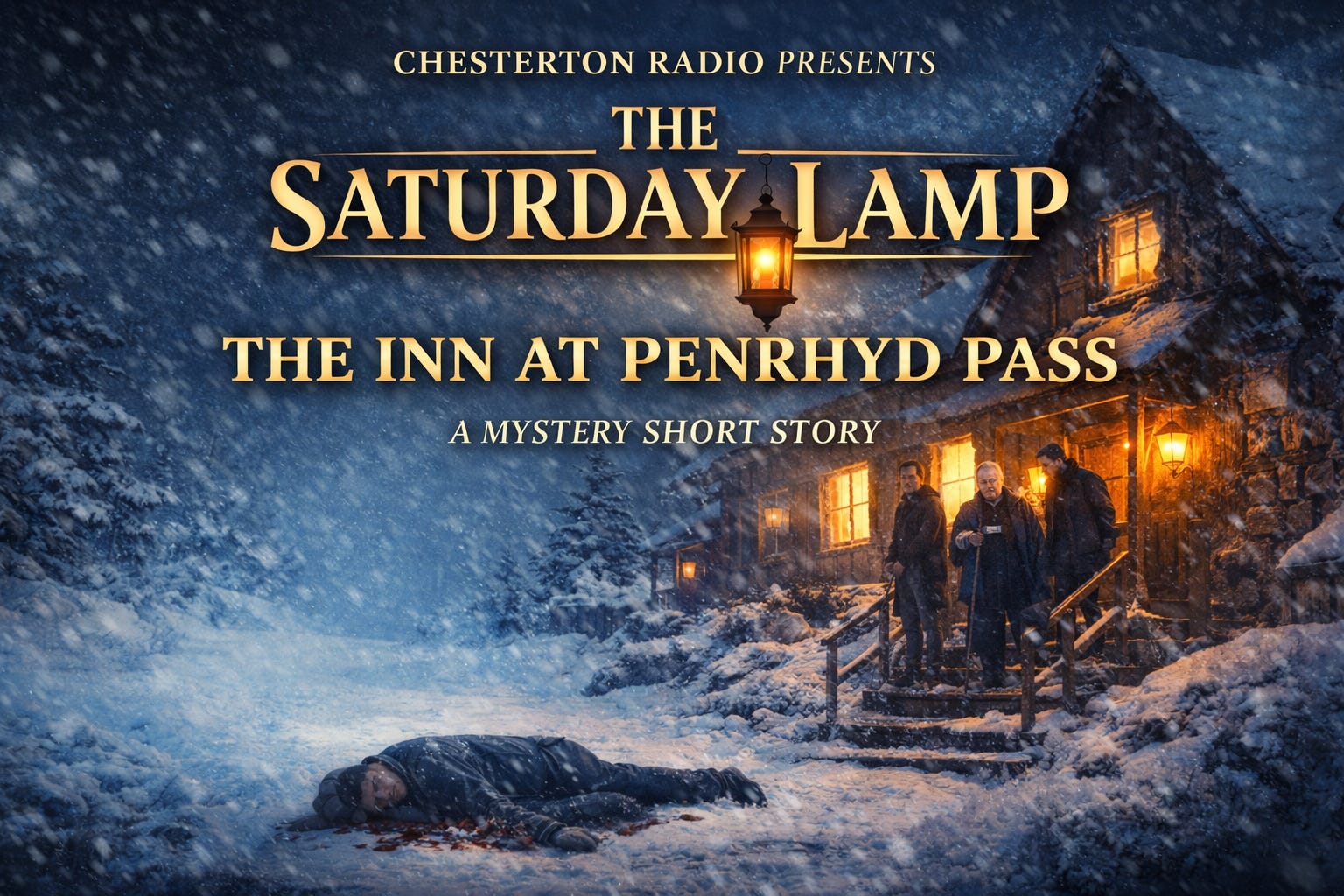
There are storms that inconvenience a man.
And there are storms that interrogate him.
The blizzard that struck Penrhyd Pass did not rage; it advanced. By dusk the road had vanished beneath white drifts shaped like frozen waves. By nightfall the mountain had erased all suggestion that human beings had ever imagined crossing it.
At the summit stood the Traveller’s Rest.
Its lamps glowed like a held breath.
Inside, Martha Llewellyn counted candles.
She had lived on the pass long enough to distrust storms that began politely.
The knock came at half past seven.
Three measured raps.
Not desperate.
Not hurried.
Certain.
When she opened the door, the wind forced its way in first. Behind it stood a tall man in a dark overcoat, snow caught in the folds like deliberate decoration.
“Arthur Harbury,” he said calmly. “I trust you have a room.”
Martha did not move for half a second.
Then she stepped aside.
“We have one.”
The mountain had sent her something back.
I. The Man Who Should Not Have Come
There were four others already stranded at the inn.
Reverend Pritchard, who had misjudged the hour and the weather.
Dr. Huw Morgan, returning from tending a farmer’s broken arm.
Miss Elinor Graves, a schoolteacher with sharp eyes and steadier nerves than she advertised.
And Tom Llewellyn, Martha’s younger brother, who had spent the afternoon bringing livestock under shelter before the storm took the hill.
Harbury entered as though into a boardroom rather than a refuge.
He removed his gloves with precision.
He declined whisky.
He watched.
He watched Martha most of all.
“You’ve kept the place well,” he said lightly.
“It keeps itself,” she replied.
The fire snapped. The wind pressed at the windows like a silent audience.
No one mentioned the quarry.
Not yet.
II. When the Lights Went Out
At nine precisely, the electricity failed.
No flicker. No warning.
Darkness swallowed the inn in a single breath.
“Fuse,” Tom muttered, rising.
He had taken two steps toward the cellar when the crash sounded.
It was not a long fall.
But it was a final one.
They found Arthur Harbury at the foot of the stairwell.
His head lay at an angle no living man would choose.
Blood darkened the boards.
Dr. Morgan knelt.
There is a way a doctor touches the dead that tells you the truth before he speaks it.
“He’s gone,” he said quietly.
Miss Graves made a small sound in her throat.
Reverend Pritchard crossed himself without quite realizing he had done so.
Tom looked at his sister.
“Martha…”
But she was looking at the stairs.
Not at the body.
At the stairs.
III. A Storm Without Exit
The telephone was dead.
The road was gone.
No one could reach Penrhyd Pass until morning — if morning came kindly.
Which meant something very simple.
The killer, if there was one, was in the room.
Dr. Morgan bent closer to the head wound.
“This was not merely a fall.”
Tom stiffened. “What do you mean?”
“There is a second impact,” the doctor said. “Above the ear. Deliberate.”
Miss Graves whispered, “Struck?”
“Yes.”
Reverend Pritchard looked at the darkened stairwell.
“Then someone here has done murder.”
The wind struck the windows again, as if in agreement.
IV. The Letter in His Pocket
They moved Harbury to the parlour.
Tom lit oil lamps.
The room became smaller.
Dr. Morgan examined Harbury’s coat pockets.
From the inner lining he removed a folded typed letter.
He read it once.
Then again.
“If you do not attend at Penrhyd Pass tonight, I shall publish what I know.”
Signed only: M.L.
Every eye turned.
Martha did not flinch.
“Yes,” she said. “I wrote it.”
Tom recoiled.
“You invited him?”
“Yes.”
“Why?”
She met his gaze without blinking.
“Because ten years ago, three men died at Harbury Quarry.”
No one spoke.
“My husband was one of them.”
The fire shifted.
Reverend Pritchard closed his eyes.
The explosion had been ruled miscalculation.
Insurance had paid.
Harbury had prospered.
“And you believed it was deliberate,” Dr. Morgan said quietly.
“Yes.”
“And you summoned him here.”
“Yes.”
“Alone.”
“Yes.”
The simplicity of the motive lay on the table like a loaded revolver.
Too simple.
Dr. Morgan did not look satisfied.
V. Grease on the Rail
Tom insisted on checking the stair.
He ran his fingers along the banister.
They came away slick.
“Doctor.”
Morgan leaned in with lamplight.
Industrial grease.
Freshly applied.
Not lamp oil.
Not accident.
Preparation.
Miss Graves stared.
“Someone intended him to fall.”
“Or intended him to fear falling,” the Reverend murmured.
Tom looked at Martha.
“Did you do this?”
Her answer was immediate.
“No.”
The wind howled harder.
Suspicion moved through the room like frost spreading along glass.
VI. The Past Was Not Alone
Interrogation began without anyone naming it so.
Tom had been in the cellar.
Martha in the pantry.
Reverend Pritchard in prayer.
Miss Graves in the parlour.
Dr. Morgan by the hearth.
Each account plausible.
Each incomplete.
Miss Graves spoke suddenly.
“I knew him.”
All heads turned.
“I worked as a clerk in his Cardiff office. Briefly.”
“Why did you leave?” Tom asked.
“I was dismissed.”
“For incompetence?”
“For noticing discrepancies.”
The word hung heavy.
“What discrepancies?” Martha asked.
“Insurance figures. Equipment valuations. Compensation delays.”
“You’re suggesting the explosion was profitable,” Tom said.
Miss Graves met his eyes.
“I am stating it.”
The storm seemed to lean closer.
VII. The Second Blow
Shortly after midnight, Tom vanished.
They found him in the stable.
Unconscious.
Blood at his temple.
Not fatal.
But deliberate.
The room fell silent.
This was no accident.
This was maintenance.
The killer had struck twice.
VIII. The Geometry of Guilt
Dr. Morgan spoke slowly.
“The grease was applied earlier in the evening.”
“How do you know?” Martha asked.
“Because cold stiffens it. It had not fully congealed.”
Miss Graves looked up.
“So the preparation came before the power failure.”
“Yes.”
“And the power failure?” Tom asked weakly.
“Could have been arranged.”
They stared at him.
“You think someone cut the fuse?”
“I think,” Morgan replied, “that darkness favors design.”
Reverend Pritchard folded his hands.
“Who among us understands machinery?”
Tom raised his hand.
“I do.”
“And who understands industrial grease?”
Tom’s hand lowered slowly.
“So does the doctor,” Miss Graves said quietly.
Silence.
Dr. Morgan did not move.
IX. The Doctor’s Shadow
It was Tom, pale and unsteady, who said it first.
“You signed the inquest report ten years ago.”
Dr. Morgan nodded.
“Yes.”
“You declared misadventure.”
“Yes.”
“And if it were deliberate?”
Morgan’s gaze did not shift.
“Then I was mistaken.”
“Or complicit,” Miss Graves said.
The fire cracked sharply.
Reverend Pritchard spoke gently.
“Huw…?”
Morgan stood.
“I did not set blasting charges.”
“No,” Martha said softly. “But you certified the bodies.”
He exhaled.
“Harbury came to me first, ten years ago. He insisted the charge miscalculation was accidental. He feared scandal.”
“And you believed him?” Tom asked.
“I believed stability mattered.”
Miss Graves stared.
“You altered findings.”
“I softened them.”
“To protect him.”
“To protect the settlement.”
“And yourself,” Martha said.
Morgan did not answer.
Outside, the storm weakened.
Inside, something else collapsed.
X. The Maintenance of Lies
Harbury had not come to silence Martha.
He had come to silence Morgan.
“He was carrying correspondence,” Miss Graves said. “Insurance revisions tied to your certification.”
Morgan nodded.
“He threatened exposure.”
“So you prepared the stairs,” Tom said.
“I prepared fright,” Morgan replied calmly. “A warning. A fall short of death.”
“And when he fell fully?” Martha asked.
Morgan closed his eyes briefly.
“Gravity completed what intention began.”
“And Tom?” Miss Graves asked.
“He saw the grease,” Morgan said. “He would have drawn the line.”
Silence settled like fresh snow.
Reverend Pritchard spoke at last.
“You calculated risk.”
“Yes.”
“As before.”
“Yes.”
“And what have you preserved?” Martha asked quietly.
Morgan looked toward the window.
“Nothing.”
XI. Dawn
The storm broke just before morning.
Light came pale and indifferent.
Harbury lay covered in the parlour.
Tom sat bandaged.
Miss Graves watched the horizon.
Reverend Pritchard prayed — not out of habit now, but necessity.
Morgan waited.
Rescue would not reach them until afternoon.
But something else had already arrived.
Clarity.
The mountain buries roads.
It does not bury truth.
And in the Traveller’s Rest, beneath the lingering scent of grease and snow and extinguished lamp oil, one thing had become clear:
Lies demand maintenance.
Truth demands courage.
Storms merely decide which arrives first.
✨ End of The Saturday Lamp – Episode I
🕯 The Saturday Lamp
A new Chesterton Radio original fiction series.
If you believe mystery should still have a moral spine…
If you believe storms should reveal more than bodies…
If you believe great radio begins on the page…
Join the Chesterton Radio Listener Club.
👉 Subscribe at ChestertonRadio.Substack.com
🎙️ Listener supported. Independent. Lit by hand.