

Intro
There are some journeys that become memorable not because of where they lead, but because they are interrupted.
A train delayed by snow.
A ship forced into harbor.
A traveler stranded far from home by weather, circumstance, or fate.
For centuries, storytellers have understood that the most interesting things often happen when the ordinary path suddenly disappears.
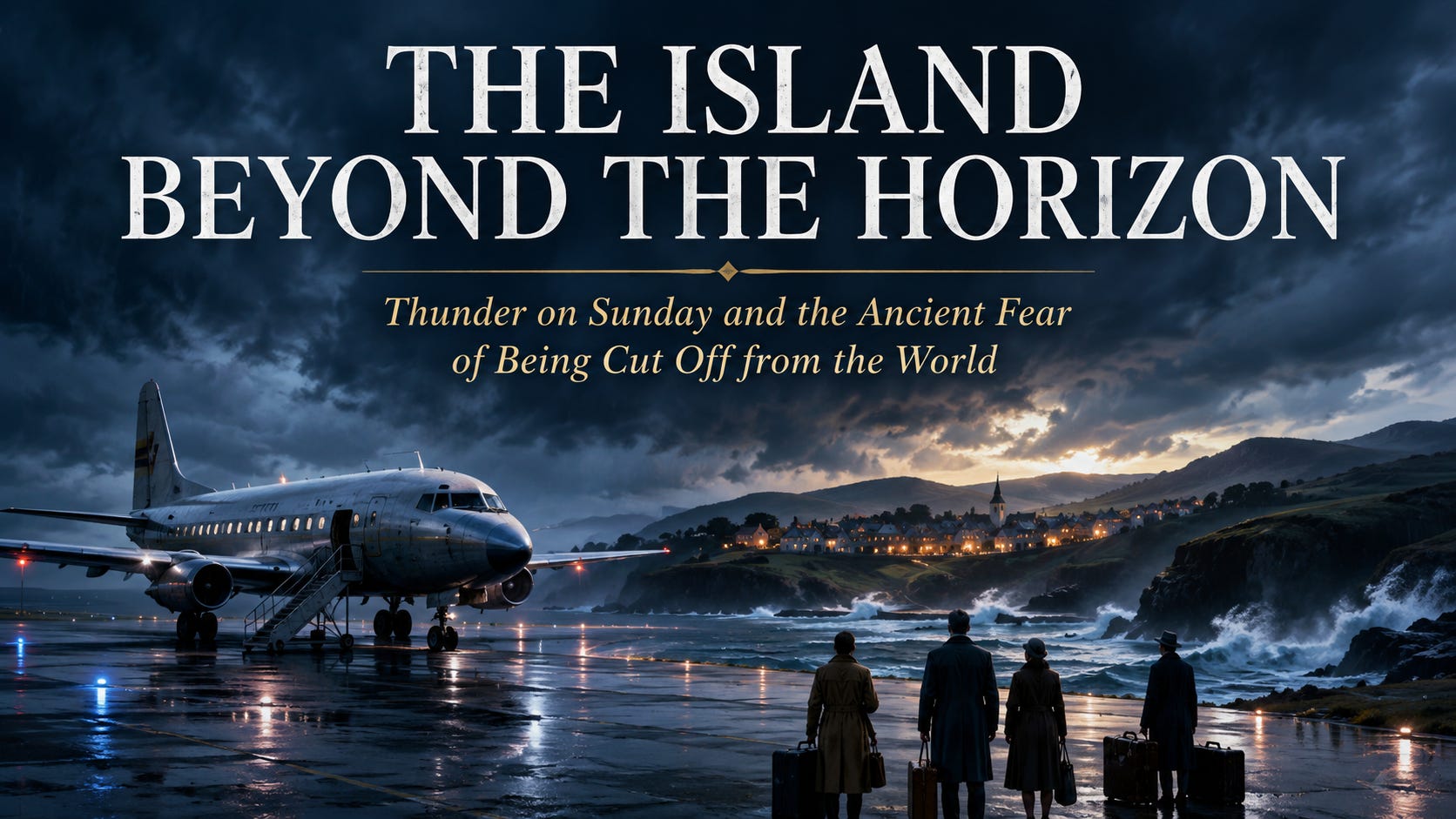
The 1973 BBC Saturday Night Theatre production Thunder on Sunday begins with just such an interruption. A damaged airliner is forced to land on a remote Scottish island. The passengers expect inconvenience. What they encounter instead is uncertainty.
Yet beneath its surface as a suspenseful radio drama lies something richer. Thunder on Sunday belongs to a long tradition of stories about islands, strangers, hidden communities, and the uneasy realization that the world is often larger—and more mysterious—than we imagine.
In an age when nearly every location can be photographed from space and nearly every question answered in seconds, such stories remind us of something we have not entirely lost: the experience of stepping beyond the familiar and discovering that not everything can be understood at first glance.
This week, we journey to the storm-bound island of Ardnabegh and explore why this forgotten BBC thriller continues to resonate more than fifty years after its original broadcast.
Because sometimes the most interesting destination is the one we never intended to reach.
Introduction
There are stories that frighten us because something terrible happens.
And there are stories that frighten us because something terrible might happen.
The second kind often lingers longer.
The locked room mystery. The deserted highway. The unfamiliar village. The train delayed in a snowstorm. The inn at the end of the road where nobody seems eager to answer questions.
Such stories do not depend primarily upon violence. They depend upon uncertainty. They ask a simple but unsettling question:
What happens when the ordinary safeguards of civilization quietly disappear?
The 1973 BBC Saturday Night Theatre production Thunder on Sunday belongs to this venerable tradition. Adapted from a novel by Scottish writer Karen Campbell, the drama begins with a practical emergency. A commercial airliner, damaged by severe weather, is forced to land on a remote island off the coast of Scotland. The passengers expect inconvenience. They expect delay.
What they do not expect is mystery.
As the storm intensifies and communication with the mainland becomes increasingly difficult, the island begins to reveal itself as something more than a temporary refuge. Questions emerge. The behavior of certain residents seems curious. The atmosphere grows uneasy.
Before long, the stranded travelers discover that isolation can be more unsettling than danger itself.
Yet Thunder on Sunday is more than a suspense story. Like many of the finest radio dramas, it serves as a doorway into larger questions about community, belonging, trust, and the strange relationship between civilization and wilderness.
The play belongs to a tradition that stretches from ancient myths to modern thrillers, from island castaways to travelers stranded in snowbound inns. It reminds us that while technology may connect us more efficiently than ever before, the deeper human experience of uncertainty has not disappeared.
The storm outside may change its form.
The storm within remains remarkably familiar.
Part I
The Story Behind the Story
Every age produces its own anxieties.
The nineteenth century feared vast wildernesses and unexplored frontiers. The early twentieth century worried about industrialization, war, and social upheaval. The Cold War era developed its own collection of concerns: espionage, isolation, hidden threats, and the possibility that familiar institutions might not be as secure as they appeared.
By the early 1970s, Britain occupied an interesting cultural moment.
The great optimism that had accompanied postwar reconstruction had begun to fade. Economic difficulties loomed. Traditional communities were changing. Modern technology promised connection and convenience, yet many people felt increasingly detached from one another.
Popular storytelling reflected these tensions.
Mysteries and suspense dramas flourished. Television offered programs such as Doomwatch, Thriller, and Survivors. Cinema embraced psychological suspense. Literature increasingly explored questions of identity, alienation, and uncertainty.
At the same time, there remained a deep affection for older storytelling traditions.
Audiences still loved mysteries.
They still loved atmospheric thrillers.
They still loved stories in which ordinary people found themselves in extraordinary circumstances.
Radio remained uniquely suited to these narratives.
The BBC had spent decades refining the art of dramatic storytelling through sound. Long before television arrived, radio writers had learned how to transform limitations into strengths. Without visual effects, they relied on atmosphere. Without elaborate scenery, they relied on imagination.
The result was often a more intimate form of storytelling.
Listeners were not spectators.
They were participants.
A storm heard through headphones could become larger than any storm shown on a screen.
A lonely voice could feel closer.
A mystery could feel more personal.
Thunder on Sunday emerged from this tradition.
Although relatively obscure today compared to famous detective dramas or long-running radio serials, the play exemplifies a particularly British style of suspense—one rooted less in action than in atmosphere.
Its setting is significant.
The Scottish islands have occupied a special place in the British imagination for generations.
To city dwellers, they represented distance.
To writers, they represented mystery.
To storytellers, they represented possibility.
Islands are naturally dramatic places.
They are worlds unto themselves.
Boundaries become visible.
Escape becomes difficult.
Communities develop distinctive identities.
Visitors become outsiders immediately.
This symbolic power appears throughout literature.
From Homer’s wandering sailors to Shakespeare’s enchanted islands, from Treasure Island to The Wicker Man, islands occupy a curious place between civilization and wilderness.
They are close enough to reach.
Yet once reached, they often feel strangely removed from ordinary life.
That tension lies at the heart of Thunder on Sunday.
The passengers arrive expecting a temporary stopover.
Instead, they encounter a place that operates according to its own rhythms and assumptions.
This contrast reflects one of the oldest themes in storytelling: the meeting between strangers and a closed community.
Such encounters reveal as much about the visitors as they do about the place itself.
The outsider notices details the insider ignores.
The newcomer questions customs that locals take for granted.
Every ordinary gesture suddenly appears significant.
This dynamic creates fertile ground for suspense.
But it also creates fertile ground for reflection.
What truly defines a community?
Who belongs?
Who remains an outsider?
What happens when people accustomed to one set of rules suddenly find themselves living under another?
These questions resonate far beyond the boundaries of a thriller.
They touch something deeply human.
Every person, at some point, has experienced the feeling of entering unfamiliar territory.
A new town.
A new job.
A new school.
A gathering where everyone else seems to know one another.
The emotional experience is surprisingly similar.
One becomes intensely observant.
One watches for clues.
One tries to determine whom to trust.
One seeks to understand the hidden rules.
The suspense of Thunder on Sunday emerges from this universal human experience.
Its mystery may be particular.
Its emotional foundation is timeless.
Part II
Synopsis: A Refuge That Feels Increasingly Uncertain
The premise of Thunder on Sunday is elegantly simple.
A commercial aircraft encounters severe weather and is forced to make an emergency landing on the remote Hebridean island of Ardnabegh.
