

There comes a moment in every parent’s life that feels strangely familiar and entirely new at the same time.
The moment arrives after years of preparation.
After school projects and soccer games.
After piano lessons and driver’s licenses.
After late-night conversations and family dinners.
After all the countless ordinary days that, taken together, somehow become a childhood.
Parents know the moment is coming.
They spend years preparing for it.
And yet when it finally arrives, they discover they were never fully prepared at all.
The child leaves home.
Not merely to attend college.
Not merely to begin a career.
But to begin a life.
For generations, this transition was understood as one of the central passages of adulthood. Young men and women left home, accepted responsibilities, embraced vocations, and gradually became the people they were meant to become.
Today, however, the transition often feels less certain.
Many parents look at the modern world and wonder what awaits their children.
The culture appears increasingly fragmented.
Communities seem weaker than they once were.
Institutions struggle to command trust.
Young adults face unprecedented opportunities alongside unprecedented confusion.
Questions that once seemed settled now appear endlessly debated.
What is a successful life?
What is worth sacrificing for?
What obligations do we owe one another?
What does it mean to serve?
What does it mean to flourish?
The uncertainty can be unsettling.
Yet every so often, a young person makes a choice that reminds us these questions still have answers.
Not easy answers.
Not universal answers.
But real answers nonetheless.
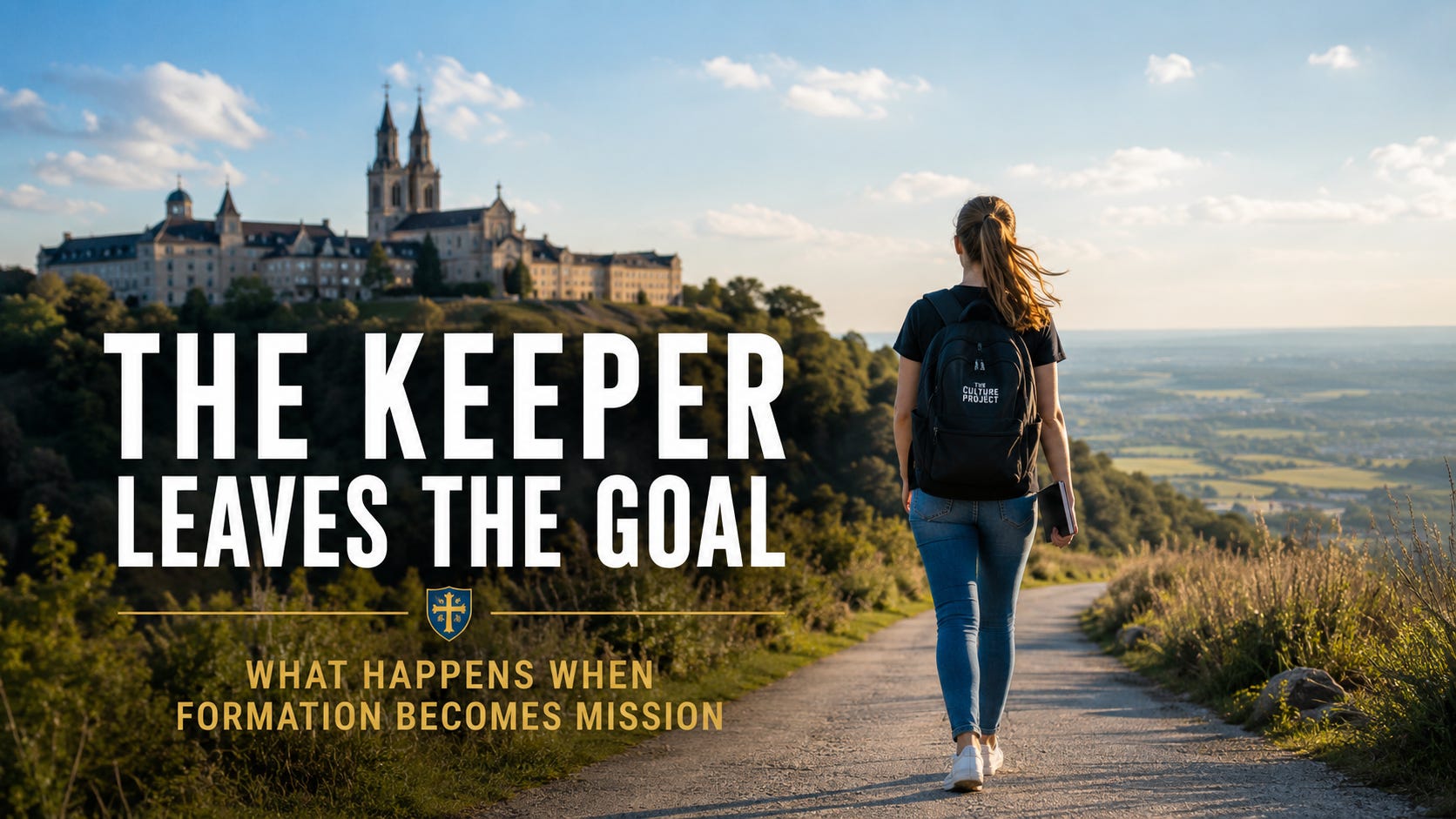
This spring, a young woman graduated from Benedictine College and joined The Culture Project as a missionary.
For our family, she will always be known by another title.
The Keeper.
Readers of the Tall Girl stories know her well.
She appeared throughout those essays and stories as a source of humor, wisdom, determination, and occasional exasperation.
Parents experience this transformation with equal parts pride and surprise.
One day you are helping a child tie her shoes.
The next day she is making decisions that will shape her future.
One day you are teaching lessons.
The next day you are watching those lessons being lived.
The transition feels sudden.
It never is.
In reality, it is the culmination of thousands of small moments spread across many years.
And perhaps that is what makes graduation so emotional.
The diploma itself is merely paper.
The ceremony lasts only a few hours.
The photographs capture a single afternoon.
Yet everyone involved understands that something larger has occurred.
An era has ended.
Another has begun.
For families associated with Benedictine College, this experience carries a particular resonance.
The college has become known not merely for academic achievement but for formation. Students arrive seeking degrees. Many leave having discovered something more.
They discover friendships.
They discover community.
They discover purpose.
Sometimes they discover vocation.
The distinction matters.
A career answers the question, “What will I do?”
A vocation answers the question, “Who am I called to become?”
The two often overlap.
But they are not identical.
Modern culture speaks constantly about careers.
It speaks less frequently about vocation.
And yet vocation remains one of the most powerful ideas available to human beings.
It suggests that life possesses direction.
It suggests that talents carry responsibilities.
It suggests that personal fulfillment is found not merely through achievement but through service.
For centuries, religious traditions have understood this instinctively.
The purpose of education was never simply employment.
The purpose of education was preparation.
Preparation for citizenship.
Preparation for family life.
Preparation for leadership.
Preparation for service.
Preparation for answering whatever call God placed before an individual life.
The remarkable thing about Benedictine College is that many students still encounter education in precisely this way.
They arrive hoping for careers.
They leave searching for mission.
And that transformation may be one of the most important educational achievements of all.
Because every civilization depends upon institutions capable of producing not merely successful people, but purposeful people.
The difference is subtle.
It is also profound.
A successful person asks, “What can I gain?”
A purposeful person asks, “What can I give?”
One question builds a résumé.
The other builds a life.
The story of The Keeper begins with that distinction.
It begins with a young woman standing at the edge of adulthood, diploma in hand, facing a world that desperately needs people willing to serve.
And it begins with a question that many parents are asking today.
Why would a young person choose mission in an age obsessed with self-interest?
The Benedictine Years
Every college promises transformation.
Visit enough campuses, read enough brochures, or attend enough admissions events and one quickly discovers that nearly every institution speaks the language of growth, leadership, opportunity, and personal development.
The promises are familiar.
Students will be challenged.
Students will be prepared.
Students will discover their potential.
Students will change the world.
Most colleges sincerely believe these things.
Yet there remains an important difference between institutions that educate students and institutions that form them.
The distinction is not always visible at first.
In fact, it is often difficult to measure.
It rarely appears in rankings.
It cannot be easily quantified through statistics.
Its effects become visible only over time.
One sees it in the choices graduates make.
One sees it in the communities they build.
One sees it in the lives they create after leaving campus.
For many families, Benedictine College has become notable precisely because of this distinction.
Students arrive from vastly different backgrounds. Some come from Catholic schools. Others come from public schools. Some come from classical academies. Others arrive from homeschooling families. Some possess strong faith. Others arrive with questions. Some know exactly what they wish to do with their lives. Others remain uncertain.
What they share is a common destination.
Four years on a hill overlooking the Missouri River.
Four years spent within a community intentionally organized around certain assumptions.
The assumption that truth exists.
The assumption that faith and reason belong together.
The assumption that education is about more than acquiring information.
The assumption that human beings flourish when they understand themselves as part of something larger than themselves.
These assumptions may seem unremarkable.
Historically, they would have been.
Yet in modern higher education they have become increasingly distinctive.
Many universities excel at providing information.
Many provide outstanding professional preparation.
Many possess extraordinary facilities, accomplished faculty, and extensive resources.
Yet students frequently leave with an unsettling question lingering beneath their achievements.
What was all of this for?
The question rarely appears during freshman year.
Freshmen are occupied with classes, friendships, and adjusting to college life.
Nor does it usually dominate sophomore year.
There are majors to declare, organizations to join, opportunities to pursue.
By junior and senior year, however, the question often begins to emerge.
The closer students move toward adulthood, the more they begin asking what sort of adults they wish to become.
This is where formation becomes important.
Information teaches students what they can do.
Formation helps them decide what they should do.
The difference is subtle.
It is also enormous.
A student can learn accounting without learning stewardship.
A student can learn biology without learning responsibility.
A student can learn engineering without learning service.
A student can learn business without learning integrity.
Technical competence matters.
Character matters as well.
The strongest educational institutions understand that both are necessary.
For generations, Benedictine College has attempted to preserve this balance.
Academic excellence remains important.
Professional preparation remains important.
Graduate school placement remains important.
Yet all of these objectives exist within a broader understanding of education.
The purpose of education is not merely success.
The purpose of education is formation.
The idea appears repeatedly throughout Catholic educational history.
John Henry Newman wrote about it.
The Benedictine tradition embodies it.
Chesterton celebrated it.
Education was never intended simply to produce workers.
It was intended to produce human beings capable of freedom, responsibility, and service.
This vision influences campus life in ways that outsiders sometimes find difficult to understand.
Students attend classes, certainly.
They also attend Mass.
They participate in service projects.
They develop friendships that often endure long after graduation.
They encounter mentors who discuss vocation as naturally as employment.
They discover communities where questions of meaning are not considered distractions from education but central to it.
The cumulative effect is difficult to quantify.
Yet it becomes visible at graduation.
One notices it in conversations.
One notices it in aspirations.
One notices it in the language students use when discussing their futures.
Not every graduate leaves with complete certainty.
Nor should they.
Life rarely unfolds according to detailed plans.
Yet many leave with something perhaps more valuable.
Direction.
A sense that their lives possess purpose.
A belief that their talents are meant to be placed in service of something larger than personal advancement.
This is where the story of The Keeper becomes part of a larger story.
For her experience is hardly unique.
Each spring, students leave Benedictine carrying diplomas and dreams.
Some enter business.
Some enter engineering.
Some enter healthcare.
Some enter education.
Some pursue religious vocations.
Some enter public service.
The professions differ.
The underlying question remains the same.
What will they do with the gifts they have received?
The answer varies from person to person.
Yet certain patterns emerge.
Again and again, one encounters graduates who speak not merely about careers but about service.
Not merely about opportunities but about responsibilities.
Not merely about success but about mission.
This language surprises some observers.
Modern culture often assumes that young people are primarily motivated by comfort, convenience, and self-interest.
The stereotype persists despite abundant evidence to the contrary.
The reality is that many young adults are searching desperately for meaning.
They want lives that matter.
They want work that matters.
They want relationships that matter.
They want to know that their efforts contribute to something worthwhile.
This desire is neither naïve nor unusual.
It is profoundly human.
The challenge is finding institutions that nurture it rather than suppress it.
The challenge is finding communities willing to speak openly about purpose, vocation, sacrifice, and service.
Benedictine College has become one such community.
Its graduates leave with degrees.
Many leave with something else as well.
They leave believing that education is not the end of a journey.
It is the beginning.
The diploma is not the destination.
It is a commissioning.
A sending forth.
A reminder that the purpose of formation is ultimately mission.
And for some students, that mission becomes unmistakably clear.
They do not simply graduate and enter the workforce.
They graduate and enter the field.
They become teachers.
Missionaries.
Healthcare workers.
Community leaders.
Builders of institutions.
Witnesses.
The Keeper’s path would soon lead in that direction.
But to understand why, one must first understand the remarkable organization she chose to join.
For The Culture Project exists because a generation of young people recognized that modern society is not suffering from a shortage of information.
It is suffering from a shortage of meaning.
And they decided to do something about it.The Culture Project and the Search for Meaning
Every generation inherits certain challenges.
Some are economic.
Some are political.
Some are technological.
And some are cultural.
The cultural challenges are often the most difficult to address because they are the hardest to see.
Economic problems can be measured.
Political problems can be debated.
Technological problems can be engineered.
Cultural problems are different.
They emerge gradually.
They influence assumptions.
They shape expectations.
They alter the way people understand themselves and one another.
By the time a cultural problem becomes obvious, it has often been developing for decades.
This reality helps explain the existence of The Culture Project.
At first glance, the organization appears unusual.
Young missionaries travel across the country speaking to students, parents, educators, and communities about human dignity, relationships, identity, purpose, and what it means to live an authentically human life.
To some observers, this may seem like an ambitious undertaking.
To others, it may seem impossible.
After all, modern society is not suffering from a shortage of voices.
Young people are surrounded by messages.
Social media delivers a constant stream of opinions.
Entertainment industries shape perceptions.
Advertising influences desires.
Technology ensures that information arrives faster than ever before.
The problem is not silence.
The problem is noise.
The average young person encounters more information in a single day than previous generations might have encountered in weeks.
And yet despite this abundance of information, many report feeling increasingly uncertain about some of life’s most important questions.
Who am I?
What is love?
What is friendship?
What is commitment?
What is freedom?
What is happiness?
What makes a life meaningful?
The paradox is striking.
Information has become abundant.
Wisdom remains scarce.
This is precisely the environment into which The Culture Project was born.
Its founders recognized something important.
Arguments alone rarely change cultures.
Statistics rarely inspire people.
Policies matter, certainly, but culture is ultimately shaped through relationships, stories, examples, and witness.
Human beings learn not merely from what they are told.
They learn from what they see lived.
This insight has deep roots within the Christian tradition.
The earliest Christians transformed the ancient world not because they possessed superior political power or military strength. They transformed it because they lived differently.
Their communities reflected a different understanding of the human person.
They treated the vulnerable differently.
They approached marriage differently.
They approached family differently.
They approached service differently.
The witness preceded the argument.
The example preceded the explanation.
In many respects, The Culture Project seeks to recover this approach.
The organization’s missionaries do not simply present information.
They present themselves.
Young adults dedicate a period of their lives to serving others, speaking about human dignity, and engaging difficult cultural questions.
The decision is remarkable precisely because it runs against prevailing assumptions.
Modern culture often encourages young people to focus relentlessly upon personal advancement.
Build your résumé.
Expand your network.
Increase your opportunities.
Maximize your options.
Protect your flexibility.
Delay commitments.
Keep every door open.
There is a certain logic to this advice.
The world can be uncertain.
Opportunities matter.
Careers matter.
Financial stability matters.
Yet an unintended consequence often follows.
Life becomes centered upon the self.
Every decision is evaluated according to personal benefit.
Every opportunity is judged according to individual advantage.
The result is not necessarily happiness.
Quite often it is anxiety.
For a life organized entirely around personal advancement eventually encounters an uncomfortable question.
Advancement toward what?
The question cannot be avoided forever.
At some point every person must decide whether life is primarily about accumulation or contribution.
Whether it is about consumption or service.
Whether it is about achievement or mission.
The most compelling aspect of organizations like The Culture Project is that they invite young people to answer those questions directly.
Not theoretically.
Practically.
A missionary accepts inconvenience.
A missionary accepts uncertainty.
A missionary accepts sacrifice.
Most importantly, a missionary accepts responsibility.
The decision reflects a belief that some things are worth giving one’s life to.
Not necessarily forever.
But genuinely.
For a season.
For a purpose.
For a mission.
Such commitments often surprise older generations.
Parents spend years helping children prepare for adulthood.
Then adulthood arrives, and the child chooses a path that appears less concerned with status than service.
The reaction is often a mixture of pride and bewilderment.
One part of the parent wonders whether the choice is practical.
Another part recognizes something beautiful.
For every parent secretly hopes that their child will become successful.
But deeper still lies another hope.
They hope their child will become good.
They hope their child will care about others.
They hope their child will possess courage.
They hope their child will stand for something worthwhile.
They hope their child will discover a purpose larger than personal comfort.
This is what makes The Keeper’s journey resonate beyond a single family.
Her story is not unique.
Across the country, young men and women continue making similar choices.
Some join missionary organizations.
Some enter teaching.
Some pursue healthcare.
Some serve in nonprofit work.
Some enter religious life.
Others build families rooted in service and community.
The specific paths differ.
The underlying impulse remains the same.
They have discovered that meaning is rarely found through self-absorption.
Meaning emerges through self-gift.
This insight would not have surprised G.K. Chesterton.
Indeed, he spent much of his life arguing precisely this point.
Modern society often promises fulfillment through unlimited freedom.
Chesterton suggested something different.
He argued that genuine freedom is discovered through commitment.
The lover commits to another person.
The parent commits to a child.
The citizen commits to a community.
The believer commits to a faith.
The missionary commits to a mission.
Paradoxically, these commitments do not diminish freedom.
They give it direction.
The same principle applies to vocation.
A vocation is not a restriction.
It is a response.
A response to a need.
A response to a calling.
A response to the realization that one’s life is meant for something beyond itself.
This realization lies at the heart of The Culture Project.
It also lies at the heart of Benedictine College’s educational mission.
Both institutions, in their own ways, are asking the same question.
What happens when young people stop asking what they can get from the world and begin asking what they can give to it?
The answer may be one of the most hopeful stories of our time.
Because despite all the cynicism, confusion, and uncertainty that dominate so many conversations about the younger generation, there remains a quiet army of young men and women choosing service over self-interest, mission over comfort, and purpose over convenience.
The Keeper has joined their ranks.
And in doing so, she reminds us of something that every civilization eventually forgets and must rediscover.
The future is not built by people who ask for the least sacrifice.
The future is built by people willing to give themselves to something worth serving.
When Parents Let Go
Every parent spends years teaching a child to leave.
The statement sounds strange at first.
Parents rarely think of themselves in these terms. They think about protecting, guiding, encouraging, correcting, supporting, and loving. They think about helping children succeed in school, navigate friendships, develop talents, and avoid mistakes.
They think about preparing children for life.
What they do not always realize is that preparation and letting go are ultimately the same thing.
The purpose of childhood is not to remain a child.
The purpose of childhood is to become an adult.
This truth seems obvious until it becomes personal.
Then it becomes difficult.
For years, parents occupy a central place in their children’s lives. They answer questions. They solve problems. They establish routines. They provide stability. Their presence is constant and reassuring.
Then, gradually, the relationship begins to change.
The child who once needed help tying shoes learns to drive a car.
The child who once asked permission for everything begins making independent decisions.
The child who once looked to parents for every answer begins developing convictions of their own.
The process unfolds so slowly that it is easy to miss.
Then one day, seemingly without warning, adulthood arrives.
Not legally.
Not ceremonially.
Actually.
The young person standing before you is no longer becoming an adult.
They are one.
This realization often arrives during moments that appear ordinary.
A conversation.
A decision.
A new responsibility.
A choice that reveals maturity where only potential once existed.
Parents recognize the change immediately.
The child remains familiar.
The role has changed.
This is one reason graduations affect people so deeply.
The emotion has surprisingly little to do with diplomas.
A diploma is simply a symbol.
The real significance lies elsewhere.
Graduation marks the moment when preparation begins giving way to mission.
The years of formation have produced something.
The question becomes what that something will do next.
For many parents, this transition contains an unavoidable tension.
On one hand, there is pride.
Pride in accomplishments.
Pride in growth.
Pride in the young adult standing before them.
On the other hand, there is loss.
Not tragic loss.
Not unhealthy loss.
But real loss nonetheless.
An era has ended.
The family will never again occupy quite the same shape.
The rhythms that once seemed permanent have changed.
The child who once returned home every afternoon now possesses a life increasingly defined by responsibilities, commitments, and relationships beyond the family itself.
This is precisely as it should be.
And yet knowing something is right does not make it easy.
Indeed, many of life’s most meaningful transitions contain both joy and sorrow.
The parent watching a child marry experiences both.
The teacher watching a student graduate experiences both.
The mentor watching a protégé succeed experiences both.
Love naturally desires closeness.
Love also desires growth.
Healthy love eventually chooses growth.
This choice requires trust.
Parents must trust that the values they taught will endure.
They must trust that lessons learned over years will remain present during moments they can no longer witness.
They must trust that their children possess the strength to navigate challenges independently.
Most of all, they must trust that the child they spent years forming has become a person capable of making good decisions without constant supervision.
Such trust is not blind.
It is earned.
It emerges from thousands of ordinary moments accumulated over many years.
A conversation at the dinner table.
A difficult lesson learned.
A mistake survived.
A responsibility accepted.
A kindness offered.
A sacrifice made.
Character develops gradually.
Then suddenly.
One day, parents discover that the child who once received guidance has become someone capable of offering guidance to others.
This realization can be startling.
It can also be deeply moving.
For years, parents invest in the future without knowing exactly what that future will look like.
They teach honesty, hoping it becomes integrity.
They teach responsibility, hoping it becomes leadership.
They teach compassion, hoping it becomes service.
They teach faith, hoping it becomes conviction.
The results remain largely invisible.
Then, occasionally, the results become visible all at once.
A son chooses service.
A daughter chooses mission.
A young adult makes a decision that reflects values planted years earlier.
And suddenly parents glimpse the harvest.
Not the final harvest.
Life continues.
Formation never truly ends.
But enough of a harvest to recognize that something good has taken root.
This is what makes The Keeper’s decision so meaningful.
Not because joining The Culture Project is extraordinary in itself.
Many worthwhile organizations exist.
Many worthy paths exist.
Rather, the significance lies in what the decision represents.
It represents a young woman choosing service.
It represents a young woman willing to dedicate part of her life to helping others.
It represents a young woman stepping into adulthood not by asking what the world owes her, but by asking what she can contribute.
Every parent hopes to witness something like this.
Not necessarily the same path.
Not the same organization.
Not the same vocation.
But the same spirit.
The spirit of responsibility.
The spirit of generosity.
The spirit of mission.
For parents eventually discover that their greatest success is not measured by their children’s achievements alone.
It is measured by their children’s character.
Achievements matter.
Character matters more.
Careers matter.
Purpose matters more.
Success matters.
Service matters more.
The world naturally celebrates accomplishments because accomplishments are visible.
Character is quieter.
One can easily list degrees, awards, titles, and promotions.
It is much harder to quantify integrity, courage, faithfulness, compassion, and generosity.
Yet these are the qualities that ultimately shape lives.
They are the qualities communities depend upon.
They are the qualities institutions require.
They are the qualities civilizations need.
And they are often formed long before anyone notices.
This truth helps explain why education matters.
It helps explain why families matter.
It helps explain why institutions like Benedictine College matter.
The purpose of formation is not merely personal success.
The purpose of formation is preparing people to serve.
Eventually, every educational journey arrives at this moment.
The student becomes the teacher.
The learner becomes the leader.
The child becomes the adult.
And the parents who spent years helping that transformation occur must take one final step.
They must let go.
Not completely.
Never completely.
Parents never cease being parents.
But they must release the illusion that their role is still to direct the story.
The story now belongs to someone else.
The child has become the author.
And that realization, however bittersweet, contains a profound kind of joy.
For it means the work succeeded.
The child is ready.
The mission has begun.
And somewhere beyond the horizon of parental control, a new chapter is waiting to be written.
The World Beyond the Goal
Every generation is told a story about success.
The details change.
The language changes.
The technology changes.
But the story remains remarkably consistent.
Work hard.
Get good grades.
Build a résumé.
Find the right college.
Secure the right job.
Earn a comfortable living.
Acquire the markers of achievement.
Repeat the process.
There is nothing inherently wrong with this story.
Hard work is good.
Education is good.
Professional success is good.
Financial stability is good.
The problem is not that these things are unimportant.
The problem is that they are insufficient.
Human beings require more than success.
They require purpose.
The distinction is one of the defining challenges of modern life.
Never before have so many people possessed so many opportunities. Never before have so many doors been open. Never before have young adults faced such an astonishing array of choices regarding education, careers, lifestyles, and identities.
And yet alongside this abundance of choice exists an equally striking uncertainty.
Anxiety rises.
Loneliness rises.
Isolation rises.
Many young adults describe feeling adrift despite possessing opportunities previous generations could scarcely imagine.
The contradiction is revealing.
It suggests that the deepest human needs cannot be satisfied by opportunity alone.
A person may possess freedom and still lack direction.
A person may possess options and still lack purpose.
A person may possess success and still feel empty.
The modern world often assumes that meaning will emerge naturally from achievement.
Experience suggests otherwise.
Meaning usually emerges from commitment.
It emerges when individuals devote themselves to something beyond their own advancement.
It emerges through service.
Through responsibility.
Through sacrifice.
Through love.
Through mission.
This is one reason the growth of organizations like The Culture Project is so interesting.
It runs directly against prevailing assumptions.
Conventional wisdom suggests that young people are becoming increasingly self-focused, increasingly detached from institutions, increasingly reluctant to make long-term commitments.
Yet thousands of young adults continue choosing service.
Thousands continue entering mission work.
Thousands continue becoming teachers, nurses, physicians, military officers, social workers, priests, religious sisters, and community leaders.
Thousands continue asking not merely what they can gain from life but what they can contribute to it.
These young people rarely dominate headlines.
Controversy receives more attention than commitment.
Conflict receives more attention than service.
Yet beneath the noise, a quieter story continues unfolding.
A generation is searching for meaning.
And many are finding it in places the broader culture often overlooks.
They are finding it in communities.
They are finding it in faith.
They are finding it in service.
They are finding it in relationships rooted in responsibility rather than convenience.
This reality helps explain why institutions like Benedictine College have attracted so much attention.
The college’s success cannot be explained solely through academics, athletics, facilities, or rankings.
Many institutions possess those things.
What Benedictine offers is something increasingly rare.
It offers a vision.
A vision in which faith and reason belong together.
A vision in which education is preparation for service.
A vision in which success and virtue are not enemies.
A vision in which vocation matters.
Students respond to such visions because human beings naturally desire purpose.
The same principle explains the appeal of the Chesterton Academy movement, the Newman Guide schools, classical education, and countless other efforts seeking to recover a richer understanding of what it means to educate a human being.
The question at the heart of these movements is remarkably simple.
What is education for?
The answer offered by modern culture often centers upon economics.
Education prepares people for employment.
Certainly it does.
But that cannot be the entire answer.
If education exists solely to produce workers, then it has forgotten something essential about human beings.
Human beings are not merely economic actors.
They are citizens.
Friends.
Spouses.
Parents.
Neighbors.
Believers.
Builders of communities.
Participants in traditions.
Stewards of institutions.
Education prepares people for all of these roles.
Or at least it should.
This is why stories like The Keeper’s matter.
Not because they are unique.
But because they are representative.
Across the country, thousands of young adults are making similar choices.
Some will never become famous.
Most will never appear on television.
Few will accumulate large followings on social media.
Yet many will profoundly influence the lives around them.
They will teach children.
They will care for patients.
They will serve parishes.
They will strengthen communities.
They will raise families.
They will build institutions.
They will quietly shape the future.
Civilizations depend upon such people.
Indeed, civilizations have always depended upon such people.
The headlines may belong to celebrities and politicians.
The future often belongs to teachers, parents, missionaries, physicians, and builders.
They are the ones who carry cultures forward.
They are the ones who preserve traditions.
They are the ones who transmit values from one generation to the next.
Chesterton understood this deeply.
Much of his writing challenged the assumption that history is made primarily by extraordinary individuals.
Again and again, he pointed toward ordinary people faithfully performing ordinary duties.
The mother raising children.
The teacher instructing students.
The craftsman perfecting his trade.
The parish priest serving a congregation.
The citizen strengthening a community.
These people rarely receive public recognition.
Yet without them, society collapses.
The future is built through countless acts of ordinary faithfulness.
The Keeper’s story belongs to this tradition.
For years, readers encountered her within the world of the Tall Girl stories.
She occupied a familiar place within the family narrative.
Now she steps beyond that narrative.
Not away from it.
Beyond it.
The child becomes an adult.
The student becomes a missionary.
The one who received formation begins helping to form others.
The transition feels deeply personal.
It is also profoundly universal.
Every generation eventually reaches this moment.
The question is never whether young people will inherit the future.
They will.
The question is what they will do with it.
And despite all the reasons for cynicism that modern life occasionally provides, there remain reasons for hope.
There remain young people willing to serve.
There remain institutions willing to form them.
There remain families willing to sacrifice for them.
There remain communities willing to support them.
The future is not guaranteed.
It never has been.
But neither is it hopeless.
For hope does not depend upon certainty.
Hope depends upon people.
People willing to answer a call.
People willing to embrace responsibility.
People willing to devote themselves to something worth serving.
And somewhere beyond the familiar boundaries of childhood, beyond the classrooms of Benedictine College, beyond the safety of home, beyond the goal she once defended so fiercely on soccer fields years ago, a young woman has begun that journey.
The field is larger now.
The responsibilities are greater.
The mission is real.
And like every meaningful mission, it begins with a single step into the world beyond the goal.Postscript: The Stories That Matter
At Chesterton Radio, we spend a great deal of time exploring old stories.
We revisit forgotten radio dramas, classic novels, great works of history, timeless music, and the writings of G.K. Chesterton. We examine ideas that have endured across generations and institutions that continue shaping lives long after their founders have passed from the scene.
Yet beneath all of these subjects lies a single question.
What keeps a civilization alive?
The answer is rarely found in headlines.
It is not usually found in politics, technology, or cultural trends, important as those things may be.
Civilizations endure because values are passed from one generation to the next.
Parents teach children.
Teachers form students.
Mentors guide young adults.
Communities preserve traditions.
Institutions carry wisdom forward.
The future is built through relationships.
That is why stories like this one matter.
The story of The Keeper is not ultimately about one young woman, one family, one college, or one missionary organization.
It is about formation.
It is about what happens when years of teaching, sacrifice, prayer, friendship, education, and love begin bearing fruit.
It is about the moment when a young person moves from receiving formation to offering it.
From being served to serving.
From being taught to teaching.
From being prepared for a mission to embracing one.
In many ways, this essay belongs to an ongoing Chesterton Radio series about the people and institutions helping to renew our culture.
Some of those stories take us to Benedictine College.
Some take us to Newman Guide schools, Chesterton Academies, and classical education programs.
Some lead us into the worlds of literature, history, faith, medicine, and community life.
Others introduce us to remarkable individuals quietly building things that matter.
The common thread is always the same.
We are searching for signs of renewal.
While much of modern media focuses upon decline, conflict, and controversy, Chesterton Radio is interested in something else.
We are interested in the builders.
The teachers.
The missionaries.
The physicians.
The parents.
The students.
The institutions.
The ordinary people performing extraordinary acts of faithfulness.
Because that is how civilizations survive.
Not through grand theories.
Not through slogans.
But through people who quietly dedicate themselves to something larger than themselves.
The story of The Keeper reminds us that such people still exist.
Young men and women continue choosing service.
Parents continue making sacrifices.
Colleges continue forming students.
Communities continue investing in the future.
And despite every reason for cynicism, hope continues finding a foothold.
At Chesterton Radio, those are the stories we want to tell.
Through our feature essays, Deep Dive podcasts, Opening Night discussions, The Music Room, The School on the Hill series, From the Wireless Archive, Daybreak, and our growing collection of original content, we seek to explore the people, ideas, and institutions helping to keep the signal alive.
If you have enjoyed this essay, we invite you to become part of the Chesterton Radio community.
A free subscription ensures you never miss future essays, podcasts, and features. A paid subscription helps support the research, writing, hosting, production, and development that make this work possible. It allows us to continue creating original content and expanding our coverage of Catholic education, culture, literature, history, and the enduring wisdom of G.K. Chesterton.
You can also support the mission by sharing articles, recommending Chesterton Radio to friends, leaving comments, and introducing others to the growing Chesterton Radio family.
Every subscriber matters.
Every share matters.
Every recommendation matters.
Together, they help us continue telling stories that might otherwise go untold.
Because in the end, civilizations are not preserved by institutions alone.
They are preserved by people.
People willing to teach.
People willing to build.
People willing to heal.
People willing to serve.
People willing to answer a call.
And every so often, if we are fortunate, we get to watch one of those people step into the world beyond the goal.
Thank you for reading.
We’ll meet you again soon—somewhere between a monastery and a classroom, a great book and a country road, a radio play and a mission field, searching for the enduring truths hidden in ordinary lives.
Until then, keep your lamp lit, keep your sense of wonder, and keep your eyes open for the stories that still give us reason to hope.
— Chesterton Radio
“The most extraordinary thing in the world is an ordinary man and an ordinary woman and their ordinary children.”
— G.K. Chesterton