

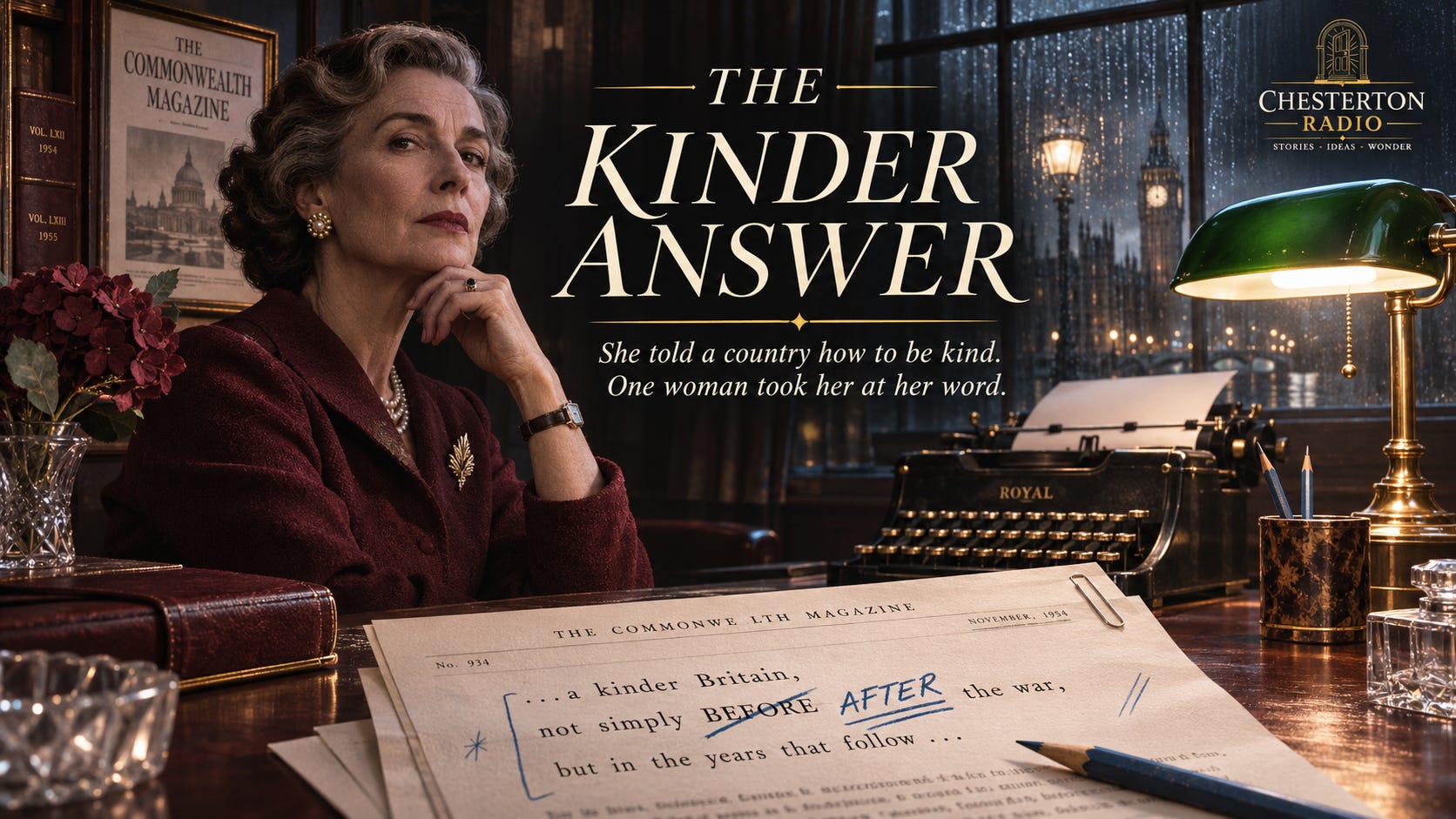
A Note from Chesterton Radio
The most frightening words in the English language are not always threats. Sometimes they are perfectly reasonable advice.
In London, 1954, Vivienne Selby has made a celebrated career of telling other people the proper thing to do. She is intelligent, sophisticated, wonderfully articulate—and accustomed to being right.
Then a young woman arrives with an old newspaper clipping and a question that cannot be answered politely.
The Kinder Answer is an original psychological mystery from Chesterton Radio Original Saturday Night Theatre, drawing upon two remarkable dramatic traditions: the quietly accumulating terror of Arch Oboler and the glittering wit, social sophistication, and devastating observations of Noël Coward.
After the story listen to our Deep Dive Podcast
Oboler understood how ordinary human behavior could become profoundly disturbing. Coward understood how exquisitely civilized people could conceal almost anything behind good manners.
This story brings those sensibilities together in a mystery about truth, conscience, and the terrible consequences of being reasonable.
A word of advice before you begin:
Pay attention to the little things. Especially the words.
Welcome to Chesterton Radio Original Saturday Night Theatre.
I. A Woman Who Followed Instructions
The trouble with telling other people what to do was that occasionally they did it.
For twenty-seven years Mrs. Vivienne Selby had advised Englishwomen on marriage, divorce, bereavement, money, morals, household servants, difficult mothers-in-law, and the proper treatment of guests who drank too much. Her weekly column, The Reasonable Course, was reprinted in fourteen newspapers and read by considerably more people than attended church.
She was fifty-eight, handsome, beautifully dressed, and possessed of a voice in which almost any instruction could be made to sound like a compliment.
She had never been accused of responsibility for a death. She regarded the distinction as unimportant, as most comfortable people do until the day they find themselves on the wrong side of it.
Her well-ordered life began to come apart at eleven seventeen on a Wednesday morning in November 1954, when her secretary admitted a young woman carrying a brown envelope.
“Mrs. Selby?”
“Occasionally,” said Vivienne, without looking up. “Though I find it less exhausting when people don’t know.”
“My name is Judith Tolland.”
Vivienne’s pen stopped.
It was a small movement, but Miss Audrey Firth, who had worked for her for eleven years, noticed it.
The young woman was perhaps twenty-two. She had dark hair, a narrow face, and a rather inexpensive blue coat whose carefully mended sleeve suggested either poverty or principles. Her gloves were wet from the rain.
“I wrote to you last month,” she said.
“Then you must forgive me. I receive several hundred letters a week. It would be rather alarming if I remembered them all.”
“You didn’t answer.”
“That happens rather more frequently.”
“I wasn’t surprised.”
Judith placed the envelope on the desk.
“My mother wrote to you too. Six years ago.”
There was a brief silence.
Miss Firth took one step toward the door.
“Shall I leave you, Mrs. Selby?”
“No, Audrey. I think you had better stay.”
Judith opened the envelope and withdrew a newspaper cutting, yellowed and carefully flattened.
It was from the issue of The English Companion dated Friday, 22 October 1948.
Vivienne recognized the familiar black border of her column.
THE REASONABLE COURSE
Dear Mrs. Selby,
I am employed in the accounts department of a charitable organization. I have discovered that money entrusted to us is not being used for the purposes for which it was collected. The gentleman responsible has asked me to meet him privately on Saturday evening. He says he can explain everything, but he has also threatened to ruin my reputation if I speak to anyone.
I have certain documents which I believe prove what has happened. I am afraid of what he may do, but I am equally afraid of accusing an innocent man. Should I go to the police first, or give him the opportunity to explain?
Yours faithfully,
A Troubled Employee.
Below it was Vivienne’s reply.
My dear correspondent,
You have mistaken courtesy for an obligation. No civilized person is entitled to demand another’s silence merely to preserve his own reputation.
Go to the police after you speak to him. If his explanation is innocent, it will withstand examination. If it is not, you must place the matter in proper hands.
Do not permit fear to disguise itself as charity.
V.S.
Vivienne read the reply twice.
“Yes,” she said. “I remember this letter.”
“Do you?”
“Not the correspondent, naturally. But the question. It was an unusually serious one.”
“My mother was the correspondent.”
Vivienne folded the paper carefully.
“I see.”
“She went to meet the man on Saturday night.”
“Yes?”
“She was found dead the following morning.”
Miss Firth made a small involuntary sound.
Judith continued.
“They said she fell down a flight of stone stairs. They said the building was badly lit and she’d probably lost her footing. The coroner called it an accident.”
Vivienne looked at her.
“Was it?”
“No.”
“How can you be certain?”
“Because somebody took the papers she was carrying.”
“That might have happened before—”
“And because my mother had been frightened enough to write to you, Mrs. Selby. My mother didn’t frighten easily.”
Vivienne placed the cutting on her blotter.
“I am very sorry for your loss.”
Judith looked at her with extraordinary calm.
“Yes. People generally are.”
The young woman’s fingers tightened around the empty envelope.
“Would you like to know something about my mother?”
“Very much.”
“She was a good bookkeeper. She could add three columns of figures while my father was talking to her, answer a question about the Sunday dinner, and tell me not to put my feet on the furniture. She was not easily impressed. When people told her something was impossible, she generally asked whether they’d tried.”
A faint smile crossed her face.
“She used to say that there were two sorts of trouble in the world: trouble you caused yourself and trouble you were handed. You had to take responsibility for the first, but there was no reason to be polite about the second.”
Vivienne said nothing.
“She believed in you.”
“Miss Tolland—”
“She thought you were wise. She read you every Friday. She cut out your answers and kept them in a little blue book. Whenever Father said the newspaper was rubbish, she told him that he’d never had a woman explain anything to him properly.”
Judith’s smile disappeared.
“On that particular Friday, she showed me the paper at breakfast. She said you were quite right. She said it would be unfair to go to the police without giving the gentleman a chance.”
Vivienne stared at the clipping.
“She went to meet him?”
“Yes.”
“Did anyone know where?”
“No. She wouldn’t tell us. She said a person deserved the opportunity to explain.”
Judith paused.
“Those were her last words to me.”
The rain tapped against the windows.
Below, in the street, a motor horn sounded and a bus changed gear with an exasperated metallic growl.
The ordinary sounds of London seemed suddenly impertinent.
“Why have you come to me now?” Vivienne asked.
Judith opened the brown envelope again.
For a moment Vivienne thought she was about to produce another document. Instead the young woman merely straightened the contents and closed it.
“Because I have discovered something about that answer.”
“What?”
“That it wasn’t the answer you wrote.”
Vivienne did not move.
Miss Firth looked up sharply.
“That’s a serious allegation,” she said.
“I know.”
“Six years is rather a long time to establish a printing error.”
“Yes,” said Judith. “It is.”
Vivienne leaned back.
“What makes you believe the answer was changed?”
“Someone who worked at the printing office has been going through his old papers. He remembered the case when he heard my name. He found something.”
“What did he find?”
“An old proof.”
Vivienne extended her hand.
“Have you brought it?”
“No.”
“Then where is it?”
“Somewhere safe.”
Judith stood.
“I didn’t come to accuse you of killing my mother, Mrs. Selby.”
“That’s reassuring.”
“I came to ask you a question.”
“And what is that?”
Judith looked directly at her.
“Why did you tell my mother to see the man before she went to the police?”
For the first time in twenty-seven years, Vivienne Selby could think of no satisfactory answer.
II. The Reasonable Course
The offices of The English Companion occupied the upper three floors of a narrow building in Bloomsbury.
The magazine had been founded in 1923 with the stated intention of improving the lives of English families. In the succeeding thirty-one years it had published advice on practically every aspect of domestic existence except how to pay for it.
Vivienne had written for the magazine since its third issue.
Her column was its principal attraction. She knew this, the editor knew it, and the proprietors had been reminded of it so frequently that they no longer regarded the information as personal.
Her office overlooked a small garden where the shrubs had been arranged by someone who believed that nature would behave better if properly supervised.
Everything inside the room was orderly.
There were two comfortable armchairs, a Georgian desk, an enormous filing cabinet, a portrait of Vivienne’s late husband, and a porcelain bowl in which she kept unanswered invitations.
The bowl was always full.
Miss Firth’s desk occupied the adjoining room.
Audrey was forty-three, unmarried, and so discreet that people had occasionally forgotten her presence while making remarks they would have preferred not to preserve for posterity.
She had heard almost everything.
She had forgiven rather less.
After Judith departed, she came into Vivienne’s office carrying the morning correspondence.
“You remembered the girl immediately,” she said.
Vivienne was standing at the window.
“I remembered the surname.”
“You weren’t surprised when she mentioned her mother.”
“No.”
“Why?”
Vivienne turned.
“Because her mother died under rather unhappy circumstances.”
“You never spoke about it.”
“There are a great many unhappy circumstances I don’t speak about, Audrey. It makes conversation possible.”
Audrey placed the letters on the desk.
“Would you like me to find the original manuscript?”
“Yes.”
“Will the office still have it?”
“If we’re fortunate.”
“And if we’re not?”
“Then we shall have to depend upon human memory, which is the most unreliable thing in the world after human gratitude.”
Audrey made no reply.
Vivienne sat down and examined the clipping again.
Go to the police after you speak to him.
It was the word after that troubled her.
Not because it was an impossible recommendation.
Under certain circumstances, hearing another person’s explanation before making an accusation might be quite sensible.
What troubled her was the phrasing.
She would ordinarily have written before.
She knew this with the confidence of a pianist recognizing a wrong note in a familiar piece.
The sentence did not sound quite like her.
She had always held that advice should reduce danger rather than merely organize it. That, at least, was how she described her professional principles. As she held the clipping she remembered a hurried conversation with Hugh, six years earlier, about a correction to a dangerous letter. She had called the concession editorial discretion. She could remember saying the phrase aloud. The word itself was not unfamiliar; it was simply one she had never permitted herself to examine.
She reached for her pencil.
It was violet, not blue, and had been sharpened to a point so fine that it was practically malicious.
Without thinking, she crossed out the word after and wrote before above it.
Then she stared at the alteration.
The door opened.
“Ah, Vivienne.”
Hugh Latham entered without waiting to be invited.
He was editor-in-chief of The English Companion, a tall, pleasantly rumpled man in his late fifties, with silver hair, a large nose, and an expression of perpetual mild concern which had served him excellently in business.
He had the gift of making disagreement sound like a social embarrassment.
“My dear, Audrey tells me you’ve had a visitor.”
“Does she?”
“A rather unhappy young woman.”
“Yes.”
“How trying.”
“For her, certainly.”
Hugh settled himself in an armchair.
“These things do return to trouble us, don’t they? Especially the things one has absolutely forgotten.”
“Have you forgotten Agnes Tolland?”
The editor’s expression remained pleasant.
“Should I remember her?”
“She was employed by the Children’s Winter Fund.”
“Good heavens. Was she?”
“She discovered irregularities in the accounts.”
“Did she?”
“And died.”
Hugh removed his spectacles.
“I do remember something about it now. A fall, wasn’t it? Terrible business.”
“She had written to my column.”
“Yes?”
“The young woman claims the answer was altered in proof.”
Hugh’s spectacles stopped halfway to their case.
“Really?”
“Apparently.”
“Well, that’s easily settled. Have Audrey fetch the manuscript.”
“She’s looking.”
“Excellent.”
He stood.
“Though I do hope we aren’t going to encourage a lawsuit. The families of unhappy people frequently find that someone must be held responsible, and newspapers have such wonderfully visible pockets.”
Vivienne looked at him.
“Do you remember the Children’s Winter Fund, Hugh?”
“Of course.”
“You were treasurer.”
“Joint treasurer.”
“And I was chairman.”
“Chairwoman, if you prefer.”
“I don’t.”
He smiled.
“Of course not.”
“Do you remember the financial difficulties?”
“Which ones?”
“The magazine’s.”
“Ah.”
Hugh looked toward the window.
“That unfortunate winter. Everything was short. Paper. Advertising. Money. Optimism. We almost went under.”
“But we didn’t.”
“No. Thanks largely to you.”
“And the fund.”
For the first time his smile faltered.
“Yes. The fund was most helpful.”
“Was it?”
“My dear Vivienne, I hope you’re not suggesting that we somehow misused charitable money.”
“I’m asking what happened to it.”
“It was repaid.”
“All of it?”
“As far as I remember.”
“As far as you remember.”
He put his spectacles back on.
“You’re being rather prosecutorial. It’s a most unattractive quality in women who aren’t employed by the Crown.”
“Then you must find me unattractive.”
“I never have.”
“You’re becoming careless, Hugh.”
He laughed.
“One must take risks.”
He reached for his hat.
“Don’t be distressed by the girl. Her mother’s death was a tragedy, but it is hardly reasonable to blame an advice column for an accident on a staircase.”
He paused at the door.
“After all, you didn’t send the poor woman there personally.”
When he had gone, Vivienne remained motionless for some time.
Then she called Audrey.
“Find everything from October 1948.”
“Everything?”
“All the correspondence. The proofs. The accounts of the Children’s Winter Fund. Whatever remains.”
“That may take a while.”
“Then begin with the letter.”
Audrey hesitated.
“Mrs. Selby?”
“Yes?”
“Do you think someone deliberately changed your advice?”
Vivienne looked down at the newspaper cutting.
“I think,” she said, “that a great many things which are called mistakes turn out to have been rather carefully arranged.”
III. A Matter of Proof
At four o’clock Audrey appeared with two cardboard folders, a box of old correspondence, and the air of a woman who had spent the afternoon extracting fossils with a teaspoon.
“I’ve found it.”
Vivienne looked up.
“The original?”
“Your original.”
She placed a sheet of yellowing typing paper on the desk.
It was the manuscript submitted to the printer in October 1948.
Across the bottom, in Vivienne’s small, elegant handwriting, were the initials V.S.
Vivienne read the reply.
You have mistaken courtesy for an obligation. No civilized person is entitled to demand another’s silence merely to preserve his own reputation.
Go to the police before you speak to him. If his explanation is innocent, it will withstand examination. If it is not, you must place the matter in proper hands.
Do not permit fear to disguise itself as charity.
There it was.
Before.
She looked up.
“Well.”
Audrey nodded.
“The girl was right.”
“Yes.”
“Shall I telephone her?”
“Not yet.”
“Why?”
“Because I should like to know how an extraordinarily important word became an extraordinarily dangerous one.”
Audrey opened the second folder.
“I found the printing schedule. The reply was typeset on Wednesday the twentieth. The first proof was returned on Thursday morning. Final approval was given at half past three that afternoon.”
“Who gave it?”
“The office.”
“That isn’t a person.”
“No. Unfortunately.”
“Who was responsible for corrections?”
“Hugh, officially. You, when there was something you wished to change. I handled correspondence but didn’t generally see the galley proofs.”
“And the printer?”
“Mr. Sayer was the composing-room foreman.”
“Is he still there?”
“He retired three years ago.”
“Can we find him?”
“He’s living in Southend. I have the address.”
Vivienne sat back.
“A person changes a word in my advice. A woman follows the changed advice and dies. Six years later someone finds the proof.”
“It could still have been an accident.”
“Of course.”
“But you don’t believe that.”
Vivienne looked at her.
“I haven’t decided what I believe.”
Audrey closed the folder.
“Mrs. Selby, you will have to be very careful.”
“Why?”
“Because if someone deliberately changed that word, they must have had a reason.”
“Presumably.”
“And if they had a reason, they may not be pleased to have it discovered.”
Vivienne smiled faintly.
“My dear Audrey, if I had confined myself to pleasing people, I should still be writing recipes for mock goose.”
“I wasn’t speaking professionally.”
“I know.”
Audrey looked toward the window.
“Neither was I.”
At half past five Vivienne telephoned Hugh Latham.
He was still in his office.
“My dear,” he said, “have we solved the tragedy?”
“We’ve confirmed that the printed answer was wrong.”
“How unfortunate.”
“The manuscript says before. The published column says after.”
“A compositor’s error.”
“Possibly.”
“Obviously.”
“An interesting distinction.”
“Vivienne, do let’s be practical. Six years ago somebody set the wrong word. It happens. We can print a correction, express sympathy to the family, and bring the matter to a civilized conclusion.”
“Can we?”
“Certainly.”
“Will it bring Agnes Tolland back?”
There was a pause.
“That isn’t fair.”
“No,” said Vivienne. “It isn’t.”
She replaced the receiver.
Outside, the rain had stopped.
London was becoming a collection of yellow windows and dark pavements.
Vivienne remained at her desk until the other offices closed.
She read the original letter three times.
On the fourth reading she noticed something she had overlooked.
The woman had written:
The gentleman responsible has asked me to meet him privately on Saturday evening.
Not a husband.
Not a lover.
Not a relative.
The letter gave no name.
But it did give a profession.
I am employed in the accounts department of a charitable organization.
She had known several charitable organizations in October 1948.
Only one had occupied a large portion of her thoughts.
The Children’s Winter Fund.
She stood and went to the filing cabinet.
The drawers contained more than twenty years of correspondence, arranged alphabetically by subject.
She opened the section marked CHARITIES.
The folder for 1948 was missing.
She searched the adjacent files.
Nothing.
She went to Audrey’s room.
The secretary’s desk had been cleared for the evening. The filing drawers were locked, as they always were.
Vivienne returned to her own office.
The folders she had been examining were exactly where she had left them.
Except for one thing.
On the desk lay the newspaper cutting Judith Tolland had brought that morning.
Vivienne had corrected it in violet pencil.
After had been crossed out.
Before had been inserted.
But now someone had crossed out before.
Very neatly.
In blue pencil.
Beneath the alteration, in small block capitals, were four words.
LEAVE IT AS IT WAS.
For several seconds Vivienne Selby stood without moving.
Then, rather to her surprise, she laughed.
It was a short and entirely humorless sound.
“Really,” she said into the empty room.
“How very rude.”
IV. The People Who Must Be Protected
Lady Fenella Carr believed that charity began at home, preferably in somebody else’s.
She was sixty-seven, immensely wealthy, twice widowed, and in possession of a face whose expression suggested that the entire twentieth century had been an unnecessary experiment.
Her house in Eaton Square was furnished in the style of a person who had bought everything she liked and nothing she needed.
Vivienne found her at luncheon the following day, addressing a small plate of poached sole with visible disappointment.
“My dear Vivienne. You look dreadful.”
“Thank you.”
“Not a bit. I’ve always said one can trust a woman who looks dreadful. Beauty is frequently an alibi.”
“I need to ask you about the Children’s Winter Fund.”
Lady Fenella lowered her fork.
“Good heavens. Are we raising money again?”
“No.”
“How refreshing.”
“I want to know what happened in 1948.”
“Something happened every day in 1948. It was an exceptionally tiresome year.”
“The fund made loans to The English Companion.”
“Oh, that.”
“You remember?”
“Of course. Hugh wanted money. You wanted to save the magazine. I wanted you to stop talking about both. So I agreed.”
“The money belonged to children.”
“Yes, dear. And the magazine was full of articles explaining how to bring them up. I thought it rather appropriate.”
“Did you read the accounts?”
“No.”
“Why not?”
“Because Hugh assured me they were perfectly sound.”
“And that satisfied you?”
Lady Fenella looked at her.
“Vivienne, I have survived two husbands, three governments, and a nephew who wished to become a poet. One cannot examine every assertion.”
“The money may have been stolen.”
“Then one should certainly examine that assertion.”
Vivienne took out her notebook.
“How much do you remember?”
“Two thousand pounds, I think. Possibly more. It was supposed to be a short loan. The magazine had suffered from the shortage of paper and an unfortunate decline in advertisements.”
“Who signed the authorization?”
“You did. Hugh arranged it.”
“And you?”
“I signed the committee minutes. Somebody had to make everything look respectable.”
Vivienne looked at her.
“Do you realize what you’ve just said?”
“Frequently. It is a most exhausting habit.”
For several moments neither woman spoke.
Then Lady Fenella put down her fork.
“You’re investigating the Tolland affair, aren’t you?”
Vivienne looked up.
“What do you know about it?”
“A great deal more than I have ever wished to.”
“Then tell me.”
“Agnes Tolland was our bookkeeper. Not particularly fashionable, but exceptionally competent. She once discovered that a supplier had charged us for blankets which were never delivered. She pursued the poor man with such ferocity that he returned the money, apologized, and subsequently went into the poultry business.”
“Did she discover anything else?”
“Apparently.”
“What?”
“Hugh said she’d become suspicious of the accounts. He thought she was making trouble.”
“Was she?”
“That depends what the accounts contained.”
“Did you dismiss her?”
“No. She was still employed when she died.”
“Who last spoke to her?”
“Hugh, I imagine.”
“Why?”
“Because she wanted to meet the treasurer.”
Vivienne studied her.
“Where were you on the Saturday evening she died?”
Lady Fenella looked genuinely startled.
“At the theatre.”
“With whom?”
“Hugh.”
“What did you see?”
“A dreadful little comedy about a young man pretending to be his own brother. Half the audience understood it, but nobody laughed. Theatre managers were extraordinarily optimistic in those days.”
“Was Hugh with you throughout the performance?”
Lady Fenella lifted her wineglass.
“My dear, one does not keep minutes of a theatrical evening.”
“Fenella.”
“Yes?”
“Was he?”
The older woman looked at the tablecloth.
“Do you remember every moment of every evening you spent in a theatre six years ago?”
“No.”
“Then neither do I.”
Vivienne waited.
Lady Fenella sighed.
“You are becoming extraordinarily unpleasant.”
“I’m told it improves with practice.”
“Hugh met me at the theatre. That is what I told the police when they asked. It was perfectly true.”
“Was he there when the curtain went up?”
“I don’t recall.”
“Was he there for the first act?”
Lady Fenella smiled faintly.
“Hugh has always been very dependable for the second half of anything.”
It was said lightly, almost affectionately.
Vivienne wrote it down.
“Did you tell the police that?”
“No.”
“Why not?”
“Because they didn’t ask.”
“Would you have told them if they had?”
Lady Fenella looked at her.
After a while she said:
“I don’t know.”
The admission cost her more than any of the jokes.
Vivienne closed the notebook.
“Fenella, did you like Agnes Tolland?”
“I barely knew her.”
“Then why are you upset?”
Lady Fenella looked toward the window.
“She had a little girl.”
“Judith.”
“Yes. I met her once. Agnes brought her to the office during the school holidays. The child had lost a button, and her mother sewed it back on while reading a balance sheet.”
She paused.
“I remember thinking it a rather vulgar thing to do in front of visitors. I was chiefly concerned that the child might drop a needle on the carpet.”
Vivienne said nothing.
“The girl thanked me when I gave her a biscuit.”
Lady Fenella looked down at her hands.
“Agnes made her thank me. Even though I’d done nothing in particular.”
She picked up her fork again.
“One has so many opportunities to be kind, Vivienne. It’s astonishing how often one settles for being agreeable.”
V. Saturday at Nine
The Westbourne Institute occupied a substantial Victorian building near the western edge of London.
It had been constructed in the confident belief that every social problem could be remedied by lectures, improving literature, and sufficient quantities of polished mahogany.
Its library was on the first floor.
The main staircase was broad and impressive, with a marble landing and portraits of dead benefactors.
A narrow service staircase ran behind the library, connecting the upper committee rooms to a small passage on the ground floor.
It was at the bottom of those stairs that Agnes Tolland had been found.
Vivienne visited the Institute on Friday morning with Judith.
The young woman had agreed to meet her at the entrance, though she made it clear that agreement should not be mistaken for forgiveness.
“I haven’t asked for that,” Vivienne said.
“I know.”
“You’re remarkably economical with your opinions.”
“My mother used to say opinions were most valuable before they were given away.”
They entered the building.
A caretaker named Mrs. Hobbs admitted them. She had worked at the Institute for nearly thirty years and retained an instinctive suspicion of anyone who asked to see a room without first explaining why.
When Vivienne mentioned Agnes Tolland, the woman’s expression changed.
“Poor soul.”
“You remember her?”
“Very well.”
“Did you find her?”
“My husband did. He was caretaker then. He’s been dead four years.”
“I’m sorry.”
Mrs. Hobbs shrugged.
“He had a good life. Better than he deserved on certain Thursdays.”
She led them upstairs.
The library was a long, high-ceilinged room filled with heavy books and green leather chairs. The windows overlooked a courtyard. At one end stood a large committee table, scarred by decades of pens and committee decisions.
“Mrs. Tolland came here often,” the caretaker said. “For meetings of the fund. She knew the place.”
“Was she expected that Saturday?”
“No meeting was scheduled.”
“Was anyone else in the building?”
“Not officially.”
“What does that mean?”
Mrs. Hobbs hesitated.
“My husband went home at eight on Saturdays. I did the final round. There was a key for the committee members who sometimes worked late.”
“Who had it?”
“The secretary and the treasurer. The chairman too, if I remember.”
Vivienne looked at Judith.
“Your mother didn’t have a key?”
“No.”
“Then how did she get in?”
“Someone must have let her in,” said Mrs. Hobbs.
She spoke as though the observation had only now occurred to her.
“Did the police ask that?” Judith demanded.
“They asked whether the doors were locked when my husband found her.”
“And were they?”
“The front doors were locked. He opened them with his key in the morning. The side entrance was locked too.”
They went through a narrow passage to the service staircase.
It was steep and badly lit by a single bare bulb.
At the bottom, beside a painted door, was a small recess containing a broom cupboard.
Mrs. Hobbs stopped.
“Here.”
No one spoke for a moment.
Judith stood looking at the floor.
Vivienne knew that the young woman had not been allowed to see the place when her mother died. Now she was seeing it for the first time.
There was nothing remarkable about the stairs.
The treads were stone. The iron handrail was cold. A small patch of discoloration remained on the plaster where something had once been repaired.
It was an ordinary place.
This seemed somehow worse.
Vivienne climbed halfway up.
“Where does that door lead?”
“To the back passage, madam.”
“Can one leave the building from there?”
Mrs. Hobbs shook her head.
“Not without a key. The outside door was always kept bolted after six. The committee knew that. Anyone with a key to the main building could draw the bolt back from inside, of course.”
“Was the service staircase used by visitors?”
“Not ordinarily. There’s the main staircase.”
“Did Mrs. Tolland know about the bolted door?”
“Of course. She’d worked here for more than a year.”
Vivienne looked at the lower landing.
“Then why would she come down this way?”
Mrs. Hobbs had no answer.
Judith went to the bottom of the staircase.
“My mother was found here?”
“Yes, miss.”
“Facing which way?”
Mrs. Hobbs looked distressed.
“I don’t know whether—”
“Please.”
The caretaker pointed.
“Her head was toward the door. Her bag had fallen under the bottom step.”
“Was it open?”
“Yes.”
“What was inside?”
“Her purse. Gloves. Some papers. Nothing particularly valuable.”
“Did she have a large brown envelope?”
Mrs. Hobbs thought.
“I don’t recall one.”
Judith looked at Vivienne.
“She took one when she left the house. It contained the accounts.”
“How do you know?”
“She showed it to my father before she went.”
Vivienne went to the bottom of the stairs and examined the little passage.
The wall had been repainted twice since 1948.
The door had acquired a new lock.
The original accident was six years old.
There was no blood to examine, no footprint to measure, no broken object waiting obligingly to be discovered.
Only a narrow staircase.
A locked door.
And a very simple question.
“Mrs. Hobbs,” Vivienne said, “if somebody were leaving the committee room after an evening meeting, how would they normally go out?”
“The main stairs. The front door.”
“And if they were frightened?”
The caretaker looked at her.
“Depends what they were frightened of.”
“Suppose they wished to get away from another person.”
Mrs. Hobbs glanced up the staircase.
“They might come down here. If they weren’t thinking.”
“But the door at the end would be locked.”
“Yes.”
“So they’d find themselves trapped.”
The old woman stared at her.
Then she said something Vivienne would remember for the rest of her life.
“Of course, madam. That’s what I told my husband.”
“When?”
“On the morning he found her.”
“What did he say?”
“He said she’d probably lost her way.”
“And you?”
“I said Agnes Tolland never lost her way.”
The caretaker looked toward the stairs.
“She knew where everything was in this building. She even knew where we’d hidden the good cups. That was why I never understood the police saying she had wandered into the wrong passage. She couldn’t have wandered anywhere in this building by accident.”
Judith sat down on the bottom step.
She began to cry.
Vivienne did not approach her.
She stood beside the locked door and looked up the narrow flight.
For the first time, she could imagine Agnes Tolland there.
Not as a woman who had fallen.
As a woman who had run.
VI. The Printer’s Widow
Thomas Sayer had been a printer for forty-six years.
He had married twice, raised four children, survived the Blitz, and lost the hearing in his left ear when a composing-room apprentice dropped a metal tray beside him.
He now lived in Southend in a narrow house containing three clocks, two cats, and a wife who expressed considerable skepticism about his former profession.
“Newspapers,” Mrs. Sayer declared, admitting Vivienne the following Monday, “are what happen when people discover they can get paid for talking.”
Tom was seated by the fire.
He had large hands, a crooked nose, and the solemn manner of a man who had spent his working life observing errors which nobody else wished to acknowledge.
“So you’re Mrs. Selby,” he said.
“Yes.”
“Used to set your column.”
“I hope I didn’t give you too much trouble.”
“More than most.”
“How unfortunate.”
“Not the writing. The corrections.”
“Really?”
“You’d change a word after we’d made up the page. Sometimes just one. Before, after, may, must. Small things. Most writers alter the adjectives. You altered what people were to do.”
Vivienne looked at him.
“That seems a rather severe criticism.”
“Wasn’t criticism. Made me careful.”
Mrs. Sayer brought tea.
“Tom’s still careful,” she said. “Takes him fifteen minutes to butter a piece of bread.”
Her husband ignored her.
“Your young lady came to see me last month.”
“Judith Tolland?”
“Yes. Fine girl.”
“She said you had found an old proof.”
“Two, actually.”
He reached for a cardboard envelope.
“I kept a duplicate of the final page. There was a dispute about a correction. Nothing to do with the death, as far as we knew then.”
He laid two sheets on the table.
The first was a printer’s proof containing Vivienne’s complete column.
The second was a correction sheet.
Vivienne leaned forward.
On the first sheet the disputed sentence read:
Go to the police before you speak to him.
The word before had been crossed out in blue pencil.
Above it was written:
after.
On the second sheet were the compositor’s instructions.
PAGE 14, COLUMN 3.
ALTER BEFORE TO AFTER.
Beneath the instruction was a small violet mark.
V.S.
Vivienne stared at it.
Tom watched her.
“That’s your approval, isn’t it?”
She did not answer immediately.
Mrs. Sayer began collecting cups.
“Tom, don’t badger the lady.”
“I’m not badgering. I’m asking.”
Vivienne looked at the violet initials.
“Yes,” she said.
“Thought so.”
“Was this the final correction?”
“Yes.”
“Who brought it to you?”
“Mr. Latham’s messenger. From the editorial office.”
“Did you ever speak to Mr. Latham about it?”
“He telephoned that afternoon. Told me the change was urgent. Wanted to make certain the word was altered. The blue was his office’s mark. Your violet initials confirmed it was authorized. I wasn’t in the business of guessing which of you meant what.”
“Did he say why?”
“No.”
“Did he say who requested it?”
Tom shook his head.
“Not in so many words.”
Vivienne looked down.
“Why did you keep the proof?”
“There was a dispute the following week. Mr. Latham said the printer had made a serious mistake. He wanted the alteration corrected in the next issue.”
“What happened?”
“Nothing.”
“Nothing?”
“He changed his mind. Told us to leave it.”
“Why?”
“He said you had decided against publishing a correction.”
Vivienne’s hand moved toward her handbag.
She stopped it.
Tom noticed.
He looked at her for a long moment.
“Mrs. Selby, I don’t suppose you remember every correction you made six years ago.”
“No.”
“But you remember this one.”
It was not a question.
The old man’s wife stood quietly by the fireplace.
Vivienne folded her hands.
“Mr. Sayer, did you tell Judith Tolland about my initials?”
“Yes.”
“And did you give her a copy?”
“Yes.”
“Why?”
Tom looked surprised.
“Because she asked.”
“You didn’t think to consult me?”
“About a proof?”
“About a matter that might affect my reputation.”
Mrs. Sayer put down the teapot with a small, decisive sound.
“Madam,” she said, “the girl’s mother is dead.”
Vivienne looked at her.
The older woman continued.
“Your reputation seems a comfortable thing to have. I don’t suppose it will suffer very much from being examined.”
The room became quiet.
Then Tom cleared his throat.
“There’s something else.”
He searched the envelope and withdrew a small slip of paper.
“Mr. Latham sent a message the day after the correction. He wanted to know whether the discarded proof had been destroyed.”
“Had it?”
“No. We kept our waste until the end of the week.”
“What did you tell him?”
“That it had been.”
Vivienne looked up.
“Why did you lie?”
“Because I didn’t like the question.”
Tom placed the slip beside the proofs.
It was a message from the editorial office, dated Friday, 22 October 1948.
Please confirm destruction of superseded proofs relating to the Children’s Winter Fund correspondence. These contain confidential material.
At the bottom was Hugh Latham’s signature.
Vivienne read it.
“Why haven’t you given this to the police?”
“Nobody asked for it.”
“That doesn’t seem a sufficient reason.”
“No,” said Tom.
He looked toward his wife.
“I’ve come to think that too.”
Outside, a gull cried over the rooftops.
Mrs. Sayer went to the window.
“There’s a good train back at four ten. You’ll want to catch it.”
Vivienne stood.
Tom returned the proofs to their envelope.
“Mrs. Selby, I have no idea who killed Mrs. Tolland. For all I know, the fall really was an accident.”
“Yes.”
“But somebody made that correction deliberately.”
“Yes.”
“And somebody wanted us to forget it.”
Vivienne picked up her gloves.
Tom’s wife opened the door for her.
On the threshold, the old woman said:
“There’s one thing I should tell you, dear.”
Vivienne stopped.
“My husband has regretted not speaking up for six years. He’s a good man, but that doesn’t make the regret any smaller.”
“I understand.”
Mrs. Sayer shook her head.
“No. You don’t.”
She looked at Vivienne with neither malice nor admiration.
“Not yet.”
VII. The Woman in the Photograph
Judith Tolland lived in a small flat above a chemist’s shop near Paddington.
There were two rooms, a kitchenette, a bookcase, and a round table covered with a cloth whose faded roses had probably once been red.
The furniture was inexpensive but clean.
On the mantelpiece stood a photograph of a woman holding the hand of a little girl.
Vivienne recognized Judith immediately.
The woman beside her was perhaps thirty-five, dark-haired, with an open, rather humorous face. She wore a plain summer dress. Her head was tilted toward the child, as though the photographer had interrupted a conversation.
“That’s my mother,” Judith said.
“She was very pretty.”
“She would have been pleased to hear you say that. She thought she looked like a horse.”
Vivienne smiled.
“An agreeable horse, I should imagine.”
“She always said she hadn’t the temperament for beauty. She preferred being useful.”
Judith took the photograph from the mantelpiece.
“It was taken in 1946. Father had bought a camera. He took about forty pictures that summer. Most of them were dreadful.”
She studied the image.
“He used to tell Mother that she couldn’t stand still long enough to be photographed. She told him he should learn to take pictures more quickly.”
She replaced the frame.
“Would you like tea?”
“Very much.”
Judith went into the little kitchen.
Vivienne examined the room.
There were books on bookkeeping, history, and English literature. A sewing machine stood beneath the window. On the table lay several sheets of typing paper covered in a neat, angular hand.
“Are you a secretary?”
“At a solicitor’s office.”
“Do you enjoy it?”
“Some of it.”
“What don’t you enjoy?”
“The part where people expect me to know what they mean instead of what they say.”
Vivienne laughed.
“You should come and work for me.”
Judith returned with two cups.
“I think that would be difficult.”
“Yes,” said Vivienne. “I suppose it would.”
They drank tea.
For some minutes they spoke of ordinary things.
Judith told her that the shop downstairs belonged to a Polish couple who played opera records every Sunday afternoon. She mentioned a friend who was engaged to a young man she disliked, and an elderly solicitor who insisted that carbon copies should be treated with the same solemnity as original wills.
Vivienne found herself liking her.
This made the conversation ahead considerably more difficult.
At last Judith opened a drawer and brought out a small blue notebook.
“My mother kept this.”
It contained dates, entries, figures, and short comments in pencil.
“Her private accounts?”
“Copies of things she was examining at work. She wasn’t supposed to bring the books home, but she was worried something might happen to them.”
Vivienne opened it.
The entries related to the Children’s Winter Fund.
In the early months of 1948, money had been raised for winter clothing, food, bedding, and emergency accommodation for children displaced or orphaned by the war.
There were payments to legitimate suppliers.
Donations from private individuals.
Receipts from fundraising concerts.
Then, in March, two thousand pounds had been transferred to the publishing company which owned The English Companion.
Beside the entry Agnes had written:
Loan approved by V.S. and H.L. Repayment promised within twelve months.
Vivienne stared at her initials.
Judith watched her.
“Is that true?”
“Yes.”
“Why did a children’s charity lend money to a magazine?”
“Because the magazine was in danger of closing.”
“Was that what the charity was for?”
“No.”
“Then why did you do it?”
Vivienne put down the notebook.
“We believed the loan could be made without endangering the children. The fund had sufficient reserves, and the magazine was one of its principal sources of donations.”
“Did you tell the people who contributed?”
“No.”
“Would they have agreed?”
“I don’t know.”
Judith considered this.
“Mother would have asked them.”
“Possibly.”
“She used to say you shouldn’t treat somebody else’s money as a compliment.”
Vivienne looked at her.
“Your mother seems to have been a rather formidable woman.”
“Only when she was right.”
“And when she wasn’t?”
“She became twice as formidable.”
For a moment they both smiled.
Then Judith turned another page.
“There was a second loan.”
Vivienne examined the entry.
Eight hundred and fifty pounds.
The payment was recorded as an emergency purchase of winter bedding for St. Andrew’s Children’s Home.
Beside it Agnes had written:
Home closed 1946. Supplier not known. Invoice number duplicated. No goods received.
Another note followed.
H.L. says error in filing. Requests meeting.
Vivienne read it again.
“Did your mother know that Hugh Latham had authorized the payment?”
“Yes.”
“Did she have the invoice?”
“She had a copy.”
“Where is it?”
“It disappeared with her envelope.”
“Was the original in the fund’s records?”
“Mother thought so.”
“Then there should have been evidence.”
“There was,” Judith said.
“What happened to it?”
“That’s what I’d like to know.”
She opened the notebook to the final page.
The last entry was dated Saturday, 23 October 1948.
Eight twenty. Side entrance. He says he will open it himself. Bring copies. Do not surrender the little book.
On the next line she had written:
I have decided to go.
Beneath it Agnes had written:
If he can explain the money, I shall be glad. If he cannot, I shall have to be brave.
There was no further entry.
Vivienne sat without speaking.
Judith closed the book.
“My father knew she was frightened. He begged her not to go. They had a dreadful argument that afternoon.”
“About the charity?”
“About her work. He thought she’d become obsessed with the missing money. He said people who had money always found ways of explaining why they should keep it.”
“Was he right?”
“Frequently.”
“And what happened after her death?”
“He blamed himself.”
Judith’s voice changed.
“He said that if he’d been a better husband, she’d have stayed home. He said it so often that I think he came to believe it.”
“Where is your father now?”
“He died in 1952.”
“I’m sorry.”
“He worked at the railway workshops. His lungs had never been strong. They said it was pneumonia.”
She looked at the photograph.
“Mother died on a Sunday morning. Father spent the next four years trying to discover what had happened. Every person he asked was very sympathetic.”
Judith folded her hands.
“That was what he couldn’t bear.”
“Sympathy?”
“Yes.”
“Why?”
“Because nobody ever did anything else.”
Vivienne looked at the blue notebook.
“May I borrow this?”
“No.”
“Why not?”
“Because people have been borrowing my mother’s papers for six years. They don’t seem to come back.”
“I only want to examine the entries.”
“You may do that here.”
Vivienne nodded.
“Very sensible.”
Judith looked at her.
“I learned from an expert.”
The words were not unkind.
That made them worse.
Before leaving, Vivienne stood beside the mantelpiece.
She studied the photograph again.
“What was your mother like when she was angry?”
Judith smiled.
“Very quiet.”
“Did she shout?”
“Never.”
“What did she do?”
“She’d look at you. Then she’d ask one question, and if you couldn’t answer it, she’d wait.”
“Wait for what?”
“For you to find a better answer.”
Vivienne looked at the smiling woman in the photograph.
For the first time she understood something about Agnes Tolland which the newspaper reports had failed to convey.
A person like that would not be easily frightened away from an inquiry.
But she might be persuaded to give somebody one last opportunity to tell the truth.
Vivienne knew, with a dreadful certainty, why such a woman would have trusted her advice.
She had spent her entire professional life cultivating precisely that trust.
VIII. The Civilized Explanation
On Tuesday morning Hugh Latham came into Vivienne’s office and closed the door.
He did not smile.
This was sufficiently unusual to be alarming.
“I understand you’ve been to Southend.”
“Yes.”
“And to the Tolland girl’s flat.”
“Yes.”
“And to Westbourne.”
“How industrious.”
“Someone has to be.”
Hugh placed his hat on a chair.
“We must talk.”
“Must we?”
“I’m afraid so.”
He sat down without invitation.
“The business with Agnes Tolland was unfortunate. Everybody knows that. But the woman died six years ago. We cannot change it.”
“No.”
“Nor can we improve the situation by reopening old scandals.”
“What scandals?”
“The charity’s financial arrangements.”
“Arrangements. What a beautiful word.”
“Please don’t be difficult.”
“Then stop being evasive.”
Hugh removed his spectacles.
“Vivienne, the magazine was in desperate circumstances in 1948. If we had closed, hundreds of people would have lost their employment. The charity would have lost its principal public supporter. We made a temporary loan.”
“We?”
“You and I.”
“Yes.”
“And the money was repaid.”
“Most of it.”
He looked at her.
“What do you mean?”
“St. Andrew’s Children’s Home.”
Hugh went completely still.
For several seconds he said nothing.
Then he laughed.
“Good God. That old mistake.”
“Eight hundred and fifty pounds.”
“An accounting error.”
“Agnes Tolland thought it was fraud.”
“Agnes Tolland was an excitable woman.”
“She was a very competent bookkeeper.”
“Competence does not prevent hysteria.”
“Nor does respectability prevent theft.”
Hugh stood.
“You’re speaking recklessly.”
“Then correct me.”
“I have nothing to correct.”
“Where did the money go?”
“To the fund’s normal expenses.”
“Which expenses?”
“I cannot possibly remember every payment made six years ago.”
“Then perhaps the records will remind you.”
He looked toward the filing cabinet.
“You won’t find anything useful there.”
“How do you know?”
“Because old accounts are frequently destroyed.”
“Are they?”
“Yes.”
“The fund’s 1948 folder has disappeared from my office.”
“Then Audrey has mislaid it.”
Vivienne watched him.
“Someone came here last Wednesday evening.”
“Did they?”
“They left a message.”
“What sort of message?”
“Rather an unpleasant one.”
Hugh said nothing.
“Written in blue pencil,” Vivienne continued. “Across a newspaper cutting. It said to leave the answer as it was.”
“Perhaps someone was trying to protect you.”
“From whom?”
“From yourself, apparently.”
For the first time, something ugly entered his voice.
Vivienne had known Hugh for nearly thirty years. He was vain, capable, occasionally dishonest in trivial matters, and unusually skilled at persuading others that his self-interest was their moral duty.
She had always believed his weaknesses were manageable.
Now she looked at him and wondered when she had first begun calling cowardice prudence simply because he expressed it pleasantly.
“Hugh, did you go to the Westbourne Institute on the night Agnes died?”
“No.”
“Lady Fenella says you joined her at the theatre.”
“Yes.”
“Was that before or after the first act?”
He looked at her.
“What’s the difference?”
“Several people at Westbourne seem to have found the difference between before and after rather important.”
Hugh stood very still.
Then he picked up his hat.
“You should be careful, Vivienne.”
“Of what?”
“Of discovering that your recollection is not as innocent as you’d like it to be.”
He went to the door.
“One last thing.”
She waited.
“The Tolland girl has been asking questions all over London. She seems determined to destroy what her mother died trying to protect.”
“Her mother was trying to protect a children’s charity.”
“Precisely.”
He opened the door.
“Think of the children, Vivienne.”
When he had gone, she sat at her desk for a long time.
Then she summoned Audrey.
“I want you to tell me something about October 1948.”
“Of course.”
“The final proof. The one in which before was changed to after.”
Audrey’s expression changed.
“Yes?”
“Did I see it?”
The secretary said nothing.
“Audrey?”
“You signed it.”
“I know that.”
“Then you saw it.”
“Did I know why the word had been changed?”
Audrey looked at her with an expression Vivienne had never seen before.
It was pity.
“Mrs. Selby, I wasn’t present when you spoke to Mr. Latham.”
“What conversation?”
“On the Thursday afternoon. He came to your room carrying the proof.”
Vivienne looked down. She had remembered the signing from the moment Judith had shown her the newspaper. What she had refused to remember was how deliberately she had done it.
Hugh had come into the room smelling of wet wool and brought the proof to her desk. Earlier that day he had telephoned to say that Agnes Tolland was threatening to approach the police about an accounting discrepancy. He had not called it an accusation of theft. He had called it an embarrassing misunderstanding that could destroy the fund before it could be corrected.
One conversation. That’s all. Give me one conversation with her before she goes to the police.
Vivienne had asked whether the books would bear inspection. Hugh had said they would, once his temporary rearrangement of funds was properly entered. She had accepted this without requiring a bank statement. He was her friend; an accountant was, to her, merely an accountant.
He had spoken of the children, the magazine’s employees, the reputations of innocent trustees. She had furnished the arguments herself after the first few sentences. That was the part she had never forgotten and never admitted.
On the proof the word before was struck through in blue. Above it appeared after. Hugh offered her the violet pencil, and she signed. She had examined the difference. She had known that a frightened woman would be told to meet her adversary before securing the protection of the police. She had agreed because she did not want the books examined that week.
It isn’t dishonest, Hugh had said. It’s simply a question of order.
She had repeated those words afterward whenever the death returned to mind. They had been useful. So useful that gradually they had taken the place of the memory itself.
Audrey was still standing beside the desk. Vivienne looked up.
“I remember what I agreed to,” she said. “The difficulty is that I have been pretending not to understand it.”
The secretary waited.
“Did you know?” Vivienne asked.
“That the advice had been changed?”
“Yes.”
“I knew the correction had been made. I didn’t know why.”
“Why didn’t you ask me?”
Audrey’s face hardened.
“Because you were my employer.”
Vivienne stared.
“That isn’t a reason.”
“It’s been a reason for a great many things.”
The secretary turned toward the door.
“Audrey.”
She stopped.
“What do you think of me?”
Audrey looked back.
For a long moment she said nothing.
Then she answered.
“I think you have spent twenty-seven years telling other people to do what you find it very difficult to do yourself.”
She left the room.
Vivienne remained at her desk.
The rain began again.
IX. An Excellent Alibi
Lady Fenella Carr received the news that Hugh Latham might have murdered someone with the expression of a woman being informed that a familiar brand of jam had been withdrawn from sale.
“How extremely inconvenient.”
“Fenella.”
“I know, dear. I know.”
They were sitting in her drawing room on Tuesday afternoon.
Vivienne had come directly from the magazine offices.
“I need you to tell me exactly what happened at the theatre on 23 October 1948.”
Lady Fenella sighed.
“I’ve already told you what I remember.”
“Not everything.”
“No.”
“Then the rest.”
The older woman looked toward the portrait of her second husband, a distinguished politician whose chief contribution to public life had been to demonstrate that an impressive voice could conceal an astonishing absence of thought.
“Charles,” she said, indicating the portrait, “once told me that a gentleman should never be obliged to account for his movements in the presence of a lady.”
“Was that before or after you discovered his second household?”
“During. He was extremely consistent.”
Vivienne waited.
Lady Fenella folded her hands.
“Very well. Hugh and I had arranged to attend the theatre that Saturday. He telephoned shortly before dinner to say he might be late.”
“Did he give a reason?”
“Some difficulty at the Institute.”
“What sort of difficulty?”
“Accounts, I think. He said a tiresome woman was making accusations.”
“Agnes Tolland.”
“Presumably.”
“Did you understand she was going to meet him?”
“Not specifically.”
“What happened?”
“I went to the theatre alone. Hugh arrived during the interval.”
“What time?”
“About twenty minutes to ten.”
“Was he agitated?”
“He was out of breath.”
“Did he explain why?”
“He said he’d had difficulty finding a taxi.”
“What was he wearing?”
“A dark overcoat. Grey suit. The usual dreadful tie.”
“Anything unusual?”
Lady Fenella hesitated.
“He’d lost his spectacles.”
Vivienne looked up.
“What?”
“His spectacles. He said he’d left them at the office.”
“Did you believe him?”
“Why shouldn’t I?”
“Did he have any injury?”
“He’d cut his hand.”
“How badly?”
“Not very. There was blood on his cuff. He said he’d broken a glass at dinner. Later, during the interval, he asked whether someone might live for hours after falling on stone stairs. I thought it an oddly medical question for a man who had just arrived late for a comic play.”
“Did you ask anything else?”
“No.”
“Why not?”
Lady Fenella looked genuinely astonished.
“Vivienne, I’ve already explained. I was at the theatre, not conducting a medical examination.”
“Did the police ask whether he was with you?”
“Yes.”
“What did you tell them?”
“That we’d attended the theatre together.”
“Did you tell them he arrived at the interval?”
“No.”
“Why?”
“Because I wasn’t asked what time he arrived.”
“That is not a serious answer.”
“I know.”
Lady Fenella’s voice changed.
“I knew it at the time.”
She rose and went to the window.
“I’d spent my life among men who behaved badly, Vivienne. Husbands, ministers, bankers, industrialists. If one had insisted upon a complete explanation for every absence and every bloodstain, society would have been impossible.”
She turned.
“So we learned not to ask.”
Vivienne said nothing.
“We called it discretion. An excellent quality. Highly valued. Absolutely essential.”
She looked at the portrait.
“And now I wonder whether discretion is merely the respectable name for refusing to know.”
Vivienne stood.
“Would you be willing to tell this to the police?”
“Yes.”
“Everything?”
“Yes.”
“Even if it damages your reputation?”
Lady Fenella smiled.
“At my age, dear, one is rapidly running out of reputation to damage.”
Then the smile disappeared.
“Do you think he killed her?”
“I think he was at Westbourne shortly before she died. I think he had stolen money from the charity. I think he arranged to meet her after she discovered it. And I think he lied about where he was.”
“That isn’t proof of murder.”
“No.”
“What would be?”
“I don’t know yet.”
Lady Fenella looked toward the fire.
“There’s something you should understand about Hugh.”
“Yes?”
“He never thought of himself as a dishonest man.”
“He stole money.”
“Perhaps. But he had reasons. He always had reasons. The magazine needed funds. A creditor was unreasonable. A payment was temporary. A misleading statement prevented unnecessary distress.”
“You’re describing theft.”
“No, Vivienne. I’m describing the way Hugh explains theft.”
She came closer.
“That is what makes him dangerous.”
Vivienne looked at her.
“He can do something dreadful and still believe the dreadful thing was forced upon him by everybody else’s failure to be reasonable.”
“Do you believe he could kill someone?”
Lady Fenella thought for a moment.
“Not from hatred.”
“Then why?”
“From embarrassment.”
The word was spoken almost contemptuously.
“He could kill a person who stood between him and the life he thought he deserved, provided he could call it an accident afterward.”
Vivienne looked away.
She had spent years defending Hugh to other people.
She had enjoyed his conversation, his loyalty in professional matters, his undemanding companionship.
She had accepted his explanations.
She had repeated them.
She had signed one.
Now she understood that his greatest talent was not persuading people to believe a lie.
It was persuading them that the truth would be unkind.
Lady Fenella took her arm.
“Vivienne, if you’re going to do something about this, do it quickly.”
“Why?”
“Because Hugh knows you’re investigating.”
“I know.”
“And because the Tolland girl is still asking questions.”
“Yes.”
Lady Fenella looked at her.
“Have you considered what he might do if she asks the wrong one?”
X. Another Invitation
The letter arrived on Wednesday morning.
It was addressed to Judith Tolland at her flat in Paddington and written on the cream stationery of The English Companion.
Dear Miss Tolland,
Mrs. Selby has told me of your concerns regarding your mother’s employment and the unfortunate events of October 1948.
I believe that some papers have recently come to light which may help us arrive at a satisfactory understanding.
I should be grateful if you would meet me at the Westbourne Institute at seven o’clock on Thursday evening. I have chosen the location because it is where the original misunderstanding occurred.
I trust that you will appreciate the value of a private discussion before involving outside parties.
Yours sincerely,
Hugh Latham.
Judith read the letter twice.
Then she telephoned Vivienne.
“Mrs. Selby?”
“Yes, Judith.”
“Mr. Latham wants me to meet him.”
Vivienne listened.
When Judith had finished reading the letter, there was a long silence.
“Where are you now?” Vivienne asked.
“At home.”
“Stay there.”
“Why?”
“Because I should very much like to prevent you from doing what your mother did.”
“I wasn’t going to accept.”
“Good.”
“Mrs. Selby?”
“Yes?”
“I thought you’d like to know that he used almost exactly the same words my mother wrote in her notebook.”
“Which words?”
“Private discussion. Satisfactory understanding. Before involving outside parties.”
Vivienne closed her eyes.
There had been no real doubt left in her mind. Only the terrible necessity of proving what she already believed.
“Judith, will you trust me with something?”
“What?”
“The next step.”
The young woman hesitated.
“I don’t know.”
“Neither do I,” Vivienne said. “Which is why I am asking rather than advising.”
Before leaving the office, Vivienne confronted Audrey with the blue-pencil message on the clipping. Audrey looked offended, which was more reassuring than a denial.
“I wrote it,” she said. “You were altering the only copy Miss Tolland had entrusted to us. If you wished to make a correction, you could use another sheet. You could not make the old paper say something it never said.”
“You might have told me.”
“I put it in writing. I thought you’d find that harder to explain away.”
The threatening message had been an instruction to preserve evidence. Vivienne felt, not for the first time, that her instincts were arranged for her comfort.
That afternoon Vivienne visited a solicitor named Arthur Pelling, who had once served on the governing committee of the Children’s Winter Fund.
Pelling was a careful man who spoke slowly, wore extremely polished shoes, and was constitutionally incapable of accepting a conclusion merely because someone important had reached it.
He examined the old proof, Agnes’s notebook entries, the recent correspondence, and Lady Fenella’s account of the theatrical evening.
“You’re suggesting a criminal conspiracy,” he said.
“I believe we’re looking at a theft, a deliberate alteration of a published letter, and a death which may not have been accidental.”
“And you believe Mr. Latham is responsible?”
“Yes.”
“What evidence directly connects him to the death?”
“He had a motive. He had a key to the building. He had an appointment with Agnes. His alibi is false. The papers she intended to use against him disappeared.”
“That would justify further investigation. It does not by itself prove murder.”
“I know.”
“Has he ever admitted being there?”
“No.”
“Then that is one of the questions which must be answered.”
Pelling made several notes.
“Mrs. Selby, before we proceed, there is something you must tell me.”
“Yes?”
“Did you authorize the alteration of the published advice?”
Vivienne looked at him.
“Yes.”
“Did you understand that the alteration would encourage Mrs. Tolland to meet Mr. Latham before consulting the police?”
“Yes.”
“Did you know she had reason to fear him?”
“She said she was afraid.”
“Then why did you authorize it?”
Vivienne looked toward the window.
“I thought the financial difficulty could be resolved privately.”
“That isn’t what I asked.”
“No.”
“Why did you change the advice?”
She considered the question.
At length she answered.
“Because I thought publicity would ruin something I cared about.”
“The magazine?”
“The magazine. The charity. My reputation.”
Pelling laid down his pen.
“Thank you.”
“That doesn’t make me look very well.”
“No.”
“I suppose you must hear a great many dreadful things in your profession.”
“Yes.”
“Do people generally tell them so willingly?”
“No. But they generally feel rather better afterward.”
“Do they?”
“I couldn’t say. They seldom return to thank me.”
He looked at the papers again.
“I can help you arrange for this evidence to be given to the police. But you must understand that your own conduct will also be examined.”
“I understand.”
“Quite publicly.”
“Yes.”
He studied her.
“Then we should begin. The sensible course is to take the originals, with signed statements as to where each was found, to the police. There may be an inquiry into a death, but it won’t be organized by you in a drawing room.”
“You make that sound almost disappointing.”
“It generally is, to people who have read detective stories. Justice, when it arrives, tends to be untidy and late.”
They spent the next hour preparing an account for the police. Vivienne signed her own admission about the corrected proof separately from what she alleged about Hugh. Pelling would not allow her to mingle what she knew with what she suspected.
Before she left, Vivienne asked one further question.
“Mr. Pelling, is it possible to commit a crime by giving advice?”
“Certainly. Depending upon the circumstances.”
“Even if one does not intend the eventual harm?”
“Intention matters. So does knowledge. So does the nature of the act. They are not interchangeable.”
She looked at him.
“And morally?”
He closed the folder.
“I advise people about the law, Mrs. Selby. I’m not sure I’d be competent to give you a satisfactory answer about morality.”
“How refreshing.”
She rose to leave.
At the door, Pelling said:
“There is one thing I can tell you.”
“Yes?”
“An apology is not the same thing as an explanation.”
Vivienne turned.
“No,” she said. “I am beginning to discover that.”
The Ledger
On Thursday morning Audrey arrived at the office unusually early.
She was carrying the old correspondence register.
“Mrs. Selby, I’ve found out who took the charity file.”
Vivienne looked up.
“Who?”
“Mr. Latham.”
“How do you know?”
“There’s a record of it in the office book. He signed for the folder on Wednesday evening, the day Miss Tolland first came to see you.”
“Why didn’t you find it earlier?”
“Because the register had been put away with the closed-year accounts. I wasn’t looking there.”
She showed Vivienne the entry.
Children’s Winter Fund, 1948. Collected by H.L. 5:40 p.m.
“Was he entitled to remove it?”
“He was editor-in-chief.”
“That’s not quite an answer.”
“No,” Audrey said. “It isn’t.”
She placed another sheet on the desk.
“And I found something else.”
It was an old memorandum, written by Hugh on the magazine’s headed paper.
V.—
The Winter Fund auditors have raised the question of the St. Andrew’s payment. Please do not discuss the matter with Mrs. Tolland until I have established the correct position. The funds are secure and will be properly accounted for.
H.
The memorandum was dated Thursday, 21 October 1948.
Vivienne remembered receiving it.
Not the words exactly, but the feeling.
The irritation of being asked to postpone an unpleasant inquiry.
The relief of being offered a reasonable explanation.
The ease with which relief becomes certainty.
“What did you think of this at the time?” she asked Audrey.
“I thought it was strange.”
“Why?”
“Because you were chairman of the fund. If the accounts were in order, there was no reason you shouldn’t discuss them with the bookkeeper.”
“Why didn’t you say so?”
Audrey looked at her.
“I did.”
Vivienne stared.
“When?”
“That afternoon. I said I thought the figures should be checked before any reply went to press.”
Vivienne struggled to remember.
Audrey continued.
“You told me that Mr. Latham understood the accounts better than either of us.”
“And then?”
“You said it would be unfair to damage a good cause because of an accountant’s suspicions.”
Vivienne looked down.
“I said that?”
“Yes.”
Audrey’s voice was very quiet.
“You also said that Agnes Tolland had not seen enough of the world to understand how respectable institutions were kept alive.”
For several moments the two women sat without speaking.
At last Vivienne said:
“Did you believe me?”
“Yes.”
“Why?”
“Because I admired you.”
Audrey looked toward the open door.
“And because I had discovered that it’s much easier to admire people than to disagree with them.”
Vivienne took the memorandum and placed it beside the correction sheet.
Hugh’s assurance.
Her initials.
The altered word.
It was possible now to see precisely how the thing had happened.
Not in a moment of madness.
Not through an extraordinary conspiracy.
Through an ordinary series of reasonable decisions.
Each person doing what seemed best.
Each person accepting the previous person’s explanation.
Each person leaving the final responsibility to someone else.
And at the end of the chain, a woman at a narrow staircase whose direction—up or down—everyone had assumed without asking why.
Vivienne looked at Audrey.
“Will you come with me to the police?”
“Yes.”
“Even if it means telling them what I said?”
“Especially then.”
For the first time that morning, Vivienne smiled.
“You’re becoming very difficult, Audrey.”
“Thank you, Mrs. Selby.”
“It wasn’t intended as a compliment.”
“I know.”
XI. The Narrow Staircase
At a quarter to seven on Thursday evening, Vivienne Selby stood outside the Westbourne Institute and considered the advantages of going home.
There were several. Home was warm, the drinks were good, and her housekeeper had never once stolen money from a children’s charity. There was also the modest but important consideration that Hugh Latham might be dangerous. She had spent thirty years knowing him, which was not quite the same thing as knowing what he might do.
Audrey stood beside her with an umbrella and a face of grave disapproval.
“I don’t like this,” she said.
“Neither do I. We seem to be making progress.”
“Mr. Pelling said not to confront him.”
“Mr. Pelling said not to attempt to obtain a confession. I have no intention of attempting anything so impertinent.”
“Then why are we here?”
Vivienne looked at the staircase visible through the glass of the entrance door. “To understand which direction she was going.”
That afternoon Pelling had accompanied Judith to the police with the surviving printer’s proofs, copies of the entries in Agnes’s notebook, Hugh’s invitation to Judith, and Lady Fenella’s account of the theatre evening. A detective inspector had taken statements and asked them not to discuss the matter with Hugh. Vivienne had already arranged to come to the Institute to examine its committee records with Mrs. Hobbs; the inspector had not forbidden her to do so. Whether that distinction would impress him afterward was a separate question.
Mrs. Hobbs let them in. On a table in the caretaker’s sitting room lay the old daybook, kept by her husband in a tidy hand.
“I couldn’t find it when you came last week,” she said. “It was in his box of papers from before the war. He wrote down everything, including things he didn’t need to.”
The Saturday entry for 23 October 1948 was only four lines long.
8.00 p.m. Mrs. H. final round. Library dark. Side door secured.
Sunday, 7.35 a.m. Mrs. Tolland found at foot of service stairs. Lower door bolted. Library as left. Police called.
Repair top rail bracket and damaged plaster before committee meets.
Vivienne read it twice. She had always preferred the meticulous to the imaginative, a principle which had not prevented her from employing Hugh.
“The library was dark when you left?” she asked.
“Yes, madam. My husband never lit a fire without a meeting on the calendar. I went round at eight, just after my husband had gone back to our rooms.”
“But he went home at eight?”
“To our rooms at the back. We lived in the caretaker’s flat then, just as I do now. Neither of us inspected the place again before Sunday.”
“And the damaged handrail?”
Mrs. Hobbs opened her cupboard and showed them a small, rusty iron bracket, its screw holes split and stretched. “He kept everything. Said a man never knew when a piece of iron might be useful. This one wasn’t. It came out of the wall at the upper landing.”
“Could it have come loose from a simple fall?”
“I suppose so. The police thought so.”
“And the library?”
“Exactly as we’d left it. The chairs beneath the table. The fireplace cold. Mr. Latham always used that room when he was working late, but there wasn’t any sign of it that night.”
Vivienne did not claim that the entries proved anything more than they did. A person might have met Agnes in an unlit room; chairs could be put back. Yet the account from the dead caretaker had an uncomfortable virtue. It had been written before anyone knew the death would become an argument.
Audrey had opened Agnes’s little blue book to its final entry.
Eight twenty. Side entrance. He says he will open it himself.
“She came up,” Audrey said.
“That’s what I think.”
“But everyone has been talking about her going down.”
“Because she was found at the bottom. We drew an arrow from the body to the door and called it an escape. We never asked which way she entered.”
The side door had been bolted when Mrs. Hobbs made her round at eight. A woman without a key had been admitted twenty minutes later by someone who knew the bolt. When the body was discovered the next morning, the bolt had been replaced. The witness who could explain that sequence had told the police he had spent the evening at the theatre.
There were still possibilities other than violence. Agnes might have slipped while climbing. A handrail might have failed and given her no support. The facts established a meeting and an opportunity to conceal it. They did not establish the action that sent her falling backward.
“I should like Mr. Latham to account for that,” Vivienne said.
Mrs. Hobbs looked up sharply. “I thought he was coming this evening.”
“He is expecting Miss Tolland. She is not coming.”
“But he’s already here, madam. He told me to light the library fire.”
Audrey shut the little book.
“Now,” she said, with an authority Vivienne had never encouraged in her, “we are leaving.”
They might have done so if Hugh had not appeared at the end of the passage.
He wore his best dark suit and had the reasonable expression of a man who is about to be unreasonable with considerable elegance.
“Vivienne. I had no idea you were supervising the household.”
“Mrs. Hobbs was showing us a rather interesting relic of the building.”
He saw the daybook and the small iron bracket. His smile did not disappear; it merely grew cautious.
“How archaeological. Is Miss Tolland here?”
“No. She has decided she prefers an explanation in the presence of people who are paid to investigate them.”
He stared at her. “You have taken her to the police?”
“We have given them the papers.”
For the first time in thirty years, Vivienne saw the expression of genuine hatred pass across his face. It lasted no more than a second. Then it was replaced by disappointment, an emotion he had always found more socially effective.
“You might have spoken to me first.”
She looked at him. “I think we have had ample opportunity.”
“All this over an old accounting matter.”
“And a woman who died.”
“An accident.”
“That is possible.”
Hugh’s eyes moved to the blue notebook. “Where did you get that?”
“Her daughter kept it.”
“Of course she did.” He gave a short, bitter laugh. “The Tollands never threw anything away. They couldn’t afford to.”
Audrey said quietly, “Her name was Tolland, Mr. Latham.”
“I know perfectly well what her name was.”
No one spoke. He had said it with such sudden force that Mrs. Hobbs took a step backward.
Vivienne opened the notebook at the final page.
“She wrote that you asked her to use the side entrance.”
“I never told her any such thing.”
“Then someone invited her through a door that could be opened only from within.”
“She may have invented it.”
“Why?”
“People imagine all sorts of things.”
“Agnes was a bookkeeper, Hugh. She made a living by distinguishing things that happened from things that had merely been imagined.”
He moved toward the library. “I don’t propose to continue this discussion in a passage.”
Vivienne did not follow. “The police will ask why you reached the theatre at the interval. They’ll ask about the money withdrawn for St. Andrew’s, which had closed two years earlier. They’ll ask about the proof you insisted the printer alter. And they’ll ask why a frightened woman who knew the building was going to leave by a bolted door.”
“Because she panicked.”
It came too quickly.
“Perhaps,” said Vivienne. “But it was bolted before she arrived. Her notebook says you were to open it for her. She must have been climbing the service stairs to reach the library.”
Hugh stopped.
“Unless,” Vivienne said, “you went downstairs to meet her.”
He turned toward her. His face had lost its usual color.
“You have no conception what was at stake,” he said. “The magazine could have folded. The fund would have been disgraced. You yourself had signed the loan. I was the only person trying to keep the whole thing alive.”
“You took eight hundred and fifty pounds for yourself.”
“I was going to replace it.”
“When?”
“When I could.”
“And when Agnes found out?”
“I wanted her to understand.”
“You wanted her silence.”
“For a few days. A week at most. She had already given me until Monday.”
Audrey looked sharply at him.
Vivienne said nothing. Hugh glanced from one woman to the other and understood that he had volunteered a detail never supplied to him in this conversation. There were a dozen innocent ways he might have learned it, of course, if he had actually spoken to Agnes. There was no innocent way for him to have learned it while sitting in a theatre.
“You met her,” Vivienne said.
“I haven’t denied knowing her.”
“At the Institute. Saturday evening.”
He looked past her at Mrs. Hobbs, who held the rusty bracket as though it weighed rather more than it did.
“Nothing I say will satisfy you.”
“You’re wrong. I should be satisfied to hear the truth.”
“You have made the truth a luxury none of us can afford.”
He moved closer. Audrey did not retreat.
“Vivienne, I can still save you from most of this. If you say the alteration was yours—as the initials demonstrate—the magazine can describe the entire affair as a tragic misunderstanding. An old scandal will remain an old scandal. The children will not suffer.”
He held out his hand. “Give me the notebook.”
Vivienne looked at him, at the hand that had signed bills, opened doors, patted shoulders, offered reassurance. How many times had she seen that gesture and mistaken possession for generosity?
“No,” she said.
His arm remained extended. Then he lowered it.
“A pity. You used to be kinder.”
“I used to be more convenient.”
Hugh regarded her with a kind of astonished disgust. “You have always been fond of the last word.”
“I know. I am trying to be cured of it.”
He went into the library, collected his coat, and left by the main entrance. He did not ask Mrs. Hobbs to unbolt the side door. He did not offer to escort any of them home. His footsteps diminished across the front hall until there was nothing to hear but the fire settling in the grate.
Audrey shut the notebook.
“He didn’t admit what happened on the stairs,” she said.
“No.”
“We still don’t know whether he pushed her.”
“No.”
“Are you disappointed?”
“Very. That is one of the things I intend not to confuse with evidence.”
Vivienne borrowed the caretaker’s daybook with Mrs. Hobbs’s written consent. She and Audrey took it directly to the detective inspector. In the statement that followed, they recorded Hugh’s words as accurately as they could, including their own questions. Mrs. Hobbs described the old bolt and the repairs her husband had made. The inspector said he would question Latham and consult the original medical and inquest papers. He declined to decide the matter there and then.
The police had never been asked in 1948 to examine a meeting on a private stair. They had examined an unfortunate fall in an empty building. The difference was now before them in documents and witnesses, not merely in a public woman’s new convictions.
It was some days before Vivienne heard the next part.
Hugh had obtained a solicitor. Confronted with the two contradictory accounts of his movements, the proof instruction, the charitable payments, the invitation to the side entrance, and the caretaker’s notebook, he admitted that he had met Agnes at the lower doorway. He maintained that he had meant only to recover the documents. They had argued while climbing. He caught her arm near the upper landing; she pulled away, struck the loosened rail, and fell backward down the stone steps. He had removed the envelope and left by the main door, without summoning help. His claim that she had been dead when he found her would have to be assessed against the medical evidence, as would the question of whether the fall itself was accidental.
No officer told Vivienne that a confession had solved a murder. The criminal investigation was continuing. The old accident finding did not vanish merely because a more credible account had emerged. The papers would be examined by people whose business was evidence, not by a columnist whose business had too often been explanation.
Yet the essential truth no longer depended upon Hugh’s goodwill. He had brought Agnes to a private meeting to keep a theft from being reported, and when she fell he had secured the papers and protected himself instead of seeking assistance. That was the account he now gave under questioning, whatever a court might eventually make of it.
Vivienne tried to picture Agnes waiting at the bottom of the staircase. Her gloves wet, the brown envelope held close against her coat. She would have heard the bolt draw back. She would have seen Hugh at the top of the narrow flight. She would have entered because she wished to give him one last opportunity to explain.
Vivienne had told her that opportunity was owed to him.
That was the part for which no policeman could offer a verdict.
XII. What the Daughter Knew
Judith Tolland came to Vivienne’s office several days later.
The newspapers had begun reporting that police were investigating the circumstances of Agnes Tolland’s death. Hugh had given a statement through his solicitor, but no one had told the family what charges, if any, would follow. The original finding of accident had not simply been erased.
Vivienne understood that the investigation, and any possible proceedings, could take months.
She also knew that she was unlikely to emerge from them with her reputation intact.
Judith sat in the chair opposite her desk.
For several minutes neither woman spoke.
Then Judith said:
“Mr. Pelling telephoned me.”
“Yes.”
“He told me what happened.”
“Yes.”
“Did Mr. Latham admit taking the papers?”
“He did.”
“And the money?”
“Yes.”
“Did he admit killing my mother?”
“He admitted that he caught her arm, that she fell on the staircase, and that he concealed what had happened. The law will have to determine the nature of his responsibility.”
Judith looked at her.
“Did he say he was sorry?”
Vivienne hesitated.
“He said he had never intended her death.”
“That’s different.”
“Yes.”
Judith looked toward the window.
“My father always said the word accident was too easily used by people who didn’t have to live with one.”
Neither spoke for a while.
Then Vivienne opened the drawer of her desk.
“I have something to show you.”
It was the original manuscript of the advice column.
She placed it beside the printed cutting.
Before.
After.
Judith looked at them.
“I’ve seen these.”
“I know.”
“I’ve seen the corrected proof too.”
“Yes.”
“And your initials.”
Vivienne folded her hands.
“I authorized the change.”
“I know.”
“I was afraid of a financial scandal. Hugh convinced me that a private explanation would protect the charity, the magazine, and everyone concerned.”
“Except my mother.”
“Yes.”
Judith looked at her.
For a long time she said nothing.
Then she asked:
“When did you remember approving it?”
“When you first showed me the printed answer. I had remembered it for years, whenever I permitted myself to think about it. I had only avoided calling it what it was.”
“You knew the advice had been changed?”
“Yes.”
“And you knew what had happened afterward.”
“Yes.”
“And you did nothing.”
Vivienne looked down.
“No.”
Judith considered this.
“Do you know why I came to see you last Wednesday?”
“Because you wanted to discover who altered the advice.”
“No.”
Vivienne looked up.
“I already knew the word had been changed,” Judith continued. “Mr. Sayer had shown me the proof. I knew you’d signed it.”
“Then what did you want?”
“To know whether you’d tell me.”
Vivienne stared at her.
Judith opened her brown envelope.
Inside were the copies of the printing proofs Tom Sayer had given her, an old letter from her father, and a few pages from Agnes’s notebook.
“I had all this when I first came.”
“Why didn’t you show me?”
“Because I wanted you to see what you’d done before you explained why you did it.”
Vivienne leaned back.
“That’s a rather cruel experiment.”
Judith nodded.
“Yes.”
“Did you think I would lie?”
“I didn’t know.”
“And now?”
“You were finally prepared to tell the truth when you knew it would hurt you.”
Vivienne waited.
“That matters,” Judith said.
“Does it?”
“Yes.”
“Does it make you forgive me?”
Judith shook her head.
“No.”
Vivienne closed her eyes briefly.
“I see.”
“My father used to say that people were always asking forgiveness because they wanted the suffering to stop.”
“Sometimes they do.”
“He said forgiveness wasn’t something the person who’d done wrong was entitled to collect.”
Vivienne looked at her.
“Your father sounds wise.”
“He was a good man. He wasn’t especially wise.”
Judith smiled faintly.
“He believed every word in the newspapers until Mother taught him not to.”
They sat quietly.
At last Judith took the photograph from her envelope.
It was another picture of Agnes Tolland, this time standing in a garden with a watering can.
“My mother wasn’t brave in the way people say brave people are. She didn’t enjoy danger. She worried about bills and illnesses and whether she was raising me properly. When Father had a cough, she’d lie awake imagining him dying. She was afraid of all sorts of things.”
She handed Vivienne the photograph.
“But when she found those accounts, she knew what she had to do.”
“Yes.”
“She wrote to you because she wanted to be certain she was being fair.”
Vivienne examined the picture.
Agnes was laughing.
A completely ordinary woman, interrupted in the middle of a completely ordinary day.
Judith continued.
“She wasn’t asking you whether she ought to do the right thing. She knew that.”
“What was she asking?”
“Whether she had to give a dishonest man the benefit of the doubt.”
Vivienne looked up.
“And I told her she did.”
“Yes.”
The word was spoken without anger.
It seemed to contain more accusation than anger could have managed.
Judith put the photograph away.
“There is one thing I still don’t understand.”
“What?”
“Why did you believe Mr. Latham?”
Vivienne thought for a long time.
“Because he was my friend.”
“That can’t be all.”
“No.”
“Then why?”
Vivienne looked toward the portrait of her husband.
“Because he told me what I wanted to hear.”
Judith waited.
“He told me that if we postponed an inquiry, everybody would be spared. That if we allowed a private explanation, the charity would be protected. That the difference between going before and going after was merely a question of courtesy.”
She paused.
“He made the wrong thing sound reasonable.”
Judith nodded.
“Yes.”
Vivienne looked back at her.
“And I helped him do it.”
There was a knock.
Audrey appeared in the doorway.
“The new editor is here, Mrs. Selby. He wants to speak to you about next week’s column.”
“Tell him I’ll be ready in a moment.”
Audrey withdrew.
Judith rose.
“Are you going to write about it?”
“Yes.”
“Everything?”
“Everything I can establish truthfully, including my own part.”
“Will they print it?”
“I don’t know.”
“Will you insist?”
“Yes.”
Judith picked up her envelope.
“Then I think we’d better leave the rest to the law.”
Vivienne rose.
“Judith?”
The young woman stopped.
“I am sorry.”
“I know.”
“That doesn’t seem a sufficient thing to say.”
“It isn’t.”
Vivienne nodded.
Judith looked toward the door.
“Mother liked your column.”
“Yes.”
“She thought you understood people.”
Vivienne said nothing.
Judith opened the door.
“Perhaps you did.”
Then she went out.
It was the most terrible thing anyone had said to Vivienne Selby in her life.
XIII. The Correction
The acting editor of The English Companion was a nervous man named Ronald Mears, whose experience of literary crises had previously been confined to a dispute over the proper preparation of asparagus.
He read Vivienne’s proposed statement three times.
Then he removed his spectacles and asked whether she was quite certain she wished to publish it.
“Yes.”
“But this is a confession.”
“It is a correction.”
“It’s rather more than a correction.”
“Then it has been overdue.”
“Mrs. Selby, you are the most valuable contributor this magazine has ever possessed.”
“That is very kind.”
“Our readers trust you.”
“Yes.”
“They admire you.”
“Yes.”
“They depend upon your judgment.”
“I know.”
Mears looked at the statement.
“Then surely there is a more discreet way to handle the matter.”
Vivienne smiled faintly.
“Ronald, discretion has done quite enough.”
He shifted in his chair.
“We could publish a short notice. A regrettable editorial error. A tragedy which arose from circumstances nobody could have anticipated.”
“But I did anticipate danger.”
“Not a death.”
“No. But I knew the woman was frightened. I knew the accounts were disputed. I knew I was changing advice that might affect her conduct.”
“Yet you believed the change reasonable.”
“Yes.”
“Surely that must count for something.”
Vivienne looked at him.
“It has counted for six years.”
She picked up the manuscript.
“Print the statement. If the proprietors refuse, I shall publish it elsewhere under my own name.”
Mears stared.
“You may lose your position.”
“Yes.”
“Your income.”
“Possibly.”
“Your influence.”
She considered this.
“I think, Ronald, that is the one thing I have already lost.”
The Last Column
The following Friday, readers opening The English Companion found an unfamiliar heading where The Reasonable Course ordinarily appeared.
A CORRECTION AND A STATEMENT
Beneath it was Vivienne Selby’s account of the altered advice published in October 1948.
She explained that the original recommendation had been to consult the police before meeting the man responsible for the disputed accounts.
She acknowledged that Hugh Latham had requested the change and that she had authorized it.
She described the circumstances of the charitable loan, her failure to insist upon an immediate investigation, and her subsequent silence.
She did not claim that her advice had legally caused Agnes Tolland’s death.
She did not claim that Hugh had intended murder.
She did not ask to be forgiven.
The statement concluded:
Mrs. Agnes Tolland wrote to me because she wished to act responsibly in a difficult and frightening situation.
I advised her to postpone the very action which might have protected her.
I did so knowingly, although I did not foresee the consequences.
The responsibility for her death must be established by the proper authorities. My responsibility for changing the advice is already established.
I have spent much of my professional life advising strangers to tell the truth when it is difficult.
For six years I did not follow that advice.
This correction is not intended to excuse the failure. It is an acknowledgment of it.
Vivienne Selby.
The response was immediate.
Some readers expressed outrage.
Others offered sympathy.
A few insisted that she had done nothing wrong, since no reasonable person could have foreseen what had happened.
One lady from Cheltenham wrote that the entire affair demonstrated the dangers of modern women involving themselves in business.
A gentleman from Bournemouth suggested that the incident might have been avoided if the public were taught to obey their superiors.
A woman from Manchester enclosed a photograph of her daughter and wrote that Vivienne’s advice had helped her leave an unhappy marriage.
Another sent a long account of a family quarrel in which the writer had followed Vivienne’s recommendations and regretted them ever since.
Several newspapers demanded her resignation.
Others praised her candor.
One called her courageous.
Another called her a hypocrite.
Both descriptions troubled her.
She read every letter.
For the first time in many years, she did not ask Audrey to sort them into categories.
A Most Ordinary Saturday
By the following Saturday afternoon, the office was almost empty.
The proprietors had suspended The Reasonable Course pending the outcome of the investigation.
Vivienne had agreed.
There would be questions.
Perhaps hearings.
Certainly public embarrassment.
She had been invited to resign and had declined to make the matter convenient by doing so.
She was not certain what she would do next.
For the first time since she was thirty-one, her future contained a considerable amount of empty space.
Audrey appeared in the doorway carrying her coat.
“I’m going home, Mrs. Selby.”
“Of course.”
“Shall I come in on Monday?”
“If the proprietors permit us to remain in possession of the furniture.”
Audrey smiled.
“They haven’t asked for your keys.”
“No.”
“Then I shall come.”
“Thank you.”
The secretary hesitated.
“Mrs. Selby?”
“Yes?”
“I haven’t said anything about the statement.”
“No.”
“I thought it was very good.”
Vivienne looked at her.
“I hope it was accurate.”
“It was.”
“That matters rather more.”
“Yes.”
Audrey opened the door.
“Good night.”
“Good night, Audrey.”
After she had gone, Vivienne sat alone.
The office was quiet.
A small fire burned in the grate.
The winter light was fading beyond the windows.
She opened the drawer containing her correspondence.
There were hundreds of letters.
People asking whether to leave their husbands.
Whether to forgive their children.
Whether to admit a disgraceful mistake.
Whether to tell a friend an unpleasant truth.
Whether to remain silent for the sake of peace.
She had always enjoyed answering such questions.
They were wonderfully manageable when the consequences belonged to someone else.
She took out the first letter.
It was from a woman in Yorkshire who had discovered that her closest friend was stealing from a small charitable fund.
The woman wrote that she could not bear the thought of destroying the friendship. She knew that people depended upon the fund, but the missing sums were not large, and her friend had promised to replace the money.
She asked whether she should give her friend another chance before bringing the matter to the attention of the trustees.
Vivienne read the letter carefully.
Then she read it again.
On the third reading she noticed a sentence she might once have passed over.
I am afraid that if I speak, everyone will say I have been unkind.
Vivienne put down her pen.
She thought of Agnes Tolland.
Of the stone staircase.
Of the young woman with the brown envelope.
Of Hugh Latham explaining that he had meant no harm.
Of Lady Fenella remembering the theatre.
Of Audrey, who had been afraid to contradict her employer.
Of Tom Sayer, who had kept the proof and said nothing.
Of herself.
She took a fresh sheet of paper.
For several minutes she considered what the woman in Yorkshire had actually asked.
Not merely whether she should report the theft.
But whether she could bear to be thought unkind.
Vivienne understood that question.
She understood it perfectly.
At last she began to write.
My dear correspondent,
You have asked whether you should act before or after giving your friend another opportunity to explain.
I am afraid the distinction has troubled me rather more than it might once have done.
There is something you must understand about the word kindness—
She stopped.
The sentence was too comfortable.
Too familiar.
Too much like the beginning of a lecture.
She crossed it out.
She sat for a long time looking at the blank space.
Then she reached for the telephone.
The woman had provided her number.
Vivienne asked the exchange for the connection and waited.
When the call came through, a woman’s uncertain voice answered.
“Hello?”
“Mrs. Harper?”
“Speaking.”
“My name is Vivienne Selby. You wrote to me about a difficulty concerning a charitable fund.”
There was a sharp intake of breath.
“Oh. Mrs. Selby. I didn’t expect you to telephone.”
“No,” said Vivienne. “I suppose you didn’t.”
“I hope you won’t think me foolish.”
“Not at all.”
“It’s only that I don’t know what to do.”
“Yes. I understand.”
The woman hesitated.
“Have you read my letter?”
“Very carefully.”
“Then perhaps you can tell me the right thing.”
Vivienne looked at the fresh sheet of paper.
The unfinished reply.
The crossed-out sentence.
The violet pencil.
She thought of the thousands of letters she had answered, the confidence with which she had told people how to live, and the terrible ease with which good intentions could become an excuse for almost anything.
“Perhaps,” she said.
“But first, Mrs. Harper, I wonder if you would tell me exactly what happened.”
The woman began to speak. At first she talked of friendship and years of small kindnesses. Then of the missing money, the people who depended on it, and an appointment that had been arranged for that evening, when nobody else would be present.
Vivienne heard the word appointment and looked at the violet pencil on her desk.
“Before you go,” she said, and immediately wished she had not interrupted. “Forgive me. I want to make sure I understand. Has she threatened you?”
The answer came hesitantly. Yes. Not in so many words. There had been talk of ingratitude, of ruining a good name, of the damage a scandal might do.
“Then you needn’t meet her alone tonight,” Vivienne said. “You can ask someone you trust to go with you, and you can bring the records to the trustees or the police. You do not owe her a private opportunity to frighten you.”
“But people will say I’ve been unkind.”
Vivienne looked at the newspaper cutting beside her blotter. She had kept it, including Audrey’s blue-pencil instruction, because for once she did not intend to improve the evidence.
“They may,” she said.
The woman in Yorkshire began to cry, with the mortified politeness of someone who had hoped to be reassured that making no trouble was a virtue. Vivienne waited, and when the woman was ready, she listened again. The other voice did not have to be brisk, brave, or reasonable in order to deserve to be heard.
The conversation lasted a long time. When it ended Vivienne did not know what the woman would do, or whether she herself had given the best possible advice. She knew only that an answer would go out into the world and become part of somebody else’s life.
The telephone stood silent on the desk.
For the first time, she was afraid of how much a sentence could weigh.
THE END
A Final Word from the Little Station
Some mysteries end when we discover what happened.
Others leave us wondering what we might have done.
We hope The Kinder Answer has given you something to think about long after its final page—and perhaps something worth discussing with someone else.
At Chesterton Radio, we believe the finest stories do more than entertain. They surprise us, challenge our assumptions, make us laugh when we least expect it, and occasionally reveal something uncomfortable about ourselves.
That is the tradition we celebrate in writers and dramatists such as Arch Oboler and Noël Coward, and the spirit in which we offer our own original fiction.
If you enjoyed this story, please share it with someone who appreciates an intelligent mystery. We’d also welcome your thoughts in the comments.
Chesterton Radio Original Saturday Night Theatre is made possible by our paid subscribers. Their generosity helps us create and share original stories, alongside the classic drama, literature, and imaginative programming that make this little enterprise possible.
If these stories are worth keeping alive, we hope you’ll consider becoming a paid subscriber.
From the Little Station on Commercial Street in Atchison, Kansas, thank you for reading.
Chesterton Radio — Stories. Ideas. Wonder.
