

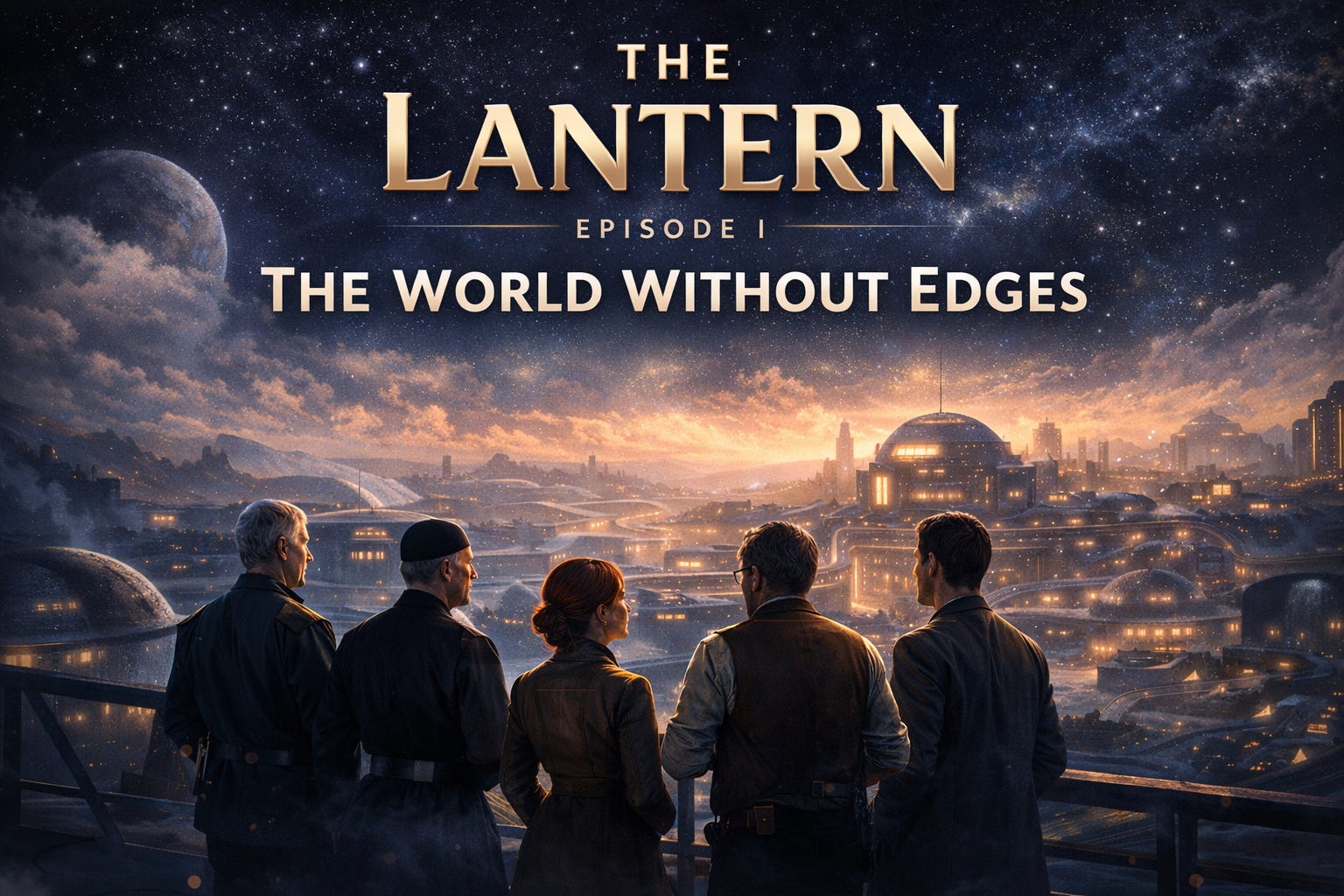
When good things grow crooked, someone must carry a light.
Tonight begins a new philosophical drama from Chesterton Radio — not of conquest, but of proportion. Not of spectacle, but of structure.
Welcome to The Lantern.
The Lantern
Episode I — The World Without Edges
When good things grow crooked, someone must carry a light.
I. A Seamless World
The Lantern entered atmosphere without flame.
Below lay a world so seamless it seemed unfinished. Land dissolved into water without coastline. Cities thinned gradually into plains. Even shadow appeared moderated, as though light had been persuaded not to divide.
Captain Alistair Rowan stood at the forward glass.
“It is a beautiful world,” he said quietly.
Elias North adjusted the brass gyroscope beside him.
“Yes,” he replied. “Beautiful systems sometimes conceal strain.”
Clara Wren glanced at her slate.
“They describe themselves as having achieved Universal Stability.”
Julian Ashcroft gave a faint, skeptical hum.
“An ambitious phrase.”
Father Lucian Vale, seated with his hat folded neatly in his hands, looked out at the gentle horizon.
“Ambition,” he said softly, “is often the first edge to disappear.”
II. The Council of Continuum
The Council chamber curved so gently that one could not quite locate its center.
Delegates sat in a loose spiral.
A woman rose to greet them.
“We welcome you,” she said warmly. “You arrive at a fortunate time. We have completed our great reform.”
Rowan inclined his head.
“And what has been reformed?”
“Division,” she replied. “We discovered that conflict arises from definition. So we removed definition.”
Julian leaned forward.
“You removed language?”
“No. We softened it.”
“You removed property?”
“We eliminated exclusion.”
“You removed borders?”
“We transcended them.”
Father Vale’s eyes wandered along the chamber walls.
“There are no corners,” he observed.
“Corners imply opposition,” she replied.
Elias North spoke for the first time.
“Corners also bear weight.”
III. The Philosophy of Continuum
Over tea that seemed determined not to offend, the Council explained their reasoning.
For centuries, disputes had fractured their civilization.
Ownership.
Doctrines.
Identity.
Inheritance.
“So we asked,” the woman continued, “whether conflict belonged to humanity — or to the lines humanity drew.”
“And you concluded?” Rowan asked.
“That peace required the erasure of lines.”
Clara asked gently, “Have other worlds adopted similar reforms?”
The woman smiled.
“It is a growing philosophy.”
Julian’s expression sharpened slightly.
“Growing philosophies,” he said, “often grow beyond their containers.”
The woman did not respond.
IV. A Child and the Stones
In a courtyard, a child attempted to stack polished stones.
Each was perfectly rounded.
They rolled apart with patient inevitability.
“We do not teach children to impose form,” said the boy’s mother. “Hierarchy begins in shape.”
Father Vale crouched beside the child.
“What happens,” he asked, “if something must remain?”
The mother hesitated.
“Remaining,” she said carefully, “is a form of exclusion.”
Elias watched the stones drift apart once more.
“It is also a form of standing,” he murmured.
The child tried again.
The stones rolled apart again.
He did not look frustrated.
Only puzzled.
V. The Tremor
The tremor began as a murmur.
Not violent.
Persistent.
A vibration that traveled uninterrupted along curved surfaces, finding no edge to interrupt its motion.
A tower sagged.
Not collapsing dramatically — but dissolving into itself.
Citizens gathered, serene.
“We will redistribute,” the Council announced.
“Redistribute what?” Julian asked.
“Weight.”
Elias studied the structural overlays.
“You have no rigidity,” he said quietly.
“We have flexibility.”
“Yes,” he replied. “And flexibility without resistance cannot arrest motion.”
Clara spoke softly.
“Have you experienced tremors before?”
The Council member answered carefully.
“Transitions are rarely without adjustment.”
“Adjustment,” Julian repeated.
VI. The Corner
Elias requested permission to construct a simple frame.
Reluctantly, they agreed.
He assembled two beams at a right angle.
A ninety-degree intersection.
A corner.
It stood.
The tremor continued — but stopped at the angle.
Energy, encountering resistance, redirected.
Citizens gathered in uneasy silence.
“It excludes,” one said.
“It defines,” North replied.
The child approached with a stone and pressed it gently into the angle.
It held.
For the first time that day, something remained.
Father Vale stood beside the corner.
“You feared division,” he said gently. “But difference is not division. It is distinction.”
The woman from the Council touched the beam.
“If we restore edges,” she said slowly, “will conflict return?”
“Yes,” Rowan answered.
Silence followed.
“And so,” he added, “will love.”
VII. Departure
From orbit, faint lines now traced the city below.
Not harsh.
Not rigid.
Defined.
The Lantern prepared to depart.
Clara reviewed her notes.
“This reform,” she said thoughtfully, “is not unique. We have encountered its language elsewhere.”
Julian folded his arms.
“Peace through erasure.”
North adjusted the gyroscope.
“Systems prefer equilibrium,” he said. “But equilibrium is not achieved by removing structure.”
Father Vale watched the planet recede.
“It is difficult,” he murmured, “to love what one cannot name.”
Rowan gave the order.
The Lantern rose silently into starlight.
“Next destination?” he asked.
North examined the incoming coordinates.
“A civilization that has abolished speech in the name of compassion.”
Rowan nodded.
“Then,” he said quietly, “we must listen.”
The Lantern vanished.
About The Lantern
Season One explores what happens when virtues exceed their measure:
Tolerance without edges.
Compassion without speech.
Progress without memory.
Justice without mercy.
Freedom without gravity.
Efficiency without feast.
Each episode stands alone.
Together, they trace a pattern.
Daily story.
Daily reflection.
A quiet hour in a noisy age.
— Chesterton Radio