

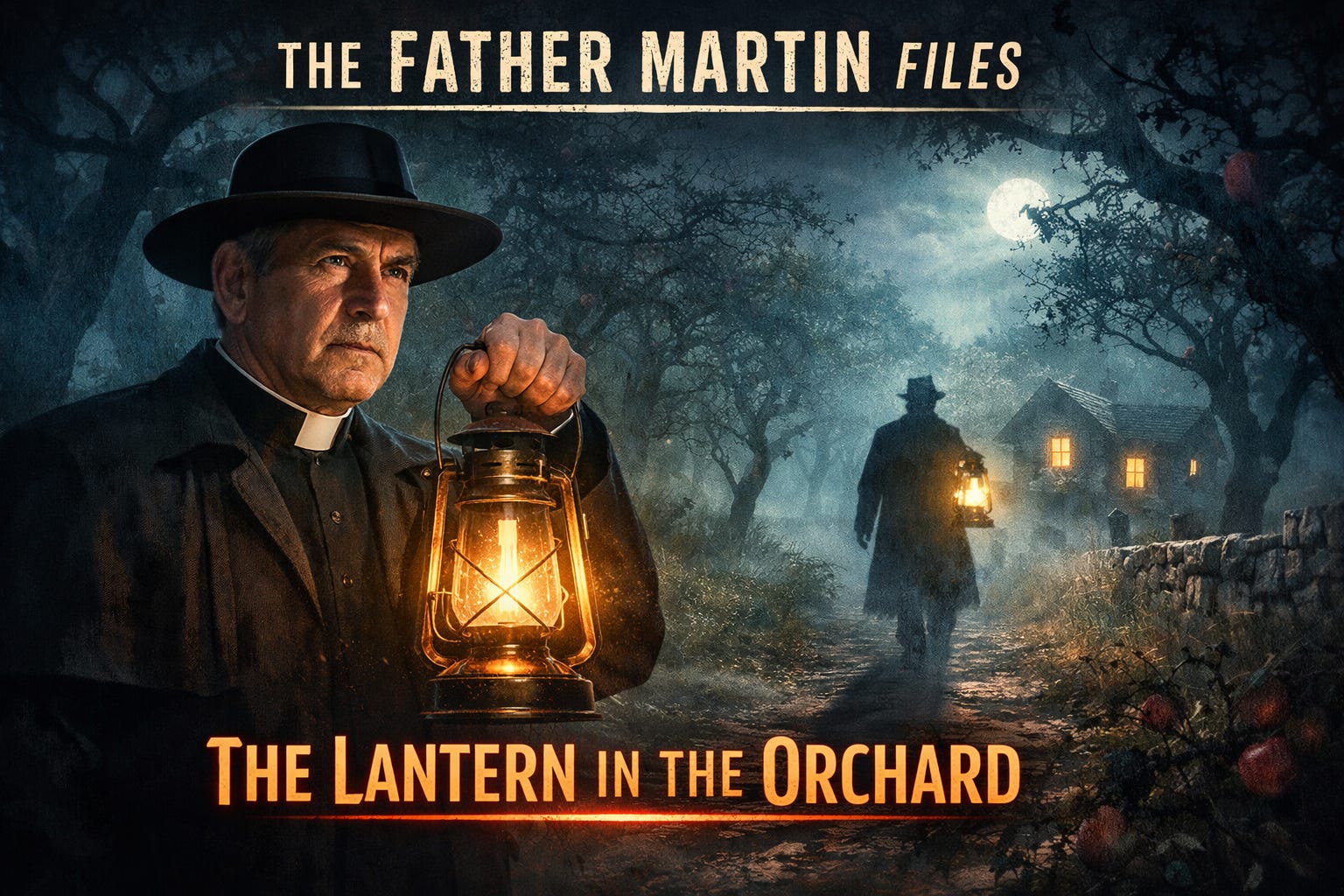
There was once a small book called The Ghost of Kingdom Come, written for children by Fr. Gerald T. Brennan, but remembered by those who never quite grew out of it. In those quiet pages, ghosts were not horrors but reminders—souls sent back not to frighten, but to finish what had been left undone.
This new series, The Father Martin Files, walks in that same lantern-light. Each tale begins with something strange in the night, but ends with something far more serious in the soul. These are not stories about the dead returning to the living—they are stories about the living learning, at last, how to become worthy of the life they have been given.
Father Martin had not come to the orchard to find a ghost.
He had come, as many priests do, to avoid the living.
The parish of St. Jude’s had lately grown restless—not with sin (which is simple enough), but with explanations (which are not). There had been disputes over land, over money, over inheritance, and—most tiresome of all—over intentions. Everyone wished to be understood; very few wished to be corrected.
And so when Mrs. Hanrahan, whose husband had died some years before, offered him the use of her cottage beyond the old orchard, he accepted with a gratitude that was only half polite.
“It is very quiet there,” she said.
Then, after a pause that seemed to reconsider the word:
“Except at night.”
Father Martin smiled, as priests must when something inconvenient has been politely warned, and took the key.
The orchard lay beyond a low stone wall, its trees bent and twisted as if they had been trained not by gardeners but by years. The cottage itself was small, clean, and thoroughly unremarkable—except that it seemed to listen.
Some houses merely stand.
Others attend.
Father Martin noticed this immediately.
His first evening passed without incident. He read by the fire, said his prayers, and slept as one sleeps in a place that has not yet decided what it is.
But at midnight, he woke.
Not with a start—but with the distinct sensation that something had begun.
He lay still for a moment, listening.
Then he rose, dressed, and stepped outside.
The orchard was lit by the moon—but not only by the moon.
There was another light.
It moved.
It did not flicker as a candle flickers, nor sway as a lantern sways in a careless hand. It moved steadily, deliberately, as though it had somewhere to go and had taken a very long time deciding to go there.
Father Martin watched it for a moment before speaking.
“Who’s there?”
The light stopped.
Then, after a pause that might have been hesitation—or invitation—it moved again, deeper into the orchard.
Father Martin followed.
Now, it must be said plainly that Father Martin did not yet assume the supernatural.
Priests who assume ghosts too quickly often miss sinners.
And sinners, as a rule, are more in need of attention.
Still, he noted something curious.
The light did not wander.
It traced a path.
The next morning, he found Mrs. Hanrahan waiting at the gate as though she had been listening for his footsteps.
“You saw it, didn’t you?” she said.
“I saw something,” said Father Martin.
She nodded with the satisfaction of one whose suspicions have finally been shared.
“They say it’s him. Mr. Calloway.”
“Who was Mr. Calloway?”
“Owned the orchard. Built the cottage. Died some years ago.” She hesitated. “Not comfortably.”
“And now walks with a lantern?”
“So they say.”
Father Martin considered this.
“Who says?”
Mrs. Hanrahan blinked.
“Everyone,” she said.
“Then I should like to meet someone in particular,” said Father Martin.
He began, as all sensible investigations do, with the least reliable witness.
Mr. Ellery, the grocer, was a man of excellent memory for unimportant details and great enthusiasm for things he had not quite seen.
“Yes, Father,” said Ellery, leaning across the counter. “Seen it myself. Twice. Moves just as you’d expect.”
“How would I expect it?”
“Well,” said Ellery, slightly offended, “like a ghost.”
Father Martin purchased a loaf of bread he did not need and left with a clearer understanding of Mr. Ellery than of the lantern.
Miss Keating, the schoolteacher, was of a different sort entirely.
“It appears irregularly,” she said. “Not every night. Always in the same area—the north side of the orchard.”
“Does it approach the cottage?”
“No.”
“Does it leave the orchard?”
“No.”
Father Martin inclined his head.
“That is very considerate of it.”
Miss Keating did not smile.
The third person he spoke to did not volunteer anything at all.
Thomas Reed was a young man of strong build and careful speech, recently returned to the town and already known, in the way of small places, for being known too little.
“You’ve seen the light,” said Father Martin.
“Yes, Father.”
“What do you make of it?”
Reed hesitated.
“It’s no business of mine,” he said.
Father Martin regarded him quietly.
“That,” he said, “is precisely the kind of answer that makes something one’s business.”
Reed said nothing.
That night, Father Martin returned to the orchard.
The light appeared again.
But this time, he did not follow it.
Instead, he went where it must go.
The north side of the orchard was darker, the trees growing closer together as though they had conspired to keep something hidden. The ground dipped slightly, forming a shallow hollow where the air seemed heavier.
Father Martin waited.
The light came.
It approached without haste and without uncertainty.
And with it—a figure.
“Good evening,” said Father Martin.
The figure stopped.
It was a man—not transparent, not unreal, but diminished, as though part of him had been left elsewhere and had not yet returned.
“Father,” said the man.
Now, there are moments when a priest must decide whether to treat a thing as natural or supernatural.
Father Martin chose instead to treat it as true.
“You are Mr. Calloway,” he said.
“I am what remains of him.”
They walked together beneath the trees.
“You carry a lantern,” said Father Martin.
“Yes.”
“For whom?”
The man did not answer.
Instead, he said, “Have you spoken to the living?”
“Yes.”
“And what do they say?”
“That you walk.”
The man gave a faint, almost weary smile.
“They always begin with what is seen,” he said. “Never with what is done.”
“And what was done?”
The man stopped.
“I refused,” he said.
Father Martin nodded, as though a long calculation had at last resolved itself.
“Yes,” he said. “I had suspected as much.”
The story, when it came, was not complicated.
It was therefore terrible.
A man had come once, in winter—hungry, cold, asking not for money but for bread.
“I told him to work,” said Calloway.
“Could he?”
“No.”
“And so?”
The lantern gave a small, steady glow.
“And so,” said Calloway, “I went inside.”
They stood in silence.
“And now?” said Father Martin.
“I am sent,” said Calloway, “to bring light where I would not bring bread.”
Father Martin considered this.
“That is often how such things are arranged,” he said.
The next day, Father Martin visited Thomas Reed again.
“You knew him,” he said.
Reed did not pretend not to understand.
“The man who came to the orchard,” Father Martin continued quietly.
Reed’s hands tightened.
“He was my father,” he said.
The words did not fall; they settled.
“And you?” said Father Martin.
“I came back,” said Reed. “Bought what was left. I wanted to see if the stories were true.”
“And are they?”
Reed looked toward the orchard.
“Yes,” he said.
That night, Father Martin returned once more.
Calloway stood waiting, the lantern steady in his hand.
“There is one more thing,” said Father Martin.
“Yes?”
“The man you refused.”
Calloway lowered his head.
“Yes.”
“He is not the one you are waiting for.”
Calloway looked up, and for the first time there was something like fear in his expression.
“No,” said Father Martin gently. “He has already forgiven you.”
Silence moved through the orchard like a wind that had forgotten how to blow.
“Then why—” began Calloway.
“Because,” said Father Martin, “you have not yet forgiven yourself.”
The lantern burned brighter—not fiercely, but more fully, as though it had at last remembered what it was for.
“And until you do,” said Father Martin, “you will mistake penance for purpose.”
They stood together at the edge of the orchard.
“And the living?” asked Calloway.
“They must not make the same mistake,” said Father Martin.
The next morning, Father Martin’s sermon was very short.
“There are ghosts among us,” he said.
“Not the kind we fear—but the kind we are meant to become.”
He paused, looking not at the crowd but through it.
“And if you wish to haunt the world,” he added gently,
“then do not refuse it.”
That night, the lantern appeared again.
But this time—it did not remain among the trees.
It moved.
Slowly.
Steadily.
Beyond the orchard.
✨ Final Note
We are not judged only by what we do—but by what we refuse to do.
And the hardest forgiveness is not from others, but from ourselves.