

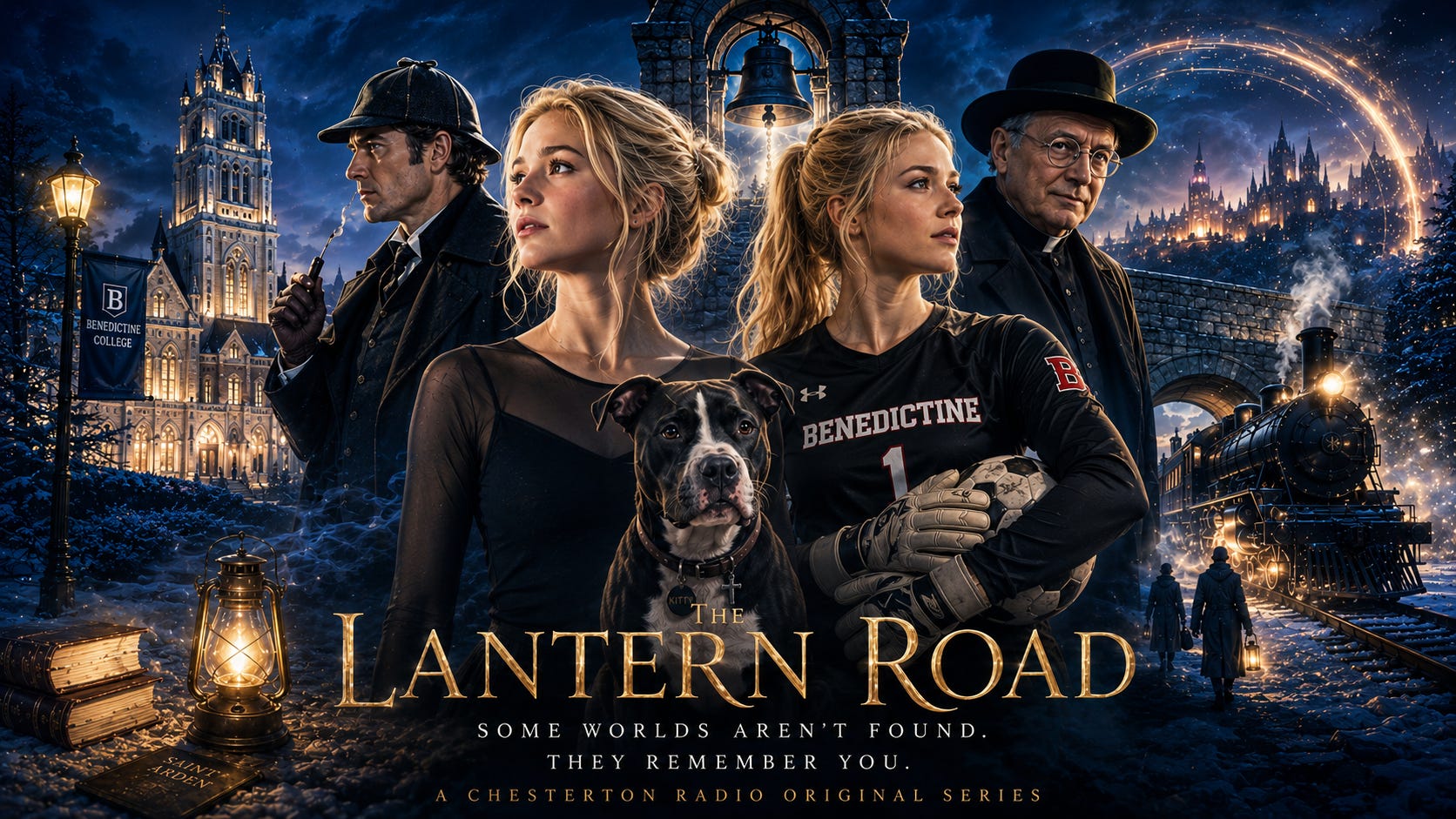
The snow began before the bells.
It came first as a silver haze drifting over the Missouri River valley below Atchison, softening the distant lights and slowly swallowing the dark edges of the world. The hills surrounding Benedictine College disappeared one by one beneath the whitening storm. Bare trees stood motionless against the sky like charcoal drawings fading into paper.
Students hurried between buildings wrapped in scarves and heavy coats while music drifted faintly from residence halls. The abbey windows glowed gold above the hill. Somewhere inside the chapel, evening prayers had just concluded.
The Tall Girl lingered outside longer than she should have.
She often did.
There were moments on campus when Benedictine College felt less like a school and more like the edge of another country. Winter especially transformed the place. Stone stairways vanished beneath snow. Bell towers emerged through fog like something from an old European painting. Even ordinary conversations seemed quieter during snowfall.
The Tall Girl loved those moments.
As a freshman she still felt half astonished to be here at all.
Only four months earlier she had been rehearsing dances in a small studio hundreds of miles away while wondering nervously whether she would belong at Benedictine. Now she crossed the same snowy paths as scholars, athletes, monks, musicians, and dreamers beneath ancient bells.
Yet lately a strange uneasiness had crept into that happiness.
Little things.
Missing conversations.
Half-remembered names.
A sense that people occasionally vanished from the edges of thought.
And always, at night, the feeling that something waited beyond the hill near the abandoned railway line.
She had never told anyone that part.
Not even her sister.
Especially not her sister.
The Keeper worried enough already.
At first it came softly over the hills above Atchison, drifting across the stone buildings of Benedictine College with the silence peculiar to the first true snow of winter. The lights of the abbey glowed amber against the darkening sky. Students crossed the campus in scarves and long coats. Laughter drifted briefly through the cold and vanished into the wind.
Far below the hill, along the old railway line near the river, a single lantern burned where no lantern should have been.
No one saw it.
Except Kitty.
The dog stood suddenly still near the edge of the quad, one paw lifted, ears raised toward the distant dark.
The Tall Girl tightened her scarf and looked down at him.
“What is it, Kitty?”
Kitty did not move.
The Tall Girl followed his gaze toward the far end of campus where the snow blurred the old tracks beyond the trees.
Nothing was there.
Or at least nothing she could clearly see.
Yet she felt something.
A strange sensation.
Not fear exactly.
More like the feeling that someone had just spoken her name softly from another room.
“The dance recital is tomorrow,” said The Keeper, walking beside her. “If you freeze to death tonight, Mother will blame me forever.”
The Tall Girl laughed faintly.
Her older sister always sounded calm, even when worried.
Everyone at Benedictine knew The Keeper.
Officially she was simply the senior goalkeeper whose impossible saves had become campus legend. Unofficially she had become one of those rare college figures who seem somehow larger than ordinary life. Professors greeted her by name. Freshmen pointed her out in the dining hall. Little girls at local soccer camps wore her number.
But to The Tall Girl she was still simply her sister.
Steady.
Protective.
Occasionally exasperating.
And tonight, beneath the falling snow, oddly uneasy.
“You felt it too,” said The Tall Girl quietly.
The Keeper hesitated.
“Felt what?”
“That.”
The Keeper glanced toward the distant rail line.
For a brief instant something unreadable passed across her face.
Then it vanished.
“You’re overtired,” she said. “Both of us are.”
But Kitty still would not move.
The wind carried the distant sound of bells.
Not the abbey bells.
These sounded older.
Far away.
Almost buried beneath the snow.
The Tall Girl frowned.
“Did you hear that?”
The Keeper turned sharply.
The bells stopped.
Only the wind remained.
Then Kitty slowly lowered himself onto the snowy ground.
And prayed.
Even after all these months it still startled people.
Kitty bowed his head between his paws exactly as he had learned to do beside the chapel steps. Some students smiled when they saw it. Others crossed themselves. One theology professor had reportedly wept.
Now, beneath the falling snow, the sight filled The Tall Girl with sudden unease.
Kitty only prayed like this when something was wrong.
The Keeper looked down at him quietly.
“We should go inside,” she said.
But neither sister moved.
Far beyond the hill, unseen in the storm, the lantern near the railway line flickered once.
And went out.
Three days later, people began forgetting.
It started small.
A sophomore named Emily failed to appear for philosophy class.
No one thought much of it.
Then her roommate mentioned casually that Emily had gone home for the weekend.
Except Emily had no roommate.
Or at least no one remembered one.
By evening, her dorm room stood empty.
No clothes.
No books.
No photographs.
No trace she had ever lived there.
The Tall Girl stared at the blank room with cold disbelief.
“She was here,” she insisted.
The resident assistant frowned apologetically.
“I think you’re mistaken.”
“Mistaken?”
The Tall Girl turned toward her sister.
“Tell her.”
The Keeper stood in the doorway very still.
“Yes,” she said quietly. “Emily was here.”
The resident assistant blinked.
“Who?”
The snow continued falling outside.
Later that night The Tall Girl searched social media.
Nothing.
No pictures.
No messages.
No account.
It was as though Emily had never existed.
Only Kitty seemed unsurprised.
The dog sat beside the window watching the darkness beyond campus.
Watching.
Listening.
As though he heard distant things none of them could hear.
Father Brown arrived the next afternoon.
The college had invited him weeks earlier for a small retreat series on literature, morality, and mystery stories. The Tall Girl had expected someone grander somehow.
Instead the little priest appeared slightly windblown and apologetic, carrying a battered umbrella and looking vaguely concerned about his luggage.
Yet within ten minutes of meeting him, people relaxed around him as naturally as around an old friend.
Father Brown listened more carefully than anyone The Tall Girl had ever met.
When she mentioned Emily after dinner, he became very quiet.
“You remember her?” she asked.
“Yes,” said Father Brown.
The Keeper looked sharply at him.
“You do?”
Father Brown stirred his tea.
“My dear young lady,” he said mildly, “there are many ways to disappear from the world. Some are older than others.”
The Tall Girl leaned forward.
“You believe us?”
Father Brown smiled faintly.
“I generally believe frightened people when they tell the truth.”
The Keeper folded her arms.
“That still doesn’t explain how everyone forgot her.”
“No,” said Father Brown. “It does not.”
Kitty rose suddenly.
The dog crossed the room, stopped beside the chapel window, and growled softly toward the darkness outside.
Father Brown watched him with interest.
“Ah,” he said.
The Tall Girl stared.
“You know about Kitty?”
“I know dogs,” said Father Brown.
Kitty lowered himself slowly onto the floor.
And began to pray.
Father Brown’s expression changed.
The warmth left it.
Not fear.
Concern.
Deep concern.
“Tell me,” he said quietly, “have the bells sounded again?”
The Keeper went pale.
The Tall Girl turned toward her sister.
“You heard them too.”
The Keeper looked away.
For several moments no one spoke.
Then she said quietly:
“When I was little, I heard them once before.”
The room became still.
Outside, snow drifted past the chapel lights.
The Keeper stared into the darkness.
“I was eleven,” she said. “We were visiting relatives during winter break. I woke during the night and heard bells somewhere outside. Not church bells. Stranger than that. I followed them.”
Father Brown did not interrupt.
“There was an old station near the river. Abandoned. At least I thought it was abandoned.”
Her voice lowered.
“There was light inside.
“And people.
“Not ordinary people.”
The Tall Girl felt cold.
The Keeper rarely spoke dramatically.
“I remember snow,” said The Keeper softly. “Lanterns. And a train waiting with steam rising around it.”
Father Brown nodded very slightly.
“What happened then?”
“I don’t know.”
The Keeper closed her eyes briefly.
“That’s the strange part.
“I remember reaching the platform.
“I remember hearing music.
“And then...
“Nothing.
“Until I woke at home the next morning.”
Silence settled across the room.
Kitty raised his head.
Far away beneath the storm, bells rang softly once.
Father Brown set down his tea.
“I think,” he said carefully, “that we may need another guest.”
Sherlock Holmes arrived on the evening train with visible irritation.
“I was informed,” he announced while removing snow from his coat, “that this matter involved altered records, impossible timelines, and the disappearance of multiple individuals from institutional memory. I was not informed that it involved a praying dog.”
Kitty regarded him calmly.
Holmes regarded Kitty skeptically.
The Tall Girl immediately disliked him.
The Keeper, however, seemed amused.
Father Brown merely smiled.
“You disapprove of praying dogs, Holmes?”
“I disapprove of conclusions unsupported by evidence.”
Kitty sneezed.
Holmes narrowed his eyes.
“That animal dislikes me.”
“He dislikes dishonesty,” said Father Brown.
“I have not lied.”
“No,” said Father Brown cheerfully. “But you are concealing curiosity.”
Holmes removed his gloves with unnecessary precision.
“Very well. I am curious.
“Three students apparently vanish from all public record within seventy-two hours.
“Handwritten notes disappear.
“Photographs alter themselves.
“And only a small group of individuals retain memory of the missing persons.
“That is interesting.”
The Tall Girl spoke quietly.
“It feels wrong.”
Holmes looked at her more carefully.
“Yes,” he said unexpectedly. “That is because the pattern is deliberate.”
The room fell silent.
“What do you mean?” asked The Keeper.
Holmes drew a folded map from his pocket.
“Each disappearance occurred near a particular geographic corridor.”
He spread the map across the table.
Old railway lines crossed the region like faint scars.
The Tall Girl stared.
“The station.”
Holmes nodded.
“The abandoned station beneath the hill.”
Father Brown leaned forward.
“And?”
Holmes tapped the map.
“Every incident centers around it.
“Furthermore...”
He hesitated.
“That station officially burned down in 1911.”
The wind rose outside.
Then Kitty stood abruptly.
The dog crossed to the door and stared into the hallway.
Low growling rumbled in his throat.
The lights flickered.
Holmes stiffened.
The temperature in the room dropped suddenly.
From somewhere far below the college came the sound of a bell.
One deep note.
Ancient.
Mournful.
The Tall Girl felt the hair rise along her arms.
Then a voice whispered faintly through the corridor.
Not loud.
Barely audible.
Yet horribly clear.
“Forget.”
The Keeper stepped backward.
Father Brown rose.
Holmes turned sharply toward the hallway.
Kitty began barking furiously.
And somewhere beneath the hill, something answered.
The tunnels beneath Benedictine College smelled of stone, iron, and ancient cold.
Holmes carried a lantern.
Father Brown carried an umbrella for reasons no one understood.
The Tall Girl carried Kitty.
The Keeper walked ahead silently.
“I used to come down here during preseason training,” she said quietly. “The maintenance doors were never locked properly.”
Holmes examined the walls.
“These passages are older than the college.”
“Much older,” said Father Brown.
Snowmelt dripped slowly somewhere in the darkness.
The deeper they descended, the quieter the world became.
Eventually even the wind disappeared.
Only their footsteps remained.
Then The Tall Girl noticed something strange.
The tunnel walls were lined with old carvings.
Not graffiti.
Symbols.
Lanterns.
Stars.
Bells.
Doors.
And again and again:
A hound kneeling beneath a bell tower.
She stopped walking.
“Father Brown.”
The priest lifted his lantern.
The carving was unmistakable.
Kitty stared at it silently.
Holmes frowned.
“These symbols are far older than the surrounding masonry.”
The Keeper touched one carefully.
“Who made them?”
“No one remembers,” said Father Brown.
The Tall Girl looked at him sharply.
“You knew about this place.”
“I knew stories,” said Father Brown.
He glanced down the tunnel.
“Stories about something called the Lantern Road.”
Holmes sighed softly.
“At last.
“The supernatural explanation arrives.”
Father Brown smiled.
“My dear Holmes, the supernatural explanation always arrives eventually. The question is whether it explains anything.”
Kitty suddenly struggled in The Tall Girl’s arms.
The dog dropped to the floor.
Then ran ahead into the darkness.
“Kitty!”
They hurried after him.
The tunnel widened suddenly.
Tracks emerged beneath centuries of dust.
And beyond them...
A station.
Lit by lanterns.
Exactly as The Keeper remembered.
Steam drifted slowly through the frozen air.
An ancient train waited beside the platform.
Its windows glowed gold.
Snow fell silently through the roofless darkness above.
The Tall Girl stopped breathing.
People moved along the platform.
But not quite like ordinary people.
Their clothes belonged to no clear time period.
Some wore heavy winter coats from another century.
Others carried lanterns shaped like stars.
None spoke loudly.
All moved with peculiar stillness.
Then a tall figure stepped forward from the mist.
He wore a long dark coat and carried a ring of iron keys.
His face looked old and tired and kind.
The Keeper went pale.
“I know him.”
The man bowed slightly.
“Yes,” he said.
His voice sounded like distant bells.
“You came here once before.”
The Tall Girl stared.
“Who are you?”
The man looked at her carefully.
“At one time,” he said, “they called me the Warden of Crossings.
“But most travelers simply call me the Keeper.”
The Tall Girl looked at her sister.
Then back at the stranger.
The Keeper himself smiled faintly.
“Names,” he said softly, “have a way of repeating themselves along the Lantern Road.”
Kitty walked calmly toward him.
Then sat.
The Keeper of Crossings bowed his head respectfully to the dog.
Holmes stared.
“That,” he announced firmly, “is an exceptionally unusual development.”
The station café overlooked endless snow.
At least that was how it appeared.
No one could determine exactly where the station existed.
The windows showed forests, mountains, frozen rivers, and distant lights moving through storms.
Sometimes the scenery changed while no one was looking.
The Tall Girl wrapped both hands around a cup of tea.
“This place shouldn’t exist.”
“Quite true,” said Holmes.
“And yet it does,” said Father Brown.
The Keeper of Crossings sat beside the fire.
“The Lantern Road exists wherever memory survives,” he said.
Holmes folded his arms.
“That sentence contains almost no measurable meaning.”
The Keeper smiled.
“You are Sherlock Holmes.”
“Yes.”
“You believe roads connect places.”
“That is generally their purpose.”
“But the Lantern Road connects meanings.”
Holmes opened his mouth.
Then stopped.
The Keeper continued quietly.
“There are places in the world where memory grows thin.
“Forgotten stations.
“Abandoned chapels.
“Old libraries.
“Lonely crossings.
“Sometimes doors open there.
“Sometimes travelers pass through.”
The Tall Girl looked toward the window.
“Where does the road go?”
“Everywhere.”
The fire crackled softly.
Then the Keeper’s face darkened.
“But something is wrong.”
Father Brown nodded.
“The Quiet.”
The Keeper looked surprised.
“You know the name.”
“I know many old names,” said Father Brown.
The Keeper lowered his gaze.
“The Quiet spreads wherever people surrender wonder.
“Where gratitude dies.
“Where memory weakens.
“Where stories are abandoned.”
Outside the windows the snow deepened.
“The missing students?” asked The Tall Girl.
“The Quiet has begun taking names,” said The Keeper.
Holmes leaned forward sharply.
“How?”
The Keeper looked directly at him.
“By persuading the world to stop remembering them.”
Holmes frowned.
“That is impossible.”
“Is it?” asked Father Brown gently.
The room became silent.
The Tall Girl thought suddenly of empty classrooms.
Blank photographs.
Vanishing friendships.
How many people disappear slowly every day because no one truly remembers them anymore?
The thought frightened her.
Kitty rested beside the fire.
But the dog had not relaxed.
His ears remained raised.
Listening.
Always listening.
Then somewhere outside the station, a bell rang once.
The Keeper stood abruptly.
“They found the gate.”
The lanterns flickered.
Far beyond the station windows, darkness moved across the snow.
And for the first time The Tall Girl saw figures walking within it.
Tall.
Silent.
Featureless.
Like people erased imperfectly.
The Quiet had arrived.
The train departed before dawn.
The station clocks showed different times depending upon which direction one looked at them.
Holmes discovered this first.
“Interesting,” he murmured.
The Tall Girl glanced upward.
One clock read 4:12.
Another read midnight.
A third possessed no hands at all.
The Keeper of Crossings noticed her confusion.
“Time behaves differently along the Lantern Road,” he said.
Holmes frowned.
“That phrase remains irritatingly imprecise.”
Father Brown smiled.
“So is time itself.”
The great locomotive breathed clouds of silver steam into the frozen dark. Lanterns swung above the platform. Travelers moved quietly through the snowfall carrying strange luggage: violin cases bound with twine, cages containing white birds, stacks of books chained together with brass clasps.
The Tall Girl stared at a woman in a blue coat carrying an enormous key nearly the length of her arm.
“Who are these people?”
“Travelers,” said the Keeper.
“To where?”
“Yes,” he replied.
Holmes closed his eyes briefly.
“I begin to understand why mythology produces alcohol.”
Despite herself, The Tall Girl laughed.
That surprised her.
Everything about the Lantern Road should have terrified her.
Yet beneath the fear she felt wonder growing steadily stronger.
The train itself looked older than history.
Dark green carriages stretched into the snowy distance beneath glowing lanterns. Frost covered the brass railings. The engine bore no company markings. Instead its black iron surface carried symbols identical to those carved beneath Benedictine College.
Lanterns.
Stars.
Doors.
And the kneeling hound.
Kitty paused beside the emblem and sniffed it solemnly.
Then, to Holmes’ visible astonishment, the conductor tipped his hat respectfully to the dog.
“Good evening, Watcher.”
Holmes stared.
“Watcher?”
The conductor blinked.
“You do not know?”
“No,” said Holmes sharply. “I do not.”
The conductor seemed puzzled.
“Strange.”
He glanced down at Kitty again.
“The old signs are returning.”
Before Holmes could continue questioning him, the whistle sounded.
The Tall Girl climbed aboard beside her sister.
The interior carriage glowed warmly with amber lamps and polished wood. It smelled faintly of cedar, old paper, and winter smoke.
Outside the windows snow drifted endlessly through darkness.
Then the train began moving.
Not quickly.
Almost gently.
Yet the sensation felt unlike ordinary travel.
The Tall Girl suddenly realized she no longer knew exactly where Benedictine College was.
Or even whether the ordinary world still existed nearby.
That frightened her enough to grip the armrest.
The Keeper noticed.
“You all right?”
“I think so.”
The Tall Girl hesitated.
“Do you ever feel like this place is somehow remembering us?”
Her sister looked toward the dark windows.
“Yes,” she said quietly.
“That is exactly what it feels like.”
The Tall Girl had never imagined silence could possess motion.
Yet the creatures pursuing them moved with exactly that terrible quality.
No footsteps.
No voices.
Only absence.
The Keeper of Crossings led them aboard while lanterns swung wildly in the storm.
“Hurry!”
Holmes climbed into the carriage with visible skepticism.
“I must observe,” he announced while snow blew through the open door, “that boarding supernatural locomotives was not part of my original itinerary.”
Father Brown settled calmly beside the window.
“Most worthwhile journeys are absent from one’s itinerary.”
The train lurched forward.
Steam engulfed the platform.
Then the station vanished behind them.
The Tall Girl stared out the window.
The landscape beyond the tracks shifted constantly.
Frozen forests gave way to flooded plains.
Mountains appeared and disappeared.
Once she glimpsed a city glowing with thousands of lanterns beneath a violet sky.
Then it was gone.
“How is this possible?” she whispered.
Holmes adjusted his coat.
“I intend to discover precisely that.”
The Keeper sat opposite them silently.
“The Bell of Saint Arden still stands,” he said.
Father Brown looked up sharply.
“I thought it lost.”
“So did many people.”
The train rattled through darkness.
“If the bell rings again,” said The Keeper, “the stolen names may return.”
The Tall Girl leaned forward.
“Then we can save them?”
The Keeper hesitated.
“Perhaps.
“But the bell tower lies beyond the Winter Country.
“And the roads there are failing.”
Kitty lifted his head suddenly.
A low growl rolled through the carriage.
Holmes stiffened.
Outside the windows shadows moved alongside the train.
Not running.
Gliding.
The lanterns inside the carriage dimmed.
The temperature dropped sharply.
Then one of the windows frosted over from the outside.
A face appeared briefly within the ice.
Not human.
Blank.
Hungry.
The Tall Girl gasped.
The train shook violently.
The Keeper rose.
“They are trying to stop us before we reach Saint Arden.”
The lights flickered again.
Then the carriage door slowly began to open by itself.
Snow and darkness poured inward.
Kitty barked furiously.
Holmes seized the handle.
Something pulled back from the other side with impossible strength.
Father Brown stood.
Quietly.
Without drama.
And began praying.
The effect was immediate.
The darkness recoiled.
The pressure against the door weakened.
The shadows outside retreated from the train.
Holmes stared.
Father Brown finished the prayer calmly and sat down again.
The detective remained motionless for several moments.
Then he said carefully:
“That was... notable.”
Father Brown smiled faintly.
“My dear Holmes, you have spent your life studying the structure of evil.
“You should not be surprised to discover that goodness also possesses structure.”
The train continued north through the snow.
Toward the Bell Beneath the Hill.
Saint Arden stood at the edge of a frozen valley where all the bells had fallen silent.
The Tall Girl saw the town first through swirling snow beyond the carriage window.
At first she mistook it for ruins.
Dark towers rose above buried streets. Bridges crossed narrow canals frozen solid beneath the winter moon. Hundreds of lantern posts lined the roads, yet none were lit.
Then she noticed something worse.
The town did not merely appear abandoned.
It appeared forgotten.
Like a place memory itself had stopped visiting.
The train slowed gradually as it entered the valley.
No one waited at the station.
No smoke rose from chimneys.
Even the snow seemed strangely muted.
Holmes studied the empty streets carefully.
“This resembles certain plague towns I have investigated,” he said quietly.
Father Brown shook his head.
“No.
“In plague towns people die.
“Here they have been surrendered.”
The Tall Girl felt cold deep inside herself.
As they stepped onto the platform, the silence pressed against them unnaturally.
No birds.
No distant voices.
No creaking signs.
Only wind.
The Keeper of Crossings lowered his lantern.
“Saint Arden was once one of the great cities of the Lantern Road,” he said.
“Pilgrims came here from every crossing.
“The bell tower could be heard across seven winter kingdoms.”
The Tall Girl looked toward the enormous black tower rising above the valley.
It seemed impossibly ancient.
“How did this happen?”
The Keeper’s expression darkened.
“People stopped remembering why the bells mattered.
“At first they neglected the rituals.
“Then the songs.
“Then the stories.
“Eventually they forgot one another.”
Holmes folded his arms.
“And that allowed this ‘Quiet’ to spread.”
“Yes.”
The Tall Girl gazed toward the frozen streets.
For a terrible instant she imagined Benedictine College looking like this someday.
Empty dormitories.
Silent chapel bells.
No music.
No laughter after soccer games.
No dancers rehearsing in bright studios.
No prayers.
The thought shook her.
Kitty suddenly barked.
The sound cracked through the valley like a stone thrown through glass.
Far away, a lantern flickered weakly to life.
Then another.
Tiny points of gold against the snow.
The Keeper stared at the dog.
“They still remember him.”
The Tall Girl looked down.
Kitty stood perfectly still facing the distant tower.
Not frightened.
Waiting.
As though he had come here before.
That thought unsettled her more than anything else.
Then the whispers began.
Soft.
Almost beneath hearing.
Forget.
Forget.
Forget.
The town looked abandoned.
Snow covered the streets.
Lanterns hung dark above empty doors.
No smoke rose from chimneys.
The Tall Girl shivered.
“It feels dead.”
“No,” said Father Brown quietly.
“Worse.
“It feels forgotten.”
The bell tower rose above the valley.
Ancient.
Black against the snow.
Half the structure had collapsed long ago.
Yet the bell still hung there.
Immense.
Silent.
The Keeper stopped walking.
“The Quiet reached Saint Arden years ago.”
Holmes examined the streets.
“No footprints.”
“No memory,” said The Keeper.
Kitty walked ahead slowly.
The dog paused beside a ruined fountain.
Then lowered himself to pray.
Immediately a lantern nearby flickered faintly to life.
The Tall Girl stared.
Another lantern glowed farther down the street.
Then another.
Tiny lights awakening across the snow.
The Keeper watched Kitty with deep sadness.
“Even now,” he whispered, “the old loyalties remain.”
A sound echoed suddenly across the valley.
Not a bell.
A whisper.
Thousands of whispers.
Forget.
Forget.
Forget.
The shadows emerged from the alleys.
Tall figures formed from drifting darkness.
Holmes drew himself upright.
“At last,” he said quietly.
“A visible enemy.”
“No,” said Father Brown.
“Only visible symptoms.”
The shadows advanced.
Lanterns dimmed again.
The Tall Girl felt memories slipping strangely at the edges of her mind.
What had Emily looked like?
What had her voice sounded like?
Panic rose inside her.
“No.”
The Keeper seized her shoulders.
“Hold onto it.”
The Tall Girl closed her eyes desperately.
Emily laughing in the dining hall.
Emily singing badly during rehearsal.
Emily borrowing scarves.
Remember.
The whispers grew louder.
Kitty barked fiercely.
Father Brown lifted his lantern.
Holmes stepped forward beside him.
And unexpectedly, The Keeper walked directly toward the shadows.
The wind tore across the valley.
The great bell loomed overhead.
Then The Keeper stopped before the ruined tower gate.
And placed both hands against it.
The stone doors trembled.
Ancient symbols blazed faintly beneath the snow.
The Keeper gasped.
The Tall Girl stared.
The carvings matched those beneath Benedictine.
Lanterns.
Stars.
Doors.
And the hound kneeling beneath the bell.
The tower groaned open.
Warm golden light spilled outward.
The shadows recoiled.
The Keeper staggered backward.
“You really are a gatekeeper,” whispered The Tall Girl.
The Keeper looked frightened.
“Yes,” she said.
“I think I am.”
The staircase inside the tower spiraled upward through ancient darkness.
The Tall Girl climbed beside Holmes while Kitty padded ahead.
“What happens if the bell rings?” she asked.
Holmes adjusted the lantern.
“I suspect we are about to discover that experimentally.”
“You still don’t believe this place is real.”
Holmes was silent briefly.
Then:
“Reality, Miss Tall Girl, is often broader than our explanations of it.
“I object not to mystery.
“I object to carelessness.”
The Tall Girl smiled faintly.
“That sounds lonely.”
Holmes looked at her sharply.
Then unexpectedly laughed.
“A remarkably perceptive observation.”
Above them the bell chamber glowed dimly.
Father Brown reached the top first.
The bell hung enormous above the valley.
Ancient inscriptions covered its surface.
The Keeper of Crossings stood beside it silently.
“You have come farther than most travelers,” he said.
Father Brown touched the bell carefully.
“What must be done?”
The Keeper looked toward the valley below.
“The bell only rings for those who remember.”
The wind rose outside.
Shadows flooded into the streets beneath the tower.
The Quiet had reached Saint Arden completely.
Lanterns died one by one.
The Tall Girl felt despair pressing against her heart.
What if forgetting was easier?
What if memory itself was only pain?
Then Kitty walked forward.
The dog sat beneath the bell.
And prayed.
The chamber became utterly still.
The inscriptions across the bell began glowing softly.
Warm light spread through the tower.
The Tall Girl suddenly remembered every vanished student perfectly.
Faces.
Voices.
Laughter.
The forgotten rushed back into her heart.
Father Brown smiled.
“Ah,” he whispered.
“The faithful little creature understands.”
The Keeper looked at the sisters.
“You must ring it together.”
The Tall Girl stared.
“Us?”
“You are the Rememberer.
“And she is the Keeper.
“The road chose correctly.”
Below them the shadows surged toward the tower.
Holmes stepped beside the doorway.
“For the record,” he announced, “this has become profoundly irrational.”
Then he drew a heavy iron bar across the entrance.
“But we shall proceed anyway.”
The sisters grasped the ancient bell rope.
The fibers felt warm.
Alive somehow.
The whispers outside rose furiously.
Forget.
Forget.
Forget.
The Tall Girl closed her eyes.
Then together the sisters pulled.
The bell rang.
The sound crossed the valley like living light.
Snow exploded from rooftops.
Lanterns blazed awake.
The shadows recoiled violently.
And across the Lantern Road, forgotten names returned.
The Tall Girl saw impossible things.
Cities relighting.
Books rewriting themselves.
Children remembered.
Songs restored.
The bell rang again.
And again.
The Quiet shrieked soundlessly beneath the tower.
Then the darkness broke apart like smoke in sunlight.
Silence followed.
Real silence.
Peaceful.
The snow drifted softly through the golden light.
Far below, the bells of Saint Arden began ringing once more.
One after another.
The valley remembered itself.
Morning came slowly.
The train waited once more beside the station platform.
Saint Arden no longer looked abandoned.
Smoke rose from chimneys.
Lanterns glowed warmly.
People moved through the snowy streets.
The Tall Girl watched them quietly.
“Will they remember us?”
The Keeper of Crossings smiled sadly.
“Some stories are remembered clearly.
“Others only as dreams.”
Father Brown adjusted his coat.
“And the Quiet?”
The Keeper’s expression darkened.
“This was only the first breach.
“Other gates are failing.”
Holmes lit his pipe thoughtfully.
“Then the pattern continues.”
“Yes.”
The Tall Girl looked toward the endless rails stretching into the snow.
“How many roads are there?”
The Keeper glanced into the distance.
“More than anyone remembers.”
Kitty barked once softly.
The Keeper bowed respectfully to the dog.
Then he looked at the sisters.
“The Lantern Road is opening again.
“And it remembers you now.”
The train whistle echoed through the valley.
Snow drifted across the tracks.
Far away beyond the mountains, another bell began ringing.
Not mournfully.
Not in warning.
Calling.
The Tall Girl felt it deep inside her heart.
Adventure.
Danger.
Wonder.
And somewhere beyond the horizon, more forgotten places waited for them.
The train departed northward into the snow.
And the Lantern Road continued on through winter, memory, prayer, and bells.
Unseen beside the ordinary world.
Waiting for travelers who still remembered how to listen.
The train carried them southward toward the ordinary world.
Yet nothing felt ordinary anymore.
The Tall Girl watched snow sweep past the windows while the Lantern Road vanished gradually behind them.
Or perhaps not vanished.
Hidden.
She was no longer certain there was a difference.
Father Brown slept peacefully in the corner with his hat tilted forward.
Holmes remained awake studying notes beneath the carriage lamp.
The detective had filled nearly twenty pages already.
Diagrams.
Timelines.
Symbols.
Questions.
Always questions.
At last Holmes lowered his notebook.
“Young lady,” he said.
The Tall Girl looked up.
“When the whispers affected you in Saint Arden...
“What did you experience exactly?”
She hesitated.
“It tried to make me stop caring.”
Holmes watched her carefully.
“Interesting.
“Not merely forgetting facts.
“But forgetting attachment.”
“Yes.”
The Keeper looked over from the opposite seat.
“That’s the frightening part.
“It feels peaceful at first.”
Father Brown opened one eye.
“Most dangerous things do.”
The priest sat upright slowly.
“The Quiet is not merely emptiness.
“It is surrender.
“The temptation to believe nothing matters enough to remember.”
The carriage fell silent.
Outside the windows the snowstorm thinned.
Distant lights appeared far away through darkness.
The ordinary world approaching again.
Or what passed for ordinary.
The Tall Girl glanced down at Kitty.
The dog slept peacefully with his head resting across her boots.
“Why do they respect him so much?” she asked softly.
Father Brown smiled faintly.
“Perhaps because gratitude is a form of memory.
“And dogs are grateful creatures.”
Holmes snorted quietly.
“That explanation is either profound or ridiculous.”
“Usually the same thing,” said Father Brown.
The train whistle echoed softly through the winter dark.
Hours later they stepped once more onto the hidden platform beneath Benedictine College.
The station looked quieter now.
Smaller somehow.
Yet the lanterns still glowed.
The Keeper of Crossings stood beside the train as steam drifted upward around him.
“You will be called again,” he said.
The Tall Girl looked at him.
“How?”
The old Keeper smiled sadly.
“The Lantern Road rarely asks permission.”
The Keeper glanced toward the tunnels leading upward.
“Will we remember all this?”
“Yes,” said the Keeper of Crossings.
“But memory carries responsibility.”
Holmes adjusted his scarf.
“And what precisely are we expected to do?”
The Keeper looked toward the darkness beyond the rails.
“Keep the bells ringing.”
For a moment no one spoke.
Then Kitty walked forward.
The dog sat before the old Keeper.
And bowed his head.
The Keeper of Crossings removed his hat solemnly.
“Good night, Watcher.”
The Tall Girl saw Holmes notice that title again.
This time the detective did not object.
They climbed the long tunnels upward toward the sleeping campus.
Snow still covered the hills.
The abbey windows still glowed against the night.
Yet everything looked subtly changed.
Or perhaps they themselves had changed.
As they emerged beside the chapel lawn, bells began ringing overhead.
Ordinary Benedictine bells.
Warm.
Familiar.
Beautiful.
Students crossed the snowy paths laughing beneath scarves and winter hats.
Music drifted faintly from a dormitory.
The Tall Girl suddenly felt overwhelming gratitude simply to remember all of it.
The Keeper stood beside her quietly.
“What now?” she asked.
Father Brown smiled.
“Now?
“Classes tomorrow morning, I should imagine.”
Holmes groaned softly.
The sisters laughed.
Even Kitty seemed pleased.
Then the wind shifted.
Very faintly from somewhere far beyond the river came the sound of another bell.
Not Saint Arden.
Somewhere farther away.
Calling.
The Keeper heard it too.
So did Holmes.
Father Brown closed his eyes briefly.
And Kitty slowly raised his head toward the dark horizon.
The Lantern Road was still there.
Still waiting.
And somewhere beyond the winter hills, other forgotten places were beginning to disappear.
The bells would need guardians.
The roads would need travelers.
And the story of the Tall Girl, the Keeper, Kitty, Holmes, and Father Brown had only just begun.
THE END