

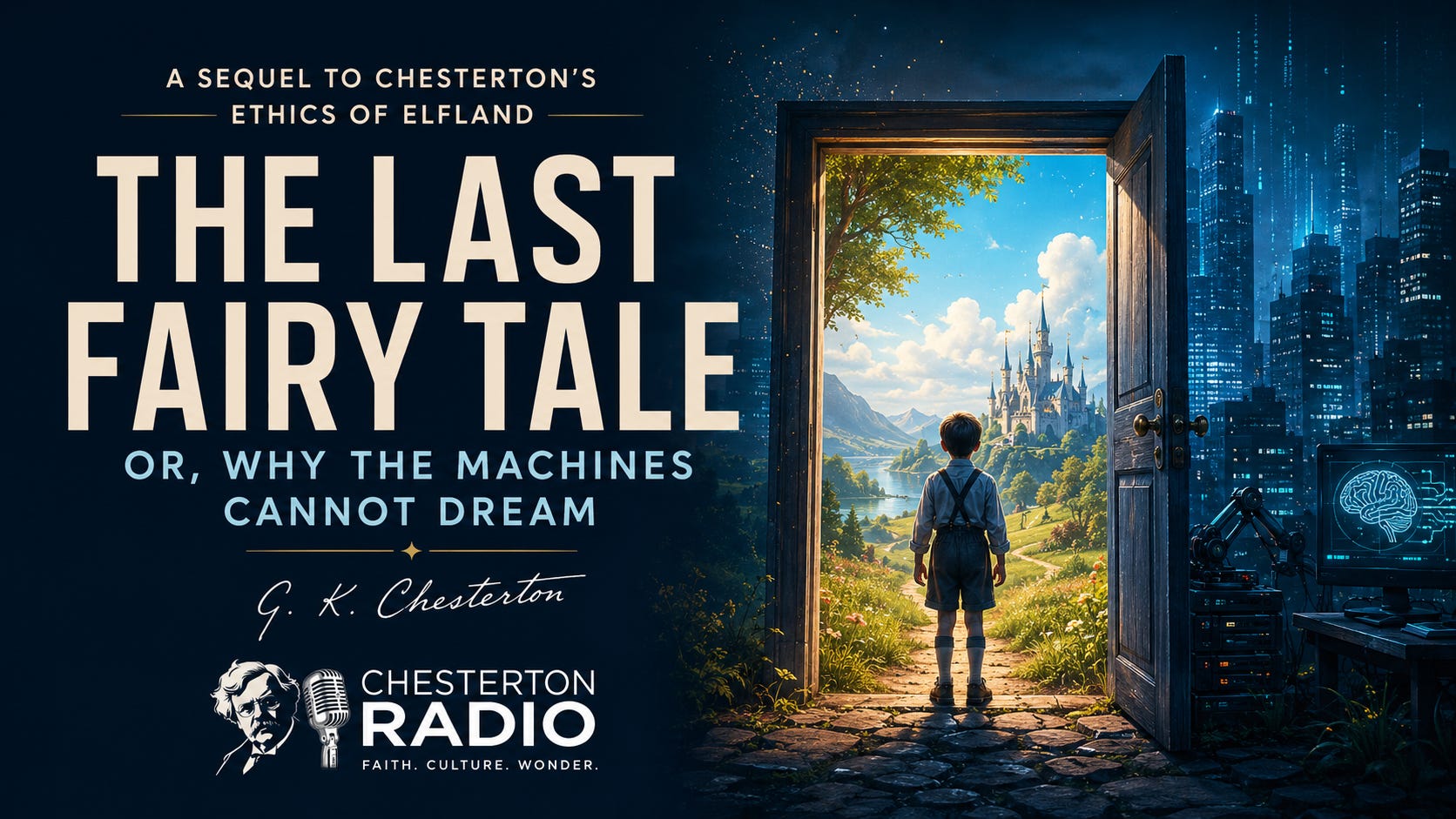
Prologue
To a Chapter Written Long Ago
There are moments in history when an old book ceases to be old.
A volume may sit neglected upon a shelf for fifty years like a sword hanging unnoticed in a hall; and then suddenly, because the world has become dark in a particular way, somebody reaches for it again as men once reached for candles during blackouts. It is not that the book has changed. It is that civilization has wandered into a region where the old truths become visible once more by contrast.
Such, I think, is the strange fate of that chapter which I once called Orthodoxy’s “The Ethics of Elfland.”
When I first wrote those pages, the modern world was already becoming mechanical; but it had not yet entirely surrendered to machinery. Men still inhabited streets filled with shopkeepers, church bells, pub signs, chimney smoke, and conversations. A child could still disappear into a field without carrying a device capable of summoning all the kingdoms of the earth into his pocket. Human beings had begun to worship efficiency, but they had not yet entirely forgotten existence.
Today the matter is very different.
The machine has grown not merely larger but more intimate. It no longer stands merely in factories stamping iron. It now accompanies men into their bedrooms, dining rooms, schools, railway carriages, and even into those lonely places where a man once escaped in order to think. The modern citizen carries a thousand invisible wires attached to his soul.
And yet the odd thing is this: the more powerful the machine becomes, the more feeble grows the philosophy surrounding it.
The old inventors were often poets despite themselves. They still regarded invention as something adventurous and almost mythological. They spoke of conquest, voyages, discovery, and the enlargement of human powers. Their engines resembled dragons harnessed to chariots.
But the modern mood surrounding machinery is curiously joyless. Men no longer speak as if machines were assisting civilization. They increasingly speak as if civilization itself were only a machine.
Now this is exactly the point at which fairy tales become urgently necessary again.
For fairy tales are not childish because they contain impossibilities. Fairy tales are ancient because they contain realities. They remind men that the universe is not merely a mechanism but an adventure. They insist that existence itself is eccentric, conditional, dramatic, and charged with moral meaning.
A fairy tale never begins by assuming that pumpkins naturally become coaches. It begins by assuming that pumpkins themselves are astonishing.
The danger of the modern world is not that men shall cease believing in dragons. Quite the contrary. The danger is that men shall cease being astonished by anything except dragons. They have grown so accustomed to miracles that only monstrosities can still awaken them.
And therefore I have attempted here to continue, however imperfectly, that earlier argument about wonder and gratitude into the age of engines and artificial minds.
For there now exists a new superstition far stranger than anything in medieval folklore: the superstition that man himself is merely a machine.
Against this dark fairy tale I know only one defense: the older fairy tales.
For the old tales always assumed something modernity increasingly denies — that man possesses a soul.
And it is because of this that the machines cannot dream.
There was once a highly practical gentleman who informed me, with the air of one announcing the abolition of winter, that fairy tales had finally disappeared from the earth because science had explained everything. He spoke as if some immense parliament of professors had at last marched into the forests carrying microscopes and warrants, and had formally evicted the elves from their ancestral property. The dragons, apparently, had been dispersed by electricity; the goblins defeated by sanitation; and the last remaining giant quietly retired upon receiving an unfavorable report from the Royal Society.
Now I have observed that whenever a man says science has explained everything, he generally means that science has explained one thing and he is tired of waiting for the rest. The truth is that science explains very little indeed; and whenever it truly explains anything it merely reveals a deeper mystery behind the first. The man who says that the rainbow is only refracted light might as reasonably say that a violin is only horsehair scraping catgut. He has not explained the wonder. He has merely described the machinery by which the wonder is conveyed.
But the real error of the modern world lies deeper still. Fairy tales have not vanished because men became scientific. Fairy tales have vanished because men became shallow. The old fairy tale was not founded merely upon ignorance; it was founded upon astonishment. And astonishment is one of the few things modern education does not encourage.
The child looked at the world and asked why apples fell downward. The modern philosopher looks at the world and asks why the child should ask such a foolish question. The old nursemaid was prepared to believe that invisible beings carried the stars across the heavens. The modern man is prepared to believe that the stars appeared accidentally out of nothing for no reason whatsoever. It is the modern explanation which is really wild and incredible.
For fairy tales did not merely teach children that dragons existed. Children already know that dragons exist. Any child who has awakened screaming from a nightmare knows that monstrous things exist somewhere in the chambers of the soul. Fairy tales taught something far more important and practical: that dragons can be defeated.
Now this ancient atmosphere of wonder depended entirely upon a certain view of the universe. It depended upon the idea that existence itself is irregular and astonishing. The sun rises every morning; but there is no necessity whatever that it should rise. The grass grows green; but there is no obligation upon grass to grow green rather than scarlet or gold. Snow falls white; but there is no cosmic law compelling snow to resemble powdered silver rather than blue fire. These things are not merely inevitable mechanisms. They are choices repeated.
The modern man talks continually about laws of nature as if nature were a parliament drafting legislation for itself. But law implies a lawgiver; and habit implies a creature capable of habits. The very phrase “laws of nature” is itself a fairy tale phrase. Trees do not obey laws. Trees cannot read. The stars are not compelled by statutes posted in the sky. The whole universe behaves not like a machine but like a drama continually performed.
It may truly be that God says every morning to the sun, “Do it again.” It may truly be that He says every spring to the daisies, “Do it again.” Repetition in nature may not be a sign of deadness at all. It may be a sign of delight.
For children repeat themselves not because they are dull, but because they are fierce with vitality. A child cries again and again for the same story because the story is alive to him every time. He shouts for the game to begin again because his appetite for existence is gigantic. Adults, being old and exhausted, mistake repetition for monotony. But perhaps repetition belongs not to machinery but to joy.
Indeed the machine is monotonous precisely because it is dead. The wheel turns because it cannot stop. The piston strikes because it cannot hesitate. The machine repeats itself because it possesses no liberty whatsoever. It is trapped forever within its own pattern like a fly imprisoned in amber.
Now there is nothing wrong with machinery itself any more than there is anything wrong with crutches or spectacles. The wheel is admirable because it assists the man. The trouble begins only when the man begins to imitate the wheel.
And this is precisely what has happened in the modern world. Machinery was originally invented to perform the mechanical parts of life so that man might remain free for the human parts. Instead, man has gradually reorganized his soul in imitation of the machine itself. He now desires efficiency where he ought to desire meaning. He desires speed where he ought to desire wisdom. He desires information where he ought to desire understanding.
The old monks who illuminated manuscripts by hand possessed infinitely less information than a modern newspaper office; yet they possessed something the newspaper office often lacks entirely: a reason for writing.
The modern world is perpetually proud of multiplying means while forgetting ends. We build engines capable of crossing continents and then ask where we ought to go. We invent systems capable of connecting every human being instantly upon earth and then discover that nobody has anything worth saying. We create artificial minds to answer questions after first abolishing philosophy, which alone explains which questions are worth asking.
The machine, however marvelous, always suffers from one incurable limitation: it knows nothing of purpose. A clock can tell the hour but not whether the hour is well spent. A calculating engine may determine the weight of a cathedral stone to the fraction of an ounce; but it cannot explain why men desired to build cathedrals.
For purpose belongs to spirit. And spirit is precisely the one thing modern civilization increasingly distrusts.
The ancient tyrants at least believed men possessed souls worth enslaving. The modern systems increasingly suggest that men are merely complicated chemical incidents behaving according to stimuli. The old despot said, “You must obey.” The new expert says, “You cannot help obeying.” The first statement was wicked but complimentary. The second is humiliating even when kindly intended.
We are informed continually that man is determined by heredity, economics, propaganda, environment, hormones, psychological conditioning, or machinery itself. A modern man is scarcely permitted to commit a sin anymore. He is merely diagnosed with one.
Now this philosophy is not only false; it is far less reasonable than the old fairy tales ever were. Fairy tales at least admitted the reality of moral choice. The prince in the enchanted forest might choose courage or cowardice. The knight might keep faith or betray it. Even the simplest nursery stories depended entirely upon freedom. The youngest child understands perfectly well that the whole excitement of a fairy tale lies in the possibility that the hero may fail.
But modern systems increasingly describe mankind as though men were merely buttons being pressed by invisible fingers. They speak of humanity exactly as one might speak of billiard balls colliding upon a table. And this philosophy produces precisely the same atmosphere as billiards: accurate, orderly, and profoundly depressing.
The old fairy tales were full of dangers because they were full of liberties. The modern world grows dull precisely because it tries continually to eliminate risk by eliminating freedom itself.
Now the most extraordinary thing about fairy tales was that they always understood limits. Indeed, the whole romance of the fairy tale depended upon boundaries. Cinderella may attend the ball, but only until midnight. The forbidden chamber must remain unopened. The magic word must not be spoken. The promise must not be broken.
All happiness hangs by a condition.
And this is not merely a fairy tale principle. It is the principle of the universe itself. Every delightful thing has limits. Wine is glorious because drunkenness is dangerous. Romance is splendid because fidelity is difficult. Courage is admirable because death exists.
The modern world, however, imagines that freedom consists in abolishing all limits whatsoever. It dreams continually of infinite choice, infinite consumption, infinite expansion, infinite progress. But infinity is not freedom. Infinity is exhaustion.
A man cannot enjoy ten thousand dinners simultaneously. He cannot love all women equally. He cannot travel every road at once. The whole glory of human life depends precisely upon its shape and therefore upon its exclusions.
A river is powerful because it has banks. Remove the banks and you do not create freedom. You create a swamp.
Now fairy tales understood another thing which modern civilization perpetually forgets. Fairy tales understood that gratitude is the beginning of happiness.
The child in the fairy tale receives gifts constantly: enchanted cloaks, invisible swords, talking birds, miraculous bread. But the gifts are always gifts. They are never entitlements. The fairy world remains magical because it remains personal. Somebody gave the gifts.
Modern civilization has almost entirely lost this sensation of gratitude. We speak continually of rights and scarcely at all of mercies. We have grown so accustomed to existence that we regard the universe itself as a sort of municipal utility which ought to continue functioning indefinitely while we complain about the service.
The modern man will stare nightly at the unimaginable miracle of stars burning above him and then become furious because his wireless signal briefly weakens.
And this ingratitude explains why modern prosperity so often produces misery instead of joy. Men can endure poverty if they possess wonder. What they cannot endure is comfort without meaning.
The old peasant who believed that angels guarded the fields may have possessed little bread; but he inhabited a cosmos alive with significance. The modern office clerk may possess electric lighting, refrigeration, medicine, automobiles, and instantaneous communication across oceans; yet he increasingly suspects that life itself may be meaningless.
It is not machinery that has made him unhappy. It is the philosophy surrounding machinery.
For machinery encourages the peculiar illusion that complexity can replace mystery. The modern man imagines that because he can describe the process by which something occurs, he has therefore explained the thing itself. He thinks love explained by chemistry because chemistry accompanies love. By the same logic one might claim that music is explained by vibrations in the air.
The old fairy tale never committed this stupidity. The fairy tale understood perfectly well that descriptions are not explanations. To say that Cinderella traveled in a pumpkin coach is not to explain magic. It is merely to describe its costume.
Now there is today a great deal of solemn prophecy concerning artificial intelligence and mechanical minds. We are informed daily that machines shall soon write poems, compose symphonies, paint pictures, diagnose illnesses, govern nations, and perhaps eventually surpass mankind altogether.
I am quite prepared to believe that a machine may someday compose sonnets exactly as I am prepared to believe that a fountain pen may someday leak upon paper in the shape of a sonnet. But there remains one thing the machine cannot do.
It cannot care.
A machine may produce a love letter without ever having loved. It may generate a prayer without ever having worshipped. It may imitate laughter with extraordinary precision while remaining incapable of merriment.
For merriment belongs to creatures conscious of mortality. Joy belongs to creatures capable of sorrow. Love belongs to creatures capable of sacrifice.
The machine cannot dream because the machine never sleeps beneath the terror and splendor of the stars. It cannot repent because it has never sinned. It cannot forgive because it has never suffered betrayal. It cannot pray because it has never feared death.
The machine has no fairy tale because it has no soul.
And therefore the final fairy tale of mankind may not concern machines becoming human at all. The final fairy tale may concern human beings remembering that they themselves are miraculous.
After all the engines and calculations and systems have exhausted themselves, man may suddenly rediscover the old astonishment. He may once again see water not merely as hydrogen and oxygen but as a wild and living thing rushing through the world like silver cavalry. He may once again see fire as something fierce and sacred rather than merely useful. He may once again look upon bread with gratitude and upon children with reverence.
For the most magical thing in the universe is not that pumpkins may become coaches.
The most magical thing is that pumpkins, coaches, stars, children, and human souls should exist at all.
And perhaps that is the last and greatest fairy tale: that existence itself is not a machine but a gift.
Then men shall understand again what all the old stories were trying desperately to say. The cosmos is not a puzzle-box to be unlocked by cleverness. It is a kingdom.
And the test of whether a man belongs in that kingdom is not whether he can build machines powerful enough to imitate life.
The test is whether he can still fall to his knees in gratitude for life itself.
Epilogue
The Fire in the Window
The world grows very tired at the end of an age.
Civilizations, like old men, begin by boasting and end by apologizing. The modern world has spent two centuries promising that machinery would make mankind free; and it now finds itself increasingly anxious, distracted, sleepless, and lonely. Men possess more conveniences than emperors once dreamed of possessing, yet they increasingly wander through life with the bewildered air of travelers who have lost the map.
The trouble is not that science has discovered too much. The trouble is that modern civilization has interpreted discovery in the wrong spirit. It has taken the machinery of the universe for the meaning of the universe.
A man may learn every chemical property of wine and still not understand why men drink together. He may measure every electrical impulse in the brain and still not know why one word from a beloved voice can alter the course of a human life. He may construct engines capable of calculating the motions of galaxies and still remain unable to explain why a child prefers one bedtime story over another.
For all the decisive things in human life are unreasonable in the best sense. Love is unreasonable. Courage is unreasonable. Sacrifice is unreasonable. Laughter itself is unreasonable. Logic can explain why a joke is constructed; it cannot explain why a joke is funny.
The machine can simulate intelligence because intelligence is partly mechanical. But there is another thing in man beyond intelligence which machinery cannot imitate because machinery cannot desire it.
The machine cannot wonder.
And wonder is the beginning of civilization.
A child staring at rain upon a window-pane possesses more philosophy than a thousand deterministic systems. A woman lighting a candle in a dark church understands more about reality than many modern metaphysicians. The peasant who thanks God for bread may comprehend the cosmos more accurately than the cynic who explains bread entirely through economics.
For gratitude is the secret of joy.
And gratitude depends upon the startling possibility that existence might not have existed at all.
That is why fairy tales remain immortal. They do not merely tell us that dragons exist. They tell us that existence itself is improbable and therefore precious. The castle in the clouds is wonderful; but the real wonder is the cloud. The enchanted forest is marvelous; but the true marvel is the tree.
Modern civilization has become exhausted partly because it has tried to live without reverence. It has attempted to retain comfort while abolishing gratitude; to retain rights while abolishing duties; to retain human dignity while denying any divine origin for man at all.
But men cannot live long upon negations. They eventually hunger for reality.
And reality is not cold.
At the end of all philosophies, a man still desires a home. At the end of all systems, he still desires friendship. At the end of all calculations, he still desires forgiveness. And at the end of all machinery, he still desires a fire in the window.
That fire is civilization itself.
Not the civilization of empires or systems or data-centers, but the older and stranger civilization built from songs, vows, stories, meals, marriages, prayers, and small acts of loyalty repeated through centuries. The civilization in which men once gathered around hearths while storms battered the darkness outside and somebody began quietly with the oldest phrase in literature:
“Once upon a time.”
It is fashionable now to say that mankind stands at the threshold of a new age of artificial intelligence. Perhaps it does. But every age ultimately asks the same question in different forms: what is man?
If man is merely a machine, then the future belongs naturally to larger and better machines.
But if man is a soul, then no machine can ever become his successor.
For a soul is not a mechanism. A soul is a mystery.
And all fairy tales, from the first fireside legend to the last story whispered beside a child’s bed, have really said the same thing: that the soul of man is more valuable than kingdoms, stranger than magic, and more enduring than stars.
The old fairy tales ended with kingdoms restored and lamps shining again in dark towers. But perhaps the reason those endings continue to move us is because they hint at something deeper than fiction.
They hint that reality itself may finally be a fairy tale.
Not a fairy tale in the sense that it is false.
A fairy tale in the sense that it is too wonderful to have been invented by us.
Postscript
From the Wireless Archive
If these reflections have stirred anything in the reader, it may be because the modern world is not starving merely for information. It is starving for enchantment.
That, at least, is the small and rather improbable purpose behind Chesterton Radio.
Chesterton Radio was founded upon the suspicion that civilization is held together not only by institutions and technologies, but by stories, prayers, songs, mysteries, laughter, memory, and wonder. It exists to preserve and revive the atmosphere of humane civilization: the world of old wireless broadcasts, great books, detective stories, poetry, theological paradox, fireside conversations, and the stubborn conviction that ordinary life is more magical than modernity permits men to believe.
In an age increasingly organized by noise, speed, outrage, and algorithms, Chesterton Radio seeks instead to build a small refuge for reflection and imagination — a sort of lamp still burning in the window.
From Atchison, Kansas, the signal continues outward through stories, essays, deep dives, old-time radio dramas, daily reflections, and the long wandering conversations that once formed the texture of civilized life.
Listeners are also invited to the Open Door — the continuous live stream at Live.ChestertonRadio.com on Rumble — where old radio plays, classic literature, music, meditations, and broadcasts drift endlessly through the night like signals from a quieter and saner century.
The Open Door exists because many people no longer merely seek entertainment. They seek companionship. They seek atmosphere. They seek a reminder that they are not alone in resisting the flattening machinery of modern life.
And projects such as these survive only because readers and listeners choose to support them.
If you believe there should still be places devoted to wonder rather than cynicism, to gratitude rather than despair, to civilization rather than noise, then please consider supporting Chesterton Radio through subscriptions, sharing the broadcasts, or simply inviting others into the conversation.
For every age grows dark in its own peculiar way.
And every age requires somebody to keep the fire lit