

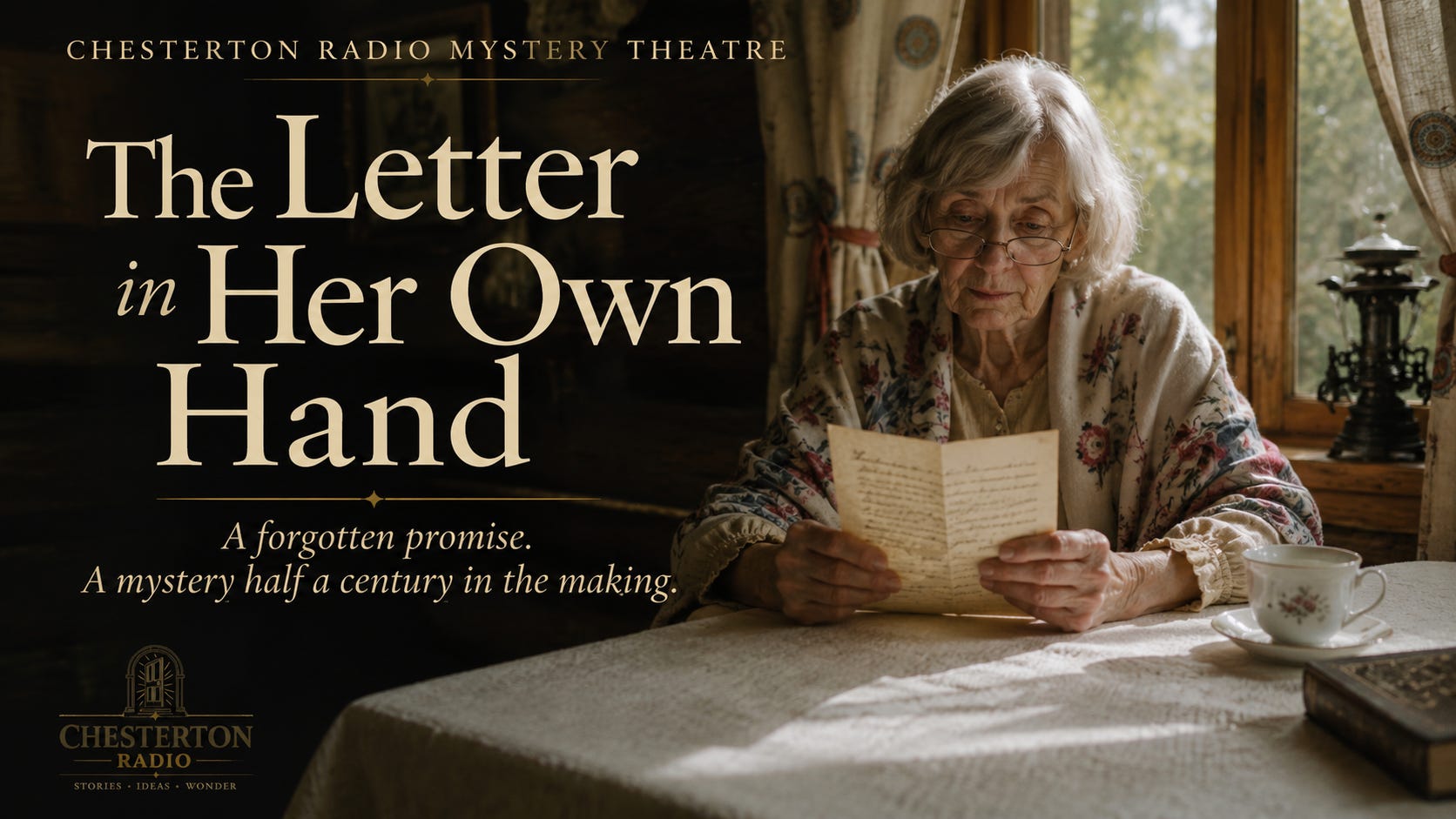
Prologue
Today's Chesterton Radio Mystery Theatre is inspired by the unforgettable style of the early CBS Radio Mystery Theater productions and the kind of intelligent, emotionally rich roles that made Agnes Moorehead one of radio's greatest actresses. This is a completely original story created in that spirit.
There are places that seem to exist just beyond the maps.
Not because they cannot be found...
...but because they can only be discovered.
One of those places stands on Commercial Street in Atchison, Kansas.
It is a narrow brick building with books on its shelves, coffee on the stove, and an old brass bell above the front door.
People come there carrying questions.
Sometimes they leave with answers.
More often, they leave with better questions.
This is the Little Station on Commercial Street.
The bell has just rung.
Someone has stepped inside.
And, as often happens in such places...
another mystery is about to begin.
Tonight’s story is called...
The Letter in Her Own Hand.
Some letters bring news.
Some bring comfort.
And once in a great while...
one arrives carrying a question that has been waiting many years to be asked.
Chapter One
Tuesday Morning
There are people who measure their lives by birthdays.
Others by Christmases.
Eleanor Vale measured hers by the first day of school.
For thirty-nine years she had stood at the front of Room Twelve in St. Matthew’s School, greeting children who were always a little taller than the year before and never quite as nervous as they believed themselves to be. Even after her retirement, September still felt like the beginning of the year. January was merely winter. September was possibility.
Now, at seventy-eight, she no longer owned a classroom, yet the habit remained.
Every Tuesday she polished the brass mail slot in the front door.
No one knew why.
Not even Eleanor herself.
Perhaps because her father had done it.
Perhaps because it gave her something useful to accomplish before breakfast.
Or perhaps because there was a quiet satisfaction in caring for small things that everyone else overlooked.
Her house stood halfway up North Fourth Street, where the older homes looked down toward the Missouri River as though they had been keeping watch for generations. It was not the largest house on the block, nor the grandest, but it possessed that rare quality of appearing exactly where it belonged.
Its floors creaked honestly.
Its windows rattled in a Kansas wind.
Its front porch had welcomed more conversations than Eleanor could ever hope to remember.
She loved it for all those reasons.
Others loved it because they imagined what it might sell for.
That, she thought, was one of the sadnesses of growing old. A place that had once been a home slowly became real estate in the minds of younger people.
The kettle began to whistle.
She removed it from the stove, poured boiling water into a blue china teapot, and carried both tea and toast to the dining room overlooking the street.
Tuesday was always correspondence day.
Former pupils still wrote to her.
Some were grandparents themselves.
One sent postcards from every country she visited.
Another telephoned every Christmas without fail.
A third still addressed every envelope exactly as he had written examination papers forty years earlier:
Miss Eleanor Vale
Please excuse my handwriting.
She smiled whenever that one arrived.
At precisely half past eight, the mail dropped through the brass slot.
One envelope landed on the hall rug with a sound unlike the others.
Heavier.
Thicker.
She noticed it immediately.
Years of correcting essays had taught her that unusual things often announced themselves in very ordinary ways.
The postman had delivered four envelopes.
The electric bill.
A circular from the historical society.
A postcard from Florence, where Susan Harding appeared determined to visit every cathedral in Europe before her knees surrendered the argument.
And one cream-colored envelope.
No return address.
No postage meter.
Only a proper stamp and careful handwriting.
Eleanor gathered the mail and returned to the dining room.
She opened the electric bill first.
Bad news was best dispatched before breakfast.
The historical society announced another lecture on river commerce.
Susan’s postcard described an afternoon spent in the shadow of Brunelleschi’s dome and concluded, as all her postcards did, by promising to bring Eleanor a bookmark she neither wanted nor needed.
Only the cream-colored envelope remained.
She turned it over once.
Then again.
The handwriting was elegant.
Deliberate.
Curiously familiar.
She reached into the drawer of the sideboard and removed a fountain pen.
Not to write.
To compare.
She laid one of her old lesson plans beside the envelope.
The capital E leaned forward at exactly the same angle.
The tail of the y curved beneath the following letter.
Even the spacing between words possessed the tiny irregularities she had spent a lifetime unconsciously creating.
She did not think—
Someone has copied my handwriting.
She thought something much stranger.
Someone writes exactly as I do.
Eleanor frowned.
There are few things more unsettling than discovering something about yourself that you have never noticed before.
She made another cup of tea.
Only then did she fetch the silver letter opener her father had carried home from the Great War.
If the letter contained bad news, it deserved to be opened properly.
She slipped the blade beneath the flap.
The paper parted without resistance.
Inside rested a single folded sheet.
No more.
No less.
She unfolded it.
The handwriting was unquestionably hers.
Not similar.
Not convincing.
Hers.
There were only three sentences.
When Richard comes on Thursday, do not sign anything he places before you.
Trust no explanation until you have remembered the blue room.
You wrote this once. You simply do not remember writing it.
At the bottom appeared her signature.
Eleanor Vale.
She stared at it for a long time.
Then, with the quiet precision of a woman who had spent a lifetime refusing to jump to conclusions, she read the letter again.
Only after the third reading did she whisper aloud the one sentence that troubled her more than any other.
“The blue room...”
She looked slowly toward the staircase.
No room in the house had been blue for over fifty years.
Yet she knew exactly which room the letter meant.
And she had never told another living soul.
Chapter Two
The Blue Room
Eleanor remained seated at the dining room table long after the tea had grown cold.
She had spent nearly forty years teaching literature, and one lesson had repeated itself often enough to become almost a law.
The impossible should always be examined for ordinary explanations before extraordinary ones.
She read the letter a fourth time.
The handwriting was hers.
That much seemed beyond dispute.
The stationery, however, was not.
She carried the page to the front window where the morning light was strongest.
Good paper always revealed itself to sunlight.
Holding the sheet against the glass, she found the faint impression of a watermark.
WHITMORE & SONS
BOSTON
The name stirred no memory.
She crossed to the rolltop desk in the study and unlocked the lower drawer.
Inside were bundles of correspondence stretching back more than fifty years, each tied neatly with ribbon and labeled in her own careful hand.
Family
School
Church
Personal
She smiled faintly.
Former students often joked that Miss Vale could have organized a tornado.
The truth was rather simpler.
Order was merely another form of kindness toward one’s future self.
She selected the bundle marked Personal and carried it back to the dining room.
For nearly an hour she searched.
She found letters from college friends.
Christmas cards.
Condolences after her mother’s death.
The acceptance letter from St. Matthew’s School, offering her first teaching position at a salary of twenty-eight hundred dollars a year.
She even found the recipe for lemon biscuits that Mrs. Donnelly had insisted was “too valuable to trust to memory.”
But nowhere did she find another sheet bearing the Whitmore watermark.
Nor did she find a single example of the mysterious phrase.
The blue room.
She tied the ribbon once more.
Very carefully.
People often believed that careful people disliked surprises.
The opposite was usually true.
Careful people simply preferred to know which surprises deserved attention.
This one certainly did.
The blue room occupied the northwest corner of the second floor.
Its walls had been painted cream decades earlier.
The braided rug beside the bed had faded almost to gray.
Only the afternoon light still remembered the room’s former color.
Eleanor stood in the doorway for several moments before entering.
She had not slept here since she was twelve.
After her sister married, it became a guest room.
Then, gradually, a place for folded quilts, Christmas decorations, and the sort of furniture that no one wished to discard.
The letter had said only one thing.
Remember the blue room.
Not search it.
Not empty it.
Remember it.
Memory.
That was different.
She closed her eyes.
The room slowly became smaller.
The wallpaper turned blue again.
The braided rug disappeared.
Two narrow iron beds stood against opposite walls.
Margaret’s dollhouse occupied the corner.
There had been...
What?
A cedar chest.
No.
A rocking chair.
No.
She frowned.
Something beneath the window.
Something her father had built himself.
She opened her eyes.
The space beneath the window was empty.
Only an old radiator remained.
“Of course.”
She whispered it aloud.
“The window seat.”
It had been removed sometime after her father died.
She had not thought of it in thirty years.
The memory arrived so suddenly that she almost laughed.
She remembered rainy afternoons.
Reading books.
Watching freight trains along the river.
Margaret pretending the window seat was a ship crossing the Atlantic.
She even remembered the small brass latch that refused to stay shut.
A storage compartment.
Built into the seat.
Eleanor looked once more at the bare wall.
The window seat was gone.
But the floor beneath it remained.
She knelt with considerably less grace than she would have managed twenty years earlier.
The oak floorboards showed their age.
Near the wall she noticed something curious.
Three narrow boards differed slightly from the others.
The grain ran in another direction.
Almost invisible.
Unless one had known where to look.
She fetched a flashlight.
The tiny nail heads were newer.
Not modern.
Merely newer than the surrounding floor.
Someone had lifted those boards.
Long ago.
She sat back on her heels.
Her first impulse was to fetch a hammer.
Her second was to ask herself a question she had taught generations of students.
Who benefits?
Someone wanted her to remember this room.
Someone knew Richard would visit on Thursday.
Someone knew she had forgotten the window seat.
But why tell her now?
Why not last year?
Or ten years ago?
Or while Margaret was still alive?
No.
Timing mattered.
Which meant Thursday mattered.
She rose slowly and brushed the dust from her skirt.
There would be no prying up floorboards today.
Not until she understood a little more.
Curiosity had solved many mysteries.
Impatience had created even more.
That afternoon, Eleanor did something she had not done in months.
She walked to the Atchison Public Library.
Margaret Ellis looked up from the circulation desk and smiled.
“Miss Vale.”
“Margaret.”
“We’ve missed you.”
“I’ve missed being here.”
Margaret came around the desk.
“Research?”
Eleanor hesitated.
“Perhaps.”
“What are we researching?”
Eleanor smiled the way only retired teachers could smile when they intended to answer a question without actually answering it.
“I’m trying to remember something.”
Margaret laughed.
“The library has been helping people do that for a hundred and fifty years.”
Eleanor rested one hand on the polished oak counter.
“I need to know who sold stationery in Atchison twenty-five years ago.”
Margaret raised an eyebrow.
“That,” she said, “is one of the more unusual questions I’ve been asked this month.”
She motioned toward the local history room.
“I suspect the answer is waiting for us.”
As the two women disappeared among shelves of city directories and business records, neither noticed the man standing across the street.
He had been watching the library entrance for nearly fifteen minutes.
When Eleanor entered, he folded his newspaper.
Waited another minute.
Then quietly crossed the street behind her.
He did not enter immediately.
Instead, he stood for a moment beneath the library’s stone archway, looking through the glass doors with the patient expression of a man who had no intention of being remembered.
Only then did he step inside.
Chapter Three
The Photograph That Wasn’t There
Margaret Ellis had been librarian long enough to recognize the difference between curiosity and concern.
Curiosity usually arrived with a notebook.
Concern arrived with silence.
As she led Eleanor into the local history room, she noticed that her old friend carried neither notebook nor handbag—only the folded letter tucked carefully inside the pocket of her cardigan.
“I have a feeling,” Margaret said, “that you’re not really looking for stationery.”
Eleanor smiled.
“I began by looking for stationery.”
“And now?”
“I’m no longer certain what I’m looking for.”
Margaret pulled a chair away from the oak table.
“That is how most worthwhile searches begin.”
The local history room smelled pleasantly of old paper and polished wood.
Tall windows overlooked Commercial Street, where the late-morning sun had begun drying yesterday’s rain from the sidewalks.
Margaret disappeared among the shelves and returned with three city directories.
“If someone sold imported stationery in Atchison,” she said, “there’s a fair chance they also sold books or office supplies.”
She opened the first directory.
“About how old is the paper?”
Eleanor considered the question.
“The letter itself?”
Margaret nodded.
“I would guess twenty-five years.”
“Then we’ll start there.”
For nearly an hour they worked quietly.
At last Margaret tapped a listing with one finger.
“There.”
Baxter & Lowell
Books • Stationery • Fine Papers
Commercial Street
Eleanor leaned closer.
“I remember Baxter’s.”
“The old bookstore.”
“I bought fountain pen ink there for years.”
Margaret smiled.
“My first dictionary came from Baxter’s.”
Eleanor looked thoughtfully at the listing.
“If they carried imported paper...”
“They might have kept purchase records.”
Margaret’s expression became apologetic.
“They closed twenty years ago.”
“So the records are gone.”
“Not necessarily.”
Margaret disappeared once more.
When she returned, she carried a shallow archival box.
“Baxter’s donated quite a bit before they closed.”
Inside were invoices.
Advertising circulars.
Catalogs.
Order books.
Everything one might expect from a careful bookseller.
Margaret lifted the final ledger from the box.
“This lists special orders.”
She opened it near the middle.
Names filled each page.
Churches ordering hymnals.
Law firms purchasing stationery.
Teachers buying examination books.
Eleanor’s eyes drifted slowly down one column.
Then stopped.
There it was.
Miss Eleanor Vale
Three boxes of Whitmore & Sons correspondence stationery.
Delivered:
April 14.
Twenty-six years earlier.
Eleanor frowned.
“I don’t remember buying it.”
Margaret looked up.
“Are you sure?”
“I remember buying paper.”
She tapped the page gently.
“But never this paper.”
Margaret closed the ledger.
“Memory is a curious thing.”
“It is.”
“And records are sometimes better than memory.”
Eleanor nodded.
“Usually.”
“But not always.”
As they prepared to leave, Margaret paused beside a cabinet of uncatalogued donations.
“I almost forgot.”
She opened the drawer.
“There was something donated last month.”
“What sort of something?”
“A photograph.”
“Of whom?”
“We don’t know.”
Margaret withdrew a mounted black-and-white photograph.
“The donor believed it was taken somewhere on Walnut Street.”
Eleanor accepted it politely.
The picture showed a family standing on the porch of an old house.
Father.
Mother.
Two daughters.
Nothing unusual.
Then she looked again.
Her breath caught.
It was her house.
Not one like it.
Her house.
The porch railing.
The maple tree.
Even the cracked third step.
Only...
It had been taken decades before she was born.
She turned the photograph over.
Nothing.
No names.
No date.
Only a penciled number from the archives.
Margaret watched her face.
“You recognize it.”
“Yes.”
“My house.”
“You’ve seen this photograph before?”
“No.”
Eleanor hesitated.
“At least...”
She looked more carefully.
“...I don’t think so.”
Something bothered her.
Not the house.
Not the family.
The little girl standing nearest the front steps.
She looked almost exactly like Eleanor’s sister Margaret had looked at six years old.
Same curls.
Same smile.
Same white dress.
Impossible.
Eleanor counted silently.
The photograph had to be at least sixty years older than Margaret.
She turned it back over.
No date.
No photographer.
No identification.
Only the image.
Margaret leaned closer.
“What is it?”
Eleanor pointed.
“The child.”
“What about her?”
“She shouldn’t be there.”
On the walk home Eleanor carried the photograph inside one of the library’s protective folders.
She stopped twice to examine it in better light.
Each time the same detail disturbed her.
The little girl’s face.
Not because it resembled Margaret.
Children often resembled one another.
No.
It was the pose.
Head slightly tilted.
Hands clasped behind her back.
A habit Margaret had possessed all her life.
One that family photographs showed again and again.
Coincidence.
Almost certainly.
Yet the feeling refused to leave her.
She reached home shortly after three o’clock.
Richard’s car was already parked at the curb.
A day early.
He stood on the porch holding a paper sack from the bakery.
When he saw her, he smiled warmly.
“I thought I’d surprise you.”
“You have.”
“I brought cinnamon rolls.”
“Then I forgive you.”
He kissed her cheek.
For a moment Eleanor simply looked at him.
Richard had his mother’s kind eyes.
His father’s careful manners.
He had never given her reason to doubt him.
Which somehow made the letter even more troubling.
He held the front door open.
“Everything all right?”
Eleanor smiled.
“Perfectly.”
She slipped the library folder beneath her arm before he could see the photograph inside.
As they entered the house, the grandfather clock in the hall struck four.
Neither of them noticed the cream-colored envelope lying just inside the mail slot.
It had arrived while Eleanor was away.
Like the first one, it bore no return address.
Like the first one, it was addressed in Eleanor’s own unmistakable hand.
Only this one contained a single sentence.
You have remembered too late.
Chapter Four
The Letter That Was Never Sent
Eleanor finally lifts the floorboards in the blue room.
Inside she discovers:
her mother’s tin document box,
old family papers,
a diary,
and several letters tied with blue ribbon.
One letter is unfinished.
It is in Eleanor’s handwriting.
She truly did write it.
Twenty-six years ago.
She simply never finished it.
As she reads her own words, memory returns.
Her sister Margaret had begun showing signs of memory loss years before anyone understood what was happening.
One afternoon Margaret became frightened.
She insisted Eleanor write a letter.
“If I forget,” she had said, “promise you’ll remember for both of us.”
The letter was meant for Eleanor herself.
Not for anyone else.
A reminder for the future.
It warned her never to sign away the house until she had looked beneath the window seat.
But before the letter was finished, Margaret became ill.
The letter was folded away with the family papers.
Never mailed.
Never found.
Until now.
Meanwhile...
Richard arrives.
Eleanor quietly asks him why he wanted the appraisal.
Instead of becoming defensive, he is hurt.
He explains that a developer has been buying every property on the block.
He feared Eleanor would receive a poor offer from someone else.
He wanted an independent appraisal to protect her.
Suddenly...
the reader realizes we have suspected the wrong person.
The final puzzle remains.
Who mailed the letter?
Eleanor looks again at the envelope.
Then at the old unfinished letter.
The answer is almost embarrassingly simple.
Years ago...
after Margaret’s funeral...
Eleanor herself had copied the unfinished draft onto fresh stationery.
Addressed it to herself.
Sealed it.
Asked Margaret Ellis—then a young librarian—to mail it if Eleanor ever began forgetting as Margaret had.
Margaret Ellis never mailed it.
She kept the promise.
Until Richard mentioned that Eleanor had become increasingly forgetful.
Only then did Margaret quietly post the letter.
Not to deceive Eleanor.
To help her remember.
Epilogue
Richard and Eleanor remove the last of the floorboards.
Inside the old window seat compartment is not money.
Not jewels.
Not a deed.
Just family photographs.
Letters.
A pressed violet.
Children’s drawings.
The ordinary treasures of a lifetime.
Richard laughs.
“We tore up the floor for this?”
Eleanor smiles.
“No.”
She picks up one of Margaret’s letters.
“We tore up the floor...”
“...to remember why this house is worth keeping.”
Chesterton Radio Mystery Theatre
Closing
Every mystery begins with a question.
The fortunate ones end with an answer.
The best ones leave us with something even greater.
A deeper understanding of ourselves.
This evening’s mystery was never really about an old letter.
It was about memory.
About promises.
And about the quiet ways in which love sometimes protects us long after the people who made those promises are gone.
The greatest treasures are seldom the ones hidden beneath floorboards or locked away in forgotten boxes.
More often, they are the ordinary things we nearly overlook until someone reminds us to see them again.
If you should ever find yourself walking along Commercial Street, listen carefully.
You may hear the old brass bell above the station door.
If you do...
come in.
The coffee is warm.
The conversation has already begun.
And there will always be room for one more friend around the table.
Until next time...
good night from the Little Station on Commercial Street.
And thank you for spending another evening with Chesterton Radio Mystery Theatre.