

Every station has a story.
Some begin with transmitters and antennas. Some begin with business plans. Some begin with a frequency on a dial.
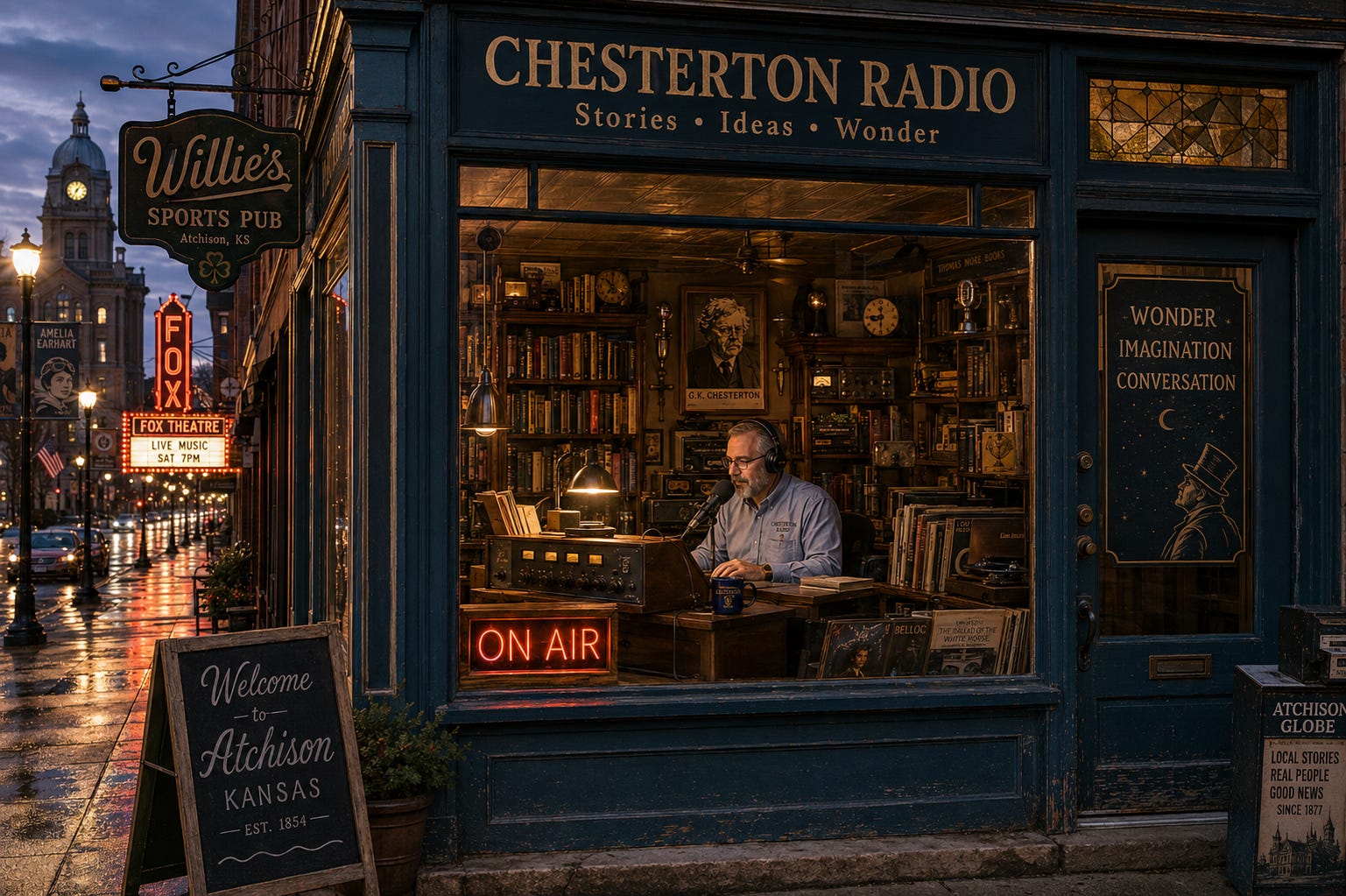
This one begins on a rainy evening in a small river town in northeastern Kansas.
At least, that’s where it appears to begin.
What follows is not a history of Chesterton Radio, nor a description of what we broadcast. It is an attempt to describe something more elusive: the kind of place a station can become when stories matter, conversations linger, and wonder is still welcome.
Welcome to the little station on Commercial Street.
Rain had a way of changing downtown Atchison.
During the day Commercial Street belonged to commerce. Delivery trucks stopped and started. Store owners swept sidewalks. People hurried from one errand to the next beneath the brick facades that had stood watch over the Missouri River valley for more than a century. The town remained handsome in daylight, but daylight emphasized function. Buildings became businesses. Streets became routes from one destination to another.
It was after sunset, particularly on rainy evenings, that the older magic returned.
The pavement darkened and began to reflect the lamps. Storefront windows glowed against the gathering dusk. The Fox Theatre marquee cast red and gold light across the wet street, transforming puddles into pools of color. Voices drifted from Willie’s Sports Pub, muffled by the weather and the thick brick walls. Farther up the hill, the courthouse clock tower rose above the town as it always had, unconcerned by traffic, politics, or the passing fashions of the age.
The rain that evening had begun shortly before sundown. Nothing dramatic. Just a steady summer rain, enough to send most people indoors and leave the sidewalks nearly empty.
Halfway down the block a narrow storefront remained brightly lit.
The sign above the entrance was simple.
CHESTERTON RADIO
Stories • Ideas • Wonder
The windows were large enough for passersby to see almost everything inside. There were bookshelves along the walls, old radios on display, framed photographs, a turntable, and more books than seemed practical for any ordinary business. Warm light spilled across the sidewalk.
Most evenings someone paused at the window.
Some came inside.
Others simply looked for a moment before continuing on their way.
There was something difficult to categorize about the place.
It was not quite a bookstore.
Not exactly a studio.
Not really a museum.
The station occupied the strange territory between things.
A place built less around transactions than conversations.
Inside, a small red ON AIR sign glowed above a doorway.
A microphone stood ready behind a desk crowded with books, notes, coffee mugs, and the accumulated clutter that gathers around people who spend their lives collecting ideas. G.K. Chesterton occupied one shelf. C.S. Lewis stood nearby. Tolkien was present, as one would expect. Belloc was impossible to avoid. Wodehouse smiled from the spine of a well-worn volume. Old radio scripts filled a cabinet beside recordings whose original performers had been gone for decades.
Nothing matched.
Everything belonged.
The station possessed the sort of order that only emerges after years of use.
A stranger entering for the first time might have assumed it had always been there.
Perhaps that was part of the illusion.
Places that become meaningful often acquire an appearance of permanence. We forget they were once new. We forget someone had to imagine them before they existed.
A little after seven o’clock, a young man pushed open the door and stepped inside carrying the smell of rain with him.
He looked around uncertainly.
“Are you open?” he asked.
The question seemed reasonable enough.
There were no price tags visible. No inventory. No obvious indication of what one was expected to buy.
The person behind the microphone laughed.
“We’re always open.”
The visitor smiled politely, though he clearly wasn’t sure whether the answer was serious.
As it happened, it was.
The station broadcast around the clock. Stories, dramas, mysteries, old radio plays, books, essays, music, conversations. Some listeners tuned in intentionally. Others discovered it accidentally while searching for something else entirely.
The accidental listeners often became the most devoted.
The young man wandered toward the bookshelves.
A few minutes later he was holding a copy of Orthodoxy and asking the sort of questions that begin with books and end somewhere entirely different.
That happened frequently.
Conversations rarely remained where they started.
Someone might arrive asking about an old detective serial and leave discussing architecture. Another might come looking for information about a radio actor and end up talking about history. A college student might discover Chesterton. An engineer might find himself defending poetry.
No one planned these conversations.
They emerged naturally from the peculiar chemistry that occurs whenever books, stories, and curious people occupy the same room.
Outside, the rain continued falling against the windows.
Inside, the discussion moved from Chesterton to Lewis, from Lewis to Tolkien, and from Tolkien to the curious modern tendency to treat imagination as something optional rather than essential.
The young visitor eventually glanced at his watch and seemed surprised by the time.
“I should probably get going,” he said.
But he lingered another twenty minutes.
People often did.
The station had become one of those increasingly rare places where nobody seemed eager to hurry anyone else away.
Not long ago such places were common.
Every town possessed a few.
The local diner.
The corner bookstore.
The hardware store where half the customers appeared to be there primarily for conversation.
The church basement that hosted everything from scout meetings to community dinners.
The front porch where neighbors gathered after sunset.
Many of those places still exist, of course. Yet fewer than before.
Some have vanished entirely.
Others survive physically while the habits that once animated them have quietly disappeared.
The loss is difficult to measure because it rarely announces itself dramatically. A building remains standing. A business continues operating. Yet something subtle changes. The sense that one may enter without a specific purpose gradually fades.
Modern life excels at efficiency. It is less enthusiastic about lingering.
A person can accomplish nearly anything without speaking to another human being. Groceries arrive at the front door. Books appear instantly on screens. News, entertainment, correspondence, and commerce all travel through the same devices.
Convenience has solved many problems.
It has also introduced new ones.
Among them is the strange experience of being connected to everyone while feeling accompanied by no one.
The distinction becomes clearer inside a place like Chesterton Radio.
Late that same evening an email arrived from a listener in Yorkshire.
The message was brief.
The writer explained that he had discovered the station while recovering from surgery several months earlier. Sleep had been difficult. Television held little interest. One night he stumbled across an old radio mystery being streamed from somewhere in America.
He listened to the entire program.
The following night he listened again.
Soon the station became part of his routine.
The note concluded with a sentence that appeared often in one form or another.
“It feels like somebody is keeping the light on.”
No business consultant would recommend building an enterprise around such an observation.
Yet that sentence contained something important.
The listener was not describing content.
He was describing companionship.
The difference matters.
Most discussions about modern media focus on information, entertainment, technology, distribution, monetization, or audience growth. These subjects are not unimportant. Radio stations require transmitters. Websites require servers. Programs require production. Every practical undertaking eventually encounters practical questions.
Yet none of those realities fully explain why a man recovering from surgery in England might feel comforted by an old detective drama originating from a storefront studio in Kansas.
The explanation lies elsewhere.
Stories create a peculiar kind of company.
Not because they eliminate solitude, but because they remind us that solitude is not the same thing as isolation.
A person reading Dickens participates in a conversation that began before he was born.
A listener enjoying a radio drama from 1948 enters a world inhabited by writers, performers, musicians, and audiences separated from him by decades.
The participants may be gone.
The conversation continues.
Perhaps that is why old stories remain alive.
Not because they are old.
Because they still speak.
The rain finally began to ease around nine o’clock.
Commercial Street grew quieter.
The reflections beneath the Fox Theatre shimmered in the darkness. Traffic diminished. Storefront lights blinked out one by one.
Inside the station, however, another program was beginning.
Somewhere beyond the windows and beyond the river and beyond the darkened plains stretching toward the horizon, listeners were gathering.
Some were settling into bed.
Some were beginning night shifts.
Some were reading.
Some were working.
A few were almost certainly falling asleep in chairs before the end of the broadcast.
The remarkable thing was not that they were listening to the same program.
The remarkable thing was that they had somehow arrived at the same place.
And like many worthwhile places, its boundaries were larger than they first appeared.
The longer one spends around stories, the more one begins to suspect that preservation and creation are not nearly as different as they first appear.
People often imagine preservation as a backward-looking activity. They picture museums, archives, climate-controlled rooms, and shelves of carefully cataloged artifacts. There is certainly some truth in that image. The past has a way of disappearing unless someone makes a conscious effort to save it.
Yet the deepest forms of preservation are surprisingly active. They involve less dusting than sharing.
A story survives because someone tells it again.
A book survives because someone recommends it.
A song survives because someone sings it.
A radio drama survives because, decades after its original broadcast, another listener discovers it and decides it still matters.
The shelves inside Chesterton Radio were filled with examples of this peculiar form of inheritance. Every volume represented a conversation that had somehow managed to outlive its own era. Every recording had traveled across years that its creators could never have imagined.
The process felt strangely familiar to anyone who had spent time building machines.
There is a particular satisfaction that accompanies the completion of a well-designed piece of equipment. Engineers know the feeling. After months or years of drawings, calculations, meetings, revisions, fabrication, testing, and troubleshooting, a machine finally begins to operate as intended. Motors start. Conveyors move. Components align. Something that previously existed only in the imagination suddenly occupies physical space.
The achievement is real.
Yet every experienced engineer eventually discovers that the machine itself is not the entire accomplishment.
What matters is what the machine makes possible.
A bridge matters because people cross it.
A factory matters because it produces something useful.
A water system matters because families depend upon it.
The object serves a purpose beyond itself.
Stories operate according to the same principle.
The story is not the destination.
It is the bridge.
Its purpose is connection.
Connection between generations.
Connection between strangers.
Connection between the present and the accumulated wisdom of the past.
The realization arrived gradually for many who found themselves drawn to the station.
Some came because they loved old radio.
Some came because they loved books.
Others arrived through entirely different routes.
One retired machinist wrote regularly from Ohio. He had spent four decades working around mills, lathes, grinders, presses, and assembly equipment. Most evenings he listened while restoring antique tools in a workshop behind his house. His messages rarely discussed philosophy. Instead he described projects. A drill press rescued from a scrapyard. A vise rebuilt after years of neglect. A machine restored not because it was valuable but because it deserved another chance to do the work it had been designed to do.
There was something deeply Chestertonian about that instinct.
Modern culture often assumes that replacement is easier than restoration. Frequently it is.
But easier and better are not identical concepts.
Some things acquire value precisely because they endure.
Old tools.
Old buildings.
Old friendships.
Old stories.
Commercial Street itself seemed built upon that understanding.
The storefronts lining the street had survived wars, depressions, economic booms, technological revolutions, and social transformations that would have seemed unimaginable to their original builders. Generations had occupied those spaces. Businesses had come and gone. Yet the street remained recognizably itself.
Atchison possessed a habit of remembering.
The Amelia Earhart banners fluttering above the sidewalks were reminders of that fact. Earhart’s story remained woven into the town’s identity not because the past was being preserved under glass but because it continued to be told. Children still learned it. Visitors still encountered it. Residents still regarded it as part of the place they called home.
The same principle applied on a smaller scale inside the station.
A detective serial from 1947 remained alive because someone was still willing to listen.
A forgotten essay remained alive because someone was still willing to read it.
A neglected book remained alive because someone continued recommending it to friends.
Culture survives through affection.
The realization stands somewhat at odds with modern assumptions. We often imagine civilization being maintained by institutions, regulations, policies, and systems. These things matter, certainly. But beneath them lies something more fundamental.
People preserve what they love.
A library exists because someone loved books.
A church survives because someone loved its traditions.
A town remains beautiful because someone cared enough to maintain it.
A radio station endures because listeners believe it is worth keeping alive.
Late one autumn evening, a young woman entered the station carrying a backpack and a notebook. She explained that she was a student at Benedictine College and had heard someone mention Chesterton during a class discussion.
“I’ve never actually read him,” she admitted.
The confession carried no embarrassment. It was simply a statement of fact.
A few minutes later she left carrying a copy of The Everlasting Man.
Several weeks passed.
Then she returned.
The conversation that followed lasted nearly an hour.
The book had not answered every question. No worthwhile book ever does. What it had done was awaken curiosity. One question had led to another. One author had led to another. One idea had opened a door into a larger intellectual landscape.
Such moments occurred often enough that they ceased to feel unusual.
Yet they remained remarkable.
The world contains countless systems designed to maximize attention. Far fewer are designed to cultivate curiosity.
Attention is immediate.
Curiosity unfolds over time.
One produces engagement.
The other produces growth.
The distinction may explain why so many listeners described the station as calming.
Calm is not generally regarded as a competitive advantage in modern media.
Excitement performs better.
Urgency performs better.
Outrage performs exceptionally well.
Wonder operates more slowly.
It asks less of the nervous system and more of the imagination.
A person listening to a mystery from the 1940s is not receiving breaking news. A person reading Chesterton is not being optimized for engagement. A person sitting quietly with a story is participating in one of humanity’s oldest forms of leisure.
The experience feels increasingly rare.
Perhaps because genuine leisure has become rare.
Not idleness.
Leisure.
The older understanding of leisure involved attention freely given to things worth contemplating. Books. Music. Friendship. Conversation. Beauty. Questions without immediate practical application.
Many of the best moments at the station emerged from precisely that sort of attention.
An evening spent discussing a novel.
A listener writing from Australia about a radio drama.
A retired teacher recommending a forgotten book.
An engineer attempting to explain why machine design and storytelling seemed strangely related.
None of these activities produced measurable efficiencies.
Yet all of them contributed to the kind of life people quietly long for.
As midnight approached, the station settled into its familiar rhythm.
The streets outside had emptied almost completely. Rainwater still glistened in the cracks between the old bricks. The Fox Theatre had gone dark. The laughter from Willie’s had faded. The courthouse clock continued its patient accounting of the hours.
Inside, however, the lights remained on.
A story was playing through the studio monitors. Somewhere across the ocean a listener in England was probably hearing the same voices. Somewhere in Australia morning had already arrived. Somewhere a truck driver was crossing a state line. Somewhere a student was studying later than intended. Somewhere a widower sat alone in a quiet house with the radio keeping company.
The remarkable thing was not the technology that connected them.
The remarkable thing was the shared affection that made the connection meaningful.
No one had assigned these listeners to the same community.
No algorithm had instructed them to gather.
They had arrived independently, drawn by stories, ideas, curiosity, memory, beauty, and the lingering conviction that wonder remains one of life’s necessities rather than one of its luxuries.
The station itself appeared modest enough. A narrow storefront. A microphone. A few thousand books. Shelves of recordings. A glowing ON AIR sign.
Yet places are not measured solely by square footage.
Some occupy larger territories than maps can record.
They live partly in memory and partly in imagination. They become landmarks not because of their size but because of what happens there.
The little station on Commercial Street belonged to that category.
Long after midnight the rain finally stopped.
The clouds began to break apart above the river valley. Reflections lingered on the pavement. The town slept.
Inside the station, the microphone waited for tomorrow’s broadcasts. Books rested on their shelves. The red ON AIR light continued glowing softly against the darkness.
And somewhere, perhaps thousands of miles away, a new listener discovered the station for the first time.
A story had begun.
A door had opened.
The invitation remained what it had always been.
Come in.
Stay awhile.
There are stories here.
There are ideas here.
There is still wonder here.
Thank you for visiting the little station on Commercial Street.
If this essay resonated with you, I hope you’ll spend some time exploring the stories, dramas, books, and conversations that fill the shelves of Chesterton Radio.
Like the station itself, this publication exists because readers and listeners choose to keep the light on.
And whether you’ve been here for years or have only just arrived, you’re always welcome.
The door is open.