

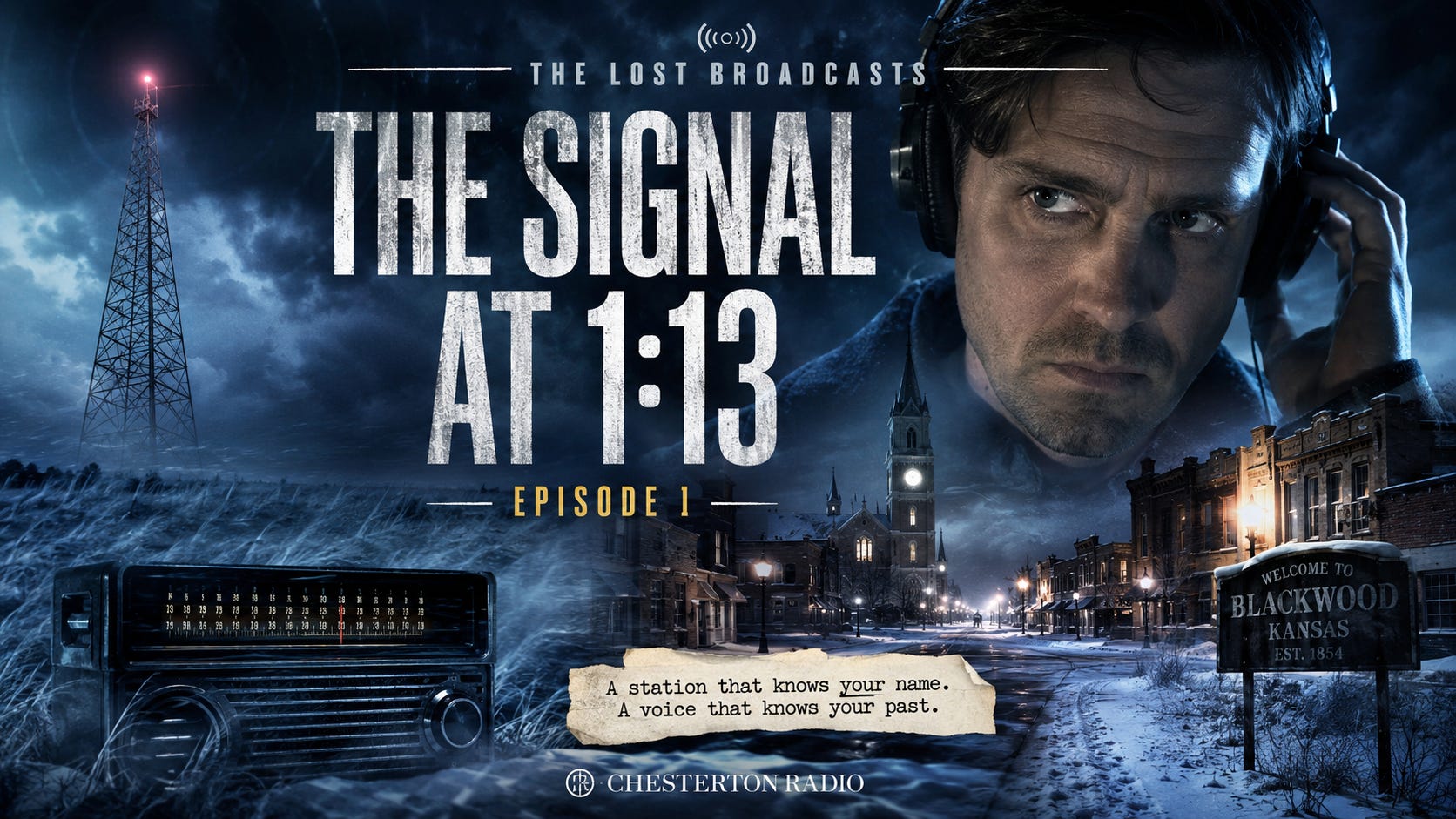
Editor’s Note — Chesterton Radio Archive Division
The following account is taken from a damaged transcription sleeve acquired during the liquidation of a defunct radio equipment warehouse outside St. Joseph, Missouri, in 1998.
The original reel was unlabeled except for a strip of masking tape bearing the words:
DO NOT REBROADCAST.
Internal references suggest the events occurred somewhere near the Kansas-Missouri border during the winter of 1958. No FCC registration has ever been located for the station repeatedly named in the recording.
The call letters, when they appear, are always the same:
WBLK.
I. The Signal at 1:13
There are some towns that seem to sleep at night, and others that merely pretend to.
Blackwood, Kansas, belonged to the second kind.
By day it was ordinary enough: a brick courthouse, two drugstores, a feed mill, a Catholic college on the hill, and a railroad line that cut through the lower part of town like a scar that had learned to whistle. Farmers came in on Saturdays. Students crossed the square in wool coats. The parish bells of Saint Agnes rang the Angelus with such punctuality that even men who had lost the faith still set their watches by it.
But at night, especially in winter, Blackwood became larger than itself.
The snow flattened the fields into one white silence. The river vanished under fog. The houses withdrew behind yellow windows. And beyond the last grain elevator, where the road bent north toward the wheat fields, the telephone poles marched away into the dark like black crosses.
It was on such a night, in January of 1958, that Thomas Vale first heard about the station that did not exist.
He was alone in the control room of KBRX, the little local station above Schneider’s Hardware, trying to keep a transmitter alive through a storm that had no respect for engineering. The wind came hard against the windows, hissing under the frames and rattling the loose glass in its putty. On the desk before him sat three coffee cups, a folded copy of Popular Electronics, and a half-disassembled microphone that had been dropped by an announcer who drank when he was happy and drank more when he was sad.
Thomas had the engineer’s habit of stillness. He did not fidget. He did not whistle. He listened.
A man who had worked signals in the Army learned that the world was never silent. It hummed, clicked, pulsed, faded, carried. The air was full of ghosts, though Thomas did not use the word. To him they were skip, harmonics, bleed, induction, weather interference, electrical leakage, and bad grounding. He believed every mystery had a chassis.
At 1:08 in the morning, the phone rang.
Thomas let it ring twice, not because he was dramatic, but because he disliked being summoned by machines. Then he picked it up.
“KBRX.”
For a moment there was only breath.
Then a woman said, “Is this the radio station?”
“It is.”
“Are you playing music?”
Thomas looked through the glass toward the empty studio. The turntables were still. The red ON AIR lamp was dark.
“No, ma’am. We signed off at midnight.”
“There’s music on my radio.”
“That wouldn’t be us.”
“It’s not like other music.”
Thomas leaned back in his chair. “What frequency?”
“I don’t know. Between stations. My husband used to tune it there when he couldn’t sleep. It’s all static usually. But tonight there’s music.”
“Could be Kansas City carrying in under the weather.”
“No,” she said.
It was the way she said it that made him sit forward.
“What’s your name, ma’am?”
“Mrs. Bell. Margaret Bell. I live on Whitaker Street.”
“What kind of music is it?”
“I don’t know. Strings. Like something from church, only not church.”
Thomas reached for a pencil.
“And you’re sure your set isn’t picking up a local record player? Sometimes wiring—”
“It said my name.”
The pencil stopped.
“Say that again.”
“The radio said my name.”
The wind pressed hard against the window. Somewhere below, the hardware store sign creaked on its chains.
Thomas looked at the wall clock.
1:11.
“Mrs. Bell, turn the set off.”
“I did.”
“And?”
“It kept playing.”
Thomas stood.
“How can a radio keep playing when it’s off?” she asked.
He had several answers. Capacitors. Faulty switch. Residual current. A frightened woman misremembering what she had done.
He gave none of them.
“Unplug it.”
There was a rustle at the other end of the line. A distant thump. Then silence.
“Mrs. Bell?”
Her voice returned, smaller now.
“It stopped.”
“All right. Leave it unplugged until morning. Bring the set by the shop if you want me to look at it.”
“It wasn’t the set.”
Thomas rubbed his eyes.
“What did it say?”
There was another pause, and when she answered, her voice had changed. It had become formal, almost embarrassed.
“It said, ‘Margaret, he waited for you.’”
Thomas waited.
“Who waited?”
“My son.”
The line clicked dead.
Thomas remained standing with the receiver in his hand. He had known Margaret Bell by sight. Everyone in Blackwood knew everyone else by sight, which was one of the town’s punishments. Her son had drowned in the Missouri River nine years earlier, in spring floodwater. There had been talk at the time that he had gone down near the ferry landing while his mother was visiting her sister in Omaha. There had been no scandal in it, only sorrow, and sorrow was the one thing Blackwood knew how to file away neatly.
Thomas replaced the receiver.
At 1:13, the static monitor on his bench crackled.
He turned.
The monitor was an old table set he kept for checking reception in town. Its dial light was dim and amber. He had left it tuned near 700, where it usually picked up a St. Louis station when the sky was right.
Now it hissed with wide, white static.
Then music emerged.
Not loudly. Not clearly. It came up as if from the bottom of a well.
Strings, yes. Mrs. Bell had been right about that. But not the lush strings of a radio orchestra. These were thinner, more distant, like four musicians playing in a cold room.
Thomas moved closer.
The melody had a peculiar quality. It seemed almost familiar, but whenever the mind reached for it, it withdrew. A hymn? A folk tune? A fragment of something heard in childhood?
He adjusted the dial.
The music remained.
He turned the volume down.
The music remained.
He switched the set off.
For one second it continued.
Then it died.
Thomas stood very still.
He opened the back of the set, touched the tubes, checked the wiring, examined the switch. Nothing was unusual. Nothing explained the extra second.
He almost laughed at himself. One second of bleed from a failing switch, and here he was standing like a farm boy before a ghost story.
He closed the set.
The phone rang again.
This time it was Mr. Laird, who owned the funeral home.
Then Miss Halpern, a schoolteacher.
Then old Ben Reese from the south road.
Each call was different, and each was the same. Music between stations. Voices under the static. A sentence addressed to the listener by name.
Mr. Laird had heard his dead wife asking why he had sold her piano.
Miss Halpern had heard children reciting the lesson she had skipped on the last day before Christmas vacation, the year the schoolhouse stove exploded and killed two boys.
Ben Reese had heard a baseball game from 1927, called by his own father, though his father had been a wheat farmer and had never called a baseball game in his life.
Thomas wrote down every word because writing things down made them less supernatural.
At 1:47, the calls stopped.
The snow thickened.
At 2:10, Thomas climbed the stairs to the roof, carrying a flashlight and a canvas coat he should have replaced years earlier. The wind struck him sideways as he stepped out into the dark. The town lay beneath him, dim and muffled. A few windows still burned. The church tower rose above the roofs, black against the snow, and beyond it the college buildings huddled on the hill.
He turned slowly, listening.
To the east, the railroad signal blinked red.
To the west, the fields vanished.
Somewhere beyond them, or above them, or inside the weather itself, a station had spoken.
Thomas did not believe that.
He believed in illegal transmitters. In pranksters. In amateur operators with too much equipment and too little sense. In atmospheric inversion. In grief.
Especially grief.
Grief could tune a man to frequencies no instrument registered.
He went back inside.
By morning, Blackwood had begun to explain the thing away.
It was interference from Kansas City.
It was sunspots.
It was a college prank.
It was Communist propaganda.
It was a hoax by boys from Saint Ignatius Hall, who were known to possess both wire and stupidity.
At eight o’clock, Thomas opened the station office and found three people waiting in the hall.
Margaret Bell was not among them.
The first was Miss Halpern, who wore a hat with a net veil and had the rigid posture of a woman prepared to be disbelieved. She brought her radio in a grocery sack. Thomas tested it while she watched.
The set worked perfectly.
“You think I imagined it,” she said.
“I think people hear things at night.”
“That is not the same as imagining them.”
“No.”
She looked at him sharply, as if surprised by the concession.
“What did you hear, Mr. Vale?”
He said nothing.
Her face softened, which annoyed him more than suspicion would have.
“You heard it too.”
“I heard music.”
“And?”
“And static.”
She picked up her radio.
“Static is sometimes what men call a voice when they do not like what it says.”
After she left, Thomas stood alone in the shop and disliked her very much.
At ten, Father Gabriel Mercer arrived.
He came without drama, as priests often do when they are about to say something alarming. He was a tall, thin man in his late sixties, with silver hair, tired eyes, and the gentle manner of someone who had long ago learned that souls are more easily bruised than persuaded. His cassock was dusted with snow at the shoulders.
“Good morning, Thomas.”
“Father.”
“I understand there was some excitement last night.”
“That depends on who’s telling it.”
“People usually become most accurate when they are frightened.”
“Not in my experience.”
Father Mercer smiled faintly. “No, perhaps not in yours.”
Thomas wiped his hands on a rag.
“What did you hear?”
“I heard three confessions before breakfast from people who did not intend to confess.”
“That’s not an answer.”
“It is the only one I have.”
The priest stepped closer to the bench, where the table radio sat with its back removed.
“Did the station identify itself?”
“No.”
“No call letters?”
“No.”
“No announcer?”
“Not unless the Holy Ghost has hired one.”
Father Mercer did not smile at that.
Thomas regretted it at once.
“I’m sorry, Father.”
“You needn’t apologize to me. The Holy Ghost has endured worse broadcasters.”
That did make Thomas smile despite himself.
The priest looked at the radio.
“There was once a proposal for a college station here.”
Thomas glanced up.
“Here?”
“Years before your time. Before mine, nearly. Educational programming. Music. Lectures. Weather for farmers. Latin lessons, if Providence wished to reduce the audience to three.”
“What happened?”
“I don’t know. It was before the war. The project failed.”
“What were the call letters?”
Father Mercer looked out the window toward the white street.
“I believe they were WBLK.”
The letters seemed to make the room colder.
Thomas set down the rag.
“Why didn’t you mention that first?”
“Because I was hoping I had remembered incorrectly.”
“And had you?”
“No.”
Thomas reached for the station logbook and wrote the letters down.
WBLK.
They looked harmless on paper. Almost comic. Four bureaucratic letters from a vanished application.
“Who ran it?”
“I don’t know. Someone at the college, perhaps. There may be records in the library.”
“Then I’ll ask Mrs. Wren.”
At the mention of Eleanor Wren, Father Mercer’s eyes changed, not much, but enough for Thomas to notice.
“She may know.”
“She knows everything that ever happened here.”
“No,” said the priest. “Only everything that was written down.”
That afternoon, Thomas crossed the square to the Blackwood Public Library.
The library had once been a bank, and still possessed the moral architecture of money: marble floor, brass railings, high windows, and a vault in the back now used for newspapers, maps, and the town’s other forms of buried treasure. It smelled of dust, coal heat, and paste.
Eleanor Wren was at the front desk, repairing the spine of a book with the seriousness of a surgeon.
She was forty-two, though grief had made her appear both younger and older depending on the light. She had dark hair pinned carelessly, intelligent eyes, and the calm self-possession of a woman whom the town had tried and failed to reduce to a tragedy.
Her husband had disappeared ten years earlier during a winter storm.
In Blackwood, people said “disappeared” because it was kinder than “died” and less troublesome than “left.”
“Mr. Vale,” she said without looking up.
“Mrs. Wren.”
“If you are here about the radio stories, I wondered how long it would take.”
“Has everyone been in?”
“Half the town has been in. The other half is pretending not to have heard anything.”
“Which half are you in?”
She looked up then.
“The half that keeps records.”
He liked her answer.
“I need to know about a station called WBLK.”
Her hand stopped on the book spine.
It was a small movement. He would have missed it if he had not spent years watching needles twitch on signal meters.
“You’ve heard the letters?”
“Father Mercer mentioned them.”
“Of course he did.”
“You know something.”
“I know the town once applied for an educational radio license in 1931. I know the college was involved. I know there was an observatory component, though I have never understood why a radio station required an observatory. I know the project ended before broadcasting began.”
“Why?”
“That depends on which file you believe.”
“Show me all of them.”
She studied him for a moment.
“Are you investigating?”
“I’m eliminating explanations.”
“That is the least romantic definition of investigation I have ever heard.”
“I’m an engineer.”
“Yes,” she said. “That was my diagnosis.”
She led him to the back vault.
Inside were filing cabinets, rolled maps, bound newspapers, and boxes labeled in a hand that had probably belonged to three dead librarians. Eleanor moved confidently among them. Thomas admired competence wherever he found it, and in that vault she possessed more authority than the mayor.
She pulled a folder from a lower drawer.
“Blackwood College Wireless Extension Proposal. 1931.”
Thomas opened it on the table.
There were typed letters, a brittle newspaper clipping, a rough site map, and a budget sheet.
The clipping showed three men standing beside a wooden crate labeled RADIO APPARATUS. One was a priest. One was a man in spectacles. The third was younger, broad-shouldered, smiling as if the future had personally congratulated him.
The headline read:
COLLEGE TO BRING CULTURE BY WIRELESS TO FARMS AND PRAIRIE HOMES
Thomas read quickly.
Lectures. Sacred music. Agricultural reports. Emergency weather alerts. Dramatic readings. Student orchestra.
Then he found the call letters.
WBLK.
“Blackwood, Kansas,” he murmured.
“That is the official explanation,” Eleanor said.
He looked up. “There’s another?”
“There are always others.”
“What does local folklore say?”
“That BLK stood for Black Light.”
“That’s ridiculous.”
“Most folklore is ridiculous until one discovers it is only inaccurate.”
Thomas turned the page.
Several documents were missing. Not misplaced. Removed. The folder contained stubs, torn edges, and numbered references to enclosures no longer present.
“What happened to the missing pages?”
“I don’t know.”
“But you have a guess.”
“Yes.”
“And?”
“I think someone removed every document after February 1931.”
“Why?”
She took another clipping from a separate envelope and placed it before him.
This one was short.
FIRE DESTROYS COLLEGE RADIO SHED
The article reported that a small outbuilding west of town had burned during a winter storm. No students were injured. One technician was treated for burns. The proposed wireless station was expected to be delayed.
Thomas frowned.
“That’s all?”
“That’s all that was printed.”
“And what wasn’t?”
Eleanor opened a ledger.
“There are two burial records from that week at Saint Agnes. Neither death appears in the newspaper.”
Thomas read the names.
Brother Anselm Pike.
Dr. Martin Rusk.
Cause of death: exposure.
“Exposure?” he said. “During a fire?”
“Apparently.”
He sat back.
Outside the vault, a child laughed somewhere in the library, then was hushed by a mother. The ordinary sound seemed strangely intrusive.
“Where was the radio shed?”
Eleanor unfolded the site map.
Thomas leaned over it.
The map showed the college, the road, the old observatory ridge, and beyond that the wheat fields west of town. There, marked in pencil, was a small square beside a tower symbol.
No road reached it.
No power line was drawn.
Thomas stared.
“That can’t be right.”
“Why?”
“That’s nearly four miles out.”
“Yes.”
“Why build a radio shed in the middle of nowhere?”
Eleanor folded her arms.
“I was hoping you would tell me.”
Thomas traced the pencil mark with one finger.
The tower stood beyond the wheat fields.
That evening, the storm worsened.
By seven o’clock, the roads were soft with drifting snow. By nine, the courthouse clock had disappeared behind blowing white. By ten, KBRX had received so many calls about the previous night’s broadcast that the station manager, a nervous man named Curtis Dale, ordered Thomas not to discuss the matter on air under any circumstances.
“We are not going to become one of those stations,” Curtis said.
“What stations?”
“The kind people laugh at.”
Thomas looked around the shabby little office, with its cracked ceiling, unpaid invoices, and promotional calendar from a seed company.
“God forbid.”
Curtis pointed at him.
“No jokes. No ghost talk. No mystery station. We provide farm reports, school announcements, weather, church services, and respectable music. That is all.”
“At midnight we provide nothing.”
“And after midnight especially.”
Thomas stayed late again, partly because of the storm and partly because he did not want to go home.
His apartment above the station was clean, sparse, and without consolation. There was a bed, a chair, a stove, a sink, two shirts drying near the radiator, and a framed photograph turned face-down in a drawer. He rarely looked at it, but he knew precisely where it was, which was one of the ways a man continues remembering what he claims to have forgotten.
At 12:30, he checked the transmitter.
At 12:45, he set a reel-to-reel recorder beside the monitor.
At 1:00, he tuned slowly across the dial.
Static. Music from Omaha. A preacher from Texas fading in and out like judgment with poor reception. Farm prices. A dance band. Static again.
At 1:12, the needle fluttered.
Thomas stopped breathing.
There it was.
Not a station exactly. A gap. A pressure in the air. A place between signals where the static seemed organized.
He started the recorder.
The tape reels turned.
At first there was only hiss.
Then music rose.
The same strings.
This time, beneath them, a voice.
Not loud. Not theatrical. A man’s voice, calm and intimate, the voice of an announcer speaking after midnight to someone alone in a kitchen.
“Good evening,” it said.
Thomas reached for the logbook.
The voice continued.
“You are listening to WBLK.”
The pencil snapped in Thomas’s hand.
The room seemed suddenly too small.
“This is the station beyond the wheat fields.”
The signal faded, returned, deepened.
“For those who have kept vigil, for those who have forgotten why they cannot sleep, for those who have mistaken silence for peace…”
Thomas leaned closer.
“…we resume our program.”
A burst of static swallowed the next words.
Then another sound emerged.
A boy laughing.
Thomas went rigid.
No.
The laugh came again, bright, careless, familiar in a way that struck beneath thought.
He reached for the volume knob, missed it, struck the side of the radio.
The boy spoke.
“Tommy?”
Thomas shut the set off.
The room went silent.
The tape reels continued turning.
He stood there with one hand on the desk.
His heartbeat was absurdly loud.
No machine had done that. No prankster knew that voice. No one in Blackwood called him Tommy. No one living.
He forced himself to rewind the tape.
His hands were steady because panic in Thomas Vale always became precision. He threaded the tape, pressed play, and listened.
Static.
Only static.
He advanced the reel.
Static.
He played the section again.
Static.
The music was gone. The announcer was gone. The laugh was gone.
Then, near the end of the recording, beneath the hiss, one sentence emerged.
A boy’s voice.
Soft.
Clear.
Terrible.
“Thomas… why did you leave him there?”
The tape clicked.
The reel spun empty.
And outside, across the snowbound town of Blackwood, the bells of Saint Agnes began to ring.
Not once.
Not twelve times.
But thirteen.
End of Episode I
Next: Episode II — “The Voices Between Stations”
From the Desk of Chesterton Radio
There are some stories that vanish when the lights come back on.
Others linger in the room a little while longer.
We suspect this may be one of the latter.
The Lost Broadcasts is part of an ongoing Chesterton Radio archive series exploring forgotten transmissions, impossible dramas, abandoned stations, strange parishes, lonely roads, and the uneasy territory where memory, conscience, and mystery begin to overlap.
Some of these stories are fictional.
Some may not be.
Chesterton Radio is a listener-supported literary and broadcasting project based in the old river town atmosphere of the American Midwest — a place for classic radio, forgotten books, strange tales, thoughtful conversation, Catholic imagination, and companionable late-night culture for people who still believe stories matter.
Each week we recover another transmission.
Some should perhaps have remained lost.
Next Transmission
Episode II — “The Voices Between Stations”
The signal spreads across Blackwood.
More listeners hear the station.
And Eleanor Wren discovers that several documents connected to WBLK were not destroyed in the fire.
They were removed.
Deliberately.
If you would like to help keep the signal alive:
The Open Door live stream continues nightly at Live.ChestertonRadio.com
The growing Chesterton Radio library is available on YouTube
Original stories, broadcasts, and deep dives are available through the Chesterton Radio Substack
Until next time:
Keep watch by the wireless.
And if the music begins after 1:13 in the morning—
listen carefully.