

Some signals fade with distance.
Others only grow stronger.
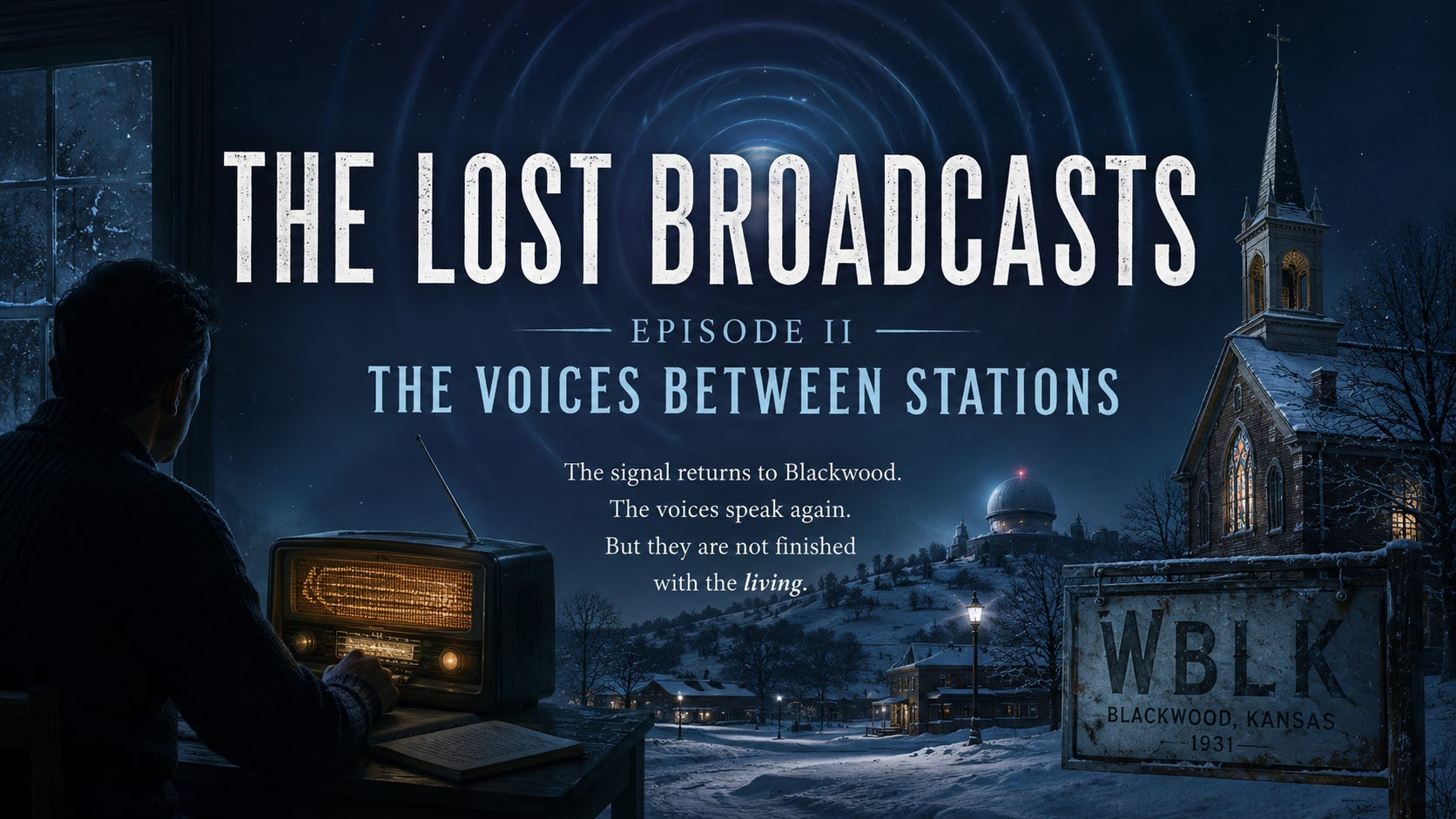
In the second episode of The Lost Broadcasts, the impossible station returns to Blackwood. More radios speak. More listeners hear what they were never meant to hear. And Thomas Vale begins to understand that WBLK may not be broadcasting from beyond the wheat fields at all.
It may be receiving something.
A literary mystery of memory, conscience, winter silence, and voices between stations.
The thirteenth bell did not die at once.
It seemed to loosen itself from the tower of Saint Agnes and travel outward through the snow, over the roofs of Blackwood, past the darkened courthouse and the shuttered shops, across the railroad line and the frozen yards where porch swings hung motionless under white crusts of ice. It went on into the fields, diminishing but not ending, as if the sound had found some other medium than air and had taken passage through wire, frost, timber, and the sleeping bones of the town.
Thomas Vale stood in the control room of KBRX with one hand resting on the recorder and the other still near the radio switch. The tape had run out, and the empty reel turned slowly now, clicking at each revolution with a dry mechanical patience that was worse than silence. He had heard bells before at impossible hours. Anyone who lived near a church eventually came to know the ordinary accidents of machinery: a rope caught wrong, a tired sacristan, a boy with a foolish sense of humor, the peculiar expansion of wood in hard weather. But no accident rang thirteen times at two o’clock in the morning, and no boy in Blackwood had climbed the bell tower in a storm merely to confirm a sentence spoken out of static.
Thomas did not move until the last vibration had left the glass.
Then he rewound the tape again.
He listened because that was what he knew how to do. He had no prayer ready, and no theory worth the dignity of speech. He had instruments, habits, and a stubborn allegiance to the measurable world. So he threaded the tape properly, set the reel, adjusted the volume, and played back the final minute.
The hiss came first, broad and ordinary. It was the sort of noise any engineer could despise safely: thermal breath, atmospheric impurity, the cottony wash of distance. Beneath it, if one wished to be fanciful, there might have been music, but Thomas would not have sworn to it. Then, almost at the end, the boy’s voice came through with the terrible intimacy of a whisper across a pillow.
“Thomas… why did you leave him there?”
He stopped the machine.
The room remained as it had been. The tubes glowed. The smell of warmed dust and electrical insulation lingered over the bench. The red lamp over the studio door was dark. A coffee cup, long cold, stood beside the folded newspaper. Nothing in the room had changed, and therefore everything had.
He did not play the sentence again.
