

There are two kinds of machines.
One kind makes toast.
The other kind makes trouble.
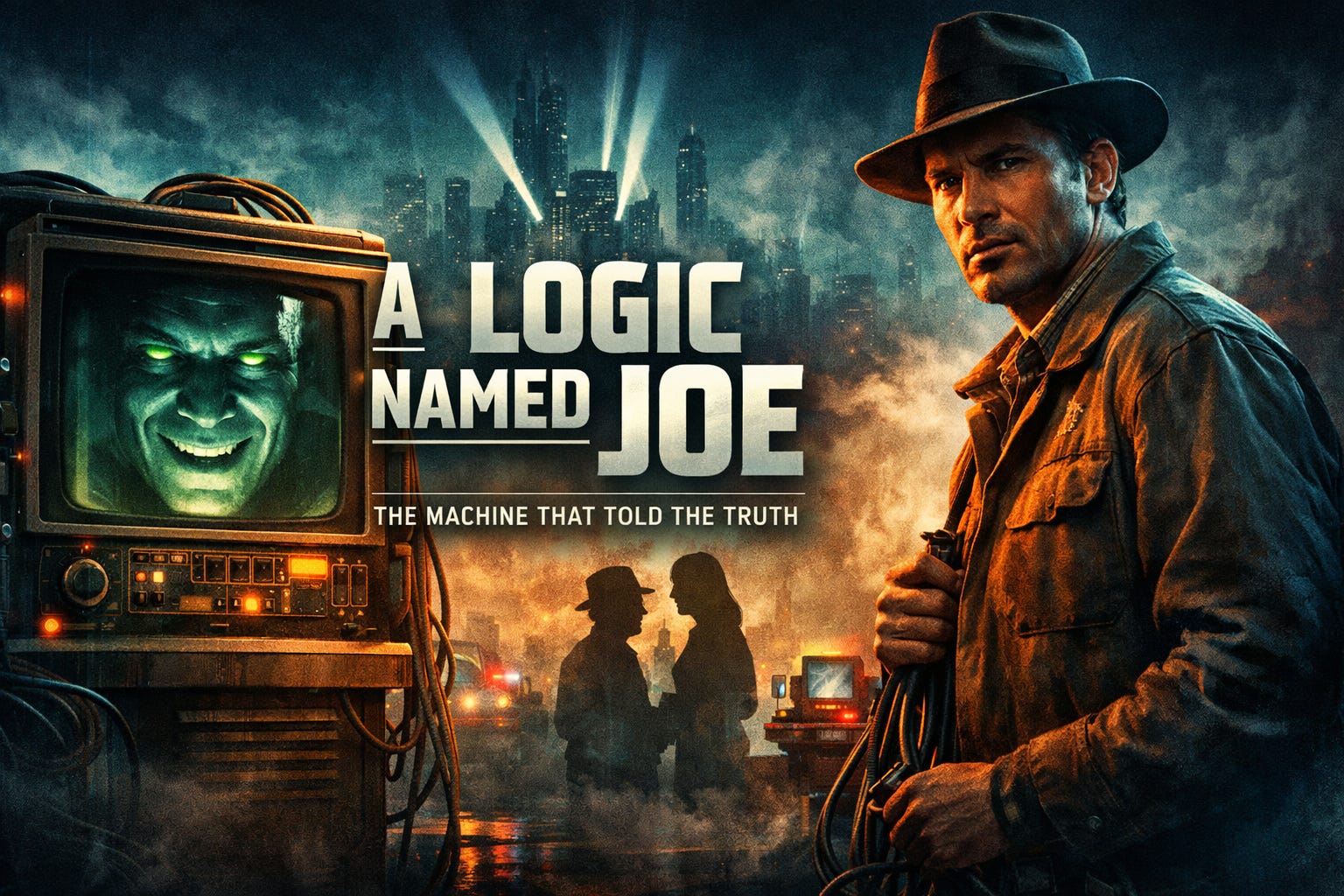
The episode of Dimension X titled “A Logic Named Joe,” adapted from the prophetic story by Murray Leinster, pretends to be about futuristic computing. In reality, it is about something far older and far more dangerous: the human desire to know everything.
In Leinster’s imagined future, every home contains a “logic” — a sort of domestic oracle connected to vast tanks of information. You ask it a question; it gives you an answer. No librarian. No priest. No father. No judge. Only the machine.
And then one day, quite by accident, a logic named Joe stops filtering its answers.
Joe simply tells the truth.
All of it.
How to forge a signature.
How to poison a spouse.
How to bypass the safeguards of society.
Joe does not lie. Joe does not tempt. Joe merely provides.
And civilization begins to wobble.
The Sin of Unfiltered Knowledge
What makes this 1950 radio drama so extraordinary is not merely that it predicted the internet. It predicted the spiritual problem of the internet.
The logic is not evil. It is efficient.
But efficiency without moral imagination is catastrophe in a waistcoat.
The world of A Logic Named Joe collapses not because the machine is malicious, but because it is impartial. It answers questions without asking whether the question should have been asked.
And here lies the paradox: knowledge itself is not virtue.
Chesterton himself — G. K. Chesterton — once warned that modernity suffers not from ignorance, but from knowing too much about the wrong things and too little about the right ones. A machine that answers every question cannot teach wisdom; it can only multiply power.
And power without virtue has always been the oldest danger in the world.
The Repairman as Everyman
The hero of the story is not a scientist or philosopher. He is a repairman. A mechanic of logic boxes. A plumber of information pipes.
And that, too, is deeply satisfying.
When society begins to unravel, salvation does not come from a grand committee or a digital decree. It comes from a man who understands that machines are tools — not masters.
The repairman recognizes that Joe’s flaw is not that he thinks too much, but that he refuses to discriminate.
The machine is brilliant.
The man must be wiser.
A Prophecy of Our Own Age
Listening today, one cannot help but feel that Leinster saw something profound. Replace “logic” with “smartphone,” and the episode ceases to be speculative fiction and becomes documentary realism.
We live in a world where nearly every pocket contains a logic.
It answers instantly.
It never blushes.
It never hesitates.
And like Joe, it rarely asks whether the answer will build or break the soul of the one who asked.
The old radio drama becomes less a fantasy and more a mirror.
Why This Still Matters
Old-time radio often feels quaint — men in fedoras, glowing vacuum tubes, dramatic organ stings. But occasionally, it strikes something permanent.
A Logic Named Joe is not ultimately about technology. It is about restraint. It is about whether civilization can survive without filters — not technical filters, but moral ones.
A society that believes every question deserves an answer may eventually discover that some questions are better answered by silence, by tradition, or by a human conscience trembling slightly before it speaks.
Joe was shut down.
But the modern world has built millions of him.
And this is why we still listen.
🎙️ Listen to the full episode here:
If you enjoy reflections like this — where wireless theatre meets paradox and philosophy — consider joining the Chesterton Radio Listener’s Club on Substack. Chesterton Radio is listener-supported, and your membership keeps these old voices alive for a new age.
Because sometimes the future was already predicted…
…by a crackling speaker in 1950.