

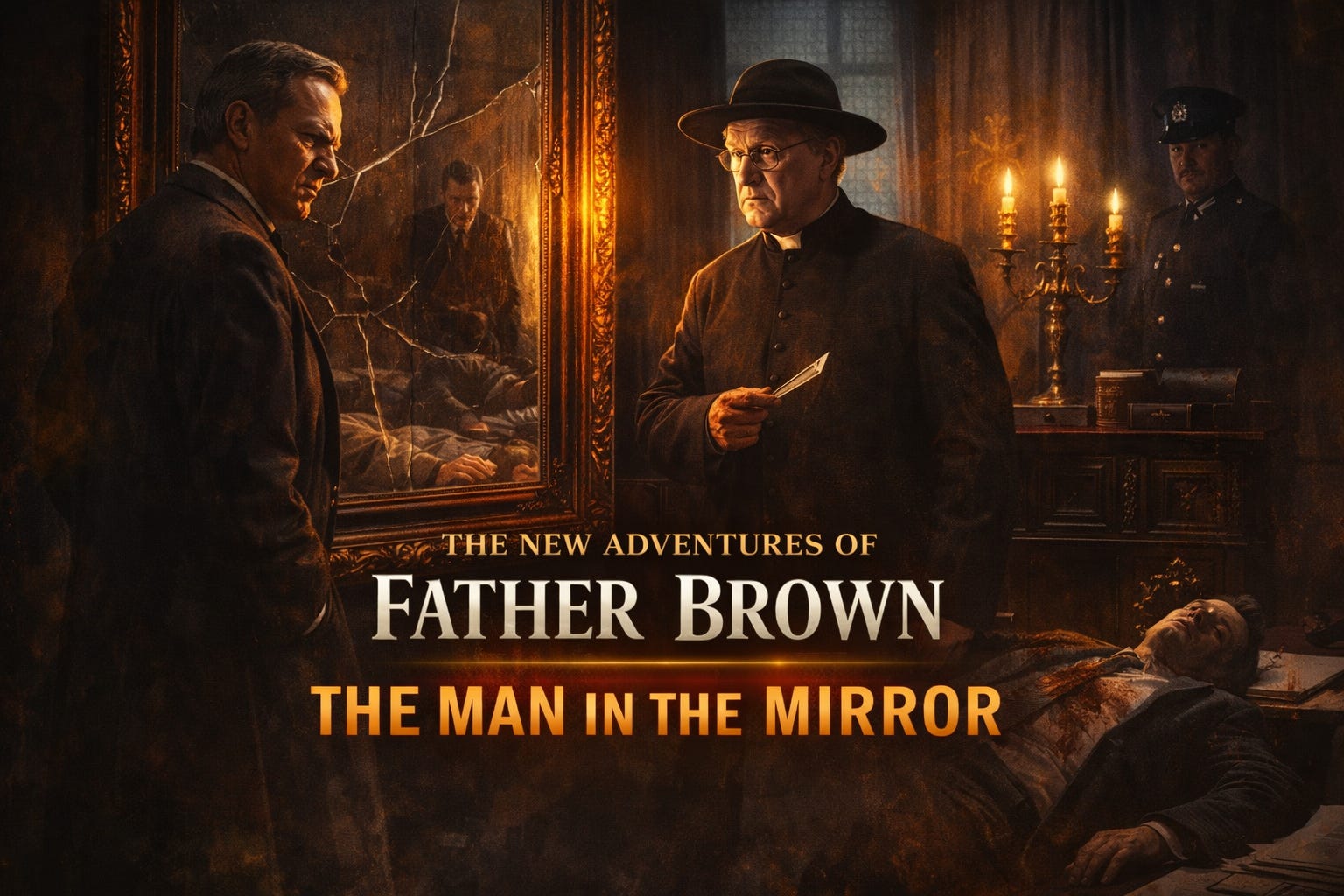
It was one of those pale English mornings that seem undecided whether to repent of the night or forgive it. A thin mist lingered along the hedgerows outside St. Bartholomew’s, and the village of Ashcombe lay quiet, as if it too were considering whether to rise and do something about its conscience.
Father Brown had just concluded Lauds.
He closed the small, worn breviary and murmured the last prayer softly: “Grant that we who seek the grace of thy protection may serve thee with a quiet mind.” Then he sighed.
“A quiet mind,” he said to himself, adjusting his spectacles. “A most dangerous possession.”
Outside, a carriage door slammed with theatrical emphasis.
Within the hour, the quiet mind would be tested.
I. The Benefactor
Sir Lionel Harbury was not a man who entered a room; he improved it by occupying it. He was tall, angular, and dressed in mourning black, though no one could quite remember who had died.
He had recently endowed the village with a new charitable trust—The Ashcombe Initiative for Moral Uplift. It involved pamphlets, lectures, and a polished brass plaque in the square inscribed with the words:
“Be Ye Doers of the Word.”
It was said Sir Lionel quoted Scripture frequently and paid for it handsomely.
“Charity must be practical,” he declared the previous evening at the town hall. “Faith without works is dead.”
He spoke the phrase as if it were a threat.
Among the assembled was one Mr. Tobias Finch, secretary to the trust—a nervous man with the aspect of someone perpetually apologizing for existing. Finch kept the ledgers. Finch kept the keys. Finch kept secrets.
At dawn, Finch was found dead in Sir Lionel’s study.
II. The Scene
Father Brown was admitted to Harbury House not because he was invited but because he was already there. He had come that morning to return a theological treatise Sir Lionel had lent him, with the intention of arguing about it gently.
The study was immaculate—so immaculate that it seemed to have been cleaned of something more than dust.
Finch lay near the great mahogany desk, a brass letter opener lodged neatly beneath his ribs. It was the sort of weapon that suggests either refinement or rehearsal.
Sir Lionel stood nearby, composed as a marble monument.
“A tragic affair,” he said coolly. “My secretary was devoted to the cause.”
“You found him?” asked the constable.
“Yes. I rise early for prayer. A discipline of mine.”
Father Brown looked around.
The desk was orderly. The safe was closed. A mirror hung above the mantel, reflecting the scene with dreadful honesty.
Father Brown gazed at the mirror rather than the body.
“Curious,” he murmured.
III. The Word and the Ledger
It emerged quickly that Tobias Finch had discovered irregularities in the charitable accounts. Certain funds designated for widows and apprentices had been redirected into “administrative restructuring.” The restructuring appeared to involve Sir Lionel’s personal estate.
Finch had written a letter.
The letter was missing.
“Finch was overzealous,” Sir Lionel insisted. “He lacked perspective. A small reallocation is not theft. It is strategy.”
“Ah,” said Father Brown softly. “A sermon with footnotes.”
Sir Lionel stiffened.
“You are suggesting—?”
“I am suggesting nothing,” said Father Brown. “Merely listening.”
The constable scratched his head. “But if Finch threatened exposure…”
Sir Lionel smiled thinly. “I hardly think murder is an efficient accounting practice.”
Father Brown continued studying the mirror.
“Efficiency is not always the motive,” he said. “Sometimes it is reflection.”
IV. The Mirror
Later that afternoon, Father Brown requested a private word with Sir Lionel.
They stood before the mantel.
“You admire Scripture,” said Father Brown gently.
“Indeed.”
“And particularly St. James.”
“Faith without works is dead.”
“Yes,” said Father Brown. “And works without faith are… noisy.”
Sir Lionel’s jaw tightened.
“You display your virtue publicly. You fund lectures. You engrave commandments in brass. But when the Word reflected something unpleasant in your own affairs, you did not straighten your collar. You smashed the mirror.”
Sir Lionel’s eyes flickered toward the mantel.
The mirror above it bore the faintest crack along its lower edge.
“When Mr. Finch confronted you,” Father Brown continued, “you argued. You grew angry. You seized the letter opener. In the struggle, you struck him.”
Silence hung like incense.
“And afterward?” Sir Lionel asked faintly.
“Afterward,” said Father Brown, “you cleaned the desk. You closed the safe. You rehearsed your innocence. But you forgot something.”
“What?”
“The mirror.”
Sir Lionel stared.
Father Brown pointed.
“When you stabbed Mr. Finch, you stood between him and the desk. The mirror shows a faint smear—there.” He leaned closer. “Blood on the lower frame. It splashed upward. You could clean the carpet, Sir Lionel. But you could not clean your own reflection.”
The great benefactor seemed suddenly smaller.
“You cannot accuse me on a smudge.”
“Oh, I can,” said Father Brown. “But I would rather accuse you of something greater.”
Sir Lionel’s voice trembled. “And what is that?”
“Of hearing the Word and not doing it.”
V. Confession
It was not dramatic. There was no shouting. No pistol drawn.
Sir Lionel sank into a chair and covered his face.
“I built the trust,” he whispered. “I told myself the money would be repaid. That the greater good justified the lesser irregularity. Finch threatened ruin. Years of work…”
“Yes,” said Father Brown. “The most dangerous words in the world are ‘for the greater good.’ They usually mean for the greater self.”
Sir Lionel gave a bitter laugh.
“I preached integrity while rearranging figures in secret.”
“Indeed,” said Father Brown. “It is surprisingly easy to fund charity. It is much harder to practice it.”
After a long silence, Sir Lionel stood.
“I will confess,” he said. “To the police. And to God.”
Father Brown nodded.
“The second confession will be more difficult. But also more hopeful.”
VI. The Quiet Mind
That evening, Father Brown returned to St. Bartholomew’s.
The village buzzed with scandal, but the church was still.
He knelt before the altar and opened his breviary again.
“Be ye doers of the word, and not hearers only.”
He smiled faintly.
“Most men,” he reflected, “prefer to admire truth at a distance. It feels safer there. Like admiring a sword from behind glass.”
He closed the book.
“But truth is not a display. It is a demand.”
Outside, the mist had lifted. The hedgerows were clear. The village square stood empty, save for the brass plaque gleaming in the evening light.
“Be Ye Doers of the Word.”
Father Brown passed it thoughtfully.
“Yes,” he said. “But begin at home.”
And with that, he went quietly about the work of the next day.
🎙 About The New Adventures of Father Brown
If you have found in this mystery something larger than murder—if you have glimpsed, beneath the shadow of crime, the brighter possibility of confession and restoration—then you have understood Father Brown better than most of the men he arrests.
The New Adventures of Father Brown continues here on Chesterton Radio, where the old wireless spirit meets new stories under the same steady lamp. These are tales not merely of whodunit, but of why we do it—and how even the most crooked conscience may yet be straightened.
Chesterton Radio is entirely listener supported. Not by grand benefactors with brass plaques, but by ordinary readers and listeners who prefer to live the Word rather than merely admire it.
If these stories have given you a mirror, a smile, or a moment of grace, consider joining the Chesterton Radio Listener Club and helping us keep the lamp lit:
👉 https://www.substack.com/chestertonradio
👉 https://www.patreon.com/chestertonradio
There are many ways to listen.
There is only one way to keep the light burning.