

There are villages in England where a stranger is noticed before he has arrived.
In Little Wychcombe this was accomplished principally by Mrs. Agnes Bell, who kept the post office, sold boiled sweets, remembered every baptism since 1898, and possessed that peculiar rural gift by which a railway ticket purchased in London could become village knowledge before its purchaser had stepped off the train.
Thus, when Father Brown came down the hill toward St. Jude’s on a wet September morning, he already knew there was a stranger in the church.
He knew it because Mrs. Bell had told him.
“He sits in the wrong pew,” she said.
Father Brown stopped.
It was characteristic of him that he did not ask what the man looked like.
“What is the wrong pew?” he asked.
Mrs. Bell looked almost offended.
“Sir Edmund Vale’s.”
“Oh.”
“And Sir Edmund knows it.”
“That makes it considerably wronger,” said Father Brown.
St. Jude’s stood at the edge of the village beneath three enormous yews. It was a little Norman church whose stones had been softened by eight centuries of rain and prayer. Inside, the air smelled of wax, old wood, damp coats and the faint mineral cold peculiar to ancient churches.
The stranger was there.
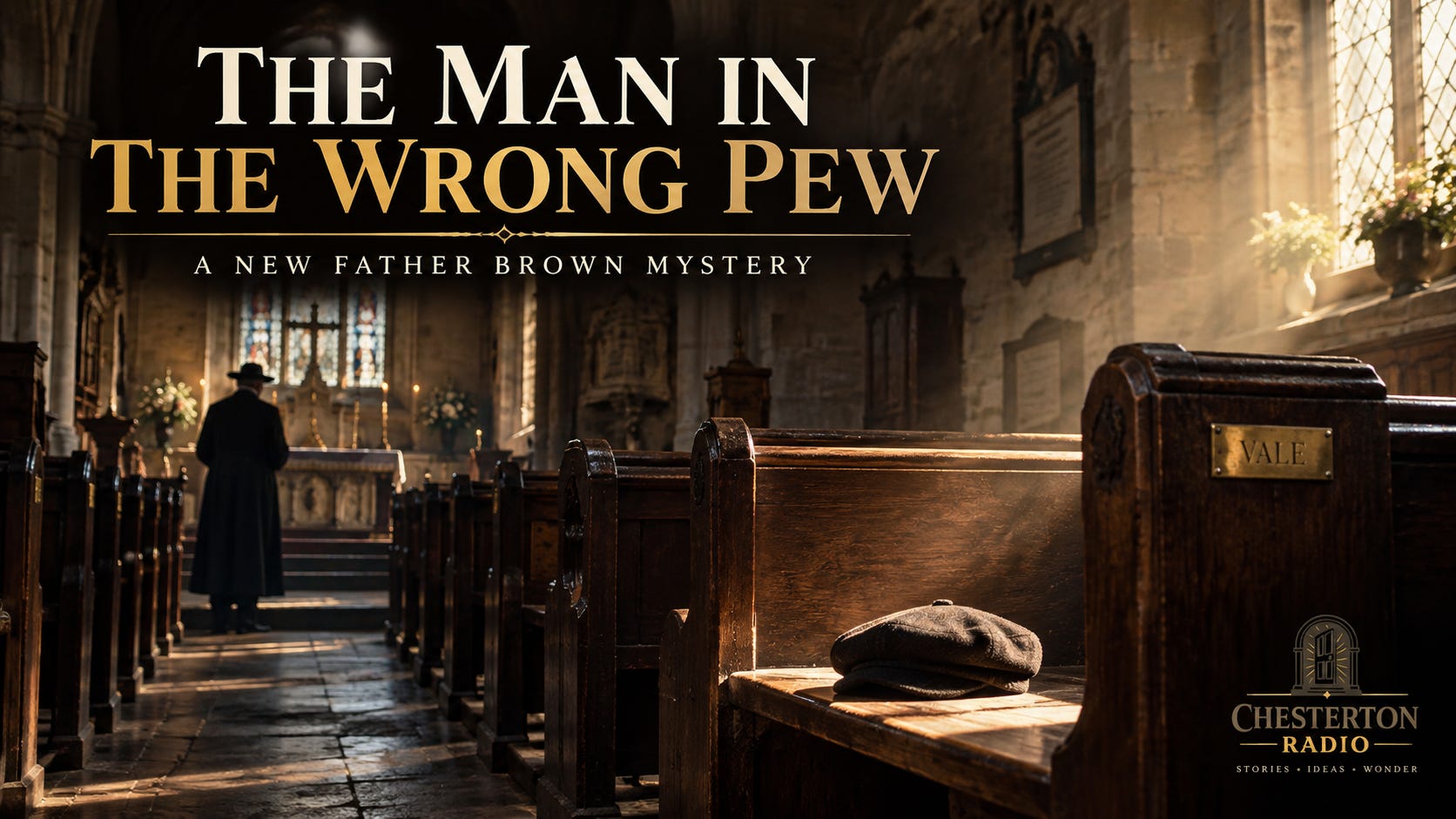
He sat halfway down the nave in a pew marked by a small brass plate:
VALE OF WYCHCOMBE
He was perhaps fifty-five, though hardship had put another decade into his face. His coat was clean but shiny at the elbows. His boots were carefully polished and badly cracked. A narrow scar ran from his left temple toward his ear.
He was looking at the crucifix.
Father Brown slipped into a pew behind him and knelt.
For ten minutes neither man spoke.
Then the stranger said without turning:
“They’ve made Him too handsome.”
Father Brown raised his head.
“The figure?”
“The Christ. No broken nose. No swollen eye. Hardly any blood. Looks like a gentleman having a difficult afternoon.”
Father Brown considered the crucifix.
“Artists sometimes improve people,” he said.
“They shouldn’t.”
“No,” said Father Brown. “God seems rather fond of leaving them unimproved.”
The man laughed once.
It was not a cheerful laugh, but it was real.
He turned.
“You’re the priest.”
“Yes.”
“Brown?”
“Yes.”
“My name’s Daniel Pike.”
Father Brown nodded.
Pike looked toward the brass plate on the pew.
“I suppose you want to tell me I’m sitting in somebody’s seat.”
“I was going to tell you Mass is at seven tomorrow.”
Pike stared at him.
Then he laughed again.
This time it lasted longer.
Sir Edmund Vale arrived at eleven precisely.
He was a tall man with silver hair, a beautifully fitted country coat, and the expression of one who had spent sixty years discovering that most difficulties disappeared when other people understood who he was.
Behind him came his solicitor, Mr. Adrian Cross, thin and immaculate; Dr. Miriam Holt, the village physician; and Vale’s nephew, Julian, a handsome young man whose clothes were expensive enough to suggest that he did not pay for them.
Sir Edmund stopped when he saw Pike.
“You.”
Pike remained seated.
Father Brown, who was replacing candles near the Lady Chapel, watched the two men.
Sir Edmund’s face did something curious. It did not become angry at first.
It became frightened.
Only afterward did it become angry.
“You were told never to come here.”
“I was told many things.”
“Get out.”
Pike looked down at the brass plate.
“I like this seat.”
Julian Vale stepped forward.
“You heard him.”
“Yes,” said Pike. “That’s the trouble with hearing people. Eventually you have to decide whether they’re telling the truth.”
Sir Edmund’s walking stick struck the stone floor.
“Father Brown!”
The priest emerged from beside the altar.
“Would you kindly remove this man?”
Father Brown blinked.
“I don’t think I can.”
“This church stands on Vale land.”
“Yes.”
“My family restored it.”
“Yes.”
“That pew belongs to my family.”
Father Brown looked at Pike.
Then at the pew.
Then back at Sir Edmund.
“I suppose we might ask which of the three belongs most completely to God.”
Nobody answered.
Pike rose.
“It’s all right, Father. I was leaving.”
As he passed Sir Edmund, the older man whispered something.
Father Brown did not hear it.
But Pike stopped.
For one second the battered face became almost gentle.
Then he said:
“You still don’t know who I am, do you?”
And walked out into the rain.
By luncheon, Little Wychcombe had produced six biographies of Daniel Pike.
Mrs. Bell said he was an ex-convict.
The publican said he had been a soldier.
Julian Vale said he was a blackmailer.
Dr. Holt had heard he was an alcoholic.
Adrian Cross described him simply as “a dangerous man.”
Sir Edmund refused to discuss him.
Father Brown listened to all six accounts and ate a boiled egg.
Inspector Harris arrived from the county police shortly after three.
“You know this Pike fellow?” Harris asked.
“I met him this morning.”
“Trouble?”
“Apparently.”
“What sort?”
“The sort where everybody knows what sort of man he is.”
Harris sighed.
“You always say things like that just before my day becomes unpleasant.”
At four seventeen it became unpleasant.
Daniel Pike was found dead in the old vestry of St. Jude’s.
He had been struck once behind the left ear with a heavy object.
The old vestry had one door opening into the churchyard and another into the church itself. The rain had turned the churchyard path to mud.
Pike lay beside a wooden table.
On the floor near his hand was Sir Edmund Vale’s silver-headed walking stick.
And in Pike’s pocket was an envelope containing five hundred pounds in notes.
Inspector Harris looked at Father Brown.
Father Brown looked at the dead man.
“Well,” said Harris, “this one appears almost indecently simple.”
“That is often when decency requires us to be suspicious.”
Sir Edmund admitted meeting Pike.
He admitted bringing the money.
He admitted that the walking stick was his.
He even admitted threatening him.
“What precisely did Pike want?” Harris asked.
Sir Edmund sat in the library at Vale House beneath portraits of twelve generations of men who looked remarkably confident about having been born.
“Money.”
“For what?”
“Silence.”
“About what?”
Sir Edmund’s jaw tightened.
“A family matter.”
Julian Vale stood by the fireplace.
“My uncle doesn’t have to answer that.”
“He does if I arrest him for murder,” Harris said.
Sir Edmund closed his eyes.
“Thirty years ago my younger brother, Stephen, caused a motor accident. He had been drinking. A woman was killed.”
“And Pike?”
“Pike was blamed.”
Father Brown looked up.
Sir Edmund continued.
“He had been in the car. He had previous convictions. Stephen had none. There was confusion. Pike was charged.”
“Wrongly?”
A long silence followed.
“Yes.”
“How long did he serve?”
“Seven years.”
“And your brother?”
“Died fifteen years ago.”
Inspector Harris stared at him.
“So Pike came back for money.”
“Yes.”
Father Brown said quietly:
“Did he ask for it?”
Sir Edmund looked at him.
“What?”
“The five hundred pounds. Did Mr. Pike ask you for it?”
“Of course.”
“How much?”
Sir Edmund hesitated.
“Five hundred.”
Father Brown’s eyes wandered to the rain streaking the windows.
“That is interesting.”
Harris knew the tone.
“What’s interesting?”
“Five hundred pounds.”
“That’s what was in his pocket.”
“Yes,” said Father Brown. “That is why it is interesting.”
Dr. Miriam Holt supplied another Daniel Pike.
“He was dying,” she said.
They stood beneath the church porch while rain drummed upon the lead roof.
“Cancer. Advanced. Perhaps three months.”
“Did Sir Edmund know?”
“I don’t think so.”
“Did Pike?”
“Certainly.”
Father Brown watched water spill from a gargoyle.
“Was he afraid?”
“No.”
“Angry?”
“Yes.”
“At Sir Edmund?”
“At everyone, I think.”
She paused.
“Except perhaps himself.”
Father Brown turned.
“That is unusual.”
“He told me he had wasted enough years hating people. He didn’t intend to waste the last few.”
“Did he say why he came back?”
Dr. Holt shook her head.
“He only said there was something he had to put right.”
Adrian Cross supplied the third Daniel Pike.
“A professional extortionist,” the solicitor said.
“Professional?” Father Brown asked.
“In temperament.”
“Ah. I wondered whether there was a guild.”
Cross frowned.
“He knew the Vale family secret. He returned when he learned Sir Edmund intended to sell part of the estate. He assumed there would be money.”
“Did you see him today?”
“Yes.”
“When?”
“Shortly after noon.”
“Where?”
“The churchyard.”
“What did he say?”
“That he wanted what was owed to him.”
“Money?”
“What else?”
Father Brown looked almost apologetic.
“That is exactly what I am trying to discover.”
Julian Vale supplied the fourth Daniel Pike.
“A parasite.”
They found him smoking beside the stable yard.
“My uncle felt guilty. Pike knew it.”
“Did you know Pike before today?”
“No.”
“Did you speak to him?”
“Briefly.”
“What did he say?”
Julian flicked ash into a puddle.
“Nothing worth remembering.”
Father Brown smiled.
“Those are often the things worth remembering.”
The young man glared at him.
“He said I looked like my father.”
“And do you?”
“Apparently.”
“Your father being Stephen Vale?”
“Yes.”
The priest’s expression changed almost imperceptibly.
“And what did Mr. Pike think of that?”
Julian shrugged.
“He laughed.”
Mrs. Bell supplied the fifth Daniel Pike.
“He saved my boy.”
Father Brown stopped with a teacup halfway to his mouth.
Mrs. Bell was crying.
It transformed her face more completely than grief ordinarily does, because nobody in Little Wychcombe had previously imagined Agnes Bell surrendering control of anything, including tears.
“My Tom,” she said. “He was seventeen then. Wild. Stole a motorbike. Daniel Pike caught him.”
“And?”
“Made him put it back.”
She wiped her eyes.
“Tom said Pike told him prison was full of men who’d done one stupid thing and then spent the rest of their lives becoming the sort of man everybody said they were.”
Father Brown put down the cup.
“Did Pike tell anyone else?”
“No.”
“Why not?”
“He said a good deed advertised was half sold.”
Father Brown sat very still.
Outside the post office, the rain had stopped.
A thin bar of evening sunlight appeared beneath the clouds.
The sixth Daniel Pike came from the dead man himself.
Inspector Harris had found a folded sheet of paper sewn inside the lining of Pike’s coat.
It was not a blackmail letter.
It was a statement.
Thirty years earlier, Daniel Pike had indeed been in the car with Stephen Vale.
Stephen had been drunk.
Pike had not.
After the accident, Stephen was unconscious. Sir Edmund arrived before the police. He persuaded Pike to say he had been driving.
Why?
Because Stephen’s wife was pregnant.
Because a conviction would destroy the family.
Because Pike already had a record.
And because Sir Edmund promised to look after Pike’s widowed mother.
He had not done so.
But that was not why Pike had returned.
At the bottom of the statement were the words:
I do not want money. I want Julian told the truth about his father before Sir Edmund dies. A man should know who his father was, but he should know the whole of him. Stephen Vale was a coward that night. He was not a coward all his life.
Inspector Harris read the sentence twice.
“So the money was planted.”
“Yes,” said Father Brown.
“And Sir Edmund lied about Pike demanding it.”
“Yes.”
“That still leaves Sir Edmund in a fairly dreadful position.”
“Yes.”
Harris leaned back.
“But you don’t think he killed him.”
“No.”
“Why?”
Father Brown looked almost embarrassed.
“Because Sir Edmund thinks money is much more important than Daniel Pike did.”
Harris stared.
“That makes no sense.”
“It makes excellent sense. Sir Edmund brought five hundred pounds because Sir Edmund imagined five hundred pounds would solve the problem. When Pike refused it, Sir Edmund left the envelope behind.”
“And the killer put it in Pike’s pocket.”
“Yes.”
“To make it look like blackmail.”
“Yes.”
“So the killer had to know about the money.”
Father Brown nodded.
“And had to misunderstand Daniel Pike.”
They gathered in St. Jude’s shortly after nine.
Sir Edmund stood near his family pew.
Julian leaned against a pillar.
Dr. Holt sat near the aisle.
Adrian Cross stood beneath the old memorial tablets.
Inspector Harris waited beside the vestry door.
Father Brown walked slowly to the pew where he had first seen Pike.
“This morning,” he said, “Mr. Pike asked Sir Edmund a very strange question. He asked, ‘You still don’t know who I am, do you?’”
Sir Edmund looked away.
“I thought he meant you had forgotten him,” Father Brown continued. “But you hadn’t. None of you had forgotten him.”
He looked around the church.
“You all remembered him extremely well.”
Nobody moved.
“Sir Edmund remembered a blackmailer. Mr. Cross remembered a criminal. Mr. Vale remembered a parasite. Dr. Holt remembered a dying man. Mrs. Bell remembered a man who once saved a foolish boy from becoming a criminal.
“And every one of you was telling the truth.”
Julian gave a contemptuous laugh.
“That’s very comforting.”
“No,” said Father Brown. “Truth is frequently uncomfortable. What is comforting is a label. A label means we need never look again.”
He picked up the envelope containing the money.
“The murderer believed this would explain everything. Five hundred pounds in a dead man’s pocket. A convicted criminal. A wealthy man with a secret. Blackmail.”
Cross said:
“Which is precisely what happened.”
“No.”
Father Brown looked at him.
“It is precisely what you thought happened.”
For the first time, Adrian Cross’s expression changed.
Only slightly.
But enough.
Father Brown continued.
“Mr. Pike told you he wanted what was owed to him.”
Cross said nothing.
“You assumed he meant money. Everybody assumed he meant money. But he did not. He wanted truth.”
Sir Edmund whispered:
“Good God.”
“You met him in the vestry after Sir Edmund left,” Father Brown said. “You tried to persuade him to take the money and disappear. But he intended to tell Julian the truth.”
Cross’s voice was cold.
“You have no evidence.”
“Oh, there is some.”
Father Brown pointed toward the old vestry.
“The weapon was not Sir Edmund’s walking stick.”
Harris produced a heavy brass object wrapped in cloth.
It was an old sanctuary bell.
“We found blood in the rim,” he said.
Father Brown nodded.
“The walking stick was placed beside the body afterward. But there was a difficulty. Mr. Pike had already seen Sir Edmund leave the church carrying that stick.”
Cross’s face had become very pale.
“That proves nothing.”
“No. But you made a second mistake.”
Father Brown held up the dead man’s statement.
“You knew Stephen Vale had not been driving. But only three living people knew that before today: Sir Edmund, Daniel Pike—and the solicitor who prepared the private settlement thirty years ago.”
Cross stared at him.
“You inherited your father’s legal practice,” Father Brown said. “And his files.”
Sir Edmund turned sharply.
Cross said:
“You cannot prove I read them.”
“No.”
Father Brown looked sadly at him.
“But Daniel Pike could.”
Silence filled the church.
Cross’s hand tightened around the back of a pew.
“He was going to destroy them.”
“Whom?”
“The Vales.”
“No,” said Father Brown. “He was trying to save one.”
Cross laughed bitterly.
“You expect me to believe that?”
“No. That is why you killed him.”
The words seemed almost gentle.
“You could understand revenge. You could understand money. You could understand blackmail. You could not understand a man who had suffered because of the Vales and nevertheless came back to prevent their last lie from becoming permanent.”
Cross’s composure broke.
“You know nothing about him!”
Father Brown’s eyes became very grave.
“That is the remarkable thing. Neither did you.”
Cross looked toward the door.
Inspector Harris moved quietly in front of it.
Then Cross sagged against the pew.
“The firm would have been ruined,” he whispered. “My father arranged it. He suppressed evidence. Sir Edmund paid him. Pike’s statement would have exposed everything.”
Sir Edmund stared at him.
“You killed a man for the reputation of a dead solicitor?”
Cross looked at him with sudden fury.
“For a name!”
Father Brown sighed.
“Yes. That is usually the expensive part.”
They took Adrian Cross away shortly before ten.
Julian remained.
So did Sir Edmund.
Grandfather and grandson stood several feet apart in the old church.
Neither seemed capable of crossing the distance.
At last Julian said:
“My father let another man go to prison.”
“Yes,” said Sir Edmund.
“And you let him.”
“Yes.”
Julian looked toward Father Brown.
“What am I supposed to think of him now?”
Father Brown was extinguishing the candles.
“Your father?”
“Yes.”
“I shouldn’t think you are supposed to think anything in particular.”
Julian frowned.
“Pike said I ought to know who he really was.”
“Yes.”
“But which was the real man? The coward who let Pike go to prison? Or whatever else he was?”
Father Brown pinched out another flame.
“Both.”
“That’s not much of an answer.”
“It is nearly the only answer there is about human beings.”
He came down the altar steps.
“We are always asking whether a man is a hero or a coward, a saint or a sinner, respectable or disreputable. We like the answer to be one word because then we may stop looking at him.”
He glanced toward the crucifix.
“But a person is not a newspaper headline.”
Julian followed his gaze.
“My father did something terrible.”
“Yes.”
“And Pike did something good.”
“Yes.”
“Pike was also a criminal.”
“Yes.”
Julian almost smiled.
“You’re not very helpful.”
“I have been told that.”
They walked toward the door.
At the Vale pew, Father Brown stopped.
There was something lying on the seat.
Daniel Pike’s cap.
The priest picked it up.
Sir Edmund said quietly:
“He sat there deliberately, didn’t he?”
“Oh yes.”
“To insult me?”
Father Brown shook his head.
“I think he wanted you to sit beside him.”
Sir Edmund stared at the empty pew.
For a long while he said nothing.
Then he sat down.
Julian hesitated.
And sat beside him.
Father Brown left them there.
The next morning was brilliantly clear.
Mass was at seven.
Mrs. Bell occupied her usual place. Dr. Holt sat near the back. Inspector Harris, who claimed never to attend church except professionally, had somehow arrived without a murder to investigate.
The Vale pew remained empty.
Until the last moment.
Then Sir Edmund entered with Julian.
They did not sit in it.
Instead they took two places farther back.
The place where Daniel Pike had sat remained empty.
After Mass, Harris found Father Brown in the churchyard watching sunlight gather on the wet yew trees.
“You knew Cross was the murderer before we found the bell, didn’t you?”
“No.”
“When did you know?”
“When everyone told me who Daniel Pike was.”
Harris groaned.
“I knew I shouldn’t ask.”
Father Brown smiled.
“They all answered a different question.”
“What question?”
“‘What do people say that he is?’”
Harris waited.
“And what should they have asked?”
Father Brown looked back through the open church door.
The morning sun had reached the empty pew.
“Who is he?”
For a moment there was only birdsong and the distant ringing of a bicycle bell.
Then Father Brown put on his hat.
“That question,” he said, “is considerably more dangerous.”
And the two men walked down the hill toward breakfast.
— THE END —
An original New Adventures of Father Brown mystery from Chesterton Radio.