

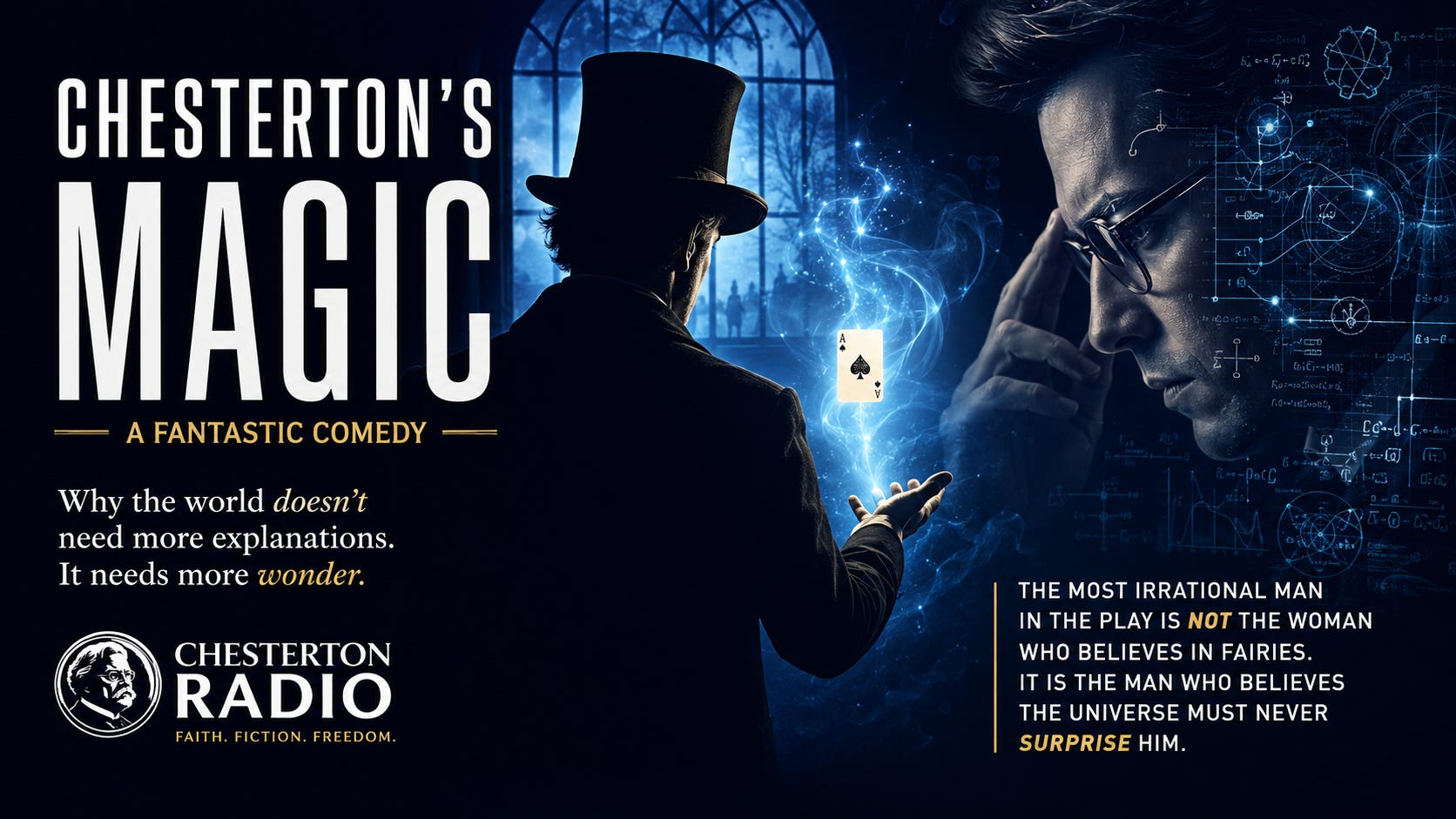
There are some plays that entertain us for an evening, and there are others that quietly accuse an entire civilization.
Magic: A Fantastic Comedy is one of the latter.
It is, on the surface, a drawing-room comedy about a conjurer. There are card tricks, arguments, social absurdities, a foolish duke, an anxious doctor, a skeptical businessman, and a young woman who still believes the world might contain fairies. But beneath the velvet curtains and polite Edwardian dialogue lies one of the most prophetic things Chesterton ever wrote: a warning that modern man does not merely doubt miracles—he doubts reality itself.
And Chesterton, with characteristic mischief, understood something long before the age of algorithms and artificial intelligence:
The truly dangerous man is not the one who believes in magic.
It is the man who believes in nothing but explanations.
The play premiered in London in 1913 after years of prodding from George Bernard Shaw, who insisted Chesterton ought to write for the stage. To the surprise of critics, audiences loved it. Shaw himself reportedly gave the production a standing ovation.
And yet Magic remains strangely neglected today.
Perhaps because it strikes too near the center of our age.
A Fairy Tale for Skeptics
The premise is deceptively simple.
A mysterious conjurer arrives at the estate of a duke to entertain guests. The duke’s niece, Patricia, has already encountered the stranger in the woods and suspects he may not merely perform magic, but actually possess it. Her brother Morris—modern, rational, aggressively skeptical—regards all such things as childish nonsense.
At first the arguments are merely philosophical.
Then the impossible begins to happen.
A trick is performed that Morris cannot explain.
And Chesterton does something astonishing: he does not portray the believer descending into madness. He portrays the skeptic descending into madness because reality refuses to obey his philosophy.
This inversion is profoundly Chestertonian.
Modern literature often assumes that faith is irrational while skepticism is sane. Chesterton turns the lantern around and asks a far more uncomfortable question:
What if endless skepticism is itself a form of insanity?
One reviewer summarized the play’s central challenge in a single line:
“Does it never strike you that doubt can be a madness, as well as faith?”
That question feels far more relevant in 2026 than it did in 1913.
The Modern World and the Death of Wonder
Chesterton saw the modern world becoming spiritually exhausted not because it believed too much, but because it believed too little.
The world of Magic is filled with educated people who can explain everything except the one thing that matters.
They can analyze tricks.
Classify ideas.
Debate abstractions.
Dissect emotions.
But they cannot stand before mystery without trying to murder it.
Chesterton understood that modern skepticism often masquerades as humility while actually being a form of pride. The skeptic claims to be merely “following the evidence,” but frequently what he means is this:
Reality must not contain anything larger than my own mind.
Morris, the rationalist brother, is not destroyed by superstition. He is destroyed by the possibility that the universe may be deeper than his categories.
And that is precisely the crisis of modernity.
The modern world can tolerate almost any vice except wonder.
A man may believe that consciousness emerged accidentally from dead matter, that morality is socially constructed, that beauty is chemical stimulation, that love is evolutionary programming, and that human beings are biological machines—and he will be called sophisticated.
But if he suspects that creation might be enchanted, he is called naive.
Chesterton knew this was backwards.
He believed that wonder was not childishness.
Wonder was sanity.
The Conjurer and the Priest
One of the great delights of Magic is the dialogue between the conjurer and the priest, Reverend Smith.
Chesterton refuses to make religion sentimental. Smith is not a vague spiritualist floating through incense and abstractions. He is intelligent, sharp, and morally serious. Meanwhile the conjurer himself is no simple fraud. He inhabits that peculiarly Chestertonian territory between trickster, prophet, and tragic wanderer.
The play dances constantly on the edge of revelation without ever entirely stepping over it.
Did the conjurer truly perform miracles?
Or were they tricks?
Chesterton never fully resolves the matter because the ambiguity is the point.
Modern audiences are trained to demand explanations. We expect the final act to reveal the mechanism hidden beneath the stage. But Chesterton denies us that comfort.
Instead, he asks whether our obsession with explanation may itself blind us.
The real magic in Magic is not supernatural power.
It is the recovery of astonishment.
Chesterton’s Revolt Against Reductionism
Today, Magic reads almost like a prophetic response to technological civilization.
We live in an age capable of simulating voices, generating images, predicting behavior, and reducing human life into streams of measurable data. Every mystery becomes a problem to optimize.
And yet the more technologically sophisticated society becomes, the more spiritually exhausted it often appears.
Chesterton foresaw this paradox.
The danger of modernity was never science itself. Chesterton loved science. He loved discovery, invention, debate, and reason. What he opposed was reductionism: the belief that human beings are nothing but chemistry, economics, biology, or machinery.
A machine may calculate.
But it cannot wonder.
An algorithm may imitate poetry.
But it cannot stand speechless beneath the stars.
This is why Magic feels unexpectedly contemporary. Morris resembles not merely a 1913 rationalist, but the modern technocrat who believes every mystery is temporary and every human experience reducible to process.
Chesterton knew something such people forget:
The world is not less miraculous because we understand part of it.
It is more miraculous.
The Red Lamp
One of the most famous moments in the play involves a red lamp outside the window suddenly changing color. Critics remembered the effect decades later.
It is a tiny thing.
No dragons appear.
No heavens split open.
No dead rise from the grave.
Just a lamp changing from red to blue.
Yet it nearly destroys Morris because the miracle is small enough to feel intimate. It enters ordinary reality like a crack in a wall.
Chesterton understood that the most frightening miracles are not gigantic spectacles but tiny impossible things appearing quietly in familiar places.
A candle burning in a dark church.
A child asking an unanswerable question.
A piece of music that suddenly feels eternal.
A human face that cannot be reduced to biology.
The world becomes unbearable the moment we realize it may contain meaning.
Why Magic Matters Now
There may never have been a better time to rediscover this play.
We inhabit an age drowning in information and starving for enchantment.
People scroll endlessly through screens searching for transcendence while insisting transcendence does not exist. They demand meaning while denying any source of meaning. They seek wonder through technology while becoming increasingly incapable of wonder at reality itself.
Chesterton would have recognized the contradiction instantly.
He would likely say that modern man has become like Morris: furious not because miracles occur, but because miracles refuse to fit inside his system.
And perhaps that is why Magic endures.
Not because it proves the supernatural.
But because it exposes the poverty of a world that cannot bear the possibility of it.
Chesterton once argued that fairy tales do not tell children dragons exist. Children already know dragons exist. Fairy tales tell children dragons can be defeated.
In Magic, Chesterton offers a fairy tale for adults.
Not to convince us that magic exists.
But to remind us that reality itself is already magical.
A Final Chestertonian Paradox
The greatest irony of Magic is this:
The most irrational character in the play is not the woman who believes in fairies.
It is the man who believes the universe must never surprise him.
And perhaps that is the permanent message Chesterton leaves to modern civilization.
A world without wonder does not become more rational.
It becomes smaller.
And eventually, unlivable.
Further Reading
Broadcast from the edge of wonder by Chesterton Radio in Atchison, Kansas — where the old stories still flicker like red lamps in the fog, and the modern world is reminded that mystery has not yet died.