

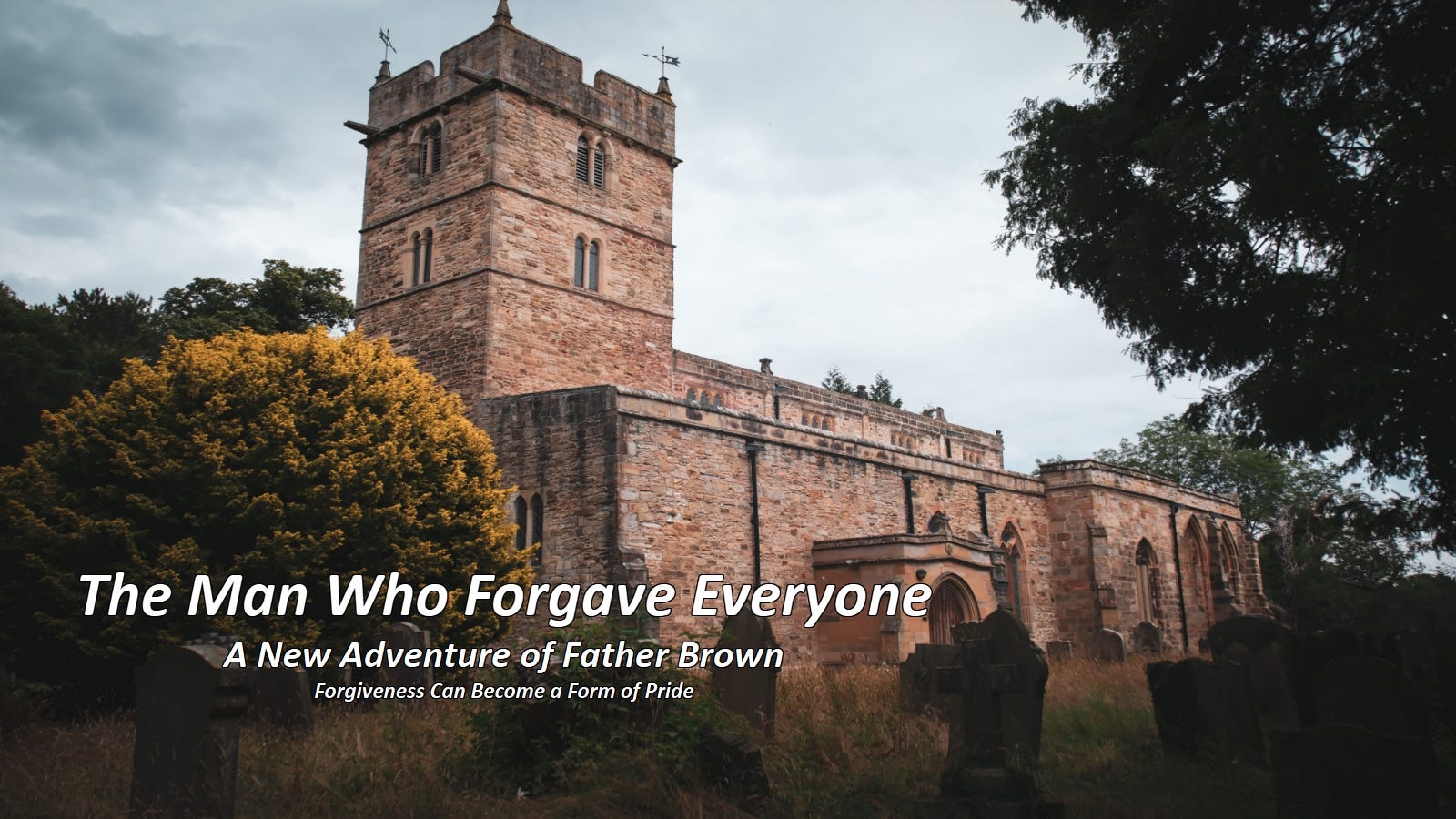
INTRO
There are some mysteries that begin with a crime.
A theft.
A murder.
A disappearance.
And there are other mysteries that begin much earlier.
They begin with a wound.
Not a wound of the body, but of the soul.
An insult remembered too long.
An injury preserved too carefully.
A grievance polished until it shines.
In the ancient cathedral town of Bellweather, a wealthy and respected benefactor has become famous for his forgiveness. His generosity is celebrated. His mercy is admired. His reputation for reconciliation is known throughout the county.
Then, on the night he publicly forgives his enemies before a packed cathedral, he vanishes.
A sealed confession disappears.
A locked chapel stands empty.
And Father Brown finds himself confronted by a mystery that is not really about a missing man at all.
For some prisons are built of stone.
And others are built of memories.
Tonight, we present a new adventure of Father Brown:
The Man Who Forgave Everyone.
PART I
The Cathedral on the Marsh
There are some English towns that appear to have been built by men, and others that appear to have grown by accident.
Bellweather belonged to the second category.
Nobody could quite explain why it existed where it did.
The marshes below it were wet enough to discourage commerce, while the hills above it were steep enough to discourage agriculture. The nearest railway line had passed it by with the polite indifference of a wealthy relative. Even the river seemed uncertain of its purpose and wandered through the landscape as though searching for a more suitable county.
Yet Bellweather remained.
It sat upon its hill like an old sea captain who had retired inland and never entirely forgiven the ocean for continuing without him.
The town’s greatest glory was its cathedral.
From a distance the great square tower appeared to float above the morning fogs rising from the marshes. Travelers often saw the tower before they saw the town itself, and there were legends of sailors in earlier centuries steering toward it in bad weather as though it were a lighthouse.
The cathedral was not beautiful in the fashionable sense.
It lacked the delicate elegance of certain French churches and the soaring ambition of the great Gothic monuments.
It was heavy.
Solid.
Stubborn.
It looked less like a building than a conviction.
The people of Bellweather were proud of it in the way Englishmen are proud of things they complain about constantly.
Visitors were told the roof leaked.
The heating failed.
The bells were out of tune.
The choir was declining.
The chapter was incompetent.
The vergers were impossible.
And afterward they were informed that it was the finest cathedral in England.
On a damp Thursday afternoon in October, Father Brown arrived in Bellweather carrying a black umbrella that had survived so many years of service that it seemed almost to have acquired ecclesiastical rank.
He descended from the local train with the distracted air of a man who had forgotten both where he was going and why.
In fact he remembered perfectly well.
An elderly priest named Father Cormack was recovering from influenza, and Father Brown had agreed to visit him.
Yet, like many journeys undertaken by Father Brown, the trip began drifting away from its stated purpose almost immediately.
The first interruption came in the form of a black dog.
The dog sat in the middle of the station platform staring at him.
It was not a threatening stare.
It was not even a friendly stare.
It was the expression of someone who suspected the universe had made a procedural error.
The animal followed him across the station yard.
It followed him down the road.
It followed him into the market square.
There it stopped and sat beside a stone pillar.
Father Brown looked down.
“You disapprove of me,” he observed.
The dog blinked.
“I daresay you’re right.”
A small boy standing nearby laughed.
“His name’s Cromwell.”
“An unfortunate burden for a dog.”
“He bites politicians.”
“Perhaps not unfortunate after all.”
The boy pointed upward.
“You should read that.”
Pinned to the pillar was a large printed notice.
Father Brown adjusted his spectacles.
The announcement read:
A SERVICE OF PUBLIC RECONCILIATION
To Be Held at Bellweather Cathedral
Sir Julian Prayerby, Bart., Will Make a Solemn Declaration of Forgiveness Toward Those Who Have Wronged Him.
The priest read it twice.
Then he read it a third time.
Finally he folded the notice carefully back against the stone.
“That is a very loud sort of forgiveness,” he said.
The boy frowned.
“What’s wrong with forgiveness?”
“Nothing.”
Father Brown glanced toward the cathedral tower.
“It is merely one of the few things that become quieter as they become larger.”
The boy clearly had no idea what this meant.
Neither did the dog.
Both appeared equally dissatisfied.
Father Brown continued up the hill.
Every town possesses a local legend.
Bellweather possessed Sir Julian Prayerby.
He was discussed at breakfast tables.
He was discussed in pubs.
He was discussed in shops.
He was discussed by people who admired him and people who disliked him and people who did both simultaneously.
Most people agreed on three facts.
First, Sir Julian was extraordinarily wealthy.
Second, he was extraordinarily religious.
Third, he was extraordinarily forgiving.
The third reputation was the most famous.
Stories circulated constantly.
There was the nephew who had insulted him publicly and received a generous inheritance.
The tenant who had failed to pay rent and received assistance instead of eviction.
The former steward accused of embezzlement who had been spared prosecution.
The journalist who had attacked Sir Julian in print and later received funding for a local charity.
Each story ended in the same way.
With forgiveness.
Bellweather had become accustomed to speaking of Sir Julian almost as a living saint.
Yet Father Brown noticed something odd.
Whenever townspeople praised Sir Julian’s forgiveness, they rarely smiled.
They sounded grateful.
They sounded respectful.
They sounded impressed.
But they did not sound happy.
The realization arrived like a tiny stone dropped into still water.
Small.
Almost meaningless.
Yet the ripples continued spreading.
Later that afternoon Father Brown visited Father Cormack.
The old priest occupied a narrow house overlooking the cathedral close.
He was recovering sufficiently to complain about everything.
This reassured Father Brown considerably.
“You’ve arrived at exactly the wrong time,” said Father Cormack.
“I usually do.”
“The whole town has gone mad.”
“Only the whole town?”
“The cathedral’s worse.”
Father Brown accepted a cup of tea.
“Why?”
“Sir Julian.”
The old priest groaned.
“He intends to forgive everyone again.”
“Again?”
“He does it every few years.”
Father Brown stirred his tea thoughtfully.
“That seems exhausting.”
“It is.”
Father Cormack leaned forward.
“Mind you, Julian Prayerby is a good man in many ways. Generous. Industrious. Faithful. But there is something odd about him.”
“What sort of odd?”
The old priest considered.
“He remembers injuries the way librarians remember books.”
Father Brown looked up.
“That is interesting.”
“He forgives them all.”
“Yes.”
“But first he catalogues them.”
Outside the window evening shadows stretched across the close.
The cathedral bells began ringing for Evensong.
Father Brown listened.
Then he smiled faintly.
“There are men who collect stamps.”
“Yes?”
“And there are men who collect grievances.”
Father Cormack stared.
The little priest sighed.
“The second hobby is considerably more dangerous.”
That evening Father Brown attended Evensong.
The cathedral glowed with candlelight.
The choir sang.
The ancient stones seemed to absorb centuries of prayer and return them as echoes.
Near the front stood Sir Julian Prayerby.
He was taller than Father Brown expected.
Elegant.
Silver-haired.
Distinguished.
His face possessed the kind of sadness people often mistake for holiness.
The congregation watched him with admiration.
Sir Julian noticed the little priest almost immediately.
Their eyes met.
For the briefest instant something flickered across Sir Julian’s expression.
Not hostility.
Not surprise.
Recognition.
As though he had suddenly remembered an unfinished conversation.
Then the expression vanished.
The famous benefactor smiled warmly.
Father Brown smiled back.
Neither man spoke.
But for reasons he could not yet explain, Father Brown felt as though the mystery had already begun.
And somewhere high above them, beyond the candles and stone vaults and autumn darkness, the cathedral bells continued ringing over Bellweather and the marshes below.
Like questions awaiting answers.
PART II
The Service of Public Reconciliation
By Friday morning Bellweather had become almost cheerful with solemnity.
There is a peculiar excitement that attends a religious ceremony when half the town regards it as a spiritual occasion and the other half regards it as a public entertainment. Bellweather possessed both halves in abundance, and they mingled freely in the market square beneath the cathedral tower.
Shopkeepers closed early.
Ladies wore their second-best hats.
The editor of the Bellweather Chronicle sent a junior reporter with a pencil sharp enough to wound.
Even Cromwell, the black dog, appeared at the cathedral gate as if suspecting some constitutional irregularity.
Father Brown spent the morning walking about the close, looking at gargoyles, puddles, chimney pots, and other objects generally ignored by serious investigators. He had a habit of seeming interested in everything except the matter at hand, which often irritated practical men. It also sometimes saved them.
Near the south porch he found an old verger polishing a brass plate with a patience that suggested either holiness or despair.
The plate bore the name:
SIR JULIAN PRAYERBY, BART.
RESTORER OF THE CHAPEL OF ST. ANSELM
Father Brown watched the old man’s hand moving in small circles.
“That name must require a good deal of polishing,” he said.
The verger glanced up.
He was thin and bent, with a face like old parchment folded too many times.
“Names usually do, Father.”
“You are Mr. Tott?”
“Abel Tott.”
“Ah. The verger.”
“One of them.”
“One of the invisible offices.”
The old man gave the faintest smile.
“Invisibility is useful in churches.”
“It is useful almost everywhere,” said Father Brown. “Except perhaps in confession.”
At that word the old man’s hand stopped.
Only for a moment.
Then the polishing resumed.
Father Brown noticed.
“Sir Julian is to destroy a confession tonight, I understand.”
“So they say.”
“You do not sound comforted.”
Abel Tott folded the cloth.
“Some papers ought to be burned. Some ought never to have been kept. Some ought never to have been written.”
“That is a complete theology of documents,” said Father Brown.
The old verger looked toward the Chapel of St. Anselm.
“It is locked now. Sir Julian has the key. Canon Wace has another. No one else enters before the service.”
“And the confession?”
“In a sealed packet. On the altar.”
“Guarded by angels?”
“By two assistant vergers and a very poor lock.”
“That may be safer than angels,” said Father Brown. “Angels are sometimes too charitable.”
Abel Tott did not smile this time.
Across the close, a young woman in a dark coat emerged from the shadow of the cloister. She paused when she saw them.
“That is Miss Ruth Prayerby,” said Abel quietly.
“She looks as if she has come to a funeral.”
“She has been coming to one for years.”
Ruth Prayerby approached with the hesitation of someone who had once belonged in a place and now entered it by permission.
She was not beautiful in any theatrical sense, but she had the grave and attentive face of a person who has suffered without becoming dramatic about it.
Father Brown bowed.
“Miss Prayerby.”
She looked surprised.
“You know me?”
“No,” said Father Brown. “But I am beginning to know Bellweather, which is nearly the same thing.”
Her smile was brief.
“Then you will know my uncle before long. Everyone knows my uncle.”
“Everyone knows his virtues, certainly.”
Ruth looked at him quickly.
“That is a careful distinction.”
“It is often the only useful one.”
She glanced toward the chapel.
“He has asked me to stand beside him tonight.”
“That is generous.”
“Yes.”
The word came out flat.
Father Brown waited.
“He forgave me long ago,” she said.
“For what?”
“For marrying a good man without money.”
“That is one of the few crimes still punished in respectable families.”
“My husband died owing debts. My uncle paid some of them.”
“That also sounds generous.”
“It was. And every year, on the anniversary of my marriage, he wrote to remind me that he had forgiven me.”
A silence followed.
Somewhere above them a pigeon fluttered beneath the eaves.
Father Brown looked suddenly sad.
“Forgiveness,” he said, “is not usually sent by annual subscription.”
Ruth’s face changed, as if she had been given permission to know what she already knew.
Before she could answer, a large voice rolled across the close.
“My dear Ruth!”
Sir Julian Prayerby came toward them with his hat in his hand and sunlight on his silver hair.
He had the magnificent courtesy of a man who has practiced humility before mirrors.
“My dear child, I had feared you might not come.”
“I said I would.”
“And Father Brown too. This is fortunate indeed.”
He turned warmly to the priest.
“Canon Wace has told me of you. You are very welcome to Bellweather.”
“Thank you,” said Father Brown. “It seems a town full of memories.”
Sir Julian’s smile became even softer.
“Memory is a Christian duty.”
“So is forgetting,” said Father Brown.
For a second the two men looked at each other.
Then Sir Julian laughed.
“Ah, yes. The little paradoxes of the priesthood. You must forgive me if I am more practical. The past must be faced before it can be forgiven.”
“Certainly,” said Father Brown. “Though some men face the past as a judge faces a prisoner.”
Sir Julian’s eyes narrowed, almost imperceptibly.
Then the splendid courtesy returned.
“You must come tonight, Father. I hope the service may be of some help to wounded hearts.”
“I am sure it will reveal them,” said Father Brown.
Sir Julian bowed and moved on.
Ruth watched him go.
“You see?” she said quietly. “He is always kindest when he is being most cruel.”
Father Brown looked after the tall figure crossing the close.
“Yes,” he said. “That is one of the most dangerous forms of intelligence.”
The service began at seven.
By then the cathedral was full.
Rain had returned, softly at first and then with steady insistence, whispering against the stained glass and dripping from the stone beasts along the roofline.
The nave glowed with candles.
The townspeople sat packed in wooden pews, smelling faintly of wool, damp hats, old hymnals, and expectation.
At the front were arranged the principal figures of the drama.
Canon Wace stood in his stall, broad and silvery, looking like a bishop who had mislaid his diocese.
Sir Julian Prayerby sat upright near the chancel steps.
Beside him sat Ruth.
On the other side was Mr. Jasper Fenn, the London skeptic, who had written three clever books proving that religion was dead and had thereby secured a comfortable living from discussing it.
He was small, neat, sharp-bearded, and restless, with the air of a man who had come to watch a conjuring trick and intended to expose the magician before the rabbit appeared.
Behind them, half hidden by a pillar, stood Maurice Prayerby.
He was Sir Julian’s younger brother, though he looked older. His clothes were respectable but tired; his face had the strained politeness of a man accustomed to entering rooms where he was not wanted.
Father Brown sat several rows back.
He noticed that Maurice did not look at Sir Julian.
He noticed that Ruth did not look at Sir Julian either.
He noticed that Abel Tott stood near the Chapel of St. Anselm with his hands clasped so tightly the knuckles shone white.
And he noticed that Sir Julian looked at everyone.
That, Father Brown thought, was the oddest thing of all.
The service itself was impressive.
Too impressive, perhaps.
There were psalms.
There were prayers.
There was an anthem so long and lovely that one could almost forget what it was about.
Then Canon Wace ascended the pulpit and spoke on reconciliation.
He spoke well, as men often do when speaking on subjects they have not recently practiced.
He said forgiveness was the foundation of civilization, the ornament of Christian character, the crown of moral effort, and the bridge between man and God.
Father Brown listened with interest.
He was fond of sermons.
Even bad sermons interested him, as bad portraits sometimes reveal more about the painter than the sitter.
Canon Wace concluded by praising Sir Julian’s “rare and public witness to mercy.”
At this, Sir Julian bowed his head.
It was beautifully done.
The bow managed to suggest humility without surrendering dignity.
Then Sir Julian rose.
He did not mount the pulpit.
That would have been too clerical.
He stood instead before the chancel steps, holding a folded paper.
“My friends,” he began, “some acts must be done publicly because the wounds they heal have been public wounds.”
The congregation leaned toward him.
He spoke of betrayal.
He spoke of loss.
He spoke of the long discipline by which resentment is overcome.
He spoke of Christian charity.
He spoke of the burden of forgiving.
He mentioned no names at first.
Then, gently and sorrowfully, he mentioned them.
He forgave his brother Maurice for “an old and bitter contest over inheritance.”
Maurice stared at the floor.
He forgave his niece Ruth for “a youthful defiance that brought sorrow upon the family.”
Ruth folded her hands.
He forgave a former servant, absent and dead.
He forgave a journalist, absent and living.
He forgave men who had misunderstood him, women who had misjudged him, tradesmen who had cheated him, tenants who had disappointed him, and friends who had failed him.
It was, in one sense, magnificent.
In another sense, it was rather like watching a man distribute medals at a battle in which he had been the only general and all the casualties were prisoners.
Father Brown looked down at his missal.
The page had fallen open at the Lord’s Prayer.
He closed it gently.
Sir Julian’s voice softened.
“But there remains one final matter.”
The cathedral became very still.
“Years ago,” he continued, “a written confession was placed in my hands. It concerned an injury so grave that I have never spoken of it publicly. I have kept that document not for vengeance, but for truth. Tonight I shall destroy it. It lies now, sealed, upon the altar in the Chapel of St. Anselm.”
A visible movement passed through the congregation.
Ruth looked startled.
Maurice raised his head.
Abel Tott closed his eyes.
Jasper Fenn smiled faintly, as if the rabbit had at last twitched beneath the tablecloth.
Sir Julian turned toward the small side chapel.
“At the conclusion of the prayers, I shall enter the chapel alone. I shall bring forth the packet. Before you all, I shall burn it. Let no man say after this night that Julian Prayerby kept a debt unpaid.”
Father Brown heard the words.
He also heard something beneath them.
It was not anger.
It was not fear.
It was something smaller and colder.
Satisfaction.
The prayers resumed.
People knelt.
The sound of voices filled the nave.
Some prayed loudly.
Some prayed softly.
Some moved their lips without sound.
Some stared at the floor and thought of dinner.
Father Brown watched Sir Julian.
The baronet’s lips moved with perfect regularity. His posture was devout. His eyes were lowered.
Yet Father Brown noticed that his gloved thumb was rubbing the edge of the folded paper in his hand.
Back and forth.
Back and forth.
Not like a man praying.
Like a man counting money.
The final amen died away under the vaulting.
Canon Wace stepped down.
Abel Tott unlocked the Chapel of St. Anselm.
Two assistant vergers stood by the doorway.
Sir Julian turned to the congregation.
“My friends, pray for me.”
Then he entered the chapel alone.
The door was closed.
Not locked.
Merely closed.
The cathedral waited.
One minute passed.
Then two.
The rain tapped at the glass.
A woman coughed.
A child whispered and was silenced.
Canon Wace frowned.
At five minutes, he nodded to Abel Tott.
The old verger opened the chapel door.
He stared inside.
Then he stepped back.
His face had gone the color of candle wax.
Canon Wace hurried forward.
Inspector Horne, who had been sitting discreetly near the rear at the request of the cathedral authorities, rose at once.
The congregation began murmuring.
Father Brown remained seated for a moment.
Then he stood up and walked slowly toward the chapel.
The Chapel of St. Anselm was small, square, and almost bare.
Its stone walls were dark with age.
Its narrow window was high and impossibly thin.
A plain altar stood beneath a faded wall painting of the saint with a book in one hand and a church in the other.
On the altar lay a candle, a brass cross, and a blackened dish prepared for burning paper.
But there was no sealed packet.
And there was no Sir Julian Prayerby.
Canon Wace whispered, “Impossible.”
Mr. Jasper Fenn, peering over his shoulder, said, “Excellent.”
Inspector Horne turned sharply.
“What do you mean, excellent?”
“I mean,” said the skeptic, “that if religion must produce mysteries, it is kind of it to produce entertaining ones.”
Father Brown was not looking at him.
He was looking at the stone floor.
Near the altar was a spot of red wax.
Beside it, almost hidden in the uneven stone, was a faint scrape.
He looked at the window.
Too narrow.
He looked at the walls.
Too solid.
He looked at the door.
Too public.
Then he looked at Abel Tott.
The old verger stood rigidly by the entrance, staring not at the chapel but at Ruth Prayerby.
Ruth had risen from her place and now stood in the nave, pale and motionless.
Maurice Prayerby had disappeared into the crowd.
The congregation surged with whispers.
Sir Julian Prayerby had entered a watched chapel alone.
The letter had vanished.
The man had vanished.
The chapel had not opened.
Father Brown crossed himself.
Inspector Horne began giving orders.
Canon Wace called for calm.
Jasper Fenn laughed under his breath.
And outside the cathedral, above the dark roofs and shining gutters of Bellweather, the rain went on falling with the steady patience of a thing that has seen many human performances and expects to see many more.
