

Introduction
There are some mysteries that begin with a corpse and some that begin with a question. G.K. Chesterton’s Father Brown always understood that the second kind is far more dangerous.
The mystery you are about to read begins with a question that has puzzled humanity for two thousand years.
Who are the truly blessed?
Most of us think we know the answer. The fortunate are blessed. The successful are blessed. The admired, the wealthy, the influential, and the powerful are blessed. They possess what everyone else is trying to obtain. Their lives appear to confirm the wisdom of the world.
Yet on a hillside overlooking the Sea of Galilee, Christ offered a very different answer.
“Blessed are the poor in spirit.”
“Blessed are they that mourn.”
“Blessed are the meek.”
The Beatitudes have always sounded slightly unreasonable. They overturn our instincts, reverse our assumptions, and challenge nearly every worldly definition of success. They suggest that the people closest to the Kingdom of Heaven may be precisely those whom society overlooks.
That paradox lies at the heart of this new Father Brown mystery.
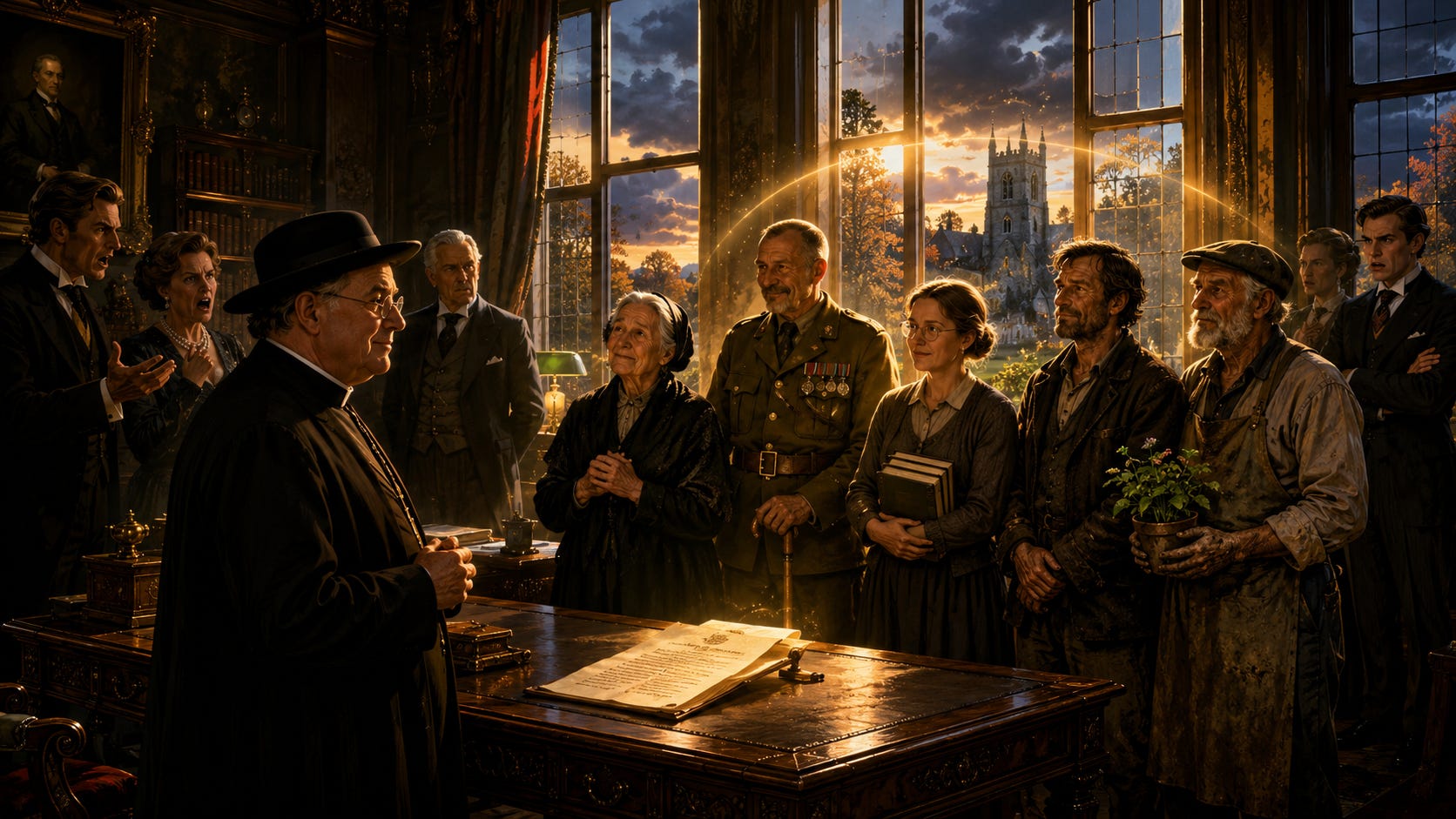
When Sir Adrian Markham, one of England’s wealthiest industrialists, dies, his family expects to inherit a vast fortune. Instead, they discover that he has left almost everything to five ordinary villagers: a widow, a disabled veteran, a humble schoolmistress, a former convict, and an aging gardener. The decision provokes outrage, scandal, and bitter accusations. Then Sir Adrian’s secretary is murdered after discovering evidence that would explain the strange inheritance.
As Father Brown investigates, he uncovers a secret transformation that occurred during the final year of Sir Adrian’s life. The wealthy businessman had begun studying the people around him through the lens of the Beatitudes. To his astonishment, he found courage among the fearful, mercy among the forgotten, gratitude among the poor, and wisdom among those whom the world regarded as failures.
But someone else discovered the same truth.
And someone was willing to kill to keep it hidden.
Like Chesterton’s original Father Brown stories, The Man Who Inherited Nothing is ultimately about more than crime. It is about pride and humility, reputation and reality, success and sanctity. It asks whether a man can spend his entire life pursuing the wrong treasure and whether the poorest people in a village might possess a wealth that cannot be measured in money.
For Father Brown, every mystery is finally a mystery about the human heart. This one concerns a heart that learned too late what Christ meant by blessing—and another that could not bear to hear it.
So step into the autumn village of St. Edmund’s Hollow, where a rich man has died, a murderer walks free, and five unlikely heirs are about to inherit far more than a fortune.
For as Father Brown would be the first to remind us, the strangest thing about the Gospel is not that God blesses the humble.
It is that we are always surprised when He does.
Part I
The village of St. Edmund’s Hollow lay in one of those folds of the English countryside that seem less a place than a pause. It was not hidden exactly; indeed, the railway touched it with sufficient regularity to assure civilization that it still existed. Yet it possessed that peculiar quality of old villages which makes them appear to have survived civilization rather than joined it. The church tower stood above the elms with the patient dignity of a thing that had watched many fashions come and go, and the winding lanes seemed less designed for traffic than for contemplation.
Father Brown arrived there on a damp autumn afternoon carrying a black umbrella that looked as tired as himself. The little priest walked from the station toward the village square with the air of a man who had nowhere urgent to go and therefore usually arrived exactly where he ought.
The sky was low and gray, and the air smelled faintly of wet leaves and wood smoke. Somewhere a church bell sounded, not with the triumphant peal of a festival but with the slow and measured voice of mourning.
The bell was tolling for Sir Adrian Markham.
Father Brown knew little about Sir Adrian beyond the fact that he had become one of the richest industrialists in England and had recently died. Wealthy men died every day, and most of them took the precaution of being forgotten almost immediately. Yet the letter that had summoned him suggested that this particular death had produced effects unusual even among the rich.
The letter had come from Arthur Fenwick, solicitor and executor of the Markham estate.
It contained only a few lines.
“Dear Father Brown,
I should value your presence at the reading of Sir Adrian’s will. Nothing criminal has occurred, so far as I know. Yet something has happened which I cannot understand. You once told me that when things become difficult to understand, they are often becoming easier to explain. I hope you were right.
Yours sincerely,
Arthur Fenwick.”
The priest smiled faintly as he remembered the phrase. He had said it years earlier during an investigation involving a stolen jeweled cross, though he could no longer remember why.
He found Mr. Fenwick waiting outside the church.
The solicitor was a tall man with silver hair and an expression suggesting that life had disappointed him chiefly by being less orderly than legal documents.
“You came,” he said.
“You seemed worried.”
“I am.”
“Has someone been murdered?”
“Not yet.”
Father Brown looked thoughtful.
“That is usually the best time to worry.”
Fenwick stared.
The priest added gently, “A murder is often easier to understand than the things that happen before it.”
The solicitor sighed.
“I hope you are mistaken.”
“So do I.”
They entered the church together.
The funeral had ended only moments earlier. A few black-clad figures still lingered among the pews. Others drifted toward the churchyard where the rain-darkened gravestones leaned at improbable angles.
At the front stood a woman dressed in worn black clothing. Her face was lined with grief, yet there was a curious serenity about her. Nearby stood a broad-shouldered man using a cane. Though his hair had gone gray, his bearing still suggested military discipline.
Father Brown noticed them because they appeared more genuinely saddened than the wealthy relatives gathered near the door.
“Who are they?” he asked quietly.
Fenwick glanced over.
“Mrs. Margaret Finch. Widow. Her husband died in a mining accident years ago.”
“And the gentleman?”
“Captain Thomas Reeves. Lost a leg during the war.”
The priest nodded.
There was something oddly noble about both figures.
Not noble in the theatrical sense.
Rather in the way old stone churches are noble.
One suspects they have suffered weather.
As they left the church, Father Brown found himself walking beside the widow.
Mrs. Finch greeted him politely.
“You knew Sir Adrian well?” he asked.
“Not really.”
The answer surprised him.
“You seem very grieved.”
She smiled faintly.
“One needn’t know a man well to mourn him.”
“No,” said Father Brown. “One often knows him better.”
She looked at him curiously.
“He was kind to me.”
“That sounds simple.”
“It is simple.”
She hesitated.
“People always think kindness must be complicated when it comes from rich men.”
Father Brown chuckled.
“Perhaps because it so rarely does.”
She laughed despite herself.
Then she grew thoughtful.
“You know, Father, Sir Adrian spent most of his life frightening people.”
“Many successful men do.”
“But not at the end.”
“No?”
She shook her head.
“He became interested in people.”
The priest glanced at her.
“What an extraordinary hobby.”
She smiled.
“That is exactly what he called it.”
Those words lingered in Father Brown’s mind long after the conversation ended.
Sir Adrian had become interested in people.
It seemed an odd thing to say.
Yet it would later become the key to everything.
The reading of the will took place that afternoon at Markham Hall.
The great house stood upon a hill overlooking the village like a medieval castle that had somehow learned accounting. It possessed all the architectural confidence that wealth acquires when it has existed long enough to mistake itself for virtue.
Inside, the atmosphere resembled that of a courtroom awaiting sentence.
Relatives occupied one side of the library.
Villagers and employees occupied the other.
Father Brown sat quietly near the fireplace.
The room contained perhaps thirty people.
Only six looked entirely uncomfortable.
The widow.
The veteran.
A schoolmistress.
A gardener.
A former prisoner.
And Arthur Fenwick.
The solicitor cleared his throat.
“Ladies and gentlemen, I shall now read the final will and testament of Sir Adrian Markham.”
The reading began conventionally enough.
Several charities received donations.
Employees received pensions.
Distant relatives inherited modest sums.
Then Fenwick stopped.
For a moment he seemed almost reluctant to continue.
Finally he resumed.
“To my nephew Julian Markham, I leave ten thousand pounds.”
A murmur passed through the room.
Julian Markham sat upright.
Ten thousand pounds was a considerable sum.
It was not, however, the fortune everyone expected.
The reading continued.
Several other family members received similar amounts.
Expressions darkened.
Then came the sentence that changed everything.
“The remainder of my estate, including all holdings, investments, properties, and liquid assets, shall be divided equally among the following individuals.”
Fenwick paused.
The room became silent.
“Margaret Finch.”
The widow gasped.
“Thomas Reeves.”
The veteran stared.
“Emily Ward.”
A shy woman near the back dropped her gloves.
“Samuel Briggs.”
A heavily built man with rough features looked as though someone had struck him.
“George Miller.”
The old gardener blinked twice and sat down abruptly.
The room exploded.
Voices rose.
Chairs scraped.
Someone shouted.
Julian Markham sprang to his feet.
“This is madness.”
Fenwick continued reading above the uproar.
The final page contained a personal statement.
His voice became quieter.
“If this disposition of my estate appears irrational, I can only reply that I spent most of my life valuing the wrong things.”
The room slowly fell silent.
Fenwick continued.
“I once believed success belonged to the strong, the admired, and the fortunate. During the final year of my life I discovered that I had been mistaken.”
The solicitor swallowed.
“I leave my estate to those from whom I learned the truth.”
Then came a final line.
A line so strange that Father Brown never forgot it.
“Among the poor I found riches. Among the mournful I found joy. Among the defeated I found victory. Among those who inherited nothing from the world, I discovered those fit to inherit everything.”
Silence followed.
A profound and uncomfortable silence.
It was broken by Julian Markham.
“I contest the will.”
His voice rang across the room.
“My uncle was manipulated.”
“No,” said Fenwick firmly.
“I witnessed the document myself.”
“Then he was deceived.”
Father Brown looked toward the five beneficiaries.
None appeared triumphant.
None appeared greedy.
Indeed, they seemed almost frightened.
The priest found this interesting.
People who unexpectedly inherit fortunes usually look delighted.
People who unexpectedly inherit burdens often look alarmed.
The distinction would prove important.
Julian’s face had gone pale with anger.
“My uncle would never have done this.”
“He did,” said Fenwick.
“He must have had a reason.”
The solicitor hesitated.
“Perhaps.”
“Then where is it?”
The question seemed to strike him.
Fenwick frowned.
“There may be documents.”
“What documents?”
“Sir Adrian kept journals.”
Several heads turned.
The solicitor looked increasingly uncomfortable.
“He spent the last year writing observations.”
“Observations about what?”
Fenwick answered reluctantly.
“People.”
Father Brown felt a curious chill.
Not fear.
Recognition.
The feeling one experiences when a puzzle piece appears before the puzzle itself.
The room erupted again.
Arguments filled the library.
Accusations flew.
Yet amid the confusion Father Brown noticed something peculiar.
One man had become very pale.
Not Julian.
Not any of the heirs.
The man was standing near the window.
Tall.
Distinguished.
Impeccably dressed.
Respected by everyone present.
Indeed, Father Brown vaguely recalled hearing him praised several times already that day.
The priest did not yet know why the man’s expression interested him.
He only knew that while others appeared angry, this gentleman appeared afraid.
And Father Brown had often observed that fear is a better clue than anger.
Especially when nobody has yet committed a crime.
Or believes they have.
Part II
It is one of the minor errors of mankind to suppose that a great uproar is always produced by a great event. More often, it is produced by the discovery that a great event has occurred privately in the soul of a single man, while all the rest of us were looking at his bank account. Sir Adrian Markham had died; that was public. Sir Adrian Markham had changed; that was almost indecently private. The second fact was what his family found unforgivable.
