

🕯️ Top Pick: The Lamp at the Door
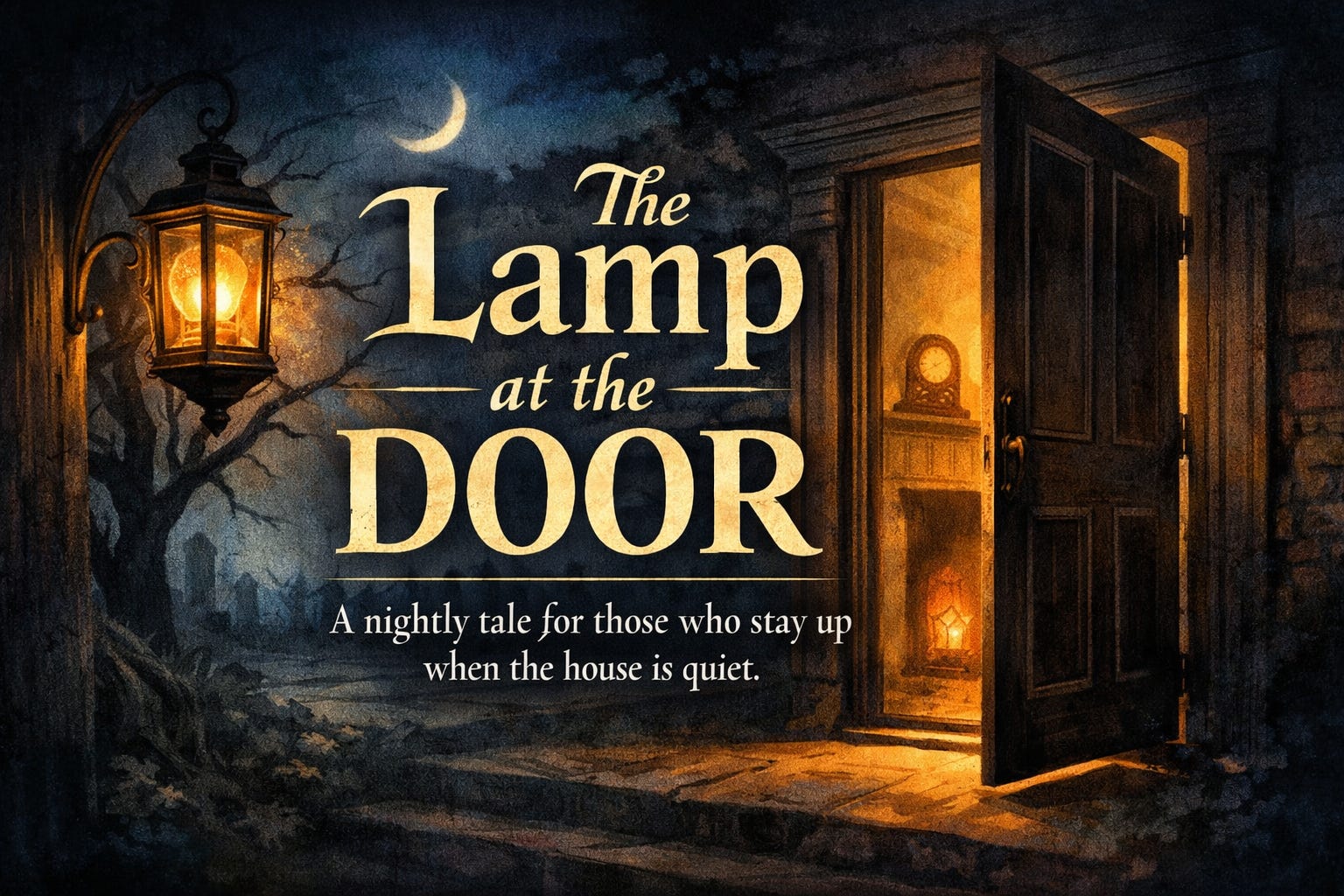
There is a particular kind of knock that does not belong to daylight.
Mrs. Eleanor Finch knew this because she had lived alone for fourteen years, and in that time had learned the language of her house. Pipes ticked. Floorboards sighed. Branches tapped the windows in wind.
But a knock — slow, deliberate, twice — meant a human being stood on the other side of the door.
It came at 10:32 PM.
Eleanor froze in her armchair. The fire had burned low. The grandfather clock in the hall hummed toward its next minute.
Knock. Knock.
Not loud. Not timid. Certain.
She did not rise at once. No one visited her at night. Not the grocer’s boy. Not the vicar. Certainly not her neighbor, Mr. Cresswell, who believed anything after 9 PM was an act of moral collapse.
The knock came again.
Knock. Knock.
She stood.
The hallway felt longer than usual. The single wall lamp cast a yellow cone of light over the door. She noticed, absurdly, that she still held her knitting needles.
“Who is it?” she called.
A pause.
Then a man’s voice — calm, slightly breathless, as if he had walked a long way.
“Terribly sorry to disturb you, ma’am. I believe I used to live here.”
Eleanor blinked.
“I’ve lived here thirty years.”
“Yes, ma’am. That would be right. I left in 1952.”
Her fingers tightened on the needles.
“This house was built in 1961.”
Another pause.
“Oh,” the voice said gently. “Then I must be mistaken about the year.”
She should have sent him away. Every sensible instinct told her to bolt the door and telephone the police.
Instead, she slid back the chain.
The porch light flickered on.
A man stood there in a dark overcoat, hat in hand. He looked ordinary in the way strangers sometimes do — average height, pale, perhaps forty. Except his clothes were wrong. The cut, the fabric, the narrow tie — they belonged to photographs in old albums.
“I won’t be a moment,” he said politely. “I only need to check something.”
“Check what?”
“The clock,” he replied.
Her stomach tightened.
“What clock?”
He smiled faintly, as if she were teasing him.
“The one in the front room. On the mantel. It stopped the night I died.”
The air seemed to leave the hallway.
“I’m sorry,” she whispered.
“Yes,” he agreed kindly. “So was I.”
She should have screamed. Instead she stepped back.
He entered without brushing against her, without the sound of shoes on tile. He walked straight to the sitting room.
Eleanor followed.
The mantel clock — brass, oval, long unwound — sat where it had for years. She never bothered with it. It had stopped at 10:32.
The man leaned close, studying it.
“That’s right,” he murmured. “That’s when she pushed me.”
Eleanor’s voice came thin. “Who?”
“My wife. She thought I’d found out about the insurance.” He glanced at her with mild regret. “I had.”
Her heart hammered. “You fell?”
“Down the cellar stairs. Head first.” He touched his temple. “Very quick.”
The room felt impossibly small.
“Why come here?” she asked.
“Because something is wrong,” he said softly. “I can’t leave. I thought perhaps… if someone knew…”
He looked at her with pleading politeness.
“I don’t want to stay.”
The clock ticked.
Once.
Eleanor gasped. It had not ticked in decades.
The man straightened.
“Oh,” he said with quiet relief. “That’s better.”
The clock hands moved.
10:32… 10:33.
The fire snapped loudly.
Eleanor looked back at him.
But the room was empty.
Only the clock ticked, steady and alive for the first time in sixty years.