

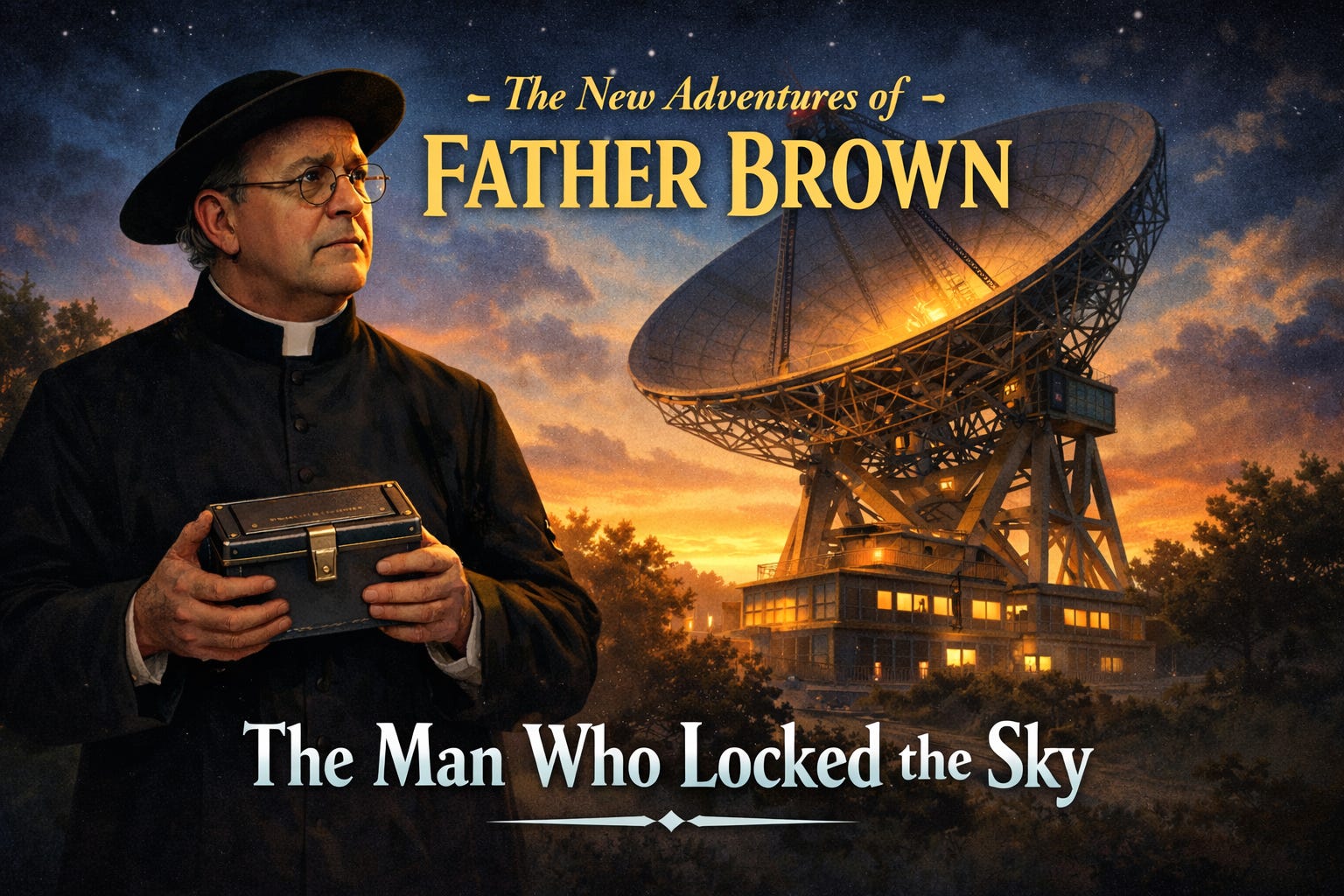
Father Brown disliked locked things on principle.
Not because he wished to open them — he had no special talent for locks, either mechanical or moral — but because locks suggested a misunderstanding. They implied that the world could be neatly divided into inside and outside, safe and dangerous, mine and yours. Father Brown, who had heard thousands of confessions, knew better.
So when he was told that a man had “locked the sky,” he felt a mild but genuine theological concern.
The village of High Ashcombe was not the sort of place where the sky could be easily interfered with. It was a bowl of green hills, sheep-speckled slopes, and one medieval church that leaned very slightly, as if still listening for the last sermon of the Reformation.
Father Brown had come to visit an old friend, Reverend Martin Hale, whose chief complaint in life was not sin but committee meetings. But when Father Brown arrived at the vicarage, he found Hale in the garden staring upward with the expression of a man who has misplaced something extremely large.
“Ah, Brown,” Hale said faintly. “You’re just in time for the end of the world.”
Father Brown set down his bag. “I hope not before tea,” he said. “Travel always makes me peckish.”
Hale pointed upward.
Above the rolling fields, just beyond the church tower, stood a colossal steel structure — a lattice of beams and panels, rising like a mechanical tree. At its top was a vast, shallow dish pointed toward the heavens.
“It’s a radio telescope,” Hale said darkly.
“Oh good,” said Father Brown. “I was afraid it was modern art.”
The structure belonged to a private research facility built on the edge of the parish — Ashcombe Signal Array. It had arrived two years earlier with grants, scientists, and a promise to “listen to the universe.” The villagers had tolerated it with the same stoicism they applied to wind turbines and modern hymns.
But this morning, Dr. Lionel Vane, the facility’s director, had been found dead in the control room.
“And someone’s saying he locked the sky?” Father Brown asked.
Hale nodded. “That’s what his assistant keeps repeating. Miss Carrow. Says his last words were, ‘I’ve done it. I’ve locked the sky.’ Then he collapsed.”
“Poison?” Father Brown asked gently.
“Apparently so. Police are on their way from the city. In the meantime, the staff are… unsettled.”
“Quite,” said Father Brown. “People prefer their skies unlocked.”
The facility looked like a monastery designed by engineers — white corridors, humming rooms, and a silence that felt less like peace than listening.
Miss Eliza Carrow met them in the main lab. She was pale, sharp-eyed, and vibrating with the kind of tension that comes from knowing too much and understanding too little.
“You’re the priest,” she said. “Dr. Vane spoke of you. Said you were ‘dangerous to tidy minds.’”
“I try not to be untidy,” said Father Brown apologetically.
“He was working all night,” she said, leading them into the control room. Screens still glowed with graphs and star maps. In the center stood a chair. It was empty now.
“He said he’d found something,” she continued. “A signal. Not random noise. Not a pulsar. A pattern. Repeating, structured.”
“A message?” asked Hale.
“He thought so. But not to us. Just… there. Like finding a book in a language no one remembers.”
“And then?” Father Brown prompted.
“He grew frightened. Not excited. Frightened. Said if certain people knew, it would cause panic. Or worse. He said he would ‘lock the sky’ before anyone could misuse it.”
“Misuse the sky?” Hale muttered. “How does one weaponize Orion?”
Father Brown was looking not at the screens, but at the desk. A mug. Papers. A small locked metal case.
“Was that his?” he asked.
“Yes,” said Carrow. “He always kept backup drives there. But it’s locked, and we don’t know the code.”
Father Brown nodded thoughtfully. “Did he often dramatize his work?”
“He was cautious. Private. But not dramatic.”
“Then when he said he locked the sky,” said Father Brown, “he meant something quite practical.”
The police arrived with the brisk energy of men determined to arrest something, even if it turned out to be the universe.
Inspector Griggs was a large man with a mustache that suggested moral certainty.
“Poison in his tea,” Griggs said. “Fast-acting. Lab access only. So someone here did it.”
He looked around at the nervous scientists like a shepherd assessing particularly suspicious sheep.
“Any enemies?” he asked.
Carrow hesitated. “There was… pressure. From a defense contractor. They wanted exclusive access to our data streams. Dr. Vane refused.”
“Names?”
“Mr. Richard Calder. He’s here today, actually. Flew in last night.”
Griggs’ mustache stiffened with purpose.
Calder was handsome, smooth, and radiated the confidence of a man who believed morality was a negotiable instrument.
“I wanted collaboration,” he said coolly. “Not control. And I certainly didn’t poison anyone. Dead scientists don’t sign contracts.”
“Where were you last night?” Griggs demanded.
“In the guest quarters. Alone. Regrettably.”
Father Brown watched him with mild interest, like a cat observing a particularly well-dressed mouse.
“Did Dr. Vane ever mention ‘locking the sky’ to you?” the priest asked.
Calder laughed. “He told me he’d rather burn his data than let it be used for weapons systems. Idealistic nonsense.”
“Not nonsense,” Father Brown murmured. “Just rare.”
Later, Father Brown wandered back into the control room alone. He stared at the great dish through the window.
Locked the sky.
He looked at the locked case again. Then at the computer terminal. Then at the mug.
He sniffed the mug.
“Ah,” he said softly.
That afternoon, Inspector Griggs gathered everyone in the lab.
“We have motive, opportunity, and access,” he began, pointing subtly at Calder. “But Father Brown has… an alternative theory.”
All eyes turned to the small priest, who looked mildly embarrassed to be so visible.
“I don’t think Dr. Vane was murdered,” he said.
There was a collective intake of breath.
“The poison?” Griggs protested.
“Yes,” said Father Brown. “He poisoned himself.”
Carrow gasped. “No! He would never—”
“Oh, I think he would,” Father Brown said gently. “If he believed it was the only way to keep his promise.”
“Promise?” Hale asked.
“To lock the sky.”
Father Brown picked up the metal case.
“This contains the only copy of the decoded signal. Dr. Vane realized something about it — not that it was a message from aliens, but that it could be interpreted as one. With enough imagination, it could start a global panic. Or be twisted into a pretext for militarization, control, fear.”
Calder scoffed. “That’s absurd.”
“Not at all,” said Father Brown. “Men have started wars over far less than a mysterious voice in the heavens.”
He continued, “Dr. Vane deleted the primary data. Wiped the servers. Locked the backup in this case. Then he took poison — knowing that without the code, and without him, the ‘message’ would die with him.”
Carrow stared at him. “But why say he locked the sky?”
“Because to him,” said Father Brown softly, “the sky is not just stars. It’s meaning. Wonder. Mystery. He was afraid we would turn it into a weapon, a slogan, a terror.”
Griggs frowned. “But the poison—”
“Was in his own mug,” said Father Brown. “A compound he synthesized in the lab. He had both knowledge and access. And a conscience.”
Calder’s voice was sharp. “So he kills himself to stop progress? That’s insanity.”
Father Brown looked at him kindly. “No. It’s sacrifice. A very old-fashioned form of progress.”
There was silence in the humming lab.
Outside, the great dish still pointed at the sky, listening.
Carrow spoke at last. “We can still break the case. Recover the data.”
“Yes,” said Father Brown. “You can. But now you know what it cost him to hide it. That may help you decide what to do with it.”
Inspector Griggs cleared his throat. “I’ll file it as suicide. Unusual circumstances.”
“Most moral acts are,” said Father Brown.
That evening, Father Brown and Reverend Hale stood by the churchyard wall, watching the sunset burn gold behind the metal silhouette of the telescope.
“Do you think he was right?” Hale asked. “To hide it?”
Father Brown considered.
“God hides Himself all the time,” he said. “Not because He has nothing to say, but because we are so very good at misunderstanding.”
He smiled faintly.
“Perhaps Dr. Vane merely learned a little divine discretion.”
Above them, the sky stretched wide, unlocked, and full of stars no one had yet turned into an argument.
And for once, that seemed miracle enough.
Chesterton Radio
Keeping the lamp lit while the world wakes.
📻 About Chesterton Radio
Chesterton Radio is a listener-supported home for timeless stories, sacred beauty, and the quiet light of Christian imagination. Inspired by the wit and wonder of G. K. Chesterton, our mission is simple: to keep great truths clothed in great stories, and to make a little room each day for reflection, joy, and faith.
We share classic radio drama, literature, music, and daily meditations that remind us the world is charged with meaning — and that grace often arrives in ordinary disguises.
🎧 Join our 24/7 live stream, The Open Door, anytime at
The lamp is always lit, and there’s always a chair by the fire.