

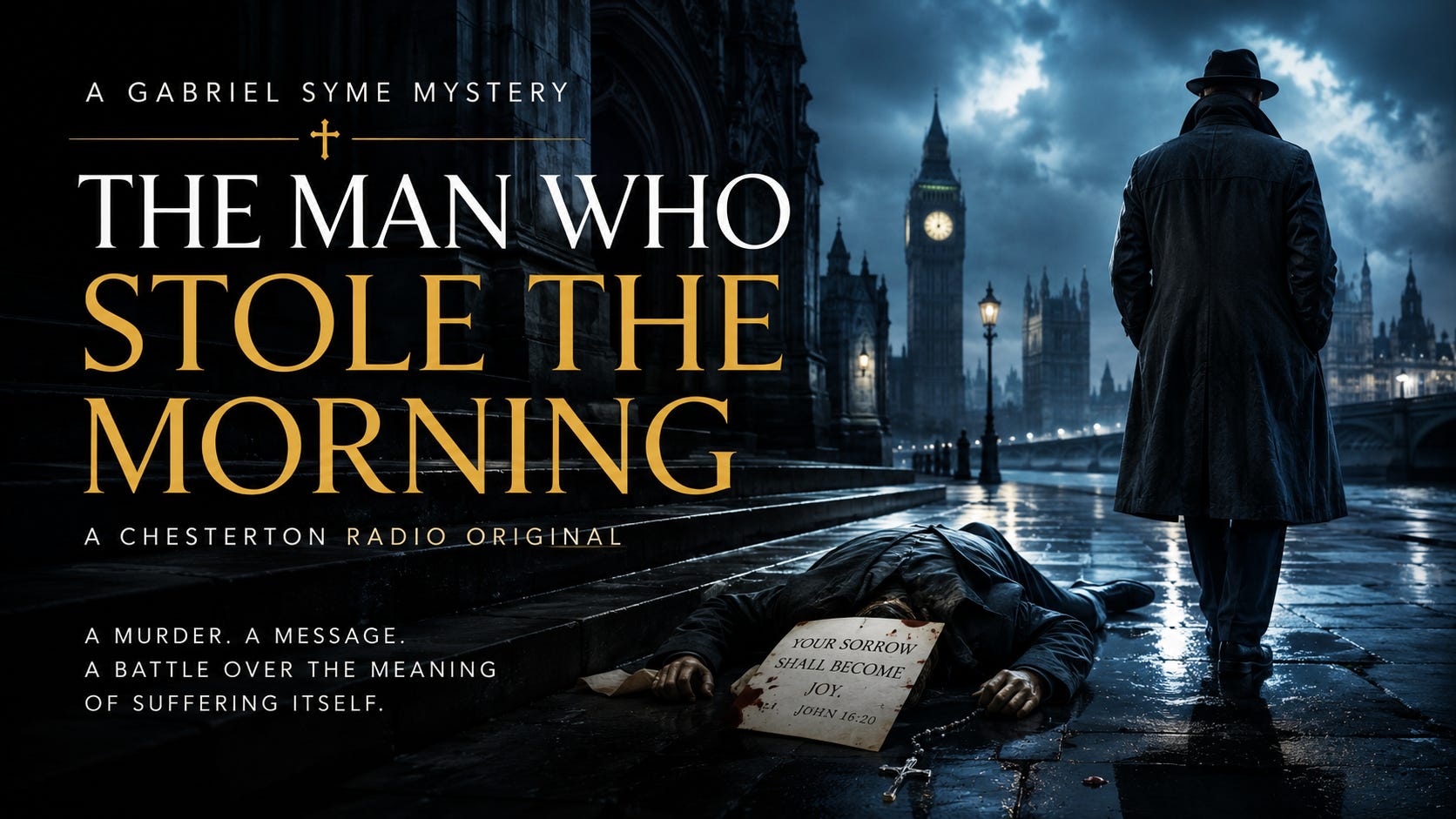
Intro
The bells begin before dawn.
London still sleeps beneath rain and smoke when Gabriel Syme is summoned to the steps of an ancient church, where a wealthy religious celebrity lies dead beneath a cryptic message from the Gospel of John:
“Your sorrow shall become joy.”
What begins as a murder investigation soon becomes something darker and stranger — a battle over the meaning of suffering itself.
In a city intoxicated with comfort, Syme must descend into a hidden world of fashionable optimism, secret societies, shattered faith, and philosophical despair. Along the way he encounters grieving widows, skeptical intellectuals, frightened priests, and men willing to kill to preserve a religion without a Cross.
But Syme knows something modern men have forgotten:
That Christianity does not promise escape from sorrow.
It promises resurrection through it.
Written in the spirit of G.K. Chesterton’s The Man Who Was Thursday and the Father Brown mysteries, The Man Who Stole the Morning is a full-length Gabriel Syme mystery of murder, paradox, rain-soaked London streets, and the terrible joy at the heart of Easter.
Chapter One
The Bell Before Dawn
Gabriel Syme had always considered it one of the strangest weaknesses of modern civilization that men feared sorrow more than sin.
He was thinking this while standing in the rain outside St. Jude’s Church in the gray half-light before dawn, with his umbrella turned backward by a violent May wind and the bells tolling as though the world had ended politely.
The city still slept. But London was never entirely asleep; it merely muttered in its dreams. Somewhere far off a lorry growled over wet cobblestones. A newspaper boy bicycled like a fugitive through the fog. The river smelled of soot and spring rain.
And beneath the church portico lay a dead man.
Syme removed his hat.
Father Anselm, the old Benedictine prior of St. Jude’s, stood beside the body holding a lantern whose golden light trembled across the corpse like a nervous conscience.
“I am very sorry to summon you so early,” said the priest quietly.
“My dear Father,” replied Syme, “the only thing more alarming than being awakened before sunrise is discovering that nobody else has been.”
The priest almost smiled.
The dead man lay upon the stone steps with his hands folded oddly upon his chest, as though someone had attempted to arrange him after death and had not entirely understood humanity. He wore an expensive charcoal overcoat soaked black with rainwater. His face was narrow and distinguished, though now fixed into a look of immense surprise.
Not terror.
Not agony.
Surprise.
A silver rosary had been wrapped around his wrist.
Inspector Bull stood nearby with the expression of a bulldog asked to appreciate poetry.
“Well,” grunted Bull, “there he is.”
“Yes,” said Syme. “I observe the murderer had the good taste not to remove him afterward.”
Bull ignored this.
“Name’s Adrian Vale. Wealthy publisher. Public lecturer. Something of a celebrity among fashionable religious people.”
“That dangerous species,” murmured Syme.
Bull pointed with his cigar.
“No visible wounds. Doctor says poison likely. Time of death perhaps between midnight and two.”
“And why was he left here?”
“That,” said Bull grimly, “is what I should very much like to know.”
Father Anselm lifted the lantern slightly.
“There is another thing,” he said.
Syme followed the priest’s gaze.
Pinned beneath the dead man’s folded hands was a small card.
Bull handed it over.
On the card were written only six words:
YOUR SORROW SHALL BECOME JOY.
Syme stared at it silently.
Then he looked toward the church doors.
“Father,” he asked softly, “what Gospel is read today?”
The priest answered at once.
“John sixteen.”
Syme’s pale eyes sharpened.
“Ah,” he said. “Then the murderer possesses either theology or irony. And I never trust either in excess.”
Rain hissed softly against the stone.
The bells continued to ring.
And somewhere behind the clouds the morning waited like a secret.
Chapter Two
The Apostle of Happiness
By nine o’clock Syme sat in Adrian Vale’s library beneath a painted ceiling crowded with saints who appeared deeply suspicious of the furniture.
The room reflected the strange modern disease by which wealthy men attempted to purchase simplicity at enormous expense. Everything was monastic except the price.
Ancient crucifixes hung beside electric lamps shaped like factory gears. Shelves of theology stood next to bestsellers with titles such as The Spirituality of Success and The Joy Revolution.
Bull snorted at one particularly glossy volume.
“Looks like religion written by a champagne advertisement.”
Syme took down the book thoughtfully.
“That,” he said, “may be the most accurate definition of modern optimism ever spoken.”
He flipped through pages filled with smiling aphorisms.
“‘Pain is merely negative thinking.’ Good heavens.”
Bull shrugged.
“People liked him.”
“Yes,” said Syme. “That is often suspicious.”
The inspector lit another cigar.
“Here’s what I’ve got. Vale became famous lecturing about happiness. Packed halls all over England and America. Rich people adored him. Claimed Christianity should be cheerful, positive, uplifting.”
“And painless?”
“Mostly.”
Syme smiled faintly.
“There are some men who would remove the Cross from Christianity exactly as one removes bones from fish.”
A secretary entered quietly carrying correspondence recovered from Vale’s desk.
She was young, nervous, plainly exhausted.
“Miss Harbury?” asked Bull.
“Yes.”
“You worked for Mr. Vale how long?”
“Three years.”
“Did he have enemies?”
She hesitated.
“Not enemies exactly.”
Syme leaned forward gently.
“My dear lady, civilized people call them ‘professional disagreements.’ Only honest people use the word enemy.”
She gave an involuntary laugh.
“There was one man,” she admitted. “Professor Lucien Marr.”
Bull looked up.
“The philosopher?”
“Yes.”
Syme’s eyebrows rose.
Lucien Marr was notorious in certain intellectual circles: a brilliant skeptic who specialized in attacking Christian doctrine with cold surgical precision. But unlike the ordinary atheist, Marr did not mock religion emotionally. He dissected it academically, which is far more dangerous.
“What was the quarrel?” asked Syme.
Miss Harbury twisted her gloves.
“Professor Marr accused Mr. Vale of… falsifying Christianity.”
“In what way?”
“He said Christianity is not a promise that sorrow disappears. He said it is the transformation of sorrow. He claimed Mr. Vale preached comfort instead of resurrection.”
Syme sat very still.
“That,” he said quietly, “sounds extraordinarily relevant.”
Bull grunted.
“Did they threaten each other?”
“No. But they debated publicly last week at Kingsmere Hall. It became… heated.”
Syme rose abruptly.
“My dear Bull,” he announced, “we must immediately interview the man most capable of murdering a cheerful theologian.”
Bull sighed.
“And why’s that?”
“Because philosophers,” said Syme, taking his hat, “commit murders for reasons ordinary criminals cannot even pronounce.”
Chapter Three
The Philosopher of Despair
Professor Lucien Marr lived in Bloomsbury among towers of books and an atmosphere of cultivated insomnia.
He received them wearing a black velvet coat and an expression suggesting he had long ago forgiven humanity for existing.
“You suspect me already,” he said pleasantly.
Bull folded his arms.
“A man’s dead.”
“Yes,” replied Marr. “That condition remains distressingly common.”
Syme wandered slowly around the room examining manuscripts.
“Professor,” he said lightly, “did you hate Adrian Vale?”
“No.”
“Did you despise him?”
“Profoundly.”
“Ah,” said Syme. “An important distinction.”
Marr poured wine.
“Vale turned Christianity into therapy for wealthy neurotics. He removed tragedy from the faith exactly as modern architects remove gargoyles from cathedrals. He made religion safe.”
Bull growled impatiently.
“Did you kill him?”
“Certainly not.”
“Can anyone confirm that?”
“Yes. I lectured at Cambridge until nearly midnight.”
Bull checked notes.
“That’s true enough.”
Syme studied the philosopher carefully.
“You quoted Scripture during your debate with Vale.”
Marr smiled thinly.
“Yes. I reminded him Christ did not say, ‘You shall avoid sorrow.’ He said, ‘Your sorrow shall become joy.’ Entirely different thing.”
“Why emphasize that?”
“Because modern men fear suffering so completely they would rather worship comfort than truth.”
The room fell silent.
Then Marr added unexpectedly:
“I liked Father Anselm.”
Syme looked up quickly.
“You know the prior?”
“Indeed. One of the few Christians intelligent enough not to sentimentalize Christianity.”
Something flickered across Syme’s face.
“Professor,” he asked quietly, “what do you think happened to Adrian Vale?”
Marr stared into his wine glass.
“I think,” he said slowly, “someone wished to punish him symbolically.”
Bull frowned.
“Meaning?”
Marr looked toward the rain-streaked window.
“Mr. Vale spent years proclaiming that sorrow itself was unnecessary. Then someone laid his corpse on church steps beneath the words of Christ about sorrow becoming joy.”
Syme’s eyes narrowed.
“Yes,” he murmured. “Not merely murder. A theological argument.”
The philosopher smiled faintly.
“You see it too.”
“Oh yes,” said Gabriel Syme softly. “And theological arguments are the most dangerous kind. Men will forgive each other for theft or lust. But they will kill one another over the meaning of hope.”
Outside, thunder rolled across London like distant artillery.
And Syme suddenly felt—not fear exactly—but the unmistakable sensation that the murderer had not finished speaking.
Chapter Four
The Woman in Gray
That evening the rain stopped.
London emerged shining and black beneath gaslight.
Syme walked alone through Kensington toward Vale’s final lecture hall, thinking rapidly in the peculiar cheerful fashion by which he approached danger. Most detectives became grim when nearing truth. Syme became almost merry.
For truth, to him, was always a kind of sunrise.
Kingsmere Hall stood dark except for one upper window glowing amber against the wet night.
A woman sat alone inside.
She wore gray.
Not fashionable gray. Mourning gray.
Syme entered quietly.
She did not seem surprised.
“You are Gabriel Syme,” she said.
“Yes.”
“I am Eleanor Vale.”
“The widow?”
“My brother’s widow.”
Syme removed his hat.
She looked exhausted beyond ordinary grief. Not shattered. Worse than shattered. Empty.
“There is something,” she said, “that the police do not know.”
Syme sat opposite her.
“My dear lady, policemen exist largely so that civilized people may delay telling the truth.”
She almost smiled.
“Adrian was dying.”
Syme froze.
“Dying?”
“Heart disease. Terminal. He knew he had perhaps six months.”
“Did anyone else know?”
“Only Father Anselm. And me.”
Syme’s thoughts shifted violently.
“Then why continue the lectures?”
“Because he was terrified.”
“Of death?”
She shook her head slowly.
“Of sorrow.”
The silence deepened.
“He had built an empire preaching happiness. But once he became ill… he could not bear suffering. Not his own. Not anyone’s. He became desperate to believe pain was meaningless.”
Syme stared at her thoughtfully.
“And Professor Marr?”
“He frightened Adrian because he spoke about suffering as though it mattered.”
She stood suddenly and crossed to the rain-streaked windows.
“Mr. Syme… my husband was not murdered because he was cheerful.”
“Then why?”
She turned.
“Because he was beginning to change.”
Syme felt the world tilt slightly.
“What do you mean?”
“He met Father Anselm repeatedly these last weeks. They argued constantly. Adrian said Christianity had become too soft. He said perhaps the Cross was not merely symbolic after all.”
“And someone objected?”
She nodded.
“There was a group around Adrian. Wealthy patrons. Influential people. They made fortunes from his books and speaking tours. If Adrian reversed himself publicly…”
“Their religion of comfort collapses,” finished Syme.
The widow whispered:
“Yes.”
At that exact instant the lights failed.
Darkness swallowed the hall.
And somewhere nearby a man screamed.
Chapter Five
The Joyful Society
The scream came from backstage.
Bull arrived moments later with constables crashing through corridors while Syme sprinted toward the sound.
They found a man unconscious beside the stage curtains.
Not dead.
Terrified.
It was Vale’s literary agent.
Pinned to his coat was another card.
THIS WORLD’S JOY PASSETH AWAY.
Bull cursed.
“Madman’s taunting us.”
Syme knelt beside the trembling agent.
“No,” he said softly. “Not taunting. Preaching.”
The man gasped:
“He was here… masked… he said Adrian betrayed the mission…”
“What mission?”
“The Society…”
Bull leaned forward sharply.
“What society?”
But the man collapsed again into panic.
Later, in the corridor outside, Bull growled:
“Well?”
Syme lit a cigarette.
“My dear Bull, we are dealing not with a murderer who happens to possess ideas. We are dealing with ideas that happen to possess a murderer.”
Bull hated sentences like that.
“Speak English.”
Syme exhaled smoke thoughtfully.
“There exists,” he said, “a cult of optimism.”
Bull blinked.
“A what?”
“A religion devoted to denying sorrow. Its members believe unhappiness itself is immoral. Pain is weakness. Grief is failure.”
“That’s insane.”
“Yes,” said Syme cheerfully. “Which is why it thrives in modern society.”
He paced slowly beneath the dim corridor lamps.
“Adrian Vale created a movement promising emotional salvation. But then he discovered suffering personally. And suffering began teaching him theology.”
Bull frowned.
“So somebody killed him before he changed sides?”
“Possibly.”
“Who?”
Syme smiled grimly.
“That is the irritating part. In movements devoted to happiness, everyone eventually becomes homicidal.”
Chapter Six
Father Anselm Speaks
Near midnight Syme returned to St. Jude’s.
The old Benedictine sat alone in the sanctuary while candlelight flickered upon stone saints worn smooth by centuries of prayer.
Syme sat beside him quietly.
After a long silence he asked:
“Did Adrian Vale confess to you?”
Father Anselm nodded.
“Yes.”
“What troubled him most?”
The priest looked toward the crucifix.
“He feared that suffering had meaning.”
Syme stared.
“Most men fear the opposite.”
“Yes,” said the monk. “But meaning demands surrender.”
The candles crackled softly.
“At first Adrian preached happiness because he wished men to rejoice. Later he preached happiness because he feared despair. Finally he preached happiness because he feared God.”
Syme leaned forward.
“And recently?”
“Recently he began to understand.”
Father Anselm’s old eyes shone strangely.
“He realized Christ did not come merely to remove pain. He came to transform it. The Resurrection does not erase Good Friday. It transfigures it.”
Syme whispered:
‘Your sorrow shall become joy.’”
“Yes.”
The priest folded trembling hands.
“Adrian planned to announce publicly that he had been wrong.”
Syme sat upright sharply.
“When?”
“Tonight.”
Everything locked suddenly into place.
Kingsmere Hall.
The panic.
The masked figure.
The society.
The murder was not revenge.
It was prevention.
Syme stood abruptly.
“My dear Father,” he said, “I believe I finally know who killed Adrian Vale.”
“Who?”
Gabriel Syme smiled sadly.
“A man who could not endure the possibility that suffering might redeem him.”
And then he hurried out into the London night.
Chapter Seven
The Man Who Could Not Weep
They found him before dawn upon Westminster Bridge.
Professor Lucien Marr stood alone above the river while morning gathered pale gold behind Parliament.
Bull approached cautiously.
“You’re under arrest.”
Marr nodded calmly.
“I assumed as much.”
Bull blinked.
“You admit it?”
“Yes.”
Syme studied him silently.
“But not for the reason they imagine,” said Marr.
The river moved beneath them like liquid iron.
“At first,” Marr continued, “I hated Adrian Vale because he trivialized suffering. He turned Christianity into anesthesia.”
“Yet you killed him because he changed,” said Syme quietly.
Marr closed his eyes.
“Yes.”
The wind swept across the bridge.
“For years,” whispered Marr, “I built my philosophy upon despair. If suffering has no meaning, then bitterness becomes wisdom. But Adrian began speaking differently. He began speaking as though sorrow itself could become holy.”
He laughed once—a terrible sound.
“And I realized that if he were right… then I had wasted my entire life worshipping grief.”
Bull handcuffed him roughly.
But Syme said nothing.
Marr turned toward him desperately.
“You understand, don’t you? If suffering can become joy… then despair is not profound. It is merely pride.”
For the first time Syme looked almost unbearably sad.
“Yes,” he said.
The philosopher whispered:
“I could not bear it.”
Then the sun rose over London.
Golden light flooded the river.
And Gabriel Syme, watching the dawn break over the dark water, remembered the strange and impossible promise spoken by Christ:
Your sorrow shall become joy.
Not denied.
Not forgotten.
Transformed.
And in that terrible and glorious difference lay the whole revolution of Christianity.
Epilogue
Morning
Later that morning the bells of St. Jude’s rang again.
But this time they sounded less like mourning than awakening.
Father Anselm celebrated Mass beneath sunlight pouring through ancient stained glass in rivers of blue and crimson fire.
Syme stood in the back pew alone.
After Communion the old monk approached him quietly.
“You solved it.”
“No,” said Syme softly. “Christ solved it two thousand years ago. We merely keep rediscovering it badly.”
The priest smiled.
Outside, London moved noisily into another ordinary day of taxis and newspapers and ambition and rain-washed streets.
But somewhere beneath all that noise another thing moved quietly through the world.
Hope.
Not optimism.
Not denial.
Something stranger and stronger.
A joy that had passed through sorrow and emerged alive on the other side.
Outro
You have been listening to The Man Who Stole the Morning, a Chesterton Radio Original mystery featuring Gabriel Syme.
If this story stirred something in you — if its strange mixture of laughter, sorrow, mystery, and hope felt like the echo of a deeper country — then stay with us.
At Chesterton Radio, we believe the old stories still breathe. The great mysteries, adventures, prayers, poems, and paradoxes of the Christian imagination are not relics of the past. They are lanterns for dark roads.
New original mysteries, fantasy adventures, deep dives, radio dramas, and daily reflections are published regularly at:
ChestertonRadio.Substack.com
And if these stories have become part of your daily rhythm, consider becoming a subscriber or named sponsor to help keep the lamps lit.
Until next time:
Do not fear the sorrow that visits you.
Only fear the sorrow that cannot be transformed.
For beyond every Good Friday waits a morning no darkness can prevent.
Listen to our Open Door 24/7 Live Stream anytime