

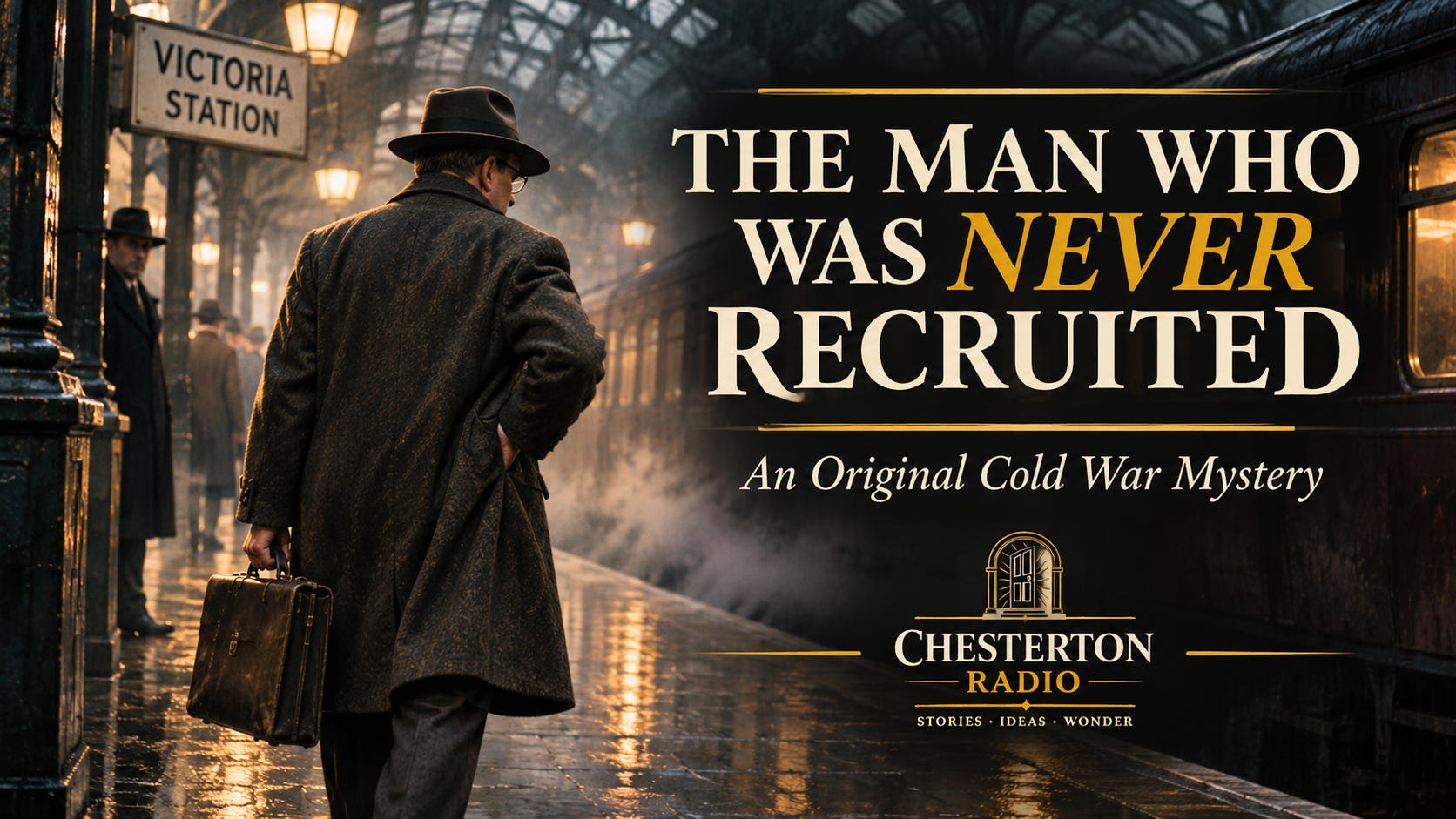
London, October 1963.
Arthur Bell is an ordinary civil servant who takes the same train home to Dorking, keeps railway timetables beside his chair, and carries his heart medicine in the left pocket of his waistcoat.
Then he dies aboard the 7:42 from Victoria.
In his possession are £600 in cash, a key to a left-luggage locker at Bruxelles-Midi, and six unexplained numbers.
There is one more complication.
For seven years, a secret British file has identified Arthur Bell as a probable Soviet penetration agent known as LANTERN.
The Russians appear to believe Bell works for British intelligence.
British intelligence appears to believe Bell works for the Russians.
But no one can answer the simplest question:
Who recruited Arthur Bell?
Thomas Vale, a fifty-six-year-old intelligence officer with an inconvenient respect for ordinary facts, is asked to find out.
What begins as an investigation into a dead spy becomes something stranger: a story about the lies governments tell their enemies, the lies institutions eventually tell themselves, and what happens when an ordinary human being becomes useful to everyone except himself.
Chesterton Radio presents The Man Who Was Never Recruited, an original twelve-part Cold War mystery.
Begin with Chapter I: “The Dead Man on the 7:42.”
Chapter I
THE DEAD MAN ON THE 7:42
The rain had begun at half past five, not decisively, but with the patient malice of London rain: enough to darken the pavements, glaze the taxis, and persuade every man leaving an office that he had once owned an umbrella and had been betrayed by it.
Arthur Bell disliked being hurried in the rain.
On most evenings he left the Ministry at six minutes past six, walked to the same bus stop, and reached Victoria with sufficient time to buy an evening paper, stand beneath the clock, and observe the departure board until his train was announced. He did not require the board. He knew the trains. But there was satisfaction in seeing a thing publicly confirm what one privately knew.
This evening he left at twenty-nine minutes past six and did not buy a paper.
The telephone call had come at eighteen minutes past.
He had been alone in the Overseas Telecommunications Supply Office except for a cleaning woman at the far end of the corridor and Mr Pritchard, who had twice put on his coat and twice remembered something he had forgotten. Bell was closing a ledger when his telephone rang.
“Bell.”
There was a small silence. Not the silence of an empty line. Bell could hear breath and, farther away, a faint mechanical clicking.
“Mr Arthur Bell?”
“Yes.”
“You have been very patient, Mr Bell.”
Bell’s hand tightened around the receiver.
“I beg your pardon?”
“Do not make us become impatient.”
The line went dead.
For several seconds Bell continued holding the receiver. Then he replaced it carefully, as though an abrupt movement might cause something to happen.
He looked at the ledger in front of him. On a scrap of Ministry paper, folded once, were six numbers he had copied that afternoon:
18427 19106 23341 24188 27603 28114
He put the paper into his wallet. Then he opened the lower drawer of his desk and looked at the brown envelope inside.
It was empty.
The money was in his briefcase.
Six hundred pounds. He had counted it twice at the bank and once in a lavatory cubicle at the Ministry, not because he doubted the bank clerk but because six hundred pounds had no business belonging to Arthur Bell. It was more than he and Margaret ordinarily kept available in months. It had appeared where it ought not to have appeared, under a reference which ought to have died years ago, and that morning Arthur had done the most reckless thing of his adult life.
He had withdrawn it.
Tomorrow he would put the money on an auditor’s desk and ask a question which could not be answered by moving a figure from one column to another.
Tonight he had only to get home.
At Victoria the crowd had thickened beneath the great roof. Damp coats brushed one another. Porters moved trolleys through gaps that ceased to exist before they reached them. Loudspeakers produced announcements in a voice of such perfect indifference that delays, departures and disasters might all have been items in the same inventory.
Bell entered by the side he always used, then stopped.
A man in a dark raincoat had stopped too.
Bell looked away at once. He told himself that this proved nothing. Half London was wearing dark raincoats. The man might have stopped to light a cigarette. He might have stopped because Bell had stopped. That was how crowds worked.
Bell began walking again.
He did not go towards the departure board. He went towards the bookstall, passed it, turned towards the refreshment room, then doubled back towards the suburban platforms.
The man in the dark raincoat was no longer behind him.
Bell felt foolish and, for perhaps ten seconds, relieved.
Then someone collided with his left shoulder.
“Sorry, sir.”
A younger man, hat low, one hand raised in apology. The contact was ordinary: a shoulder, an elbow, the brief intimacy of strangers in a station. Bell muttered that it was all right. The man disappeared into the crowd.
Bell walked another twenty yards before he became aware of the pressure beneath his breastbone.
Not pain yet. A warning.
He stopped beside a pillar and slipped his hand inside his coat, then beneath it towards the left inside pocket of his waistcoat.
His fingers found cloth.
He searched again.
The little metal tube was not there.
For one astonishing moment the missing tube frightened him more than the pressure in his chest.
He checked the right pocket. His trouser pockets. His coat. He opened his briefcase on the floor and moved the brown envelope, papers and sandwiches Margaret had wrapped that morning. Nothing.
A woman complained as she stepped around him.
Bell closed the case.
He remembered putting the tube into his waistcoat after breakfast. He remembered Margaret asking whether it needed filling and his saying no. He remembered touching it at luncheon, a private reassurance after climbing the stairs too quickly.
He had not forgotten it.
He looked across the concourse.
The man in the dark raincoat was standing near the barrier.
Bell picked up his briefcase.
The 7:42 was already at the platform.
He moved towards it.
He did not run. Arthur Bell had never been a man who ran for trains. Even now, with his heart beating too hard and his mouth dry, some lifelong discipline prevented him from making a spectacle of himself. He walked quickly, presenting his ticket with a hand that trembled only once.
On the platform he glanced back.
The dark raincoat had passed the barrier.
Bell entered the nearest second-class compartment, found it nearly full, and went on. He wanted people around him but not people who would look at him. He found a compartment with an elderly man reading the Evening Standard, a young woman with a parcel on her knees, and a commercial traveller arranging samples beneath the seat.
Bell sat by the corridor.
The pressure had become pain.
He put his briefcase between his shoes and told himself to breathe normally.
At 7:42 the train moved.
The station lamps began to slide backward.
Arthur Bell looked at them and understood, with a clarity so complete that it was almost calm, that the people who had borrowed his name had finally come to collect it.
He did not know who they were.
That was the worst of it.
For six years strangers had known things about Arthur Bell which Arthur Bell did not know. They had greeted him, watched him, thanked him, credited money to him, written his name beside journeys he had never made. A woman in Brussels had once looked at him with gratitude for an act he had not performed. A frightened Czech had shaken his hand and said, “We owe you everything,” before vanishing into a crowd. There had been files he was not allowed to see, accounts that carried his initials, telephone calls in which men waited for him to say something he did not understand.
And now somebody had taken the medicine from his pocket.
The train entered the darkness beyond the station throat.
Bell shut his eyes.
When he opened them, a man was standing in the corridor beyond the glass.
Not the younger man who had bumped him. The other one. The dark raincoat.
Their eyes met.
The man did not threaten him. He did not smile. He simply looked at Bell, and in that moment Bell’s body supplied all the terror the stranger had omitted.
Bell reached again for the empty pocket.
The newspaper slipped from the elderly passenger’s hands when Arthur Bell pitched forward.
By the time the train staff found a doctor among the passengers, Bell was lying on the compartment floor with his collar opened and his spectacles beneath the seat. The doctor worked with the brisk concentration of a man who already suspected that concentration would not be enough.
At Clapham Junction, while attention remained fixed on the compartment, a man in a dark raincoat stepped from another carriage and walked away without hurrying.
Arthur Bell never reached Dorking.
* * *
Thomas Vale first heard the name at nine seventeen the following morning.
He was eating toast at his desk because he had missed breakfast at home and because the canteen’s toast, though objectively worse, had the advantage of arriving without requiring him to wash a plate. The telephone rang while he was attempting to scrape marmalade from the paper wrapper with a knife.
“Vale.”
“Mr Vale? Peter Haldane. Counterintelligence Analysis.”
Vale looked at the toast.
“That sounds exhausting.”
There was a pause at the other end, brief but perceptible.
“Sir Adrian would like you downstairs.”
“Now?”
“Yes.”
“Then he must have heard about the toast.”
This time Haldane did not pause. “Room B-Seventeen.”
The line went dead.
Vale ate the toast.
At fifty-six he had reached an age at which immediate summonses from important men produced less speed than they once had. He had learned that institutions used urgency as other people used scent: often, generously, and not always because anything smelled bad.
He put on his jacket, found his spectacles beneath a file, and went downstairs.
Room B-Seventeen was not, as its designation suggested, a room intended for people. It had no window and seemed to have been designed around a metal table. Peter Haldane stood beside it.
Vale knew him by sight. Haldane was thirty-four, narrow-faced, dark-haired, and carried himself with the contained impatience of a man who had already read the papers and could not understand why other people still required conversation. His suit was well cut without being conspicuous. His tie had not moved since breakfast.
On the table lay the contents of a dead man’s pockets.
Haldane said, “Thomas Vale?”
Vale looked behind himself. “It appears so.”
Haldane did not smile, but something near his left eye considered it.
“Arthur Henry Bell,” he said. “Fifty-four. Ministry of Aviation. Overseas Telecommunications Supply Office. Died last night on the Victoria-Dorking service. Preliminary cause is myocardial infarction.”
“Then why are we in a basement?”
Haldane gestured towards the table.
There was a wallet, a railway season ticket, a comb, two keys on a ring, a fountain pen, a handkerchief, a packet of mints, three shillings and some coppers, a small notebook containing addresses, and a pair of spectacles with one bent arm. There was also a thick packet of banknotes secured by a paper band.
Vale looked at it.
“How much?”
“Six hundred pounds.”
Vale looked again at the dead man’s season ticket.
“Perhaps the railways have become more expensive.”
Haldane moved a second object forward: a small brass key on an oval metal tag stamped 214 and BRUXELLES-MIDI.
“And this.”
“Left luggage.”
“Presumably.”
“And presumably you have someone going to Brussels.”
“Sir Adrian asked that nothing be done until you had seen the material.”
Vale glanced at him. That was interesting. Wren did not normally delay action so that Thomas Vale might enjoy the sensation of being consulted.
Haldane placed a folded scrap of paper beside the key. Six groups of five digits had been written in blue-black ink.
18427 19106 23341 24188 27603 28114.
“Cipher?” Vale asked.
“We don’t know.”
“You have cipher people.”
“They don’t know either.”
“That must be uncomfortable for them.”
Haldane’s mouth moved this time.
Vale picked up the paper by its edge. The handwriting was small, upright, and without flourish. The numbers were spaced carefully. Bell had made no attempt to conceal them.
“What else?”
“Nothing of operational significance.”
“That phrase has killed more facts than censorship.”
Haldane waited.
Vale looked again at the objects. “Wedding ring?”
“On the body.”
“Watch?”
“Also on the body. Cheap. Still working.”
“Medicine?”
Haldane consulted a sheet. “None listed.”
“Did the doctor expect any?”
“The police report mentions a history of heart trouble according to the widow, but they haven’t taken a full statement.”
Vale bent closer to the waistcoat, which had been placed in a brown evidence sack and then removed for examination. The left inside pocket showed a faint pale circle in the cloth, no larger than a florin, where something hard had habitually rested. Along the seam was a dusting of white so slight that it might have been tailor’s chalk.
“What lived there?” he asked.
Haldane leaned forward. “Where?”
“In the pocket.”
“We don’t know.”
Vale straightened. “Then ‘nothing of operational significance’ may be premature.”
Haldane’s expression cooled a fraction. “The police regarded it as a natural death.”
“They may be right.”
“You don’t sound convinced.”
“I haven’t yet had time to become convinced of anything.” Vale pointed at the cash. “Where did a civil servant get six hundred pounds?”
“That is one reason you’re here.”
“And the other?”
Haldane did not answer immediately.
Vale waited.
It was one of his few professional talents which had improved with age. Younger men believed silence was an empty space and rushed to fill it. Vale had discovered that silence was often the room in which the truth changed its clothes.
Haldane finally said, “Bell was known to us.”
Vale glanced down at the season ticket again. “Personally?”
“No.”
“As what?”
Haldane’s eyes went to the door.
The door opened.
Sir Adrian Wren entered without knocking.
He was a year older than Vale and looked ten years younger. Some men aged by losing things; Adrian seemed merely to refine them. His hair had gone silver without thinning, his face had acquired lines that improved its authority, and his dark suit appeared to have understood the purpose of the meeting before anyone else did.
“Tom.”
“Adrian.”
Wren looked at Haldane. “Show him.”
Haldane opened a thin grey folder he had kept beneath the inventory sheets.
On the cover, in red capitals, was a single word.
LANTERN.
Below it: ARTHUR HENRY BELL.
Vale did not touch the file.
“How long?” he asked.
