

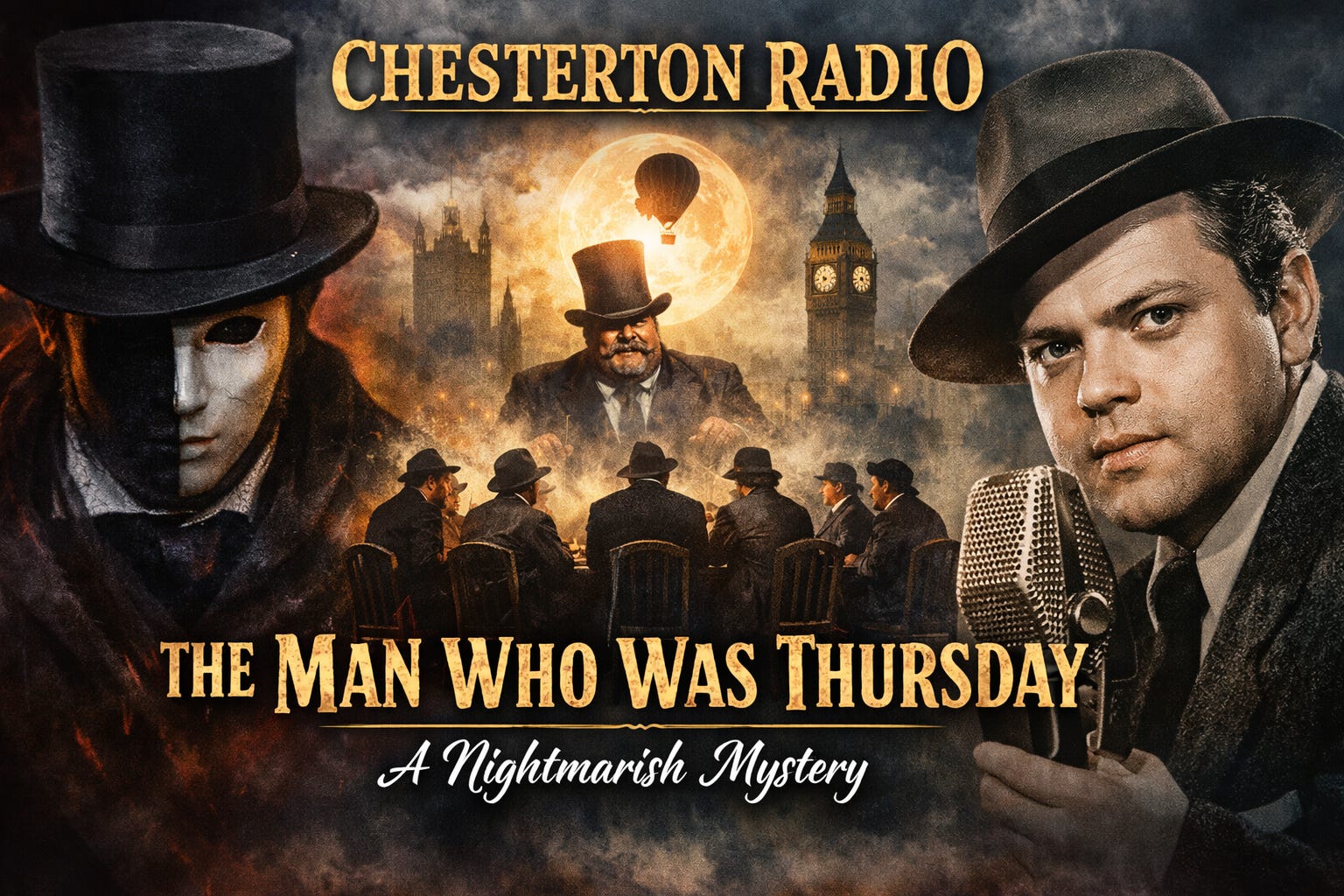
When Orson Welles introduced The Man Who Was Thursday on The Mercury Theatre on the Air in September 1938, he did not promise clarity.
He did not promise comfort.
He warned the audience.
Welles explained that the story was “generally about anarchism.” And then he added — with characteristic theatrical gravity — that you would not understand the story until the end.
And you might not understand it even then.
It was not false modesty. It was preparation.
Because The Man Who Was Thursday by G. K. Chesterton is not merely a detective story. It is a labyrinth disguised as a thriller. A theological riddle wearing a police badge.
And both the BBC and Mercury Theatre productions capture that delicious disorientation.
The Story: A Council of Days
Gabriel Syme, poet and secret policeman, infiltrates a shadowy anarchist council whose members are named after the days of the week. He becomes Thursday.
The premise feels political. Revolutionary conspiracies. Bomb plots. Underground cells.
It is — at first glance — about anarchism.
But Chesterton never writes only about what appears on the surface.
One by one, Syme discovers that the other council members are not anarchists at all. Each is a detective. Each thought himself alone among enemies. Each feared chaos surrounded him.
Until they begin to realize something astonishing:
They are on the same side.
Except for Sunday.
The vast, jovial, terrifying president of the council — a man whose laughter shakes rooms and whose identity grows more mysterious with every revelation.
And then comes the strange pursuit. Balloons. Costumes. Allegory. Creation imagery. A banquet that feels like Genesis staged as theatre.
The thriller dissolves into dream.
The political satire opens into metaphysics.
The nightmare becomes cosmic.
The BBC Saturday Night Theatre Version
The BBC adaptation, produced under Saturday Night Theatre, preserves the philosophical arc of the novel with remarkable patience.
The early debates about poetry and order are allowed to breathe. The tension builds gradually. The council scenes carry weight — not only suspense, but irony. The final symbolic sequence unfolds with gravity rather than haste.
The BBC version invites contemplation.
You feel the architecture of Chesterton’s argument forming beneath the dialogue:
Chaos is not creative — order is.
Fear often masks fellowship.
The enemy may not be who you think.
The universe may not be indifferent.
It is thoughtful. Measured. Deeply faithful to the book’s dreamlike logic.
The Mercury Theatre: Urgency and Warning
The Mercury Theatre adaptation, by contrast, moves like a spark in dry grass.
Welles compresses the narrative, sharpens the exchanges, and intensifies the paranoia. The council feels more dangerous. The stakes feel more immediate. The chase more breathless.
But what makes the Mercury version unforgettable is Welles’s introduction.
By telling listeners they may not understand the story — even at the end — he frames it not as entertainment alone, but as enigma.
He prepares the listener for paradox.
He warns them that this is not a tidy detective story where the clues align and the curtain falls neatly.
He hints that the meaning is layered.
In a sense, Welles gives away the game — and preserves it at the same time.
Because The Man Who Was Thursday is not about uncovering a criminal conspiracy.
It is about uncovering the structure of reality.
Anarchism — and Something Greater
Yes, the novel engages anarchism. Chesterton was responding to real Edwardian anxieties about terrorism, nihilism, and revolutionary ideology.
But Chesterton’s deeper concern was metaphysical.
Anarchism in the novel becomes a symbol for the fear that there is no order at the heart of existence.
The detectives’ isolation reflects the modern soul — believing itself alone in sanity amid universal chaos.
Sunday represents something more troubling and more magnificent.
When Syme asks, “Have you ever suffered?” the story shifts from political satire to theological meditation.
Sunday’s answer is ambiguous — yet immense.
This is why Welles was right.
You do not understand the story until the end.
And even then, you may not.
Because Chesterton does not offer explanation so much as revelation.
Why Listen to Both?
Listening to the BBC and Mercury versions side by side reveals something powerful:
The BBC production preserves the philosophical dream.
The Mercury version heightens the existential tension.
Together, they show that the story is both drama and doctrine.
Both adaptations confirm that this “nightmare” is strangely joyful.
Chesterton once said that the world would not perish for lack of wonders, but for lack of wonder.
The Man Who Was Thursday restores wonder — by destabilizing certainty.
🎧 Listen Now on Chesterton Radio
Experience both adaptations on Chesterton Radio:
Listen in the quiet of evening.
Let the laughter of Sunday echo.
Allow yourself to be puzzled.
And remember Welles’s warning:
You may not understand it until the end.
You may not understand it even then.
That is part of the gift.
Join the Chesterton Radio Listeners Club
Chesterton Radio exists because listeners believe stories like this still matter.
If you value:
Classic radio drama
Literary depth
Thoughtful, faith-infused reflection
A refuge from modern noise
We invite you to join our Chesterton Radio Listeners Club.
Members receive:
Early access to features
Exclusive reflections
Behind-the-scenes commentary
Direct support of independent broadcasting
But more than perks, you join a fellowship — a small band of Thursdays who discover they are not alone.
In a world that often feels anarchic, that may be the greatest comfort of all.
Welcome to Chesterton Radio.