

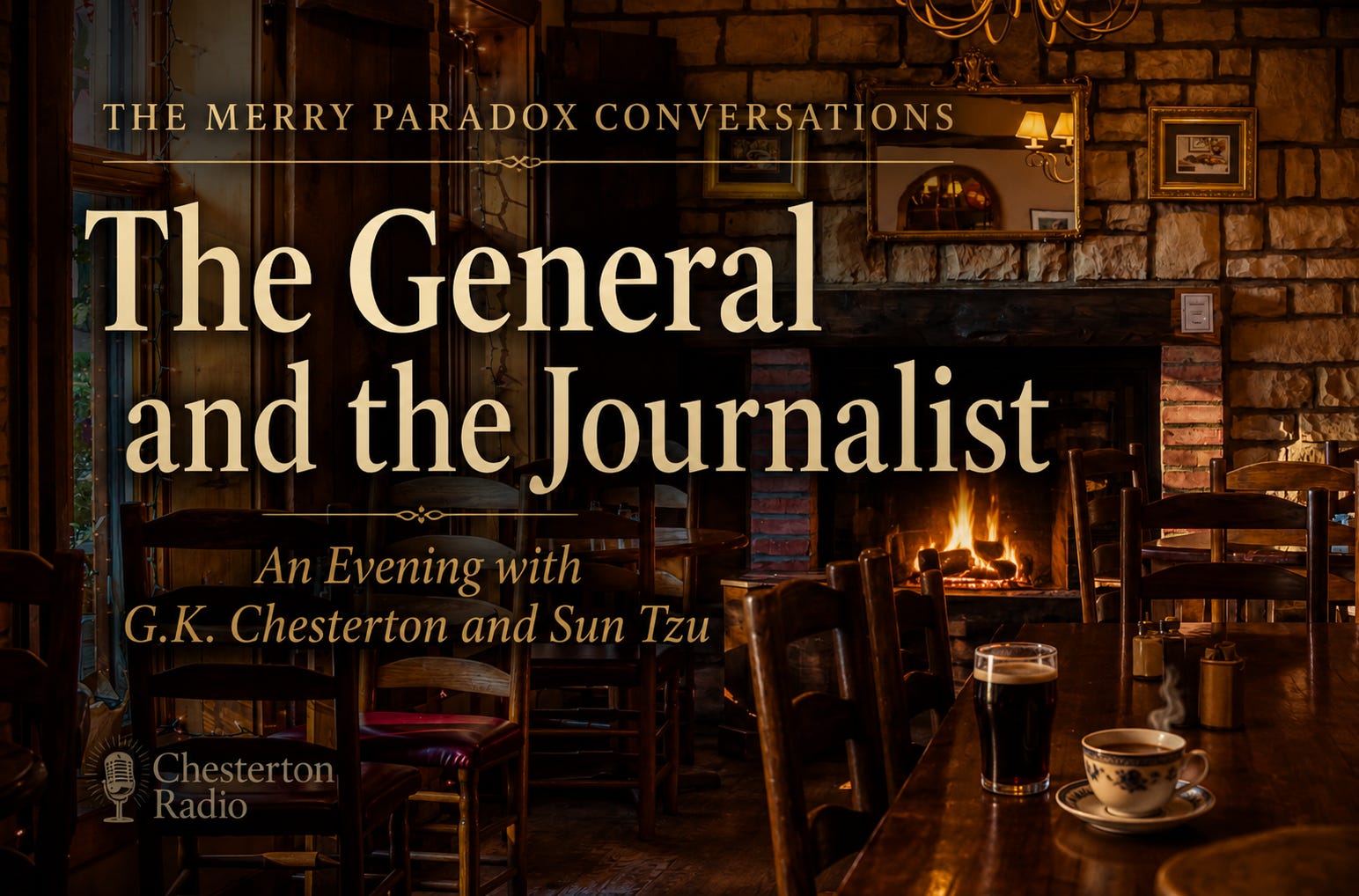
The General and the Journalist
An Evening with G.K. Chesterton and Sun Tzu
Editor’s Invitation
There are books that explain the past.
There are biographies that introduce remarkable people.
There are essays that examine great ideas.
This is none of those.
The Merry Paradox is an old public house that exists somewhere beyond the reach of maps, calendars, and ordinary history. Its fire burns every evening. Its tables are well worn. Its shelves are crowded with books that appear to have arranged themselves. Travelers arrive from many centuries, not by magic, but with the quiet inevitability of rain finding its way to the earth.
The landlord never explains how such things are possible.
He merely keeps the glasses polished, the tea hot, the ale fresh, and the conversation uninterrupted.
On certain evenings, history itself seems to stop by.
Tonight’s guests could scarcely be farther apart in geography or time. One is the broad-shouldered English journalist and essayist, G.K. Chesterton, whose delight in paradox uncovered profound truths hidden in ordinary life. The other is Sun Tzu, the ancient Chinese philosopher whose Art of War has become one of the most quoted—and perhaps most misunderstood—books ever written.
The world remembers one as a defender of common sense, the other as a master of strategy.
Yet before the evening is over, both will discover that they have spent far more of their lives studying peace than conflict, human nature than warfare, and the quiet disciplines that preserve civilization than the dramatic moments that threaten it.
The conversation you are about to overhear never happened.
And yet, one hopes, everything said within it is true.
Take a seat near the fire.
The landlord has already set another place at the table.
Part I — Rain at The Merry Paradox
“There are inns that serve travelers. There are inns that serve history. The Merry Paradox has always welcomed both.”
The Landlord’s Note
People sometimes ask whether the weather affects business, and I generally tell them that it depends less upon the weather than upon the people caught in it.
A sudden shower sends hurried men running through my door, where they spend more time glancing at the sky than speaking to one another. A slow rain, however, performs a quieter service. It persuades a fellow that there is little use in hurrying toward a destination which has already become damp. He removes his coat, accepts a warm fire as an old friend, and discovers that another human being is seated opposite him. Many excellent conversations have begun because neither participant found sufficient reason to walk back into the rain.
I have often thought that hospitality is among the least celebrated of the virtues, perhaps because it leaves behind so little evidence of itself. A fortress remains after the soldiers have departed. A cathedral stands long after its builders have been buried. Even a poor argument may linger in memory for years. But a good welcome disappears almost immediately. It survives only in the feeling that one was expected, though no invitation had ever been written.
The finest patrons are not always the ones who speak the most. Some carry whole libraries in their silence. Others arrive full of stories before they have even removed their gloves. The trick, if there is one, is discovering which sort of company the evening has chosen to provide. That is not something a landlord controls. My responsibility extends only as far as the fire, the glasses, and the keeping of good order. Conversation has always preferred arranging itself.
Our regulars understand this without discussing it. Mr. Ellwood, who claims to have retired from the railway three separate times, occupies the same chair whenever his knees allow. Mrs. Barker reads whatever volume happens to be nearest the window, insisting that books choose their readers more often than the reverse. Two elderly brothers play chess every Thursday, though neither appears concerned about winning. They spend more time admiring one another’s mistakes than exploiting them.
One grows fond of such habits. They give an inn its memory.
There are no clocks within The Merry Paradox. Visitors occasionally notice their absence, though few remark upon it. Time behaves well enough here without constant supervision. Evening arrives. Lamps are lit. Glasses are filled. At some point conversation finds its deepest current, and long afterward someone realizes that midnight has quietly slipped past without asking permission.
Perhaps that is why unusual guests never seem especially unusual.
History, I have found, possesses better manners than gossip. It does not announce itself with trumpets. It removes its hat, wipes its boots upon the mat, and asks whether there might still be room near the fire.
The rain had settled into one of those patient English evenings that seemed less interested in falling than in accompanying the earth with a steady whisper. The windows carried silver threads of water from top to bottom, blurring the lane beyond into little more than the suggestion of hedgerows and lanterns.
I polished another tankard, looked toward the door, and found myself wondering—not for the first time—whether this might prove to be one of those evenings that would be remembered long after the last ember had faded.
I. Rain at The Merry Paradox
The Merry Paradox never appeared remarkable to those who visited it often. That, perhaps, was its greatest distinction. Like all places genuinely loved, it revealed itself gradually, withholding its deeper charms from those who demanded immediate astonishment.
The room was neither large nor small. It possessed exactly the dimensions required for conversation. The oak beams overhead had darkened with generations of smoke until they resembled polished walnut. Shelves crowded with books occupied the wall opposite the bar, though no one recalled having seen anyone arrange them. Volumes seemed simply to migrate over the years, finding companions among subjects they had never anticipated. A worn copy of Homer leaned comfortably beside a collection of sermons. A treatise on astronomy shared a shelf with country recipes. Nobody found this disorder troubling. Books, like people, often formed friendships their authors would never have predicted.
The fire had been burning since late afternoon. It was a practical fire rather than a dramatic one, more interested in warming the room than impressing newcomers. Every now and then a log settled with a quiet sigh, sending a handful of sparks climbing briefly before disappearing into the chimney. The smell of seasoned oak mingled with damp wool, fresh bread, polished brass, tea, and the faint bitterness of good ale.
Conversation drifted easily through the room. It never competed with itself. A man discussing sheep prices at one table instinctively lowered his voice as another recited a favorite passage from a novel nearby. Laughter rose and fell without disturbing reflection. Even silence seemed to possess a comfortable place among the furnishings.
Outside, rain continued its patient work upon the cobblestones.
The bell above the entrance gave its modest announcement.
A broad figure filled the doorway, paused to remove a rain-soaked hat, and smiled with unmistakable satisfaction at the sight of the fire.
There are people who enter a room searching for attention.
There are others who enter as though grateful the room already existed.
The gentleman who crossed the threshold belonged firmly to the latter company.
Water glistened upon the shoulders of his overcoat. His spectacles required immediate attention, which he supplied with elaborate care before returning them to his nose. Only then did he look about the room with the cheerful expression of someone who had rediscovered a favorite chapter in a beloved book.
“Good evening,” he said, not loudly, but with such genuine pleasure that everyone within earshot found themselves included in the greeting.
Several patrons nodded.
One raised his glass.
The railway man shifted slightly to make space nearer the hearth.
No formal introductions were necessary. Those who knew him called him Mr. Chesterton. Those meeting him for the first time usually discovered, within ten minutes, that he had somehow become an old acquaintance.
He approached the bar.
“I believe,” he said, resting both hands upon the polished oak, “that the weather has been attempting to persuade me to become a fish.”
“It has made similar offers to everyone else,” I replied as I reached for his customary glass.
“Then I trust we have all declined with equal firmness.”
“I cannot speak for the trout.”
His laugh arrived instantly and wholeheartedly.
“A fair objection.”
He accepted the freshly drawn pint with unmistakable appreciation, studying it for a moment before taking the first sip.
“I have often suspected,” he remarked, “that civilization depends less upon constitutions than upon people who know how to keep a proper public house.”
“That seems an unfair burden for landlords.”
“It is certainly an unfair burden for constitutions.”
The exchange drew quiet amusement from those nearest the bar. Such conversations were familiar here. Ideas wandered as freely as customers.
For a while Chesterton remained where he was, commenting upon the rain, asking after familiar faces, inquiring whether Mrs. Barker had at last finished the immense Russian novel she had been reading for nearly a fortnight. He possessed the unusual gift of making ordinary questions sound like matters of genuine importance. People answered him fully because they sensed he was interested in the answer rather than merely the asking.
Only after finishing half his pint did he turn toward his customary chair beside the fire.
He stopped.
Not abruptly.
Merely with the slight hesitation of a man who has discovered that someone else has arrived before him.
The chair was occupied.
Its occupant sat quietly with an earthenware cup of tea resting upon the table before him.
He appeared neither young nor old in the ordinary sense. His face possessed the serenity sometimes found among men who have spent more years observing than explaining. His clothing was simple, his posture unforced, his attention directed not toward any individual but toward the life of the room itself. He watched conversation much as another man might watch rain upon a river, interested less in individual drops than in the movement they created together.
Chesterton remained standing for a moment, not from uncertainty but from curiosity.
He looked back toward the bar.
I caught his eye.
There are introductions that require speeches.
There are introductions that require only good manners.
This was the latter.
I carried a fresh pot of tea toward the fireside.
“Mr. Chesterton,” I said, placing it gently upon the table, “may I introduce Master Sun?”
The gentleman inclined his head with quiet courtesy.
Chesterton smiled—not with surprise, but with the unmistakable delight of a man who had just discovered that the evening had become considerably more interesting than he had expected.
He set down his pint.
“Then,” he said warmly, extending his hand, “I believe I should be grateful to the rain after all.”
And with that, before a single philosophical question had been asked, the evening truly began.
II. The Stranger by the Fire
If there is such a thing as a civilized silence, it generally lasts no longer than the time required to pour a second drink.
The silence that settled between Mr. Chesterton and Master Sun belonged to that agreeable variety. It was neither awkward nor expectant. Rather, it possessed the easy composure of two men who had each spent a lifetime learning that conversation need not begin the instant two strangers are introduced. Modern people often mistake speed for sincerity. They hurry toward opinions before they have acquired the far more valuable possession of acquaintance. A good conversation, like a well-built bridge, derives its strength from the care taken in laying its first stones.
Chesterton remained standing for a moment after offering his hand, his broad face illuminated by the fire as much as by his own evident pleasure. The older gentleman accepted the greeting with a slight inclination of the head rather than the vigorous shake customary in England, yet there was nothing distant in the gesture. It conveyed precisely what a proper greeting ought to convey: respect freely given, without unnecessary ceremony.
“Please,” said Sun, indicating the chair beside him.
Chesterton sat, setting his pint upon the polished oak table with almost exaggerated care, as though instinctively recognizing that the evening deserved to begin without haste.
For a little while they watched the fire.
One of the curious virtues of an English public house is that it grants permission for shared silence. Elsewhere silence is often interpreted as failure. At a railway station it suggests delay. At a dinner party it provokes anxiety. In Parliament it is generally considered impossible. Yet before a generous fire, with rain upon the windows and honest drink upon the table, silence acquires something of the dignity enjoyed by old trees. It becomes part of the landscape rather than an interruption of it.
Chesterton finally broke the quiet.
“I hope you will forgive me if I confess to having imagined you differently.”
Sun’s eyes remained upon the flames.
“I have forgiven many readers for less.”
The reply arrived so gently that Chesterton laughed before realizing it had been a joke.
“Then we begin as colleagues,” he said. “For I have spent years disappointing people who expected a prophet and found instead an untidy journalist.”
“I have spent longer disappointing those who expected a conqueror.”
“Ah,” said Chesterton, delighted. “Then we are doubly colleagues.”
The tea had cooled slightly. Sun lifted the cup without apparent concern.
“There is a curious burden,” he observed, “in becoming known for one book.”
Chesterton leaned back.
“I have often thought so. The public discovers a single volume, places it upon a shelf labelled ‘Author Explained,’ and thereafter refuses to admit that the author himself has any further evidence.”
Sun regarded him with quiet interest.
“In my country, readers once understood that a book grows older together with its reader.”
“And in mine,” Chesterton replied, “many insist upon remaining younger than the books they quote.”
The remark drew another smile from the older man.
Across the room Mrs. Barker turned a page with deliberate care. The two brothers continued their chess match without appearing any closer to victory than they had been an hour earlier. Near the bar Mr. Ellwood had begun explaining, for perhaps the hundredth time, why every railway timetable represented an optimistic rather than a factual document. Nobody interrupted him. Familiar stories, like familiar hymns, require no novelty in order to justify their repetition.
The landlord brought fresh hot water for the teapot and quietly refreshed Chesterton’s pint without asking whether another was wanted. Some questions are answered long before they are spoken.
Chesterton watched him return to the bar.
“I have frequently maintained,” he said, “that civilization depends upon unnoticed excellence. One notices the cathedral because it is magnificent. One forgets the fellow who quietly keeps the roof from leaking.”
Sun nodded.
“In war, people praise the victorious general.”
“In journalism,” Chesterton replied, “they praise the man who happened to write yesterday’s headline.”
“And both forget the thousands who made either possible.”
The observation rested comfortably between them.
Outside, the rain continued with the patient consistency of something that had no appointments elsewhere.
Chesterton folded his hands upon the table.
“I wonder, Master Sun, whether history has not been rather unfair to you.”
“History is occupied. Fairness is not always convenient.”
“Quite.”
He considered this for a moment before continuing.
“I have heard businessmen invoke your name while attempting hostile takeovers. Politicians quote fragments of your book before elections. Sports commentators appear convinced you intended to improve football management. I should not be surprised to learn that husbands and wives occasionally consult you before family disagreements.”
“They do.”
“They do?”
“They misunderstand me there also.”
Chesterton laughed so heartily that several nearby patrons looked over, smiling without knowing the cause.
“It must be an extraordinary experience,” he said at last, “to become famous for advice one never intended to give.”
Sun’s answer came after a thoughtful pause.
“People often search books for permission.”
“Permission?”
“To become what they already wished to become.”
Chesterton’s expression grew more thoughtful.
“That is a remarkably uncomfortable observation.”
“It has been uncomfortable for many centuries.”
The Englishman slowly turned his glass between his hands.
“I begin to suspect,” he said, “that your greatest military victories have all been fought against careless readers.”
For the first time, the older philosopher allowed himself a brief laugh.
“It is difficult to defeat an army.”
“And easier to defeat an editor?”
“No.”
Sun’s eyes brightened.
“Editors are better supplied.”
Again the laughter came, and this time even the landlord smiled quietly while polishing another glass.
Conversation, like music, often announces its key before revealing its melody. The subjects discussed during the first quarter-hour seldom determine where the evening will end, but they tell attentive listeners how the travellers think. These two had not yet spoken seriously of kingdoms, armies, governments, or philosophy. They had discussed rain, books, editors, readers, and the curious burden of being misunderstood. Yet beneath these ordinary matters another conversation had already begun—one concerning the strange distance that often separates what a man writes from what later generations imagine he must have meant.
Chesterton, whose curiosity seemed inexhaustible, glanced toward the shelves lining the far wall.
“I have often wondered,” he said, “whether books enjoy one another’s company after the libraries close.”
“I believe they do.”
“You believe books converse?”
“I believe readers merely overhear them.”
Chesterton rested both elbows upon the table with unmistakable satisfaction.
“There, sir, you have given me an idea I shall probably spend several years attempting to prove.”
“It was already your idea.”
“Possibly,” Chesterton admitted. “The best conversations frequently consist of discovering that another man has arrived at one’s own front door from the opposite side of the hill.”
Neither man spoke for a while.
The fire settled deeper into its bed of glowing embers. Rain continued tracing silver paths down the old leaded windows. Somewhere near the kitchen a loaf emerged from the oven, and the warm fragrance of fresh bread drifted gently through the room. The ordinary life of the inn surrounded the extraordinary meeting without acknowledging any difference between them.
At length Chesterton lifted his glass.
“There is one thing I should like to settle before we venture into more dangerous territory.”
Sun inclined his head.
“When two authors meet for the first time, which is preferable—to discuss books, or to avoid them altogether?”
The older man considered the question with evident seriousness.
“Perhaps,” he replied, “one should first discuss the people who read them.”
Chesterton’s eyes brightened.
“An excellent answer.”
He raised his pint slightly.
“Then let us postpone armies.”
“And begin,” said Sun, lifting his teacup, “with human beings.”
The fire gave a quiet crack as another log settled into place, and in that simple agreement the evening crossed an invisible threshold. The conversation was no longer about two authors who had unexpectedly met. It had become an inquiry into the creatures who had carried both of their books across the centuries—and who, despite all their progress, remained remarkably unchanged.
III. The First Pint
The conversation had now acquired that quality possessed by the best evenings in old inns: it no longer seemed to belong to those who had begun it. Like the fire before which the two men sat, it had found its own course. A log might occasionally shift the direction of the flame, but no one could honestly claim to control it.
The Merry Paradox had seen many such conversations. Some had begun with theology and ended with gardening. Others had commenced with the breeding of horses before arriving, by some entirely reasonable sequence of observations, at the immortality of the soul. It was one of the quieter triumphs of conversation that it often discovered truths while appearing merely to wander.
The landlord had long ago learned that there was little profit in steering such journeys. A host provides the table, the light, and the refreshment. The destination belongs to the travelers.
For several moments neither Chesterton nor Sun spoke. The pause was occupied instead by the small sounds that distinguish a living room from an empty one: the soft turning of pages, the settling of burning timber, the muted clink of glass against polished oak, the steady whisper of rain against leaded panes. Outside, the world appeared wrapped in mist. Inside, the fire had drawn its own circle of weather.
Chesterton looked thoughtfully into his glass before speaking.
“I have always envied the ancients one particular advantage.”
Sun regarded him with mild curiosity.
“They believed conversation could accomplish something.”
“And modern people do not?”
“They certainly converse,” Chesterton replied, smiling. “Indeed, I suspect they converse more than any generation in history. They possess newspapers, telephones, broadcasts, public meetings, lectures, conferences, and enough correspondence to occupy an army of postmen. Yet after all this talking, one somehow encounters remarkably little conversation.”
Sun rested both hands around his teacup.
“There is a difference.”
“I thought you might say so.”
“The purpose.”
Chesterton nodded, inviting him to continue.
“Many speak,” Sun said quietly, “to arrange the world around themselves. Few speak in order to discover the world that already exists.”
The Englishman leaned back with evident satisfaction.
“There,” he said, “is precisely the sort of sentence one wishes someone had uttered before one spent twenty years writing articles.”
“It would not have saved you.”
“No?”
“You would still have written them.”
Chesterton laughed.
“You have a suspiciously accurate understanding of journalists.”
“I have known generals.”
The distinction required no explanation.
A smile passed between them.
Across the room the chess players had reached the sort of position where every move appeared simultaneously obvious and impossible. One brother frowned at the board with theatrical concentration while the other watched him with unmistakable affection.
“It occurs to me,” Chesterton observed, following their gaze, “that chess may be the only civilized activity in which two gentlemen devote themselves entirely to defeating one another while sincerely hoping the other remains clever.”
Sun watched the players for a time before answering.
“A poor opponent teaches little.”
“Exactly.”
Chesterton brightened.
“I have often suspected that disagreement is among the greatest forms of hospitality. We invite another mind into our own by allowing it to rearrange the furniture.”
Sun considered the metaphor.
“Only if the house is strong.”
“Ah.”
Chesterton pointed a finger in quiet triumph.
“There speaks the engineer rather than the philosopher.”
“I have always believed they are neighbors.”
“That is a comforting thought.”
“It should be.”
The landlord arrived with a wooden board bearing fresh bread still warm from the oven, a small dish of butter, and a wedge of cheese. He placed it between them without ceremony.
“Gentlemen.”
Neither had ordered it.
Neither seemed surprised.
Good inns anticipate hunger in much the same way good friends anticipate discouragement.
Chesterton broke the loaf with evident pleasure.
“I have never trusted a philosophy incapable of appreciating fresh bread.”
Sun accepted a slice.
“In my country we might have said rice.”
“Then civilization appears to have possessed admirable variety.”
“The principle remains.”
“Which is?”
Sun spread a little butter with deliberate care.
“No one reasons well while hungry.”
Chesterton stopped in the act of reaching for the cheese.
“My dear sir,” he declared, “you may have solved half of political history.”
The older philosopher smiled.
“Only half?”
“The remainder concerns digestion.”
Their laughter mingled with the comfortable murmur of the room.
For a little while they spoke not of ideas but of travel. Chesterton recalled country inns where the landlord had insisted every traveler was a friend whose name had simply been forgotten for the moment. Sun described mountain roads where conversation between strangers began because both understood that tomorrow’s journey might depend upon today’s kindness.
Though the landscapes differed, each discovered in the other’s account something unexpectedly familiar.
“It is curious,” Chesterton reflected, “how often we mistake customs for principles. We imagine hospitality belongs to one nation because it wears different clothing elsewhere.”
Sun nodded.
“The clothing changes.”
“The welcome does not.”
“The wise host,” said Sun, “understands that every traveler arrives carrying invisible burdens.”
Chesterton remained silent for a moment.
The sentence had landed somewhere deeper than wit ordinarily reached.
“I fear,” he said at length, “that modern civilization has become fascinated by visible burdens instead. We measure luggage. We count possessions. We calculate incomes. Yet the heaviest things a man carries are usually those no scale can weigh.”
Sun’s answer came almost at once.
“The unseen decides the seen.”
Chesterton smiled.
“I should like to embroider that upon every newspaper office.”
“They would print it.”
“And immediately forget it.”
The philosopher inclined his head in agreement.
For a while they watched the rain.
The windows reflected the fire more brightly now that darkness had settled fully over the lane. Beyond the glass the world had become little more than shifting shadows and the occasional glow of a distant lantern.
“There is another curiosity,” Chesterton said at last.
“What is it?”
“I have observed that people are forever searching for extraordinary men.”
“And do they find them?”
“Occasionally.”
“Then why continue searching?”
“Because,” Chesterton replied, “they overlook extraordinary ordinary men.”
Sun waited.
“The finest schoolmaster. The honest baker. The village nurse. The stationmaster who keeps every promise. These people rarely become famous.”
“They become necessary.”
“Precisely.”
Chesterton’s voice softened.
“I sometimes think civilization survives because millions of unknown people continue performing duties that no historian will ever record.”
Sun looked slowly around the room.
The brothers over their chessboard.
Mrs. Barker reading by the lamp.
Mr. Ellwood describing impossible railway timetables to a listener who had clearly heard every version before.
The landlord polishing another glass with unhurried precision.
“A kingdom,” he said quietly, “is defended long before soldiers are needed.”
Chesterton followed his gaze.
For a long moment neither man attempted to improve upon the thought.
It seemed enough simply to observe the little republic gathered within the walls of the inn.
No one there imagined himself important.
No one sought applause.
Yet every person contributed something without which the evening would have been poorer.
The bread.
The fire.
The books.
The laughter.
The listening.
The welcome.
At last Chesterton raised his glass once more.
“It appears,” he said, “that we have managed to discuss civilization for nearly an hour without mentioning governments.”
Sun lifted his teacup.
“Perhaps that is why the conversation has remained peaceful.”
Chesterton’s laughter rang warmly through the room.
“My dear Master Sun,” he replied, “I begin to suspect that your famous book may not truly be about war at all.”
The older philosopher looked into the dancing fire before answering.
“It never was.”
The words were spoken so quietly that they might almost have been mistaken for another sound from the hearth. Yet as the silence settled around them, everyone who had been listening—even those who had not realized they were listening—felt that the evening had crossed another threshold. The title of an ancient book still hung in the air, but its pages had begun to open in an entirely unexpected direction.
IV. The Long Conversation
It is one of the peculiar gifts of a good public house that it encourages difficult subjects by refusing to treat them as difficult. A question that might become a quarrel beneath the harsh lights of a debating hall often softens into genuine inquiry when accompanied by a crackling fire, fresh bread, and the quiet confidence that neither participant is obliged to win. The walls of The Merry Paradox had absorbed enough earnest conversation over the years to know that truth rarely announced itself with raised voices. More often it arrived unnoticed, seated quietly beside an observation that had seemed almost too ordinary to deserve attention.
The rain had deepened into darkness. The windows no longer looked out upon the lane so much as reflected the room itself. Every pane had become another fireplace, another gathering of friends, another reminder that much of what we believe to be outside us is first discovered within.
Chesterton turned his glass slowly between his hands.
“May I confess something that has puzzled me for years?”
“Certainly.”
“I have never entirely understood why your book became popular among people who enjoy conflict.”
Sun listened without interruption.
“I do not mean soldiers,” Chesterton continued. “Soldiers, at their best, understand the cost of violence better than the rest of us. I mean those comfortable gentlemen who read about strategy while seated safely in upholstered chairs. They speak as though victory were a sporting accomplishment rather than a human tragedy.”
Sun rested his cup upon its saucer.
“They read the title.”
“And not the book?”
“They read enough to find themselves.”
Chesterton nodded thoughtfully.
“Which is precisely the danger.”
“The danger?”
“We seldom read books honestly. We recruit them. We enlist authors into causes they never volunteered to serve.”
The older philosopher regarded the fire for several moments before replying.
“A sword reflects the face of whoever holds it.”
Chesterton smiled.
“That is either a profound truth or an excellent warning.”
“Perhaps both.”
For a while they watched the flames consume another length of oak. Fire possesses a curious impartiality. It accepts the crooked branch and the straight one with equal willingness. It concerns itself neither with the vanity of the tree nor the pride of the woodsman. It simply burns according to its nature.
“I have often wondered,” Chesterton resumed, “whether the world has misunderstood strength itself.”
Sun looked toward him.
“In what way?”
“We admire the dramatic forms of strength because they are easiest to notice. The charging cavalry. The triumphant politician. The loud speaker who leaves no opponent unanswered. Yet when I consider the strongest people I have known, they were almost always remarkable for their restraint.”
Sun inclined his head slightly.
“The strongest bow is not the one always drawn.”
“There,” Chesterton exclaimed softly, “is an image I shall remember.”
“The purpose of the bow is not to remain bent.”
“No more,” Chesterton replied, “than the purpose of a fist is to remain clenched.”
The observation lingered between them.
Across the room, one of the chess players quietly resigned his game with a smile that suggested he had lost only the match and not the evening. His brother immediately began arranging the pieces for another. Victory, it seemed, had interrupted nothing worth preserving.
Sun noticed the exchange.
“They understand.”
“What do they understand?”
“That the game is smaller than the friendship.”
Chesterton followed his gaze.
“Would that every nation possessed such players.”
The philosopher answered with characteristic simplicity.
“Every nation does.”
Chesterton looked surprised.
“Then why do they so rarely govern?”
The question was followed by one of those silences that do not evade an answer but prepare the ground for one.
“Because,” Sun said at last, “friendship does not seek power as eagerly as ambition.”
The Englishman sighed with unmistakable recognition.
“There speaks several thousand years of experience.”
“And several elections.”
Both men laughed quietly.
The landlord, passing nearby with another basket of bread, caught only the laughter. Experience had taught him that the best conversations often sounded happiest immediately after the most serious observations.
He replenished the loaf without interrupting.
Hospitality, he believed, should enter a conversation as gently as punctuation.
Chesterton accepted another slice.
“I have always distrusted the modern habit of dividing humanity into camps.”
“Camps?”
“The practical and the idealistic. The strong and the gentle. The thinkers and the doers. We appear convinced that every virtue requires an enemy.”
Sun broke the bread carefully before answering.
“Division is useful.”
Chesterton raised an eyebrow.
“I did not expect you to say that.”
“It is useful when dividing wood for the fire.”
Chesterton laughed.
“And elsewhere?”
“It should be used carefully.”
The philosopher placed half the loaf upon the other’s plate.
“People divide the world because it is easier than understanding it.”
Chesterton remained quiet.
He had spent much of his life resisting fashionable simplifications. Every decade seemed determined to explain civilization by means of a single theory, a single economic principle, a single political slogan, a single scientific discovery. Reality, meanwhile, continued its stubborn refusal to become simple.
“I sometimes think,” he said at length, “that every age mistakes reduction for wisdom.”
Sun looked interested.
“Explain.”
“If a child asks what a forest is, one may point to a tree. If an adult insists that the forest is only a tree, one has ceased explaining and begun forgetting.”
The older philosopher’s expression brightened almost imperceptibly.
“You enjoy wholes.”
“I distrust fragments pretending to be wholes.”
Sun nodded.
“In strategy, the map is not the land.”
Chesterton looked delighted.
“And in journalism, the headline is not the story.”
“Yet many live by headlines.”
“And some governments do.”
The room settled again into thoughtful quiet.
Outside, the rain had finally begun to ease. Individual drops could now be heard striking the windows instead of the steady curtain that had accompanied the earlier part of the evening. Somewhere in the lane a horse passed at an unhurried pace, its hooves softened by wet cobblestones.
“It occurs to me,” Chesterton said, “that your reputation has been built upon victory.”
“So I am told.”
“And yet everything you have said tonight concerns avoiding unnecessary conflict.”
Sun’s answer came without hesitation.
“Victory is expensive.”
Chesterton waited.
“The wisest victory is the one already achieved before anyone notices.”
The Englishman smiled slowly.
“That sounds suspiciously like something a peacemaker would say.”
“It is.”
“And not a conqueror?”
Sun shook his head.
“A conqueror measures what he has taken.”
He paused before continuing.
“A wise ruler measures what has remained undamaged.”
The words settled over the table with the quiet weight of something both ancient and perpetually new.
Chesterton looked around the room.
The books remained upon their shelves.
The fire continued its patient work.
Mrs. Barker had closed her novel and was gazing contentedly into the flames.
The brothers had begun a second game.
The landlord polished another glass, though it scarcely appeared to require polishing.
Nothing in the room sought attention.
Everything contributed.
At last Chesterton spoke almost to himself.
“Perhaps civilization is not built by great victories at all.”
Sun did not answer immediately.
Instead, he looked toward the landlord, who at that moment was replacing another log upon the fire with practiced care.
Then he looked back at Chesterton.
“Perhaps,” he said, “it is built by those who quietly keep the fire from going out.”
Neither man added another word.
Some thoughts are complete long before conversation ends.
The fire answered with a gentle shower of sparks that climbed briefly into the chimney before vanishing into the darkness beyond the roof, as though carrying the evening’s newest insight into the endless night above The Merry Paradox.
V. The Measure of Victory
There are certain moments in every memorable conversation when the participants cease trying to answer one another and begin answering something larger. It is not always possible to identify the precise instant at which this occurs. The change resembles twilight. No one can point to the exact minute when afternoon surrendered to evening, yet everyone eventually notices that the lamps have become necessary.
So it was at the table beside the fire.
The discussion had wandered through books, journalism, hospitality, and the unnoticed labors upon which civilizations quietly depend. War, strangely enough, had remained at the edge of the conversation like a traveler patiently waiting his turn. It had not been excluded. It had merely been denied the privilege of arriving first.
The landlord noticed that the room itself had grown quieter. Not silent—The Merry Paradox never aspired to silence—but attentive. Even those occupied with their own affairs had acquired that subtle habit of listening without appearing to listen. Mrs. Barker’s book lay closed upon her lap. The railwayman’s latest story had reached one of its familiar resting places. The chess players had paused between games, their pieces standing ready as though they too were waiting for the next move.
No one stared toward the fireside.
Good manners prevented that.
Yet the room had become, almost imperceptibly, a single conversation.
Chesterton leaned forward.
“I should like to ask you about victory.”
Sun inclined his head.
“It is the word most commonly associated with your work.”
“It is.”
“And perhaps the least examined.”
The older philosopher smiled faintly.
“Words often suffer that fate.”
Chesterton rested his elbows upon the table.
“In my own country, success is frequently mistaken for proof. A man prospers, and people immediately conclude that he must therefore be right. A politician wins an election, and wisdom is attributed to him before he has spoken a sentence. Even newspapers measure themselves by circulation more readily than by truth.”
Sun listened with the patient attention that had characterized the entire evening.
“I wonder whether victory has become another such word.”
“In what way?”
“We admire it before asking what it has cost.”
The philosopher looked into the fire.
“A physician may save a life by removing a limb.”
Chesterton nodded.
“No one calls that a perfect cure.”
“No.”
“And yet,” he continued, “when nations speak of victory, they often speak as though no limb had been lost.”
For a long while Sun remained silent.
When he finally answered, his voice was scarcely louder than the rain had been earlier that evening.
“The happiest victories are forgotten.”
Chesterton regarded him with curiosity.
“I believe you must explain that.”
“The bridge that remains standing is rarely celebrated.”
“The bridge that collapses certainly is.”
“The harvest gathered without conflict is seldom remembered.”
“But famine is.”
“The village that sleeps peacefully through the night does not compose songs about its safety.”
Chesterton smiled.
“Only about the thief who disturbed it.”
Sun nodded.
“The world remembers interruption.”
“The ordinary triumphs,” Chesterton said thoughtfully, “are invisible.”
“They are the foundation.”
The Englishman sat back.
“I begin to suspect that history suffers from the same defect as journalism.”
Sun raised an eyebrow.
“It reports events.”
“And neglects conditions.”
“Yes.”
“The newspaper tells me about yesterday’s battle. It seldom tells me about the thousand peaceful exchanges that made civilization possible before anyone thought of drawing a sword.”
The older man considered this.
“Peace is difficult to describe.”
“Because nothing happens?”
“Because everything does.”
The sentence lingered.
The landlord, wiping another glass with the unhurried care that had become second nature over many years, found himself smiling without quite knowing why. Some observations possess the peculiar quality of seeming obvious only after someone has spoken them aloud.
Chesterton broke another piece of bread.
“I once knew a village blacksmith,” he said. “He was never mentioned beyond the neighboring counties, never addressed a public meeting, never wrote a book, and never imagined himself important. Yet every farmer trusted him. Every horse depended upon him. Every wagon required his skill sooner or later. Had he disappeared for a month, half the district would have come quietly to a halt.”
Sun listened.
“Who was the greater servant of civilization—the famous statesman who gave speeches in London, or the blacksmith who ensured that food reached the market?”
Sun answered almost immediately.
“They served different parts of the same body.”
Chesterton smiled broadly.
“There speaks a man unwilling to flatter either profession.”
“Flattery weakens judgment.”
“I have occasionally suspected as much.”
The philosopher’s expression remained serene.
“A ruler who believes only praise hears nothing.”
“And a journalist who believes only criticism understands nothing.”
The two men shared another quiet laugh.
The landlord crossed the room carrying a fresh kettle.
As he poured hot water into the teapot, Chesterton looked up.
“You perform your office with extraordinary discretion.”
The landlord shrugged.
“It is easier to refill a cup before it is empty.”
Sun watched the steam rise.
“So it is with many things.”
The landlord returned to the bar without another word.
Chesterton followed him with his eyes.
“There,” he said, “is a principle that applies equally well to governments, families, and friendships.”
Sun nodded.
“Wisdom often arrives disguised as routine.”
Outside, the rain had ceased entirely.
For the first time that evening, the windows reflected not water but darkness. Somewhere beyond the glass an owl called across the fields, and the sound entered the room without disturbing its peace.
“It occurs to me,” Chesterton said after a thoughtful pause, “that modern civilization has become fascinated by dramatic solutions.”
“What sort of solutions?”
“The final victory. The decisive election. The invention that changes everything overnight. We have grown impatient with slow improvements.”
Sun folded his hands.
“Trees disagree.”
Chesterton laughed.
“They have always been stubborn conservatives.”
“They grow.”
“Very slowly.”
“They still grow.”
The Englishman nodded.
“There is wisdom in forests.”
“There is.”
“And perhaps impatience is only another form of pride.”
Sun looked toward the fire before answering.
“The seed that demands fruit tomorrow is not ambitious.”
“No?”
“It is ignorant.”
The observation settled comfortably between them.
Chesterton seemed to roll it gently about in his thoughts, as one might examine a smooth stone found during a walk.
“Then perhaps,” he said at length, “the greatest victories are not dramatic at all.”
Sun did not reply immediately.
Instead, he looked around the room.
The chessboard had been reset.
Mrs. Barker had reopened her novel.
Mr. Ellwood was helping another patron into a damp overcoat.
The landlord adjusted a lamp whose flame had grown slightly uneven.
Everything proceeded without haste.
Without applause.
Without announcement.
Finally the philosopher spoke.
“The greatest victory is to leave people free to forget that victory was ever necessary.”
Chesterton looked steadily into the fire.
For several moments he offered no answer.
Then he lifted his glass in a gesture that required no words.
Sun raised his teacup in return.
Around them, the ordinary life of The Merry Paradox continued exactly as before.
Yet the room seemed subtly altered.
Nothing had changed.
Everything had deepened.
And anyone who might have entered the inn at that moment would have found only two thoughtful men sharing bread, tea, and ale beside a warm fire—never suspecting that they had quietly arrived at one of the oldest questions in human history, and perhaps one of its simplest answers.VI. After Closing Time
By the time the conversation had reached its quietest depths, no one in The Merry Paradox had any clear recollection of when the evening itself had grown late.
That was one of the unnoticed mercies of the place.
Elsewhere, the passing hours announced themselves with clocks, railway timetables, closing bells, and impatient obligations. Here, time seemed content to accompany conversation rather than interrupt it. The fire had settled lower in the grate, no longer sending lively sparks up the chimney but glowing with the deep, steady confidence of seasoned oak that had found its purpose. The lamps cast pools of amber light upon the old tables, softening every edge until the room appeared less illuminated than remembered.
One by one, the ordinary rituals of departure began.
Mrs. Barker placed a ribbon between the pages of her novel and returned it to the shelf from which she had borrowed it earlier in the evening. She never asked whether the book belonged to the inn. Neither did anyone else. Books that found their way into The Merry Paradox rarely concerned themselves with ownership. They seemed to understand that they had arrived where they were meant to be.
The two brothers shook hands across the chessboard before carefully returning every piece to its box. Neither spoke of the evening’s victories. Their conversation had already moved on to whether the apple trees behind the church might blossom early this year.
Mr. Ellwood buttoned his heavy coat with the deliberate concentration of a man who had reached an age at which unnecessary haste had finally revealed itself as unnecessary. Before leaving, he thanked the landlord for the ale as though receiving a personal kindness rather than settling an ordinary account.
Such courtesies are easily overlooked.
Civilizations are built from them.
Chesterton watched these quiet departures with unmistakable affection.
“I believe,” he said at length, “that we have spent an entire evening discussing humanity without once becoming cynical.”
Sun rested his hands around the now-empty teacup.
“Cynicism is often mistaken for experience.”
“And experience?”
“Experience should make us kinder.”
The Englishman smiled slowly.
“That may be the shortest rebuke to modern journalism ever spoken.”
“It was not intended as one.”
“I shall borrow it anyway.”
“You already have.”
They laughed once more, though softly now, as men do when they recognize that an evening has reached its natural conclusion.
The landlord approached their table carrying neither fresh bread nor another drink. Instead, he placed a small brass candle between them and lit it from the fire.
Its flame was modest.
It did not compete with the hearth.
It merely offered companionship.
“I find,” he said, “that conversation deserves a light of its own.”
Neither guest answered immediately.
The gesture required no explanation.
After a moment Chesterton looked toward the older philosopher.
“I began this evening imagining I might learn something about strategy.”
“And have you?”
“I believe I have learned something rather different.”
Sun waited.
“I expected to meet the author of a military treatise.”
“And instead?”
“I have spent the evening in the company of a student of human nature.”
For perhaps the first time that night, the older man’s expression revealed something approaching satisfaction.
“The two are difficult to separate.”
Chesterton nodded.
“I see that now.”
The rain had ceased entirely.
Beyond the leaded windows the lane lay quiet beneath a sky in which a few patient stars had begun to appear between retreating clouds. The silence outside differed from the silence within. One belonged to the countryside. The other belonged to minds that had discovered there was no further need to persuade.
At last Sun rose.
His movements possessed the same economy that had characterized every word he had spoken. Nothing hurried him. Nothing delayed him.
Chesterton stood as well.
“I hope,” he said warmly, “that this will not be our only conversation.”
The older philosopher looked toward the fire before answering.
“No worthwhile conversation is ever the last.”
He extended his hand.
Chesterton accepted it with genuine warmth.
For a brief moment they remained standing beside the hearth: one a broad English essayist whose delight lay in uncovering the extraordinary within the ordinary; the other an ancient Chinese philosopher who had spent a lifetime observing that the greatest victories often passed unnoticed. They had approached the same mountain from opposite sides and discovered, somewhere above the clouds, that the summit afforded room enough for both.
Sun inclined his head to the landlord.
“Thank you.”
“You are always welcome.”
The philosopher crossed the room, opened the old oak door, and stepped into the cool night.
The bell above the lintel sounded once.
Then the lane was still.
Chesterton remained where he was for several moments.
“I neglected to ask,” he said at last, “which road leads home.”
The landlord smiled as he gathered the empty cups.
“I’ve noticed that remarkable guests seldom require directions.”
“And do they often return?”
The landlord looked toward the door, where a faint breath of cool air still lingered.
“Those who leave good questions behind usually do.”
Chesterton considered this with evident pleasure.
“It seems an excellent admission policy.”
“I’ve never found a better one.”
The last lamp near the window was lowered.
The fire was gently banked for the night.
Outside, the stars continued their quiet work over fields that had forgotten the rain.
Inside, the warmth remained.
The landlord carried the glasses back to the bar, wiped the polished oak one final time, and paused before extinguishing the remaining candles.
He had listened to many memorable conversations over the years. Some had been brilliant. Some had been amusing. A few had been historically important.
The best, however, possessed another quality altogether.
They left the room gentler than they had found it.
He drew the bolt across the old wooden door.
Tomorrow there would be fresh bread, another fire, familiar faces, and perhaps an unfamiliar one. Someone would arrive carrying questions. Someone else would unknowingly carry part of an answer. The inn would do what it had always done: offer both a table, ask neither to hurry, and trust that truth was patient enough to share a meal.
For there are inns that shelter travelers from the weather.
And there are a very few that shelter conversations from time.
The Merry Paradox, he reflected as the last ember settled into the ash, had always been happiest doing both.
There are inns that serve travelers. There are inns that serve history. The Merry Paradox has always welcomed both.
The Door Remains Open
Eventually every good evening reaches the point at which no further words are required.
The glasses stand empty.
The fire settles into glowing embers.
The chairs are pushed gently beneath the tables.
Outside, the rain has stopped, and the ordinary world waits patiently beyond the old oak door.
Whether G.K. Chesterton and Sun Tzu ever met matters far less than whether their ideas still can.
The questions they explored beside the fire are not confined to one century, one civilization, or one language. They belong wherever thoughtful people gather with sufficient humility to listen before answering, to inquire before judging, and to seek wisdom rather than victory.
That, perhaps, is the real purpose of The Merry Paradox.
Not to escape history.
But to remind us that history is, at its best, an ongoing conversation.
If this evening has left you wishing you could visit the old inn yourself, then perhaps you already have.
Every time a good book is opened with an open mind...
Every time two friends disagree without becoming enemies...
Every time truth is sought with both conviction and charity...
...the fire is lit once more.
Thank you for spending another evening at The Merry Paradox.
The landlord will keep the kettle warm.
There is always another chair beside the fire.
And somewhere beyond the reach of clocks and calendars, another remarkable guest has just opened the door.
Keep the Fire Burning
Chesterton Radio is made possible by readers and listeners who believe timeless stories and thoughtful conversation still matter. If this evening at The Merry Paradox has been worth your time, please consider subscribing, becoming a paid supporter, and sharing Chesterton Radio with someone who would feel at home beside this fire. Until next time, the kettle is on, another chair waits by the hearth, and the door remains open.