

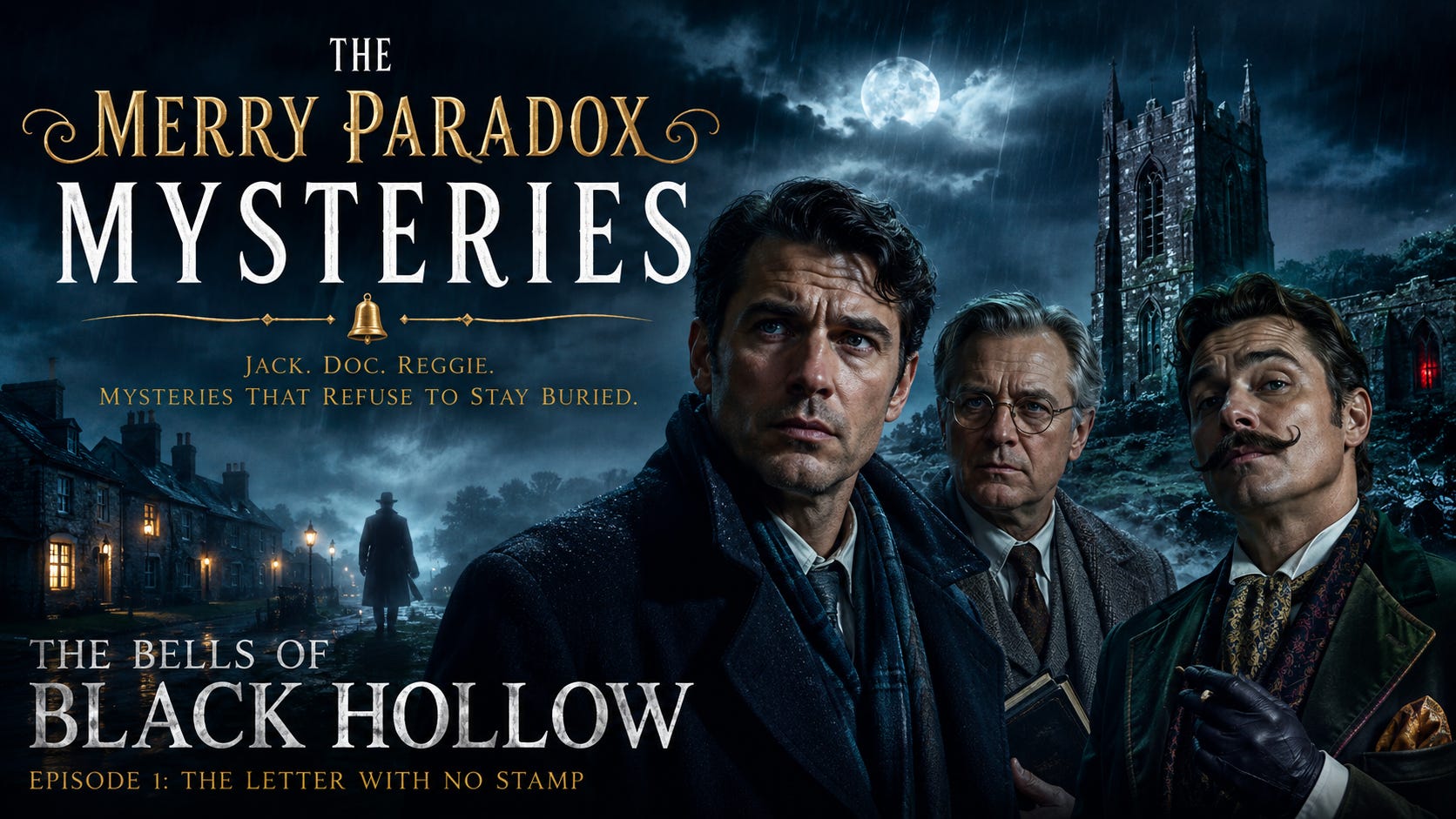
Welcome to The Merry Paradox Mysteries
There are mysteries that begin with a murder.
There are mysteries that begin with a missing jewel, a secret letter, or a scream in the night.
And then there are the rare mysteries that begin with a story.
In a quiet corner of London stands an old public house called The Merry Paradox. It is not famous. It does not appear in guidebooks. Yet on certain evenings, when the rain taps softly against the windows and the fire burns low upon the hearth, three old friends gather beneath the shadow of a brass bell.
Jack Mallory, adventurer and former correspondent.
Dr. Nicholas Grant, physician, scholar, and skeptic.
Reginald Finch—known to all as Reggie—actor, storyteller, and enthusiastic collector of trouble.
Together they have crossed deserts, climbed mountains, uncovered forgotten histories, exposed criminals, and occasionally escaped with their lives through no merit of their own.
Now, at long last, they have agreed to tell their stories.
Some are curious.
Some are dangerous.
Some are sad.
And a few remain unexplained.
Pull up a chair. The fire is warm, the evening is young, and the first tale is about to begin.
Welcome to The Merry Paradox Mysteries.
It was raining over London with that particular persistence which makes the city seem less like a place and more like an argument. The lamps along Fleet Street shone in wavering yellow pools, the pavements were black with wet, and the wheels of the late omnibuses hissed like whispers as they passed. Men hurried beneath umbrellas. Women gathered their collars close. Newspapers sagged under the arms of boys calling out headlines nobody wished to stop and read. The whole city seemed to be going home, or else pretending it had one.
But behind a narrow red door, down a side street with no importance on any map, there was warmth, firelight, pipe smoke, and a painted wooden sign that swung in the rain.
The Merry Paradox.
It was not the largest pub in London, nor the oldest, nor the most fashionable, which is to say that it had escaped three of the commonest causes of ruin. It had a low ceiling darkened by generations of smoke, a bar polished by elbows rather than by servants, and a great fireplace at the back where the coals glowed red beneath a black iron hood. Above the mantel hung a cracked mirror, two cavalry sabres, an engraving of Dr. Johnson, and a brass ship’s bell that no one had ever seen rung.
In the corner nearest the fire sat three men who, to any stranger, might have appeared to be merely avoiding the weather. This would have been true, but not complete. They were men who had avoided more than weather in their time.
Jack Mallory sat with his back to the wall, as he always did. He was not a large man, but he had the compact stillness of one who had learned long ago that danger announces itself most honestly in small movements. His dark hair was touched with gray at the temples, and there was a narrow scar running from the corner of his left eyebrow toward the cheekbone, as if some hurried hand had once tried to erase him and failed. He had been called many things in many countries: correspondent, adventurer, nuisance, meddler, liar, patriot, spy. He preferred “Jack.”
Across from him, Dr. Nicholas Grant was reading a small book in Greek and frowning at it as though the author had personally insulted him. Grant was tall, spare, and prematurely white-haired, with a scholar’s stoop and a soldier’s eyes. He had studied medicine, antiquities, theology, comparative folklore, poisons, dead languages, and several living ones he considered less useful. His friends called him Doc, not because he was especially fond of the nickname, but because he was not.
The third man, Reginald Finch, occupied the best chair by the hearth and treated it as a throne. He was broad, cheerful, handsomely untidy, and wore a velvet waistcoat of an alarming green which he insisted was tasteful in candlelight. Reggie had been an actor, singer, mimic, journalist, card player, unpaid diplomat, paid liar, and once, for nine regrettable days in Cairo, the official cultural attaché of a country he had never visited. He had the gift of seeming harmless in every language.
Reggie lifted his glass, inspected the fire through it, and sighed.
“There are evenings,” he said, “when civilization proves itself.”
Jack glanced at him. “By beer?”
“By shelter,” said Reggie. “Beer is merely shelter made visible.”
Doc did not look up from his book. “That is not merely false. It is aggressively false.”
“My dear Nicholas, all great truths begin by offending the narrow-minded.”
“All your great truths begin by ordering another round.”
“A method sanctified by repetition.”
Jack smiled faintly and watched the rain streak the window. There were nights when the three of them met at The Merry Paradox and spoke of nothing more dangerous than bad theatre, worse politicians, and the moral decline of English coffee. There were other nights when a stranger came through the door, or a telegram arrived, or Reggie remembered a debt owed by a duchess, and the world altered course before last orders.
This was such a night, though none of them knew it yet.
The door opened.
A gust of wet wind crossed the room, fluttered the newspaper on the bar, and nearly extinguished one of the candles. The landlord, Mr. Biddle, looked up from polishing a glass with the air of a man prepared to resent the weather on behalf of the establishment.
A boy stood in the doorway.
He was no more than twelve, thin as a match, with a cap pulled low and a coat too large for him. Rain ran from the brim of his cap and dripped onto the floorboards. He looked not merely wet but frightened, and not merely frightened but determined not to be.
“Which of you is Mr. Mallory?” he asked.
The room quieted in that subtle way rooms do when a private question is asked too loudly.
Jack set down his glass. “I am.”
The boy crossed the room quickly and held out an envelope. His fingers were red with cold.
“Was told to give you this.”
“By whom?”
The boy shook his head. “Gentleman.”
“What gentleman?”
“Didn’t give a name.”
Reggie leaned forward. “Was he a tall gentleman, a short gentleman, a fat gentleman, a thin gentleman, a gentleman with a sinister limp, or the sort of gentleman who says ‘my good lad’ before underpaying you?”
The boy blinked. “He had gloves.”
“Ah,” said Reggie. “One of the gloved classes. Dangerous.”
Jack took a coin from his pocket, but the boy backed away.
“Already paid.”
“By the gentleman with gloves?”
The boy nodded.
“How much?”
“Five shillings.”
Doc looked up at last. “For carrying a letter across London in the rain?”
The boy’s mouth tightened. “I didn’t ask questions.”
“Wise child,” said Reggie. “You’ll go far, unless you continue delivering mysterious letters to men in public houses, in which case you’ll go suddenly.”
Jack stood and laid the coin on the table. “Take it anyway.”
The boy hesitated only a second, then snatched it with the speed of long practice. He turned to go.
“Wait,” said Jack.
The boy stopped.
“Where did he give it to you?”
“Outside St. Bride’s.”
“When?”
“Ten minutes ago.”
Jack moved a little closer. “Did he follow you?”
The boy shook his head, but his eyes betrayed uncertainty.
“You looked?”
“Once.”
“And?”
The boy swallowed. “There was a cab.”
“What kind?”
“They’re all black in the rain.”
“Was anyone in it?”
“Couldn’t see.”
Jack nodded. “Go out the back.”
Mr. Biddle, who had known Jack Mallory long enough not to ask questions at such moments, lifted the counter hatch and jerked his head toward the kitchen passage. The boy disappeared behind the bar.
The room resumed its noise, but less convincingly than before.
Jack returned to the table and looked at the envelope.
It was cream-colored, heavy, and entirely plain. His name was written across it in a precise black hand.
Mr. John Mallory
The Merry Paradox
Fleet Street, London
There was no stamp. No postmark. No seal. But in the upper left corner, embossed almost invisibly into the paper, was a small bell.
Doc saw it at once.
“That is not stationer’s decoration.”
“No,” said Jack.
Reggie had lost his cheerfulness. “Are we about to be murdered before supper?”
“That depends,” said Jack, opening the envelope.
Inside was a single sheet, folded once.
Jack read it without speaking. Then he read it again.
Reggie groaned. “Never trust a man who reads silently twice. It means either death or poetry.”
Jack handed the letter to Doc.
Doc adjusted his spectacles and read aloud.
Mr. Mallory,
I write because I am told you once found a dead man who was still alive, and exposed a living man who had been dead for seven years. I do not know whether this is true, but I pray that your reputation is only half deserved.
There is something wrong in Black Hollow.
The bells are ringing again.
They were taken down in 1649.
Last night, all seven rang from the old church tower at midnight, though there are no bells in it and no living man will enter it after dark.
This morning, Mr. Elias Vane was found in the nave, white-haired and dead, with his hands over his ears.
The constable says it was his heart. The vicar says nothing. The villagers say the Hollow has remembered.
Come before Sunday, or do not come at all.
Yours in urgency,
A Friend of the Dead
Doc lowered the page.
For a moment the fire snapped and the rain tapped steadily at the glass.
Reggie looked from one face to the other.
“I dislike anonymous correspondents,” he said. “They combine the worst qualities of cowards and dramatists.”
Jack took the letter back. “Black Hollow.”
Doc frowned. “There is a Black Hollow in Northumberland. Another in Devon. Possibly one in Wales, though everything in Wales sounds like a warning when pronounced by an Englishman.”
Jack turned the envelope over. “There’s nothing else.”
Reggie reached for it. “Let me see.”
Jack gave it to him.
Reggie held it close to the lamp, sniffed it, squinted at the embossed bell, and then, to Doc’s visible annoyance, licked the corner.
“Really,” said Doc.
“Gum arabic,” said Reggie.
“You have identified the adhesive on an envelope. Civilization is saved.”
“No stamp,” said Reggie. “Hand-delivered. Expensive paper. Written by someone educated enough to use a semicolon but nervous enough not to trust the post.”
Jack looked at him. “And?”
“And the paper smells faintly of lavender, damp stone, and train smoke.”
Doc closed his book. “Lavender?”
Reggie looked wounded. “I have gifts.”
“You have cologne.”
“That too.”
Jack held the page near the fire, not close enough to scorch it. No hidden writing appeared. He turned it toward the lamp. The watermark showed a crown and the initials H & B.
Doc leaned over. “Harrowby and Bell. Good paper. Sold mostly in the north.”
Jack’s eyes narrowed. “Bell.”
“Coincidence,” said Doc.
“In our experience,” said Reggie, “coincidence is merely Providence wearing a false moustache.”
Jack ignored this. “Taken down in 1649.”
Doc nodded slowly. “That would be the Commonwealth period. Many church bells were removed, broken, sold, or hidden during the disturbances. Bells were not merely instruments. They were symbols. Parish identity. Feasts. Warnings. Deaths. Weddings. Alarms.”
“And ghosts,” said Reggie.
“Superstition.”
“Tradition with better lighting.”
Doc gave him a sour glance. “A church tower cannot ring bells that are not there.”
“Exactly,” said Reggie. “That is the sort of thing people notice.”
Jack tapped the letter against the table. “Elias Vane. Name means anything?”
Doc shook his head. “Vane is an old northern name. Elias Vane sounds like either a Puritan pamphleteer or a man who leaves money to cats.”
Mr. Biddle arrived with three fresh glasses, though none had been ordered. He placed them down quietly and looked at the letter in Jack’s hand.
“No trouble, Mr. Mallory?”
“Possibly.”
“Here?”
“Not yet.”
The landlord accepted this with the weary dignity of a man who had once found a Balkan prince unconscious beneath the billiard table and had since adjusted his expectations.
Jack said, “Do you know a village called Black Hollow?”
Biddle thought for a moment. “Aye. Up past York way, isn’t it? Near the moors. Had an uncle drove cattle through there before the railway came. Said it was a place where even the sheep looked sorry.”
“That’s promising,” said Reggie.
Biddle lowered his voice. “There was a story about bells.”
Doc looked up sharply. “What story?”
The landlord rubbed the side of his nose. “Only old talk. Church bells cursed, or stolen, or buried. Seven bells, maybe. Something about them ringing when someone was to die.”
Reggie sat back. “There it is. I knew supper would be spoiled.”
“Who told you?” asked Jack.
“My uncle. He was a liar when sober and a prophet when drunk, so I never knew what to do with him.”
Jack folded the letter and placed it carefully back in the envelope.
Doc watched him. “You are considering this.”
“I am past considering.”
“Of course you are,” said Doc. “A boy brings an anonymous letter, mentions invisible bells, a corpse, a deadline, and the phrase ‘Friend of the Dead,’ and you naturally decide to go.”
“Would you rather stay?”
“Yes,” said Doc.
“No,” said Reggie.
Doc turned on him. “You just said supper was spoiled.”
“Supper is spoiled because the mystery exists. Staying here would not unspoil it. It would merely make us ignorant and anxious, which is my least attractive condition.”
“You have so many to choose from,” said Doc.
Jack rose and took his coat from the peg. “The night train north leaves from King’s Cross at eleven.”
Doc groaned. “The night train north is an invention of the devil.”
“Many useful things are,” said Reggie, standing. “The corkscrew, for example.”
Doc remained seated. “Let us be precise. We have no client, no verified crime, no address, no payment, no certainty the letter is not a trap, and no reason to insert ourselves into the rural hysteria of a village famous only for depressing livestock.”
Jack buttoned his coat.
Doc sighed. “And yet I am apparently going.”
“You are,” said Jack.
“Why?”
“Because if the bells are a trick, you’ll want to know how. If they are not a trick, you’ll want to be the first man of science to deny it in person.”
Reggie clapped Doc on the shoulder. “He has you there, Nicholas.”
Doc stood with the expression of a man rising in court to hear an unjust sentence. “I am going because both of you are reckless, sentimental, and insufficiently trained in pathology.”
“Friendship,” said Reggie, “has worn uglier disguises.”
They were almost at the door when Mr. Biddle called after them.
“Mr. Mallory.”
Jack turned.
The landlord had lifted the newspaper from the bar. “Evening Standard came in an hour ago. Might be nothing.”
Jack crossed to him.
Biddle pointed to a small column near the bottom of the page. It was barely more than a paragraph.
COUNTRY DEATH IN OLD CHURCH
North Riding Mystery
Jack read it quickly. The article was brief, cautious, and wrong in the way newspapers are wrong when they are pretending not to enjoy themselves. It stated that Mr. Elias Vane, aged sixty-eight, land agent and local magistrate, had been found dead early that morning in the ruined church of St. Anselm, Black Hollow. Death was presumed natural. No suspicious circumstances were reported. The body had been discovered by the parish sexton shortly after dawn.
There was no mention of bells.
Jack looked at the date.
The paper was today’s.
Doc had read over his shoulder. “If he was found this morning, the letter must have been written after the discovery and brought to London by train.”
“Unless it was written before,” said Reggie quietly.
Doc stared at him.
Reggie shrugged. “I merely contribute horror where needed.”
Jack folded the newspaper and placed a coin on the bar. “May I?”
Biddle nodded. “Bring it back if it turns out not to be evidence.”
“And if it does?”
“Then bring back a better story.”
They stepped out into the rain.
Fleet Street had thinned. The newspaper boys were gone. The lamps trembled in the puddles. Somewhere in the distance, a church clock struck ten, each note softened by weather and stone.
Jack paused beneath the sign of The Merry Paradox and looked back down the narrow street.
A cab stood at the far corner.
It was black, glossy with rain, its horse stamping faintly in the gutter. The driver sat hunched beneath his cape. The windows were dark.
Doc followed Jack’s gaze. “That cab?”
“Yes.”
Reggie’s voice lost all ornament. “The boy saw one.”
Jack stepped off the curb.
At once, the cab moved.
Not hurriedly. Not dramatically. It simply rolled away from the corner, turned into the main road, and vanished into the wet traffic.
Jack watched until it was gone.
“Follow?” asked Reggie.
“No.”
“Why not?”
“Because whoever was in it wanted us to see it.”
Doc pulled his coat tight. “Then we are being invited.”
Jack looked at the letter once more.
“No,” he said. “We are being measured.”
They reached King’s Cross a little before eleven, wet, cold, and in Reggie’s case tragically deprived of pudding. The great station roof hung above them like a cathedral built for smoke. Porters shouted. Steam billowed. Lamps glared through fog. Families embraced as though rail travel were a form of military service. Somewhere a whistle screamed, and the iron beast of the northbound train stood breathing on the platform.
Jack purchased three tickets to York and made inquiries with the clerk, who confirmed there was a branch connection that might get them within ten miles of Black Hollow by morning, assuming the local line was running and the engine had not “taken against the weather,” which he described as a known failing of machinery and men.
They found an empty compartment near the rear.
Reggie threw himself into the corner seat. “Wake me for murder or breakfast, whichever improves the plot.”
Doc took the opposite seat, opened his medical bag, and began checking its contents with the solemnity of a priest preparing vessels for Mass.
Jack sat by the window.
The train lurched. Steam swept past the glass. The platform began to slide away.
London receded in fragments: lamps, faces, brick walls, signal lights, black roofs shining under rain. Then the city loosened its grip and the train gathered speed, plunging north through darkness.
For a while none of them spoke.
There is a peculiar intimacy in a railway compartment at night. Men who would not confess a toothache by daylight will speak of death after midnight, when the world outside has vanished and the glass reflects only the faces within. But these three had traveled too often together to require much speech. Jack watched the night. Doc pretended to read and failed. Reggie slept for seventeen minutes, woke with a start, and announced that he had dreamed of a bishop playing the accordion in a burning windmill.
“Prophetic?” asked Jack.
“Indigestion,” said Doc.
Reggie looked wounded. “You reduce the mystical life to the stomach.”
“Frequently, yes.”
Jack unfolded the newspaper again.
Elias Vane. Land agent. Magistrate. Found dead in the nave. No suspicious circumstances.
He had seen those words before in other forms and other countries. No suspicious circumstances often meant no one wished to be suspicious. Natural causes often meant unnatural causes had powerful friends. Rural peace often meant fear had learned to speak softly.
At Peterborough, a man in a gray overcoat walked past their compartment twice. At Newark, Jack saw him again on the platform, though he did not board. At Doncaster, a woman in mourning entered the next carriage and got off before the train moved. At York, just before dawn, the three men stood stiff and cold on the platform while a porter directed them toward the branch line with the air of one sending them not to a destination but to a condition.
The smaller train consisted of two carriages, one guard’s van, and an engine that looked personally offended by the existence of hills. It carried a farmer, three crates of chickens, a Methodist minister asleep under a newspaper, two silent women with baskets, and a smell of coal smoke, wet wool, and agricultural resignation.
Day came slowly.
The land outside the window changed from black to gray to a pale, hard green. Fields opened under a low sky. Stone walls ran like old scars across the hills. Villages appeared and vanished: a church spire, a cluster of roofs, a dog in the road, smoke rising straight from chimneys where there was no wind.
Then came the moor.
It rose beyond the last fields, vast and brown and empty, with patches of heather dark as bruises. The sky seemed lower there. The train labored along the edge of it, following a narrow valley where a stream flashed among stones. At a small station whose nameboard had lost half its paint, the guard shouted something that might have been “Black Hollow Road.”
They got down.
No one else did.
The train departed with visible relief.
The station consisted of a platform, a shed, a bench, and a timetable so weather-beaten it might have been archaeological. Beyond it, a road climbed between drystone walls toward a notch in the hills. A signpost leaned at an angle.
BLACK HOLLOW – 4 MILES
Reggie stared at it. “Four miles before breakfast is not travel. It is penance.”
Doc pointed. “There’s a trap.”
At the far side of the station yard stood a pony and trap, with a man beside it wearing a brown coat and a hat pulled low. He was narrow-faced, middle-aged, and had the look of a man who had been waiting unwillingly for some time.
“Mr. Mallory?” he called.
Jack walked toward him. “Yes.”
The man glanced at Doc and Reggie. “These with you?”
“They are.”
“Then get in.”
Reggie brightened. “At last, the hospitality of the north.”
The driver did not smile. “I’m not hospitality. I’m paid.”
“An honest distinction.”
Jack studied him. “By whom?”
The man looked toward the hills. “Same as sent the letter.”
“You know who that is?”
“No.”
“But you took payment.”
“Aye.”
“From a gentleman with gloves?”
The man’s eyes flicked back to him. For the first time, he seemed uneasy.
“No,” he said. “From a lady.”
Doc and Reggie exchanged a glance.
Jack said, “What lady?”
“She didn’t give a name.”
“What did she look like?”
“Veiled.”
Reggie sighed. “Naturally.”
The driver climbed onto the seat. “You coming or not? Road’s bad after rain.”
They got in.
The trap jolted out of the yard and began the climb toward Black Hollow.
For the first mile, the road ran between walls and sheep fields. Then the land narrowed. The hills rose closer on either side, their slopes dark with heather and stone. The stream ran below them, unseen but always heard. Here and there, black rock jutted from the ground like the bones of some buried giant. The pony moved steadily, head down, breath steaming.
No one passed them.
After a while, the driver pointed with his whip.
“There.”
At first Jack saw only the valley bending between the hills. Then the village appeared, tucked into the hollow as if it had slid there and never managed to climb out.
Black Hollow was not large. Perhaps forty houses, all built of the same dark stone, clung along a crooked street that descended toward a little square. Smoke rose from chimneys, but there was no sound of voices. Beyond the village, on a mound above the stream, stood the ruined church.
St. Anselm’s.
Its tower rose square and broken against the gray sky. The roof of the nave was partly gone. Ivy crawled over the walls. The windows were empty black arches. Crows circled above it in slow, ragged loops.
Doc leaned forward. “There is your bell tower.”
Reggie crossed himself lightly, then pretended he had only adjusted his collar.
As they descended toward the village, Jack noticed faces at windows. Curtains moved. A man stopped sweeping a doorstep and watched them pass without greeting. A woman carrying a pail turned and went back indoors. Even the dogs did not bark.
Fear, Jack thought, had a weather of its own.
The trap stopped before an inn with a swinging sign.
The Seven Bells.
The sign showed seven golden bells hanging from a wooden frame. But someone had recently painted a black line across each bell, as if crossing out a name.
Reggie looked at the sign, then at the ruined church on the hill.
“I begin to suspect,” he said, “that this village is not overburdened with subtlety.”
The driver climbed down. “Rooms are kept for you.”
“By the veiled lady?” asked Jack.
“Aye.”
“Is she here?”
“No.”
“Where is she?”
The driver hesitated.
Then, from somewhere above the village, a bell rang.
It was a single note.
Deep. Clear. Impossible.
The pony reared.
The driver swore and grabbed the reins. Doors opened along the street. Faces appeared, pale and stricken. The sound rolled down from the ruined tower and trembled through the hollow.
One bell.
Then another.
A second note joined the first, lower and mournful.
Doc had gone white.
Jack turned toward the church.
A third bell rang.
Then a fourth.
Then a fifth.
By the sixth, every villager in the street was motionless.
By the seventh, even Reggie had stopped breathing.
The sound hung over Black Hollow like judgment.
Then it ceased.
For three heartbeats there was silence.
Then a woman screamed.
The inn door burst open and a young man stumbled into the street, hatless, wild-eyed, and gasping as though he had run from the dead.
“It’s the vicar!” he cried. “God help us, it’s the vicar!”
Jack caught him by the shoulders.
“What about the vicar?”
The young man stared at him without recognition.
“He’s in the tower,” he whispered. “And the bells are gone.”
End of Episode One
The bells of Black Hollow rang before the eyes of an entire village.
Seven bells.
Seven impossible notes.
But when the ringing stopped, the terror had only begun.
For the villagers insist that no bells remain in the tower.
They were removed centuries ago.
And now the vicar has been found inside the ruined church.
Whether he is witness, victim, or something stranger, no one yet knows.
Tomorrow, Jack, Doc, and Reggie climb the hill to St. Anselm’s Church.
There they will discover that the dead man found in the nave may not have been the first victim.
And that someone in Black Hollow is desperately hiding the truth.
The mystery continues in:
Episode Two
The Vicar in the Tower
Until then, keep a lamp lit.
And if you hear bells after midnight...
count them carefully.