

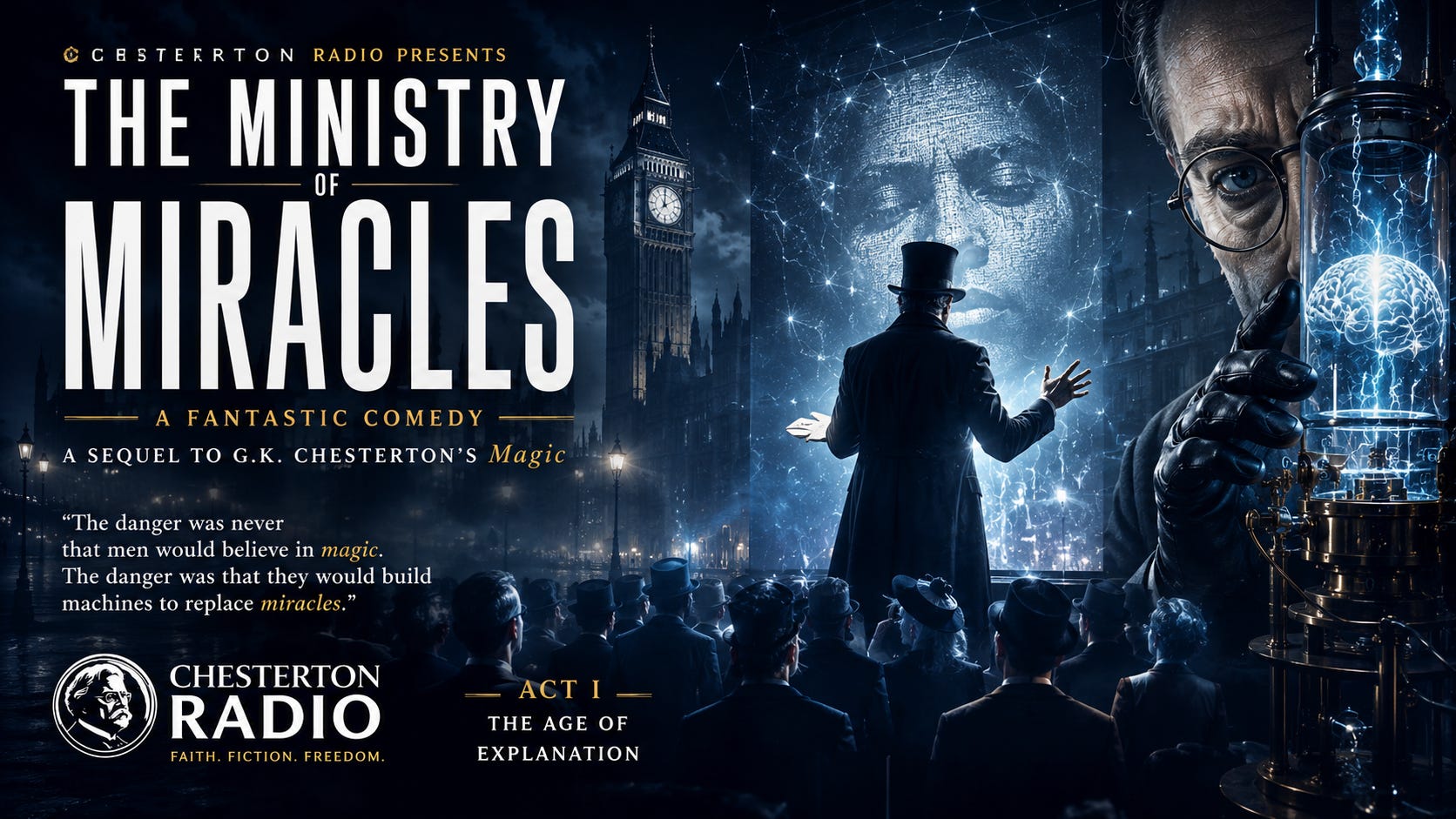
Intro
The rain had already swallowed London by the time the Ministry opened its doors.
Not the cheerful rain of gardens and green fields, but the cold metropolitan rain that turns gaslight into halos and men into silhouettes. Somewhere beyond the black roofs of Westminster, trains screamed through the dark like wounded machinery. The pavements reflected electric signs in shattered colors. The modern world was awake — brilliantly illuminated and spiritually exhausted.
And in the center of it stood a new institution promising the final victory of civilization:
A laboratory that claimed it could manufacture wonder.
No prayers.
No saints.
No miracles.
No God.
Only science, psychology, machinery, and the careful engineering of human emotion.
But there are some doors mankind was never meant to lock from the inside.
And there are some old magicians who do not entirely disappear.
Tonight, on Chesterton Radio, we begin a new journey into paradox, mystery, and the dangerous edge between enchantment and explanation:
The Ministry of Miracles
A Fantastic Comedy
A sequel to G.K. Chesterton’s Magic
Not merely a story about illusions.
But about a civilization that has forgotten the difference between mystery and manipulation.
The lamps are lit.
The audience is gathering.
And somewhere in the dark, a conjurer is returning.
The Ministry of Miracles
A Fantastic Comedy
Act I — The Age of Explanation
The rain had begun before evening, and by eight o’clock London had taken on that peculiar appearance which makes even the most modern street seem older than Nineveh. The electric lamps burned steadily through the wet air, but they did not abolish the darkness; they only gave it edges. The pavements shone like black mirrors. The motorcars hissed past like impatient animals. Above the roofs the sky was neither cloudy nor clear, but a single vast substance, as if the heavens themselves had been rubbed out with a wet sponge.
In a narrow street near Westminster, where clubs, societies, and committees had collected themselves with the quiet ferocity of fungi, there stood a building lately acquired by the Institute for Psychical Reconstruction. It had once been a chapel, then a lecture hall, then a warehouse for medical instruments, and was now called, by those who admired it, the Ministry of Miracles.
Its new name was not official. Officially it was the National Laboratory for the Study and Direction of Religious Impulse. But men never use official names except when they are trying to conceal either affection or crime. The newspapers, with their instinct for vulgar poetry, had christened it the Ministry of Miracles, and the name had stuck.
Inside, there was a great hall fitted with velvet seats, copper wires, concealed lamps, brass cabinets, screens, lenses, speaking tubes, electrical organs, and other instruments of an appearance at once scientific and theatrical. It was the kind of room in which a man might equally expect to see a sermon measured, a soul photographed, or a ghost manufactured under government supervision.
At the back of the hall, two gentlemen stood looking down upon the machinery from a small gallery. One was a thin, pale man with a large head and a very precise beard. His name was Dr. Septimus Gale, and he had made a public reputation by proving that almost everything which had ever happened had happened for some other reason. He had explained courage as vanity, charity as tribal instinct, martyrdom as nervous disturbance, prayer as respiratory habit, and love as a complicated commercial misunderstanding between the glands.
The other man was younger, or seemed younger because he was more enthusiastic. He was Mr. Adrian Bolt, a rising journalist and public lecturer, famous for the phrase, “The future will be managed.” His hair was brushed backward in the manner of men who are always entering a room slightly before themselves. He wore a flower in his buttonhole, not because he loved flowers, but because he believed them useful in softening the public image of intelligence.
“It is magnificent,” said Bolt.
“It is necessary,” said Dr. Gale.
“That is better than magnificent,” answered Bolt. “The age of magnificent things is over. The age of necessary things has arrived.”
Dr. Gale smiled, though not with his mouth. He was one of those men whose face seemed to perform all expressions privately.
“Tonight,” he said, “we shall do what religion has always attempted to do, but badly. We shall produce awe under controlled conditions.”
“Excellent,” said Bolt. “That is the whole future in a phrase.”
“It is also the whole past in a bottle,” said Gale. “For thousands of years mankind has been misled by accidental emotions. Thunder. Darkness. Music. Death. Birth. The stars. The sea. The unexpected kindness of enemies. These accidents created religion. We are merely removing the accident.”
“And keeping the religion?”
“Keeping the function,” said Gale. “The word religion is compromised. We prefer integration.”
Bolt nodded eagerly. He always nodded as if he were applauding with his head.
Below them, workmen moved across the floor, arranging cables and checking lamps. At the center of the platform stood a plain black chair. Behind it hung a screen of white fabric. On either side were two tall cases resembling confessionals, except that instead of crosses they bore dials.
“Will they see anything?” asked Bolt.
“They will see what they are ready to see.”
“Ah,” said Bolt, delighted. “That is subtle.”
“No,” said Gale. “It is measurable.”
At that moment a door opened behind them, and a woman entered the gallery.
She was no longer young, though she had preserved something more arresting than youth: the air of a person who had never consented to become dull. Her face had the delicate firmness of one who had suffered illusions and kept wonder. Her grey eyes were very steady, but they did not look deadened by steadiness. They looked as if they had once seen something and had never been able to unsee it.
“Dr. Gale,” she said.
The scientist turned.
“Lady Patricia,” he said, bowing. “You honor us.”
“I am not sure that I do,” she replied. “But I have come.”
Mr. Bolt stepped forward.
“Lady Patricia Carleon,” said Gale, “may I present Mr. Adrian Bolt, whose articles have done so much to prepare the public mind for our work.”
“Then he has my condolences,” said Patricia.
Bolt laughed, not because he found this amusing, but because he was too quick to suppose that every insult from a lady of rank must be a joke.
“I am delighted,” he said. “Your family has a certain historic connection with these matters, has it not?”
Patricia looked at him.
“My family has a historic connection with most follies,” she said. “Like other old families.”
“With conjuring, I meant,” said Bolt.
“With conjuring?” she repeated.
“With the famous incident. The old Carleon affair. The magician. The lamp. The nervous collapse of your brother. Forgive me if I speak too plainly. It is practically a classic case.”
“My brother was not a case,” said Patricia.
“No, of course not. I only meant—”
“You meant that a human being becomes much more convenient when he is classified.”
Dr. Gale intervened with the smoothness of a man rescuing a colleague from sincerity.
“Mr. Bolt means only that the incident has been discussed in psychological circles.”
“It has been discussed everywhere,” said Patricia, “except by those who understood it.”
“And who understood it?” asked Gale.
Patricia turned her eyes toward the hall below. For a moment the great machines blinked in the dimness like patient insects.
“I am not sure anyone did,” she said. “That may be why it was important.”
Bolt smiled again.
“There speaks the old romantic spirit.”
“No,” said Patricia. “There speaks the old human spirit. It is older than romance and will probably outlive journalism.”
Dr. Gale regarded her carefully.
“You have come at your brother’s request?”
“Yes.”
“Sir Morris is expected.”
“He is always expected,” said Patricia. “That is his tragedy. He has been expected to arrive at certainty for twenty years.”
“And has he?”
“He has arrived everywhere else.”
There was a little silence. Below, one of the workmen tested a lamp, and a cone of cold blue light fell across the central chair.
Bolt leaned over the rail.
“That is beautiful.”
Patricia looked at the light.
“No,” she said softly. “It is clever.”
Dr. Gale folded his hands behind him.
“Lady Patricia, I know you distrust us.”
“I distrust any man who announces that he has discovered the mechanism of the soul before he has discovered the use of his own.”
“You think us arrogant?”
“No. Arrogance is often lively. You are something worse. You are tidy.”
Bolt laughed again, more cautiously.
“Surely order is better than chaos.”
“That depends,” said Patricia. “A corpse is more orderly than a child.”
Dr. Gale’s smile returned.
“You see, Mr. Bolt? We have before us the precise imaginative temperament for which this institution exists. Lady Patricia feels that analysis destroys the object analyzed.”
“Does it not?” she asked.
“No. It explains it.”
“And that is not the same thing?”
“It is the beginning of mastery.”
“There,” said Patricia. “That is what I came to hear.”
“What?”
“The word mastery.”
Dr. Gale did not answer immediately. He walked toward the rail and looked down upon the hall as a general might look down upon a map.
“Humanity,” he said, “has been mastered long enough by shadows. By fears. By inherited terrors. By priests, poets, mothers, dreams, and dead men’s voices. We are proposing, for the first time, that man should master the forces which made him kneel.”
“And when he has mastered kneeling,” said Patricia, “what will he do with his knees?”
Bolt made a little sound of admiration.
“That is epigrammatic.”
“It is practical,” she said.
Before he could reply, another door opened, and a man entered so quietly that they all turned only after he had come several paces into the gallery.
He was tall, spare, and rather bent, though not with age alone. He had the appearance of a man who had spent many years arguing with an invisible opponent and had neither won nor lost. His face had once been handsome in a hard, impatient way, but the hardness had cracked. His eyes were brilliant and tired. He carried an umbrella, though it had failed him completely, and drops of rain fell from its edges onto the polished floor.
“Morris,” said Patricia.
Sir Morris Carleon looked at her and bowed with a curious mixture of affection and embarrassment.
“My dear Patricia.”
Then he saw Gale.
“Doctor.”
“Sir Morris,” said Gale. “We are honored indeed.”
“Are you?” said Morris. “I had understood that honor was one of the pre-scientific sentiments.”
“It remains useful socially.”
“That is what I always thought religion would become,” said Morris. “Useful socially.”
His voice was dry, but Patricia heard the tremor under it. She had heard it before—many years before, in another room, when a lamp had changed color and a man had discovered that his philosophy had no provision for facts.
Bolt was looking at Morris with frank fascination.
“Sir Morris, this is a remarkable evening. Your presence gives it a historical symmetry. You were, if I may say so, one of the last men to suffer from the old superstition. Tonight you will witness the birth of the new science.”
Morris turned toward him.
“You are young,” he said.
“I hope so.”
“Then let me give you advice. Never call any science new until you know how old its mistakes are.”
Bolt flushed.
Dr. Gale appeared faintly amused.
“You remain skeptical, Sir Morris.”
“Entirely.”
“Of us?”
“Of everyone.”
“Even of skepticism?”
Morris looked at him sharply.
“Especially of skepticism.”
For the first time, Dr. Gale seemed genuinely interested.
“That is an unusual development.”
“It is an occupational disease,” said Morris. “If a man spends twenty years doubting everything, he eventually doubts doubt. It is the one thing he has had most practice upon.”
Patricia watched him with pity. There was something heroic and wretched about Morris now. In youth his unbelief had been a sword. In middle age it had become a wound.
“You received my letter?” asked Gale.
“I did.”
“And you understand the purpose of tonight’s demonstration?”
“No,” said Morris. “I understand the advertisement.”
Bolt spoke quickly.
“It is not an advertisement.”
“My dear sir,” said Morris, “everything public is an advertisement. The only question is whether it advertises soap, salvation, or the advertiser.”
Dr. Gale inclined his head.
“We intend to show that mystical experience can be produced without superstition. That visions, conversions, ecstasies, and inward certainties can be generated by known stimuli.”
“And therefore are false?”
“Not false. Functional.”
“I see,” said Morris. “You will not deny men their souls. You will merely manufacture them.”
“We shall deliver them from irrational terrors.”
“By rational terrors?”
“By knowledge.”
Morris walked to the rail. Below, the hall had begun to fill. Well-dressed men and women entered in murmuring groups. There were clergymen eager to be modern, atheists eager to be reverent, aristocrats eager to be startled, journalists eager to be first, and politicians eager to appear without committing themselves to an appearance. There were also several earnest young women with notebooks and several earnest young men with no visible means of emotion.
At the front of the hall sat a bishop with a face like a benevolent pudding. Beside him sat a famous materialist whose bald head shone under the lamps with almost sacerdotal solemnity. They were conversing pleasantly, having discovered that each regarded the soul as a metaphor, though for different professional reasons.
“It is an impressive congregation,” said Morris.
“We avoid that term,” said Gale.
“Of course. I forgot. Words are dangerous when they remember things.”
Patricia turned suddenly.
“What exactly will happen tonight?”
Dr. Gale answered with calm precision.
“A volunteer will be seated in that chair. Through a combination of light, sound, suggestion, atmospheric pressure, controlled scent, and mild electrical influence, we shall induce a state historically indistinguishable from religious exaltation.”
“Historically indistinguishable,” repeated Patricia. “That is an interesting phrase. A wax apple is botanically indistinguishable from an apple to a man who has never been hungry.”
“The subject will report overwhelming peace, moral clarity, and the sense of communion with a larger order.”
“With what larger order?”
“With whatever symbol is personally meaningful.”
“So if a Christian sits there, he may see Christ?”
“He may experience an image derived from his own mental inheritance.”
“And if a pagan?”
“His own corresponding symbol.”
“And if a stockbroker?”
“Possibly a rising market,” said Morris.
Bolt laughed too loudly.
Patricia did not laugh.
“So you will give every man the god he already carries in his pocket.”
“We will reveal that he carried it there all along,” said Gale.
“And if there is a God outside his pocket?”
Dr. Gale looked at her almost kindly.
“That is precisely the unnecessary hypothesis.”
At that moment, the lights in the hall dimmed slightly. A bell sounded once—low, musical, and curiously intimate. The audience settled.
Dr. Gale glanced at his watch.
“We must go down.”
He offered his arm to Patricia, who declined it without rudeness.
Morris remained by the rail.
“You are not coming?” asked his sister.
“In a moment.”
She lingered.
“Morris.”
“Yes?”
“Why did you come?”
He looked down into the hall.
“Because I was afraid not to.”
She touched his sleeve gently, then followed the others.
For a few seconds Morris stood alone in the gallery. Rain struck the high windows. Somewhere below, machinery hummed softly. He closed his eyes, and a memory returned with the cruelty of small things: a room, a lamp, a man in evening dress, and a light changing color where no wire ran and no explanation reached.
He opened his eyes angrily.
“Damn the lamp,” he said.
A voice behind him answered:
“On the contrary. Bless it.”
Morris turned so violently that his umbrella fell.
In the shadow near the door stood a man.
He wore a dark coat slightly old-fashioned in cut, and in his hand he held a battered silk hat. His face was difficult to see because the light from below left him half in darkness. He might have been forty or sixty. His hair, where it showed, was touched with grey. His eyes were bright, amused, and melancholy.
Morris did not speak.
The stranger bowed.
“I beg your pardon. I did not mean to alarm you.”
Morris gripped the rail.
“Who are you?”
“A late arrival.”
“You have no right to be here.”
“That is often the beginning of hospitality.”
Morris stared at him.
“I know your voice.”
“That is unfortunate. Voices should be free to improve with age.”
Morris took one step forward.
“You.”
The stranger said nothing.
“You are dead,” said Morris.
“I have heard the same said of many excellent institutions.”
“You vanished.”
“That is not quite death. Though it is one of its minor accomplishments.”
Morris’s face had gone pale.
“I saw you once.”
“Yes.”
“You ruined my life.”
The stranger considered this.
“No,” he said. “I believe I only interrupted it.”
Morris gave a short laugh, like something breaking.
“You expect me to accept this? After all these years? You appear in another theatre of tricks, at another public performance, just as these people are preparing—”
“Preparing to explain miracles,” said the stranger. “Yes. It seemed courteous to attend.”
Morris lowered his voice.
“Were you a conjurer?”
“I was often paid as one.”
“Were you more than that?”
The stranger looked toward the hall.
“My dear sir, most men are more than they are paid as.”
Morris struck the rail with his hand.
“I have asked myself that question every day for twenty years.”
“Then you have been more faithful than many believers.”
“Answer me.”
The stranger’s face grew grave.
“No.”
“No?”
“No answer would help you.”
“You mean you will not tell me.”
“I mean that telling is not the same as giving. A man may be told there is music, and remain deaf. He may be told there is bread, and remain hungry. He may be told there is mystery, and merely add it to his list of facts.”
Morris breathed hard.
“You speak as you spoke then.”
“I am sorry. One does acquire habits.”
The bell sounded again below.
The stranger turned.
“They are beginning.”
Morris blocked his way.
“You shall not go down.”
“Why not?”
“Because I will not have it happen again.”
“What happen?”
“I do not know!” cried Morris. “That is the whole horror of it.”
The stranger looked at him with sudden compassion.
“No,” he said quietly. “That was the whole mercy of it.”
Morris seemed unable to answer.
After a moment the stranger stooped, picked up Morris’s umbrella, and handed it to him.
“It is raining,” he said.
“I know that.”
“Do you?”
And before Morris could reply, the stranger passed him and descended the stairs.
Below, the audience had settled into expectant silence.
Dr. Septimus Gale stood upon the platform. He looked taller under public light and less human. Behind him the white screen glowed faintly. The central chair waited.
“Ladies and gentlemen,” he began, “we are met tonight not to mock the past, but to understand it. Man has always lived among miracles because man has always lived among misunderstandings. Thunder was once a god. Disease was once a demon. Dreams were once messages from beyond the grave. The savage worshipped what he could not explain. Civilization began when explanation replaced worship.”
There was applause from some parts of the hall, though the bishop clapped only with his fingertips.
Gale continued.
“But there remains one region where civilization has hesitated. We have explained the heavens, the body, the origin of species, the instincts of the tribe, the reflexes of the nervous system. Yet men still speak of conversion, vision, revelation, grace, communion with the infinite. Tonight we shall show that these experiences, too, belong not to another world, but to this one. They are not false because they are natural. They are natural, and therefore at last they can be made useful.”
Bolt, seated near the front with a notebook, wrote rapidly: NATURAL MIRACLE MADE USEFUL.
Patricia sat beside Morris, who had taken his place late and silently. She leaned toward him.
“You are ill.”
“No.”
“You look as you looked then.”
“Please be quiet.”
On the platform, Gale gestured toward the chair.
“Our first demonstration will be simple. We have invited a subject of balanced intelligence, moderate religious inheritance, and no known pathological tendencies.”
A nervous little man rose from the front row and climbed the steps to the platform. He was introduced as Mr. Edwin Pym, a civil servant from the Department of Public Instruction. He wore spectacles and the expression of one who had spent his life approving forms in triplicate.
Gale seated him in the chair.
“You are comfortable?”
“Yes.”
“You understand that nothing supernatural is expected?”
“Certainly.”
“You are not here to prove religion?”
“Certainly not.”
“Nor to disprove it?”
“I hope not,” said Mr. Pym anxiously.
“Excellent.”
The audience laughed.
The lights dimmed.
A low sound filled the room—not music exactly, but something like the memory of music. A faint fragrance drifted through the air, difficult to identify, suggestive at once of incense, wet leaves, childhood rooms, and hospitals. The white screen behind Mr. Pym slowly brightened.
At first nothing appeared upon it.
Then there was a shape.
It was not distinct. It might have been a doorway. It might have been a hill under stars. It might have been merely a trick of light.
Mr. Pym’s face changed.
That was the disturbing thing. The machinery was impressive, the screen clever, the sound effective; but the change in the little civil servant’s face was more powerful than any of it. His mouth relaxed. His eyes filled with tears. He looked suddenly like a man who had been forgiven by someone whose existence he had forgotten.
A murmur passed through the hall.
Dr. Gale watched closely, not triumphantly, but with professional satisfaction.
“Mr. Pym,” he said softly, “what do you perceive?”
The little man answered in a whisper.
“It is all right.”
“What is all right?”
“Everything.”
“Can you describe the experience?”
Mr. Pym smiled.
“I have been afraid all my life.”
“Yes?”
“I need not have been.”
Several people in the audience shifted uneasily. The bishop took out a handkerchief.
Gale raised one hand, and the sound faded. The light diminished. The fragrance dispersed.
Mr. Pym blinked.
He looked embarrassed.
“I beg your pardon,” he said.
The audience applauded uncertainly, then warmly.
Gale helped him from the chair.
“You see,” said the doctor, turning to the hall, “we have produced, without creed, priest, sacrament, or supernatural agency, the essential emotional structure of religious consolation.”
At that moment, a voice from the back of the hall said:
“No, you have not.”
Everyone turned.
The stranger stood in the central aisle, hat in hand.
Dr. Gale frowned.
“Who spoke?”
“I did.”
“And who are you?”
“A conjurer.”
A ripple ran through the room. Patricia’s hand tightened on her chair. Morris stared straight ahead as if refusing to see what he saw.
Bolt half rose, delighted by the interruption.
“A conjurer! How appropriate.”
Dr. Gale was less delighted.
“This is a scientific demonstration, sir.”
“I noticed the resemblance.”
There was laughter.
Gale stiffened.
“If you have some objection, perhaps you will state it.”
“Gladly,” said the stranger. “You did not produce religious consolation.”
“What did we produce?”
“Consolation.”
The audience stirred.
Gale smiled thinly.
“A distinction without a difference.”
“My dear doctor,” said the conjurer, walking slowly down the aisle, “distinctions without differences are the only things modern people notice. Distinctions with differences they call superstition.”
Gale studied him.
“You deny that religious experience can be mechanically induced?”
“No.”
That answer surprised the hall.
“You admit it?”
“I admit that almost anything can be mechanically induced. Laughter can be induced by gas. Courage by brandy. Sleep by chloroform. Appetite by exercise. Loyalty by uniforms. Love by moonlight, if the parties are sufficiently young and the moon sufficiently unscrupulous.”
The laughter was louder now.
“But,” he continued, “no sane man concludes that laughter is only gas, courage only brandy, sleep only chloroform, appetite only exercise, loyalty only tailoring, or love only an astronomical abuse.”
Patricia smiled despite herself.
Gale lifted his hand.
“You are playing with analogies.”
“Certainly. They are safer than playing with souls.”
The room fell quieter.
Gale’s eyes narrowed.
“You accuse us of that?”
“I accuse you of being successful.”
“Successful?”
“Yes. Failures are often innocent. Success is the dangerous thing.”
Gale descended one step from the platform.
“Sir, if you are indeed a conjurer, you make your living by deception. It is curious to hear you lecture science on honesty.”
The stranger bowed.
“That is because a conjurer deceives men who know they are being deceived. The honest conjurer says, ‘I am about to trick you.’ The dangerous conjurer says, ‘I am about to save you from being tricked.’”
A sound like approval moved through the audience, though no one quite dared to applaud.
Gale’s voice hardened.
“Perhaps you would favor us with a demonstration of honest deception.”
The stranger looked at him.
“Tonight?”
“Now.”
Morris whispered, “No.”
Patricia turned.
But the stranger had already stepped onto the platform.
Gale gestured to the table nearby.
“We have cards, coins, apparatus—”
“I need none.”
“Ah. A miracle, then?”
“No. Something much less common.”
“What?”
“A small act.”
He turned to the audience.
“Ladies and gentlemen, Dr. Gale has shown you a man placed in a chair and surrounded by influences until he felt peace. I will now show you something far more inexplicable.”
He looked down at Mr. Pym, who had returned to his seat, pale and confused.
“Sir, would you stand?”
Mr. Pym rose reluctantly.
“You felt peace just now?”
“Yes.”
“Do you feel it still?”
Mr. Pym hesitated.
“No. Not exactly.”
“Do you wish to feel it again?”
“Yes.”
“Very much?”
“Yes.”
“Then here is my trick.”
The conjurer stepped down from the platform and stood before him.
“I cannot give it to you.”
The hall was utterly still.
Mr. Pym stared.
The conjurer spoke more gently.
“No machine can give it to you either. It may give you the sensation of having received something. But the most important things in life are not sensations. They are relations. Peace is not something poured into a man like water into a bottle. Peace is what happens when a man is restored to the truth of things.”
Dr. Gale cut in sharply.
“This is preaching.”
“No,” said the conjurer. “Preaching is longer.”
The audience laughed again, but nervously.
The conjurer turned back to Mr. Pym.
“Do you want peace?”
“Yes.”
“Then go home tonight and forgive the person you have refused to forgive.”
Mr. Pym’s face went white.
The hall seemed to draw a single breath.
“That,” said the conjurer, “is the trick.”
Mr. Pym sat down suddenly.
Gale stepped forward.
“This is intolerable.”
“On the contrary,” said the conjurer. “It is almost intolerably ordinary.”
“How could you know anything about this gentleman?”
“I know nothing about him.”
“You guessed.”
“Of course. I am a conjurer.”
Bolt was scribbling furiously. Patricia could see the headline forming in his eyes.
Gale addressed the audience.
“Ladies and gentlemen, you have witnessed a clever piece of cold reading. Nothing more.”
“Nothing more!” cried the conjurer cheerfully. “The motto of the age.”
Gale turned on him.
“You believe, I suppose, in the supernatural?”
“I believe in the natural,” said the conjurer. “That is much harder.”
“Do you believe in miracles?”
“Yes.”
“Can you perform them?”
“No.”
That answer stopped even Morris.
The conjurer looked around the hall.
“A miracle is not magic done by a magician. It is reality done by God. I can perform tricks. God performs facts.”
Gale laughed coldly.
“You are a theologian disguised as a mountebank.”
“And you,” said the conjurer, “are a mountebank disguised as a theologian.”
There was applause now, quickly suppressed.
Dr. Gale’s composure had cracked, though only slightly.
“Sir, you came here to disrupt this proceeding.”
“I came because I was invited.”
“By whom?”
The conjurer seemed to consider.
“By the building.”
This produced confusion.
“The building?”
“Yes. It used to be a chapel, did it not?”
Gale’s face changed almost imperceptibly.
“That is irrelevant.”
“Nothing that has been prayed in is ever entirely irrelevant.”
For the first time, Patricia saw fear in Gale’s eyes—not supernatural fear, but social fear, the fear of a man whose ceremony has slipped beyond management.
Gale recovered.
“We cannot continue this farce. Security—”
But before anyone moved, a woman’s voice spoke from the front row.
“Let him continue.”
It was the bishop’s sister, Lady Ullswater, a formidable old woman with a cane and an expression of permanent theological disappointment.
“I paid a guinea,” she said, “and this is the first sensible entertainment of the evening.”
Laughter broke the tension.
Gale bowed stiffly.
“Very well. One minute.”
The conjurer returned to the platform.
“One minute is more than enough for many miracles and too much for most explanations.”
He faced the audience.
“I shall perform no wonders tonight. You have had wonders enough. I shall merely ask you to notice a curious fact. Dr. Gale has built a machine to produce awe. But why should awe need producing? Why are you not awed already?”
No one answered.
“You are sitting,” he continued, “on a spinning globe, under a roof of stars, each of you carrying in your skull a darkness full of pictures, each of you having come from nothing by birth and going toward something by death, each of you capable of loving what you cannot possess and forgiving what you cannot forget. And yet you have paid money to sit in a dark room and be made to feel mysterious by electricity.”
The silence deepened.
“That is the achievement of modern civilization. It has made the universe so dull that men must buy back wonder by the hour.”
Patricia felt tears rise unexpectedly to her eyes. Morris sat rigid, his hands clenched.
Gale said quietly, “Finished?”
“Not quite.”
The conjurer turned to the white screen.
“What is behind that?”
“Apparatus.”
“Of course. There is always apparatus behind a screen. It is the first principle of both conjuring and politics.”
He walked toward it.
Gale moved quickly.
“You must not touch that.”
“I shall not.”
The conjurer stopped several feet away.
“Then I will end with the smallest possible experiment. Dr. Gale produces visions by machinery. I shall produce no vision. I shall merely ask whether there is anything in this room which his machinery did not arrange.”
He lifted his hand and pointed—not at the screen, not at the lights, not at the chair, but at a small red lamp burning above the side door marked EXIT.
It was an ordinary safety lamp, dull and official, the sort of thing no one notices unless the building is on fire.
“Observe,” said the conjurer, “that it is red.”
Morris rose half from his chair.
Patricia whispered, “Morris.”
The hall turned toward the lamp.
It burned red.
Nothing happened.
For five seconds, ten seconds, twenty seconds, nothing continued to happen with almost supernatural emphasis.
Then the conjurer laughed.
“You see? Reality resists theatrical timing. That is one of its charms.”
There was a relieved murmur, even laughter.
Gale smiled.
“Your miracle has failed.”
“My dear doctor,” said the conjurer, “you are still confusing miracles with performances.”
He bowed to the audience.
The red lamp went out.
The hall gasped.
A moment later it burned again.
Blue.
Not bright. Not spectacular. Simply blue.
The sound that followed was not applause, nor fear, nor disbelief. It was the sound of several hundred people discovering simultaneously that they had bodies.
Dr. Gale stood motionless.
Bolt dropped his pencil.
The bishop crossed himself, then looked embarrassed and uncrossed himself halfway.
Morris made a terrible sound and sat down.
Patricia did not move. Her eyes were fixed on the conjurer, who looked not triumphant but sad.
Gale strode to the side door, pulled it open, and shouted to someone beyond. A technician appeared. There was confusion, examination, denial. The lamp flickered once.
It was red again.
Dr. Gale turned back to the audience.
“A fault in the circuit,” he said loudly. “Ladies and gentlemen, there is plainly a fault in the circuit.”
The conjurer put on his hat.
“Plainly,” he said.
Then he descended from the platform and walked up the central aisle.
As he passed Patricia, he paused.
She looked up at him.
“Was it you?” she asked.
He smiled faintly.
“My dear lady, that is the least interesting question.”
Then he was gone.
The hall erupted.
People stood, argued, laughed, protested, prayed, explained, denied, and demanded their hats. Dr. Gale called for order. Mr. Bolt rushed after three different headlines at once. The bishop remained seated with the look of a man who had swallowed a doctrine and was uncertain whether it agreed with him.
Morris sat very still.
Patricia touched his arm.
“Morris.”
He spoke without looking at her.
“It has begun again.”
“No,” she said.
“Yes.”
“No,” she repeated. “Last time it happened to you. This time it has happened to them.”
He looked around the hall: at the scientists explaining, the journalists inventing, the clergy hesitating, the public trembling between amusement and awe.
Then, from somewhere in the machinery behind the screen, there came a sound no one had arranged.
It was very soft.
Almost nothing.
A child laughing.
But there was no child in the hall.
The lights went out.
And Act I ended in darkness.
Outro
And so the first act closes in darkness.
A blue lamp burns where no mechanism should reach.
A room full of skeptics suddenly remembers fear.
A scientist discovers that explanation is not the same thing as control.
And somewhere beyond the machinery and arguments, laughter echoes from an empty place where no child stands.
Was it a trick?
A coincidence?
A fault in the wiring?
Or merely the first crack in the smooth glass wall modern civilization has built between itself and wonder?
Chesterton understood something our own age has nearly forgotten:
The opposite of faith is not reason.
The opposite of faith is the belief that reality must never surprise us.
In the coming acts, the Ministry will grow more powerful. The machinery will become more sophisticated. The manufactured miracles will become more convincing. And the temptation facing modern humanity will become more terrible:
Not whether men can explain mystery—
—but whether they will prefer imitation mystery to the real thing.
For now, the rain continues over London.
The crowd disperses into wet streets and electric fog.
And somewhere ahead in the darkness, the conjurer walks on.
From the Wireless Archive of imagination and paradox… broadcast from Chesterton Radio Substack in Atchison, Kansas.
Where the old lamps still burn, the impossible still knocks politely at the door, and the modern world is reminded that the universe is far stranger—and far more beautiful—than the machines intended.