

Intro
London has seen many religions.
It has worshipped kings, empires, revolutions, machines, markets, progress, reason, and occasionally even God. It has burned incense before cathedrals and stock exchanges with equal solemnity. It has watched old faiths collapse beneath electric light and new faiths rise from newspapers, laboratories, and political speeches.
But now London has encountered something far more dangerous than superstition.
It has encountered manufactured transcendence.
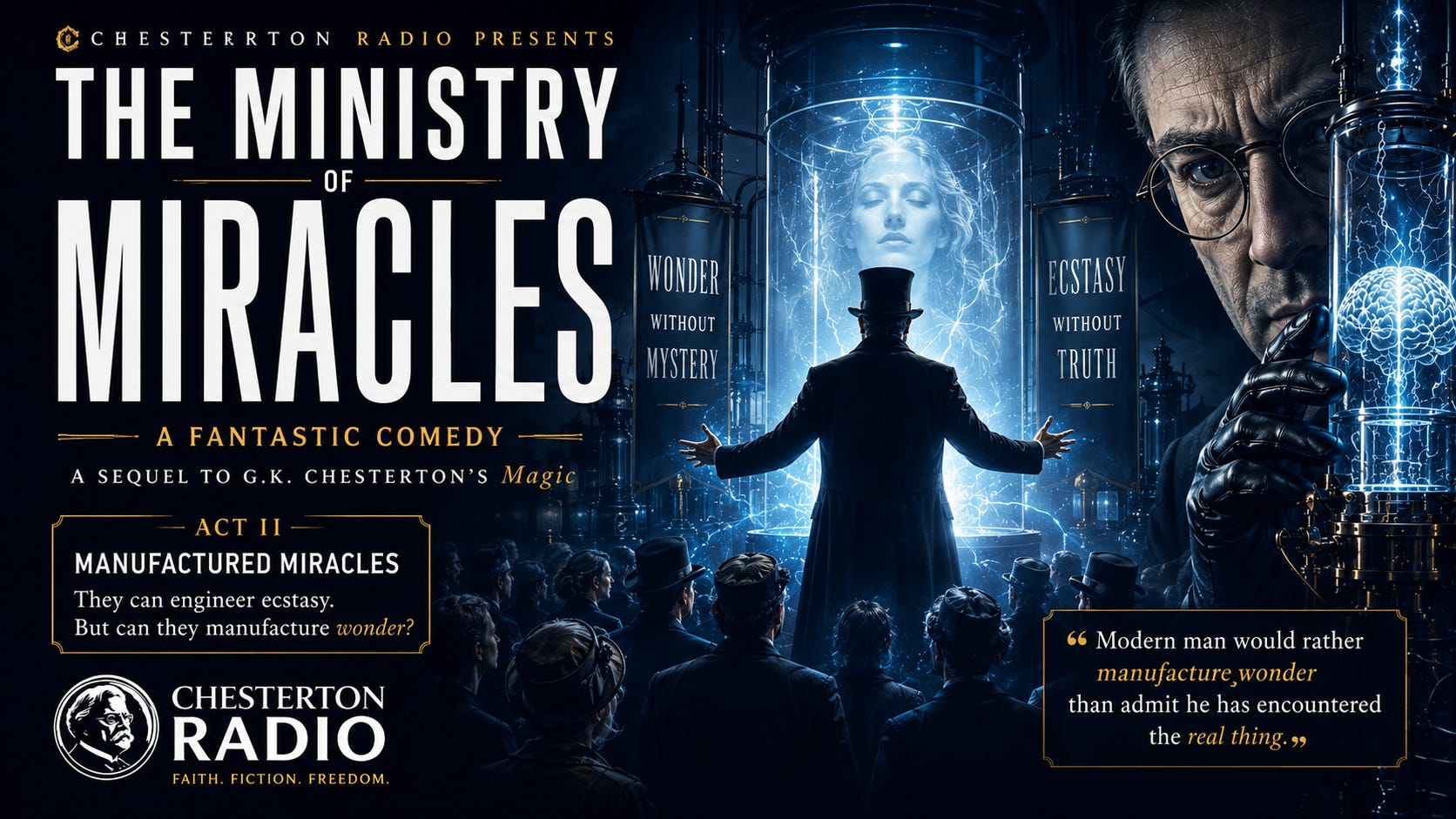
The Ministry of Miracles promises a new civilization:
wonder without mystery, ecstasy without sacrifice, visions without truth, and salvation without God. Through wires, chemicals, light, suggestion, and machinery, it claims it can engineer the very experiences once called spiritual.
And perhaps most terrifying of all—
it may actually work.
Meanwhile, somewhere beyond the machinery and official explanations, an old conjurer walks again through the streets of London. Not preaching. Not threatening. Not conquering.
Simply reminding people that reality itself may still be enchanted.
Tonight on Chesterton Radio, we continue The Ministry of Miracles:
Act II — Manufactured Miracles
Where the modern world begins discovering that the greatest danger was never magic—
—but counterfeit magic powerful enough to replace reality itself.
London awoke angry.
Not frightened at first. Not reverent. Certainly not humble.
Angry.
The rain had ceased sometime before dawn, leaving the city washed but not cleansed. The streets shone under pale morning light like steel newly drawn from water. Newspaper boys shouted at corners with voices full of triumph and catastrophe. Omnibuses rattled through Westminster carrying clerks, typists, laborers, civil servants, journalists, and bishops, all reading different explanations of the same impossible event.
The Morning Clarion declared:
ELECTRICAL MALFUNCTION INTERRUPTS SCIENTIFIC DEMONSTRATION
The Daily Standard preferred:
MINISTRY EXPOSES PUBLIC SUPERSTITION
The Illustrated Echo abandoned restraint altogether:
THE BLUE LAMP OF WESTMINSTER
WAS IT A GHOST?
Meanwhile the more intellectual journals adopted the tone peculiar to modern thought whenever it is most frightened: complete confidence accompanied by vocabulary.
One editorial announced:
“The so-called supernatural incident reveals the lingering susceptibility of the post-theological imagination to symbolic disruption under conditions of collective emotional expectation.”
Another insisted:
“The event demonstrates the persistence of archetypal irrationality within mass democratic consciousness.”
A third concluded triumphantly:
“The public’s reaction proves the urgent necessity of further rational education.”
None of them mentioned that several reporters had fainted.
By nine o’clock every café in London contained at least one expert explaining why no sensible person could possibly believe what everyone had plainly seen.
And above the city, in offices filled with wires and polished brass, the Ministry of Miracles was attempting to regain possession of reality.
Dr. Septimus Gale stood at the head of the conference chamber with the expression of a man who had spent the entire night dissecting panic and found it disappointingly alive.
The chamber itself resembled a chapel redesigned by accountants. Everything shone. Everything aligned. Even the silence appeared regulated.
Around the long black table sat officials, advisers, journalists friendly to the Ministry, and two government representatives whose chief qualification seemed to be the ability to look grave about events they did not understand.
At the far end sat Adrian Bolt.
He had not slept.
This was visible not because he appeared exhausted, but because he appeared more energetic than usual. Fatigue in certain modern men acts not as a weight but as an accelerant. Bolt’s eyes glittered feverishly. Before him lay newspapers covered in notes and circles.
Gale rested both hands upon the table.
“The incident,” he said calmly, “was sabotage.”
Nobody replied immediately.
One of the government men cleared his throat.
“You are certain?”
“No,” said Gale. “But certainty is a private luxury. Public administration requires conclusions.”
This appeared to satisfy them.
A woman from the Ministry’s communications office spoke next.
“The public response is deeply unstable. Attendance requests for the next demonstration have tripled overnight.”
“Excellent,” said Bolt automatically.
Gale turned sharply.
“Not excellent.”
Bolt blinked.
“With respect, Doctor, the entire nation is discussing us. Interest at this scale is unprecedented.”
“Interest,” said Gale, “is merely fear before it becomes opinion.”
He began pacing slowly.
“The situation is dangerous because the public has confused two entirely separate things.”
“The lamp and the demonstration?” asked one official.
“No. The emotional and the supernatural.”
Bolt leaned forward.
“But surely the public fascination proves the hunger for transcendence we discussed.”
“Yes,” said Gale coldly. “And hunger is useful only if controlled.”
There was a silence.
One of the older advisers—a sociologist with silver spectacles and the face of a disappointed walrus—adjusted his papers.
“The conjurer must be identified.”
“We are attempting to do so,” said Gale.
“No records?”
“None.”
“No stage history?”
“None.”
“No legal identity?”
“None.”
Bolt spoke carefully.
“People are already romanticizing him.”
“People romanticize influenza,” said Gale. “That does not make it desirable.”
“But if handled correctly—”
“Nothing supernatural occurred.”
Bolt hesitated.
Then he said quietly:
“You saw the lamp.”
The room became still.
Gale stopped pacing.
“I saw a colored light.”
“You know that is not enough.”
“What is enough?” snapped Gale suddenly. “Emotion? Atmosphere? Collective suggestion? The primitive human terror of coincidence?”
Bolt did not answer.
Gale’s voice lowered again.
“We are not dealing with facts. We are dealing with interpretation. And interpretation belongs to whoever speaks first and longest.”
The communications woman nodded eagerly.
“Exactly. The narrative environment remains recoverable.”
The sociologist murmured:
“If we lose interpretive authority, the educational consequences could be catastrophic.”
Another official added:
“We could lose thirty years of secular progress.”
“No,” said Gale quietly. “We could lose administrative predictability.”
That sentence settled over the room like frost.
Because every man there understood what it meant.
Not merely that the public might become religious again.
But that a population capable of wonder is difficult to govern.
At nearly the same hour, Lady Patricia Carleon sat in the library of her brother’s townhouse watching rainwater slide slowly down the windows.
The room smelled faintly of old books, coal smoke, and neglected certainty.
Morris stood at the fireplace holding an untouched glass of whiskey.
He had not shaved.
This alone would have shocked half the philosophical societies of London.
For twenty years Sir Morris Carleon had remained the high priest of cultivated skepticism: elegant, devastating, mercilessly lucid. Young intellectuals quoted him at dinner parties with the same reverence previous centuries reserved for saints.
Now he looked like a man who had spent the night arguing with furniture.
Patricia closed the newspaper she had been pretending to read.
“You should sleep.”
“No.”
“You look ill.”
“I am ill.”
She waited.
“At last,” he added bitterly, “I have become intellectually honest.”
She rose quietly and crossed the room.
“Morris…”
He laughed suddenly.
“Do you know what is truly dreadful?”
“What?”
“I no longer know whether I fear superstition or hope for it.”
The fire shifted softly.
Patricia regarded him with deep sadness.
“You hoped the Ministry would explain it away.”
“Yes.”
“And instead?”
He turned toward her violently.
“Instead it happened again.”
“No,” she said.
“Yes!”
“The lamp is not the important thing.”
“It changed.”
“You are still obsessed with the trick.”
“Because I cannot bear the alternative.”
“And what alternative is that?”
Morris stared into the fire.
“That reality means something.”
The words seemed to exhaust him.
Patricia spoke gently.
“You do not fear irrationality, Morris.”
He looked up sharply.
“You fear obligation.”
He shut his eyes.
Outside, a carriage rattled through the wet street.
“You always did possess the gift of cruelty disguised as kindness,” he said.
“It is not cruel.”
“It is monstrous.”
“No. Merely moral.”
He crossed slowly toward the shelves.
“For twenty years,” he said quietly, “I have attempted to reduce the universe to something manageable. Something explainable. Something incapable of demanding anything from me.”
“And has it succeeded?”
“No.”
He laughed again, but now the laughter sounded dangerously near tears.
“That is the true humiliation. Skepticism promises freedom and produces exhaustion. One spends one’s life pulling down altars only to discover that doubt itself becomes an altar.”
Patricia sat again.
“And now?”
“Now,” said Morris, “some impossible mountebank walks back into London exactly as before and turns a lamp blue in front of half the intellectual establishment of England.”
There was a pause.
Then Patricia asked quietly:
“Did you speak to him?”
Morris looked at her.
For the first time since childhood, fear entered his face plainly.
“Yes.”
“And?”
“He spoke as if nothing had happened.”
“Perhaps to him nothing had.”
“No,” whispered Morris. “That is the terrible thing. I think he pities us.”
By afternoon, stories about the conjurer had spread across London with the speed peculiar to impossible things.
A tobacconist in Lambeth swore the man had paid for cigarettes with coins bearing the face of no king anyone recognized.
A cab driver claimed the stranger knew his destination before he spoke.
A flower seller insisted the man had repaired a broken toy merely by handing it back to a child.
Most of these stories were certainly false.
Which made them dangerous.
Because lies accumulate around truth the way iron filings gather around hidden magnets.
Near Charing Cross Station, in a narrow café crowded with steam and argument, the conjurer himself sat quietly drinking tea.
No one noticed him at first.
This was partly because he possessed the old and nearly extinct ability to occupy a room without attempting to dominate it. Modern people overlook such men because they are trained to notice only performers.
At a nearby table, two railway clerks argued over the previous night.
“It was wires,” said one.
“How do you know?”
“Everything’s wires now.”
“That is not an explanation.”
“It’s enough of one.”
The conjurer smiled faintly into his cup.
At the counter, a waitress struggled with a jammed mechanical register.
She struck it repeatedly.
“Beastly thing.”
The conjurer rose.
“May I?”
She shrugged.
He touched the machine lightly.
The drawer sprang open.
“How did you do that?”
“I apologized to it.”
The waitress laughed.
“That’s nonsense.”
“Yes,” he agreed pleasantly. “Machines appreciate nonsense. They are surrounded by reason all day.”
A little girl nearby stared at him.
“Are you a magician?”
The entire café turned slightly toward the question.
The conjurer considered carefully.
“No,” he said at last. “I am merely unemployed by reality.”
The girl frowned.
“That doesn’t make sense.”
“My dear child,” he said, “that is because you are still intelligent.”
Her mother hurriedly pulled her away.
Modern civilization always becomes nervous when children ask the correct questions.
That evening, Adrian Bolt arrived alone at the Ministry long after the public offices had closed.
The corridors were dim.
Electrical hums echoed through the walls like artificial insects.
He wandered through the demonstration hall slowly.
The central chair remained upon the platform.
The white screen hung silent.
The blue lamp above the side door now burned a perfectly ordinary red.
Bolt stared at it.
Then he spoke aloud into the empty room.
“How was it done?”
No answer came.
Yet he remained uneasy.
Because for the first time in his life he had encountered something worse than irrationality.
He had encountered ambiguity.
Bolt had built his career on certainty. Every article, lecture, and broadcast depended upon immediate interpretation. Modern journalism could survive lies, scandal, corruption, hysteria, even war.
But it could not survive mystery.
Mystery slowed narrative.
And slowed narratives became dangerous.
He moved toward the platform.
The machinery stood exposed now: coils, projectors, scent apparatus, pressure regulators, acoustic emitters.
He should have found comfort in them.
Instead they suddenly appeared theatrical.
Not scientific.
The realization disturbed him profoundly.
Behind him, a voice said:
“Excellent stagecraft.”
Bolt spun around.
The conjurer stood near the rear aisle.
“How did you get in here?”
“Through the door. It remains unfashionably useful.”
Bolt recovered quickly.
“You enjoy appearing unexpectedly.”
“No,” said the conjurer. “Modern people merely expect reality to announce itself beforehand.”
Bolt studied him intensely.
“Who are you?”
“A question asked by policemen, journalists, lovers, and theologians. Usually with disappointment.”
“You caused chaos last night.”
“No,” said the conjurer. “I merely interrupted organization.”
“You think this is amusing.”
“I think everything is serious. That is why one must laugh constantly.”
Bolt approached him cautiously.
“You know what people are saying?”
“Yes.”
“Some think you are supernatural.”
“That is very rude of them.”
“You deny it?”
“I deny being manageable.”
Bolt stared.
“You speak in riddles.”
“Only because modern language has become too literal for truth.”
The journalist folded his arms.
“You could end this.”
“Yes.”
“Then why don’t you?”
The conjurer looked around the hall.
“My dear Mr. Bolt… do you truly believe the danger lies in a colored lamp?”
“Then where does it lie?”
The conjurer’s expression changed.
The amusement faded slightly.
“In the machines.”
Bolt glanced at the apparatus.
“They are harmless.”
“No machine is harmless once men begin confusing it with authority.”
“These are merely instruments.”
“So was the guillotine.”
Bolt frowned.
“You oppose science?”
“No. I oppose small souls using large tools.”
The words lingered.
Then the conjurer stepped onto the platform and touched the central chair.
“Do you know what is truly interesting about this machine?”
“What?”
“It works.”
Bolt looked surprised.
“Then you admit the Ministry is correct?”
“Oh, the machine produces sensations perfectly well. Peace. Awe. Reverence. Ecstasy. Terror. Human beings are extraordinarily easy to disturb chemically and psychologically.”
“Then religion really is reducible.”
The conjurer smiled sadly.
“My dear man… hunger can be stimulated artificially. That does not prove food imaginary.”
Bolt said nothing.
The conjurer descended from the platform.
“The Ministry has made a dreadful mistake.”
“What mistake?”
“They believe that because a thing can be imitated, it therefore does not exist.”
He moved toward the door.
Bolt called after him.
“Then what is real?”
The conjurer paused.
“Anything that remains when manipulation stops.”
And he disappeared into the corridor.
Bolt stood alone beside the silent machinery.
For the first time in years, he felt afraid of an idea.
Three nights later the Ministry held its second public demonstration.
This time the crowd stretched around the block.
Police struggled to maintain order.
Carriages clogged the streets.
Vendors sold pamphlets.
Street preachers denounced science.
Science lecturers denounced street preachers.
Several men attempted to sell blessed electrical fuses.
London had become religious again in the worst possible way: commercially.
Inside the hall the atmosphere was feverish.
New apparatus had been added.
Silver coils wound upward like mechanical vines.
Glass cylinders pulsed with pale light.
Hidden speakers breathed low harmonics through the chamber.
Patricia entered beside Morris.
“What have they changed?” she whispered.
“Everything,” he said grimly.
Dr. Gale appeared upon the platform to enormous applause.
He looked magnificent.
That was the alarming thing.
Modernity becomes most seductive precisely when most arrogant.
“Ladies and gentlemen,” Gale announced, “recent events have demonstrated both the promise of our work and the unfortunate persistence of irrational interpretation. Tonight we shall proceed beyond isolated emotional stimulation into complete visionary integration.”
The audience leaned forward.
“Human transcendence,” Gale continued, “has always depended upon accidental symbols inherited from primitive cultures. We propose something greater: universalized revelation.”
The machinery began humming.
Lights dimmed.
A woman seated near the front gasped softly.
The screen behind the platform brightened—not white this time, but deep silver-blue like moonlight through water.
Then shapes appeared.
Not fixed images.
Possibilities.
Each viewer seemed to perceive something slightly different.
Some saw landscapes.
Others faces.
Others cathedrals.
Others stars.
The audience became transfixed.
A man near the aisle began weeping openly.
A woman whispered prayers.
Another laughed uncontrollably.
Morris gripped his chair.
Patricia looked around in alarm.
The experience was powerful.
Too powerful.
Because it lacked depth.
It stimulated longing without fulfillment.
Like drinking seawater.
People emerged from the visions not peaceful but desperate for more.
Patricia understood suddenly:
The Ministry was not creating transcendence.
It was manufacturing spiritual addiction.
She turned toward Morris—
—and saw him staring at the back of the hall.
The conjurer stood there silently among the crowd.
Watching.
Not triumphant.
Mourning.
Then, very slowly, he removed his hat.
At that exact moment the machinery faltered.
The visions flickered.
The humming deepened into distortion.
Lights pulsed erratically.
Dr. Gale shouted orders.
Technicians rushed behind the screens.
Then suddenly—
everything stopped.
No sound.
No light.
No ecstasy.
Only silence.
Several people cried out.
One woman sobbed hysterically.
The audience sat stunned, like addicts denied a dose.
Then somewhere in the darkness, a child’s voice began singing softly.
An old hymn.
Very faint.
One by one, other voices joined.
No command had been given.
No machine operated.
No atmosphere engineered.
The singing spread slowly through the hall like candlelight moving through ruins.
Simple.
Human.
Uncontrolled.
Dr. Gale stood frozen.
Because for the first time he understood the one thing the Ministry could never manufacture:
Voluntary wonder.
Patricia looked toward the rear aisle.
The conjurer was gone.
But above the side door, the small red lamp burned steadily blue.
Outro
And so Act II ends not with thunder, but with silence.
The Ministry builds its greatest machine.
The visions grow stronger.
The crowds kneel.
The experts celebrate.
The newspapers proclaim the triumph of engineered transcendence.
And then—
nothing.
No revelation.
No ecstasy.
No synthetic salvation.
Only darkness.
Until a single human voice begins to sing.
Not commanded.
Not programmed.
Not induced by machinery.
Freely.
And in that moment the Ministry glimpses the one force modern civilization can never fully mechanize:
the human soul answering mystery voluntarily.
The struggle has now changed.
This is no longer merely a debate between belief and skepticism.
It is becoming a battle between authentic wonder and manufactured enchantment… between reality and imitation reality… between mystery received humbly and transcendence sold commercially by the hour.
And somewhere in London, beneath rain-soaked lamps and electric fog, the conjurer continues walking quietly through the city—watching, waiting, and perhaps mourning what mankind is becoming.
In Act III, the Ministry will grow more aggressive. Public fascination will become obsession. The machinery will begin moving beyond spectacle into influence. And Morris Carleon will descend deeper into the terrifying possibility that skepticism itself may have become a prison.
But for now, the blue lamp still burns above the door.
And the night grows stranger.
From the Wireless Archive of paradox, mystery, and imagination… broadcast from Chesterton Radio Substack in Atchison, Kansas.
Where old stories still flicker against the modern dark, where wonder has not entirely surrendered to machinery, and where the signal remains open to all travelers moving through the fog between faith and reason.
Join us for Act III of The Ministry of Miracles — coming soon on Chesterton Radio.