

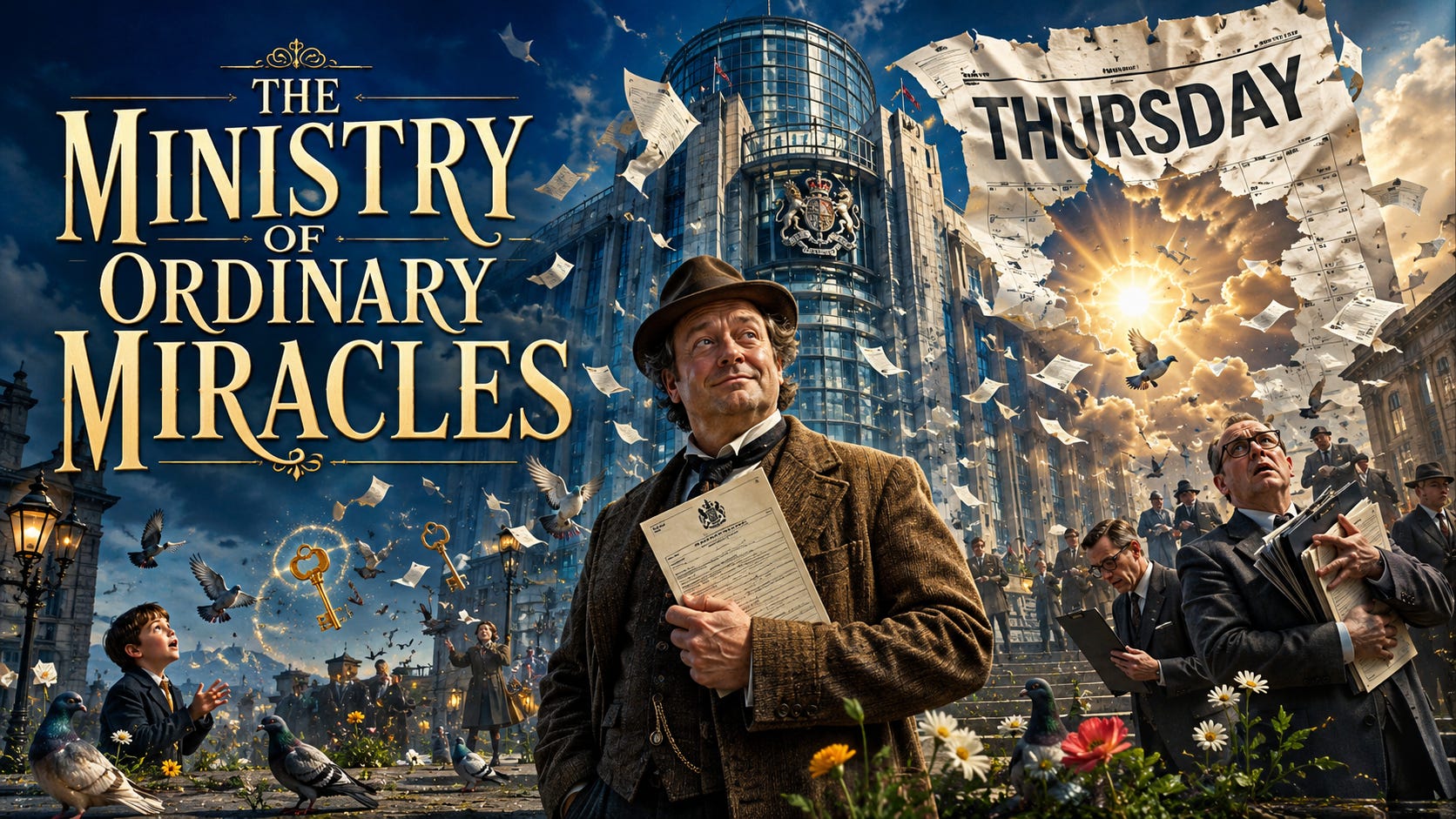
The Ministry of Ordinary Miracles
A New Original Tale from Chesterton Radio
There are some stories that begin with dragons, and some that begin with detectives.
This one begins with a government memorandum.
That is far more frightening.
The world has always contained two kinds of people. The first kind looks at a sunrise and sees a miracle. The second looks at the same sunrise and wonders whether the proper forms were filed.
Our story concerns the unfortunate moment when the second sort of person gained administrative authority over the first.
Set in the curious English town of Little Paradox, The Ministry of Ordinary Miracles follows the adventures of Ambrose Bell, journalist, philosopher, and defender of obvious truths. When a newly created government ministry decides that ordinary life has become far too unpredictable, it begins regulating coincidences, inspiration, happiness, lost keys, unexpected acts of kindness, and eventually the days of the week themselves.
What follows is a tale of absurd bureaucracy, common sense, cheerful rebellion, and the astonishing discovery that reality may be much harder to manage than anyone expected.
Written in the spirit of classic English fantasy and satire, this story is offered as a tribute to the enduring mystery hidden within ordinary things.
After all, the greatest miracle may not be that extraordinary things happen.
It may be that ordinary things happen at all.
And so our tale begins on a Thursday.
A day which, according to official records, no longer existed.
The trouble began on a Thursday.
This would not ordinarily have been remarkable, for troubles have always shown a peculiar affection for Thursdays. Mondays are too obvious. Tuesdays are too industrious. Wednesdays are occupied with becoming Thursdays, and Fridays spend most of their time pretending to be holidays.
But this Thursday was remarkable because it had been officially abolished three weeks earlier.
The citizens of Little Paradox had received the notice by post.
The document arrived in a pale blue envelope bearing the seal of the Ministry of Ordinary Miracles, an institution so new that nobody remembered voting for it and so large that everybody assumed someone else had.
The notice read:
NOTICE OF TEMPORAL REALIGNMENT
In accordance with the Administrative Rationalization and Continuity Enhancement Act, Thursday shall no longer occur.
Citizens are instructed to proceed directly from Wednesday to Friday.
Any appearance of Thursday should be reported immediately.
Do not engage with unauthorized Thursdays.
Thank you for your cooperation.
Most people accepted this with admirable resignation.
After all, modern life had accustomed them to many strange developments.
The railway no longer arrived according to the timetable.
The town clock had become decorative.
The tax forms required six pages to explain the first page.
Compared with these realities, the disappearance of Thursday seemed almost reasonable.
The baker relabeled his weekly schedule.
The school removed Thursday from its calendar.
The mayor issued a statement praising the Ministry’s commitment to efficiency.
Only one citizen objected.
Mr. Ambrose Bell was sitting outside the post office feeding breadcrumbs to pigeons when he read the announcement.
He wore a battered brown hat and a coat whose pockets appeared capable of containing anything from newspapers to garden tools.
He read the notice twice.
Then he looked at the pigeons.
Then he looked at the sky.
Finally he looked at the postmaster.
“They’ve abolished Thursday.”
“Yes,” said the postmaster.
Bell nodded thoughtfully.
“That seems ambitious.”
“The Ministry says it will improve administrative efficiency.”
Bell considered this.
“Does Thursday know?”
The postmaster blinked.
“What?”
“Has anyone informed Thursday?”
“Thursday isn’t a person.”
Bell scratched his chin.
“That may explain why nobody asked its opinion.”
The postmaster sighed.
Everyone in Little Paradox liked Ambrose Bell.
Nobody entirely understood him.
This was partly because he had the unfortunate habit of asking obvious questions.
Obvious questions are among the most dangerous things in the world.
Entire governments have been known to collapse when confronted with one.
Three weeks later Thursday returned.
Or perhaps it had never left.
The distinction would become important.
The morning dawned exactly like a Thursday.
The sunlight possessed that peculiar Thursday quality which lies somewhere between industriousness and anticipation.
The birds sang Thursday songs.
The church bell sounded Thursday notes.
Even the pigeons behaved as though Thursday had every right to exist.
Bell knew immediately.
He was crossing the town square when he stopped abruptly.
“Good heavens.”
Mrs. Bingley emerged from her bakery carrying a tray of fresh rolls.
“What is it?”
Bell pointed dramatically.
“It’s Thursday.”
She looked around nervously.
“Where?”
“Everywhere.”
Mrs. Bingley examined the sky.
It looked disappointingly ordinary.
“I don’t see it.”
“That’s because you’ve spent three weeks pretending not to.”
Bell took a deep breath.
“It smells like Thursday.”
“How can a day smell?”
“The same way it exists.”
This answer was not especially helpful.
Unfortunately, it was also correct.
At precisely nine o’clock two black automobiles entered the square.
They bore the silver emblem of the Ministry of Ordinary Miracles.
Three men emerged.
Each wore a gray suit.
Each carried a clipboard.
Each possessed the expression of a man who had spent too much time reading regulations and not enough time observing clouds.
The leader approached the crowd.
He cleared his throat.
“We have received reports of an unauthorized Thursday.”
The crowd shifted uneasily.
Bell stepped forward.
“It isn’t unauthorized.”
The official frowned.
“Our records indicate Thursday was discontinued.”
“Your records are mistaken.”
“Our records are never mistaken.”
Bell smiled.
“Then they have accomplished something no human being has ever managed.”
The official ignored this.
He opened a large binder.
According to the Ministry, Thursday had ceased to exist.
According to the sky, the sun, the church bell, the pigeons, and every living creature in Little Paradox, Thursday remained stubbornly present.
This discrepancy created administrative difficulties.
The official consulted several documents.
The documents agreed with one another.
Reality did not.
The leader introduced himself as Deputy Assistant Regional Coordinator Horace Blenkinsop.
This title occupied most of his business card.
Mr. Blenkinsop had spent twenty-two years in public service.
He believed deeply in order.
He believed moderately in regulations.
He believed passionately in forms.
Reality, however, occupied a distant fourth place.
“You understand,” he said, “that Thursday no longer exists.”
Bell pointed upward.
The sun shone brightly.
“Then what is that?”
“The sun.”
“And what day is it shining on?”
“The question is irrelevant.”
“It seems remarkably relevant.”
Blenkinsop consulted his binder again.
“The Ministry has determined that four weekdays are sufficient.”
“Why?”
“Efficiency.”
Bell stared.
“Efficiency for whom?”
Blenkinsop appeared genuinely puzzled.
This was not a question he had encountered before.
“Efficiency generally.”
Bell laughed.
It was not a mocking laugh.
It was the laugh of a man who has discovered that someone has accidentally put a hat on a cabbage.
“My dear fellow,” he said, “nothing is more dangerous than efficiency generally.”
A crowd had gathered.
Little Paradox was a town that appreciated entertainment.
Since the cinema had closed and the cricket team had not won a match in eighteen months, an argument about the existence of Thursday represented excellent value.
Blenkinsop grew increasingly uncomfortable.
The problem was simple.
Reality refused to cooperate.
Every instrument confirmed it was Thursday.
Every clock confirmed it was Thursday.
Even the Ministry’s own schedules insisted it was Thursday.
Someone in the central office had forgotten to remove the word from several hundred forms.
The evidence accumulated.
Unfortunately, evidence is notoriously indifferent to authority.
At noon a telegram arrived.
Blenkinsop opened it eagerly.
Then he frowned.
Then he read it again.
Finally he handed it to Bell.
The message stated:
URGENT.
HEAD OFFICE REPORTS INCREASING INSTANCES OF UNAUTHORIZED THURSDAYS.
SEVERAL REGIONS EXPERIENCING TEMPORAL NONCOMPLIANCE.
INVESTIGATE IMMEDIATELY.
Bell folded the telegram.
“I fear the situation is worse than you thought.”
“How?”
“Thursday appears to be spreading.”
The crowd laughed.
Blenkinsop did not.
For the first time he felt a sensation unfamiliar to experienced bureaucrats.
Doubt.
A very small doubt.
A doubt approximately the size of a mustard seed.
Yet such doubts possess alarming growth potential.
He looked around the square.
Children were playing.
The baker sold bread.
Church bells rang.
Pigeons strutted importantly.
Everything appeared ordinary.
And for reasons he could not explain, this troubled him more than anything else.
Because the Ministry had been created to regulate extraordinary events.
Coincidences.
Unexpected recoveries.
Remarkable luck.
Sudden inspiration.
The mysterious tendency of lost objects to appear in the last place one looks.
At first these regulations seemed harmless.
Then necessary.
Then inevitable.
And finally universal.
Now the Ministry regulated nearly everything that made life interesting.
People required permits for surprising ideas.
Applications for improbable success.
Documentation for unexpected happiness.
The forms had multiplied.
The miracles had not.
Or perhaps they had simply moved elsewhere.
Bell watched the troubled official.
Then he spoke quietly.
“Would you like to know what the real problem is?”
Blenkinsop hesitated.
Against his better judgment, he nodded.
Bell gestured toward the town.
“The Ministry began by trying to regulate miracles.”
“Yes.”
“Then it started regulating coincidences.”
“Correct.”
“Then inspiration.”
“Naturally.”
“Then happiness.”
Blenkinsop shifted uneasily.
Bell smiled sadly.
“You kept expanding because ordinary life kept refusing to stay ordinary.”
The official stared.
Bell continued.
“You thought miracles were rare interruptions.”
“And?”
“What if they aren’t?”
The square fell silent.
Even the pigeons seemed attentive.
“What if existence itself is miraculous?” Bell said softly.
“What if sunrise is miraculous? What if friendship is miraculous? What if bread is miraculous? What if Thursdays are miraculous?”
Nobody spoke.
The bells of St. Michael’s began striking one o’clock.
The sound rolled across the square.
Warm.
Ancient.
Comforting.
Entirely unauthorized.
Bell removed his hat.
The others followed.
Even Blenkinsop.
For one brief moment nobody consulted a regulation.
Nobody checked a form.
Nobody asked permission.
They simply listened.
And somewhere, far away in the vast headquarters of the Ministry of Ordinary Miracles, a clerk accidentally filed a report in the wrong cabinet.
This seemingly insignificant event would eventually trigger the greatest administrative crisis in modern history.
For hidden within that misplaced report was a discovery so shocking that it threatened the entire Ministry.
A discovery that would soon force the government to confront a terrible possibility:
Not only did Thursday exist.
So did miracles.
And neither appeared interested in obtaining official approval.
To Be Continued...
The next chapter: “The Department of Lost Keys and Found Wonders”
Until Next Time...
The citizens of Little Paradox have survived the abolition of Thursday.
For the moment.
Yet darker administrative clouds are gathering.
Reports of unauthorized miracles continue to arrive at Ministry headquarters. Lost objects are being found without permits. Unexpected happiness has been observed in several districts. Rumors persist that a small boy has experienced wonder without first obtaining approval from the appropriate department.
Most alarming of all, certain officials have begun asking questions.
History suggests that bureaucracies can survive almost anything except curiosity.
In our next installment, Ambrose Bell encounters the mysterious Department of Lost Keys and Found Wonders, where a filing error threatens to reveal a secret capable of overturning the Ministry’s entire understanding of reality.
Until then, keep a careful watch on the ordinary things around you.
The sunrise.
The laughter of friends.
A familiar road.
A warm loaf of bread.
A bell ringing in the distance.
These things may appear perfectly commonplace.
That is exactly how miracles prefer to travel.
If you enjoyed this original Chesterton Radio story, consider subscribing to support future adventures, original fiction, literary essays, deep-dive podcasts, and broadcasts from the ever-open door of Chesterton Radio.
The signal remains on.