

Introduction
There are moments in history when a civilization discovers that it has become powerful enough to frighten itself.
The builders of the first steam engines experienced it. The physicists who unlocked the atom experienced it. The pioneers of the computer age experienced it. They looked upon their inventions with a mixture of pride and unease, sensing that they had opened a door whose destination remained unknown.
We are living through such a moment now.
Artificial intelligence has moved from science fiction into daily life with astonishing speed. Machines now write essays, compose music, generate images, answer questions, and assist in tasks that only a few years ago seemed to require uniquely human intelligence. Each month brings announcements of systems more capable than the last. Some observers foresee an age of unprecedented prosperity. Others warn of disruption, unemployment, and social upheaval. Between the prophets and the pessimists, ordinary people are left wondering what all of this means for the future of human life.
Yet beneath the headlines and technical demonstrations lies a deeper question—one that has less to do with machines than with ourselves.
What is a human being for?
That question may seem strangely old-fashioned in an age of algorithms and data centers. Yet it is precisely the question that every civilization must answer if it hopes to remain civilized. A society may possess extraordinary wealth, remarkable technology, and immense power, but if it loses sight of the purpose of human life, its achievements begin to drift without a compass.
More than a century ago, G.K. Chesterton confronted a similar crisis. The technologies were different. The factories were powered by steam rather than silicon. The debates centered on industrialization rather than artificial intelligence. Yet Chesterton recognized a danger that remains with us today: the temptation to value efficiency more highly than wisdom, productivity more highly than beauty, and systems more highly than persons.
He did not oppose progress. He opposed forgetting why progress matters.
And so, in an age increasingly fascinated by machines that appear to think, it may be worth listening once again to a writer who never ceased reminding us what it means to be human.
For the future of artificial intelligence may ultimately depend upon a much older question than technology itself.
The question is whether we still understand the difference between a machine and a man.
There was a time when the most advanced technology in Europe was found behind monastery walls.
The modern imagination does not readily picture monks as innovators. We imagine them shuffling quietly through stone corridors, illuminating manuscripts by candlelight, tending gardens, ringing bells, and chanting ancient prayers while the world passed them by. Yet this image, though not entirely false, misses something essential. The monasteries of Christendom were not museums. They were engines. They were centers of learning, agriculture, architecture, metallurgy, brewing, medicine, and scholarship. They preserved civilization not merely by remembering the past but by building the future.
A monk in the twelfth century might spend hours copying a manuscript by hand. Today a machine can reproduce the contents of an entire library in seconds. A medieval abbot might have commanded the most sophisticated mechanical systems in his region. Today a graduate student carries more computational power in his pocket than was available to entire nations a generation ago.
And now we stand before a new machine unlike any that has come before.
Artificial intelligence writes essays, summarizes books, generates images, drafts contracts, answers questions, composes music, and increasingly performs tasks that once seemed to belong exclusively to human minds. The machine no longer merely lifts what is heavy. It appears to think.
That appearance has filled many people with excitement. It has filled many others with dread.
Will machines replace workers? Will artists become obsolete? Will teachers, writers, engineers, and even physicians find themselves competing against algorithms that never sleep, never tire, and grow more capable each year? Are we approaching an age of unprecedented abundance—or an age in which human beings themselves become unnecessary?
These questions dominate boardrooms, universities, governments, and social media feeds. Yet beneath all the technical discussions lies a deeper question. It is not a question about computers. It is a question about man.
What exactly are human beings for?
That is not a question engineers can answer with a specification sheet. It is not a question economists can answer with a spreadsheet. It is not a question programmers can answer with code.
It is a philosophical question. More importantly, it is a spiritual question.
And it is precisely the kind of question that G.K. Chesterton spent his life asking.
Every Age Has Its Machine
Human history can be told through machines.
The water wheel transformed agriculture. The windmill changed entire landscapes. The printing press shattered the monopoly of handwritten knowledge. The steam engine compressed distance and time. Railroads stitched continents together. Electricity illuminated the night. The assembly line multiplied production beyond anything previous generations could imagine. Computers reshaped communication, commerce, and culture.
Each innovation arrived with promises and warnings.
The printing press would enlighten humanity—or spread dangerous ideas.
The railroad would unite nations—or destroy communities.
The factory would create prosperity—or reduce men to cogs.
The computer would democratize knowledge—or overwhelm society with information.
In many cases both predictions proved true.
Technology is rarely purely good or purely bad. A hammer can build a cathedral or destroy a statue. The moral character belongs not to the tool but to the hand that wields it.
Chesterton understood this instinctively. Contrary to popular caricature, he was not hostile to technology. He was not a romantic who wished to return to candles and horse carts. He enjoyed modern conveniences. He appreciated practical inventions. He admired ingenuity.
What he distrusted was something else.
He distrusted the tendency to mistake means for ends.
A civilization becomes confused when it asks how before it asks why.
We often congratulate ourselves on our increasing ability to accomplish things without pausing to consider whether the things we are accomplishing are worth accomplishing in the first place.
The machine itself is not the danger.
The danger is forgetting what the machine is for.
That danger accompanies every technological revolution.
It accompanies ours as well.
Why Artificial Intelligence Feels Different
Yet artificial intelligence unsettles us in a way previous machines often did not.
The tractor replaced muscle.
The crane replaced lifting.
The automobile replaced walking.
The calculator replaced arithmetic.
But AI appears to replace thought itself.
A machine that lifts more weight than a human does not threaten our understanding of humanity. We have always known that oxen can pull more than men and that rivers can exert greater force than armies.
A machine that writes poetry, however, feels different.
A machine that drafts legal arguments feels different.
A machine that answers questions, generates designs, and appears to reason creates an unsettling impression that one of humanity’s defining characteristics is no longer uniquely human.
For centuries, intelligence occupied a privileged position in modern thought. Many philosophers treated rationality as the distinguishing feature of mankind. If reason separates us from animals, what happens when a machine begins performing tasks associated with reason?
The anxiety is understandable.
But it may rest on a misunderstanding.
Chesterton often challenged assumptions that everyone else accepted without question. He delighted in discovering that a problem was not where people thought it was.
The modern debate about artificial intelligence often assumes that intelligence is the most important thing about human beings.
Chesterton would likely have asked whether that assumption itself is mistaken.
After all, if intelligence alone defines humanity, then the smartest person possesses more humanity than the simplest person. The university professor would be more fully human than the farmer. The mathematician more human than the child. The genius more human than the laborer.
Chesterton rejected such thinking utterly.
The dignity of a human being does not depend upon his productivity, his education, his efficiency, or his IQ.
The poorest laborer possesses the same inherent worth as the wealthiest industrialist.
The infant possesses the same dignity as the scholar.
The elderly widow possesses the same value as the engineer designing the latest machine.
Human worth is not earned through performance.
It is bestowed through personhood.
And that distinction becomes increasingly important as machines become increasingly capable.
The Cult of Efficiency
One of Chesterton’s recurring criticisms of modern civilization was its obsession with efficiency.
Efficiency is a wonderful servant.
It is a terrible master.
To ask how to perform a task more efficiently is often useful. Engineers ask such questions every day. Manufacturers ask them. Farmers ask them. Doctors ask them.
Civilization would stagnate without such questions.
The problem arises when efficiency becomes the highest good.
Imagine a world governed entirely by efficiency.
Meals become nutritional calculations.
Friendship becomes networking.
Marriage becomes optimization.
Children become projects.
Education becomes workforce preparation.
Religion becomes psychological therapy.
Art becomes content.
Life itself becomes a sequence of measurable outputs.
Such a world may be highly productive.
It would also be profoundly inhuman.
Chesterton saw this danger long before the age of artificial intelligence. He watched industrial society increasingly treat people as units of production. He saw economic systems evaluated solely by output while neglecting questions of beauty, virtue, family, and happiness.
He understood something that modern society frequently forgets.
The most important things in life are often gloriously inefficient.
Love is inefficient.
Friendship is inefficient.
Conversation is inefficient.
Prayer is inefficient.
A mother reading a story to her child is not maximizing productivity.
An old man teaching his grandson how to fish is not optimizing resources.
A family gathered around a dinner table is not pursuing measurable output.
Yet these moments contain much of what makes life worth living.
The danger of artificial intelligence is not that machines become human.
The danger is that humans begin to think like machines.
The danger is that we come to measure ourselves by the standards we created for our tools.
And once that happens, we risk forgetting that the value of a human life can never be reduced to efficiency, productivity, or performance.
The monks understood this.
That is why they prayed.
That is why they sang.
That is why they copied manuscripts by hand even when the work was tedious and slow.
They believed that some things possessed value beyond utility.
In that belief may lie one of the most important lessons for the age of artificial intelligence.
The Machine That Thinks
There is a curious moment that occurs when most people first encounter artificial intelligence.
At first it seems like a novelty.
One asks it a question. It provides an answer.
One asks it to write a paragraph. It writes one.
One asks it to summarize a book, explain a scientific principle, generate a photograph, compose a song, or draft a business proposal. The machine obliges.
The response is often surprise.
The second response is usually unease.
For centuries mankind divided the world into two categories. There were things and there were persons. There were objects and there were minds. There were tools and there were thinkers.
Artificial intelligence appears to blur those distinctions.
The machine seems to think.
Yet appearances can be deceptive.
A century ago, Chesterton wrote a short story called The Oracle of the Dog. In the story, a mysterious dog appears capable of identifying murderers. The animal seems to possess supernatural powers. People marvel at what they believe they are seeing. The mystery, of course, is not solved by accepting appearances. It is solved by looking beneath them.
Chesterton delighted in exposing false assumptions. He understood that people often become trapped not because they lack intelligence, but because they accept the wrong premise.
Artificial intelligence presents us with a similar temptation.
The machine appears to think.
But what exactly do we mean by thinking?
That question matters more than any software update.
A calculator performs mathematical operations faster than any human being. Yet no one imagines that a calculator understands mathematics. It manipulates symbols according to rules.
A chess engine can defeat the greatest grandmaster who ever lived. Yet the computer does not know that it is playing a game. It experiences neither triumph nor disappointment. It possesses no desire to win and no fear of losing.
Likewise, artificial intelligence can generate astonishingly sophisticated responses without possessing any awareness of what those responses mean.
The machine does not understand love.
It can describe it.
The machine does not understand grief.
It can write about it.
The machine does not understand beauty.
It can imitate discussions of beauty.
The machine does not understand God.
It can summarize theology.
The distinction is easy to miss because language is so closely associated with thought. We naturally assume that something capable of producing human-like language must possess human-like understanding.
Yet language is not understanding.
The map is not the territory.
The menu is not the meal.
The description of a sunset is not the sunset itself.
A machine may generate ten thousand pages about courage without ever experiencing fear.
It may write a symphony without ever hearing music.
It may produce a prayer without ever praying.
This distinction is not a criticism of artificial intelligence. It is simply an observation about its nature.
A telescope is marvelous because it allows us to see farther.
A bulldozer is marvelous because it allows us to move more earth.
Artificial intelligence is marvelous because it allows us to process and organize information on a scale previously unimaginable.
But marveling at a tool should not require misunderstanding it.
The machine is impressive precisely because it is a machine.
It need not become a person to be useful.
What the Machine Cannot Know
If a medieval monk suddenly appeared in a modern data center, he would likely be astonished.
Rows of servers would stretch before him like metallic cathedrals.
Fans would hum.
Lights would blink.
Information would move through invisible pathways at nearly the speed of light.
The sheer power of the system would seem miraculous.
Yet after the initial amazement faded, the monk might ask a surprisingly simple question.
“What does it know?”
The modern answer would likely involve petabytes, databases, models, and algorithms.
The monk would listen patiently.
Then he might ask again.
“No. What does it know?”
The question is deeper than it appears.
Knowledge is not merely information.
A child knows his mother.
A husband knows his wife.
A farmer knows the land.
A monk knows God.
These forms of knowing cannot be reduced to data.
One may possess every measurable fact about a person while knowing nothing of that person’s soul.
One may memorize theological texts while never having prayed.
One may study love academically while never having loved.
The modern world frequently confuses information with wisdom because information is easy to measure.
Wisdom is not.
Information can be stored.
Wisdom must be cultivated.
Information can be transmitted.
Wisdom must be lived.
Information can be copied instantly.
Wisdom grows slowly.
Chesterton repeatedly defended ordinary human wisdom against the arrogance of experts who believed knowledge alone could solve every problem.
He did not oppose expertise. He opposed the illusion that expertise was sufficient.
A society may possess extraordinary technical knowledge while losing its moral bearings entirely.
History offers numerous examples.
The twentieth century was among the most scientifically advanced periods in human history.
It was also among the bloodiest.
The same civilization that split the atom built concentration camps.
The same age that produced remarkable medical advances produced industrialized warfare.
Knowledge increased.
Wisdom did not necessarily keep pace.
Artificial intelligence magnifies this challenge.
It grants humanity unprecedented access to information.
Whether it contributes to wisdom remains an open question.
The answer depends largely on us.
Wonder, Gratitude, and the Soul
Suppose an artificial intelligence generates a perfect description of a sunrise.
Every color is rendered beautifully.
Every detail is accurate.
Every sentence is eloquent.
Now imagine a farmer standing in a field before dawn.
The horizon begins to brighten.
The darkness retreats.
Birds begin to sing.
The sky erupts into gold and crimson.
The farmer removes his hat and quietly whispers a prayer of gratitude.
Which of the two understands the sunrise?
The answer seems obvious.
Yet modern culture often struggles to explain why.
The machine possesses more information.
The farmer possesses less information.
Nevertheless, the farmer understands something the machine never can.
The farmer experiences wonder.
Wonder is one of Chesterton’s great themes.
In fact, one could argue that Chesterton spent his entire career defending wonder against cynicism.
He believed that modern people often lose their appreciation for existence itself. We become so accustomed to reality that we cease to notice how extraordinary it is.
Children rarely suffer from this problem.
Children regard ordinary things as miraculous.
A puddle.
A bird.
A tree.
A star.
An insect.
Everything is astonishing.
Chesterton believed adulthood should not extinguish that sense of wonder but deepen it.
The mature man should not be less amazed than the child.
He should be more amazed.
For he understands more fully how remarkable existence truly is.
Artificial intelligence may eventually surpass human beings in countless narrow tasks.
It may become faster.
More accurate.
More knowledgeable.
More capable.
Yet no increase in computational power can produce wonder.
Wonder is not a calculation.
Neither is gratitude.
Neither is love.
Neither is sacrifice.
Neither is worship.
A machine cannot choose courage over cowardice.
It cannot forgive an enemy.
It cannot mourn a friend.
It cannot hold the hand of a dying parent.
It cannot kneel in prayer.
It cannot stand before God.
These limitations are not temporary engineering challenges awaiting future breakthroughs.
They arise from the nature of the thing itself.
The machine lacks not merely additional data.
It lacks personhood.
And personhood is precisely what makes human life sacred.
The Danger of Forgetting Ourselves
The greatest threat posed by artificial intelligence may not be that machines become too human.
It may be that humans become too mechanical.
Already we hear people describe themselves using the language of machines.
We optimize ourselves.
We program ourselves.
We upgrade ourselves.
We process information.
We manage inputs.
We maximize outputs.
Such language may seem harmless.
Often it is.
But language shapes imagination.
And imagination shapes culture.
If we repeatedly describe human beings as biological computers, we eventually begin treating them that way.
If a man is merely a machine, then efficiency becomes the highest virtue.
If a child is merely a machine, then education becomes programming.
If society is merely a machine, then government becomes engineering.
If humanity is merely a machine, then morality becomes mathematics.
Chesterton saw where such thinking leads.
Once human beings are reduced to mechanisms, there remains no firm basis for dignity, freedom, or rights.
Machines possess functions.
Persons possess value.
A machine matters because of what it does.
A person matters because of what he is.
The distinction seems simple.
Yet the future of civilization may depend upon remembering it.
For the machine age is no longer approaching.
It has arrived.
The question before us is not whether artificial intelligence will reshape society.
The question is whether society will remember what artificial intelligence can never be.
The monks understood this long ago.
They knew that knowledge alone was insufficient.
They knew that wisdom mattered more than information.
They knew that a man is more than his usefulness.
And they knew that beyond every library, every invention, every machine, and every empire stood a mystery greater than them all:
the human soul.
The Monastery’s Secret
If one wished to preserve civilization, where would one begin?
The modern answer would likely involve technology.
We would build data centers.
We would digitize records.
We would establish communications networks.
We would create redundant backups.
We would distribute information across multiple locations.
All of these would be sensible measures.
Yet civilization has survived previous collapses without any of them.
Long before cloud storage, before printing presses, before universities, before nation-states as we know them, there existed communities scattered across Europe that quietly preserved much of what would later become Western civilization.
They were monasteries.
To understand why monasteries matter to the age of artificial intelligence, one must first understand what monasteries actually accomplished.
Popular imagination often pictures monasteries as retreats from the world. In one sense they were. Men withdrew from cities and courts. They abandoned political ambition and commercial competition. They sought silence where others sought power.
Yet this withdrawal produced an unexpected result.
By stepping back from the race for power, the monks became the custodians of things more enduring than power.
When kingdoms fell, they remained.
When dynasties disappeared, they remained.
When armies marched across Europe, they remained.
Empires rose and collapsed around them like waves breaking against stone cliffs.
The monasteries endured because they were built upon something deeper than politics or economics.
They were built upon purpose.
This is the monastery’s secret.
The monks knew what they were for.
And civilizations that know what they are for are surprisingly difficult to destroy.
Saving More Than Books
Much has been written about monks preserving manuscripts.
The story is true.
Within monastery walls, generations of scribes copied Scripture, philosophy, history, literature, theology, law, and science.
Had they not done so, much of the ancient world might have vanished forever.
Yet focusing only on manuscripts risks missing the larger point.
The monks were not merely saving books.
They were saving a way of seeing reality.
Imagine a monk seated at a wooden desk in a cold stone room.
Outside, storms rage.
Kings wage wars.
Borders shift.
Armies burn villages.
Yet by candlelight the monk patiently copies words onto parchment.
From the perspective of immediate utility, the activity seems absurd.
There are more urgent things to do.
More practical things.
More efficient things.
Why spend months copying a manuscript when the world is falling apart?
Because the monk understood something that modern societies frequently forget.
Civilization survives not merely because people possess power.
Civilization survives because people preserve meaning.
A society may possess enormous wealth and advanced technology while slowly forgetting why any of those things matter.
A society may construct magnificent buildings while losing sight of the truths those buildings were intended to serve.
A society may generate vast quantities of information while becoming increasingly uncertain about wisdom.
The monks guarded meaning.
That was their true work.
The books were important because they carried truths.
The libraries mattered because they preserved memory.
The buildings mattered because they sheltered worship.
Everything pointed beyond itself.
And that is precisely what distinguishes civilization from mere organization.
A beehive is organized.
A computer network is organized.
A factory is organized.
Civilization is something more.
Civilization asks what all the organization is for.
The Things Worth Doing Slowly
The age of artificial intelligence celebrates speed.
Faster processors.
Faster networks.
Faster answers.
Faster decisions.
Faster production.
Speed is often beneficial.
No one wishes to return to an age when a letter required months to cross an ocean.
No engineer designing a safety system hopes for slower calculations.
No surgeon desires less capable equipment.
Yet modern society frequently assumes that faster is automatically better.
The monks would have disagreed.
They understood that some things possess an intrinsic pace.
Friendship cannot be accelerated indefinitely.
Neither can trust.
Neither can wisdom.
Neither can virtue.
Neither can love.
A man may acquire information rapidly.
Character develops slowly.
One may read a hundred books on courage.
Actual courage emerges through years of choices.
One may consume endless information about parenting.
A child still grows one day at a time.
One may study prayer academically.
Prayer itself remains stubbornly personal.
Many of the most valuable human activities resist acceleration.
They require patience precisely because they involve persons rather than processes.
Artificial intelligence may help us gather information faster.
It may assist with analysis.
It may reduce repetitive labor.
These are genuine benefits.
But no algorithm can compress the experience of becoming wise.
No machine can eliminate the need for moral formation.
No software can automate virtue.
The monastery reminds us that the deepest forms of human growth operate according to a different clock.
And that clock cannot be optimized.
Why Beauty Matters
One of the strangest features of monasteries is that they often contain extraordinary beauty.
This fact makes little sense from a purely utilitarian perspective.
If efficiency were the ultimate goal, a monastery could be little more than a collection of functional structures.
The walls could be plain.
The windows simple.
The music eliminated.
The art discarded.
The architecture reduced to its cheapest form.
Yet throughout history, men built soaring abbeys, carved intricate stonework, composed sacred music, painted illuminated manuscripts, and devoted immense effort to things that served no obvious practical purpose.
Why?
Because beauty is not a luxury.
Beauty is evidence that human beings hunger for more than utility.
A machine asks whether something works.
A human being asks whether something is beautiful.
A machine evaluates function.
A human being seeks meaning.
Chesterton understood this deeply.
Again and again he argued that modern civilization undervalues beauty because beauty cannot easily be measured.
Economists can quantify production.
Engineers can quantify performance.
Scientists can quantify physical properties.
Beauty remains stubbornly resistant to spreadsheets.
Yet no civilization has ever flourished without it.
Beauty nourishes the soul in ways that cannot be captured by metrics.
A cathedral does not merely shelter worshippers.
It teaches them.
A piece of music does not merely entertain.
It reveals.
A work of art does not merely decorate.
It elevates.
The same principle applies to human life.
A civilization devoted entirely to efficiency may become wealthy.
A civilization devoted entirely to utility may become powerful.
But a civilization that loses its capacity for beauty becomes spiritually impoverished regardless of its material success.
The monks understood this.
Their buildings proclaimed it.
Their music proclaimed it.
Their lives proclaimed it.
And perhaps their message is more relevant today than it has been for centuries.
The Forgotten Question
Artificial intelligence raises countless technical questions.
How powerful will future systems become?
Which jobs will change?
What regulations should exist?
How should data be managed?
How should algorithms be governed?
These are important questions.
But beneath them lies a more fundamental one.
What kind of human beings do we wish to become?
That question rarely appears in technical discussions because it cannot be answered technically.
It requires philosophy.
It requires theology.
It requires wisdom.
Most importantly, it requires humility.
The monks understood that every human achievement exists within a larger framework of meaning.
Knowledge serves wisdom.
Wisdom serves truth.
Truth serves God.
Remove that hierarchy and confusion inevitably follows.
Knowledge begins serving power.
Technology begins serving control.
Efficiency begins serving itself.
Means become ends.
Tools become masters.
The monastery’s secret was not superior technology.
It was clarity of purpose.
The monks knew that civilization ultimately rests not upon machines but upon moral and spiritual foundations.
They knew that every generation inherits treasures it did not create.
They knew that every generation bears responsibility for passing those treasures forward.
And they knew that no amount of technical sophistication can substitute for wisdom.
Their lesson for the age of artificial intelligence is therefore surprisingly simple.
Build the machines.
Develop the technology.
Advance the science.
Expand human knowledge.
But never forget the things the machines are meant to serve.
For civilization is not saved by information alone.
It is saved by truth.
It is sustained by beauty.
It is guided by wisdom.
And it is ultimately measured not by the power of its machines, but by the character of the people who build them.
The Engineer’s Question
For much of my professional life, I have designed machines.
Some have been relatively small. Others have filled entire rooms. Some have been intended to manufacture medical devices, others to process industrial materials, automate inspections, handle products, or perform tasks that once required teams of workers. In recent years, I have found myself increasingly involved in discussions about robotics, artificial intelligence, automated laboratories, machine vision systems, and data-driven industrial processes.
Whenever people hear that someone designs automation equipment, they often ask the same question.
“Aren’t you worried that these machines will replace people?”
It is a reasonable concern. The question has accompanied nearly every major technological advance since the beginning of the Industrial Revolution. Similar fears greeted textile machinery, assembly lines, industrial robots, and personal computers. In each case, some jobs disappeared, others changed, and entirely new professions emerged that previous generations could scarcely have imagined.
Yet after years spent building machines, I have come to believe that the question itself often misses something important.
The purpose of engineering is not to eliminate human beings.
The purpose of engineering is to solve problems for human beings.
That distinction may seem subtle, but it is foundational.
When a farmer purchases a tractor, the goal is not to eliminate farming. The goal is to make farming more productive and sustainable. When a hospital acquires advanced diagnostic equipment, the goal is not to eliminate physicians. The goal is to improve patient care. When a manufacturer installs automation equipment, the objective is usually not to create an empty building filled only with robots. The objective is to produce products more safely, more consistently, and more economically.
Technology succeeds when it serves human flourishing.
It fails when human beings become servants of the technology.
Chesterton understood this distinction better than many modern commentators. Although he lived long before artificial intelligence, he witnessed the tremendous industrial transformations of the late nineteenth and early twentieth centuries. He observed both the benefits and the dangers that accompanied mechanization. What concerned him was not the existence of machines. It was the tendency of modern societies to reorganize themselves around the needs of machines rather than the needs of people.
A factory should exist for the benefit of human beings.
Human beings should not exist for the benefit of the factory.
The statement seems obvious. Yet history demonstrates how easily societies forget it.
One need only look at some of the darker chapters of industrial history to see examples of workers treated as interchangeable components within larger systems. Men, women, and even children were sometimes viewed primarily through the lens of productivity. Their value was measured according to output. Their identities became increasingly tied to economic function.
The machine did not create this error.
The error arose because people began to adopt a mechanical understanding of humanity.
That temptation remains with us today.
In fact, artificial intelligence may intensify it.
As algorithms become more capable, it becomes increasingly tempting to evaluate ourselves according to the standards at which algorithms excel. Machines process information rapidly. Therefore we begin to value speed above reflection. Machines operate continuously. Therefore we begin to glorify constant activity. Machines optimize measurable outcomes. Therefore we increasingly focus on metrics, dashboards, analytics, and performance indicators.
These tools can be extraordinarily useful. Any engineer knows the importance of measurement. Data often reveals problems that intuition alone would miss. Quantitative analysis has transformed manufacturing, medicine, transportation, and countless other fields.
The danger emerges when measurement becomes a substitute for judgment.
Some of the most important engineering decisions I have encountered could not be reduced to equations alone. Technical analysis might identify several viable solutions. The final decision often depended upon experience, practical wisdom, customer needs, long-term maintainability, operator safety, budget constraints, and considerations that existed partly outside the realm of pure calculation.
Good engineers understand that successful systems must function not merely on paper but in reality.
Reality is stubbornly human.
Operators become tired.
Customers change their minds.
Maintenance technicians improvise.
Managers pursue unexpected priorities.
Markets shift.
Regulations evolve.
Projects encounter unforeseen obstacles.
The best designs are rarely those that optimize a single variable. They are the designs that balance numerous competing realities while remaining focused on the people who ultimately depend upon the system.
In this respect, engineering contains an unexpectedly moral dimension.
Every machine embodies assumptions about what matters.
A manufacturing line may prioritize speed, flexibility, reliability, safety, quality, cost, ergonomics, or some combination of all six. Decisions must be made. Tradeoffs are unavoidable. Resources are finite.
The engineer therefore confronts a question that is partly technical and partly philosophical.
What is the machine for?
Artificial intelligence raises precisely the same question on a larger scale.
What is AI for?
The answer should not simply be “whatever is possible.”
History provides ample evidence that technological capability and moral wisdom do not always advance together. Human beings have repeatedly demonstrated their ability to create powerful tools before fully understanding how those tools should be used.
Nuclear energy offers a striking example. The same scientific principles that can power cities can also destroy them. The technology itself does not determine the outcome. Human judgment determines the outcome.
Artificial intelligence presents a similar challenge.
Used wisely, it may help physicians identify diseases earlier, assist researchers in discovering new treatments, enable engineers to solve complex problems more efficiently, and allow educators to provide more personalized instruction. It may free people from repetitive administrative tasks that consume time without adding much value. It may become one of the most powerful productivity tools ever developed.
Yet if adopted carelessly, it may also encourage dependency, diminish critical thinking, weaken genuine human interaction, and contribute to a culture increasingly mediated by algorithms rather than relationships.
The technology itself cannot decide which path society follows.
That responsibility remains ours.
One of the most striking features of modern discussions about artificial intelligence is how frequently they focus on capability while neglecting purpose. We ask what future systems will be able to do. We speculate about performance improvements, computational power, and increasingly sophisticated applications. These discussions are fascinating and often important.
But capability alone cannot answer the questions that matter most.
A machine may eventually write a novel.
Should it?
A machine may eventually diagnose illness.
Under what circumstances?
A machine may eventually provide companionship.
What kind of companionship?
A machine may eventually perform many tasks currently associated with human work.
How should society respond?
These questions belong not merely to engineers and programmers but to philosophers, theologians, educators, parents, and citizens.
In other words, they belong to all of us.
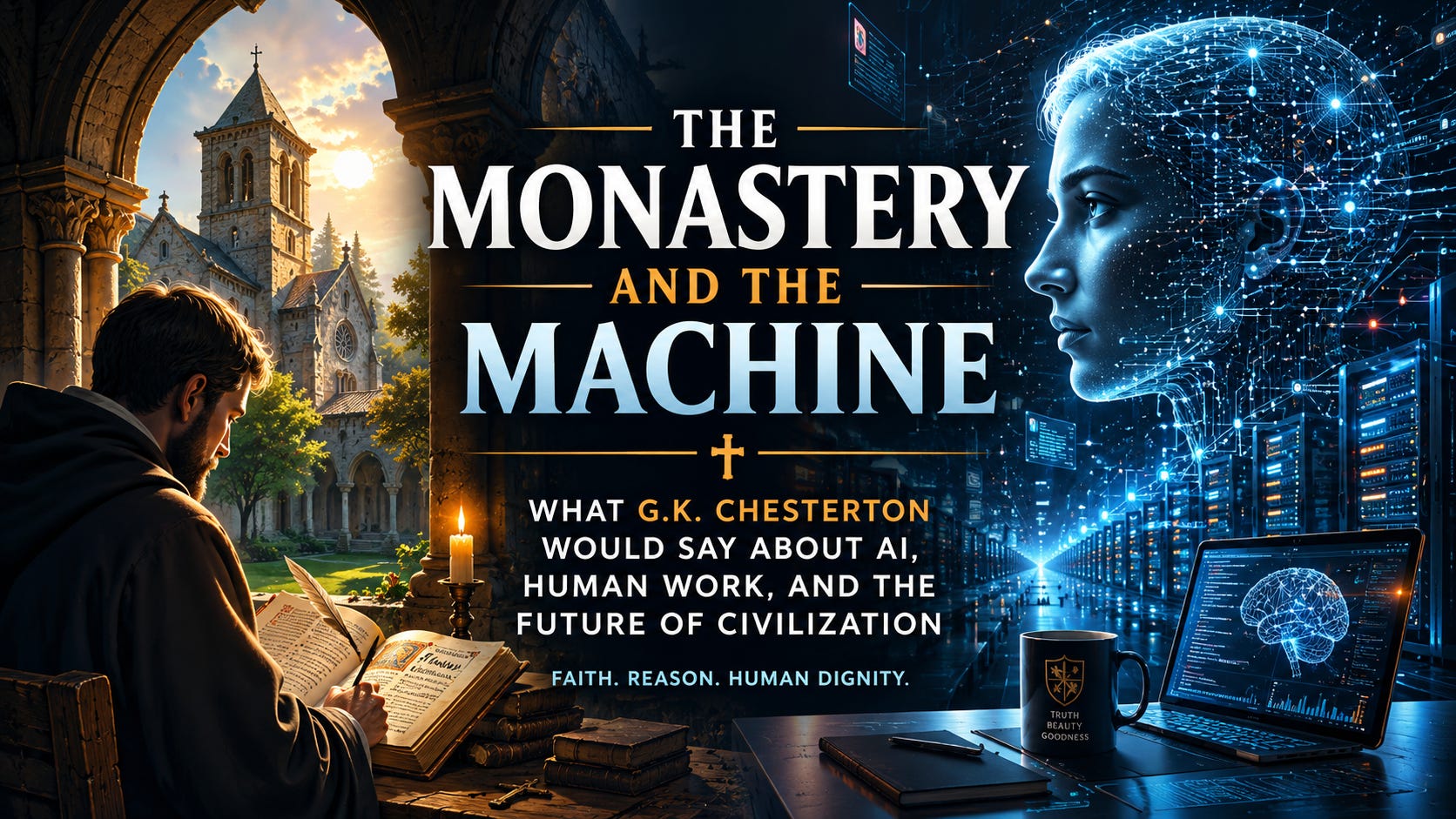
The monastery and the machine are not enemies.
The monk and the engineer are not rivals.
Both are attempting, in different ways, to understand reality and serve human flourishing. The monk asks questions about ultimate purpose. The engineer asks questions about practical implementation. Civilization needs both.
The engineer without the monk may build powerful systems without understanding why they should exist.
The monk without the engineer may understand the goal without possessing the tools necessary to achieve it.
The healthiest societies require both wisdom and competence.
They require vision and execution.
They require contemplation and action.
And perhaps that is the deepest lesson artificial intelligence presents to our age.
The future will not be determined primarily by what our machines become capable of doing.
The future will be determined by whether human beings retain the wisdom to remember what machines are for.
If we remember that lesson, artificial intelligence may become one of the greatest tools ever created.
If we forget it, no amount of computational power will save us from our own confusion.
For the central question has never really been whether machines can think.
The central question is whether human beings can continue to think clearly about themselves.
Conclusion: The Bell and the Server Rack
Imagine two sounds.
In one place, a monastery bell rings across a quiet valley.
Its purpose is ancient. It calls men to prayer. It marks the passing of time. It reminds those who hear it that their lives belong to something larger than themselves.
In another place, a server rack hums inside a climate-controlled data center.
Its purpose is modern. It stores information. It processes requests. It helps power the digital world upon which much of contemporary civilization depends.
Both are products of human ingenuity.
Both represent remarkable achievements.
Both, in their own way, are monuments to the creative power of the human mind.
Yet there is an important difference.
The server rack can tell us almost anything except why we exist.
The bell exists precisely to ask that question.
Perhaps that is why the monastery still has something to teach the machine age.
The monks who preserved civilization did not do so because they possessed the most powerful technology. They did so because they remembered what technology was for. They understood that knowledge serves wisdom, that power serves purpose, and that civilization ultimately rests not upon machinery but upon meaning.
Artificial intelligence will undoubtedly change the world. It may transform industries, accelerate discovery, and reshape daily life in ways we cannot yet imagine. The machines will become faster. The models will become larger. The capabilities will continue to expand.
But none of these developments can answer the questions that matter most.
What is justice?
What is beauty?
What is love?
What is truth?
What is man?
Those questions remain stubbornly, gloriously human.
Chesterton once suggested that the most extraordinary thing about the world is not that it works, but that it exists at all. He believed that wonder was the beginning of wisdom, and gratitude the beginning of sanity. In an age increasingly captivated by artificial intelligence, that insight may be more important than ever.
For the ultimate challenge before us is not whether machines will become more intelligent.
The challenge is whether human beings will remain wise.
If we remember that technology is a servant rather than a master, if we continue to place the human person at the center of our social and economic life, and if we preserve our capacity for wonder in a world of increasing automation, then the future need not be feared.
The machine may become more powerful.
But the soul remains more important.
And when future generations look back upon this moment, they may discover that the decisive question was never whether the machine could think.
The decisive question was whether mankind remembered what thinking was for.