

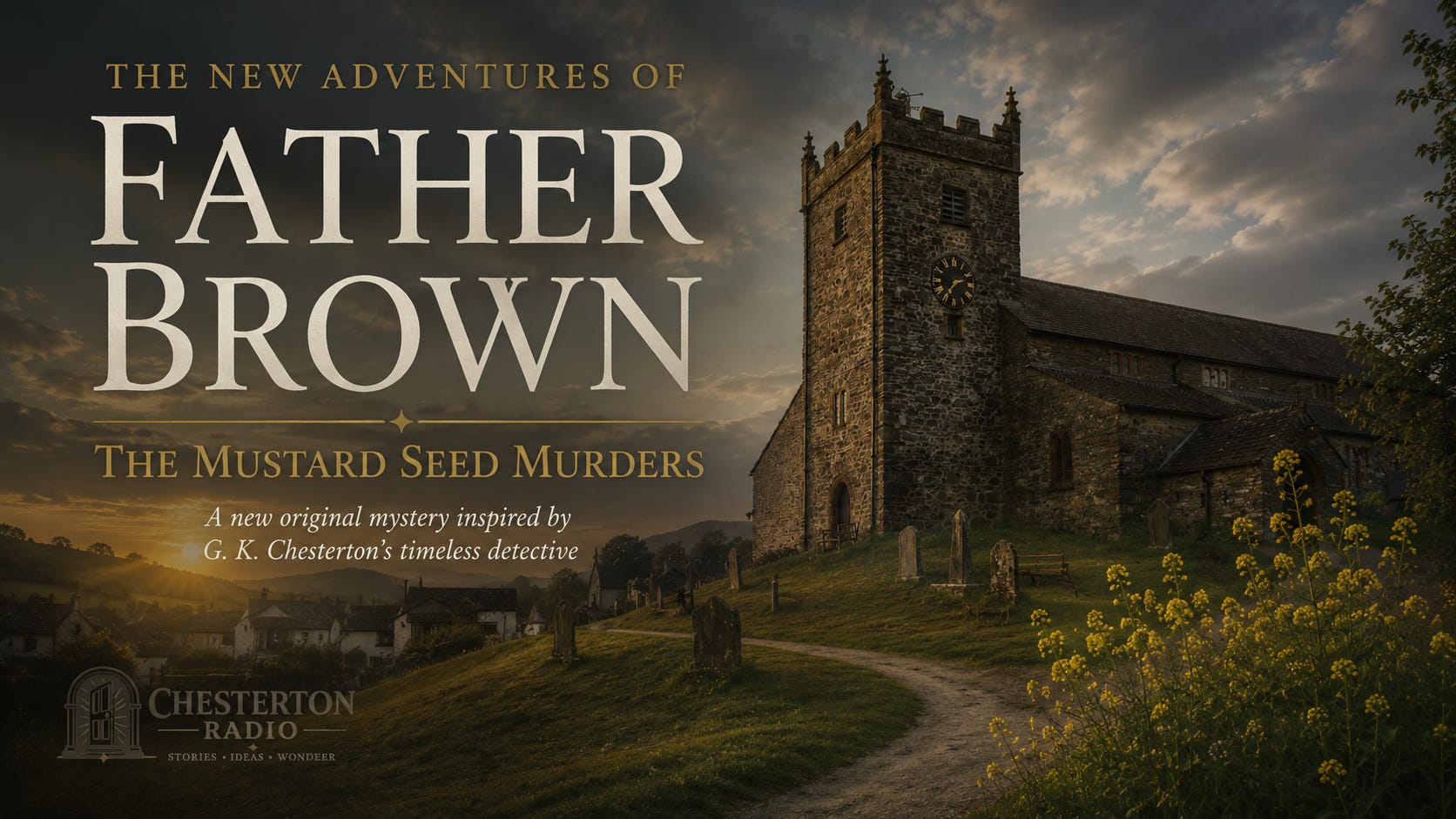
Intro
Welcome once again to The Little Station on Commercial Street, here on Chesterton Radio.
I’m glad you’ve stopped by.
There are villages in England where nothing remarkable seems ever to happen... until someone remembers that human souls are always remarkable. A quiet church. A modest memorial garden. A handful of mustard plants. The sort of place where everyone knows everyone else’s name—and believes they know everyone else’s heart.
That, of course, is usually when Father Brown arrives.
Tonight’s story is “The Mustard Seed Murders,” an original Father Brown mystery inspired by today’s Morning Prayer and Our Lord’s parable of the mustard seed. It is not a lost story by G. K. Chesterton, but a new adventure written in the spirit of the little priest whose greatest talent was never solving crimes—it was understanding sinners.
Like the best Father Brown stories, this mystery asks us to look not at the spectacular, but at the ordinary... because grace and evil both have a habit of beginning with very small things.
So settle into your favorite chair, pour another cup of tea, and listen carefully.
The smallest clue...
may be the one that changes everything.
From The Little Station on Commercial Street...
this is The New Adventures of Father Brown.
Part One — The Garden of Small Things
“The Kingdom of Heaven is like a grain of mustard seed...”
The twelve-fifteen train from London deposited Father Brown upon the platform of St. Bartholomew’s Halt with all the ceremony of a man laying down a parcel he had nearly forgotten to deliver. The station possessed only a single platform, a faded sign, and a porter whose chief occupation appeared to be polishing spectacles already immaculate.
Father Brown thanked him as though he had rendered some extraordinary service.
The porter seemed mildly embarrassed.
“I’ve done nothing, Father.”
“Most worthwhile things look that way,” said Father Brown pleasantly.
The porter considered this as the little priest disappeared into the lane beyond the station.
St. Bartholomew’s was one of those English villages that gave strangers the illusion that nothing had changed in centuries. That illusion was carefully maintained by generations who quietly moved cottages, widened roads, installed electricity, replaced roofs, and argued endlessly over flower boxes while insisting that everything remained exactly as it had always been.
Father Brown liked villages for precisely that reason.
They reminded him that permanence was usually constructed from thousands of tiny alterations.
Waiting outside the station stood the Reverend Arthur Miles, a vigorous Anglican vicar whose enthusiasm was only slightly restrained by his collar.
“Father Brown! We’ve been looking forward to your visit.”
“You’ve hidden it remarkably well,” Father Brown replied, smiling.
The vicar laughed.
“I suppose we have. Though I suspect you’ll discover our troubles soon enough.”
“I generally do,” said Father Brown. “Mostly because everyone kindly explains them.”
They walked together toward the church.
St. Bartholomew’s Church stood upon a slight rise overlooking the village green. It was not magnificent. A cathedral inspires awe because it reaches toward Heaven; a parish church often inspires affection because Heaven appears already to have reached it.
Beside the churchyard a gathering of villagers surrounded a freshly completed memorial garden.
It was, to many eyes, disappointingly modest.
A winding gravel path.
Three weathered oak benches.
A small stone cross.
Wildflowers.
Lavender.
Foxgloves.
And, in one corner, a neat patch of mustard plants no larger than a dining table.
Several gentlemen examined it with polite disappointment.
“I expected something grander,” one murmured.
“So did I,” agreed another.
Father Brown bent almost immediately toward the mustard patch.
The tiny yellow blossoms danced gently in the breeze.
“Beautiful,” he said quietly.
The first gentleman looked puzzled.
“It’s hardly impressive.”
“No,” said Father Brown.
“Neither was Bethlehem.”
The memorial had been commissioned by Mrs. Eleanor Whitcombe, widow of the village schoolmaster.
She approached them carrying gardening gloves still dusted with soil.
“I hope you approve, Father.”
“I don’t believe gardens require my approval.”
She smiled.
“They seem rather...small.”
“They’re supposed to be.”
She looked relieved.
“My husband used to say people remember great speeches for a week and small kindnesses for a lifetime.”
Father Brown looked around the garden.
“I suspect he was right.”
Not everyone shared her satisfaction.
Across the path stood Sir Reginald Ashcombe.
He was a man whose expensive clothes always appeared slightly too expensive, as though they had been chosen less for elegance than for evidence. His silver-headed walking stick seemed intended to remind observers that old families remained old even when their fortunes were newly polished.
He surveyed the garden with visible dissatisfaction.
“I cannot imagine why the committee approved this.”
Mrs. Whitcombe answered gently.
“My husband loved simple things.”
“So did Saint Francis,” Sir Reginald replied dryly. “That hardly obliges the rest of England.”
Nearby stood Harold Pierce, the village solicitor.
Unlike Sir Reginald, Pierce possessed no obvious arrogance.
His smile accomplished the same work more efficiently.
“The village was expecting something...more substantial.”
Mrs. Whitcombe lowered her eyes.
“I had only enough money for this.”
Sir Reginald sighed.
“Precisely.”
Father Brown looked from one face to another.
The exchange lasted only seconds.
Yet something about it lingered in his mind.
People often imagined cruelty announced itself loudly.
More often it merely arrived dressed as practicality.
The dedication ceremony itself lasted scarcely fifteen minutes.
The vicar spoke warmly of service.
Children sang.
An elderly woman placed flowers beneath the stone cross.
Father Brown offered a brief blessing.
When he finished, silence settled over the little garden.
Even the birds seemed reluctant to interrupt it.
Then everyone returned almost immediately to ordinary conversation.
Who needed roof repairs.
Who had won the cricket match.
Whether rain might spoil the fête.
Life resumed exactly where it had paused.
Father Brown thought that was one of God’s favorite miracles.
As the crowd dispersed, a small girl remained kneeling beside the mustard plants.
She could not have been more than nine.
Carefully she picked a fallen blossom and placed it back upon the soil.
Father Brown watched her.
“Has it fallen too soon?”
She nodded solemnly.
“It wasn’t finished growing.”
“No?”
“It might still help.”
Father Brown smiled.
“What is your name?”
“Emily.”
“And who taught you to think like that?”
She pointed toward the churchyard.
“My grandfather.”
Father Brown looked.
An old gardener was quietly trimming hedges.
No one appeared to notice him.
He noticed everyone.
Later that afternoon Father Brown wandered through the village alone.
He observed things that most visitors would never remember.
A carpenter silently repairing the gate of a widow who clearly could not pay him.
A baker placing an extra loaf into the basket of an elderly customer.
A postman stopping for several minutes simply to listen to a lonely veteran tell the same story for perhaps the hundredth time.
Tiny acts.
Invisible acts.
Acts that would never appear in newspapers.
Yet they seemed, somehow, to hold the village together.
Like roots beneath the earth.
That evening the church bells rang for Evensong.
The sunlight lay across the memorial garden in long golden bands.
Sir Reginald Ashcombe chose the gravel path as his shortcut home.
He paused beside the mustard patch.
His expression softened—though whether from memory or calculation, no one could have said.
A warm breeze stirred the yellow flowers.
Tiny seeds drifted almost invisibly across the path.
He brushed absentmindedly at his sleeve.
Then continued walking.
No one noticed.
Not even Father Brown.
For the first time that day...
he had looked away.
And somewhere beyond the churchyard wall, hidden by the gathering twilight, another pair of eyes had been watching Sir Reginald’s every step.
The first seed had already been planted.
The New Adventures of Father Brown
The Mustard Seed Murders
Part Two — The First Seed
The following morning arrived with the sort of quiet confidence peculiar to English summers.
Mist lingered above the meadows until the sun persuaded it to become merely another memory. Swallows skimmed low over the churchyard. Somewhere beyond the cottages a blacksmith’s hammer struck iron with the patient rhythm of a clock older than time itself.
Father Brown was already awake.
He had celebrated the early Mass in the little Lady Chapel before anyone else had entered the church. Afterwards he remained for several minutes in silent thanksgiving before wandering slowly through the churchyard with his battered breviary tucked beneath one arm.
He paused beside the memorial garden.
The dew clung to every blade of grass.
Tiny beads of water glittered on the mustard plants.
Father Brown bent down.
One of the seed pods had burst during the night.
Dozens of tiny black seeds lay scattered across the gravel path.
He smiled.
“So eager to become something larger,” he murmured.
Behind him came the scrape of a rake.
The old gardener looked up from his work.
“Morning, Father.”
“Good morning.”
“They’ll spread everywhere if I don’t keep after them.”
“The mustard?”
The gardener nodded.
“It starts with one little plant.”
Father Brown laughed softly.
“So does nearly everything.”
The old man regarded him curiously.
“You’ve seen that before?”
“I’ve spent my life seeing it.”
Breakfast at the Crown Inn was already lively.
Farmers discussed weather with the seriousness usually reserved for diplomacy.
The village doctor argued that England had become too dependent upon automobiles.
Someone insisted the cricket umpire had been bribed.
Someone else declared that was impossible because nobody possessed enough money to bribe him.
Father Brown listened happily while buttering toast.
Across the room Sir Reginald Ashcombe sat alone near the window reading correspondence.
Harold Pierce entered moments later carrying a leather dispatch case.
“You received my letter?”
Sir Reginald folded the newspaper.
“I did.”
Pierce lowered his voice.
“I think we should discuss the boundary survey before tonight.”
Sir Reginald frowned.
“There is nothing to discuss.”
“There may be.”
“I’ve paid you handsomely for thirty years to ensure there never is.”
Pierce smiled in that careful way solicitors often smile when they have already begun charging by the hour.
“As you wish.”
He departed without another word.
Father Brown never looked directly toward them.
Yet he remembered every sentence.
Later that afternoon the village prepared for its weekly market.
Children chased one another around the green.
Mrs. Whitcombe arranged flowers beside the memorial cross.
Emily carefully watered the mustard patch using a tin watering can nearly as large as herself.
Sir Reginald approached unexpectedly.
The little girl stepped politely aside.
“They’re growing nicely,” she said.
“I suppose they are.”
“My grandfather says they’ll become very big.”
Sir Reginald looked down at the tiny plants.
“I sincerely hope not.”
Emily frowned.
“Why?”
“They’ll only make everything untidy.”
She considered this for a moment.
“My grandfather says gardens aren’t supposed to stay tidy.”
Sir Reginald gave a faint smile.
“No. I imagine he would.”
He continued walking.
Emily watched him disappear around the church.
Father Brown had wandered into the village library, where the librarian proudly showed him parish records dating back more than two centuries.
“There are stories hidden in these books,” she said.
“There usually are.”
She opened one volume.
“The old property maps are especially fascinating.”
Father Brown examined them with polite interest.
Field boundaries.
Garden walls.
Footpaths.
Tiny strips of land.
Tiny changes made over generations.
He noticed several pages had been repaired.
Others appeared to have been removed entirely.
“Curious,” he said.
“The solicitor borrowed those years ago.”
“Mr. Pierce?”
She nodded.
“They came back...rather different.”
Before Father Brown could ask another question, the church bell began ringing violently.
Not for worship.
Not for celebration.
The alarm bell.
People came running from every direction.
The bell continued without rhythm.
Urgent.
Insistent.
Terrified.
Father Brown hurried toward the memorial garden.
A crowd had already formed.
No one spoke above a whisper.
Sir Reginald Ashcombe lay upon the gravel path beside the mustard plants.
His silver-headed cane rested several feet away.
His hat had rolled beneath one of the benches.
The village doctor knelt beside him.
After several long moments he slowly removed his spectacles.
“I’m afraid...”
No one needed him to finish.
Mrs. Whitcombe quietly crossed herself.
Emily buried her face against her grandfather’s coat.
The Inspector from Market Harborough, summoned by telephone, arrived less than an hour later.
He examined the body carefully.
“There are no wounds.”
“No.”
“No sign of struggle.”
“No.”
The doctor hesitated.
“There is something unusual.”
He pointed toward Sir Reginald’s right hand.
The fingers remained tightly clenched.
With great care the inspector opened them.
Resting against the dead man’s palm...
was a single tiny black mustard seed.
The inspector looked around at the garden.
His eyes narrowed.
“A message.”
Several villagers gasped.
Father Brown did not.
Instead he quietly looked down at Sir Reginald’s polished shoes.
The soles carried traces of damp earth.
Yellow pollen.
And dozens—
perhaps hundreds—
of mustard seeds.
He glanced toward the little patch beside the path.
Then upward into the branches of the old beech tree overhead.
The wind stirred gently through its leaves.
The tiny flowers nodded as though answering some question only they had heard.
The inspector straightened.
“We shall begin by asking,” he declared, “who wished Sir Reginald dead.”
Father Brown continued looking at the scattered seeds.
Almost to himself he whispered,
“No...
I think we ought first to ask...
who wished him to live.”
The inspector stared.
“What on earth do you mean?”
Father Brown looked sadly toward the body.
“Because hatred explains very little.”
He paused.
“But love—
love often explains everything.”
Far beyond the churchyard wall, hidden behind a row of ancient yews, someone quietly turned away before anyone noticed they had been watching.
The second seed had already begun to grow.
The New Adventures of Father Brown
The Mustard Seed Murders
Part Three — The Measure of a Man
The inspector introduced himself as Detective Inspector Edmund Gresham of the County Constabulary.
He was a capable officer with the habit of standing very straight whenever events became untidy, as though neat posture might encourage neat evidence.
He removed his gloves.
“No one leaves the village until we’ve spoken with them.”
The announcement was received with the peculiar silence that falls upon respectable people when they suddenly discover that respectability has become relevant.
Sir Reginald’s body remained where it had fallen while the police photographer completed his work.
Father Brown stood quietly beneath the great beech tree overlooking the memorial garden.
The inspector joined him.
“You’ve solved murders before, Father.”
“So I’ve been told.”
“What do you make of this?”
Father Brown looked toward the little patch of mustard plants.
“I think someone has mistaken size for importance.”
The inspector frowned.
“I beg your pardon?”
“We’re all staring at one tiny seed.”
“Because it was found in the victim’s hand.”
“Exactly.”
Father Brown smiled gently.
“And no one is looking at the whole garden.”
The village doctor approached carrying his black leather bag.
“There are no obvious injuries.”
“Heart attack?” asked the inspector.
“I thought so initially.”
“And now?”
The doctor hesitated.
“I found a faint odor.”
“What sort of odor?”
“Bitter almonds.”
Father Brown looked up.
The inspector frowned.
“Cyanide?”
“Possibly.”
“The laboratory will confirm it.”
The doctor nodded.
“But if it is cyanide, it was administered very recently.”
“No injection?”
“None.”
“No wound?”
“None.”
“No glass or cup nearby.”
The inspector looked again at the gravel path.
“So he was poisoned...”
“...while simply walking through a garden,” finished Father Brown.
The villagers gathered in uneasy clusters across the green.
Fear had already begun rearranging old friendships.
The baker whispered with the postmaster.
The blacksmith spoke quietly to the publican.
Conversations stopped whenever a constable passed.
Father Brown wandered among them without asking questions.
People spoke to him anyway.
The old carpenter shook his head.
“Sir Reginald wasn’t loved.”
“No.”
“But he wasn’t hated enough for this.”
Father Brown smiled faintly.
“Those two things are not always opposites.”
Mrs. Eleanor Whitcombe sat alone on one of the oak benches.
She had not cried.
Her grief seemed older than tears.
Father Brown sat beside her.
“You knew Sir Reginald well?”
“As well as anyone knew him.”
“He supported the school?”
“He donated money.”
She chose the words carefully.
“My husband always said generosity and kindness are cousins.”
“And not twins?”
She smiled sadly.
“No.”
After a long silence she added,
“He never understood little things.”
Father Brown glanced toward the memorial.
“What do you mean?”
“He would give one hundred pounds to repair the church roof.”
She paused.
“But he’d step over a child who’d dropped her books.”
Later that afternoon, Inspector Gresham began formal interviews in the parish hall.
Harold Pierce entered first.
The solicitor appeared perfectly composed.
“When did you last see Sir Reginald?”
“Yesterday evening.”
“What did you discuss?”
“Estate matters.”
“What estate matters?”
“Confidential ones.”
The inspector folded his notebook shut.
“Mr. Pierce...”
“This is privileged communication.”
“Your client has just been murdered.”
Pierce adjusted his spectacles.
“Even death has not yet repealed English law.”
The inspector’s patience visibly shortened.
Outside, Father Brown wandered into the church.
The building was empty.
Sunlight streamed through the stained-glass windows in narrow shafts of blue and crimson.
Near the front pew knelt little Emily.
She was praying.
Father Brown waited until she had finished.
“Were you praying for Sir Reginald?”
She nodded.
“And for whoever killed him.”
Father Brown looked at her with quiet admiration.
“Why both?”
She seemed surprised by the question.
“Because one of them is dead.”
She hesitated.
“And the other one still has to wake up tomorrow.”
Father Brown removed his hat.
Children occasionally said things so simple that adults spent entire libraries rediscovering them.
As evening approached, the inspector requested the parish records concerning Sir Reginald’s estate.
The village librarian arrived carrying several leather-bound ledgers.
“I’ve brought everything.”
She frowned.
“Almost everything.”
“What is missing?”
“The oldest land survey.”
“When was it last seen?”
She consulted a borrowing register.
“Thirty-one years ago.”
“Who borrowed it?”
She looked down.
“Mr. Harold Pierce.”
The inspector exchanged a quick glance with Sergeant Collins.
“Has it ever been returned?”
“No.”
Pierce, standing only a few feet away, spoke calmly.
“It was destroyed in a flood.”
The librarian blinked.
“We never had a flood.”
Pierce smiled politely.
“My office did.”
No one answered.
Father Brown was not watching Pierce.
He was watching the librarian.
She looked puzzled.
Not because she doubted the explanation.
Because she had only just remembered that no one had ever asked about that missing book before today.
Just before sunset, Father Brown returned alone to the memorial garden.
The police cordon had been removed.
The gravel path was empty once more.
He knelt beside the mustard patch.
Several seed pods had opened during the warmth of the afternoon.
Hundreds of tiny black seeds now dotted the path.
He picked one up between thumb and forefinger.
“So small,” he whispered.
Footsteps approached behind him.
It was the old gardener.
“I thought I’d find you here.”
Father Brown smiled.
“Everyone keeps talking about the seed.”
The gardener nodded.
“Aye.”
“But gardeners know better.”
“What do they know?”
The old man gently broke open another seed pod.
Dozens more seeds fell into his weathered palm.
“No garden...”
he said quietly,
“...ever grows from one seed.”
Father Brown looked thoughtfully at the handful of tiny black grains.
Then, very slowly, he smiled.
For the first time since Sir Reginald’s death...
he believed he understood the shape of the mystery.
Not the murderer.
Not yet.
But the question.
And Father Brown had long believed that asking the right question was usually more important than finding the first answer.
As the evening bell rang across the village, unnoticed by everyone else, a solitary figure slipped into the vestry of St. Bartholomew’s Church and quietly closed the door behind him.
The second murder had already begun.
The New Adventures of Father Brown
The Mustard Seed Murders
Part Four — The Second Harvest
The village slept uneasily.
No one admitted to fear.
English villages rarely did.
Instead, lamps burned a little later than usual. Curtains were drawn before dusk. Doors that had stood unlocked for generations were quietly bolted. Mothers called children indoors long before the evening bell.
The murder had changed nothing.
It had changed everything.
Father Brown was the first to enter the church the following morning.
The silence seemed unusually heavy.
Not empty.
Waiting.
He genuflected before the Blessed Sacrament and remained kneeling for several minutes. As dawn slowly filled the nave, pale shafts of light reached across the worn flagstones like fingers searching for something forgotten.
He rose and began his customary walk through the church.
Nothing appeared disturbed.
The sanctuary lamp burned steadily.
The hymn books were neatly arranged.
A faint smell of beeswax lingered from the previous evening.
Then he stopped.
Someone had moved one of the vestry chairs.
Only a few inches.
Just enough that it no longer aligned with the others.
Father Brown smiled sadly.
“There are two kinds of untidiness,” he murmured.
“One comes from carelessness.
The other from haste.”
At eight o’clock, Harold Pierce arrived.
He carried the same leather dispatch case as always.
The churchwarden greeted him.
“Morning, Mr. Pierce.”
“Good morning.”
“The vicar’s expecting you in the vestry.”
“So he said.”
Pierce disappeared through the small oak door.
No one thought anything of it.
Several villagers saw him enter.
No one saw him come out.
The choir gathered shortly afterward to rehearse for Sunday.
Mrs. Ellison, the organist, frowned.
“The solicitor is late.”
“The vicar will fetch him.”
The Reverend Miles walked to the vestry and knocked gently.
“Mr. Pierce?”
No answer.
He tried again.
Still nothing.
The door was locked.
From the inside.
Within minutes the inspector, still in the village because of Sir Reginald’s death, was summoned.
Constables cleared the church.
The heavy oak door resisted every attempt to force it quietly.
Finally the inspector nodded.
“Break it.”
The shoulder of the village blacksmith struck once.
Twice.
On the third blow the lock splintered.
The door swung inward.
Harold Pierce sat in the vicar’s chair.
His spectacles remained perfectly straight.
One hand rested upon the writing desk.
The other hung lifeless beside the chair.
His expression was strangely peaceful.
Too peaceful.
The doctor bent over him.
After only a few moments he looked up.
“The same.”
“Cyanide?”
“It appears so.”
The inspector stared around the tiny room.
One door.
One window.
The window was latched from the inside.
No hidden passages.
No signs of struggle.
No glass.
No bottle.
No weapon.
Nothing.
“It is impossible,” whispered Sergeant Collins.
Father Brown quietly answered,
“No.
Only incomplete.”
The inspector searched every inch of the vestry.
Cupboards.
Prayer books.
Cassocks.
Communion vessels.
Nothing.
Finally Sergeant Collins called from beside the body.
“Sir...”
The inspector crossed the room.
Resting beneath Harold Pierce’s open hand...
lay another tiny mustard seed.
Exactly like the first.
The room became very still.
Inspector Gresham slowly straightened.
“So.
The murderer wishes us to know these crimes are connected.”
Father Brown did not answer.
Instead he walked to the narrow vestry window.
Outside, the memorial garden was plainly visible.
The mustard patch shimmered gently in the morning breeze.
By afternoon the newspapers had arrived from London.
DOUBLE MURDER BAFFLES COUNTY POLICE
MYSTERY OF THE MUSTARD SEED KILLER
Reporters began telephoning.
Photographers appeared.
Villagers who had never traveled farther than York suddenly found themselves quoted in national newspapers.
The inspector grew steadily more impatient.
“The whole country will expect answers.”
Father Brown smiled.
“The whole country generally expects them rather sooner than they arrive.”
That evening, the inspector spread maps across a table in the parish hall.
“Two wealthy men.
Both poisoned.
Both found with mustard seeds.
One dies outdoors.
The second dies inside a locked room.”
He tapped the map.
“The obvious explanation is a single murderer.”
Father Brown remained silent.
“The second victim knew something.”
Still silence.
“He was eliminated before he could speak.”
Father Brown nodded politely.
“Entirely reasonable.”
The inspector looked relieved.
“Then you agree?”
“I agree that it is reasonable.”
“And?”
Father Brown folded his hands.
“I have found that reasonable explanations are rather like umbrellas.”
The inspector blinked.
“In what way?”
“They are wonderfully useful.”
He smiled.
“But they are not the sky.”
Late that night Father Brown walked once more through the memorial garden.
The moonlight silvered the gravel path.
The mustard plants swayed almost imperceptibly.
He knelt and touched the earth.
Something troubled him.
Not the poison.
Not the locked room.
Not even the second murder.
Something far smaller.
He looked toward Sir Reginald’s favorite path through the garden.
Then toward the vestry window.
Then back again.
At last he whispered to himself,
“No...
No one leaves a signature twice.”
He remained motionless.
“If the seed were a message...”
he continued,
“...it would only need to be written once.”
A slow smile crossed his face.
The mustard seed was not a signature.
It was not a symbol.
It was not even a clue.
It was an accident.
Or rather...
it had been made to look like one.
Somewhere in the darkness, an owl called across the churchyard.
Father Brown rose slowly.
For the first time, he believed the murderer had made a mistake.
Not in committing the crime.
But in assuming that everyone noticed the same things.
They did not.
Most people looked at what was unusual.
Father Brown had spent a lifetime looking at what everyone else ignored.
Tomorrow, he decided, he would stop asking who had poisoned two men.
He would begin asking a far stranger question.
Why had someone wanted the murders to appear connected at all?
The New Adventures of Father Brown
The Mustard Seed Murders
Part Five — The Missing Acres
The following morning dawned clear and unexpectedly warm.
Inspector Gresham disliked warm mornings after murders.
They encouraged villagers to leave their homes, gather in little groups, exchange theories, and unknowingly contaminate both evidence and common sense.
By nine o’clock, both had become equally difficult to preserve.
Father Brown, however, welcomed the sunshine.
He spent nearly an hour sitting on one of the benches in the memorial garden, apparently watching nothing at all.
Children crossed the green on their way to school.
The baker carried fresh loaves to the inn.
Emily stopped, as she always did, to water the mustard patch.
She looked up at Father Brown.
“Have they caught him?”
“Not yet.”
She nodded gravely.
“I’ve been praying.”
“For the murderer?”
“And for Inspector Gresham.”
Father Brown smiled.
“That is very charitable.”
“He looks tired.”
“He is.”
Emily poured the last of the water around the little plants.
“My grandfather says flowers don’t grow faster because you keep pulling on them.”
Father Brown laughed aloud.
“I believe your grandfather would make an excellent detective.”
The inspector had established a temporary office in the parish hall.
Maps covered one wall.
Photographs covered another.
The center table was buried beneath notebooks, parish records, and estate plans.
Father Brown wandered in carrying only his umbrella.
“I wonder if I might borrow the old property maps.”
Inspector Gresham looked surprised.
“I should have thought you’d be interested in poison.”
“I am.”
“But poison generally answers the question of how.”
He rested his hand on one of the maps.
“I’ve become interested in why.”
The inspector handed him several rolled surveys.
“They’re all yours.”
For nearly two hours Father Brown spread the maps across the long oak table.
Some dated back almost a century.
Others had been redrawn after the Great War.
Most appeared ordinary.
Until they were laid one upon another.
Father Brown borrowed tracing paper from the schoolmaster’s widow.
He quietly compared every boundary.
Every hedge.
Every lane.
Every footpath.
Occasionally he made a tiny pencil mark.
When he finally leaned back, he wore the expression of a man who had found exactly what he had hoped not to find.
Mrs. Whitcombe entered carrying tea.
“You’ve been studying those all morning.”
“Yes.”
“Find anything interesting?”
Father Brown looked thoughtfully at the oldest survey.
“It depends what one means by interesting.”
She smiled.
“My husband always said that was your way of saying yes.”
“He sounds like a perceptive man.”
She glanced at the maps.
“They’re only old property lines.”
“No.”
He shook his head.
“They’re old promises.”
Inspector Gresham returned just as Father Brown was carefully aligning two surveys.
“What have you found?”
Father Brown pointed to a narrow strip of land beside the churchyard.
“How wide would you say that is?”
The inspector shrugged.
“Perhaps six feet.”
“And on this older survey?”
He looked again.
“Twelve.”
Father Brown nodded.
“Precisely.”
The inspector frowned.
“It could simply be an inaccurate drawing.”
“It could.”
Father Brown pointed to another parcel.
“And this orchard?”
“It has moved.”
“No.”
“The wall has.”
Another comparison.
Another.
And another.
Tiny changes.
Never more than a few feet.
Never enough to attract attention.
Never enough for an expensive lawsuit.
Individually meaningless.
Collectively...
astonishing.
The inspector straightened.
“My God.”
Father Brown quietly nodded.
“The estate didn’t become large because someone stole a farm.”
He rested his finger upon dozens of little alterations.
“It became large because someone stole gardens.”
The inspector stared across the table.
“How much land are we talking about?”
“I haven’t finished counting.”
Father Brown smiled faintly.
“But I suspect...”
He looked again at the maps.
“...several hundred acres.”
The room fell silent.
“Over how many years?”
“Thirty.”
Inspector Gresham slowly removed his spectacles.
“No one noticed?”
Father Brown looked out the window toward the memorial garden.
“Oh, they noticed.”
“They simply believed each loss was too small to matter.”
The village librarian arrived with another box of parish records.
“I found these in the attic.”
She placed them carefully on the table.
“Receipts?”
“Boundary agreements.”
Father Brown opened the first volume.
Inside were signatures from dozens of villagers.
Some marked only with an X.
Others beautifully written.
Each acknowledged a “minor adjustment” to neighboring property.
Compensation:
Five pounds.
Ten pounds.
Twenty.
Enough money to discourage argument.
Never enough to replace what had been lost.
The inspector flipped through the pages.
“They all signed.”
Father Brown nodded.
“So they believed.”
The inspector looked puzzled.
“What do you mean?”
Father Brown turned one of the documents toward the light.
“The description.”
The inspector leaned closer.
The legal language occupied nearly an entire page.
The actual change appeared in one sentence.
A sentence buried in technical language almost impossible for an ordinary laborer to understand.
Father Brown sighed.
“It is surprisingly easy to hide dishonesty inside respectability.”
That afternoon the old gardener appeared carrying a wooden box.
“I thought these might interest you.”
Inside lay dozens of faded photographs.
Village fêtes.
School picnics.
Harvest festivals.
Church bazaars.
The gardener pointed toward one image taken almost thirty years earlier.
“There.”
Standing together...
Sir Reginald Ashcombe.
Harold Pierce.
The schoolmaster.
The vicar.
Half the village.
Father Brown studied the picture.
Then another.
Then another.
His eyes settled on a face standing almost unnoticed near the edge of every photograph.
Always present.
Never central.
Never smiling.
The village pharmacist.
Mr. Jonathan Mercer.
Quiet.
Respectable.
Almost invisible.
The old gardener noticed Father Brown’s expression.
“Jonathan?”
“You know him well?”
“As well as anyone.”
“What sort of man is he?”
The gardener answered without hesitation.
“The sort that remembers every child’s birthday.”
That evening Father Brown visited the pharmacy.
Shelves lined with polished bottles reflected the fading sunlight.
The room smelled faintly of lavender, peppermint, and old wood.
Jonathan Mercer looked up from his work.
“Father.”
“I hope I’m not interrupting.”
“Never.”
Mercer smiled warmly.
“What can I do for you?”
Father Brown looked around the little shop.
Everything possessed its proper place.
Every bottle aligned.
Every label perfectly written.
He noticed a framed photograph on the wall.
A woman.
Two young children.
All smiling.
Mercer followed his gaze.
“My wife.”
Father Brown nodded gently.
“They’re beautiful.”
“They were.”
The single word lingered in the air.
“Were?”
Mercer’s eyes drifted toward the window overlooking the church.
“My wife died fifteen years ago.”
“I’m sorry.”
“So am I.”
“And your children?”
“They left the village.”
A pause.
“They preferred not to remember.”
Father Brown did not ask why.
Instead he purchased a packet of cough lozenges he did not need.
As Mercer wrapped the small parcel with meticulous care, Father Brown noticed something else.
The pharmacist’s hands were perfectly steady.
Except when he mentioned the past.
Only then had the slightest tremor appeared.
As Father Brown stepped back into the evening light, he looked once toward the memorial garden.
The inspector had been asking who possessed the knowledge to administer poison.
That was an easy question.
The village pharmacist certainly did.
But Father Brown had never trusted easy questions.
The harder question was this:
Who had spent thirty years quietly watching small injustices accumulate—one tiny theft, one forgotten promise, one unnoticed sorrow at a time?
Behind him, the bell above the pharmacy door gave a gentle ring.
Jonathan Mercer stood watching through the window.
Not suspiciously.
Not fearfully.
But with the melancholy patience of a man who had been carrying a burden for a very long time.
Father Brown removed his hat in farewell.
Mercer returned the gesture.
Neither man spoke.
Yet each had begun to understand the other a little better.
And somewhere between understanding and judgment lay the truth.
The New Adventures of Father Brown
The Mustard Seed Murders
Part Six — The Harvest
The funeral of Sir Reginald Ashcombe filled St. Bartholomew’s Church.
Not because everyone mourned him.
Because everyone wished to understand him.
Death often granted a curiosity that life had failed to earn.
Father Brown stood quietly near the rear of the church while Inspector Gresham watched the congregation.
“There he is,” the inspector whispered.
Jonathan Mercer, the village pharmacist, sat alone in the last pew.
His head was bowed.
He did not once look toward the coffin.
After the service Father Brown asked the inspector for one final favor.
“I should like everyone to gather in the memorial garden.”
“The entire village?”
“As many as will come.”
“And why?”
Father Brown smiled.
“Because the garden has been telling us the truth from the beginning.”
Within the hour nearly every villager stood around the little mustard patch.
The old gardener.
Mrs. Whitcombe.
Emily.
The vicar.
The doctor.
The librarian.
The carpenter.
Jonathan Mercer.
Inspector Gresham folded his arms.
“Well, Father?”
Father Brown looked around the circle.
“You have all been trying to discover who planted the mustard seed.”
He shook his head.
“No one did.”
Several villagers exchanged puzzled glances.
“The seeds found beside both bodies came from this garden.”
He gently touched one of the drying seed pods.
“Every afternoon the pods burst.”
He squeezed it lightly.
Dozens of tiny black seeds scattered across the gravel.
“They cling to shoes.”
He looked toward the path where Sir Reginald had fallen.
“They cling to trouser cuffs.”
He smiled.
“And they have a particular affection for polished leather.”
Emily laughed.
The inspector did not.
“So the seed meant nothing?”
“Oh, it meant something.”
Father Brown looked toward the sky.
“But not what the murderer intended.”
Inspector Gresham frowned.
“Then why was the second seed beneath Mr. Pierce’s hand?”
“Because someone placed it there.”
The villagers gasped.
“But that is precisely my point.”
He turned toward the inspector.
“If the first seed was natural...”
“...the second had to imitate it.”
“And if someone imitated it...”
“They knew the first one had been accidental.”
The inspector stared.
“Good Lord.”
“The murderer did not leave a signature.”
“He corrected one.”
Father Brown walked slowly toward the vestry.
“The second mystery is simpler.”
He opened the narrow window.
It swung outward only a few inches.
“The window was locked.”
“Yes.”
“After the murderer left.”
Inspector Gresham frowned.
“Impossible.”
Father Brown pointed upward.
A long cord for opening the high ventilator hung beside the wall.
“It is also attached to the window latch.”
The churchwarden nodded.
“It has been for years.”
“No one noticed because no one ever uses it except the verger.”
Father Brown smiled.
“Our murderer did.”
He demonstrated.
Standing outside, one could pull the cord through the narrow opening, release the latch, leave the room, and then draw the window closed again. Gravity allowed the latch to settle back into place.
A simple village mechanism.
Hidden in plain sight.
The inspector slowly shook his head.
“We searched for secret panels.”
“And missed an ordinary piece of church furniture.”
The inspector turned immediately toward Jonathan Mercer.
“You have knowledge of poisons.”
“I do.”
“You knew the church.”
“I did.”
“You had opportunity.”
“Yes.”
Mercer spoke so calmly that the inspector hesitated.
Finally he asked,
“Did you murder Sir Reginald Ashcombe?”
A long silence followed.
Then Mercer answered.
“Yes.”
Several villagers cried out.
Mrs. Whitcombe covered her mouth.
Emily looked at Father Brown in confusion.
The little priest gently rested a hand upon her shoulder.
Mercer removed his spectacles.
For the first time, everyone noticed how tired he looked.
“Thirty-one years ago,” he began quietly, “my father owned six acres beside the river.”
The old gardener closed his eyes.
“I remember.”
“It wasn’t much.”
Mercer’s voice remained almost conversational.
“But it was ours.”
He looked toward the property maps lying on the bench.
“Mr. Pierce assured my father he was signing a boundary clarification.”
He smiled sadly.
“He signed away nearly half the land.”
“My father couldn’t read legal language.”
The villagers stood perfectly still.
“He died believing he’d made the mistake.”
Mercer’s voice faltered.
“My mother believed it too.”
He looked at his hands.
“I knew better.”
He continued.
“Then I watched it happen again.”
“And again.”
“The widow lost her orchard.”
“The blacksmith lost his lane.”
“The carpenter lost his workshop.”
“The school lost its playing field.”
“Always a few feet.”
“Always perfectly legal.”
“Always too small for anyone to fight.”
He looked toward the mustard plants.
“I kept telling myself that one day someone would stop them.”
“No one did.”
Father Brown spoke softly.
“So you decided to stop them.”
Mercer nodded.
“When Sir Reginald walked through the garden...”
“I placed cyanide upon the end of his walking stick.”
The doctor looked surprised.
“The silver knob?”
Mercer nodded.
“He had a habit.”
He looked sadly toward the cane now resting in police custody.
“He always moistened his fingers before adjusting his gloves.”
The doctor whispered,
“That would have been enough.”
“A tiny amount.”
“Bitter almonds.”
“No visible wound.”
Father Brown nodded.
“So ordinary a habit that no one thought to ask how often he touched his own hands.”
Mercer closed his eyes.
“I knew his routines.”
Inspector Gresham asked quietly,
“And Harold Pierce?”
Mercer looked toward the church.
“He came to me.”
“He knew.”
“He said the maps had been discovered.”
“He wanted money.”
“Otherwise he would tell the police everything.”
The pharmacist sighed.
“So I invited him to the vestry.”
“You poisoned him there?”
Mercer nodded.
“In communion wine.”
The vicar looked horrified.
“No.”
Mercer answered immediately.
“I would never have profaned the Sacrament.”
He pointed toward the vestry.
“There is always an ordinary water jug for meetings.”
Father Brown nodded.
“I wondered.”
Inspector Gresham stepped forward.
“You realize you’ll hang.”
Mercer looked at him peacefully.
“I realized that before the second murder.”
“Then why commit it?”
The pharmacist’s answer came almost as a whisper.
“Because after the first...”
“I discovered I had already become the sort of man who could.”
No one spoke.
It was perhaps the saddest sentence Father Brown had heard in many years.
The constables quietly approached.
Mercer held out his wrists before anyone asked.
As they led him away, he stopped beside Emily.
“I’m sorry.”
The little girl looked up at him.
“I’ll pray for you.”
Mercer’s eyes filled with tears.
“I believe...”
he said softly,
“...that is the first kind thing anyone has done for me today.”
That evening Father Brown remained alone in the memorial garden.
The setting sun turned the mustard flowers to gold.
Inspector Gresham joined him.
“I still don’t understand one thing.”
“What is that?”
“You seemed almost sympathetic.”
Father Brown looked thoughtfully at the tiny plants.
“I was.”
“To a murderer?”
“To a sinner.”
He smiled sadly.
“The two are not always the same thing.”
The inspector was silent.
Father Brown bent down and picked up a single mustard seed from the path.
“So small.”
He rolled it gently between his fingers.
“People imagine great evil begins with great wickedness.”
“It seldom does.”
“It begins when we decide that one small injustice doesn’t matter.”
He looked toward the church.
“And holiness begins in exactly the same way.”
“One unnoticed kindness.”
“One quiet act of mercy.”
“One prayer offered for a stranger.”
He glanced toward the lane where Jonathan Mercer had disappeared with the constables.
“The devil understands mustard seeds.”
A gentle breeze carried more tiny seeds across the gravel.
Emily, carrying her little watering can, carefully knelt beside the plants.
Without saying a word, she watered them.
Father Brown watched her for a long moment.
Then he smiled.
“The Kingdom of God,” he said softly,
“is still growing.”
The church bell began to ring for Evening Prayer.
Its sound drifted across the village, over cottages and gardens, over fields reclaimed and fields lost, over graves and growing things alike.
Father Brown placed the tiny seed back upon the earth.
For he knew, as Chesterton himself might have written, that God does not build His Kingdom by spectacular miracles alone, but by the faithful tending of small things until they become great enough to shelter the world.
Outro
[Gentle piano returns beneath. Evening church bells.]
You’ve been listening to The New Adventures of Father Brown from The Little Station on Commercial Street here on Chesterton Radio.
If tonight’s mystery reminded you that the greatest battles are often fought in the smallest corners of the human heart, then Father Brown has done what he has always done best. He solved crimes not merely by following clues, but by understanding temptation, mercy, and the strange mixture of both that lives inside every one of us.
If you enjoyed this original adventure, you’ll find many more treasures waiting at Chesterton Radio—classic radio dramas, forgotten mysteries, literary deep dives, Morning Prayer, essays, poems, and conversations that celebrate stories, ideas, and wonder.
If you’d like to help keep The Little Station on Commercial Street on the air, the best way is to become a supporting subscriber on Substack. Your support helps preserve remarkable stories from the past while creating entirely new ones inspired by the timeless wisdom of G. K. Chesterton and the great storytellers who came before us.
You’ll also become part of Chesterton Radio World, where listeners gather around the shared conviction that good stories don’t merely entertain us—they teach us how to see.
Until next time...
keep your eyes open for the ordinary.
As Father Brown might remind us, the smallest kindness may be the beginning of a miracle... and the smallest compromise may be the beginning of a tragedy.
Good night.
God bless you.
And remember...
the Open Door is always on.
Only caught one mispronunciation... "No visible *wounds*" lol. But otherwise a pretty good reading, the technology has come a long way!
This isn't too bad, actually...