

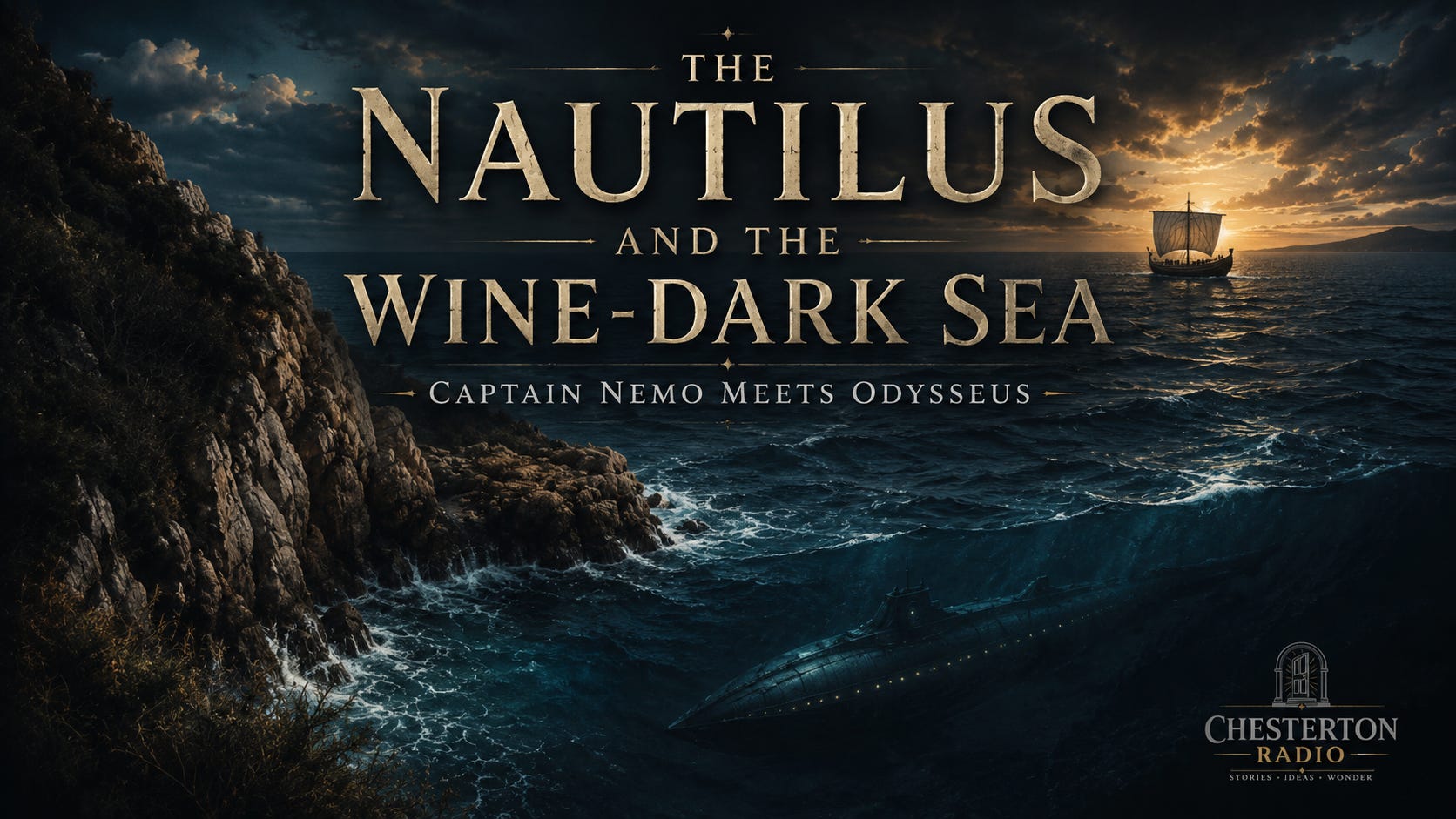
INTRODUCTION
There are stories that belong to history, stories that belong to legend, and a few that seem to drift somewhere between the two.
The Nautilus and the Wine-Dark Sea begins in that uncertain water.
Captain Nemo knows the sea as few men ever have. He has measured its depths, crossed its hidden valleys, studied its creatures, and built a vessel capable of going where no ordinary ship can follow.
Odysseus knows the sea differently.
He knows what it means to be tested by it.
To lose men upon it.
To fear it.
To outwit it.
And above all, to cross it for one reason: to get home.
When the Nautilus discovers a current that should not exist, Captain Nemo follows it beneath the Mediterranean and into waters beyond every chart he possesses.
There he finds an ancient wreck.
Fresh footprints on the seabed.
A broken oar bearing the name of an island known to every reader of Homer.
Ithaca.
What follows is not simply a meeting between Jules Verne and Homer.
It is a meeting between two captains.
One is a wanderer desperately trying to return home.
The other is a wanderer who has spent years convincing himself he no longer has one.
This is a Chesterton Radio original adventure.
The Nautilus and the Wine-Dark Sea.
CHAPTER ONE
The Impossible Current
There are seas one crosses and seas one remembers.
The Mediterranean belongs to the second kind. No other sea is so crowded with memory. Empires have risen around it and vanished into its shores. Merchants, soldiers, pilgrims, pirates, philosophers, saints, and conquerors have all watched the same line of blue water darken beneath the evening sky. Its islands seem less like accidents of geology than fragments of history left floating upon the surface. Even a man determined to think only as a naturalist cannot cross it without feeling that he travels through something more than geography.
Captain Nemo, however, did not regard the Mediterranean sentimentally.
To him it was a system of depths, temperatures, currents, coastlines, mineral deposits, living species, and mechanical possibilities. He knew its submarine contours with an intimacy few sailors could have claimed of its surface. He had crossed beneath waters where fleets had fought, cities had disappeared, and wrecks had rested undisturbed for centuries. If the poets had their Mediterranean, Captain Nemo had another: measurable, charted, physical, and obedient to law.
That distinction became important on the third night after we passed through the Strait of Gibraltar.
The Nautilus had been proceeding eastward at a moderate speed. We had spent much of the day submerged, rising only briefly in the late afternoon to permit astronomical observation and the renewal of air. The weather above had been calm, with a mild wind from the northwest and a sea so smooth that Ned Land remarked it looked almost unnatural. By sunset we were submerged again.
At approximately eight o’clock I entered the great salon and found Captain Nemo standing over the chart table.
The electric lamps had been lowered. Beyond the observation windows the Mediterranean was entirely black, except where an occasional pale organism passed through the darkness like a wandering spark. Conseil occupied himself near one of the specimen cases, rearranging several mollusks collected earlier that day. Ned Land had established himself upon the divan with the resigned expression of a man enduring captivity by refusing to be impressed by anything within it.
Nemo did not at first acknowledge my arrival.
He stood with one hand resting upon the table and the other holding a small sheet of figures. His gaze moved repeatedly between the paper and the chart beneath it.
I had learned that silence around Captain Nemo did not always signify displeasure. More often it meant that something had engaged him completely.
I approached.
“Captain?”
He raised his head.
“Professor Aronnax.”
“Have we altered course?”
“No.”
There was something in the brevity of the reply that prompted another question.
“Then our position is not what you expected.”
Nemo looked at me with the faintest suggestion of approval.
“Precisely.”
Ned Land lifted his head from the divan.
“That sounds promising.”
Conseil glanced toward him.
“For whom, Monsieur Land?”
“For anyone who would like the captain to admit the sea has surprised him.”
Nemo ignored the remark.
He motioned me closer to the chart.
“Our last surface observation placed us here.”
He indicated a point south of Sardinia.
“Our engines have maintained their assigned speed. The course has varied by less than half a degree. Yet repeated calculations place us farther north and east than we should be.”
“Instrument error?”
“Checked.”
“Magnetic deviation?”
“Insufficient.”
“Then a current.”
“That is the only explanation that remains.”
Ned sat upright.
“Good. We have solved it.”
Nemo looked toward him.
“No, Mr. Land. We have named it.”
That silenced even the Canadian for a moment.
I examined the figures more closely.
The Mediterranean is by no means motionless beneath its surface. Water enters through Gibraltar, evaporation alters salinity, temperature differences produce layers, winds influence circulation, and every strait, coast, and submarine contour contributes its own local effects. But Nemo had spent years studying such phenomena. If a current strong enough to displace the Nautilus materially had existed in these waters, it was difficult to believe he would have been unaware of it.
“At what depth?” I asked.
“Three hundred and twelve meters.”
I looked again at the chart.
“An eastward flow?”
“Yes.”
“That is unusual.”
“It is worse than unusual.”
Nemo handed me the paper.
“Observe the last three measurements.”
The numbers showed an increase.
The current was strengthening.
I confess the figures interested me immediately. Perhaps that admission reveals something of the naturalist’s defect. Where a prudent man sees danger, the scientist often sees a phenomenon. The possibility of encountering an unknown submarine current in the Mediterranean seemed to me astonishing, though perhaps not impossible. I began at once considering explanations.
“A deep density flow?”
“Then the temperature and salinity should differ more markedly from the surrounding water.”
“A geothermal influence?”
“Possible in principle.”
“Submarine volcanic activity?”
“Perhaps.”
Nemo’s tone indicated that he found none of these satisfactory.
He summoned his first officer, who entered carrying another slate. The two exchanged several sentences in the private language of the Nautilus. I understood none of the words, but Nemo’s expression changed.
Not greatly.
With him, it seldom did.
Yet I had spent enough time aboard his vessel to recognize the difference between surprise and interest. Surprise passed quickly. Interest deepened.
He turned toward the control station.
“Reduce speed.”
The vibration beneath our feet softened.
Then ceased entirely.
The Nautilus drifted.
There are few sensations stranger than complete silence inside a submarine. When the machinery stopped, I became conscious of the enormous mass of water surrounding us. The hull no longer seemed a vehicle moving through the sea but a chamber suspended within it. The faint creaking of metal became audible. Somewhere aft a pump continued briefly and stopped.
Nemo watched the instruments.
No one spoke.
Five minutes passed.
Then ten.
The vessel moved.
It was unmistakable.
Even without the instruments one could feel a slight alteration in the angle of the hull. Nemo ordered another positional check.
We had drifted east.
He ordered the exterior lamps activated.
At once the darkness beyond the great window divided before us. Electric light swept outward into the water and illuminated countless suspended particles, each too small to distinguish individually until it crossed the beam.
They all moved in the same direction.
East.
At first the effect was subtle. Then, once perceived, it became impossible not to see. Fine debris, planktonic matter, and occasional pale organisms streamed steadily past the observation windows as though the Nautilus rested inside some invisible river.
Conseil came nearer.
“It is quite distinct.”
Ned stood beside him.
“Everything is distinct when it is carrying you somewhere you did not choose to go.”
Captain Nemo ordered the engines forward at one quarter speed and turned the Nautilus across the flow.
The response was immediate. The vessel moved laterally, but with noticeable resistance. At half speed we made better progress. At three quarters, we crossed the strongest part of the stream.
Nemo had expected the current to possess some limited width.
It did not.
We continued crossing it.
Five hundred meters.
A kilometer.
Then two.
The particles still moved eastward.
The temperature varied little. Salinity changed only slightly. There was no obvious gradient to suggest a boundary between water masses. Nor did the seabed below reveal any channel sufficient to account for the phenomenon. It was as though a river had been laid through the Mediterranean without banks.
For the next hour the Nautilus became what Captain Nemo loved most: a laboratory.
He ordered measurements at multiple depths. Water samples were taken. The current’s speed was calculated repeatedly. The vessel crossed and recrossed the stream. Nemo compared readings, rejected hypotheses, revised them, and demanded new observations.
I watched him with admiration.
It would have been easy to mistake his intensity for stubbornness. But Nemo did not cling to explanations merely because they were his. He discarded them ruthlessly whenever the evidence failed to support them. His pride lay not in always being correct but in refusing to be satisfied by an answer that was merely convenient.
At approximately eleven o’clock he made his decision.
“We will follow it.”
Ned Land turned slowly.
“I was afraid you were going to say that.”
Nemo continued studying the chart.
“Why afraid?”
“Because whenever you find something nobody understands, you sail directly toward it.”
“And what would you propose?”
“Distance.”
“Distance does not produce knowledge.”
“Sometimes it produces survival.”
Conseil, with characteristic fairness, said, “Monsieur Land is not entirely wrong.”
Ned looked at him in surprise.
“Thank you.”
“But Captain Nemo is not entirely wrong either.”
“Take it back.”
Nemo’s mouth moved slightly. It was the nearest he came to smiling.
Then he ordered the Nautilus east.
We entered the current and allowed it to assist our progress.
At first there was little to distinguish the voyage from any other submerged passage. The Mediterranean floor lay beneath us in pale undulations of sand and rock. Fish flashed briefly through the electric beams and vanished. Dense patches of marine vegetation appeared around isolated elevations. Once we passed above what seemed to be the remains of a relatively modern wreck, its hull collapsed and half buried beneath sediment.
But after midnight the seabed began to descend.
The transition was gradual enough that I did not at first appreciate its scale. At three hundred meters the bottom remained clearly visible. By five hundred, the ground had become a succession of descending ridges. At seven hundred, the electric lamps showed only the nearest slopes. Beyond them lay darkness.
The Nautilus continued downward.
Nemo had stopped consulting the chart.
That fact impressed me more than anything else.
He watched the instruments instead.
“Eight hundred meters,” I said.
No answer.
“Nine hundred.”
The floor sloped away beneath us.
At a thousand meters, it vanished altogether.
Our lamps reached downward and found nothing.
Ned stood with his arms crossed.
“Deep enough?”
Nemo looked at him.
“No.”
We descended.
At twelve hundred meters, the water temperature fell sharply.
At fourteen hundred, it rose again.
That anomaly interested both of us.
“Geothermal influence,” I suggested.
“Perhaps.”
“A volcanic region?”
“Perhaps.”
His repeated use of that word became increasingly irritating to me.
“Captain, you seem determined not to believe any explanation.”
“On the contrary, Professor. I intend to believe the correct one.”
At approximately sixteen hundred meters, the seabed reappeared.
A dark ridge lay ahead.
It rose steeply and seemed at first to form an unbroken wall.
The current flowed directly toward it.
Ned came nearer the window.
“There. Finished.”
“Finished?” I asked.
“Water cannot pass through a mountain.”
Nemo stared at the ridge.
“No.”
The Nautilus continued.
The wall of stone filled more and more of the view. I began to share Ned’s confidence that our mysterious current must divide or rise somewhere before reaching it.
It did neither.
The particles in the beam continued streaming directly ahead.
Nemo reduced speed.
The ridge was now less than a hundred meters away.
“Captain—”
He raised one hand.
At seventy meters the rock appeared solid.
At fifty, I could distinguish vertical fractures.
At thirty, Conseil pointed.
“There.”
A black line divided the stone.
The line widened as we approached.
It was not a crack.
It was an opening.
The current entered it.
Nemo ordered the Nautilus stopped.
The vessel continued forward.
Reverse power checked the motion.
We held position perhaps twenty meters from the entrance.
The opening was narrow compared with the dimensions of the ridge, yet large enough to admit the Nautilus. Its upper boundary vanished into darkness. Its walls descended beyond the reach of our lights.
“A submarine canyon?” I asked.
Nemo shook his head.
“A passage.”
Ned exhaled.
“No.”
Nemo looked at him.
“No what?”
“We are not going in there.”
“My dear Mr. Land, you continue to confuse preference with command.”
“I am trying to help you live long enough to appreciate the distinction.”
Nemo returned his attention to the opening.
The current pulled steadily toward it.
I moved beside him.
“We know nothing of its dimensions.”
“Correct.”
“It may narrow.”
“Yes.”
“It may terminate.”
“Yes.”
“It may be volcanic.”
“Yes.”
“It may contain unstable rock.”
“Certainly.”
I waited.
Nemo did not turn.
“Captain, do any of those possibilities discourage you?”
At last he looked at me.
“Professor, if every unknown passage were avoided because it might contain danger, there would be very little geography.”
Ned muttered something in English.
Nemo gave the order.
The engines moved ahead.
Slowly, the Nautilus entered the opening.
The effect was immediate. Rock walls closed around us on both sides. The electric beams illuminated surfaces of unusually dark stone polished smooth by moving water. I expected to see irregular shelves, debris, and jagged projections. Instead the passage possessed an almost disturbing uniformity. It was not straight, but its broad curves appeared worn rather than fractured.
The current strengthened.
The engines compensated.
For several minutes we moved without incident.
Then Conseil spoke.
“The water has changed.”
Ned glanced at him.
“It is still wet.”
Conseil ignored him.
“The color.”
I approached the observation window.
At first I thought the difference merely an effect of the dark rock. But as I watched the particles streaming through the beam, I saw that Conseil was right.
The water possessed a hue I had never observed at that depth.
It was not blue.
Not green.
Not black.
There was a faint purplish cast to it, almost crimson at certain angles under the electric lamps.
“Mineral suspension,” I said.
“Perhaps,” Nemo replied.
Again that word.
Ned pressed closer to the glass.
“It looks like wine.”
The phrase struck me with absurd force.
Wine-dark.
I had encountered the expression in translations of Homer and in endless scholarly discussion concerning what exactly the poet had meant by it. The phrase had always seemed to belong to poetry rather than optics.
Yet there it was.
I nearly laughed.
The coincidence was too literary for a naturalist to respect.
Nemo ordered a water sample taken.
When the cylinder was brought into the salon and examined beneath ordinary illumination, the liquid appeared almost clear. But when Nemo held it before the electric lamp, a faint violet coloration became visible.
No obvious sediment settled.
No organism could be distinguished.
The sample possessed no unusual odor.
“We should analyze it chemically,” I said.
“We will.”
Ned regarded the cylinder.
“So the sea is purple.”
“Only under certain light,” I replied.
“That makes it much better.”
The current increased suddenly.
The deck shifted beneath us.
An officer called from the navigation station.
Nemo moved at once.
The Nautilus was accelerating without engine power.
He ordered reverse.
The engines engaged.
Our forward motion slowed.
Then resumed.
Nemo increased power.
The vibration became stronger.
Still we moved.
The great vessel which had crossed oceans, descended into impossible depths, and resisted forces that would have crushed ordinary ships was being carried forward like driftwood.
Nemo’s face hardened.
“More power.”
The engines thundered.
For several seconds we held position.
Then a deep metallic sound traveled through the hull.
Not an impact.
A groan.
The lamps flickered.
The current surged.
The Nautilus moved forward.
No one spoke.
Captain Nemo stared at the gauges.
It was the first time I had ever seen the sea take his vessel somewhere he had not chosen to go.
The passage widened abruptly.
The walls vanished from the reach of our lamps.
Ahead lay open darkness.
For a moment I believed we had entered some enormous cavern.
Then the forward beam struck an object on the seabed.
Nemo raised his hand.
“Reduce.”
The Nautilus slowed as much as the current permitted.
We passed over a dark shape.
At first I mistook it for rock.
Then I saw a timber.
Another.
A curved hull.
A mast lay broken beside it.
The object was a ship.
Not a modern ship.
A wooden vessel of extraordinary antiquity.
Nemo ordered the lamps downward.
The wreck emerged from darkness.
Amphorae lay scattered across the sediment.
Bronze fittings reflected the light.
A circular shield rested partly buried beside the hull.
The vessel’s construction was unlike anything from the modern Mediterranean. Its proportions, fastenings, and surviving ornamentation suggested a period so remote that I hesitated to say the word aloud.
“Greek.”
Nemo remained silent.
I moved closer to the window.
“Very early Greek.”
Conseil joined us.
“How early, Monsieur?”
“I cannot say.”
Ned looked from me to the wreck.
“Old enough to be interesting?”
“Old enough that it should not look like that.”
The problem became obvious the longer I stared.
Ancient timber submerged in seawater does not simply remain waiting in recognizable form for thousands of years. Marine organisms attack it. Chemical processes alter it. Sediment buries it. Pressure, currents, and geological changes complete the destruction.
Yet sections of this wreck appeared remarkably intact.
Not untouched.
But preserved to an extent that seemed impossible.
Nemo saw the same thing.
He ordered the Nautilus lower.
We descended until only twenty meters separated us from the seabed.
The hull of the wreck came into clearer view.
I could distinguish rope.
Rope.
That detail disturbed me more than the bronze.
The fibers looked darkened but not disintegrated.
Nemo ordered the light widened.
The beam swept across the seabed.
Conseil spoke.
“Monsieur.”
His voice had changed.
I turned.
He pointed beyond the wreck.
At first I saw only sediment.
Then the beam moved slightly.
There were marks in it.
Regular depressions.
Paired.
I leaned nearer.
Footprints.
Human footprints.
They began beside the wreck.
They crossed the seabed in a wavering line and continued eastward.
The edges were sharp.
Nothing had yet softened them.
No drifting sediment had filled them.
Whatever had made those impressions had walked there recently.
Very recently.
Ned Land said nothing.
For once, even he had no comment.
Captain Nemo stood absolutely still.
The current continued flowing past the wreck.
The footprints continued into the darkness beyond our lamps.
I felt then a sensation I had not experienced anywhere else aboard the Nautilus. We had visited unknown depths. We had encountered enormous creatures. We had crossed places where no other human eye had looked.
But this was different.
This was not simply something undiscovered.
It was something that should not exist.
Nemo turned from the window.
His face was composed again.
“Prepare the diving apparatus.”
I stared at him.
“Captain, surely you do not intend—”
He looked toward the footprints.
“Professor, that vessel is ancient.”
“I agree.”
“And someone has walked away from it.”
“That appears to be the case.”
“Recently.”
I could not deny it.
Nemo faced me.
“Then the question is no longer whether the current exists.”
He looked once more into the darkness.
“The question is where those footprints go.”
Outside, the strange purple water flowed eastward through the hidden passage.
And for the first time since our voyage began, I found myself remembering not a chart, nor a scientific paper, nor any theory of currents.
I remembered a poet.
A blind poet, if the old traditions were true.
A poet who had described this sea long before naturalists measured its depths.
The wine-dark sea.
I dismissed the thought immediately.
At least I tried to.
But the words remained with me as the Nautilus hovered above the impossible wreck and Captain Nemo prepared to walk upon the floor of a sea that no longer seemed entirely our own.
CHAPTER TWO
Footprints Beneath the Sea
Captain Nemo’s decision to leave the Nautilus did not surprise me.
What surprised me was the speed with which he acted upon it.
Within minutes the preparations were underway. The diving apparatus was brought out, lamps were checked, air reservoirs inspected, and the small chamber adjoining the platform was made ready. Nemo gave his orders quietly and without visible haste, but the crew responded with the precision of men accustomed to following him into places where ordinary prudence would have counseled retreat.
I had accompanied him often enough beneath the sea to know that no environment suited him better. On land, Captain Nemo always appeared to me like a man under restraint. Beneath the surface he seemed released. The sea was his territory, his refuge, and almost his country. Yet as I watched him prepare to step out into that strange current, I could not forget the expression I had seen on his face when the engines failed to hold us against it.
The current had carried the Nautilus.
Now Nemo intended to walk into it.
“Professor,” he said, fastening the final connections of his apparatus, “you will accompany me.”
I had expected the invitation and accepted at once.
Conseil stepped forward before I could say anything more.
“And Monsieur will of course require assistance.”
Ned Land, standing nearby, gave him a sidelong look.
“You mean you would rather drown with him than stay aboard with me?”
Conseil answered with complete seriousness.
“I have always found Monsieur’s accidents instructive.”
Ned made a sound that could have been laughter or resignation.
Nemo considered Conseil for a moment and nodded.
“You may come.”
Ned folded his arms.
“And me?”
“No.”
The Canadian’s expression hardened.
“You think I am more useful locked inside?”
“I think your talents are not the ones required.”
“I can recognize a footprint.”
“I do not doubt it.”
“And I can recognize a bad idea.”
“That talent has already been demonstrated.”
Ned stared at him, but Nemo had turned away.
There was nothing theatrical in the exchange. Their antagonism had become so familiar that neither man needed to raise his voice. Yet I sensed in Ned’s objection something more than irritation. He disliked being excluded from danger almost as much as he disliked being exposed to it involuntarily.
“Try not to discover anything alive,” he said to me as the chamber door closed.
“I shall do my best.”
“That is exactly what worries me.”
The inner hatch sealed.
Water entered.
The level rose quickly around us, cold at first, then strangely warm as it reached my chest. I felt the familiar pressure through the suit and adjusted the breathing apparatus. The chamber filled completely. Nemo opened the outer hatch.
The current seized us immediately.
It was not violent enough to throw us from our feet, but it pressed against the body with a steady force that made every movement deliberate. Nemo signaled toward the seabed and stepped out. I followed, with Conseil behind me.
The Nautilus‘s exterior lamps illuminated the wreck from above.
Seen through the observation window, the vessel had appeared old. Seen from the seabed, it seemed impossible.
The hull lay canted slightly to port, its lower timbers buried in pale sediment. The mast had broken near the base and stretched away into darkness. Several amphorae remained lodged beneath a collapsed section of decking. Others had rolled outward and come to rest among fragments of wood, rope, bronze fittings, and what appeared to be the remains of a wicker basket.
I approached the nearest timber.
Even through the thickness of my glove I could feel its grain.
It was waterlogged, certainly, and darkened by immersion. Marine growth clung to portions of it. Yet the wood retained structural integrity that no object of great antiquity should have possessed under such conditions.
Nemo knelt beside the hull.
He examined the fastening between two planks and directed his lamp along the seam.
I recognized the construction only in general terms. The vessel was built according to methods long abandoned, its planks joined in a manner consistent with very early Mediterranean shipbuilding. Bronze fastenings had been used in places where iron would later become common. The surviving forms suggested a craft designed for both sail and oar.
Nemo touched one of the fittings.
Then he looked at me.
I understood the question in his gesture.
I moved nearer and examined it.
Bronze.
He scraped lightly at the surface.
A film of corrosion came away.
The metal beneath was sound.
Too sound.
Conseil had gone to the nearest amphora.
He turned it carefully in the sediment and illuminated the markings near its neck.
I crouched beside him.
The decoration was simple, geometric, and unmistakably ancient in character.
Not classical.
Earlier.
Much earlier.
My thoughts began moving faster than I wanted them to.
The Bronze Age Mediterranean had left behind many mysteries. Ships had crossed these waters long before historians understood the full extent of their commerce. Mycenaeans, Minoans, Phoenicians, and peoples whose names survive only imperfectly had traded, raided, migrated, and fought across the sea. A wreck of extraordinary age was not in itself impossible.
Its condition was.
Nemo had moved toward the stern.
He found a bronze blade partially trapped beneath a section of planking.
With some effort he freed it.
The weapon was short, leaf-shaped, and beautifully balanced despite its corrosion. Nemo examined it with the detached admiration of an engineer encountering good workmanship from a forgotten age.
I could imagine him thinking that men had always known how to solve the problems necessity placed before them.
Conseil pointed to another object.
A shield.
We had seen it from the Nautilus, but its form was clearer now. It was large and round, with a bronze facing over a lighter structure beneath. The surface bore marks which might once have been decorative.
Nemo lifted the edge and exposed the sediment underneath.
Something pale protruded from it.
For one terrible moment I thought it was bone.
It was leather.
A strap.
Still flexible.
I stared at it.
Leather does not lie for thousands of years upon a seabed and remain flexible.
Nemo turned it between his fingers, then looked toward the wreck.
The contradiction had become too great to ignore.
Whatever the vessel’s style suggested, whatever the weapons suggested, whatever the amphorae suggested, the wreck itself had not been submerged for millennia.
I wished we could speak.
The silence imposed by the diving apparatus made the discovery more unsettling. We communicated by gesture while the current whispered past our suits and the lamps cast enormous shadows across the wreck.
Nemo motioned toward the footprints.
We followed.
Up close they were even more disturbing.
The first impressions began less than three meters from the side of the wreck. They were clearly human, made by bare feet. I knelt beside one and placed my gloved hand next to it.
The foot had been somewhat larger than mine.
The toes were visible.
The heel had sunk deeply.
The person had been walking with difficulty.
The tracks did not proceed in a straight line. They wandered slightly, sometimes crossing one another, as though whoever made them had been struggling against the current.
Then we found a second set.
I stared for several seconds before I was certain.
Another person had walked away from the wreck.
These footprints were smaller.
Then a third trail appeared.
And a fourth.
The sediment beyond the vessel had been disturbed by several human beings.
Conseil raised his lamp and swept it outward.
The tracks converged.
They all led east.
Toward the darkness.
Nemo stood.
He looked back at the Nautilus, then forward along the trail.
I knew what he intended.
I shook my head.
He ignored me.
Nemo began walking.
The current pressed steadily against us, but the seabed remained level enough for progress. We moved perhaps fifty meters from the wreck, then a hundred. The Nautilus‘s great lamps diminished behind us until its hull became a dark silhouette within a halo of electric light.
Ahead, the footprints continued.
The strange color of the water had become more apparent outside the vessel. Where our portable lamps cut through it, the light acquired a faint violet cast. At times the sediment itself seemed tinged with red, though when I brought my lamp close the color vanished.
There was something deeply disorienting about the place.
It was not merely that the evidence contradicted itself. It was that every individual thing appeared reasonable until considered with the others.
An ancient ship.
Possible.
Preserved rope.
Unlikely.
Flexible leather.
Extremely unlikely.
Fresh human footprints beside a Bronze Age wreck.
Impossible.
Yet there they were.
Nemo stopped.
He pointed ahead.
The trail divided around an outcrop of dark rock.
On the far side lay a shape partly hidden in sediment.
We approached.
It was a body.
The man lay face down.
His clothing moved faintly in the current.
For several moments none of us moved.
Nemo knelt and turned the body carefully.
The face was that of a young man.
Perhaps thirty years old.
His hair was long. A short beard covered his jaw. His clothing consisted of a woven tunic belted at the waist, with remnants of a heavier garment tangled around one leg.
There was no diving apparatus.
No helmet.
No breathing device.
Nothing.
Yet the body was here, hundreds of meters beneath the surface, in water under pressure that should have made any ordinary descent impossible.
Nemo examined him.
No wound was visible at first.
Then Conseil pointed to the man’s neck.
A dark bruise ran beneath the jaw.
Nemo looked toward the wreck.
I understood his thought.
The man had not necessarily drowned.
He may have died before the ship sank.
That explained one thing.
It explained nothing else.
Nemo searched the body.
At the belt he found a small bronze knife.
Around the dead man’s neck hung a cord.
A simple object was tied to it.
A carved piece of bone.
Nemo held it beneath the lamp.
It depicted a horse.
A crude little horse, perhaps a charm or household token.
I felt a peculiar chill despite the temperature of the water.
It meant nothing.
A horse was among the oldest subjects of human art.
Yet in that place, beside that ship, the object seemed to carry the weight of suggestion.
Nemo replaced it carefully.
We continued.
The footprints became less distinct as the sediment hardened, but here and there they reappeared in patches of finer material.
At approximately two hundred meters from the wreck we encountered something I could not explain at all.
The tracks stopped.
Not gradually.
Not because the seabed changed.
They simply ended.
Four sets of footprints led to a patch of open ground.
Beyond it there was nothing.
No marks.
No disturbance.
No bodies.
No fissure.
No rising slope.
The people who had walked away from the wreck had reached this point and vanished.
Nemo moved slowly around the area.
He inspected the seabed.
He examined the nearby rocks.
Conseil did the same.
I directed my lamp upward.
Only dark water.
No rope.
No ascending bubbles.
No structure above.
The depth at this point made any natural ascent by an unaided human being inconceivable.
Nemo remained motionless.
Then he bent down and placed one hand into the final footprint.
He seemed to be measuring it.
No.
He was feeling the sediment.
He lifted his hand.
A faint cloud rose.
The impression was fresh.
Very fresh.
He looked at me.
I could see his eyes through the glass of the helmet.
Whatever theories he possessed, none had satisfied him.
We returned to the wreck.
The current had strengthened slightly.
The walk back required more effort, and I became increasingly conscious of the Nautilus‘s lamps ahead. Their brightness had acquired a strange emotional significance. They were no longer merely illumination. They were a fragment of our own world.
At the wreck, Nemo stopped once more.
He examined the hull from the opposite side.
There, partly hidden beneath the collapsed stern, he discovered a narrow opening.
He motioned for us to wait.
Then he entered.
I followed despite the difficulty.
The interior was cramped and littered with debris. Amphorae had shattered against the ribs of the vessel. A wooden chest lay overturned. Several bronze objects were scattered nearby.
Nemo directed his lamp toward the chest.
The lid had broken open.
Inside were small metal disks.
At first I thought them coins.
They were not.
They were rough pieces of bronze, some stamped with marks, others merely cut by weight.
Trade metal.
Nemo took one.
Conseil pointed farther inside.
A wooden tablet had become wedged beneath a beam.
It was partially coated with wax.
Marks were visible.
Writing.
I leaned so close that my helmet nearly struck the beam.
The signs were not Greek letters as I knew them.
They were older.
Angular.
Syllabic.
I had seen reproductions of similar characters in archaeological studies.
Mycenaean.
Or something remarkably like it.
At the time, the script known to scholars from ancient tablets had not yet yielded all its secrets. But its appearance here struck me with extraordinary force.
The vessel was not imitating antiquity.
It belonged to it.
Nemo touched my arm.
He pointed upward.
The wreck creaked.
The current had shifted it.
We withdrew quickly.
Outside, a cloud of sediment rose as one section of the hull settled lower.
Then a sound reached us.
I felt it before I understood it.
A vibration through the water.
Low.
Rhythmic.
Three pulses.
Silence.
Then three more.
Nemo froze.
Conseil looked toward me.
The sound came again.
Not from the Nautilus.
From ahead.
East.
Beyond the place where the footprints ended.
Nemo turned toward the darkness.
The pulses repeated.
Slow.
Regular.
Not geological.
Not random.
Something was producing them.
Nemo signaled that we would return immediately.
This time I did not object.
We crossed the final distance to the Nautilus and entered the diving chamber. The hatch closed behind us, pumps expelled the water, and the pressure gradually normalized.
When at last the inner door opened, Ned Land was waiting.
He took one look at us.
“You found something.”
Nemo removed his helmet.
“Several things.”
Ned looked at me.
“That means none of them were good.”
I pulled off my own helmet and drew several deep breaths.
“An ancient wreck. Bronze weapons. Early writing. Human remains.”
“Human remains I understand.”
“Fresh footprints.”
Ned’s expression changed.
“How fresh?”
“Recent.”
“From the dead man?”
“No.”
“Then from whom?”
“We do not know.”
Nemo had already turned toward the control room.
I followed.
“Captain, the sound.”
“I heard it.”
“What was it?”
“I do not know.”
“You have a theory?”
“Several.”
“None you believe.”
He looked at me.
“Not yet.”
The Nautilus remained hovering above the wreck.
Nemo ordered the external microphones and acoustic instruments directed eastward.
We waited.
At first there was only the continuous murmur of the current and the faint internal noises of the vessel.
Then the sound came through the apparatus.
Three low pulses.
A pause.
Three more.
Ned entered behind us.
“What is that?”
No one answered.
The pulses repeated.
This time another sound followed them.
Faint.
So faint that I thought at first it was interference.
A long, rising vibration.
It seemed almost musical.
Conseil listened intently.
“An animal?”
“Possibly,” I said.
Nemo shook his head.
“Too regular.”
“Machinery?” Ned asked.
That suggestion was more disturbing.
There should have been no machinery here.
Nemo ordered the signal amplified.
The sound filled the room.
Three pulses.
Pause.
Three pulses.
Then the long note.
It rose, trembled, and faded.
The men around us listened without speaking.
I noticed something on the instrument table.
A compass.
Its needle had begun to move.
Slowly at first.
Then more quickly.
It turned east.
Stopped.
Trembled.
Then turned farther, away from magnetic north.
Nemo saw it.
He moved to the second compass.
The same.
A third.
The needle shifted.
Every compass aboard the Nautilus was beginning to fail.
Nemo ordered the engines ahead.
“Captain?” I asked.
“We are leaving the wreck.”
“Returning west?”
“No.”
Ned stared at him.
“You are following that sound.”
Nemo did not answer immediately.
He looked toward the forward observation window.
Beyond it the strange water flowed into darkness.
Then he said, “Whatever produced those footprints reached a place where they ended. Whatever is making that signal lies beyond it. And this current is carrying us toward both.”
Ned shook his head.
“So we turn around.”
Nemo’s gaze remained fixed ahead.
“We tried that.”
The engines engaged.
For a moment the Nautilus held against the current.
Then the current strengthened.
The wreck began to move backward relative to us.
Not because Nemo had advanced.
Because the sea had taken hold of us again.
The ancient ship disappeared behind.
Our lights swept across bare rock.
The tunnel narrowed.
The sound continued through the instruments.
Three pulses.
Pause.
Three pulses.
Then the long, mournful note.
I stood beside the captain.
Neither of us spoke.
Several minutes later the forward lamps illuminated something suspended in the water.
Nemo reduced speed.
At first it appeared to be debris.
Then the object turned slowly in the current.
A piece of wood.
Worked by hand.
Nemo ordered it brought into the collection chamber.
When it was finally placed before us, I recognized it as part of a ship’s oar.
The wood was fresh.
A fracture at one end exposed pale fibers.
It could not have been in the water long.
Along its shaft someone had cut a series of symbols.
I bent over them.
The marks were different from those on the tablet in the wreck.
These were letters.
Primitive, but recognizable.
Greek.
I sounded them slowly.
Ned leaned closer.
“What does it say?”
I read them again to be certain.
The inscription consisted of only one word.
A place-name.
A name I had known since childhood.
A name that belonged to poetry, legend, and one of the oldest stories in the world.
I looked at Captain Nemo.
“Ithaca.”
No one spoke.
Nemo took the broken oar in both hands.
His expression revealed nothing.
Outside the hull, the current carried the Nautilus deeper into the passage.
And for the first time I began to suspect that we were not simply traveling toward an unknown place.
We were traveling toward a memory.
CHAPTER THREE
Beyond the Chart
The word Ithaca did not prove what I feared it proved.
I repeated this to myself several times as Captain Nemo stood beneath the electric lamps examining the broken oar. A name is a small thing upon which to construct an impossibility. There were islands called Ithaca in my own century; there had been an Ithaca in the Mediterranean for thousands of years. That some sailor had carved its name into an oar was hardly evidence that the Nautilus had sailed out of the nineteenth century and into the age of Homer.
Indeed, considered rationally, the inscription ought to have reassured me.
It did not.
The fragment lay across Nemo’s hands, water still running from the fresh fracture in the wood. Its construction was primitive but competent. The blade was narrow, its shaft shaped by tools rather than machinery, and the marks carved along it possessed the irregularity of a man’s hand. Whatever vessel had carried it could not have been far away. The exposed fibers had not darkened, and there was scarcely any marine growth upon the wood.
Ned Land remained beside me, looking from the oar to my face.
“Well?”
“Well what?”
“You said Ithaca.”
“Yes.”
“The Ithaca?”
“There is only one island of consequence by that name in these waters.”
“That is not what I asked.”
I knew precisely what he meant.
“No, Ned. I am not prepared to say that.”
He folded his arms. “Good.”
“Good?”
“I have enough problems without finding out that old Greek stories are waiting around the next corner.”
Conseil, who had been studying the inscription, said quietly, “The stories would presumably consider us the strange part.”
Ned looked at him.
“That does not improve things.”
Captain Nemo placed the oar upon the table and turned toward the instruments. He had listened to us without participating. His refusal to engage the implication irritated me, perhaps because I wanted him to dismiss it.
“Captain, you recognize the name.”
“Naturally.”
“And the wreck?”
“Ancient.”
“The writing?”
“Ancient.”
“The oar?”
“Recent.”
“Exactly.”
He looked at me.
“You are attempting to combine three observations into a conclusion for which we possess no mechanism.”
“I am attempting to understand them.”
“Then begin with what we know.”
Nemo spoke without mockery. This was his method, and at that moment I was grateful for it.
We knew that the Nautilus had encountered a previously unrecorded submarine current. We knew that the current entered a geological passage of unknown extent. We knew that within that passage lay a vessel constructed according to methods associated with extreme antiquity, yet preserved in a condition inconsistent with such age. We knew that several persons had apparently walked away from that vessel recently. We knew that an oar bearing the name Ithaca had been found farther along the current.
Everything else was speculation.
Unfortunately, the facts were already more extraordinary than most speculations.
Nemo ordered the broken oar preserved and returned to the navigation room. I followed him. The Nautilus was still moving eastward, its engines operating at reduced power while the current supplied much of our forward motion. The strange pulsing signal continued intermittently through the acoustic instruments, though it had weakened since leaving the wreck.
Three low vibrations.
A pause.
Three more.
Then, occasionally, that long rising note which seemed almost musical.
Nemo had assigned two crewmen to record the intervals. I examined their figures. The pulses were not perfectly periodic. Sometimes twenty seconds separated one sequence from the next; sometimes nearly a minute. The variation weakened the theory of machinery but did not eliminate it.
“Could it be geological?” I asked.
“Rock under stress can produce vibration.”
“But not like this.”
“Not usually.”
“An animal?”
“Possible.”
“One capable of producing three identical pulses repeatedly?”
Nemo glanced toward me. “Professor, you have spent your life studying animals. Surely you do not require me to tell you that repetition is hardly foreign to them.”
He was correct. Cetaceans, fish, crustaceans, and innumerable other creatures produced patterned sounds. Yet there was something about these vibrations I found difficult to assign to an animal. Perhaps it was merely the environment. Had I heard them in the Atlantic I might have proposed a biological origin without hesitation. Here, beside an impossible wreck and an oar from Ithaca, every phenomenon seemed infected by the mystery surrounding it.
The passage continued downward.
The walls, which had widened after the wreck, gradually closed around us again. Nemo maintained enough power to keep the Nautilus centered in the flow, but he no longer attempted to reverse our progress. The earlier test had proved the current stronger than the vessel’s engines within the narrowest sections. His only practical choice was to proceed until the passage widened sufficiently to permit maneuvering.
I asked how far we had traveled since entering the fissure.
“Approximately eleven nautical miles.”
That surprised me. Without the usual visual references, our progress had seemed much shorter.
“And our depth?”
“One thousand eight hundred and forty meters.”
Ned, who had entered behind us, stopped.
“Under the Mediterranean?”
“Yes.”
He looked upward instinctively, as though the sea above might become visible through the steel.
“How much farther down does this thing go?”
Nemo replied, “We shall know when it stops descending.”
Ned muttered something about explorers and lunatics having been separated by insufficient terminology.
The tunnel soon answered his question.
At two thousand meters it began to fall more steeply.
The Nautilus angled downward. Our exterior lamps illuminated dark walls veined with mineral deposits. Some reflected the light with metallic brilliance; others glowed faintly red. The water temperature increased by several degrees.
Nemo ordered continuous readings.
The geological character of the passage had begun to fascinate him. Whatever anxiety he might have felt about our loss of control had been overtaken by scientific curiosity. He pointed out formations suggesting tremendous pressure and ancient volcanic activity. In several places the walls were coated with deposits that seemed to have precipitated from mineral-rich water over vast periods.
“This passage may connect separate geological basins,” I suggested.
“Perhaps.”
“That would explain the current.”
“It might explain a current.”
“But not this one?”
“The volume is too great.”
Nemo indicated the velocity measurement.
“If water has been flowing through this passage at anything approaching the present rate for geological time, the Mediterranean would require a corresponding source and outlet. The balance would be detectable.”
“Unless the current is temporary.”
“Precisely.”
That possibility changed the problem.
“How temporary?”
Nemo looked at the instruments.
“That is what I would very much like to know.”
The thought remained with me. We had treated the current as though it were a feature of geography, but perhaps it was an event. Something had begun. Something might also end.
The Nautilus descended another two hundred meters.
Then the compass failed completely.
The needle did not merely deviate. It rotated.
Slowly at first, then faster, until it turned through several complete circles and stopped at an angle bearing no relationship to magnetic north. The secondary compass behaved similarly.
Nemo immediately ordered electrical systems near the instruments isolated.
There was no improvement.
“Local magnetic ore,” I said.
“Possible.”
“At this depth, with volcanic formations—”
“I know.”
He sounded impatient now.
Not with me.
With the phenomenon.
Nemo trusted instruments because instruments did not possess imagination. Men saw monsters where there were animals, gods where there were storms, miracles where there were coincidences. Instruments reported temperature, pressure, direction, distance, and time without fear or mythology.
Now the instruments were beginning to disagree with the world.
The magnetic readings fluctuated wildly. The thermometer registered a sudden decrease of nearly six degrees, then returned to its previous value. The pressure gauge showed a momentary reduction inconsistent with our depth.
Nemo had it checked.
The gauge was functioning correctly.
“Another.”
A second instrument was connected.
It produced the same reading.
I stared at it.
“Captain, if that pressure is correct—”
“It is not.”
“But both instruments—”
“The pressure cannot decrease while our depth increases.”
“Unless our depth is wrong.”
He looked toward the depth apparatus.
For several seconds neither of us spoke.
Nemo ordered an independent sounding.
The result differed from the first measurement by more than two hundred meters.
A second attempt produced another figure.
Ned had been watching our faces.
“I don’t need to understand the numbers to know I don’t like them.”
Nemo ordered the Nautilus slowed.
The engines reduced power.
Our speed did not change.
He reduced them further.
Still no change.
Finally he stopped the engines entirely.
We continued forward at nearly twelve knots.
The current had become a torrent.
The walls passed rapidly through the beams. Nemo ordered the vessel kept centered using the rudder and diving planes. The Nautilus responded, but sluggishly.
The long note sounded again through the acoustic apparatus.
This time it was louder.
It rose from somewhere ahead, sustained for perhaps five seconds, then vanished.
A second note answered.
Lower.
Farther away.
Conseil entered the navigation room.
“Monsieur,” he said to me, “there is something outside.”
Nemo turned.
“What?”
“I do not know.”
That answer from Conseil was sufficiently unusual that we followed him at once.
At the great observation window the water had changed again.
The violet coloration was stronger now. Our electric lamps penetrated it poorly, as though the water contained a fine suspension capable of scattering the light. Yet I could see movement beyond the illuminated region.
Large shapes.
Ned joined us.
“Fish?”
“Possibly.”
One entered the beam.
I had never seen its species.
The creature was approximately a meter long, slender, with a high dorsal fin and unusually large eyes. Its body reflected the electric light in silver-blue flashes. Several smaller individuals followed it.
I moved closer.
The general anatomy was familiar enough to classify broadly, yet certain features seemed archaic. The structure of the fins, the shape of the jaw, the armored scales along part of the body—each reminded me of forms known primarily from fossil evidence.
“Professor?” Nemo asked.
“I don’t know.”
He looked at me.
It was perhaps the first time that night I had given him the answer he preferred.
More creatures appeared.
Some resembled ordinary Mediterranean species. Others differed subtly. A squid passed through the beam whose proportions I had never encountered. Small luminous organisms gathered around it in clouds. Then something larger moved at the edge of visibility and vanished before I could identify it.
Conseil was transfixed.
Ned was not.
“If anything out there has been extinct for a million years, I don’t want to know.”
“Extinction is not always absolute,” I said automatically. “Species may survive in isolated environments.”
“Good. Let them stay isolated.”
The current carried us onward.
Then the tunnel began to rise.
At first the change was slight. Nemo detected it from the diving planes before the depth instruments became reliable again. The Nautilus adjusted its angle and followed the ascending passage.
The water temperature fell.
Pressure readings stabilized.
The compass remained useless.
For nearly an hour we climbed.
I became aware of fatigue only when Conseil quietly suggested that I sit down. None of us had slept. The discoveries had accumulated too quickly for exhaustion to overcome curiosity.
The depth indicator eventually fell below a thousand meters.
Then eight hundred.
Six hundred.
The tunnel widened.
Nemo restarted the engines at low power and found that we could now influence our speed. He tested reverse thrust.
For the first time since entering the deeper passage, the Nautilus slowed.
Ned noticed immediately.
“Now.”
Nemo looked at him.
“We can turn around now.”
“Possibly.”
“Not possibly. You just proved it.”
“I proved we can resist the current at this location.”
“Then resist it.”
Nemo’s gaze moved toward the darkness ahead.
Ned stepped closer.
“We’ve found the current. We’ve found the wreck. We’ve found your purple water and the professor’s impossible fish. We can come back with whatever instruments you want.”
“No.”
The answer was quiet.
Ned’s face tightened.
“Why?”
Nemo looked toward me.
“Because the pressure has fallen.”
I understood before Ned did.
“Too quickly,” I said.
Nemo nodded.
We were ascending.
But not quickly enough to account for the readings.
“How deep are we?” I asked.
“According to the sounding, five hundred and twenty meters.”
“And the pressure?”
Nemo gave me the figure.
I thought I had misheard.
“That corresponds to—”
“Approximately ninety meters.”
Ned stared between us.
“Which one is right?”
Nemo replied, “Both instruments are functioning.”
“That wasn’t my question.”
“No,” Nemo said. “It was not.”
The Nautilus continued upward.
At four hundred meters, the pressure corresponded to sixty.
At three hundred, thirty.
The discrepancy increased.
Then something even stranger happened.
The water around us began to brighten.
Not from our lamps.
Nemo ordered them extinguished.
Darkness filled the salon.
For several seconds nothing was visible.
Then a faint gray illumination appeared ahead.
Natural light.
At a depth the instruments still placed at more than two hundred meters.
I felt my heartbeat quicken.
“Bioluminescence?” I suggested, though I knew better.
Nemo did not dignify the theory with an answer.
The gray light strengthened.
We could see the walls without our lamps now. They rose around us like the sides of an enormous submerged canyon.
The Nautilus climbed.
One hundred and fifty meters according to the sounding.
Pressure suggested twenty.
One hundred meters.
Pressure suggested ten.
Then the depth indicator jumped.
The needle fell almost instantly toward zero.
The vessel pitched upward.
Nemo seized the rail.
“Ballast!”
Orders rang through the ship.
The Nautilus rose.
The water outside became brilliantly blue.
A roaring sound surrounded us.
For an instant I believed the hull had ruptured.
Then the bow broke the surface.
Sunlight exploded through the observation windows.
After so many hours beneath electric lamps, the brightness was almost painful. I covered my eyes.
The Nautilus rolled once upon a heavy swell and steadied.
No one spoke.
We had surfaced.
Nemo moved first.
He ordered the upper platform opened and climbed toward it.
Aronnax the scientist should perhaps have remained below to examine the instruments.
Aronnax the man followed him.
Ned and Conseil came behind me.
The hatch opened.
Air entered.
I stopped.
There are smells one does not notice until they have been absent: salt carried by wind, sunlight warming wet metal, distant vegetation, the faint organic breath of land.
I climbed onto the platform.
The sea stretched around us beneath a sky of extraordinary clarity.
For several moments the scene appeared completely ordinary.
That was perhaps the most unsettling thing about it.
There was no violet water at the surface. No impossible darkness. No monstrous landscape. The sea was blue, the wind mild, the sun low toward the western horizon.
Land lay to the north.
A mountainous island or perhaps a peninsula rose from the water, its slopes dark with vegetation.
Ned breathed deeply.
“Whatever else happened, at least the air still works.”
Conseil shaded his eyes.
“Land.”
Nemo had already raised his glass.
I looked toward the coast.
Something was missing.
It took me several seconds to identify it.
There were no buildings visible.
No harbor.
No lighthouse.
No smoke from a steamer.
No sail large enough to suggest modern commerce.
Nothing.
Only mountains, forest, rocky shore, and sea.
Nemo handed me the glass.
I examined the coastline.
A narrow beach.
Trees.
A column of smoke rising inland.
“Someone lives there.”
“Apparently.”
“Where are we?”
Nemo did not answer.
The compass on the platform still refused to indicate north.
He ordered an astronomical observation.
The sun gave us latitude with reasonable confidence.
The result made no sense.
We should have been hundreds of miles from any coast matching what lay before us.
Nemo repeated the calculation himself.
The result remained.
Ned watched.
“Lost?”
Nemo lowered the instrument.
“No.”
“Do you know where we are?”
“No.”
“That’s what lost means.”
Nemo ignored him.
I turned slowly, studying the horizon.
Then I noticed the sea.
A vessel lay perhaps two miles to the southwest.
I raised the glass.
It was small.
Wooden.
One mast.
A square sail.
No funnel.
No modern rigging.
No iron hull.
I adjusted the focus.
Men moved along its deck.
The vessel rose and fell heavily in the swell.
It looked old.
Not neglected.
Old in design.
Ancient.
My hands tightened around the glass.
“Nemo.”
He took it.
For a long time he said nothing.
Ned asked, “What?”
Nemo handed him the glass.
The Canadian examined the vessel.
“Fishing boat?”
“No,” I said.
“Then what?”
I could see more now as it approached.
The hull was long and narrow. Oars projected from openings along the sides, though only a few were being used. The sail had been patched repeatedly. A high curved stern rose above the deck.
A form I knew from drawings.
From pottery.
From reconstructions.
From museums.
I felt the same resistance within myself that I had felt upon reading the word carved into the oar. Reason did not vanish in the face of impossible evidence. It fought.
“Professor?” Conseil asked.
“I don’t know.”
But I did.
Or I feared that I did.
Nemo ordered the Nautilus‘s flag lowered and gave instructions that no crewman appear on the upper deck unnecessarily. He seemed suddenly conscious of what the submarine would look like to men aboard that wooden vessel.
A black metal shape resting upon the sea.
No sails.
No oars.
No smoke.
No visible means of movement.
The approaching sailors had seen us.
Their reaction was immediate.
Men crowded the rail.
Several pointed.
One raised what appeared to be a spear.
Another fell to his knees.
Ned lowered the glass.
“They don’t seem happy to see us.”
“Would you be?” I asked.
The strange ship altered course.
Not away.
Toward us.
That surprised Nemo.
He watched carefully.
The vessel was in poor condition. Its sail was torn. Several oars were missing. The hull sat low in the water. The men aboard appeared exhausted.
Yet they were coming toward the Nautilus.
As the distance closed, individual figures became visible.
They wore tunics.
Some had bronze helmets.
One carried a round shield.
Ned no longer made jokes.
Conseil stood beside me in silence.
The ship approached to within several hundred meters and stopped.
A man moved to its bow.
Even at that distance something about him distinguished him from the others. He was not the largest man aboard, nor the most richly dressed. His clothing was worn. His beard was untrimmed. Yet the men around him watched him constantly, as sailors watch the person upon whose decision their lives depend.
He called across the water.
The words were carried away by the wind.
He called again.
This time I heard enough.
The language was Greek.
But not the Greek I knew.
Its sounds were older, its forms strange, its pronunciation unlike the reconstructed classical speech familiar to scholars.
Still, fragments were intelligible.
The man was asking who we were.
Nemo looked at me.
“Can you answer?”
“Perhaps.”
“In his language?”
“Not well.”
“Try.”
I stepped forward.
Every man aboard the ancient ship watched me.
I called out a greeting in the oldest Greek I could manage.
The effect was extraordinary.
The sailors erupted into speech.
Some pointed.
One laughed.
Another crossed himself—or rather made a gesture I did not recognize.
The man at the bow raised his hand and they fell silent.
He answered.
I caught perhaps half of it.
“He asks what manner of ship this is.”
Ned said, “Tell him Canadian.”
I ignored him.
Nemo considered the question.
“Tell him it is the Nautilus.”
I did.
The name traveled strangely across that ancient water.
The man repeated it.
“Na-u-ti-los.”
He looked at the black hull beneath our feet.
Then he called another question.
This one I understood more clearly.
“He asks what king you serve.”
Nemo’s expression changed.
It was a question uniquely suited to him.
He stepped beside me.
“Tell him I serve none.”
I translated as best I could.
The man listened.
Then, unexpectedly, he smiled.
He called something back.
I struggled with the words.
“What did he say?” Nemo asked.
“I think—”
The man repeated himself.
This time I understood.
“He says that perhaps you and he will understand one another.”
Nemo looked toward him with new interest.
The Greek captain gave an order. His sailors lowered a small boat.
Four men climbed into it.
The captain joined them.
They began rowing toward us.
Ned watched their approach.
“Are we letting them aboard?”
Nemo said nothing for several seconds.
Then he answered.
“Yes.”
The boat crossed the final stretch of water.
As it came alongside, I studied the man seated in its stern.
He was perhaps forty years old, though hardship made certainty difficult. A scar marked one leg. His hands were those of a sailor and fighter. His eyes moved constantly—not nervously, but attentively. Before the boat even touched the Nautilus, he had examined the hatch, the metal plates, the absence of rigging, the position of each of us, and perhaps a dozen other details I had not noticed him noticing.
He climbed onto the platform without assistance.
His first step upon the metal seemed to surprise him. He looked down, then toward Nemo.
Neither man spoke.
For several seconds the two captains simply regarded one another.
The Greek’s astonishment was obvious, but fear was not. He touched the steel beneath his feet, looked toward the smooth black surface of the Nautilus, and then at the sea surrounding us.
Finally he spoke.
I understood enough to translate.
“He asks whether your ship travels beneath the water.”
Nemo’s eyebrows rose.
The question had come remarkably quickly.
“Tell him yes.”
I did.
The Greek considered this.
Then he asked how.
Nemo almost smiled.
“Tell him that answer would take longer.”
When I translated, the stranger laughed.
Not loudly.
But genuinely.
It was the first ordinary human sound I had heard since we entered the impossible current.
Then his expression became serious.
He placed one hand upon his chest.
He spoke his name.
The wind seemed to disappear.
I knew the word before my mind permitted me to understand it.
Ned looked toward me.
Conseil stopped breathing.
Even Captain Nemo’s composure altered.
The stranger repeated the name.
“Odysseus.”
For a moment the world became very still.
The battered ship.
The bronze weapons.
The ancient Greek.
The broken oar.
Ithaca.
All the evidence which I had kept separated in my mind suddenly joined itself into a single impossible conclusion.
The man standing upon the deck of the Nautilus looked from me to Nemo, apparently puzzled by our silence.
Then he spoke again.
This time the words were simple enough that I understood every one.
He was Odysseus, son of Laertes.
King of Ithaca.
And he was trying to find his way home.
CHAPTER FOUR
The Man from Ithaca
There are encounters whose importance is obvious only in retrospect.
This was not one of them.
From the moment the stranger called himself Odysseus, son of Laertes, king of Ithaca, every man upon the platform of the Nautilus understood that something had happened for which no ordinary explanation would suffice. The difficulty lay not in recognizing the importance of the moment but in deciding what kind of importance it possessed.
Ned Land’s hand moved instinctively toward the knife at his belt.
Conseil stared at the stranger with the concentrated attention he usually reserved for an unidentified species.
Captain Nemo alone seemed almost unchanged.
He studied Odysseus.
Odysseus studied him.
I stood between them, absurdly aware that for the first time in my life I had become the interpreter between a man of the nineteenth century and a man who, if he spoke the truth, belonged to an age which my own knew only through ruins, poems, and disputed memory.
The stranger repeated his name.
“Odysseus.”
I had heard the Greek differently in lecture rooms, in scholarly recitations, and in the mouths of men attempting to reconstruct sounds no living ear had heard for thousands of years. This pronunciation was rougher than those exercises, more fluid in places, more heavily accented in others. It belonged not to grammar but to breath.
I translated his declaration again.
“Odysseus, son of Laertes. King of Ithaca.”
Ned looked at me.
“You’re sure.”
“No.”
That answer seemed to relieve him.
“I am sure that is what he said.”
The relief disappeared.
Odysseus watched our exchange. Though he could not understand the words, he plainly understood the uncertainty.
He spoke again.
This time he indicated himself, the battered vessel beyond us, and the horizon.
I caught fragments.
Sea.
Home.
Long time.
Men lost.
Ithaca.
Captain Nemo said quietly, “Ask him where he has come from.”
I attempted the question.
Odysseus answered at once, but his reply was too rapid for me. I asked him to repeat it. He did so more slowly.
Several names emerged.
An island.
A woman.
A storm.
Another island.
The sea god.
I understood enough to become uncomfortable.
“What did he say?” Nemo asked.
“I am not certain.”
“Tell me what you are certain of.”
“He has been driven from his course repeatedly. He believes the sea is hostile to him. He has lost men. He has been trying to return to Ithaca for years.”
Ned exhaled through his nose.
“That sounds familiar.”
I knew what he meant, and so did Nemo.
The captain ignored him.
The Greek ship rolled on the swell behind us. Its condition was worse at close range than I had first judged. The sail was patched in multiple places. Two oars on the port side were missing altogether. One section of the gunwale had been repaired with fresh timber of a different color. Several men aboard appeared to be wounded. One lay beneath a piece of sailcloth near the stern while another tended him.
Odysseus followed my gaze.
He spoke urgently.
This time the meaning was clearer.
His men needed water.
Food.
Perhaps medicine.
The issue changed the nature of the encounter at once.
Nemo looked toward the damaged vessel.
Whatever else Captain Nemo was, he was not indifferent to suffering. He could deny kingdoms and nations, but rarely a man in immediate need.
“How many?”
I asked Odysseus.
He replied.
“Seventeen,” I told Nemo. “Possibly eighteen. I am not certain whether he counted the wounded man separately.”
Nemo turned toward one of his officers and gave several orders.
Fresh water was brought first.
Odysseus watched the containers emerge through the hatch with intense interest. He seemed less astonished by the metal vessels themselves than by the speed with which they appeared. Two of his sailors remained in the small boat, staring at the Nautilus as though it might submerge beneath them without warning.
When Nemo indicated that the water was for his men, Odysseus did something I did not expect.
He did not immediately take it.
He asked a question.
I struggled with the phrasing and finally understood.
“Is there a price?”
Nemo’s expression hardened slightly.
“No.”
I translated.
Odysseus looked at him for several seconds.
Then he accepted.
It occurred to me that this exchange revealed more about both men than any declaration could have done. Odysseus had lived too long among kings, raiders, hosts, strangers, and enemies to assume that gifts were free. Nemo, who had rejected nearly every political order of mankind, still preserved an almost absolute code concerning the relief of distress.
The water went first to the Greek ship.
Food followed.
Nemo wisely chose simple provisions: bread, preserved meat, dried fruit, and several containers of broth. I advised against anything likely to appear too unfamiliar. Odysseus inspected each item before sending it across. He asked the name of the dried fruit. Conseil supplied the classification before I stopped him.
Ned leaned toward me.
“If this turns out to be some sailor from Crete with a sense of humor, I will never let you forget it.”
“I would welcome that explanation.”
“You don’t sound like it.”
“I would welcome it scientifically.”
“That is not the same thing.”
He was right.
While the provisions were transferred, Nemo invited Odysseus below.
The Greek captain understood the gesture immediately but hesitated.
He looked toward his own ship.
Nemo said, “Tell him his men may remain alongside.”
I translated.
Odysseus called several orders across the water. His crew responded. Then he turned back to Nemo and nodded.
There was no ceremonial quality to what followed.
No one announced that the king of Ithaca was entering the Nautilus. No music marked the meeting of ages. Odysseus merely approached the hatch, looked into it, and descended.
Yet the sight affected me profoundly.
I had seen Captain Nemo welcome no kings aboard his vessel. Indeed, the very title would normally have prejudiced him against a man. Now one of the oldest kings in Western memory climbed down into a submarine built by a man who had declared himself subject to none.
I followed.
Odysseus entered the interior of the Nautilus without fear, but not without wonder.
He concealed it poorly at first.
The electric lamps stopped him.
He raised one hand toward the light but did not touch it. He looked for flame and found none. His eyes followed the wire leading into the wall.
He said something to me.
“What does he ask?” Nemo said.
“He wants to know what is burning.”
“Nothing.”
I translated as best I could.
Odysseus frowned.
Nemo gestured toward the lamp.
“Electricity.”
The word had no equivalent I could readily supply. I attempted an explanation involving force, lightning, and controlled fire. Odysseus listened carefully, then asked whether the light came from captured lightning.
Ned laughed.
Nemo did not.
“Not entirely wrong,” he said.
That was the first moment I saw genuine respect enter his expression.
Odysseus moved on.
The interior metal fascinated him more than ornament would have done. He struck one bulkhead lightly with his knuckles and listened to the sound. He examined the joints between plates. He looked down the passageway and asked how much of the ship lay beneath the surface.
Nemo answered.
I translated the dimensions approximately.
Odysseus stopped walking.
He looked back toward the hatch through which we had entered, then toward the steel around him.
He understood scale.
That mattered.
A lesser man might simply have stared. Odysseus began calculating.
He asked how many rowers were required.
Ned grinned before I translated.
“Tell him none.”
I did.
Odysseus looked at Nemo.
“No rowers?”
“No.”
“No sail?”
“No.”
The Greek captain pointed downward, then forward.
How does it move?
Nemo motioned toward the machinery spaces.
“Tell him we will show him.”
Odysseus gave a small nod.
It was not awe.
It was acceptance of an unanswered question.
We led him first to the salon.
There, at last, his composure nearly failed.
Not because of the electric lights or the metal.
Because of the collection.
The cases of shells, corals, minerals, preserved specimens, and objects recovered from the sea drew him immediately. He moved slowly among them, touching nothing without permission. He recognized several species. Others puzzled him.
Then he saw the weapons.
Captain Nemo had collected arms from many countries and periods. Swords, daggers, spears, firearms, armor, and objects recovered from wrecks occupied part of the display.
Odysseus stopped before them.
I watched his face carefully.
A Roman sword meant nothing to him.
A medieval weapon was entirely foreign.
A firearm confused him.
But one bronze blade held his attention.
It was similar to the weapon we had recovered from the ancient wreck.
He pointed.
Then he said something rapidly.
I caught the word for bronze and another term I did not know.
Nemo took the blade from its case and handed it to him.
Odysseus weighed it.
His manner changed at once.
The king disappeared.
The warrior remained.
He tested the balance with a slight movement of the wrist, examined the edge, looked at the fastening, and turned the weapon over.
Then he handed it back.
He said one word.
Poor.
Ned laughed loudly.
Even Nemo smiled.
“Why?” Nemo asked.
I translated.
Odysseus indicated the blade’s casting and the transition between blade and hilt. He explained at greater length. My vocabulary was insufficient, but the meaning was clear enough.
“He says the metal is good, but the maker did not understand how it would be used. The blade is too heavy here.”
I indicated the forward third.
“He believes it would turn the wrist after impact.”
Nemo examined the weapon.
He tested it himself.
Odysseus watched him.
Then Nemo nodded.
“He is correct.”
That changed something between them.
Not greatly.
But perceptibly.
Until then Nemo had been observing an extraordinary historical phenomenon. Now he had encountered another craftsman of reality, a man who understood weight, leverage, material, and consequence through experience.
Odysseus moved to the great observation window.
The shutters were still open.
He stopped.
Beyond the glass the sea extended downward, blue near the surface and darkening into depth.
I shall never forget his expression.
He had lived upon the sea for years. He knew its violence, its moods, its horizons, its reefs, its winds. He had watched men drown in it. To him, as to nearly every sailor before our century, the surface of the sea was a boundary.
Now he looked through it.
Fish moved past the glass.
Sunlight descended in shifting shafts.
The underside of his own vessel was visible above and behind us, distorted by the waves.
Odysseus stepped closer until his hand nearly touched the glass.
He spoke softly.
I did not understand every word.
One phrase I did.
“Under Poseidon’s house.”
Nemo heard the name.
His face changed.
“Poseidon?”
I nodded.
“He thinks we travel beneath the domain of Poseidon.”
“Tell him the sea belongs to no god.”
I hesitated.
Ned noticed.
“You may want to soften that one.”
Nemo looked at me.
“I said what I meant.”
I translated.
Odysseus turned.
For the first time, the curiosity in his expression gave way to caution.
He asked whether Nemo feared the god.
Nemo answered immediately.
“No.”
I translated.
Odysseus studied him for a long moment.
Then he said something so quietly that I nearly missed it.
I asked him to repeat it.
“What?” Nemo said.
“He says fear and belief are not the same thing.”
Silence followed.
Ned looked toward the ceiling.
Conseil pretended to examine a specimen.
Nemo regarded Odysseus with an expression I could not read.
Then he said, “Ask him whether Poseidon built his ship.”
Odysseus answered before I had fully finished translating.
“No.”
“Then men did.”
“Yes.”
“Ask him whether men built mine.”
I did.
Odysseus looked around him.
He answered more slowly.
“Yes.”
Nemo placed one hand against the metal wall.
“Then here, at least, men have done something without Poseidon.”
I translated.
Odysseus listened.
He did not become angry.
Instead he smiled slightly.
Then he replied.
“What did he say?” Nemo asked.
I could not prevent a smile of my own.
“He says perhaps that is why Poseidon is angry.”
Ned laughed.
This time Nemo did too.
It was brief, but genuine.
The tension vanished.
For several minutes they continued through the vessel.
Nemo showed Odysseus the library next.
That room produced a different kind of astonishment.
The Greek captain understood shelves and writing materials, but the sheer quantity of books was incomprehensible to him. He asked whether all of them contained laws.
I told him no.
Histories.
Science.
Poetry.
Philosophy.
Maps.
Accounts of voyages.
Odysseus looked at the walls.
Then he asked how many men had spoken in those books.
I translated the question.
Nemo considered it.
“Thousands.”
Odysseus stared again.
The weight of that answer seemed greater to him than the steel hull.
He approached one shelf and pointed to a volume.
I followed his hand.
It was a modern edition of Homer.
For one moment I could not breathe.
The spine bore the title plainly.
Odyssey.
I moved quickly between him and the shelf.
Too quickly.
Odysseus noticed.
Of course he noticed.
His eyes shifted to me.
Then to the book.
Then back.
Nemo saw it as well.
Ned muttered, “Now this should be interesting.”
Odysseus pointed.
He asked what the word meant.
I had no answer ready.
How could I explain that the book described him?
That men in our world, thousands of years after his death, would know his name?
That poets, schoolboys, sailors, scholars, and nations not yet imagined would tell stories about his wanderings?
Captain Nemo saved me.
“Tell him it is a poem about a sailor.”
I looked at him.
That was true.
Barely.
I translated.
Odysseus seemed satisfied for the moment.
He reached toward the book, then stopped and asked permission.
Nemo gave it.
Odysseus opened the volume.
The printed letters meant nothing to him.
He turned several pages.
Then he handed it back.
He said something.
“What?”
“He says there are too many words for one sailor.”
Ned burst out laughing.
I had to look away.
Nemo returned the book to the shelf.
We left the library soon afterward.
I was grateful.
The encounter had made clear how dangerous our knowledge could become. If the man truly was Odysseus, then we possessed information about his life that he himself did not yet know. Even if Homer had preserved only fragments and inventions, the distinction between memory and prophecy could become dangerously thin.
Nemo appeared to have reached the same conclusion.
He said nothing until we entered the dining room.
There he ordered a meal prepared for our guest.
Odysseus watched the table set with obvious interest. He recognized bread, fish, olives, and wine. Other foods required explanation. He refused nothing but sampled everything cautiously.
Nemo sat opposite him.
I took the position between them to translate.
Ned and Conseil joined us.
For a time the atmosphere became almost ordinary.
Odysseus ate like a man who had not seen a generous meal in too long, but he did not gorge himself. He drank the wine slowly. Before beginning, he poured a small quantity onto the floor.
Nemo looked at it.
I understood the act immediately.
An offering.
Odysseus spoke a brief invocation.
Nemo waited until he had finished.
Then he said, “That will stain.”
I did not translate.
Ned saw my face.
“What did he say?”
“Nothing necessary.”
The meal continued.
Communication improved with repetition. Odysseus adapted to my vocabulary quickly. When I did not understand a word, he found another way to express the idea. He drew shapes on the table with his finger. He used objects. He repeated patterns until I understood.
It was then that I began to appreciate the quality of his mind.
He did not merely speak.
He solved communication.
Within an hour he had begun identifying which kinds of words I understood and which I did not. He simplified grammar when addressing me. He tested unfamiliar terms against context. Once he deliberately used a word I had misunderstood earlier and watched my reaction.
When I corrected myself, he smiled.
He was teaching me his language while learning mine through the act of conversation.
Nemo noticed too.
Eventually he asked the question that mattered most.
“How did he come here?”
I translated.
Odysseus’s expression changed.
He set down his cup.
His account came slowly.
He had been sailing toward Ithaca after leaving an island whose name I could not identify. The wind had been favorable. During the night the sea changed color. His steersman believed a storm was approaching, but the stars remained visible.
Then the current appeared.
It took them east.
They lowered the sail.
The current strengthened.
They attempted to row against it.
Several oars broke.
The water darkened.
There was a noise beneath the ship.
Not thunder.
Not an animal.
Something like a great door opening under the sea.
The vessel was drawn toward rocks.
Odysseus ordered his men to abandon unnecessary cargo.
Then the ship struck.
He remembered darkness.
Cold.
Water.
Men shouting.
After that—
He stopped.
I waited.
Nemo leaned forward.
Odysseus resumed.
He remembered waking upon the sea under unfamiliar stars.
His ship was damaged.
Some men were gone.
Others had appeared.
I frowned.
“Appeared?”
I asked him to repeat it.
He did.
Men who had not been aboard before.
Nemo’s eyes narrowed.
“How many?”
Three.
They were dead.
Their clothing was strange.
One carried metal unlike bronze.
Odysseus had ordered the bodies placed into the sea.
I felt cold.
“Ask him what the metal looked like.”
He described gray metal, hard, rusted in places.
Iron.
Perhaps.
Then he said something else.
A phrase involving the dead men’s clothing.
I asked for clarification.
One wore boots with nails in the soles.
Another had a belt buckle made of a bright metal.
The third had a small object of glass.
None of these details proved anything individually.
Together they suggested something I did not wish to consider.
“What happened to them?” Nemo asked.
“They were already dead.”
“And his missing men?”
Odysseus did not know.
Some had vanished when the ship passed through the dark water.
Nemo sat back.
For the first time since our encounter, neither captain had anything to say.
The Nautilus moved gently beneath us.
Outside, the ancient Greek ship rose and fell beside the hull.
The implications were growing.
The current had not simply carried us from one place to another.
Things were crossing.
Perhaps in both directions.
Odysseus broke the silence.
He asked Nemo a question.
I listened carefully.
“He wants to know where you are trying to go.”
Nemo looked at him.
“Nowhere.”
I hesitated again.
“Translate it.”
I did.
Odysseus frowned.
He thought he had misunderstood.
He asked again.
Nemo answered with greater precision.
“The Nautilus travels where I command it. I have no port.”
Odysseus listened.
The idea interested him more than I expected.
He asked whether Nemo’s home had been destroyed.
Nemo’s face changed.
Barely.
But enough.
“No.”
Odysseus waited.
Nemo added nothing.
The Greek king asked whether Nemo had been exiled.
“No.”
“Banished?”
“No.”
“Then why can you not go home?”
Ned lowered his eyes.
Conseil became very still.
I wished suddenly that my Greek were worse.
Nemo looked directly at Odysseus.
“I did not say I could not.”
I translated.
Odysseus understood.
For a moment his expression contained something close to sympathy, which was probably the one thing Captain Nemo would have tolerated least.
The king did not press him.
Instead he lifted his cup.
He spoke quietly.
“What did he say?” Nemo asked.
I translated.
“He says a man who can go home but does not must have found either a very great freedom or a very great sorrow.”
Nemo’s gaze hardened.
“And which does he think?”
Odysseus answered.
I listened twice before I translated.
“He says he does not know you well enough yet.”
Ned looked up.
Something passed between the two captains.
Not friendship.
Not yet.
Recognition, perhaps.
Each had discovered that the other could not be dismissed.
The meal ended shortly afterward.
Nemo ordered additional food and water sent to Odysseus’s crew. He also permitted me to examine the wounded man aboard the Greek vessel, though I warned that my medical training was limited.
Before Odysseus returned to his ship, he paused once more at the great observation window.
The sun was sinking.
Its light entered the water at a low angle, turning the sea beyond the glass first gold, then bronze, then gradually darker.
Odysseus watched it.
He said something almost to himself.
I translated softly.
“The sea changes its face but not its nature.”
Nemo stood beside him.
“Does he believe that?”
“I think so.”
Nemo looked through the glass.
“Then he is wrong.”
Odysseus heard the tone and asked what Nemo had said.
I translated.
He considered it.
Then he answered.
“He says perhaps that is because you know the sea from below.”
Nemo turned toward him.
Odysseus continued.
“And he knows it from above.”
I expected Nemo to object.
Instead he nodded.
When Odysseus climbed back onto the platform, night had nearly fallen. His sailors greeted him with visible relief. The provisions had already been transferred.
Before descending into his boat, he turned to Nemo.
He asked whether the Nautilus would remain nearby until morning.
Nemo looked toward the horizon.
“Yes.”
I translated.
Odysseus nodded.
Then he pointed toward the west.
He spoke at greater length.
I understood enough to feel a new unease.
“What?” Nemo asked.
“He says we should not remain on the surface after the moon rises.”
“Why?”
Odysseus looked toward the darkening sea.
The word was unfamiliar.
He repeated it.
Then he described the sound.
Singing.
Voices.
Women, perhaps.
From an island.
Ned looked at me.
“No.”
Conseil asked, “What does he mean?”
I already knew.
I had known from the moment he described it.
But I resisted the word until Odysseus himself supplied another.
A name.
Old even in his own time.
A name that had survived into ours.
I turned to Captain Nemo.
“He says the current has carried us near an island where sailors hear voices from the shore.”
Nemo’s expression remained skeptical.
Odysseus spoke once more.
This time the word was unmistakable.
I translated it.
“The Sirens.”
No one laughed.
Nemo looked toward the western horizon.
The final edge of the sun disappeared beneath the sea.
For a long moment nothing changed.
Then, somewhere beyond the darkening water, so faintly that I could not be certain I had heard it at all, came a single human note.CHAPTER FIVE
The Island That Sings
The first note was so faint that I could not be certain I had heard it.
It seemed to come from somewhere beyond the western horizon, though sound upon the sea is notoriously treacherous. A voice may travel farther over water than over land, yet its source becomes difficult to place. Wind, temperature, and the shape of the coast all conspire against certainty. I knew enough acoustics to distrust my own ear.
Captain Nemo distrusted it more.
He remained on the platform after Odysseus returned to his ship, his eyes fixed upon the darkening sea. The last red light of sunset had vanished, and the first stars appeared above us. The Greek vessel floated perhaps two hundred meters away, its sail lowered, several lanterns glowing dimly along the deck.
No one aboard it sang.
Yet the sound came again.
Longer this time.
A single sustained tone.
Not loud.
Not beautiful in any conventional sense.
But human.
Ned Land muttered, “There.”
Conseil said nothing.
Nemo turned immediately toward the hatch.
“Below.”
There was no alarm in his voice, but there was command enough to move us all.
The upper platform was cleared. The hatch was sealed. Nemo ordered the Nautilus to descend twenty meters and remain stationary beneath the surface.
The effect was immediate.
The ordinary sounds of night vanished.
No wind.
No slap of waves against the hull.
No Greek voices from the neighboring ship.
Only the low mechanical pulse of the Nautilus and the pressure of water surrounding us.
For perhaps five minutes we heard nothing.
Ned looked at me.
“Good.”
I was not so sure.
Nemo had already ordered the acoustic apparatus prepared.
The instruments aboard the Nautilus were not the modern devices a future century might employ, but Nemo had long experimented with the transmission of sound through water. He knew that water carried vibration with extraordinary efficiency. A bell struck beneath the sea could be heard at astonishing distances. Whales, dolphins, and other marine creatures exploited the same principle in ways science had only begun to understand.
He had no intention of trusting human ears alone.
The external receivers were opened.
At first there was only water.
A deep continuous murmur filled the room, interrupted occasionally by a distant clicking sound or the scrape of something along the seabed.
Then the note returned.
This time it was clear.
Conseil looked up sharply.
Ned’s expression altered.
Nemo moved closer to the instrument.
The sound rose gradually, then fell.
A second tone entered beneath it.
Then a third.
Not a melody.
Not yet.
But structured.
I felt a tightening in my chest.
“Voices,” I said.
Nemo shook his head.
“Possibly.”
“What else?”
“Several things.”
He began listing them almost irritably: wind through coastal cavities, waves entering sea caves, resonance through hollow rock, air movement through natural fissures, marine animals producing harmonic sound.
Ned folded his arms.
“You left out women sitting on an island waiting for sailors.”
Nemo ignored him.
The sound came again.
This time there were words.
Or something near enough to words that the mind supplied them.
I leaned closer.
The tones overlapped strangely. One voice seemed farther away than the others, another close enough to whisper through the wall.
Conseil frowned.
“Is it Greek?”
“I cannot tell.”
The sound changed.
For one instant I thought I heard French.
My own language.
Not merely syllables resembling it.
A word.
My name.
Pierre.
I stepped back.
Nemo saw me.
“What?”
“Nothing.”
“That was not nothing.”
I tried to answer calmly.
“I thought I heard a word.”
“What word?”
I hesitated.
“My name.”
Ned looked toward the instrument.
“Turn it off.”
Nemo’s gaze sharpened.
“No.”
The Canadian stared at him.
“You hear your name come through the wall from an island full of dead sailors and your answer is no?”
“My answer is that Professor Aronnax’s perception is evidence requiring examination.”
“Your evidence can wait.”
“No.”
Nemo ordered the signal amplified.
The sound filled the room.
I wished he had not.
At greater volume, the structure became more apparent. The voices did not simply sing. They moved in and out of one another, separating and recombining as though several currents of sound crossed beneath the sea.
Then something else happened.
The language changed.
Conseil gripped the edge of the table.
I heard him whisper, “Monsieur.”
“What?”
He did not answer at once.
His eyes remained fixed ahead.
“What did you hear?”
He swallowed.
“My mother.”
Ned looked at him.
Conseil rarely spoke of his family.
The simplicity of the answer unsettled me more than if he had shouted.
Ned moved toward the instrument.
“Off.”
Nemo stepped between him and the controls.
“No.”
Ned’s face hardened.
“You want to study it, fine. Study it tomorrow. Right now it is doing something to us.”
“That is why we study it now.”
Ned took another step.
“So that we can all go mad with accurate notes?”
Nemo’s expression changed.
Not anger.
Recognition.
The Canadian had said something the captain could not easily dismiss.
Nemo turned to me.
“Professor, are you experiencing visual disturbance?”
“No.”
“Dizziness?”
“No.”
“Nausea?”
“No.”
“Disorientation?”
“Only what one might reasonably expect.”
That almost made Conseil smile.
Nemo questioned him next.
Then Ned.
No physical symptoms.
Only the voices.
Nemo ordered the acoustic system attenuated rather than shut down.
The sound diminished.
My thoughts cleared almost immediately.
That fact interested him.
“Intensity matters,” he said.
“Then stop increasing it.”
He ignored the rebuke.
The phenomenon might therefore involve suggestion or neurological response to particular frequencies. Certain tones could produce discomfort, vertigo, even panic. Resonance affected the body. Infrasound had been associated with unease. There were reports of auditory phenomena causing hallucination under unusual conditions.
These were reasonable ideas.
I offered them.
Nemo accepted none fully, but he did not reject them.
Then the Greek ship appeared in the forward observation window.
It had moved.
We were still submerged, but its dark hull could be seen above us through the water.
Oars dipped.
The vessel was trying to leave.
Nemo ordered the Nautilus raised to periscope depth.
There was no periscope in the modern sense; observation required careful approach and limited exposure. We surfaced just enough for the upper structure to break the water.
Night had fallen completely.
The Greek ship was under oar, moving east.
Toward us.
Away from the western horizon.
Odysseus stood at the stern.
Even at that distance his urgency was obvious.
He was shouting orders.
Several sailors had cloth bound around their heads.
One man fought against two others trying to restrain him.
Nemo stared.
“Ask him what is happening.”
We surfaced fully.
The moment the hatch opened, the singing became louder.
Not dramatically.
But enough.
Odysseus shouted across the water.
I struggled to understand.
“He says we must leave.”
“Why?”
“He says the voices grow stronger after moonrise.”
The moon had not yet cleared the horizon.
Nemo looked west.
“Where is the island?”
Odysseus pointed.
I saw nothing.
Only darkness.
Then Conseil saw it.
A low shape.
Black against black.
Perhaps three miles distant.
The island had no visible fires.
No harbor.
No sign of habitation.
Yet from it came the singing.
Nemo took the glass.
The coastline was steep and irregular. White water broke along rocks at its base. Above the cliffs rose what appeared to be low vegetation and scattered trees.
Nothing supernatural.
Nothing impossible.
He lowered the glass.
“We will approach.”
I thought Ned might strike him.
Odysseus’s reaction was worse.
He understood enough from Nemo’s gesture.
He shouted across the water, then ordered his own men to row faster.
Nemo said, “Tell him I intend only to observe.”
I translated.
Odysseus answered furiously.
“What?”
“He says the dead intended only to listen.”
Nemo’s eyes narrowed.
“Ask him whether he has been there before.”
The answer surprised me.
Yes.
Odysseus had encountered the island previously.
I asked how he survived.
He described wax.
Men with stopped ears.
Himself bound to the mast.
Ned stared at me.
“He did what?”
“He had himself tied down so he could hear them without steering the ship toward shore.”
Ned looked at Odysseus.
Then at Nemo.
“You two are going to get along far too well.”
Nemo ignored him.
He was fascinated now.
“Ask what he heard.”
I did.
Odysseus hesitated.
For the first time since meeting him, he seemed unwilling to answer.
Then he said something quietly.
“What?”
I translated.
“Home.”
Nemo’s face changed slightly.
Odysseus continued.
Not Penelope exactly.
Not Ithaca exactly.
The voices promised knowledge of everything he had lost and everything awaiting him. They told him that if he came ashore he would understand his own life.
Nemo asked whether the voices spoke truth.
Odysseus gave a strange answer.
“Some.”
“That is not possible to determine?”
“He says that was the danger.”
Nemo looked toward the island again.
I understood.
A lie can be dismissed.
Truth is harder.
The Nautilus turned west.
Odysseus shouted.
Nemo ordered us below.
I followed him into the salon.
“Nemo, what exactly do you intend?”
“To determine the source.”
“Odysseus has already told you what happens to men who approach it.”
“He has told me what he believes happened.”
“You heard the voices.”
“Yes.”
“You heard what they did to Conseil.”
“Yes.”
“And still—”
He turned.
“Professor, if a phenomenon can reach this vessel through steel, water, and distance, I must understand it.”
“Must?”
“Yes.”
That word carried more weight than curiosity.
I remembered Nemo’s relationship with danger. He did not merely dislike ignorance. He regarded it as a kind of dependence. A thing he did not understand retained power over him.
The Nautilus submerged.
This time Nemo took us deeper.
Thirty meters.
Then fifty.
The singing remained audible through the receivers.
At seventy meters it weakened.
At one hundred it returned.
That result surprised him.
“Reflection from the seabed,” I suggested.
“Or transmission through rock.”
The island appeared beneath us gradually.
Its cliffs continued underwater, falling steeply into a narrow shelf before descending into darkness. Caverns opened beneath the rock.
There.
A scientific explanation.
At least partly.
Nemo directed the lamps toward the cavities.
Waves entering upper chambers could compress air. Water movement through narrow passages could create resonant tones. Multiple caverns could generate harmonics.
The physical setting was perfect.
He almost smiled.
“You see.”
I wanted to.
Then the voice said my name again.
Pierre.
Not through the acoustic instrument.
Inside the salon.
I turned.
No one stood behind me.
Conseil had heard something too.
His face went pale.
Ned swore.
Nemo did not move.
The singing had changed.
We were hearing it through the hull.
Not loudly.
But clearly.
Nemo ordered the acoustic system shut down completely.
The receivers were closed.
The sound remained.
That silenced him.
The voices continued.
At first they were indistinct.
Then one emerged.
A woman’s voice.
Soft.
Near.
I heard words I had not heard since childhood.
A room.
A window.
Rain against glass.
My mother calling me.
Not memory.
Presence.
For an instant I forgot the Nautilus.
I forgot Nemo.
I forgot the island.
I knew only that someone I had loved was speaking from a place I had believed closed forever.
Then Conseil took my arm.
“Monsieur.”
His grip hurt.
The pain restored me.
I looked at him.
He was crying.
Quietly.
Ned had moved against the far wall, jaw clenched, eyes fixed downward.
Nemo stood near the observation window.
He had not spoken.
The voice had reached him too.
I knew it from his face.
Odysseus had said the Sirens offered each man what mattered most.
What did they offer Captain Nemo?
The question frightened me.
Then Nemo moved toward the window.
Slowly.
Not as a captain inspecting danger.
As a man approaching someone he recognized.
“Nemo.”
He did not answer.
The voice became clearer.
I could not hear the words intended for him, only the melody surrounding them.
Nemo placed one hand against the glass.
Outside lay the submerged cliffs.
Beyond them, darkness.
“Nemo.”
Nothing.
Ned saw what was happening.
He crossed the room and seized the captain by the shoulder.
Nemo turned violently.
For one instant I believed he would strike him.
Then the voice changed.
Nemo froze.
His face emptied.
Not softened.
Emptied.
Whatever he heard now had gone deeper.
He whispered a word.
I did not understand it.
Perhaps it was not French.
Perhaps it was a name.
Then he moved toward the door.
Ned blocked him.
“Where are you going?”
Nemo shoved him aside.
Ned came back harder.
The two men struggled.
Conseil and I intervened.
Nemo fought with astonishing strength.
He was not unconscious.
That was worse.
His eyes were open.
Focused.
He knew exactly what he was doing.
He wanted to leave the Nautilus.
The voices rose.
Then another sound cut through them.
A deep impact against the hull.
Once.
Twice.
Three times.
Nemo stopped.
We all did.
The pattern repeated.
Three blows.
Pause.
Three blows.
I knew it.
The same sequence we had heard inside the passage.
The same low pulses.
Ned looked at me.
“What is that?”
Then I understood.
“Odysseus.”
The Greek ship was above us.
He was striking something against the hull.
Again.
Three blows.
Pause.
Three blows.
The singing wavered.
Nemo’s eyes changed.
He blinked.
The spell—if that was the word—did not vanish, but something else had entered his attention.
Rhythm.
Reality.
Metal.
The hull beneath his hand.
He looked around the room.
Ned still held one arm.
Conseil held the other.
Nemo pulled free.
Not violently now.
He turned toward the control station.
“Full power.”
His voice was hoarse.
The crew obeyed.
The Nautilus accelerated eastward.
The voices followed.
For several minutes they seemed almost beside us.
Then they receded.
Slowly.
Painfully.
At five miles from the island, the singing became faint.
At ten, it vanished.
No one spoke for a long time.
Nemo remained standing at the controls.
Ned sat down heavily.
Conseil wiped his face and pretended not to.
I looked back through the window.
Only darkness.
The island was gone.
When we surfaced again, Odysseus’s ship waited nearby.
The moon now stood above the horizon.
Its light silvered the worn sail.
Odysseus came across in the small boat.
Nemo met him on the platform.
Neither man needed translation at first.
Odysseus looked at him.
Nemo looked back.
Then Odysseus said one word.
I understood it.
“Proud.”
Nemo’s expression hardened.
Odysseus pointed toward the island behind us.
Then toward himself.
Then toward Nemo.
He spoke slowly enough for me to follow most of it.
“He says he also believed he could hear the song and remain master of himself.”
Nemo said nothing.
Odysseus continued.
“He says that is why he had himself bound.”
Nemo looked toward the Greek ship.
“Tell him I was not bound.”
I translated.
Odysseus smiled faintly.
Then he looked toward Ned, Conseil, and me.
He answered.
“What?”
I almost smiled.
“He says you were.”
Nemo turned toward us.
For several seconds no one moved.
Then something unexpected happened.
He laughed.
Only once.
Quietly.
But genuinely.
The tension broke.
Odysseus climbed onto the platform.
Nemo offered him his hand.
The Greek captain looked at it, understood the gesture, and took it.
There was no declaration of friendship.
No oath.
Nothing grand.
But the relationship between them had changed.
Captain Nemo had approached the island believing knowledge would protect him.
Odysseus had saved him with something older than knowledge.
He had known when a man should not trust himself.
Later, when I returned alone to the salon, I found Nemo standing before the observation window.
The sea was black beyond the glass.
I almost left.
Then he spoke.
“Professor.”
“Yes?”
“You will make no record of what I heard.”
“I do not know what you heard.”
He turned slightly.
“Good.”
That was all.
I never asked him.
But from that night onward I understood something I had not understood before.
Captain Nemo feared almost nothing in the sea.
The Sirens had not shown him something he feared.
They had shown him something he wanted.
CHAPTER SIX
Beneath Scylla
Captain Nemo did not mention the Sirens again.
By morning, the Nautilus had resumed its easterly course with Odysseus’s vessel following as closely as wind and oar permitted. The sea was calm. The sky had cleared. Nothing in the ordinary appearance of the world suggested that, only hours before, voices had passed through steel and water and called men by names no stranger could have known.
Nemo behaved as though the matter had been closed.
I knew better.
He was not a man who forgot unexplained things. He set them aside, sometimes for years, but never abandoned them. The Sirens had entered that private collection of unanswered phenomena somewhere behind his eyes.
What he needed now, I think, was an enemy that possessed a body.
Odysseus provided one.
He came aboard shortly after sunrise carrying a rough chart scratched on a wooden tablet. It was not a map in the modern sense. Coastlines appeared only approximately, islands were marked by symbols, and distances were expressed in days of sailing rather than measured units. Yet the practical knowledge behind it was impressive. Odysseus knew which headlands could be seen from which islands, where currents changed after storms, where reefs lay hidden beneath certain winds, and which passages could be attempted only under favorable conditions.
He placed the tablet on Nemo’s chart table.
The contrast between the two navigational worlds could hardly have been greater.
Nemo’s charts contained latitude, longitude, soundings, coastal surveys, and carefully plotted routes. Odysseus’s contained experience.
He pointed to a narrow passage between two landforms.
Then he spoke at length.
I translated slowly.
“He says this is the shortest route east.”
Nemo examined the tablet.
“And the other route?”
Odysseus indicated a wide arc to the south.
“Several days longer.”
“Why avoid the shorter passage?”
Odysseus looked at him as though the answer were obvious.
“Scylla.”
Ned Land, seated nearby, closed his eyes.
“No.”
Conseil looked up with interest.
Nemo did not react.
“Ask him what Scylla is.”
I did.
Odysseus frowned, considering how to explain something he apparently regarded as common knowledge.
He described a cliff.
A narrow channel.
A creature living within caves.
Many necks.
Many mouths.
Men taken from ships.
Ned opened his eyes.
“How many mouths?”
I asked.
Odysseus held up six fingers.
Ned looked at Nemo.
“Take the long route.”
Nemo ignored him.
He asked whether Odysseus had seen the creature himself.
Yes.
That answer changed the discussion.
“Clearly?”
Odysseus replied at once.
He had seen men lifted from the deck.
He had watched them carried upward toward the rock.
He had heard them screaming.
Nemo’s expression remained calm.
“How large?”
Odysseus described the visible portions as best he could.
“Ask whether the bodies emerged from one opening or several.”
I translated.
Odysseus hesitated.
Several.
Nemo looked at me.
“There.”
“There what?”
“Multiple animals.”
Odysseus could not understand the words, but he understood Nemo’s tone and objected immediately.
I tried to explain the captain’s theory.
Several creatures inhabiting the cliff.
Long-necked marine predators.
Perhaps cephalopods.
Perhaps something unknown.
Odysseus listened.
Then he shook his head.
One.
He was certain.
Nemo asked how he could know.
Odysseus answered with a question.
If six dogs belonged to the same house, were they six houses?
Ned laughed.
Nemo did not.
“That proves only that he has named the phenomenon collectively.”
I translated more cautiously than the original.
Odysseus shrugged.
Names did not matter.
Men died.
That ended his argument.
Nemo studied the modern chart for several minutes.
The geographic correspondence was imperfect. We had already learned that the sea around us did not match nineteenth-century maps with useful precision. Coastlines had shifted. Islands appeared where none should exist. Other features were missing.
But there was indeed a narrow channel approximately where Odysseus indicated.
Nemo traced it.
“Depth?”
Odysseus did not know.
“Of course he does not.”
Ned said, “Neither do we.”
Nemo looked toward him.
“Then we shall measure it.”
Ned stood.
“That is what I was afraid of.”
Within an hour the decision had been made.
We would approach the passage submerged.
Odysseus objected strongly.
He did not understand why any man would willingly pass beneath the creature.
Nemo explained that a predator attacking ships at the surface might be harmless at depth.
Odysseus considered this.
Then he asked whether Nemo had ever seen Scylla underwater.
“No.”
“Then how do you know where she hunts?”
Nemo’s eyes narrowed.
The question was irritating because it was good.
“I do not.”
Odysseus nodded.
He had made his point.
Nevertheless, he agreed to follow at a distance until the Nautilus had inspected the route.
His ship could not match us underwater, so we established a simple signal. If the passage proved safe, we would surface beyond it and send a boat back.
If not—
Ned asked what signal represented that.
Odysseus replied, “No boat.”
The Canadian appreciated the efficiency of the system.
By midday the cliffs appeared.
They rose directly from the sea in two dark walls, forming a channel perhaps half a mile wide at its narrowest point. The western cliff was steep but irregular. The eastern side rose higher and seemed almost vertical, its upper portions white with birds.
Even from a distance the passage looked dangerous.
Currents converged between the cliffs.
The sea changed texture as it entered.
Nemo watched through the glass.
“Charybdis?”
Odysseus nodded toward the opposite side.
Another phenomenon lay there, partly hidden by distance: a broad region where the water seemed to rotate.
A whirlpool.
Not continuously, but in pulses.
The surface sank.
Then rose.
Then sank again.
Nemo became visibly interested.
“Now that,” he said, “I believe.”
Ned stared at him.
“You believe the whirlpool but not the six-headed monster?”
“One is hydrodynamics.”
“And the other?”
“Biology badly remembered.”
Odysseus asked what he had said.
I did not translate.
The Nautilus descended.
At fifty meters the cliffs continued downward.
At one hundred they narrowed.
At two hundred the western wall became a broken slope.
The eastern cliff plunged much farther.
Nemo steered toward it.
Our lamps swept across enormous stone faces fractured by caves.
There were dozens.
Some small.
Some large enough to admit the Nautilus.
Conseil stood beside me.
“Suitable habitat.”
“For what?”
He looked at the cave mouths.
“That remains the difficulty.”
Nemo ordered speed reduced.
We approached the first opening.
Nothing moved.
The second contained fish.
The third appeared empty.
At the fourth we found bones.
Large ones.
Nemo stopped the vessel.
The lamps brightened.
A scattered field of skeletal remains lay on the ledge outside the cave.
Fish.
Dolphins.
Turtles.
At least one animal I could not identify.
And human bones.
Ned swore softly.
Odysseus had not been exaggerating.
Nemo examined the scene through the glass.
“Predator’s den.”
I agreed.
“Possibly.”
He looked at me.
“You sound like me.”
“Association is dangerous.”
Conseil pointed upward.
Scratches marked the stone.
Long parallel grooves.
Some extended several meters.
Nemo ordered measurements.
“Claws?” I asked.
“Perhaps.”
The word returned.
We moved toward the next cave.
Something withdrew into it.
Fast.
Too fast for me to identify.
“Did you see that?”
Nemo nodded.
The Nautilus advanced.
The cave widened.
Then a shape emerged.
At first I saw only an eye.
Large.
Reflective.
Then a head.
Long.
Narrow.
The mouth opened.
Rows of teeth caught the light.
The creature lunged.
Its neck extended farther than seemed anatomically reasonable.
The jaws struck the observation glass.
The impact shook the salon.
Conseil stepped back.
Ned reached instinctively for his harpoon, then seemed annoyed by the steel wall between himself and the target.
The creature recoiled.
It was perhaps five meters from head to visible body.
No.
Longer.
The neck continued into darkness.
I stared.
“Marine reptile?”
Nemo did not answer.
The animal struck again.
The glass held.
Then another head appeared from the cave.
Ned looked at me.
“Two.”
A third emerged.
Then a fourth.
The mouths opened.
They moved independently.
The legend entered the room with us.
For one instant I understood why generations of sailors had described a single monster with many necks.
Nemo remained calm.
“Several animals.”
He was almost pleased.
The fifth head appeared.
Then the sixth.
Ned counted aloud.
“One, two, three, four, five, six.”
Nemo’s jaw tightened.
The creatures moved together.
Their necks twisted around one another in the current.
The bodies remained hidden.
“Six animals,” Nemo said.
No one argued.
He ordered the Nautilus backward.
The heads followed.
The longest struck the hull.
Another wrapped partly around the forward structure.
A third snapped at the electric lamp.
The lamp broke.
Darkness swallowed half the view.
Nemo ordered full illumination from the opposite side.
The animals recoiled.
Light affected them.
“Photophobic,” I said.
“Good.”
He turned to the control station.
“Increase forward lamps.”
The beams intensified.
The creatures withdrew toward the cave.
For a moment the explanation seemed complete.
Unknown marine predators.
Long-necked.
Cave-dwelling.
Sensitive to light.
Six individuals inhabiting the same den.
A sailor seeing them from above would easily believe one monster possessed six heads.
Nemo looked almost satisfied.
Then the cave emptied.
Not six bodies.
One.
It emerged slowly.
The salon became silent.
The six necks joined a single central mass.
There was no ambiguity.
One torso.
One enormous body.
Six independently moving necks.
The creature braced itself against the rock with multiple limbs, some clawed, some almost finlike. Its anatomy violated every classification I knew.
Conseil whispered, “That is inconvenient.”
Ned turned toward Nemo.
“Several animals?”
Nemo did not reply.
Scylla launched itself from the cave.
The Nautilus shuddered under the impact.
One neck wrapped around the railings near the forward platform.
Another struck repeatedly at the glass.
A third disappeared beneath us.
Nemo gave orders rapidly.
Full power.
Starboard rudder.
Dive.
The submarine moved downward.
Scylla came with us.
The creature’s limbs scraped along the hull.
Metal rang through the vessel.
One exterior lamp vanished.
Then another.
Ned watched the creature through the remaining window.
“I can kill it.”
“From inside?”
“Let me out.”
Nemo looked at him as though he were insane.
Ned pointed toward the diving chamber.
“I have killed whales larger than that.”
“Whales do not have six heads.”
“Then I get six chances.”
Nemo refused.
The Nautilus descended toward the base of the cliff.
Scylla released one hold and struck another.
The hull rang.
A warning bell sounded from aft.
One of the exterior structures had been damaged.
Nemo changed tactics.
“Toward the wall.”
I stared at him.
“Captain?”
“Toward the wall.”
He brought the Nautilus close to the cliff.
Dangerously close.
Scylla occupied the space between.
The creature recoiled.
Nemo pressed closer.
Rock scraped the starboard plating.
The sound was terrible.
But the maneuver worked.
The animal could not maintain its grip without being crushed against the stone.
One neck released.
Then another.
Then three at once.
Nemo reversed hard.
The Nautilus slid backward.
Scylla twisted away.
For several seconds the creature floated fully exposed in the electric beams.
I saw details no ancient sailor could ever have described.
The body possessed a broad central structure supported by several powerful limbs. Six muscular necks radiated from it, each terminating in a head with independently mobile jaws and eyes. Along the lower body hung structures unlike either tentacles or legs.
It was grotesque.
But it was real.
Nemo saw that too.
Whatever insult the creature offered to classification, it had mass, anatomy, and behavior.
That meant it could be studied.
He almost regained his composure.
Then the water behind Scylla changed.
The current reversed.
Violently.
The creature reacted before we did.
Every head withdrew.
Its limbs gripped the cliff.
Nemo looked toward the instruments.
“Charybdis.”
The whirlpool above was affecting the deep water.
The Nautilus began sliding sideways.
Toward the opposite side of the channel.
Nemo ordered full power.
The engines responded.
We gained nothing.
The current accelerated.
The seabed rose.
Sediment lifted into the water.
Visibility collapsed.
Nemo relied on the instruments.
One hundred meters to the opposite wall.
Eighty.
Fifty.
Then the submarine tilted.
Not toward the wall.
Downward.
The current had become a vertical flow.
Nemo shouted orders.
Ballast was blown.
The Nautilus rose slightly.
Then dropped again.
Charybdis was not merely a surface whirlpool.
It was a column.
A rotating mass of water plunging downward through the channel.
Nemo understood immediately.
“Full ahead.”
“Which direction?” I asked.
“Across the rotation.”
He steered tangentially.
The Nautilus swung.
The hull groaned.
We crossed the current at an angle.
For several moments nothing changed.
Then the downward pull weakened.
We moved outward.
Nemo had found the edge.
Another surge caught us.
This time he compensated before it took hold.
The vessel broke free.
The depth stabilized.
No one spoke.
Nemo kept the engines at full power until we were several miles beyond the passage.
Only then did he reduce speed.
We surfaced east of the cliffs.
Odysseus’s ship appeared in the distance.
He had not entered the channel.
Wisely.
Nemo sent the boat.
When Odysseus came aboard, he looked first at the damaged lamps, then at the scratches along the hull.
He did not smile.
He asked one question.
“Scylla?”
Nemo answered before I translated.
“Yes.”
Odysseus nodded.
Then he asked another.
“One?”
Nemo looked at him.
I waited.
Finally he said, “One.”
I translated.
Odysseus accepted the answer without triumph.
That seemed to irritate Nemo more than laughter would have.
He asked what had happened beneath the water.
I described the creature.
Odysseus listened carefully.
Six necks.
One body.
Large cave.
Light-sensitive.
Multiple limbs.
When I finished, he said something unexpected.
“What?”
“He says he did not know she had legs.”
Nemo looked at him.
Odysseus shrugged.
He had only ever seen the heads.
For a moment all four of us considered the implication.
The legend had been wrong.
And yet the legend had also been right.
Perhaps more right than we had been willing to admit.
Nemo turned toward the sea.
“An animal.”
Odysseus heard the tone and asked what he meant.
I translated.
Odysseus considered this.
Then he nodded.
“Yes.”
Nemo looked surprised.
Odysseus continued.
“What does he say?”
I listened.
“He says of course she is an animal.”
Ned laughed.
Nemo frowned.
“Then what is the disagreement?”
Odysseus answered at length.
I translated as carefully as I could.
“He says calling something an animal does not make it less terrible.”
Nemo looked toward the cliffs.
That answer seemed to stay with him.
By evening the repairs were underway. The exterior damage was serious but not crippling. One lamp assembly would need replacement. Several railings were torn away. The starboard hull bore long scratches but remained sound.
Ned inspected them from the platform.
“Six heads.”
Conseil stood beside him.
“Apparently.”
“One body.”
“Apparently.”
Ned shook his head.
“I preferred several animals.”
“So, I suspect, did Captain Nemo.”
That night I found Nemo in the salon examining sketches I had made from memory.
He had already produced his own.
Detailed.
Measured.
Scientific.
Each neck.
Each limb.
The proportions of the body.
The apparent musculature.
The response to light.
He was classifying the unclassifiable.
I stood beside him.
“What will you call it?”
He did not look up.
“Nothing yet.”
“Scylla seems available.”
His pencil stopped.
For several seconds he said nothing.
Then he resumed drawing.
“That is a name from a poem.”
“Perhaps.”
He looked toward me.
“Professor.”
“Yes?”
“Do not start.”
I smiled.
He returned to the sketch.
Outside the window, the sea moved quietly past.
Somewhere behind us, beneath an ancient cliff, six heads waited in the dark.
Captain Nemo had entered the passage determined to prove that legend had exaggerated nature.
Instead, he had discovered something more unsettling.
Nature had occasionally exceeded the legend.
CHAPTER SEVEN
The Woman Who Knew the Ship
For two days after our passage beneath Scylla, nothing extraordinary occurred.
I began to distrust the quiet.
The Nautilus proceeded eastward at reduced speed while Odysseus’s ship followed above us whenever weather permitted. Captain Nemo had abandoned his earlier reluctance to accommodate the Greek vessel. At night we surfaced nearby, allowing Odysseus’s men to replenish water and receive provisions. During the day Nemo sometimes remained at the surface rather than leaving the ancient sailors behind.
He never explained this change.
I suspected Scylla had something to do with it.
Nemo had gone into the channel believing that the Nautilus possessed an advantage no ancient mariner could have imagined. He had been correct. We had seen the creature from below, discovered its anatomy, survived its attack, and crossed waters that had killed generations of sailors.
Yet Odysseus had known something Nemo had not.
He had known the danger was real.
That distinction seemed to have made Nemo less dismissive of the Greek captain’s warnings, though not more willing to admit it.
The sea around us had become increasingly difficult to reconcile with any geography I knew. Some islands resembled familiar Mediterranean formations; others did not. Coastlines appeared where Nemo’s charts showed open water. Depths changed unexpectedly. Currents flowed according to patterns our instruments could measure but not predict.
Most troubling to me were the stars.
I had spent part of each clear night observing them.
The constellations were recognizable.
That fact initially reassured me.
Then I began measuring.
Certain stars did not occupy precisely the positions I expected. The differences were slight, but systematic. At first I blamed our instruments. Then our uncertain location. Then atmospheric refraction.
By the third observation I could no longer dismiss the discrepancy.
The heavens themselves had shifted.
Not greatly.
But enough.
I had not told Ned.
I had not told Conseil.
I had told Nemo.
He had listened without interruption and asked to see my calculations. The following night he repeated the observations himself.
He never gave me his conclusion.
He did, however, order every astronomical reading recorded separately from the ship’s ordinary log.
That told me enough.
On the morning of the third day, Odysseus requested that we alter course toward an island lying several miles north of our route.
Nemo objected immediately.
We stood upon the upper platform while the Greek captain pointed toward a distant line of green rising above the horizon.
“Why?” Nemo asked.
I translated.
Odysseus answered that his men needed rest.
Nemo indicated the supplies we had already given them.
“They have food. They have water.”
“Rest,” Odysseus repeated.
There was something in his tone that suggested more.
I asked.
He explained that several men were ill. One wound had worsened. Another sailor had developed a fever. Their ship required repairs that could not easily be made at sea.
Nemo looked toward the Greek vessel.
The men aboard it had indeed deteriorated. Weeks of exposure, hunger, injury, and exhaustion had taken their toll.
“What island?”
I asked Odysseus.
He gave the name.
Aeaea.
I felt the familiar tightening in my chest.
Nemo noticed.
“What?”
“Nothing.”
“Professor.”
I had come to dislike the way he said my title whenever he knew I was withholding something.
“Aeaea.”
“Yes?”
“The name occurs in Homer.”
Odysseus was watching us.
Nemo’s expression became impatient.
“Everything appears to occur in Homer.”
“This particular island belongs to Circe.”
Ned, who had joined us, stopped.
“Who?”
Conseil answered before I could.
“The enchantress.”
Ned closed his eyes.
“No.”
Nemo looked toward the island.
“Ask Odysseus whether this Circe is there.”
I did.
Odysseus nodded.
“Ask whether she is dangerous.”
The Greek captain considered the question.
Then he gave an answer that required little translation.
“Yes.”
Ned pointed toward the southern horizon.
“There. We have our course.”
Odysseus added something.
“What now?” Ned asked.
“He says she is also his friend.”
The Canadian stared at him.
“That man needs better friends.”
Nemo asked whether Odysseus trusted her.
The answer took longer.
I struggled with several words.
“He trusts her hospitality.”
“That is not what I asked.”
“I know.”
Odysseus apparently understood our difficulty. He tried again.
This time I translated more confidently.
“He says Circe will not harm us if we enter as guests.”
Ned laughed without humor.
“And if we don’t?”
Odysseus looked at him.
I translated the question.
His answer was immediate.
“Then we should not enter.”
That settled nothing.
Nemo examined the island through his glass.
The slopes were green. A sheltered bay opened on the southern side. Fresh water appeared to descend from the hills.
He made the practical decision.
“We will anchor offshore.”
Odysseus agreed.
By midday we entered the bay.
Aeaea was beautiful.
That was the first thing I distrusted about it.
After the black cliffs of Scylla and the barren island of the Sirens, I had become accustomed to danger announcing itself through geography. Aeaea offered no such warning. Forest descended almost to the shore. Olive trees grew along the lower slopes. Wildflowers covered open meadows. Birds moved through the branches.
The water was clear enough to reveal pale sand several meters below.
No wrecks.
No bones.
No monstrous shapes.
The Nautilus anchored approximately half a mile offshore.
Odysseus brought his vessel into shallower water.
His men reacted to the island with an ease that surprised me. Several appeared relieved. One laughed as soon as his feet touched the beach.
This was not their first visit.
Odysseus invited Nemo ashore.
Nemo declined.
Odysseus expected the refusal.
Then he said something that changed the captain’s mind.
“What?” Nemo asked.
“He says Circe already knows you are here.”
Nemo looked toward the shore.
“How?”
Odysseus shrugged.
“He says she knows many things.”
“Did someone signal?”
“No.”
“Did he send a man ahead?”
“No.”
Nemo’s expression hardened.
“Then she does not know.”
Odysseus smiled.
It was not mockery.
That made it worse.
A figure appeared on the beach.
A woman.
Even at half a mile I could see her standing near the water.
Alone.
She raised one hand.
Not toward Odysseus.
Toward the Nautilus.
Nemo lowered the glass.
“We are going ashore.”
Ned sighed.
“Of course we are.”
The landing party consisted of Nemo, myself, Conseil, Ned, and two crewmen. We used one of the Nautilus‘s boats.
As we approached the beach, I studied the woman.
She appeared neither young nor old.
That is an unsatisfactory description, but I can offer no better one.
At one angle she seemed perhaps thirty. At another, older. Her hair was dark and loosely bound. Her clothing was simple by the standards of the world we had entered, though finer than that worn by Odysseus’s sailors.
She carried no staff.
No weapon.
No symbol of office.
Nothing marked her as extraordinary.
Odysseus stood beside her.
When our boat grounded, Nemo stepped into the shallow water and walked ashore.
Circe looked at him.
Then she looked past him.
At the Nautilus.
Her expression changed.
Not surprise.
Recognition.
She spoke.
I did not understand the first sentence.
Odysseus did.
He looked sharply toward her.
I asked him to repeat it.
He hesitated.
“What did she say?” Nemo asked.
I turned to Circe.
She repeated the words more slowly.
This time I understood enough.
“She says—”
I stopped.
Nemo waited.
“She says the sea does not know your ship.”
No one moved.
Nemo looked at Circe.
“What does that mean?”
I translated.
Circe answered.
Her Greek differed from Odysseus’s. It was clearer to my ear, almost as though she instinctively adjusted her speech to what I could understand.
That disturbed me.
“She says every ship leaves something in the sea.”
“What?”
I asked.
Circe gestured toward the water.
A path.
Memory.
Perhaps both.
I struggled to translate.
“She says the sea remembers what belongs to it.”
Nemo’s patience thinned.
“Water does not remember.”
Circe listened to my translation.
She smiled.
Then she answered.
“What?”
“She asks whether you are certain.”
Nemo looked toward the Nautilus.
“Tell her I am.”
Circe nodded.
She did not argue.
Instead she welcomed us.
That was somehow more unsettling.
We followed her inland.
A path led through olive trees toward a large stone house set above the bay. Animals moved among the trees.
I noticed them immediately.
Lions.
Ned stopped.
One lay in the shade perhaps thirty meters away.
Another moved through the grass.
Neither threatened us.
A wolf crossed the path ahead and disappeared among the trees.
Conseil stared.
“Remarkable.”
Ned kept one hand near his knife.
“That is not the word.”
Circe noticed.
She said something.
Odysseus laughed.
“What?” Ned asked.
“She says they are well fed.”
“Excellent.”
The house itself was substantial but not fantastical. Stone walls surrounded a courtyard. Smoke rose from an opening in the roof. Servants moved through the interior.
Human servants.
I admit I looked carefully.
No pigs.
That relieved me more than it should have.
Odysseus’s wounded men were brought inside.
Circe examined them.
Whatever else she might be, she understood medicine.
She cleaned wounds with wine and boiled water. She used honey beneath dressings. Several herbs I recognized possessed genuine medicinal properties. Others were unfamiliar.
Nemo watched closely.
“Ask what that plant is.”
Circe answered before I translated the full question.
She gave its name.
Nemo looked at me.
“How did she know what I asked?”
“I don’t know.”
He asked another question directly in French.
Circe listened.
Then she pointed toward the herb.
She could not have understood.
Yet she had.
Nemo tried again.
German.
No reaction.
English.
Nothing.
Then French again.
Circe looked at him.
She said a single Greek word.
Nemo turned to me.
“What?”
“Meaning.”
“What meaning?”
I asked her.
She replied at length.
I translated slowly.
“She says words are boats.”
Ned looked at me.
“Words are what?”
“Boats.”
Circe continued.
“She says the boat is not the thing carried inside it.”
Nemo stared at her.
“That is nonsense.”
I translated.
Circe shrugged.
Then she turned back to the wounded sailor.
For the next hour she ignored us.
That may have been the most effective thing she could have done to Captain Nemo.
He examined everything.
The construction of the house.
The hearth.
The tools.
The pottery.
The plants.
The animals.
Nothing was impossible.
Everything belonged plausibly to an ancient Mediterranean world.
Circe herself performed no visible miracle.
She mixed medicines.
Gave instructions.
Prepared food.
Spoke with Odysseus.
Once she laughed.
The ordinary nature of the scene made my unease grow.
Eventually she invited us to eat.
Ned looked at Odysseus.
The Greek captain understood.
He ate first.
Ned watched.
“How long before we know?”
I almost laughed.
The food was excellent.
Bread.
Cheese.
Olives.
Roasted meat.
Fruit.
Wine diluted with water.
Nemo drank little.
Circe sat opposite him.
For some time she addressed Odysseus rather than us.
Then she turned toward Nemo.
She asked his name.
“Nemo.”
I translated.
Circe repeated it.
She understood the meaning.
No one.
Her eyes remained on him.
Then she said something.
“What?”
I listened again.
“She says that is a heavy name.”
Nemo’s face hardened.
“Ask her why.”
Circe answered.
“Because a man must carry it alone.”
Ned looked down at his cup.
Conseil became fascinated by his bread.
Nemo did not respond.
Circe turned to me.
She spoke my name.
“Aronnax.”
I had not told her.
My hand stopped halfway to the table.
Nemo saw it.
“Did Odysseus tell her?”
“I don’t know.”
I asked him.
Odysseus shook his head.
Circe named Conseil.
Then Ned.
Ned stood.
“That’s enough.”
Circe regarded him calmly.
He remained standing for a moment.
Then, perhaps realizing that he had no useful action to take, sat again.
Nemo leaned forward.
“Who are you?”
I translated.
Circe smiled slightly.
She answered.
“Circe.”
“That is a name, not an answer.”
She understood the translation.
Her reply was simple.
“Nemo is also a name.”
For once Captain Nemo had no immediate response.
After the meal, he demanded to speak with her alone.
Circe refused.
Not from fear.
She indicated me.
I was required to translate.
Nemo accepted reluctantly.
We walked to a terrace overlooking the bay.
The Nautilus lay below us, black against the blue water.
Circe looked at it for a long time.
Nemo began.
“How did you know my ship did not belong here?”
She answered with another question.
“Where was it built?”
Nemo said nothing.
“Ask her what she means.”
I did.
She repeated the question.
Nemo finally answered.
“On an island.”
Circe waited.
He added nothing.
She asked whether that island existed in this sea.
Nemo’s eyes narrowed.
“No.”
Circe nodded.
“How do you know that?”
Her answer took time to translate.
She spoke of paths.
Not roads.
Paths in water.
Paths in dreams.
Paths between places that should not touch.
Some opened rarely.
Some opened when the earth moved.
Some when the sea changed.
Some when men called upon powers they did not understand.
Nemo interrupted.
“Geological passages.”
Circe looked at him.
He described the tunnel beneath the sea.
The current.
The magnetic anomalies.
The changes in pressure.
The wreck.
The footprints.
The broken oar.
Circe listened.
She did not appear surprised.
That troubled Nemo more than anything she had said.
“Ask her what happened.”
I did.
Her answer was quiet.
“The door opened.”
Nemo’s expression hardened.
“There is no door.”
Circe pointed toward the sea.
“Then return the way you came.”
Nemo said nothing.
Circe continued.
The path had opened before.
Not often.
Sometimes objects came through.
Wood.
Metal.
Bodies.
Once a ship.
Long ago.
Or perhaps not long ago.
Her description of time became difficult to follow.
“Ask where they came from.”
Circe looked at Nemo.
She answered directly.
“From where he comes.”
Nemo stepped closer.
“Impossible.”
Circe did not move.
Nemo began explaining.
Time could not behave as she described.
Matter could not simply pass between ages.
A current could carry an object through distance but not through history.
Circe listened patiently.
Then she asked him how old the wreck was.
Nemo stopped.
“Ask her again.”
I did.
She repeated it.
How old was the wreck?
Nemo did not answer.
Circe asked how fresh the footprints were.
Still nothing.
How old was the oar?
Silence.
Circe looked toward the Nautilus.
“Your ship answered before you did.”
I translated.
Nemo turned away.
For several moments he stared at the sea.
Then he asked the question I had been waiting for.
“Can we return?”
Circe’s expression changed.
For the first time, I saw uncertainty.
“Yes.”
Nemo turned back.
“How?”
She did not know.
The path was not a road that remained open.
It moved.
It narrowed.
It disappeared.
Sometimes it returned.
Sometimes not.
Nemo asked how long we had.
Circe looked toward the horizon.
Then she said something I misunderstood.
I asked her to repeat it.
The sea was wounded.
That was the closest translation I could produce.
“Wounded?”
Nemo repeated.
Circe pointed toward the bay.
She explained that things were moving through which should remain separated.
The dead men on Odysseus’s ship.
The wreck.
The current.
The strange objects she had seen in earlier years.
The passage was becoming unstable.
Nemo listened with growing concentration.
This language he could translate into his own framework.
A transient geological or physical anomaly.
A connection between regions—or times—maintained by some unknown process.
Unstable.
Potentially collapsing.
He asked what would happen if it remained open.
Circe looked at Odysseus’s ship.
Then at the Nautilus.
Her answer was simple.
“More will cross.”
“From our world into this one?”
“And from this one into yours.”
Nemo glanced toward me.
I thought of Scylla.
The Sirens.
The strange creatures in the tunnel.
Ned had joined us quietly from the courtyard.
He had heard enough.
“Captain.”
Nemo did not respond.
Ned pointed toward the sea.
“We find that passage.”
“Yes.”
“And we go through.”
Nemo looked at Circe.
“Yes.”
Odysseus approached.
He had apparently understood enough of the conversation to know what was being decided.
He spoke.
I translated.
“He says he is coming.”
Nemo shook his head.
“No.”
Odysseus repeated himself.
Nemo turned toward him.
“Your place is here.”
I translated.
Odysseus’s expression changed.
He pointed west.
Then toward the sea.
Then toward himself.
I listened.
“He says his place is Ithaca.”
Nemo answered, “Then go there.”
Odysseus’s jaw tightened.
He spoke more sharply.
“He says he has been trying.”
Nemo looked toward the damaged Greek vessel.
The problem was obvious.
Odysseus’s ship might not survive another major storm, much less the forces surrounding the passage.
Nemo said nothing.
Circe watched both men.
Then she spoke.
Her words were addressed to Nemo.
“What?”
I translated.
“She says you should take him.”
Nemo looked at her.
“Why?”
Circe’s answer was quiet.
“Because you know how to cross the sea.”
She looked toward Odysseus.
“And he knows why.”
Nemo stared at her.
I felt the meaning before I fully understood it.
He did too.
He disliked it.
Circe turned away.
The conversation was finished.
We remained on Aeaea until the following morning.
Odysseus’s wounded men improved. Repairs were made to his ship. Fresh water and food were loaded aboard.
Circe asked nothing in return.
At dawn she stood on the beach while we prepared to leave.
Nemo approached her once more.
He had one final question.
“Are you a goddess?”
I nearly objected to translating it.
Circe smiled.
Then she answered.
I listened.
“What did she say?” Nemo asked.
I looked at her.
She had already turned toward the sea.
“She asks whether the answer would change what you have seen.”
Nemo remained silent.
We returned to the Nautilus.
As our boat crossed the bay, I looked back.
Circe stood alone at the water’s edge.
The lions moved among the trees behind her.
Nothing impossible happened.
No transformation.
No thunder.
No apparition.
She simply watched us leave.
Yet as I climbed onto the platform, I found myself more disturbed by Circe than I had been by Scylla.
Scylla had violated what I knew of anatomy.
Circe had violated something more fundamental.
She had known things.
Captain Nemo stood at the bow.
Odysseus’s repaired ship raised its sail.
The Nautilus‘s engines began to turn.
We left Aeaea behind.
For several hours no one mentioned the woman on the shore.
Then, shortly before noon, Nemo summoned me to the chart room.
He had spread every record of our passage across the table.
Pressure readings.
Temperatures.
Magnetic measurements.
Current velocities.
Astronomical observations.
He pointed to my calculations of the stars.
“You are certain?”
“Yes.”
“How certain?”
I hesitated.
“Certain enough that I no longer believe instrument error explains it.”
Nemo looked down.
“The difference corresponds to centuries.”
“Perhaps more.”
“How many?”
I gave him my estimate.
He remained silent.
Then he asked, “Professor, if the stars confirm the woman, what do we call her?”
I understood the question.
Not her name.
What she was.
“I don’t know.”
Nemo nodded.
For once, that answer seemed to satisfy him.
He rolled up the charts.
Then a bell sounded from the control room.
Once.
Twice.
A third time.
Nemo looked toward the door.
An officer entered rapidly.
He spoke in the private language of the crew.
Nemo’s expression changed.
“What is it?” I asked.
He turned toward me.
“The current.”
“What about it?”
“It has found us again.”
We hurried to the observation window.
The water outside had begun to darken.
Blue became violet.
Violet deepened toward the color I remembered from the hidden passage.
The Nautilus had not found the road home.
The road had found the Nautilus.
And behind us, on the surface, Odysseus’s fragile wooden ship was being drawn into it as well.
CHAPTER SEVEN
The Woman Who Knew the Ship
For two days after our passage beneath Scylla, nothing extraordinary occurred.
I began to distrust the quiet.
The Nautilus proceeded eastward at reduced speed while Odysseus’s ship followed above us whenever weather permitted. Captain Nemo had abandoned his earlier reluctance to accommodate the Greek vessel. At night we surfaced nearby, allowing Odysseus’s men to replenish water and receive provisions. During the day Nemo sometimes remained at the surface rather than leaving the ancient sailors behind.
He never explained this change.
I suspected Scylla had something to do with it.
Nemo had gone into the channel believing that the Nautilus possessed an advantage no ancient mariner could have imagined. He had been correct. We had seen the creature from below, discovered its anatomy, survived its attack, and crossed waters that had killed generations of sailors.
Yet Odysseus had known something Nemo had not.
He had known the danger was real.
That distinction seemed to have made Nemo less dismissive of the Greek captain’s warnings, though not more willing to admit it.
The sea around us had become increasingly difficult to reconcile with any geography I knew. Some islands resembled familiar Mediterranean formations; others did not. Coastlines appeared where Nemo’s charts showed open water. Depths changed unexpectedly. Currents flowed according to patterns our instruments could measure but not predict.
Most troubling to me were the stars.
I had spent part of each clear night observing them.
The constellations were recognizable.
That fact initially reassured me.
Then I began measuring.
Certain stars did not occupy precisely the positions I expected. The differences were slight, but systematic. At first I blamed our instruments. Then our uncertain location. Then atmospheric refraction.
By the third observation I could no longer dismiss the discrepancy.
The heavens themselves had shifted.
Not greatly.
But enough.
I had not told Ned.
I had not told Conseil.
I had told Nemo.
He had listened without interruption and asked to see my calculations. The following night he repeated the observations himself.
He never gave me his conclusion.
He did, however, order every astronomical reading recorded separately from the ship’s ordinary log.
That told me enough.
On the morning of the third day, Odysseus requested that we alter course toward an island lying several miles north of our route.
Nemo objected immediately.
We stood upon the upper platform while the Greek captain pointed toward a distant line of green rising above the horizon.
“Why?” Nemo asked.
I translated.
Odysseus answered that his men needed rest.
Nemo indicated the supplies we had already given them.
“They have food. They have water.”
“Rest,” Odysseus repeated.
There was something in his tone that suggested more.
I asked.
He explained that several men were ill. One wound had worsened. Another sailor had developed a fever. Their ship required repairs that could not easily be made at sea.
Nemo looked toward the Greek vessel.
The men aboard it had indeed deteriorated. Weeks of exposure, hunger, injury, and exhaustion had taken their toll.
“What island?”
I asked Odysseus.
He gave the name.
Aeaea.
I felt the familiar tightening in my chest.
Nemo noticed.
“What?”
“Nothing.”
“Professor.”
I had come to dislike the way he said my title whenever he knew I was withholding something.
“Aeaea.”
“Yes?”
“The name occurs in Homer.”
Odysseus was watching us.
Nemo’s expression became impatient.
“Everything appears to occur in Homer.”
“This particular island belongs to Circe.”
Ned, who had joined us, stopped.
“Who?”
Conseil answered before I could.
“The enchantress.”
Ned closed his eyes.
“No.”
Nemo looked toward the island.
“Ask Odysseus whether this Circe is there.”
I did.
Odysseus nodded.
“Ask whether she is dangerous.”
The Greek captain considered the question.
Then he gave an answer that required little translation.
“Yes.”
Ned pointed toward the southern horizon.
“There. We have our course.”
Odysseus added something.
“What now?” Ned asked.
“He says she is also his friend.”
The Canadian stared at him.
“That man needs better friends.”
Nemo asked whether Odysseus trusted her.
The answer took longer.
I struggled with several words.
“He trusts her hospitality.”
“That is not what I asked.”
“I know.”
Odysseus apparently understood our difficulty. He tried again.
This time I translated more confidently.
“He says Circe will not harm us if we enter as guests.”
Ned laughed without humor.
“And if we don’t?”
Odysseus looked at him.
I translated the question.
His answer was immediate.
“Then we should not enter.”
That settled nothing.
Nemo examined the island through his glass.
The slopes were green. A sheltered bay opened on the southern side. Fresh water appeared to descend from the hills.
He made the practical decision.
“We will anchor offshore.”
Odysseus agreed.
By midday we entered the bay.
Aeaea was beautiful.
That was the first thing I distrusted about it.
After the black cliffs of Scylla and the barren island of the Sirens, I had become accustomed to danger announcing itself through geography. Aeaea offered no such warning. Forest descended almost to the shore. Olive trees grew along the lower slopes. Wildflowers covered open meadows. Birds moved through the branches.
The water was clear enough to reveal pale sand several meters below.
No wrecks.
No bones.
No monstrous shapes.
The Nautilus anchored approximately half a mile offshore.
Odysseus brought his vessel into shallower water.
His men reacted to the island with an ease that surprised me. Several appeared relieved. One laughed as soon as his feet touched the beach.
This was not their first visit.
Odysseus invited Nemo ashore.
Nemo declined.
Odysseus expected the refusal.
Then he said something that changed the captain’s mind.
“What?” Nemo asked.
“He says Circe already knows you are here.”
Nemo looked toward the shore.
“How?”
Odysseus shrugged.
“He says she knows many things.”
“Did someone signal?”
“No.”
“Did he send a man ahead?”
“No.”
Nemo’s expression hardened.
“Then she does not know.”
Odysseus smiled.
It was not mockery.
That made it worse.
A figure appeared on the beach.
A woman.
Even at half a mile I could see her standing near the water.
Alone.
She raised one hand.
Not toward Odysseus.
Toward the Nautilus.
Nemo lowered the glass.
“We are going ashore.”
Ned sighed.
“Of course we are.”
The landing party consisted of Nemo, myself, Conseil, Ned, and two crewmen. We used one of the Nautilus‘s boats.
As we approached the beach, I studied the woman.
She appeared neither young nor old.
That is an unsatisfactory description, but I can offer no better one.
At one angle she seemed perhaps thirty. At another, older. Her hair was dark and loosely bound. Her clothing was simple by the standards of the world we had entered, though finer than that worn by Odysseus’s sailors.
She carried no staff.
No weapon.
No symbol of office.
Nothing marked her as extraordinary.
Odysseus stood beside her.
When our boat grounded, Nemo stepped into the shallow water and walked ashore.
Circe looked at him.
Then she looked past him.
At the Nautilus.
Her expression changed.
Not surprise.
Recognition.
She spoke.
I did not understand the first sentence.
Odysseus did.
He looked sharply toward her.
I asked him to repeat it.
He hesitated.
“What did she say?” Nemo asked.
I turned to Circe.
She repeated the words more slowly.
This time I understood enough.
“She says—”
I stopped.
Nemo waited.
“She says the sea does not know your ship.”
No one moved.
Nemo looked at Circe.
“What does that mean?”
I translated.
Circe answered.
Her Greek differed from Odysseus’s. It was clearer to my ear, almost as though she instinctively adjusted her speech to what I could understand.
That disturbed me.
“She says every ship leaves something in the sea.”
“What?”
I asked.
Circe gestured toward the water.
A path.
Memory.
Perhaps both.
I struggled to translate.
“She says the sea remembers what belongs to it.”
Nemo’s patience thinned.
“Water does not remember.”
Circe listened to my translation.
She smiled.
Then she answered.
“What?”
“She asks whether you are certain.”
Nemo looked toward the Nautilus.
“Tell her I am.”
Circe nodded.
She did not argue.
Instead she welcomed us.
That was somehow more unsettling.
We followed her inland.
A path led through olive trees toward a large stone house set above the bay. Animals moved among the trees.
I noticed them immediately.
Lions.
Ned stopped.
One lay in the shade perhaps thirty meters away.
Another moved through the grass.
Neither threatened us.
A wolf crossed the path ahead and disappeared among the trees.
Conseil stared.
“Remarkable.”
Ned kept one hand near his knife.
“That is not the word.”
Circe noticed.
She said something.
Odysseus laughed.
“What?” Ned asked.
“She says they are well fed.”
“Excellent.”
The house itself was substantial but not fantastical. Stone walls surrounded a courtyard. Smoke rose from an opening in the roof. Servants moved through the interior.
Human servants.
I admit I looked carefully.
No pigs.
That relieved me more than it should have.
Odysseus’s wounded men were brought inside.
Circe examined them.
Whatever else she might be, she understood medicine.
She cleaned wounds with wine and boiled water. She used honey beneath dressings. Several herbs I recognized possessed genuine medicinal properties. Others were unfamiliar.
Nemo watched closely.
“Ask what that plant is.”
Circe answered before I translated the full question.
She gave its name.
Nemo looked at me.
“How did she know what I asked?”
“I don’t know.”
He asked another question directly in French.
Circe listened.
Then she pointed toward the herb.
She could not have understood.
Yet she had.
Nemo tried again.
German.
No reaction.
English.
Nothing.
Then French again.
Circe looked at him.
She said a single Greek word.
Nemo turned to me.
“What?”
“Meaning.”
“What meaning?”
I asked her.
She replied at length.
I translated slowly.
“She says words are boats.”
Ned looked at me.
“Words are what?”
“Boats.”
Circe continued.
“She says the boat is not the thing carried inside it.”
Nemo stared at her.
“That is nonsense.”
I translated.
Circe shrugged.
Then she turned back to the wounded sailor.
For the next hour she ignored us.
That may have been the most effective thing she could have done to Captain Nemo.
He examined everything.
The construction of the house.
The hearth.
The tools.
The pottery.
The plants.
The animals.
Nothing was impossible.
Everything belonged plausibly to an ancient Mediterranean world.
Circe herself performed no visible miracle.
She mixed medicines.
Gave instructions.
Prepared food.
Spoke with Odysseus.
Once she laughed.
The ordinary nature of the scene made my unease grow.
Eventually she invited us to eat.
Ned looked at Odysseus.
The Greek captain understood.
He ate first.
Ned watched.
“How long before we know?”
I almost laughed.
The food was excellent.
Bread.
Cheese.
Olives.
Roasted meat.
Fruit.
Wine diluted with water.
Nemo drank little.
Circe sat opposite him.
For some time she addressed Odysseus rather than us.
Then she turned toward Nemo.
She asked his name.
“Nemo.”
I translated.
Circe repeated it.
She understood the meaning.
No one.
Her eyes remained on him.
Then she said something.
“What?”
I listened again.
“She says that is a heavy name.”
Nemo’s face hardened.
“Ask her why.”
Circe answered.
“Because a man must carry it alone.”
Ned looked down at his cup.
Conseil became fascinated by his bread.
Nemo did not respond.
Circe turned to me.
She spoke my name.
“Aronnax.”
I had not told her.
My hand stopped halfway to the table.
Nemo saw it.
“Did Odysseus tell her?”
“I don’t know.”
I asked him.
Odysseus shook his head.
Circe named Conseil.
Then Ned.
Ned stood.
“That’s enough.”
Circe regarded him calmly.
He remained standing for a moment.
Then, perhaps realizing that he had no useful action to take, sat again.
Nemo leaned forward.
“Who are you?”
I translated.
Circe smiled slightly.
She answered.
“Circe.”
“That is a name, not an answer.”
She understood the translation.
Her reply was simple.
“Nemo is also a name.”
For once Captain Nemo had no immediate response.
After the meal, he demanded to speak with her alone.
Circe refused.
Not from fear.
She indicated me.
I was required to translate.
Nemo accepted reluctantly.
We walked to a terrace overlooking the bay.
The Nautilus lay below us, black against the blue water.
Circe looked at it for a long time.
Nemo began.
“How did you know my ship did not belong here?”
She answered with another question.
“Where was it built?”
Nemo said nothing.
“Ask her what she means.”
I did.
She repeated the question.
Nemo finally answered.
“On an island.”
Circe waited.
He added nothing.
She asked whether that island existed in this sea.
Nemo’s eyes narrowed.
“No.”
Circe nodded.
“How do you know that?”
Her answer took time to translate.
She spoke of paths.
Not roads.
Paths in water.
Paths in dreams.
Paths between places that should not touch.
Some opened rarely.
Some opened when the earth moved.
Some when the sea changed.
Some when men called upon powers they did not understand.
Nemo interrupted.
“Geological passages.”
Circe looked at him.
He described the tunnel beneath the sea.
The current.
The magnetic anomalies.
The changes in pressure.
The wreck.
The footprints.
The broken oar.
Circe listened.
She did not appear surprised.
That troubled Nemo more than anything she had said.
“Ask her what happened.”
I did.
Her answer was quiet.
“The door opened.”
Nemo’s expression hardened.
“There is no door.”
Circe pointed toward the sea.
“Then return the way you came.”
Nemo said nothing.
Circe continued.
The path had opened before.
Not often.
Sometimes objects came through.
Wood.
Metal.
Bodies.
Once a ship.
Long ago.
Or perhaps not long ago.
Her description of time became difficult to follow.
“Ask where they came from.”
Circe looked at Nemo.
She answered directly.
“From where he comes.”
Nemo stepped closer.
“Impossible.”
Circe did not move.
Nemo began explaining.
Time could not behave as she described.
Matter could not simply pass between ages.
A current could carry an object through distance but not through history.
Circe listened patiently.
Then she asked him how old the wreck was.
Nemo stopped.
“Ask her again.”
I did.
She repeated it.
How old was the wreck?
Nemo did not answer.
Circe asked how fresh the footprints were.
Still nothing.
How old was the oar?
Silence.
Circe looked toward the Nautilus.
“Your ship answered before you did.”
I translated.
Nemo turned away.
For several moments he stared at the sea.
Then he asked the question I had been waiting for.
“Can we return?”
Circe’s expression changed.
For the first time, I saw uncertainty.
“Yes.”
Nemo turned back.
“How?”
She did not know.
The path was not a road that remained open.
It moved.
It narrowed.
It disappeared.
Sometimes it returned.
Sometimes not.
Nemo asked how long we had.
Circe looked toward the horizon.
Then she said something I misunderstood.
I asked her to repeat it.
The sea was wounded.
That was the closest translation I could produce.
“Wounded?”
Nemo repeated.
Circe pointed toward the bay.
She explained that things were moving through which should remain separated.
The dead men on Odysseus’s ship.
The wreck.
The current.
The strange objects she had seen in earlier years.
The passage was becoming unstable.
Nemo listened with growing concentration.
This language he could translate into his own framework.
A transient geological or physical anomaly.
A connection between regions—or times—maintained by some unknown process.
Unstable.
Potentially collapsing.
He asked what would happen if it remained open.
Circe looked at Odysseus’s ship.
Then at the Nautilus.
Her answer was simple.
“More will cross.”
“From our world into this one?”
“And from this one into yours.”
Nemo glanced toward me.
I thought of Scylla.
The Sirens.
The strange creatures in the tunnel.
Ned had joined us quietly from the courtyard.
He had heard enough.
“Captain.”
Nemo did not respond.
Ned pointed toward the sea.
“We find that passage.”
“Yes.”
“And we go through.”
Nemo looked at Circe.
“Yes.”
Odysseus approached.
He had apparently understood enough of the conversation to know what was being decided.
He spoke.
I translated.
“He says he is coming.”
Nemo shook his head.
“No.”
Odysseus repeated himself.
Nemo turned toward him.
“Your place is here.”
I translated.
Odysseus’s expression changed.
He pointed west.
Then toward the sea.
Then toward himself.
I listened.
“He says his place is Ithaca.”
Nemo answered, “Then go there.”
Odysseus’s jaw tightened.
He spoke more sharply.
“He says he has been trying.”
Nemo looked toward the damaged Greek vessel.
The problem was obvious.
Odysseus’s ship might not survive another major storm, much less the forces surrounding the passage.
Nemo said nothing.
Circe watched both men.
Then she spoke.
Her words were addressed to Nemo.
“What?”
I translated.
“She says you should take him.”
Nemo looked at her.
“Why?”
Circe’s answer was quiet.
“Because you know how to cross the sea.”
She looked toward Odysseus.
“And he knows why.”
Nemo stared at her.
I felt the meaning before I fully understood it.
He did too.
He disliked it.
Circe turned away.
The conversation was finished.
We remained on Aeaea until the following morning.
Odysseus’s wounded men improved. Repairs were made to his ship. Fresh water and food were loaded aboard.
Circe asked nothing in return.
At dawn she stood on the beach while we prepared to leave.
Nemo approached her once more.
He had one final question.
“Are you a goddess?”
I nearly objected to translating it.
Circe smiled.
Then she answered.
I listened.
“What did she say?” Nemo asked.
I looked at her.
She had already turned toward the sea.
“She asks whether the answer would change what you have seen.”
Nemo remained silent.
We returned to the Nautilus.
As our boat crossed the bay, I looked back.
Circe stood alone at the water’s edge.
The lions moved among the trees behind her.
Nothing impossible happened.
No transformation.
No thunder.
No apparition.
She simply watched us leave.
Yet as I climbed onto the platform, I found myself more disturbed by Circe than I had been by Scylla.
Scylla had violated what I knew of anatomy.
Circe had violated something more fundamental.
She had known things.
Captain Nemo stood at the bow.
Odysseus’s repaired ship raised its sail.
The Nautilus‘s engines began to turn.
We left Aeaea behind.
For several hours no one mentioned the woman on the shore.
Then, shortly before noon, Nemo summoned me to the chart room.
He had spread every record of our passage across the table.
Pressure readings.
Temperatures.
Magnetic measurements.
Current velocities.
Astronomical observations.
He pointed to my calculations of the stars.
“You are certain?”
“Yes.”
“How certain?”
I hesitated.
“Certain enough that I no longer believe instrument error explains it.”
Nemo looked down.
“The difference corresponds to centuries.”
“Perhaps more.”
“How many?”
I gave him my estimate.
He remained silent.
Then he asked, “Professor, if the stars confirm the woman, what do we call her?”
I understood the question.
Not her name.
What she was.
“I don’t know.”
Nemo nodded.
For once, that answer seemed to satisfy him.
He rolled up the charts.
Then a bell sounded from the control room.
Once.
Twice.
A third time.
Nemo looked toward the door.
An officer entered rapidly.
He spoke in the private language of the crew.
Nemo’s expression changed.
“What is it?” I asked.
He turned toward me.
“The current.”
“What about it?”
“It has found us again.”
We hurried to the observation window.
The water outside had begun to darken.
Blue became violet.
Violet deepened toward the color I remembered from the hidden passage.
The Nautilus had not found the road home.
The road had found the Nautilus.
And behind us, on the surface, Odysseus’s fragile wooden ship was being drawn into it as well.
CHAPTER EIGHT
The Wrath of the Sea
The current found us shortly after noon.
At first there was no visible disturbance at the surface. Odysseus’s ship continued under a light wind, its patched sail drawing steadily, while the Nautilus maintained a parallel course several hundred meters away. The sky remained clear. Nothing in the weather suggested danger.
Only the water changed.
From the observation window I watched the blue deepen gradually into violet. The transition was so subtle that I might have dismissed it had I not seen the same coloration in the submarine passage. Captain Nemo ordered samples taken at once. The result was identical: clear under ordinary light, faintly purple when viewed at certain angles beneath the electric lamps.
The current increased within minutes.
Nemo ordered the engines brought up to compensate, and for a time the Nautilus held its course. Odysseus’s vessel did not. The Greek ship began drifting northward despite its sail.
Nemo surfaced.
Odysseus was already shouting orders to his men. Oars went out. The sailors pulled hard, but the ship continued sideways.
“The current!” I called.
Odysseus answered.
He knew.
Nemo raised his glass and studied the horizon.
There was no land nearby.
No reef.
No visible whirlpool.
Only open sea.
He turned toward the control station.
“Bring us alongside.”
The Nautilus moved toward the Greek ship.
As we approached, I could see the strain in the ancient vessel. Men bent over the oars. The steering oar was held hard against the current. The sail had been shortened, though there was scarcely enough wind to matter.
Nemo called to Odysseus.
I translated.
“We will take you in tow.”
Odysseus looked at the black hull of the submarine.
He understood at once.
He refused.
Nemo stared at me.
“What did he say?”
“He says his ship will not survive being pulled by yours.”
Nemo examined the Greek vessel again.
Odysseus was probably right.
The Nautilus could tow a far greater mass, but the ancient hull had never been designed to accept such force. A line strong enough to control it might tear the bow apart.
Nemo thought for several seconds.
Then he altered the plan.
“We match her speed and keep close. If she founders, we take the men aboard.”
Odysseus accepted that.
For perhaps twenty minutes the two vessels drifted together.
Then the wind died.
Completely.
The sail collapsed.
The sea became smooth.
That frightened Odysseus more than the current.
He looked west.
Clouds had appeared.
A dark line.
Not unusual in itself.
But it was moving quickly.
Too quickly.
Nemo saw it.
“Storm.”
Odysseus shouted something.
“What?”
I listened.
“He says it is not a storm.”
Nemo lowered the glass.
“What does he call it?”
I asked.
Odysseus answered.
Poseidon.
Nemo’s face hardened.
“Tell him it is weather.”
I translated.
Odysseus laughed once.
There was no humor in it.
Then the first wind struck.
It came from nowhere.
The sea, smooth a moment before, roughened instantly. The Greek ship rolled hard. Men seized lines. The mast bent.
Nemo ordered us below.
The Nautilus submerged to ten meters.
The storm intensified above us.
Through the observation window the surface became a silver chaos. Foam and air were driven downward. The water around us darkened until only the exterior lamps provided useful vision.
Then the current accelerated.
Nemo watched the instruments.
“Twenty knots.”
I stared.
“Impossible.”
“Apparently not.”
He increased engine power.
The vessel strained.
The current took us north.
“What about Odysseus?”
Nemo turned.
“Surface.”
We rose.
The hatch opened into violence.
Rain struck like thrown gravel. Wind tore at our clothing. The Greek ship had fallen behind and was nearly lost in spray.
Ned Land climbed onto the platform beside me and pointed.
“There!”
For an instant the ship appeared.
Then a wave hid it.
When it returned, the sail was gone.
The mast still stood, but the yard had broken loose.
Odysseus’s men were rowing.
In that sea.
I could scarcely believe it.
Nemo shouted an order and the Nautilus moved closer.
The Greek ship disappeared behind another wave.
Then the water beneath us changed.
The Nautilus lurched.
Not from the wave.
From below.
Nemo grabbed the rail.
The entire vessel twisted several degrees to starboard.
A second surge followed.
The sea around us began rotating.
Nemo ordered us below immediately.
The hatch closed.
“Whirlpool?” I asked.
“No.”
He looked at the instruments.
“Several currents.”
They were crossing.
One from the west.
One from below.
Another from the north.
The Nautilus had entered a region of moving water unlike anything Nemo had charted.
Then the compass began spinning.
The pressure gauge fluctuated.
The temperature dropped.
Circe’s warning returned to me.
The sea was wounded.
Nemo did not need the phrase.
He had his own language.
“Instability,” he said.
“Of what?”
He did not answer.
The Greek ship struck the hull.
The sound rang through the Nautilus.
We all turned.
Nemo shouted for the exterior lights.
Odysseus’s vessel appeared beside us, broadside to the current.
The ancient ship slammed against the submarine again.
Wood splintered.
The mast snapped.
Several men fell into the sea.
Ned was already moving.
“Boat!”
Nemo stopped him.
“Impossible in this water.”
“Then surface.”
“We will crush them.”
Another sailor went overboard.
Ned turned on him.
“Do something.”
Nemo’s expression changed.
He hated helplessness more than danger.
He ordered the Nautilus submerged slightly, bringing the platform closer to the waterline of the Greek ship.
Then he opened the upper hatch.
Ned understood first.
We climbed out into the storm.
The Nautilus lay low in the water.
Odysseus’s ship drifted toward us.
A line was thrown.
It missed.
A second came aboard.
Ned caught it.
He wrapped it around a cleat.
The two vessels came together.
The Greek hull struck steel.
Men began crossing.
Not by gangway.
By jumping.
One after another they leaped from the wooden deck to the wet metal surface of the Nautilus.
Conseil and I dragged them toward the hatch.
Ned hauled on the line.
Odysseus remained aboard his ship.
Of course he did.
He was sending his men first.
A wave broke over both vessels.
I lost sight of him.
When the water cleared, three more Greeks had crossed.
Another lay in the sea between the ships.
Ned went after him.
He caught the man’s arm just before the hulls closed.
For one horrible second I thought the sailor would be crushed.
Ned pulled him clear.
“How many?” Nemo shouted.
I could not hear.
Odysseus held up four fingers.
Four remaining.
The current shifted again.
The Greek ship moved away.
The line snapped tight.
Wood screamed.
Nemo looked at the bow.
The towing point was tearing loose.
“Cut it!”
Ned stared at him.
“If we cut it, they lose the ship.”
“If we do not, they lose the bow.”
Odysseus heard enough to understand.
He drew his knife.
And cut the line himself.
The Greek vessel vanished into the rain.
For a moment we saw nothing.
Then it reappeared thirty meters away.
Odysseus and the final three men were still aboard.
Ned swore.
“We go after them.”
Nemo ordered the Nautilus forward.
The engines roared.
The submarine moved through the water.
Slowly.
Too slowly.
The current was stronger.
The Greek ship drifted toward a wall of rising water.
Not a wave.
Something stranger.
A ridge.
A line several meters high advancing across the sea.
Nemo stared.
“What is that?”
I had no answer.
The ridge struck the Greek ship.
It vanished.
Completely.
I shouted.
Ned did too.
The Nautilus entered the same water.
The hull dropped.
Then rose.
Everything tilted.
The lamps flickered.
A metallic crash came from below.
The current seized us.
The next several minutes became almost impossible to separate in memory.
Water hammered the hull.
The Nautilus rolled beyond any angle I had experienced aboard her.
Men were thrown against walls.
Glass broke in one of the specimen cases.
An alarm sounded from the engine room.
Nemo remained at the controls.
He ordered ballast shifted.
The vessel responded weakly.
“Damage aft!”
An officer reported it.
Nemo understood before I did.
One engine had lost power.
The current turned us broadside.
Nemo fought it.
The Nautilus turned halfway.
Then stopped.
For the first time I saw fear in the crew.
Not panic.
They trusted Nemo too completely for panic.
But fear.
The submarine had always been stronger than the sea.
Now she was not.
Nemo drove the remaining engine harder.
The vibration became violent.
A second alarm sounded.
I moved toward him.
“Captain, you will destroy it.”
“Then we use what remains.”
“We do not even know what we are fighting.”
“I know enough.”
He pointed toward the instruments.
The flow had a pattern.
Nemo had recognized it.
The crossing currents rotated around a central region.
If he could reach the outer edge, the Nautilus might escape.
He turned the vessel incrementally.
The engine screamed.
We gained several meters.
Then lost them.
Another surge struck.
The lights went out.
Darkness.
Complete.
The emergency system engaged seconds later.
Dim red illumination filled the salon.
Nemo ordered manual readings.
The instruments answered slowly.
We were descending.
Fast.
“Ballast.”
No response.
“Again.”
Still nothing.
One ballast valve had jammed.
Nemo left the control station himself.
I followed.
He entered the machinery passage and climbed down toward the damaged system.
The ship tilted beneath us.
Steam, water, and oil had mixed across the deck.
A crewman lay against the wall.
Conseil helped move him.
The man’s chest was crushed.
He was alive.
Barely.
Nemo saw him.
For one second the technical problem vanished from his face.
He knelt.
The sailor recognized him.
He said something in the crew’s private language.
Nemo answered.
The man smiled.
Then he died.
Nemo remained there a moment longer than necessary.
The Nautilus descended another ten meters.
The moment ended.
Nemo stood.
He reached the damaged valve.
Two crewmen were already trying to free it.
He joined them.
The mechanism would not move.
Ned arrived.
He took one look.
“Lever.”
A bar was brought.
The four men forced it.
Nothing.
Ned changed position.
“Again.”
They pulled.
The bar bent.
The valve moved slightly.
Nemo saw it.
“Again.”
This time it opened.
Water rushed.
The ballast began clearing.
The vessel stopped descending.
Ned leaned against the wall, breathing hard.
Nemo looked at him.
No words were necessary.
We returned to the control room.
The storm still raged.
The remaining engine continued operating.
Nemo ordered the bow upward.
The Nautilus climbed.
At thirty meters the pressure readings changed.
At twenty they changed again.
Then the compass needle stopped spinning.
It pointed east.
Not north.
East.
Nemo saw it.
So did I.
“Magnetic field?”
“Perhaps.”
“From what?”
No answer.
The long note began.
The same note from the tunnel.
The same sound that had preceded the wreck.
It filled the hull without any acoustic system engaged.
Nemo froze.
The crew looked toward him.
Another note answered from below.
Then three pulses.
Pause.
Three pulses.
The pattern.
Odysseus.
I do not know why I thought it.
“Surface.”
Nemo stared at me.
“What?”
“Surface.”
“We are not stable.”
“Odysseus.”
Ned understood.
“He may be alive.”
Nemo looked toward the instruments.
Another pulse sounded.
Three.
Pause.
Three.
He ordered the vessel up.
The Nautilus rose.
The surface came violently.
We broke through into rain and darkness.
The storm had weakened.
Not ended.
But weakened enough to see.
Ned climbed out first.
I followed.
Wreckage floated everywhere.
Planks.
Rope.
Broken oars.
The Greek ship was gone.
“Odysseus!”
No answer.
We searched.
Then Ned pointed.
A piece of mast floated fifty meters away.
Three men clung to it.
One waved.
Odysseus.
The Nautilus moved toward them.
The rescue took minutes.
It felt like an hour.
Odysseus was the last aboard.
He collapsed on the platform.
His hands were bleeding.
His face was cut.
But he was alive.
Nemo stood over him.
Odysseus looked up.
He spoke.
I translated.
“He says you lost a man.”
Nemo stared.
“How does he know?”
Odysseus shook his head.
He did not know.
He had felt it.
Or heard it.
The Greek word was unclear.
Nemo’s face hardened.
Odysseus struggled to stand.
Ned helped him.
Then Odysseus looked at the sea.
He spoke again.
“What?”
“He says Poseidon has taken his ship.”
Nemo answered instantly.
“A storm took his ship.”
I translated.
Odysseus laughed weakly.
Then he pointed toward the damaged Nautilus.
“He asks what took yours.”
Nemo did not reply.
We went below.
The surviving Greeks were given dry clothes, food, and medical attention. Several were injured. One had a broken arm. Another had swallowed enough seawater to remain unconscious for hours.
Nemo went to the dead crewman.
I followed at a distance.
The body had been laid in the salon temporarily.
Nemo stood beside it.
The man’s face had been covered.
Odysseus entered quietly.
He stopped when he saw the body.
No one translated.
Some things require none.
Odysseus removed a small cup from the table.
He poured wine onto the deck.
Nemo looked at him.
The same act he had mocked days earlier.
An offering for the dead.
Odysseus spoke a prayer.
Nemo did not interrupt.
When it was finished, he said quietly, “He was a good man.”
I translated.
Odysseus nodded.
He answered.
“What?”
“He says the sea does not ask whether a man is good.”
Nemo’s jaw tightened.
“No.”
Odysseus continued.
“He says that is why men must.”
Nemo looked at him.
Something changed in the room.
Odysseus had not challenged his science.
He had not invoked the gods.
He had simply drawn a line between what the sea did and what men owed one another afterward.
Nemo turned toward the body.
For a long time no one spoke.
Later that night the storm ended.
The current remained.
It carried us east.
The Nautilus could move under her own power again, though one engine remained damaged. The Greek ship was gone. Odysseus and his surviving men now had no vessel except ours.
Nemo stood in the chart room studying the instruments.
Odysseus entered.
I remained to translate.
The Greek captain asked where the Nautilus was going.
Nemo pointed toward the current.
“Where it leads.”
Odysseus shook his head.
He said something more sharply.
“What?”
“He says that is not a course.”
Nemo looked at him.
“It is the only one available.”
Odysseus stepped closer.
He pointed to the chart.
Then to Nemo.
Then toward the sea.
His words came slowly.
I understood almost all of them.
“He says he once believed that surviving the sea meant defeating it.”
Nemo listened.
“He says every storm became an enemy. Every island became an obstacle. Every warning became something to overcome.”
Nemo’s expression hardened.
“And?”
Odysseus looked toward the observation window.
“He says it cost him men.”
Silence.
Then Odysseus turned back.
“He says sometimes a captain’s pride is more dangerous than the storm.”
Nemo’s face went cold.
“Tell him to be careful.”
I hesitated.
“Translate.”
I did.
Odysseus did not retreat.
He answered quietly.
“He says that is exactly what his men once thought.”
Nemo stared at him.
I expected anger.
Instead he turned away.
Odysseus left.
Several minutes passed.
I was about to follow when Nemo spoke.
“Professor.”
“Yes?”
“Was he right?”
The question surprised me more than anything that had happened that day.
I answered carefully.
“About which part?”
He looked toward the sea.
“Do not be diplomatic.”
I considered the dead sailor.
The damaged engine.
The Sirens.
Scylla.
Circe.
The impossible current.
“I think,” I said, “that you and Odysseus are very different men with the same dangerous habit.”
Nemo glanced toward me.
“And what habit is that?”
“Assuming that because you can endure something, you are therefore meant to challenge it.”
He said nothing.
Outside the window the sea had become calm again.
Purple water moved steadily past the hull.
Then something appeared ahead.
At first I thought it was fog.
A pale band lay across the sea.
The Nautilus approached.
The temperature fell.
The lights dimmed.
And through the glass I saw shapes beneath the water.
Human shapes.
Hundreds of them.
Motionless.
Standing where no men could stand.
Captain Nemo came beside me.
For the first time since I had known him, he did not ask what they were.
He simply stared.
The current carried us toward them.
CHAPTER NINE
The Waters of the Dead
At first I believed the figures beneath the water were rocks.
The current had carried the Nautilus into a pale region where the sea seemed almost luminous despite the absence of any visible source of light. The purple coloration that had followed us since the storm was fading, replaced by a gray-green transparency unlike anything I had seen in the Mediterranean. Ahead, beneath perhaps twenty meters of water, dark forms rose from the seabed in irregular rows.
Captain Nemo stood beside me at the observation glass.
Neither of us spoke.
The Nautilus moved forward slowly.
Then one of the shapes turned.
Not much.
Only enough for the electric lamps to catch the outline of a face.
I stepped closer.
Human.
There could be no mistake.
A man stood upon the seabed.
His clothing moved in the current.
His arms hung at his sides.
His head was turned slightly upward.
There was no diving apparatus.
No helmet.
No source of air.
Yet he remained upright.
Another figure appeared behind him.
Then another.
Men.
Women.
Some clothed in forms I recognized from our own century. Others wore garments belonging to antiquity. One seemed to be dressed as a sailor. Another wore armor. A third carried what looked like a shepherd’s staff.
Ned Land came into the salon and stopped abruptly.
“What are those?”
I had no answer.
Conseil joined us.
His face lost color.
The figures continued.
There were dozens now.
Perhaps hundreds.
They stood across the seabed in loose groups, not arranged like graves or monuments but as though people had gathered there and then ceased moving.
Nemo ordered the engines reduced to their lowest practical speed.
The Nautilus drifted among them.
One figure stood only a few meters from the glass.
A young sailor.
His eyes were open.
He looked directly at us.
Ned took a step backward.
“Dead?”
“Apparently,” I said.
“Apparently?”
I looked at the man’s face.
The skin was pale but not decomposed. His hair moved gently in the water. There were no bubbles from his mouth.
He should have been dead.
That was the only rational conclusion.
Yet the word seemed inadequate.
The sailor slowly raised one hand.
Ned swore.
Conseil seized my arm.
The hand touched the glass.
Not physically; several meters of water separated us.
But the gesture aligned perfectly with the observation window.
The sailor’s palm remained raised.
Then his lips moved.
I could not hear him.
He lowered his hand.
The current carried us past.
No one spoke for several seconds.
Nemo finally said, “Increase illumination.”
The exterior lamps brightened.
The effect made the scene worse.
The seabed stretched away beneath us, pale and almost featureless. The figures occupied it in every direction.
Some moved.
Barely.
A turn of the head.
A hand lifting.
A body shifting as though walking very slowly through water.
Others remained completely motionless.
Conseil whispered, “Monsieur, are they preserved bodies?”
The question restored something in me.
Science.
Observation.
Classification.
“I don’t know.”
Nemo ordered temperature and salinity readings.
Normal.
Pressure normal for depth.
No unusual gas concentration was detected in the water samples.
He ordered the vessel stopped.
The Nautilus hovered.
A woman stood fifty meters ahead.
Her clothing appeared ancient.
She held a child.
The child moved.
I felt the rational structure of the world bending again.
Nemo turned toward the diving chamber.
I knew immediately what he intended.
“No.”
He looked at me.
“Professor?”
“You cannot go outside.”
“I intend to examine them.”
“After everything we have seen, you still believe proximity will make this more understandable?”
“Yes.”
Ned stepped between him and the door.
“Not this time.”
Nemo’s expression hardened.
“Move.”
“No.”
“Mr. Land.”
“You nearly walked out of the ship for the Sirens. You lost a man in the storm. We do not know what those things are.”
Nemo looked toward the figures.
“Which is why—”
“No.”
The word carried unusual force.
Ned rarely attempted to command Captain Nemo.
This time he did.
For several seconds I expected violence.
Then Odysseus entered.
He had apparently heard enough through the open doorway to understand the argument.
He approached the glass.
The moment he saw the figures, his expression changed.
Not surprise.
Recognition.
He spoke one word.
I understood it.
“Dead.”
Nemo turned.
“Ask him what this place is.”
I translated.
Odysseus stared into the water.
He spoke slowly.
The name he gave was not one I expected.
Oceanus.
Then another.
The land beyond.
The dead.
I struggled with the phrasing.
“He says these are waters near the road to Hades.”
Ned closed his eyes.
“Of course they are.”
Nemo’s face remained impassive.
“Ask whether he has been here before.”
Odysseus nodded.
Yes.
He had traveled to the edge of the world to speak with the dead.
That statement should have sounded absurd.
Instead, surrounded by silent figures beneath the sea, it sounded almost practical.
Nemo asked how.
Odysseus described rites.
Blood.
Offerings.
A pit.
Shades gathering.
I translated only the essentials.
Nemo listened.
Then he looked toward the observation glass.
“These are bodies.”
Odysseus answered.
I translated.
“He says no.”
“What are they?”
“Shades.”
Nemo’s expression sharpened.
“That word explains nothing.”
Odysseus shrugged.
“He says it is not supposed to.”
Nemo turned away.
I almost smiled, but the surrounding scene extinguished any humor.
The current moved again.
Not strongly.
The Nautilus began drifting forward.
Nemo ordered the engines held neutral.
He wanted to observe where the current carried us.
I wondered whether Odysseus’s warning about pride had affected him after all.
The figures gradually changed.
At first most appeared ancient.
Then I began seeing clothing I recognized.
A Roman soldier.
A medieval sailor.
A man in a coat from perhaps the seventeenth century.
Then another whose clothing could have belonged to my own lifetime.
The chronology was impossible.
I mentioned it to Nemo.
He saw it too.
“The current.”
“What about it?”
“If the passage crosses time—”
I stopped.
It was still difficult to say aloud.
Nemo finished the thought.
“Then perhaps objects are not the only things carried through.”
The idea was horrible.
“Dead men from different ages?”
“Perhaps.”
“Collected here?”
“Perhaps.”
Odysseus listened to our tone.
I translated imperfectly.
He shook his head.
“What?”
“He says they are not collected.”
“Then what?”
“He pointed toward the current.
“He says the dead go where the sea takes them.”
Nemo stared at him.
“That is poetry.”
Odysseus answered.
“He says perhaps.”
For once, Nemo did not argue.
We continued.
The pale water deepened.
The figures became fewer.
Then one appeared directly ahead.
Nemo froze.
I noticed the change in him before I saw the man.
He was perhaps forty.
Dark hair.
A beard.
He wore clothing unlike the ancient dead surrounding him.
Nineteenth-century.
His face was familiar.
Not to me.
To Nemo.
The captain gripped the edge of the window.
The man beneath the water looked upward.
Nemo whispered something.
I did not understand.
The figure moved closer.
Not walking.
Gliding.
There was nothing theatrical in it. No glowing light. No spectral transparency. He simply approached through the water as though distance had lost importance.
Nemo stepped toward the glass.
I remembered the Sirens.
“Nemo.”
He ignored me.
The figure raised one hand.
Nemo raised his.
Their palms aligned on opposite sides of the glass.
The captain’s face changed completely.
The hardness disappeared.
For the first time I saw not Captain Nemo, master of the Nautilus, but the man buried beneath that name.
He spoke.
A name.
This time I heard it clearly, though I did not recognize it.
The figure’s lips moved.
No sound entered the salon.
Nemo answered anyway.
Odysseus watched him.
No one else moved.
Then another figure emerged behind the first.
A woman.
She stood beside the man.
Nemo closed his eyes.
When he opened them again, a third figure had appeared.
A child.
Then another.
His family.
I did not know their names.
I did not need to.
Nemo stepped back as though struck.
The figures remained.
His hand fell from the glass.
Ned looked away.
Conseil lowered his head.
Odysseus alone continued watching Nemo.
There was no curiosity in his face.
Only understanding.
Nemo turned.
“Move the ship.”
I had never heard his voice sound like that.
An officer hesitated.
Nemo shouted.
“Move!”
The engines engaged.
The Nautilus accelerated.
The figures began sliding past the window.
The man followed us.
Then the woman.
Then the children.
Not swimming.
Simply remaining beside the vessel as it moved.
Nemo stared ahead.
“Faster.”
The engine speed increased.
Still the figures remained.
The current outside strengthened.
The pale water seemed to pull them effortlessly.
Nemo ordered full power.
The damaged engine protested.
A vibration passed through the hull.
I stepped toward him.
“Captain—”
“Full power.”
We accelerated.
The figures finally fell behind.
One by one.
The children vanished first.
Then the woman.
The man remained longest.
For several seconds he seemed to stand motionless in the water while the Nautilus moved away.
Then darkness swallowed him.
Nemo continued staring forward.
No one dared speak.
Odysseus approached slowly.
Nemo heard him.
“Do not.”
The Greek captain stopped.
He did not need translation to understand.
Nemo turned.
His face had closed again.
But not completely.
Something remained broken open.
Odysseus said a single sentence.
I translated quietly.
“He says the dead know how to wait.”
Nemo’s eyes flashed.
“Tell him the dead know nothing.”
I translated.
Odysseus nodded.
Then he replied.
“He says perhaps that is why they are patient.”
Nemo turned away.
The Greek king did not follow.
Later that day the Nautilus entered deeper water.
The figures disappeared completely.
The sea returned to ordinary blue.
No pale illumination remained.
No voices.
No impossible bodies standing on the seabed.
We might almost have imagined them.
Almost.
Nemo shut himself in his cabin.
He remained there for six hours.
The crew continued their duties in silence.
Odysseus’s men occupied sections of the vessel normally unused. They had adapted to the Nautilus with astonishing speed. Some still disliked enclosed passages, but hunger and exhaustion had overcome fear. Nemo had ordered hammocks arranged for them and given strict instructions that they be treated as guests, not prisoners.
Ned spent most of the afternoon with the Greeks.
The absence of a common language bothered him less than I would have expected. Sailors possess their own vocabulary of gestures. Within hours he had established which men understood fishing, which understood rigging, and which were sufficiently strong to interest him.
Conseil remained with me.
I attempted to organize my notes.
It was useless.
How does one record scientifically that the dead stood beneath the sea?
At some point I stopped pretending.
“What do you think they were?” Conseil asked.
“I don’t know.”
He nodded.
The answer had become frequent.
“Do you believe they were dead?”
“Yes.”
“And alive?”
“No.”
He considered.
“Then perhaps Monsieur Odysseus’s word is useful.”
“Shades?”
“Yes.”
“That is not a scientific category.”
“No.”
Conseil looked toward the observation glass.
“Perhaps not everything waits for science to categorize it.”
I looked at him.
“You have been spending too much time with Odysseus.”
“Possibly.”
At sunset Nemo emerged.
He looked exhausted.
Not physically.
Older.
He entered the salon and asked for Odysseus.
The Greek captain came.
Nemo dismissed everyone except me.
That surprised me.
I assumed he wanted an interpreter.
He did.
For several moments neither man spoke.
Nemo finally asked whether Odysseus had truly spoken with the dead before.
Yes.
“Whom?”
Odysseus named several figures.
A prophet.
A companion.
His mother.
Nemo’s expression changed slightly at the last.
“His mother?”
I translated.
Odysseus nodded.
He described seeing her among the shades.
He had not known she was dead.
He had tried to embrace her.
Three times.
Each time his arms passed through.
I translated.
Nemo listened without interruption.
Then he asked, “Was she real?”
Odysseus answered almost immediately.
“He says yes.”
“How does he know?”
Odysseus looked toward the floor.
Then replied.
“He says because she told him something he did not want to know.”
Nemo’s face tightened.
He understood.
Perhaps better than I did.
Nemo sat down.
Odysseus remained standing.
The silence lengthened.
Then Nemo asked another question.
“Why did he go there?”
Odysseus explained that he needed knowledge of the way home.
A prophet among the dead could tell him how to reach Ithaca.
Nemo almost laughed.
Not from amusement.
“Even the dead were part of his route home.”
I translated.
Odysseus considered this.
Then said yes.
Nemo looked toward him.
“Everything is about Ithaca.”
Again, yes.
Nemo’s irritation returned.
“Why?”
Odysseus stared at him as if the question itself were strange.
He answered at length.
I translated slowly.
“He says Ithaca is not the best island.”
Nemo listened.
“It is not the richest.”
Odysseus continued.
“It is rocky. The soil is poor in places. Other islands are larger. Some are more beautiful.”
He paused.
“But it is his.”
Nemo’s face did not change.
Odysseus went on.
His father had grown old there.
His son had grown up there.
His wife waited there.
His fields were there.
His people knew his name before the world knew it.
He did not love Ithaca because it was perfect.
He loved it because it was home.
Nemo looked down.
For perhaps a minute the only sound was the machinery beneath us.
Then he said quietly, “A place can cease to exist.”
I translated.
Odysseus answered.
“Yes.”
“A people can be destroyed.”
“Yes.”
“A country can be taken.”
Odysseus nodded.
Nemo’s voice hardened.
“Then what is home?”
Odysseus thought for a long time.
I expected another answer about Ithaca.
Instead he said something different.
I had to ask him to repeat it.
“He says perhaps home is what remains yours even after someone takes it.”
Nemo stared at him.
The words seemed to wound him.
Odysseus did not apologize.
They sat together in silence.
That was the beginning of their friendship.
Not the Sirens.
Not Scylla.
Not the storm.
Those had created respect.
This created understanding.
Neither man told the other his whole story. Nemo did not explain the figures we had seen. Odysseus did not ask their names. He merely understood that the dead beneath the water had belonged to Nemo.
And Nemo understood that Odysseus knew what it was to carry dead people toward a home they would never see.
Eventually the Greek captain stood.
Before leaving, he placed one hand on the table.
He said something quietly.
“What?” Nemo asked.
I translated.
“He says the dead are not the reason to stop going home.”
Nemo’s face became unreadable.
Odysseus left.
I remained.
Nemo walked to the observation window.
Night had fallen outside.
For once there was no strange color in the sea.
No singing.
No figures.
Only the familiar darkness of deep water.
I should have left him alone.
Instead I asked, “Do you believe what we saw?”
Nemo did not turn.
“I believe we saw it.”
“That is not the same question.”
“It is the only answer I have.”
“Do you still believe there is a scientific explanation?”
He remained silent.
Then he said, “Professor, the existence of an explanation and our ability to discover it are not the same thing.”
That sounded like Nemo.
Yet something had changed.
Earlier he would have said the explanation existed and he intended to find it.
Now he admitted a second possibility.
That there might be truths a man could stand beside without possessing.
A bell sounded.
An officer entered.
He carried new navigational readings.
Nemo examined them.
His entire posture changed.
“What is it?” I asked.
“The current.”
“Again?”
“It is changing direction.”
He spread the chart.
For hours we had been carried east.
Now the flow bent southeast.
Then south.
Nemo compared the pattern with our original observations.
His eyes sharpened.
He moved rapidly to another chart.
The current was curving back upon itself.
A loop.
No.
A route.
“Captain?”
He looked at me.
“I think I know where the passage is.”
The words should have filled me with relief.
Instead I thought of Odysseus.
His ship was gone.
His men were aboard ours.
And if Nemo had found the road back to the nineteenth century, the question we had avoided since the storm could no longer be postponed.
The Nautilus might soon be able to go home.
Odysseus still could not.
CHAPTER TEN
The Road to Ithaca
Captain Nemo did not announce his discovery to Odysseus immediately.
That omission told me how seriously he regarded it.
Had the problem been purely technical, he would have summoned the Greek captain at once, explained the current as far as our language permitted, and decided upon a course. Instead he remained in the chart room for nearly two hours after concluding that the anomalous flow had begun to circle back toward the region where we had first entered this impossible sea.
He checked every observation twice.
Then a third time.
I watched him work.
The Nautilus had gathered more data during the past several days than any ordinary vessel could have obtained in months. Current speeds, temperatures, changes in pressure, magnetic deviations, astronomical observations, water samples, depth readings, and the strange violet coloration had all been recorded. Taken separately, the figures remained contradictory. Taken together, they described a rough pattern.
The current did not simply run east or west.
It formed a moving corridor.
At times the corridor opened.
At times it narrowed.
At times it seemed to double back upon itself.
The phenomenon behaved less like a permanent ocean current than like a tide within an invisible system whose boundaries we could not see.
Nemo placed several transparent sheets over the chart.
Each contained a different series of observations.
When combined, the lines converged.
“Here,” he said.
His finger rested over a region of open water perhaps eighty nautical miles south of our present position.
“What is there?”
“According to my chart? Nothing.”
“And according to this sea?”
“We shall find out.”
I leaned closer.
The location corresponded approximately—not exactly—to where several of our instruments had behaved most erratically during the original crossing.
“You think the passage is reopening.”
“I think it never fully closed.”
“But moved.”
“Or we moved relative to it.”
He looked at the chart.
“The distinction may be meaningless.”
I followed the looping lines.
“If we reach that point?”
“We may be able to enter the same current.”
“And return?”
Nemo did not answer at once.
“Perhaps.”
It was an unusually modest word for him.
I understood why.
Nothing guaranteed that the current would carry us to the same place from which we had come. We had assumed the original passage linked two points—or two times—but Circe had warned that the boundary was unstable. A door that moved through time might not open twice into the same room.
Still, this was the first genuine possibility of return we had found.
I should have felt relief.
Instead I thought of Odysseus.
His ship had been destroyed.
His surviving men now slept in hammocks inside a vessel built three thousand years after their age.
Without us, they had no means of continuing their journey.
I looked at Nemo.
He knew exactly what I was thinking.
“Say it.”
“Odysseus.”
His expression closed slightly.
“What about him?”
“He cannot come through.”
“Why not?”
The answer surprised me.
“You would take him?”
“I asked whether he could come through.”
“I don’t know.”
“Neither do I.”
“The Nautilus survived once.”
“Yes.”
“His men might survive aboard.”
“Possibly.”
I studied Nemo more closely.
He had already considered it.
Of course he had.
“Then why haven’t you told him?”
Nemo turned back to the chart.
“Because before asking a man to choose between his world and ours, I would prefer to know that ours is reachable.”
That was reasonable.
Yet incomplete.
“Would you really bring Odysseus into the nineteenth century?”
Nemo’s hand stopped.
He looked at me.
“What would you propose?”
“Taking him to Ithaca.”
The room became very quiet.
Nemo looked down at the chart again.
“Ithaca may be hundreds of miles away.”
“Perhaps.”
“The Nautilus is damaged.”
“Yes.”
“One engine remains unreliable.”
“Yes.”
“We do not know how long the passage will remain accessible.”
“Also true.”
“You are arguing badly, Professor.”
“I am not arguing yet.”
He almost smiled.
“Then spare me the preliminary concessions.”
I folded my arms.
“Very well. We found him trying to get home. His ship is gone because he followed us into waters that were already becoming unstable. He helped save you from the Sirens. He warned us about Scylla. He stayed with us through the storm. And now we may have a way home while he does not.”
Nemo’s face hardened.
“His ship was not destroyed because of me.”
“I did not say it was.”
“You implied responsibility.”
“I implied obligation.”
That word struck him.
He turned.
“To whom?”
“To him.”
“Why?”
“Because he is here.”
Nemo stared at me.
The answer had come more quickly than I expected.
Perhaps because Odysseus himself had said something similar after the crewman’s death. The sea did not ask whether a man was good.
That was why men must.
Nemo looked toward the door.
“Bring him.”
Odysseus entered twenty minutes later.
He came alone.
His clothing had been replaced in part by simple garments from the Nautilus, though he continued to wear his own belt and bronze knife. The combination was strange but not ridiculous. Indeed, he had adapted to the ship so completely that some crewmen now greeted him almost as one of themselves.
He looked at the charts.
Then at Nemo.
He knew something had changed.
Nemo began directly.
I translated.
“We may have found the road by which the Nautilus came here.”
Odysseus listened.
He did not immediately understand.
I tried again.
A path through the sea.
A path back to Nemo’s country.
His expression became serious.
He asked where.
Nemo indicated the region on the chart.
Odysseus studied it.
He recognized none of the markings, but he understood direction and distance once I explained them.
Then he asked the question I had expected.
“Does it pass Ithaca?”
“No.”
I translated.
Odysseus looked at Nemo.
“How far?”
We did not know.
Odysseus asked whether the current might carry us nearer.
Nemo answered no.
Not if his theory was correct.
The current would take us away from this sea entirely.
Odysseus absorbed that.
Then he looked toward me.
He asked where Nemo’s country was.
That question proved unexpectedly difficult.
“Far away,” I said.
He waited.
“Not only far in distance.”
His eyes narrowed.
He had always suspected more than we had told him.
I tried to explain time.
Not days.
Not years of travel.
Years themselves.
Ages.
Generations.
The world from which the Nautilus came lay thousands of years beyond his own.
Odysseus listened without interrupting.
He had encountered enough impossibility by then to spare us disbelief.
When I finished, he walked to the observation window.
The sea outside was calm.
He remained there for some time.
Finally he asked how many years.
I gave him the number as approximately as I could.
His face changed.
Not fear.
Grief.
“My house?”
I understood without translation.
Gone.
Or transformed beyond recognition.
Penelope gone.
Telemachus gone.
Ithaca changed.
His kingdom reduced to ruins, history, and story.
Perhaps that was the first moment he truly understood what we were.
Not merely strangers from another land.
Men from a world in which everything he loved had already ended.
He turned back.
“You know me.”
The words came slowly.
I looked at Nemo.
Neither of us answered.
Odysseus’s expression sharpened.
He pointed toward the library.
The book.
The one I had hidden from him badly.
He knew.
“How?”
I could not lie anymore.
“We have stories about you.”
He stared.
“Stories?”
“Poems.”
The word affected him less than I expected.
He had lived in a world where songs preserved names.
He understood immediately.
“Am I dead?”
Ned Land, who had entered quietly at the rear of the room, lowered his eyes.
I answered.
“Yes.”
Odysseus looked toward the sea.
Then he laughed.
Not bitterly.
Almost with wonder.
“Good.”
The answer surprised all of us.
I asked why.
His expression became practical again.
“If men sing of me, I reached home.”
I felt something inside me tighten.
No one spoke.
Odysseus looked directly at me.
“Did I?”
This was the question we had avoided from the moment we met him.
I thought of the Odyssey on Nemo’s shelf.
Penelope.
The bow.
The suitors.
The bed built around the living tree.
The ending known to centuries.
And I realized that to answer would not merely satisfy curiosity.
It might alter every decision Odysseus made from this point forward.
Nemo spoke before I could.
“Do not tell him.”
Odysseus turned sharply.
He understood the tone even before translation.
I translated.
His anger was immediate.
He demanded to know why.
Nemo answered.
“Because if you know the end of your road, it is no longer your road.”
Odysseus stared at him.
I translated carefully.
The king did not accept the argument.
He pointed toward himself.
His men.
The lost ship.
The years at sea.
He had earned the right to know.
Nemo listened.
Then answered more quietly.
“Perhaps.”
That surprised me.
“But what would you do if Professor Aronnax told you that you reach Ithaca?”
Odysseus said he would go there.
“What if he told you that you do not?”
The Greek captain did not answer.
Nemo continued.
“Would you stop?”
Still nothing.
“Then the knowledge serves no purpose.”
Odysseus’s eyes narrowed.
“It serves me.”
Nemo shook his head.
“It owns you.”
For the first time the disagreement between them became truly sharp.
Odysseus accused Nemo of speaking like a man who possessed knowledge and refused hospitality.
Nemo replied that some gifts were poison.
Odysseus said a captain had no right to hide the coastline from a sailor.
Nemo answered that this was not coastline.
It was fate.
The word surprised all of us.
Nemo heard himself say it.
Odysseus did too.
The Greek captain’s anger faded slightly.
“You believe in fate now?”
Nemo’s expression became cold.
“No.”
Odysseus smiled.
“Then why fear it?”
Ned made a quiet sound that might have been admiration.
Nemo ignored him.
I finally intervened.
“We know stories about Odysseus. We do not know whether everything in them happened.”
That was true and, perhaps, merciful.
I explained oral tradition.
Poetry.
Centuries of retelling.
Events changed by memory.
Names preserved while details shifted.
Odysseus listened.
This he understood better than temporal mechanics.
He asked whether the stories said he reached Ithaca.
I hesitated.
Nemo did not stop me this time.
“Yes.”
Odysseus closed his eyes.
Just once.
Then opened them.
“Penelope?”
“Yes.”
“Telemachus?”
“Yes.”
His shoulders lowered.
The change was small, but visible.
Years of tension seemed to leave him.
He did not ask for details.
That surprised me most.
He had wanted the one fact.
Home remained there.
Enough.
He turned to Nemo.
“I will not go with you.”
Nemo looked at me.
I translated.
“Why?”
Odysseus almost laughed.
“Ithaca.”
Of course.
Nemo walked back to the chart.
“The passage may not remain open.”
Odysseus nodded.
He understood.
“The Nautilus may not get another opportunity.”
Again, he understood.
“If we take you toward Ithaca first, we may lose our way home.”
Odysseus’s expression changed.
He did not answer immediately.
Then he said, “Go.”
Nemo looked at him.
The Greek king pointed toward the chart.
Toward the current.
Toward Nemo.
“Go home.”
The irony landed silently.
The man who had spent years fighting every force in the sea to reach Ithaca now told Nemo to take the road home while it remained.
Nemo did not move.
Odysseus continued.
He and his men would find another vessel.
Another island.
Another way.
He had done so before.
Nemo looked at the damaged submarine around him.
Then at the man standing opposite.
“No.”
Odysseus frowned.
Nemo pointed to the chart.
“We take you to Ithaca.”
I translated.
Odysseus stared.
He thought he had misunderstood.
I repeated it.
The Greek king shook his head.
He would not allow it.
Nemo’s opportunity to return might disappear.
Nemo answered almost irritably.
“It is my ship.”
Odysseus objected again.
Nemo’s temper rose.
“It is my decision.”
I translated.
Odysseus stepped closer.
He said something very slowly.
I understood every word.
“A captain does not spend his men for another captain’s home.”
The sentence struck Nemo like an accusation.
Perhaps because that was exactly the calculation he had been making.
The Nautilus was damaged.
One sailor had already died.
The passage home might close.
Taking Odysseus to Ithaca would expose every man aboard to additional danger.
Nemo could give away his own chance.
Could he give away theirs?
He turned toward the door.
“Summon the officers.”
The meeting that followed lasted nearly an hour.
The Greek sailors were not present.
Neither was Odysseus.
Nemo spoke with his own crew in the private language they shared. I understood none of it.
But I understood the structure.
He explained the choices.
He pointed to charts.
He described damage.
He showed the estimated route to the anomaly.
Then the possible route toward Ithaca.
Men asked questions.
One engineer spoke at length.
Another officer disagreed.
Nemo listened.
He did not command.
That fact astonished me.
When the discussion ended, the men looked toward him.
Nemo said something brief.
Several nodded.
One smiled.
The engineer who had argued most strongly placed his hand against his chest and answered.
The others followed.
Nemo dismissed them.
I waited until we were alone.
“What did they say?”
He looked at me.
“They said the ship is mine.”
“That sounds like a convenient crew.”
“No.”
He glanced toward the closed door.
“They said the choice is ours.”
That was different.
“And?”
Nemo looked at the chart.
“They chose Ithaca.”
I felt a wave of relief stronger than I expected.
“All of them?”
“Enough.”
He began rolling the charts.
Then stopped.
“Professor.”
“Yes?”
“Do not romanticize this.”
“I wasn’t.”
“You were about to.”
I smiled.
He did not.
“We are not embarking upon a pilgrimage. We will calculate the shortest viable route. We will repair what we can while underway. We will search continuously for signs that the passage is changing. If conditions become critical, I reserve the right to turn back.”
“Understood.”
“And Odysseus is not to know the crew voted.”
“Why?”
“Because then he will argue with all of them.”
That was probably true.
When Nemo informed him of the decision, Odysseus did argue.
For some time.
Eventually Nemo ended the discussion in the only way available.
He ordered the Nautilus under way.
Odysseus stood in the salon as the engines increased.
He felt the change through the deck.
He looked at Nemo.
The captain pointed east.
“Ithaca.”
Odysseus said nothing.
Then he did something I had never seen him do.
He bowed his head.
Not deeply.
Not as a subject before a king.
As one captain to another.
Nemo returned the gesture.
The matter was settled.
The difficulty was finding the island.
Odysseus knew his sea through landmarks, winds, stars, and remembered distances. Nemo knew ours through instruments and coordinates. Neither map fitted perfectly.
So they navigated together.
It became one of the most remarkable things I witnessed during the voyage.
Odysseus stood beside Nemo in the chart room and described mountains.
Nemo calculated possible positions.
Odysseus recalled how long a ship under favorable wind took between islands.
Nemo converted days of sailing into approximate distances.
Odysseus described currents recognizable by temperature and floating vegetation.
Nemo ordered measurements.
They disagreed constantly.
They also began solving problems neither could have solved alone.
A headland Odysseus insisted should exist did not appear where expected. Nemo examined depth profiles and concluded that we were farther south than believed.
Odysseus rejected the calculation because a certain star rose at the wrong angle.
I checked.
He was right.
Nemo revised the position.
Later Nemo identified a submarine ridge extending beneath what appeared to be open water and predicted an island beyond the horizon.
Odysseus doubted him.
Two hours later mountains appeared.
Odysseus laughed.
Nemo permitted himself a smile.
Their rivalry had become almost companionable.
Ned watched the process with increasing amusement.
“All they need now is to start arguing about whose ship is better.”
Conseil said, “I believe the question has been settled.”
“Tell Odysseus.”
“I have no intention of doing so.”
On the second evening, Odysseus joined us in the salon after his men had gone to sleep.
Nemo had opened the great observation windows.
The Nautilus traveled near the surface, and moonlight filtered downward in broken silver patterns.
Odysseus stood before the glass.
He no longer stared at the underwater world as he had the first time.
He had begun to understand it.
Not scientifically.
But spatially.
He could read the angle of the seabed.
Recognize shallow water.
Identify schools of fish associated with coastlines.
He had learned to see the sea from below.
Nemo came beside him.
Odysseus spoke.
I translated.
“He says Poseidon would hate this ship.”
Nemo answered, “Then we have found common ground.”
Odysseus laughed.
For a while they watched the water.
Then Odysseus asked what Nemo would do when he returned to his own sea.
The question caught him unprepared.
Nemo said he would continue his voyages.
“Where?”
“Everywhere.”
“Why?”
Nemo frowned.
“I do not understand.”
Odysseus repeated the question.
Why?
To study.
To explore.
To remain free.
To avoid the nations of men.
Odysseus listened.
Then asked where the voyage ended.
Nemo answered, “It does not.”
Odysseus looked toward him.
“Then it is not a voyage.”
Nemo’s expression sharpened.
“What is it?”
Odysseus thought.
“A leaving.”
The word remained between them.
Nemo turned toward the glass.
I expected him to reject it.
He did not.
Odysseus continued more gently.
He spoke of Troy.
When he left Ithaca for war, he knew why.
When he left Troy for home, he knew where.
The years between had been terrible, but direction had made suffering bearable.
A man could endure almost any sea if somewhere beyond it was a shore.
Nemo asked whether a man required land to have direction.
Odysseus said no.
Then he pointed toward Nemo’s chest.
The meaning was clear.
Direction did not come from a compass.
Nemo looked away.
The next morning we found signs of land.
Not land itself.
Birds.
Small branches floating on the surface.
Olive leaves.
Ned identified the smell before anyone else.
“Smoke.”
We surfaced.
The wind carried it faintly from the east.
Odysseus came onto the platform.
He breathed deeply.
His face changed.
He turned toward the horizon.
Nothing was visible.
Yet he knew.
“Ithaca?”
I asked.
He shook his head.
Not yet.
But near.
He recognized the air.
That sounded impossible to me until I remembered that sailors who live among islands learn distinctions invisible to visitors. Vegetation, soil, smoke, currents, and wind combine into signatures no chart records.
Odysseus remained on deck all morning.
The Nautilus moved eastward.
Near noon, mountains appeared.
Low at first.
Then clearer.
An island.
Odysseus did not move.
I expected joy.
Instead he became very still.
Years had condensed into that horizon.
Men dead at Troy.
Men lost at sea.
Ships destroyed.
Islands escaped.
Temptations survived.
A wife aging without him.
A son growing into manhood.
All of it ended in a dark line of land.
Nemo handed him the glass.
Odysseus did not take it.
He wanted his own eyes.
The island grew.
More details appeared.
Rocky slopes.
Trees.
A high ridge.
Small bays.
Odysseus whispered something.
“What?” Nemo asked.
I listened.
“He says it is wrong.”
My heart dropped.
“Wrong?”
Odysseus pointed.
A ridge should have been farther north.
A bay was missing.
A mountain too high.
Nemo examined the coast.
Perhaps we had found another island.
Perhaps the geography had shifted.
Perhaps the story had lied.
Odysseus stared.
Then he laughed.
A strange, exhausted laugh.
He pointed toward the southern slope.
There.
A formation of rock.
Three peaks.
One lower than the others.
He knew it.
The uncertainty vanished.
His eyes filled with tears.
He did not hide them.
“Ithaca.”
The word passed through the men around us.
Even those who did not understand Greek understood that.
Nemo remained beside him.
He did not speak.
The island approached.
Odysseus gripped the railing.
Then suddenly he turned.
“Stop.”
Nemo looked at him.
Odysseus repeated it.
He did not want the Nautilus to approach the harbor.
Nemo asked why.
Odysseus did not know what waited there.
He had been gone too long.
Enemies might control the island.
His house might no longer be safe.
He needed to arrive unseen.
The old cunning had returned.
Home did not make him careless.
Nemo understood immediately.
“Submerged.”
Odysseus looked toward me.
I explained.
The Nautilus would take him beneath the water.
Close to shore.
Where no watcher could see.
For a moment the king simply stared.
Then he smiled.
A dangerous smile.
Ned recognized it.
“I almost feel sorry for whoever is waiting for him.”
The Nautilus descended.
We approached Ithaca beneath the sea.
Odysseus stood at the observation window.
The seabed rose.
Sunlight brightened.
Fish scattered before the bow.
Then the island appeared from below.
Rock.
Sand.
Roots reaching into water.
The foundations of a world he knew.
Odysseus placed one hand against the glass.
This time there were no shades beyond it.
No Sirens.
No monsters.
Only home.
Nemo stood behind him.
I watched the two men.
One had crossed every sea trying to reach this shore.
The other had crossed every sea trying to need none.
And somewhere behind us, far beyond any horizon we could see, the passage back to Nemo’s own world remained open.
Perhaps.
For how long, no one knew.
CHAPTER ELEVEN
The Shore
Ithaca looked smaller from beneath the sea.
That surprised me.
For years the island had existed in my imagination not as geography but as destination: the fixed point toward which one of the oldest stories in the world had bent itself. Every storm, every monster, every loss, every temptation in Odysseus’s wandering gained meaning because somewhere beyond them lay this rocky island.
Seen through the great observation window of the Nautilus, however, Ithaca was simply land.
A steep underwater slope rose toward a narrow shelf of pale stone. Above it, sunlight fractured upon the surface. Fish moved through beds of weed. Roots reached from the shore into shallow water. Nothing in the geology announced that men would remember this place for thousands of years.
Odysseus stood with one hand against the glass.
He had scarcely moved since the island came into view.
Captain Nemo remained several paces behind him.
No one else spoke.
The Nautilus proceeded slowly along the coast at a depth of perhaps fifteen meters. Odysseus directed us by gesture and occasional words, studying the shoreline from a perspective no sailor of his age could have imagined. Again and again he recognized features not from their appearance above water but from their relation to what he remembered.
A point of rock.
A narrow inlet.
A reef.
A stand of trees visible beyond the shallows.
At first his instructions were hesitant. Then certainty returned.
He pointed toward a bay.
I translated.
“He knows this one.”
Nemo ordered the engines reduced further.
Odysseus continued describing the coast. A harbor lay beyond the headland, but he did not want to approach it. Too exposed. Too many eyes. His return must remain secret until he understood what had happened during his absence.
Nemo understood the caution immediately.
“Ask him where.”
Odysseus thought for some time.
Then he indicated a smaller cove concealed behind a rocky projection west of the main harbor.
No large vessel could enter safely.
The Nautilus could.
Nemo studied the depth.
“Seven meters.”
Odysseus did not understand the figure.
I explained that the submarine might pass, but with little clearance.
Nemo looked toward the coast.
He had taken the Nautilus through narrower and more dangerous passages.
“Proceed.”
The vessel turned.
The seabed rose beneath us.
At five meters above the bottom, Nemo slowed almost to a crawl. The black hull passed over stones bright in the afternoon light. Schools of small fish scattered before us. We were so near shore that I could see individual leaves moving above the waterline when the swell lifted.
Odysseus leaned forward.
His face had changed.
The warrior, navigator, king, liar, survivor, and wanderer had all fallen away.
He looked almost young.
Then he pointed.
A rock formation stood ahead.
Three stones.
One leaning against the other two.
He spoke rapidly.
I caught only fragments.
Childhood.
Fishing.
Father.
Nemo looked toward me.
“What?”
“He says he used to come here with Laertes.”
His father.
Odysseus stared at the stones.
The silence that followed felt more intimate than grief.
He had returned not merely to an island but to a landscape full of earlier versions of himself.
The Nautilus entered the cove.
It was barely more than an indentation between rocks. Trees concealed much of the shore. No buildings were visible. A narrow strip of beach lay between the water and rising ground.
Nemo ordered the vessel stopped.
We hovered.
Odysseus did not move.
Ned Land finally broke the silence.
“Well.”
He stopped there.
There was nothing useful to add.
Odysseus turned from the window.
His eyes found Nemo.
He spoke.
I translated.
“He asks how he leaves the ship.”
Nemo gave instructions for the small boat.
Odysseus shook his head.
“No boat?”
I asked.
He pointed toward the water.
He wanted to swim.
Nemo frowned.
“Why?”
The answer was obvious once translated.
No boat must be found on the beach.
No strange object.
Nothing that might announce his return.
He wanted to arrive as though the sea itself had delivered him.
Ned smiled.
“That I understand.”
Nemo considered the distance.
Perhaps a hundred meters.
Easy enough for a strong swimmer in calm water.
But Odysseus had survived a storm, lost his ship, and spent days aboard the Nautilus. Nemo seemed reluctant.
Odysseus saw it.
He laughed.
Then he reminded us, with considerable pride, that he had crossed worse water.
Ned nodded approvingly.
“He has.”
Nemo looked toward the upper hatch.
“Very well.”
The preparation took little time.
Odysseus gathered only what belonged to him.
His bronze knife.
A short sword recovered after the storm.
A cloak.
A small pouch of food.
Nothing from the Nautilus that might betray the impossible voyage.
That surprised me.
I had expected him to take some token of our world.
He refused.
Ned offered him a knife of modern steel.
Odysseus tested the balance.
He admired it.
Then handed it back.
Ned looked offended.
“Why?”
I translated.
Odysseus replied that a weapon no smith on Ithaca could explain would raise questions he did not wish to answer.
Ned considered this.
Then nodded.
“He’s learning.”
Conseil quietly observed that Odysseus had probably been learning for considerably longer than any of us.
The Greek sailors gathered in the salon.
That presented a more difficult problem.
Odysseus could not simply leave all of them aboard the Nautilus. They were Ithacan and allied men, survivors of the same voyage, and many had families of their own.
Nemo proposed landing them farther along the coast in small groups.
Odysseus agreed.
Their return would be scattered.
Unremarkable.
Men arriving from wreckage, from fishing craft, from neighboring settlements.
Rumor would spread, certainly.
But rumor already belonged to Odysseus.
The first group departed before sunset.
Ned accompanied them to shore in the Nautilus‘s boat and returned alone.
The second followed an hour later.
By dusk only Odysseus and four of his closest companions remained.
He spoke with each of them privately.
I did not listen.
There are moments even a narrator has no right to enter.
When the last men left, Odysseus stood alone among us.
His isolation felt strange.
For so much of the voyage he had been captain of men.
Now he possessed no ship.
No crew.
Only destination.
Nemo invited him to dine once more.
Odysseus accepted.
The meal was quiet.
Ned drank more wine than usual.
Conseil said little.
I found myself studying Odysseus’s face and thinking not of the man before me but of the one who would survive in story.
The temptation to tell him everything returned.
I knew what waited.
Penelope.
Telemachus.
The suitors.
The bow.
Recognition.
Blood.
Reunion.
There was something cruel about possessing that knowledge while he walked blindly toward it.
But Nemo had been right.
Knowledge of the future could become a chain.
Odysseus did not ask again.
Perhaps that was his final act of courage aboard the Nautilus.
He chose the road without demanding the ending.
After the meal he went once more to the library.
I followed at a distance.
He stood before the shelf where the Odyssey remained.
This time I did not block his path.
He looked at the book.
Then at me.
He pointed.
I nodded.
“Yes.”
He touched the spine.
Not reverently.
Curiously.
He opened it.
The printed words remained unreadable to him.
He turned several pages.
Some editions contained illustrations.
This one did not.
That was fortunate.
Odysseus closed the book.
Then he laughed softly.
I asked why.
He gestured toward its thickness.
Too many words for one sailor.
The same joke as before.
But this time it was different.
Now he knew the sailor was himself.
I smiled.
“Perhaps sailors make more trouble than they remember.”
He did not understand the French.
The tone was enough.
He returned the book.
Before leaving the library, he asked one final question.
Would men remember Penelope too?
I answered yes.
His face softened.
Then Telemachus?
Yes.
Laertes?
Yes.
His companions?
Some.
He accepted that.
Not everyone becomes a poem.
He looked once more at the shelf.
Then left.
We surfaced after dark.
The cove lay black around us.
No moon had yet risen. Stars filled the sky.
The shore was close enough that waves could be heard breaking softly against stone.
Odysseus climbed onto the platform.
Nemo followed.
I came behind them.
Ned and Conseil remained near the hatch.
For a while the three of us stood without speaking.
Ithaca smelled of earth.
That is the detail I remember most.
After so many days of steel, salt, oil, machinery, and deep water, the air carried soil, leaves, smoke, and something growing beyond the trees.
Odysseus breathed it in.
His eyes closed.
He knew the smell.
Home has its own evidence.
Nemo looked toward the dark shore.
Odysseus spoke.
I translated.
“He says you should come.”
Nemo’s answer was immediate.
“No.”
Odysseus expected it.
He asked why.
Nemo gestured toward the Nautilus.
“My place is here.”
I translated.
Odysseus studied him.
Then he looked toward the island.
“Tonight?”
Nemo frowned.
I repeated the word.
Tonight.
Was the Nautilus his place tonight?
Nemo did not answer.
Odysseus continued.
He was not asking Nemo to remain.
Only to step ashore.
To stand upon Ithaca.
To eat bread beneath a roof.
To see morning from land.
Nemo’s face closed.
“No.”
Odysseus looked disappointed, but not surprised.
Nemo added something I had not expected.
“Land makes claims.”
I translated.
Odysseus considered this.
Then he nodded.
“Yes.”
That answer unsettled Nemo more than disagreement would have.
Odysseus stepped closer to the edge of the platform.
He removed his cloak and bound it tightly around his shoulders.
Then he turned back.
For a moment he seemed uncertain how to say farewell.
Nemo solved the problem by offering his hand.
Odysseus looked at it.
Then ignored it.
He embraced him.
Nemo froze.
Ned looked away.
Conseil smiled.
I almost laughed at the expression on Nemo’s face.
He tolerated the embrace for perhaps two seconds before returning it awkwardly.
Odysseus stepped back.
He spoke.
I translated.
“He says you saved his life.”
Nemo shook his head.
“No more than he saved mine.”
I translated.
Odysseus accepted that.
Then he said something longer.
I listened.
The sentence was difficult.
Not because of vocabulary.
Because I wanted to render it correctly.
“He says he has met many men who wanted kingdoms.”
Nemo waited.
“Many who wanted treasure.”
Odysseus continued.
“Some wanted glory.”
He looked at the Nautilus.
“Some wanted to escape the gods.”
Nemo’s mouth tightened.
Then Odysseus looked directly at him.
“He says you are the first man he has met who wants nothing.”
Nemo almost smiled.
“Then he understands my name.”
Odysseus shook his head.
“No.”
He spoke again.
I translated.
“He says a man who truly wants nothing does not build a ship like this.”
Nemo’s expression changed.
Odysseus continued before he could respond.
“He says the Nautilus is too beautiful for a man who wants nothing.”
No one spoke.
The machinery beneath us hummed quietly.
Nemo looked down at the black hull.
Perhaps he had never considered it that way.
The Nautilus was not only withdrawal.
It was creation.
Music.
Books.
Art.
Engineering.
A world constructed by a man who claimed he had rejected the world.
Odysseus had seen the contradiction.
Nemo recovered.
“What does he think I want?”
Odysseus smiled.
He answered with infuriating simplicity.
“He says you must discover that.”
Nemo shook his head.
“Greek.”
Odysseus laughed.
Then his expression became serious.
He looked toward Ithaca.
When he spoke again, the humor was gone.
I listened.
A man may sail away from his home.
He paused.
That does not mean his home has sailed away from him.
I did not translate immediately.
Nemo looked at me.
“Professor?”
I told him.
The words settled over us.
Nemo stared toward the shore.
For one extraordinary moment I thought he might accept the invitation.
His hand moved toward the rail.
Then stopped.
“No.”
But the word had changed.
It was no longer refusal given as certainty.
It was postponement.
Odysseus seemed to hear that too.
He did not press him.
Instead he removed something from the pouch at his belt.
A small pottery cup.
Crude.
Ordinary.
He handed it to Nemo.
Nemo looked at it.
“What is this?”
Odysseus explained that it had survived the wreck because he had carried it inside his clothing. It had belonged to the ship.
Nothing valuable.
Nothing royal.
A sailor’s cup.
Nemo accepted it.
Then he disappeared through the hatch.
Odysseus watched.
Ned looked at me.
“What’s he doing?”
“I don’t know.”
Nemo returned holding the broken oar.
The one we had found in the current.
The one bearing the name Ithaca.
Odysseus stared at it.
His face changed.
He took it.
He examined the carving.
Then he said something rapidly.
“What?” Nemo asked.
I listened.
“He knows the hand.”
“Whose?”
Odysseus spoke the name of a sailor.
One of the men who had disappeared when his ship passed through the strange current.
A man he had assumed dead.
Nemo looked toward the oar.
The implication was immediate.
The current had carried the fragment away.
Perhaps into another time.
Perhaps toward our world.
And then somehow back into the passage where we found it.
Odysseus ran his hand over the carved letters.
Ithaca.
He looked toward the shore.
Then he gave the oar back.
Nemo shook his head.
“No. Take it.”
Odysseus refused.
Why carry a broken oar onto an island where every man knew where he was?
Nemo understood.
He kept it.
Then Odysseus climbed down the ladder.
The water reached his waist.
He pushed away from the hull.
For several seconds he remained beside the Nautilus.
A man between ship and shore.
Then he began to swim.
We watched him.
No one spoke.
The distance was short.
He moved steadily.
Once he stopped and looked back.
Nemo still stood at the edge of the platform.
Odysseus raised one hand.
Nemo raised his.
Then the Greek captain turned toward land.
A wave lifted him.
Lowered him.
Another.
His feet touched bottom.
He stumbled.
Recovered.
Then stood.
Odysseus walked out of the sea.
The moment was almost disappointingly ordinary.
No thunder.
No music.
No god appeared.
A tired man stepped through shallow water onto a narrow beach.
He bent down.
Touched the earth.
For a long time he remained kneeling.
Ned looked away.
Conseil did not.
Neither did Nemo.
Odysseus picked up a handful of soil.
He pressed it to his face.
Then he stood.
He looked once more toward the Nautilus.
And disappeared among the trees.
We remained there long after he was gone.
Finally Nemo said, “Submerge.”
The order was quiet.
We went below.
I returned to the salon.
The observation window filled with water.
Ithaca vanished above us.
Nemo stood alone beside the chart table.
The pottery cup rested in his hand.
He turned it slowly beneath the electric light.
A common object.
Cheap clay.
One small crack near the rim.
Nothing about it belonged in the Nautilus‘s museum.
Perhaps that was why he placed it there.
Not among the antiquities.
On his own desk.
The engines began.
We turned west.
No one aboard knew whether the passage home still existed.
The damaged Nautilus gathered speed.
Behind us lay Ithaca.
Ahead lay an uncertain sea.
I thought of the sentence Odysseus had left with Nemo.
A man may sail away from his home.
That does not mean his home has sailed away from him.
Captain Nemo stood before the observation glass for a long time.
Then, very quietly, he ordered full speed.
CHAPTER TWELVE
The Passage Closes
Captain Nemo drove the Nautilus west through the night.
The damaged engine had been restored to partial service, but only partial. Every increase in speed produced a vibration through the starboard side of the vessel, subtle at first and then strong enough to rattle glassware in the salon. The engineers had warned Nemo that the repair would not tolerate prolonged strain.
He ordered full speed anyway.
No one objected.
The decision to take Odysseus to Ithaca had been made collectively, but the consequences of that decision now belonged to all of us. Somewhere behind the black horizon lay an island where a king had finally stepped ashore. Somewhere ahead lay a moving passage through an impossible sea.
If it still existed.
I remained in the chart room for most of the night. Nemo had spread our observations across every available surface. The current which had followed us after Aeaea had weakened during the approach to Ithaca, but it had not disappeared. Samples still showed the faint violet coloration under electric light. Magnetic readings continued to fluctuate. Most importantly, the flow had resumed the broad southwesterly arc Nemo believed would eventually intersect the region of our first crossing.
He had constructed a prediction from almost nothing.
The current, he believed, behaved cyclically.
Not with the regularity of an ordinary tide, but with enough repetition to suggest structure. The strongest magnetic deviations seemed to precede changes in direction. Pressure anomalies occurred near the same intervals. Temperature shifts followed. The violet coloration intensified as the phenomena converged.
Nemo believed these were not separate curiosities.
They were symptoms.
Of what, he still could not say.
I watched him draw another line across the chart.
“If the sequence repeats,” he said, “the strongest convergence should occur here before dawn.”
His pencil touched a point perhaps sixty miles ahead.
“And if it does not?”
“Then we continue measuring.”
“That is not what I asked.”
He looked at me.
“No.”
I waited.
At last he said, “Then we may have lost the passage.”
The admission came without drama.
That made it more serious.
I looked toward the closed door leading aft.
Most of Odysseus’s men were gone now, landed secretly along the Ithacan coast. The Nautilus had become quieter again. For several days ancient voices had filled its passages. Bronze weapons had rested against steel bulkheads. Men born before Rome existed had eaten beneath electric light.
Now only our own crew remained.
The extraordinary had departed almost as quietly as it had arrived.
“You regret it?” I asked.
Nemo knew what I meant.
“No.”
Too quickly.
I said nothing.
He continued working.
After several minutes he added, “Regret is generally a confession that one made the wrong decision.”
“And you did not?”
“No.”
“Even if the passage is gone?”
His pencil stopped.
Then he looked at me.
“I said no.”
That was the answer.
Not because he knew we would return.
Because he had chosen.
There are decisions whose correctness depends upon their result.
This was not one of them.
Shortly after midnight Ned Land entered the chart room carrying two cups of coffee.
He gave one to me.
He placed the other beside Nemo.
The captain glanced at it.
“Thank you.”
Ned shrugged.
It was a small exchange, but I noticed it. Their relationship had changed during the voyage as surely as Nemo’s relationship with Odysseus had. The Canadian still wanted freedom. Nemo still refused to promise it. But the old hostility had lost some of its simplicity.
Ned studied the chart.
“How far?”
“Approximately forty-eight nautical miles.”
“To what?”
Nemo looked at him.
“We will know when we arrive.”
Ned nodded.
“Good.”
I expected a complaint.
None came.
He drank his coffee and looked toward the observation window.
Then he said, “The Greek would have asked the same question.”
Nemo almost smiled.
“He would have argued with the answer.”
“Yes.”
“And then ignored it.”
“Yes.”
Ned nodded again.
“I liked him.”
“So did I.”
The words came naturally.
Only afterward did Nemo seem aware that he had said them.
Ned noticed too.
He wisely let the moment pass.
By two in the morning the first signs appeared.
The compass needle began drifting east.
At first only two degrees.
Then five.
Then ten.
The water temperature fell sharply despite no significant change in depth.
Nemo came alive.
Orders moved through the vessel.
Additional samples.
Pressure readings.
Engine condition.
Depth soundings.
Acoustic monitoring.
Every system aboard the Nautilus was turned toward the phenomenon.
The violet coloration returned.
Faint.
Then stronger.
I felt relief.
That emotion quickly became anxiety.
The changes were occurring faster than before.
During our first crossing the anomalies had accumulated over hours.
Now they changed within minutes.
The compass needle swung through ninety degrees.
Pressure readings fluctuated.
The acoustic instruments picked up the familiar low vibration.
Three pulses.
Pause.
Three pulses.
Ned looked toward me.
“There he is.”
I knew what he meant.
The pattern had become inseparable from Odysseus in our minds, even though we had no reason to believe he had caused it.
Nemo did not smile.
“The signal preceded our meeting with him.”
“Perhaps he was always ahead of us.”
“Mr. Land.”
“I am only improving your science.”
Nemo ignored him.
The pulses returned.
This time they were followed by the long note.
The sound filled the salon.
Conseil entered.
“The same?”
“Yes.”
He listened.
His expression remained calm.
We all knew what had followed those sounds before.
The wreck.
The crossing.
The impossible sea.
The Nautilus continued southwest.
At three thirty the current strengthened.
Nemo reduced engine power and allowed the water to carry us.
The damaged machinery quieted.
Our speed increased anyway.
Ten knots.
Twelve.
Fourteen.
The current was growing.
Nemo plotted each reading.
Then the seabed dropped.
The change was abrupt.
The Nautilus passed over a shelf and entered deep water. Our lights reached downward but failed to find bottom.
“Sounding.”
The result came.
One thousand meters.
Then twelve hundred.
Then fifteen.
The depth increased faster than the slope alone could explain.
Nemo ordered a second reading.
Different.
A third.
Different again.
The instruments were beginning to disagree.
We had seen this before.
“Captain,” I said.
“I know.”
His voice carried something I had not heard in hours.
Hope.
The pressure gauge dropped.
Not enough.
Then again.
The compass spun.
The water outside deepened to wine-dark purple.
We had found the road.
Or it had found us.
The Nautilus entered the strongest part of the flow.
Nemo ordered the engines idle.
The vessel accelerated.
The current pulled us downward and west.
Walls appeared.
Black stone.
A fissure.
Not the same passage.
At least I did not think so.
The walls were narrower.
More irregular.
Perhaps the crossing had moved.
Perhaps we had entered another branch.
Perhaps none of our spatial language applied.
The Nautilus descended.
Eighteen hundred meters.
Pressure suggested less than half that.
Temperature rose.
Then fell.
The lights dimmed.
Nemo ordered auxiliary power.
No improvement.
The electric system itself was being affected.
Ned came beside me.
“If this is the door home, it needs work.”
I would have answered, but a tremendous impact shook the vessel.
We were thrown forward.
An alarm sounded.
Nemo seized the rail.
“Report.”
The answer came from aft.
The damaged engine mounting had failed.
One shaft was misaligned.
The engine could not be used.
Nemo’s face hardened.
“How much power remains?”
The reply was not encouraging.
One engine.
Reduced speed.
Steering still functional.
Ballast functional.
Electrical systems unstable.
The current was carrying us faster than any engine could have done.
For the moment power mattered less than control.
Then the passage narrowed.
The Nautilus turned sideways.
Nemo corrected.
The rudder responded slowly.
Rock passed less than ten meters from the observation window.
Ned stared.
“Too close.”
Nemo knew.
The current pressed us toward the wall.
He ordered the remaining engine ahead.
The vessel turned.
Barely.
Metal scraped stone.
The sound traveled through the hull.
The lights flickered.
Conseil gripped the edge of a cabinet.
Nemo increased power.
The engine vibrated.
The bow moved away from the wall.
Then another current struck from below.
The Nautilus rose violently.
The upper hull hit rock.
The impact was enormous.
Glass shattered behind us.
A lamp fell.
Darkness.
Emergency illumination came on.
Nemo shouted orders.
We were still moving.
Too fast.
The passage angled upward.
The Nautilus followed involuntarily.
Pressure dropped.
Depth readings jumped.
The same impossible sequence as before.
But compressed.
Much faster.
I realized what was happening.
“The passage is collapsing.”
Nemo looked at me.
“What evidence?”
“The anomalies.”
“Those occurred before.”
“Not this quickly.”
Another impact.
A section of ceiling collapsed behind us.
Rock filled the water.
Nemo saw it through the aft instruments.
He no longer argued.
The route was closing.
“Full power.”
The remaining engine engaged.
Its vibration became violent.
We accelerated with the current.
The walls rushed past.
The violet water brightened.
Then darkened.
The long note sounded continuously now.
Not musical.
A pressure.
A vibration through the hull.
Men covered their ears.
It did not help.
Nemo kept one hand on the control rail.
Ahead, the passage divided.
Two openings.
No chart.
No time.
Nemo stared.
“Left.”
I asked, “Why?”
“Temperature.”
The left passage was colder.
During our original crossing, the water had cooled before pressure normalized.
It was almost nothing.
But almost nothing was all we had.
The Nautilus turned left.
The current weakened.
My heart dropped.
Wrong.
Then the magnetic needle snapped north.
For one second.
Then spun again.
Nemo saw it.
“Continue.”
The passage narrowed further.
A great fissure opened ahead.
Light came through it.
Natural light.
Impossible at this depth.
The Nautilus climbed.
The pressure gauge fell.
The sounding still showed hundreds of meters.
The light increased.
The engine alarm sounded again.
The engineer reported overheating.
Nemo did not reduce power.
I stepped toward him.
“Captain.”
“No.”
“The engine—”
“No.”
“If it fails before—”
“Then we fail nearer the surface.”
There was nothing to answer.
The Nautilus climbed.
Two hundred meters.
Pressure suggested thirty.
One hundred meters.
Pressure suggested ten.
The light became brilliant.
The walls vanished.
Open water.
Nemo ordered maximum ballast release.
The vessel rose.
Then stopped.
The current changed direction.
It pulled backward.
Ned shouted.
The Nautilus hung in the water.
Above us light.
Behind us darkness.
The ship was caught between worlds.
Nemo ordered full power.
The engine roared.
We rose perhaps one meter.
Then slipped back.
The current strengthened.
The hull vibrated.
The engine temperature entered the danger range.
“Captain!”
Nemo looked at the gauge.
He knew.
The engine could not survive much longer.
He ordered more electrical power to the motor.
An officer hesitated.
Nemo repeated the command.
The lights dimmed.
The motor screamed.
The Nautilus moved upward.
Slowly.
One meter.
Two.
Then stopped again.
The current pulled.
Ned gripped the rail.
“Can we lighten her?”
Nemo looked toward him.
“What?”
“Weight.”
Ballast was already blown.
Ned pointed aft.
“Anything else.”
Nemo understood.
Orders went out.
Emergency stores.
Replaceable machinery.
Collected mineral samples.
Anything not essential.
Weights were released.
External storage containers dropped.
The vessel rose slightly.
Still not enough.
Ned looked toward the museum.
Nemo followed his gaze.
For one strange moment the issue became almost comic.
The Nautilus carried years of treasures recovered from the sea.
Gold.
Artifacts.
Minerals.
Objects Nemo had preserved when nations and men meant nothing to him.
He hesitated.
Then he gave the order.
Open the lower collection release.
I had not known such a system existed.
Sections of ballast storage had been used to carry dense recovered material.
Now it was dumped.
Metal.
Stone.
Treasure.
History.
All fell away.
The Nautilus became lighter.
The vessel rose.
Nemo watched the gauges.
The current pulled harder.
The motor screamed.
Then something broke.
A deep mechanical crack.
The engine stopped.
Silence.
For one instant the Nautilus hung motionless.
Then we began sliding backward.
Ned swore.
Conseil whispered my name.
Nemo stared ahead.
There was no more power.
The light above us remained perhaps twenty meters away.
So close.
Then I remembered something.
“The tanks.”
Nemo looked at me.
“What tanks?”
“Compressed air. Emergency reserves.”
“For ballast?”
“No.”
I pointed upward.
“Reaction.”
He understood.
The Nautilus possessed compressed air used for diving operations and emergency systems. Venting it downward through suitable outlets would not provide much thrust.
But we did not need much.
Nemo calculated rapidly.
“Open the lower purge valves.”
The crew obeyed.
Compressed air exploded beneath the vessel.
The Nautilus shuddered.
Rose.
The current pulled.
More air.
Pressure dropped in the reserves.
The vessel rose again.
Ten meters.
Eight.
Five.
The light filled everything.
Then the current reversed one final time.
The stern dropped.
The bow lifted.
The Nautilus shot upward.
We broke the surface.
Sunlight flooded the salon.
The vessel rolled hard.
Then settled.
For several seconds no one moved.
No alarms.
No vibration.
No impossible note.
Only waves against the hull.
Nemo looked at the compass.
The needle pointed north.
Steady.
He looked at the pressure gauge.
Normal.
Temperature.
Normal.
Then at me.
“Position.”
We surfaced fully.
The upper hatch opened.
Ned went first.
I followed.
The sky was blue.
Ordinary blue.
The Mediterranean stretched around us.
A steamship’s smoke appeared on the distant horizon.
I stared at it.
No sight had ever seemed more wonderful.
A steamship.
Modern.
Black smoke.
Industrial.
Ugly.
Beautiful.
Conseil climbed onto the platform.
He saw it.
He smiled.
“Home?”
The word affected me.
I looked toward Nemo.
He stood at the hatch.
He did not answer.
Ned did.
“Close enough.”
We determined our position later.
The result was astonishing.
We were within a few dozen miles of where the Nautilus had first encountered the anomalous current.
The date was more astonishing still.
According to every chronometer aboard, almost no time had passed.
Hours.
Not days.
Certainly not the length of our journey.
Nemo checked the instruments repeatedly.
There was no explanation.
The sun confirmed the date within reasonable uncertainty.
A passing merchant vessel transmitted a signal consistent with our century.
We were back.
Ned spent several minutes laughing.
Conseil sat quietly on the platform.
I could not stop looking at the ordinary sea.
Nemo remained below.
When I found him, he was in the salon.
The shelves had suffered during the passage.
Several specimen cases were broken.
A painting had fallen.
Objects lay across the floor.
He was picking them up.
One by one.
I helped.
Neither of us spoke.
Eventually I saw the pottery cup.
Odysseus’s cup.
It lay beneath the edge of a table.
Unbroken.
I picked it up.
Nemo saw it.
He took it from me.
For a moment his face softened.
Then he placed it carefully on the desk.
Beside it lay the broken oar.
Ithaca.
The carved word remained.
Proof.
If proof was the correct word.
“Will you record the voyage?” I asked.
“Yes.”
I was surprised.
“For publication?”
“No.”
“Then why?”
Nemo looked around the salon.
“Because it happened.”
I nodded.
“What will you call it?”
He thought.
Then he looked toward the observation window.
Outside, the Mediterranean moved calmly past.
“The anomaly.”
I smiled.
“That is terrible.”
He almost smiled.
“What would you call it?”
I looked at the oar.
The cup.
The familiar sea.
“The wine-dark sea.”
Nemo’s expression became skeptical.
“A phrase from a poem.”
“Yes.”
He considered.
Then he said, “Perhaps the poet knew something.”
That was the closest Captain Nemo ever came to admitting it.
Repairs began immediately.
The damaged engine would require substantial work.
External structures needed replacement.
The hull had survived remarkably well, though the scars along it would remain.
Ned inspected them from the platform.
He ran one hand over the deep scratches left by Scylla.
“These aren’t going anywhere.”
Nemo stood nearby.
“No.”
“What will you tell people made them?”
Nemo looked at him.
“Who exactly do you imagine I am going to tell?”
Ned laughed.
Later that evening we remained surfaced.
The weather was calm.
The Mediterranean reflected a red sunset.
I stood alone for some time.
Then Nemo joined me.
He held Odysseus’s cup.
I did not ask why.
We watched the shore in the distance.
A modern coast.
Buildings.
Smoke.
Roads.
Human life.
Nemo’s world.
He had spent years learning how not to need it.
I wondered whether anything had truly changed.
Odysseus had warned me indirectly against asking such questions too soon.
A man could know the direction of a voyage before reaching its end.
Nemo placed the cup on the metal railing.
“Professor.”
“Yes?”
“Do you believe he reached Penelope?”
The question surprised me.
“You know the poem.”
“I asked what you believe.”
I looked toward the horizon.
“Yes.”
Nemo nodded.
“And the rest?”
“The suitors?”
“The story.”
I thought of everything Homer had preserved.
Everything he had changed.
Everything no poem could contain.
“I think he reached home.”
Nemo looked toward land.
“That is not the same answer.”
“No.”
He understood.
Home was more complicated than arrival.
For Odysseus.
For Nemo.
For anyone.
The sun disappeared.
Nemo picked up the cup.
Then he turned toward the hatch.
He stopped once.
Looked back toward shore.
And remained there longer than necessary.
That was all.
But I remembered Ithaca.
And the words of a king standing barefoot upon the deck of the Nautilus.
A man may sail away from his home.
That does not mean his home has sailed away from him.
Captain Nemo descended into his ship.
The hatch remained open behind him.
For a little while longer, the Nautilus did not submerge.
EPILOGUE
The Amphora
For three weeks after our return, Captain Nemo refused to revisit the question of the passage.
The Nautilus required repairs, and he devoted himself to them with the concentration of a man grateful for a problem that obeyed ordinary laws. The damaged engine was dismantled. Bent mountings were replaced. Electrical conductors burned during the final ascent were rewound. The exterior lamps destroyed beneath Scylla were rebuilt, and sections of railing torn from the upper platform were restored.
The scars upon the hull proved more difficult.
Some could be polished away.
Others were too deep.
Ned Land took particular pleasure in those.
He would occasionally run his hand across one of the long grooves and ask Conseil whether six-headed marine reptiles were generally covered by marine insurance.
Conseil would reply that classification should precede actuarial consideration.
Their arguments became increasingly elaborate.
Nemo ignored them.
The Nautilus returned gradually to herself.
That phrase occurred to me one afternoon as I watched the crew restore the salon. Broken specimen cases had been replaced. Books scattered during the passage were returned to their shelves. Paintings were rehung. Instruments were recalibrated.
Within a month a visitor might have noticed nothing unusual.
Almost nothing.
Two objects remained upon Nemo’s desk.
A pottery cup.
And a broken oar.
The cup was unremarkable. I had examined it several times without permission and once with it. The clay contained nothing I could identify as extraordinary. Its manufacture was crude but competent. Its form was consistent with an ancient origin.
The oar was more troublesome.
The wood had been analyzed.
Old.
Very old.
How old we could not determine with the methods available aboard the Nautilus. But the species was Mediterranean, the workmanship ancient, and the carving unmistakably made by hand.
The letters remained.
ITHACA.
Neither object proved anything.
An ancient cup could survive for centuries.
A broken oar could be recovered from a wreck.
Even the word Ithaca proved little. The island had existed in our own age.
Evidence is a peculiar thing. We often imagine that extraordinary experiences should leave extraordinary proof.
They rarely do.
The world is full of objects that become remarkable only when someone knows where they have been.
Nemo kept both.
That was evidence enough for me.
Our course carried us gradually westward. The captain resumed his ordinary habits. He studied currents. Collected specimens. Read late into the night. Played the organ.
The music changed.
I cannot prove that.
No instrument could have measured it.
Yet I heard less anger in it.
Not happiness.
Certainly not peace.
But space.
As though something inside the music had opened and was no longer being forced shut.
One evening I found him playing while the Nautilus rested upon the seabed at a depth of approximately eighty meters.
I sat without speaking.
He knew I was there.
When the final chord faded, he remained at the keyboard.
Then he asked, “Do you still intend to write about it?”
“I have written about everything.”
“That was not my question.”
I understood.
“Someday.”
He turned slightly.
“To whom?”
“I don’t know.”
“Then you have already acquired the correct readership.”
I smiled.
“You kept records.”
“Technical records.”
“Of Scylla?”
“Yes.”
“The Sirens?”
A pause.
“Observations.”
“The dead?”
Longer.
“No.”
I looked toward him.
“Why not?”
Nemo closed the cover over the keys.
“Because I have nothing useful to observe.”
“You saw them.”
“Yes.”
“So did we.”
“Yes.”
“Odysseus recognized the place.”
“He recognized what he believed the place to be.”
“You recognized people.”
His face changed.
Only slightly.
I regretted the sentence.
Nemo stood.
“Professor, there are events which become less true when one attempts to reduce them to measurements.”
I stared at him.
That sentence could not have been spoken by the Captain Nemo I first met.
He saw my expression.
“Do not look so pleased.”
“I said nothing.”
“You were about to.”
“I was only wondering what happened to the man who insisted everything had an explanation.”
“He remains correct.”
“Of course.”
Nemo walked toward the observation window.
The exterior lamps illuminated the seabed. Small fish moved through the light. Beyond them lay darkness.
“The mistake,” he said, “is assuming that an explanation must be available to us.”
I joined him.
“That sounds suspiciously like humility.”
He looked at me.
“Do not ruin it.”
We stood together for several minutes.
Then a bell sounded.
An officer entered.
He spoke quickly.
Nemo frowned.
“What is it?” I asked.
“A discovery.”
That word aboard the Nautilus had acquired unfortunate possibilities.
Nemo left the salon.
I followed.
The crew had detected an object partially buried in sediment perhaps two hundred meters from the vessel. Under ordinary circumstances this would hardly have interested Nemo. The seabed of the Mediterranean was scattered with the remains of thousands of years of human navigation.
But the object lay alone.
No wreck.
No debris field.
No surrounding cargo.
Only a shape protruding from pale sand.
Nemo ordered the diving apparatus prepared.
Ned joined us when he heard.
“What did you find?”
“We don’t know.”
“That has not worked out well lately.”
This time Nemo smiled.
The divers left the Nautilus.
I accompanied them.
The sea was calm.
Ordinary.
I reminded myself of that repeatedly as we crossed the seabed.
Our lamps illuminated sand disturbed only by small marine animals. The object appeared ahead.
Ceramic.
A vessel.
An amphora.
Part of its neck protruded from the sediment.
Nemo knelt beside it.
He examined the surrounding sand before touching anything.
No wood.
No metal.
No sign of a ship.
We carefully freed the vessel.
It was intact.
That alone was unusual.
One handle had a small chip.
Otherwise the amphora had survived remarkably well.
Nemo signaled.
We carried it back.
Ned waited in the diving chamber when we returned.
He looked at the vessel.
“Wine?”
Conseil examined it.
“Possibly oil.”
Ned looked disappointed.
The amphora was taken to the laboratory.
Nemo supervised its cleaning personally.
Marine deposits covered much of the exterior. We removed them gradually.
The form was ancient.
Greek.
I knew enough archaeology to recognize that much, though not enough to date it confidently.
Conseil examined the clay.
Nemo studied the handles.
Then I saw the mark.
A series of shallow scratches beneath one handle.
Not decoration.
Letters.
I moved closer.
Nemo noticed my reaction.
“What?”
“There.”
He turned the vessel.
The inscription was incomplete.
Several characters had been obscured by deposits.
Nemo cleaned them carefully.
One emerged.
Then another.
Greek.
I read slowly.
The inscription was not a sentence.
A name.
I felt the room become very quiet.
Ned looked between us.
“Well?”
I did not answer.
Nemo stared at the letters.
Conseil asked, “Monsieur?”
I read the name aloud.
“Elpenor.”
Ned frowned.
“Who?”
I looked toward Nemo.
He knew.
Elpenor.
One of Odysseus’s men.
The young sailor who died on Circe’s island.
The man Odysseus encountered among the dead.
The man whose body had remained unburied until Odysseus returned to Aeaea and performed the funeral rites.
Ned waited.
I explained.
When I finished, he looked at the amphora.
Then at me.
“That doesn’t prove anything.”
“No.”
“Could be another man.”
“Yes.”
“Common name?”
“I don’t know.”
Ned turned toward Nemo.
“Well?”
Nemo did not answer.
He continued cleaning the vessel.
Another mark appeared beneath the name.
Not letters.
A simple drawing.
A ship.
A child’s drawing almost.
Hull.
Mast.
Sail.
And beside it, scratched more crudely, something else.
A long dark shape.
Pointed at both ends.
No mast.
No sail.
Ned stopped smiling.
Conseil leaned closer.
The proportions were wrong.
The artist had clearly not understood what he had seen.
But I did.
So did Nemo.
The Nautilus.
No one spoke.
Nemo took a cloth and cleaned the remaining sediment.
There was nothing else.
No date.
No explanation.
No message.
Only a dead sailor’s name.
A Greek ship.
And beside it a black vessel that would not exist for three thousand years.
Ned broke the silence.
“I suppose that is inconvenient.”
Conseil looked at him.
“Extremely.”
Nemo remained still.
Then he did something unexpected.
He laughed.
Not loudly.
Not for long.
But without bitterness.
He placed one hand on the amphora.
“Professor.”
“Yes?”
“Where did we find it?”
I gave the coordinates.
He repeated them.
Then he went to the chart.
The location was nowhere near any known site connected with the Odyssey.
Of course it wasn’t.
That would have been too easy.
Nemo marked the position.
He recorded depth.
Temperature.
Sediment.
Condition.
Everything measurable.
Then he closed the log.
“What will you do with it?” I asked.
“Preserve it.”
“In the museum?”
He looked toward the salon.
“Yes.”
The amphora was placed among the antiquities.
Not beside the cup.
Not beside the oar.
Nemo treated it as an archaeological specimen.
Publicly, if anything aboard the Nautilus could be called public, it was merely another object recovered from the Mediterranean.
But that evening I noticed he had positioned it where he could see it from the organ.
We continued west.
Days passed.
No violet water returned.
The compass behaved.
Pressure obeyed depth.
Currents flowed according to recognizable causes.
The Mediterranean resumed its ancient indifference.
I began to wonder whether the passage had closed permanently.
Perhaps Circe had been right.
Perhaps doors open.
And close.
Perhaps the sea occasionally permits two ages to touch and then carries on as though nothing has happened.
I stopped trying to decide.
There are mysteries diminished by explanation.
Others are diminished by refusal to wonder.
One morning, shortly before sunrise, I climbed onto the platform.
Nemo was already there.
Land lay on the horizon.
A modern coast.
Smoke rose from a town.
A church bell carried faintly across the water.
Nemo stood facing it.
For once the Nautilus was not moving.
I joined him.
Neither of us spoke.
After several minutes I noticed something beside him.
The pottery cup.
Odysseus’s cup.
He had brought it from below.
Nemo held it loosely in one hand.
The eastern sky brightened.
He looked toward shore.
I remembered Odysseus’s invitation on Ithaca.
Come ashore.
Nemo had refused.
Land makes claims.
The captain remained at the railing.
Then he asked, “How far?”
I estimated.
“Perhaps two miles.”
He nodded.
Another minute passed.
Then he gave an order through the speaking tube.
The Nautilus moved forward.
Not away from land.
Toward it.
I looked at him.
He ignored me.
We approached slowly.
One mile.
Half a mile.
Fishing boats moved near the harbor.
Nemo ordered the engines stopped.
The Nautilus rested on the surface.
The shore was close now.
Close enough to see houses.
Trees.
People.
A road.
Ordinary life.
Nemo looked at the cup.
Then at land.
His hand moved toward the ladder.
Stopped.
For one moment I thought he would descend.
He did not.
Not yet.
Instead he placed the cup on the railing and stood beside it as the sun rose.
I understood.
Odysseus had required ten years to reach Ithaca.
Nemo’s journey might be longer.
The Nautilus remained upon the surface.
The hatch stayed open.
And for the first time since I had known Captain Nemo, the shore did not appear to him as something from which he was escaping.
It was simply there.
Waiting.
Behind us, beneath the Mediterranean, an amphora rested among the treasures of the Nautilus.
Upon it a dead Greek sailor had scratched two ships.
One belonged to his world.
The other belonged to ours.
Between them he had drawn no sea at all.
OUTRO
The sea keeps many things.
Ships.
Names.
Bones.
Treasures.
Stories.
Perhaps, now and then, it keeps a doorway too.
Captain Nemo returned from the wine-dark sea with no explanation he could prove, no chart another navigator could reliably follow, and no certainty that the passage would ever open again.
He brought back only a few impossible things.
A broken oar.
A sailor’s cup.
An amphora bearing the name of a dead Greek.
And a memory of a man who had crossed every sea because somewhere beyond it lay a shore he still called home.
Odysseus returned to Ithaca.
Captain Nemo returned to the Nautilus.
But returning and going home are not always the same thing.
Perhaps that was the final lesson of the wine-dark sea.
Not that science had failed.
Not that legend had conquered reason.
But that the world may contain truths larger than any one way of understanding them.
Nemo could measure the sea.
Odysseus knew why a man crossed it.
And for a little while, each captain sailed with the knowledge of the other.
Thank you for listening to The Nautilus and the Wine-Dark Sea, a Chesterton Radio original adventure.
And wherever your own voyage has taken you—
may there still be a shore worth returning to.
P.P.S. — Help Keep the Little Station on the Air
If The Nautilus and the Wine-Dark Sea gave you a few hours of adventure, wonder, and something worth thinking about afterward, please consider helping us keep Chesterton Radio going.
Chesterton Radio is an independent little station trying to build something increasingly rare: a place for great stories, old books, radio drama, faith, imagination, conversation, and ideas that deserve more than a few seconds of attention.
Your support helps us preserve classic programs, create new original stories like this one, produce our podcasts and Deep Dives, and keep The Open Door streaming around the clock.
Support Chesterton Radio:
https://chestertonradio.substack.com/subscribe
Explore the Chesterton Radio World:
📻 Chesterton Radio on Substack — New original stories, podcasts, Deep Dives, Daybreak, The Common Room, The Front Porch, The Marketplace, and more.
🚪 The Open Door — Live 24/7 — Step through the door and hear what’s playing right now from the Little Station on Commercial Street.
https://live.chestertonradio.com/
🎧 Chesterton Radio on YouTube — Classic radio, literature, original programs, Deep Dives, and the growing Chesterton Radio archive.
https://www.youtube.com/@ChestertonRadio
☕ Buy Me a Coffee — A simple way to toss a few dollars into the tip jar and help keep the lights on.
https://www.buymeacoffee.com/chestertonradio
🛍️ Chesterton Radio Shop — Shirts, mugs, gifts, and other ways to carry a little of the station into the world.
https://shop.chestertonradio.com/
Chesterton Radio is built on a simple idea: great stories and great ideas still matter.
If you believe that too, subscribe, share an episode with a friend, tune in to the live stream, or help support the work.
Every listener helps keep the door open.
Chesterton Radio
Stories • Ideas • Wonder
The Little Station on Commercial Street
Atchison, Kansas