

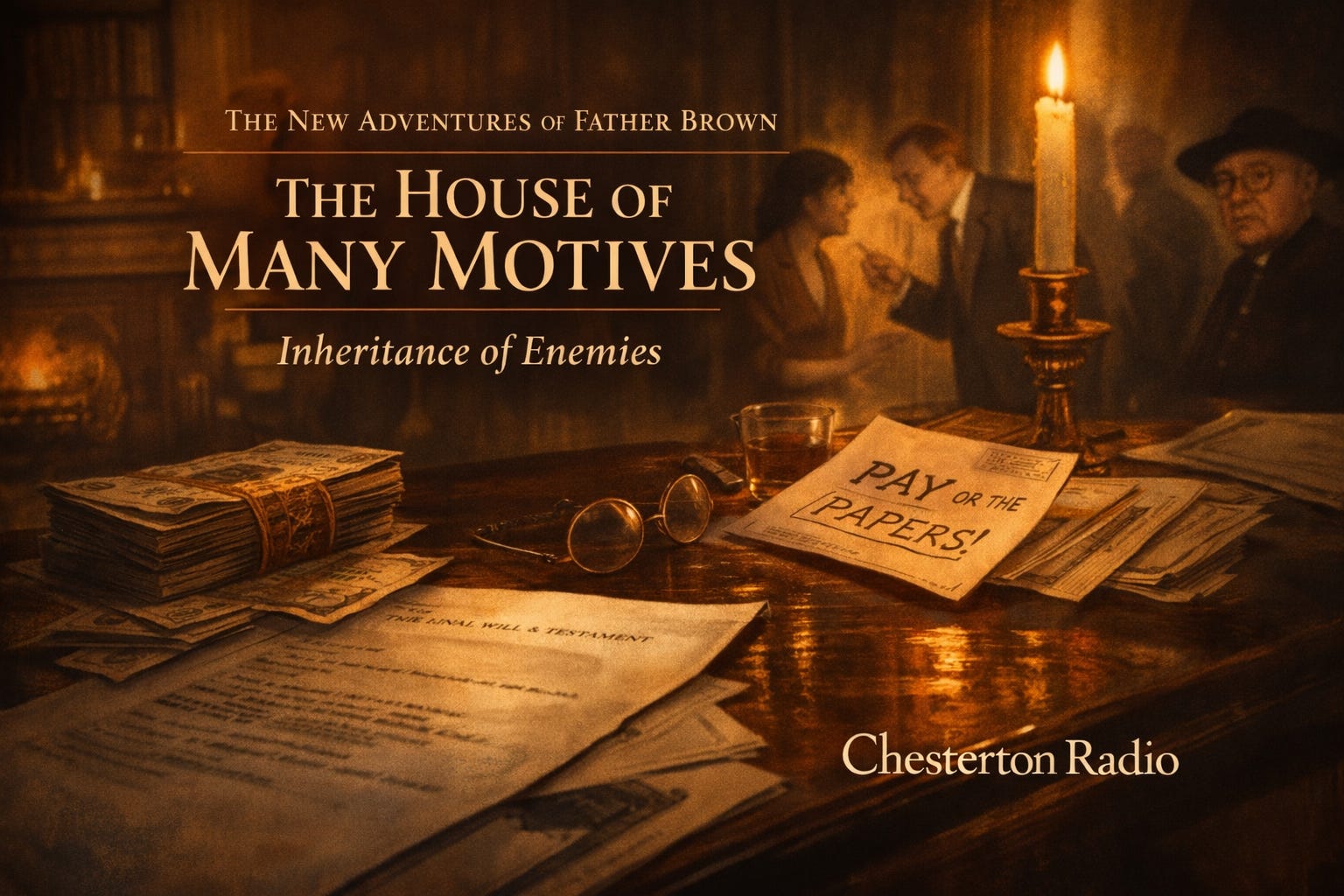
When money moves, consciences tremble.
It is a curious fact that grief becomes most articulate when money is involved.
The morning after Sir Reginald Harcourt’s death dawned with indecent brightness. Harcourt Manor stood washed in sunlight, as though the heavens wished to suggest nothing serious had occurred beneath its roof.
Inside, the drawing room felt smaller.
Inspector Mallory had not permitted anyone to leave. Breakfast was served in uneasy silence, punctuated only by the deliberate clink of silver against porcelain — that sound polite society makes when it would rather be shouting.
Father Brown stirred his tea with absent gentleness.
“You find this restful?” asked Colonel Ashford irritably.
“I find tea always hopeful,” said Father Brown. “It reminds us that boiling water may yet become something civil.”
The Colonel muttered something about priests and irrelevance.
It was at eleven o’clock that the solicitor arrived.
Mr. Pembroke was a narrow man in a narrower coat, carrying a leather case as though it contained artillery.
“We are gathered,” he began, clearing his throat, “to read the final testament of Sir Reginald Harcourt.”
Miss Evelyn Harcourt sat upright like a drawn blade.
Mr. Lionel Graves leaned back, expression composed, fingers steepled.
Mrs. Devereux did not look at anyone.
Father Brown observed them all with a look so mild it bordered on distraction.
The Will
The will was long.
Very long.
Sir Reginald had been generous in prose, if not in sentiment.
There were minor bequests — a watch to the Colonel, a modest sum to Mrs. Devereux, several decorative tokens to distant relations.
Then came the silence before the wound.
“The majority of the estate,” read Mr. Pembroke carefully, “including all controlling interests in Harcourt Industrial Holdings, is hereby transferred to the Harcourt Foundation for Industrial Restitution.”
The words seemed to alter the oxygen in the room.
“And the trustees of this foundation,” the solicitor continued, “shall be appointed upon activation of the foundation charter.”
“Which trustees?” demanded Evelyn.
Mr. Pembroke hesitated.
“The document names three provisional trustees.”
He read the names.
One was a retired judge.
One was a former union representative.
The third was…
“…Father Brown.”
Every head turned.
Father Brown blinked mildly.
“Oh dear,” he said softly. “I had hoped to remain a spectator.”
Inspector Mallory narrowed his eyes.
“You knew of this?”
“I knew,” said Father Brown carefully, “that Sir Reginald was troubled.”
“You knew you were named?”
“I knew he intended to make amends.”
There are moments when silence becomes accusation.
Mr. Graves stood abruptly.
“This is absurd! A priest and a union agitator in charge of my company?”
“Former company,” corrected the solicitor.
Graves’ composure cracked — not loudly, but perceptibly.
The First Crack
“What exactly is this foundation?” demanded Colonel Ashford.
The solicitor opened a secondary document.
“It is established to investigate and compensate individuals harmed by industrial negligence connected to Harcourt Holdings.”
The phrase fell like dust from a collapsed ceiling.
Mrs. Devereux whispered, “The factory…”
No one answered her.
But everyone knew.
Twenty years earlier, a Harcourt textile plant had partially collapsed during expansion renovations. Four workers had died. Twelve were injured.
The official ruling: structural failure due to material fatigue.
The official conclusion: tragic accident.
The official compensation: minimal.
Father Brown spoke gently into the silence.
“It is astonishing how accidents improve when examined twenty years later.”
Inspector Mallory turned sharply.
“You believe this foundation relates to the collapse?”
“I believe,” said Father Brown, “that Sir Reginald had recently discovered something.”
Mr. Graves laughed — too quickly.
“Discovered? What, precisely?”
“That accidents are rarely accidental,” said the priest.
The Documents
That afternoon, Inspector Mallory authorized a review of Sir Reginald’s private papers.
They were found not in his study — but locked inside a smaller cabinet behind the portrait in the gallery.
Adrian Vale, the painter, had known about the hidden panel.
“Sir Reginald liked symbolism,” he murmured nervously. “Secrets behind likenesses.”
Inside the cabinet were:
Copies of engineering inspection reports
Handwritten annotations
Bank transfers
And several letters marked but not sent
Father Brown lifted one of the inspection reports.
The safety certifications bore Lionel Graves’ signature.
But beneath them, in Sir Reginald’s hand, were notes:
“Numbers altered.”
“Load tolerance reduced.”
“Accelerated expansion without reinforcement.”
Inspector Mallory turned slowly toward Graves.
Graves did not flinch.
“This proves nothing,” he said smoothly. “Revisions occur in all projects.”
“Revisions,” said Father Brown, “are rarely followed by funerals.”
The Confessions
That evening, Father Brown asked a quiet question of the butler.
“Did Sir Reginald attend Mass regularly?”
“Yes, Father.”
“And recently?”
The butler hesitated.
“He requested private confession three times in the last month.”
Father Brown’s expression changed almost imperceptibly.
“Three times?”
“Yes, Father.”
Inspector Mallory overheard.
“You were his confessor?”
“No,” said Father Brown gently. “Another priest.”
“Then how is that relevant?”
Father Brown folded his hands.
“Because men who plan murder do not usually attend repeated confession.”
“You’re suggesting he expected to die?”
“I am suggesting,” said the priest softly, “that he was preparing his soul.”
The Letters
Among the unsent letters was one addressed to Lionel Graves.
It read:
“I have uncovered the truth regarding the 2004 expansion.
You assured me all structural calculations were sound.
I now possess evidence they were not.
We will discuss restitution at dinner.”
Inspector Mallory closed the letter slowly.
“That sounds like motive.”
“Yes,” said Father Brown. “But not necessarily for murder.”
Graves’ voice hardened.
“This is a witch hunt.”
“No,” said Father Brown mildly. “It is an audit.”
The Blackmail
The following discovery complicated everything.
A sealed envelope addressed to Sir Reginald had arrived the morning of his death.
Inside: a photocopy of the altered safety report.
Attached was a typed note:
“You are not the only one who remembers.
Pay what is owed — or the papers receive everything.”
Inspector Mallory stared at the group.
“Blackmail.”
Colonel Ashford looked stunned.
Mrs. Devereux went pale.
Evelyn closed her eyes.
“Which of you sent this?” demanded the Inspector.
No one spoke.
But something shifted in the room.
They were no longer united by resentment.
They were divided by fear.
Shame Surfaces
That evening, voices rose behind closed doors.
Evelyn accused Graves openly.
Graves implied Mrs. Devereux had long-standing knowledge of the structural irregularities.
The Colonel insisted the entire matter would ruin “good men” unnecessarily.
Adrian Vale withdrew entirely.
Father Brown sat quietly in the library.
Inspector Mallory entered.
“You think Graves did it.”
“I think,” said Father Brown, “that Graves is afraid.”
“Of prison?”
“No.”
“Of exposure?”
“Yes.”
Mallory leaned forward.
“Then he poisoned Harcourt to stop the foundation.”
“Perhaps.”
The priest looked up.
“But something troubles me.”
“What?”
“Graves knew Sir Reginald planned restitution. Yet he attended the dinner.”
“So?”
“Fear avoids the spotlight.”
A Stranger Detail
Father Brown returned to the gallery and studied the portrait again.
There was something in the painted eyes — not guilt, but relief.
He turned to Adrian Vale.
“When did he sit for this final session?”
“Three weeks ago.”
“Before or after he reopened the factory files?”
“After.”
Father Brown nodded slowly.
“A man who discovers he has been deceived may rage.”
“Yes,” said Vale.
“But a man who discovers he has deceived himself… grows quiet.”
The Real Question
That night, Father Brown gathered them again.
“You are all arguing about money,” he said calmly.
“Of course we are!” snapped Evelyn.
“No,” said Father Brown gently. “You are arguing about blame.”
He walked slowly around the room.
“The factory collapse required two things: altered reports… and a signature.”
He looked at Graves.
“And silence.”
He looked at Evelyn.
“And silence.”
He looked at Mrs. Devereux.
“And silence.”
The room felt colder.
“You are not merely hiding hatred,” he continued softly.
“You are hiding shame.”
Mrs. Devereux burst into tears.
“I knew,” she whispered. “I saw the preliminary report. The load calculations were wrong. Reginald asked Lionel to correct them. Lionel said delay would bankrupt the expansion.”
Graves’ composure fractured.
“And Reginald agreed to proceed.”
Evelyn stared at her father’s portrait.
“He chose profit.”
“Yes,” said Father Brown quietly. “He chose wrongly.”
Inspector Mallory stepped forward.
“Then the motive is clear. Graves kills him before restitution ruins him.”
Father Brown shook his head.
“No.”
“Why not?”
“Because Graves had already lost.”
They stared at him.
“What do you mean?”
“He had already been exposed — at least to Sir Reginald.”
“Then why murder?”
“Because,” said Father Brown gently, “someone else feared exposure more.”
The room stiffened.
“You are searching for the most angry person,” he continued.
“You should search for the most ashamed.”
Final Movement
Inspector Mallory demanded, “Are you saying the blackmailer is the murderer?”
“Not necessarily.”
“But you know who it is.”
Father Brown looked toward the windows.
The moonlight reflected faintly.
“Sir Reginald went to confession three times,” he said.
“A man preparing to confess publicly?”
“Yes.”
“Or preparing to name another?”
He turned back toward them.
“The poison was not administered in anger.”
His voice dropped.
“It was administered in desperation.”
A faint sound came from the corridor.
The butler entered, pale.
“Inspector… someone has attempted to burn the factory documents.”
The room erupted.
Father Brown closed his eyes briefly.
“Ah,” he said softly.
“When money moves, consciences tremble.”
He opened his eyes.
“And now they are shaking.”
To be continued in Episode III: “The Smile in the Portrait.”