

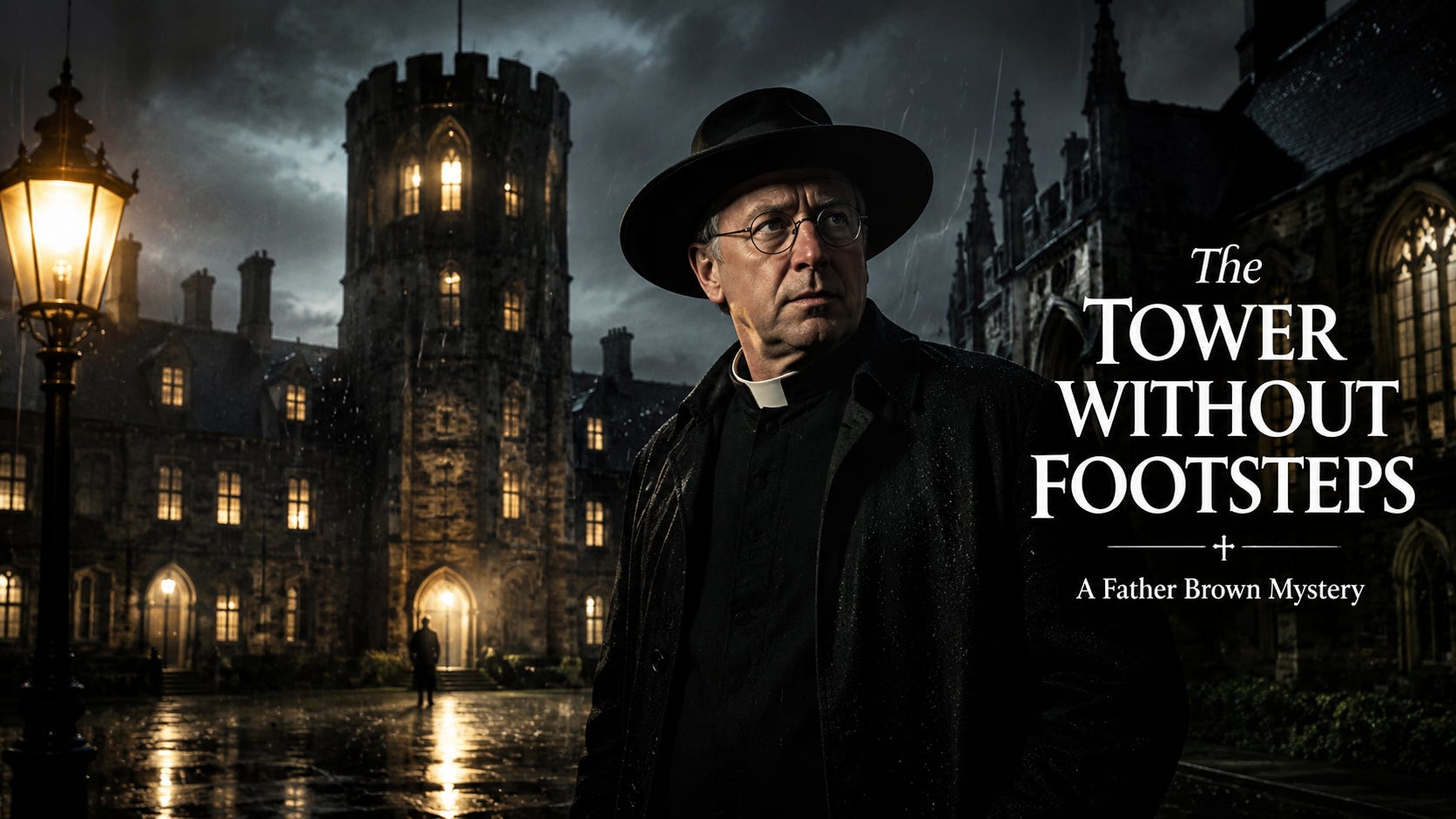
A celebrated Catholic benefactor comes to a small college town with a fortune in one hand and a secret in the other. Before midnight, he is found dead in a locked tower. But Father Brown is troubled less by the corpse than by the living — because every witness seems to have feared the dead man before he died.
Episode One
The Tower Without Footsteps
There are some towns which seem to have been built not so much upon hills as upon memories. St. Anselm’s was such a town: a little Catholic college town above a brown and swollen river, where the roofs rose in wet triangles against the autumn sky, and the bells of the abbey church told the hours as if time itself had entered the Benedictine order.
On the Monday evening of the storm, the whole town seemed to be listening.
Rain ran down the windows of the college library. It shone on the black branches of the elms. It gathered in silver threads along the iron railings and dropped steadily from the stone saints over the chapel door. Somewhere below the bluff a train gave a lonely cry, and the sound came up through the rain like a soul remembering it had once intended to be cheerful.
Father Brown arrived late.
He was a small, round-faced priest with an umbrella much too large for him and boots that had clearly never believed in dignity. He entered the great hall of St. Anselm’s with a splash, a blink, and a small apology to no one in particular.
“I beg your pardon,” he said to the porter. “I have brought half the Missouri River with me.”
The porter, who had not smiled for seven years except at funerals, smiled.
“The banquet has begun, Father.”
“Yes,” said Father Brown, removing his hat. “Banquets generally do begin before wisdom arrives.”
The banquet was in honor of Mr. Sebastian Vale.
Everyone at St. Anselm’s knew the name. Indeed, most people in Catholic intellectual circles knew it. Sebastian Vale was a financier, lecturer, publisher, donor, controversialist, and defender of civilization — especially when civilization could be printed on expensive paper and sold in hardback. He had funded journals, rescued institutions, founded prizes, and ruined reputations with equal efficiency.
He was a tall man with a silver beard and very calm eyes. His smile had the polish of a marble floor. Men had slipped on it.
Father Brown saw him at the high table beneath the portraits of dead abbots and deader presidents. Vale was speaking. Everyone else was listening with that careful attention given to rich men, sick men, and men holding pistols.
“We live,” said Vale, raising his glass, “in an age which mistakes noise for courage and confession for truth. The task of institutions like St. Anselm’s is not merely to preserve learning, but to preserve judgment.”
There was applause.
Father Brown noticed that it began half a second late.
After dinner, the company broke into shining fragments. Professors drifted toward coffee. Trustees whispered near the fireplace. Students hovered at the edges of adulthood, pretending not to be impressed by power. Outside, the storm increased until the windows trembled.
Dean Gabriel Harrow found Father Brown near a bookcase, studying a stuffed owl.
“Father Brown. I am so grateful you could come.”
The dean was handsome in the manner of men whose anxieties had been well educated. He had a long scholar’s face, a careful voice, and the exhausted courtesy of one forever arranging chairs before invisible guests.
“I was invited,” said Father Brown. “That usually means I have come by mistake.”
“Mr. Vale particularly asked for you.”
“Did he?”
“Yes. He said he had admired some of your—well, some of your interventions.”
Father Brown looked faintly alarmed.
“Dear me. One should never admire interventions. They are nearly always signs that something has gone wrong.”
Dean Harrow lowered his voice.
“He wishes to speak with you privately before he leaves tomorrow.”
“That sounds serious.”
“It is serious. He is considering endowing the new Institute for Moral Imagination.”
Father Brown looked across the room at Sebastian Vale, who was now speaking to a young Dominican sister in a white habit and black veil. The sister stood very still. Her stillness was not timid. It was the stillness of a drawn bow.
“Institutes,” said Father Brown, “are dangerous things. They tend to begin by preserving truth and end by preserving themselves.”
The dean gave a thin smile, as though unsure whether he had heard a joke or a diagnosis.
Before he could answer, there was a small disturbance near the doors.
A young man had entered wet from the rain. He wore a student’s jacket, carried a notebook, and possessed the tragic confidence of twenty-one. His name, Father Brown learned later, was Thomas Reed. He edited a student paper called The Bell-Rope, which no one read except those it offended.
Reed walked directly toward Sebastian Vale.
Vale turned before the young man reached him.
“Mr. Reed,” he said, pleasantly. “How theatrical.”
“You were asked to answer the questions before publication,” said Reed.
“And you were advised not to confuse malice with journalism.”
The room had gone quiet in the peculiar way rooms do when everyone pretends not to hear.
Reed’s face flushed.
“You bought silence from people who trusted you.”
Vale’s expression did not change.
“My dear boy, one does not buy what is already plentiful.”
The words were soft, almost amused.
They struck harder than a shout.
Sister Miriam stepped between them.
“This is neither the time nor the place.”
“No,” said Vale. “It is precisely the place. St. Anselm’s exists to teach young men to distinguish justice from vanity. Mr. Reed is still working through the second term.”
The student looked as if he might strike him. Instead he turned and walked out into the rain.
Afterward, everyone began talking at once.
That, Father Brown thought, is how civilized people scream.
At ten minutes past ten, Sebastian Vale excused himself. He told the dean he wished to review several manuscripts in the old library tower before retiring. The tower stood at the north end of the library: a round stone addition from a more romantic and less practical century. It contained rare books, college archives, a narrow stair, and one room at the top with a green-shaded reading lamp and a view of the river.
The tower door locked from the inside.
At twenty minutes past ten, Sister Miriam also left the hall.
At half past ten, Thomas Reed was seen crossing the quadrangle in the rain.
At eleven, the chapel bell rang once.
At twelve minutes past eleven, Father Brown found himself alone with Sebastian Vale’s empty coffee cup.
This was not, in itself, suspicious. But Father Brown was an old hand at coffee cups. They are among the few objects in the world that do not pretend to be better than they are.
Vale’s cup was untouched.
A man may forget his coffee. He may dislike his coffee. He may even renounce coffee for Lent with heroic and unnecessary violence. But Sebastian Vale had stirred his coffee, sugared it, and left it exactly full.
Father Brown looked at the cup for some time.
Then he looked toward the dark library door.
The scream came at twenty-three minutes past eleven.
It was not a loud scream, but it had that terrible quality which makes loudness irrelevant. It came from the old tower stair.
By the time Father Brown reached the library, several others were already there: Dean Harrow, Sister Miriam, two professors, and a broad, damp policeman named Inspector Bellamy, who had been attending the banquet in plain clothes because his wife sat on a college committee and believed policemen should occasionally meet books socially.
At the base of the tower door stood an elderly librarian, Miss Copley, with a ring of keys shaking in her hand.
“It was locked,” she kept saying. “It was locked from within.”
Inspector Bellamy took the keys, tried the handle, then frowned.
“Stand back.”
The door was heavy oak with black iron hinges. It took four men and a bench used as a ram to break it open.
The stair beyond was dark.
No one had come down it.
No one was on it.
At the top, in the circular reading room, Sebastian Vale sat in a chair beside the green lamp.
He was dead.
There was no blood. No sign of struggle. No overturned furniture. His silver head had fallen slightly forward, as though he had grown tired while reading and had decided to inspect his own soul.
On the table before him lay three things:
A closed leather portfolio.
A fountain pen.
And a small brass handbell.
Inspector Bellamy bent over the body. He was a practical man, and practical men are often most disturbed by things that are too neat.
“Doctor,” he said.
But there was no doctor present.
Father Brown had remained near the doorway. He was looking not at the dead man but at the floor.
The carpet was old and red. Mud showed clearly on it.
There were muddy footprints leading from the doorway to the chair.
There were no muddy footprints leading back.
Bellamy saw it too.
“Well,” he said softly. “That’s theatrical enough.”
Dean Harrow was pale.
“The windows?”
“Sealed,” said one of the professors after checking. “Painted shut. And that drop would kill a man twice.”
Sister Miriam stood near the shelves, her rosary tight in her hand. She was not looking at Vale. She was looking at the brass bell on the table.
Father Brown noticed that.
Inspector Bellamy touched Vale’s wrist, then his neck.
“Cold already.”
“How long?” asked Harrow.
“I’m not a doctor. But not five minutes.”
Miss Copley whispered, “But the bell.”
Everyone turned.
“What bell?” said Bellamy.
“The handbell,” said the librarian. “I heard it. That is why I came.”
Bellamy looked at the brass bell on the table.
“You heard that?”
“Yes.”
“When?”
“Just before I screamed. I was in the lower archive room. I heard it ring three times from above.”
Bellamy straightened.
“If he rang it, he was alive then.”
Father Brown said nothing.
The inspector looked at him.
“You disagree, Father?”
“I was only thinking,” said Father Brown, “that bells are like men. They sometimes make a noise after the hand has left them.”
Bellamy stared.
“Is that theology or evidence?”
“I am afraid it is only experience.”
They searched the room. The portfolio contained endowment documents. The fountain pen was uncapped but unused. The brass bell had no mark upon it. Vale’s watch had stopped at 11:47, though the college clock had not yet struck midnight. In his coat pocket was a folded note on St. Anselm’s stationery.
It contained one sentence:
You will tell the truth tonight, or I will.
No signature.
At midnight the chapel bells rang twelve times over the storm.
The sound filled the tower. It rolled through the library, across the quadrangle, over the wet roofs and down toward the black river. Father Brown listened to it with his head slightly tilted.
Inspector Bellamy sent for a doctor and posted a man at the broken tower door. The guests were kept in the great hall. The storm prevented easy departures. The college, which had spent all evening honoring a man, now had to discover whether anyone had loved him enough not to kill him.
At ten minutes after midnight, as Bellamy questioned the first witnesses, Thomas Reed was brought in from the rain.
His coat was soaked. His face was white.
“I didn’t kill him,” he said before anyone accused him.
“Then why run?” said Bellamy.
“I didn’t run.”
“You left the banquet after threatening him.”
“I didn’t threaten him. I asked him to answer questions.”
“With your fists?”
Reed looked toward Father Brown, though he did not know why.
“I went to the chapel.”
“To pray?”
“No,” said Reed. “To think. Some of us still do that without permission.”
Bellamy gave him a hard look.
“Did you see Mr. Vale after ten-ten?”
“Yes.”
The room changed.
Father Brown, who had been staring into the fire, looked up.
“When?” asked Bellamy.
“About twenty minutes to twelve.”
“That is impossible,” said Dean Harrow. “He was in the tower.”
Reed swallowed.
“I saw him crossing the cloister.”
“In the rain?”
“No. Under the covered walk. He was going toward the chapel.”
Bellamy stepped closer.
“You are certain?”
“Yes.”
“Did he speak?”
Reed hesitated.
“Yes.”
“What did he say?”
The student looked suddenly younger.
“He said, ‘There are worse things than being exposed, Mr. Reed.’”
No one moved.
Then Sister Miriam spoke for the first time since they had found the body.
“That cannot be.”
Reed turned on her.
“You saw him too.”
The sister’s face became utterly still.
Everyone looked at her.
Bellamy’s voice was careful now.
“Is that true, Sister?”
Sister Miriam closed her eyes briefly.
“Yes.”
“When?”
“At perhaps quarter to twelve.”
“Where?”
“In the east corridor, outside the archive room.”
“And he was alive?”
She looked at Father Brown.
The little priest’s face was gentle, almost sad.
“I thought he was,” she said.
Inspector Bellamy let out a breath.
“Then either Mr. Vale died after quarter to twelve, walked upstairs, locked himself in, rang a bell, and sat down dead—”
“Or,” said Dean Harrow hoarsely, “someone is lying.”
Father Brown looked around the room: at the frightened dean, the pale sister, the angry student, the broken door, the locked tower, and the rain beating like fingers on the glass.
“No,” he said softly.
Bellamy turned.
“No?”
Father Brown’s eyes rested at last on Sebastian Vale’s untouched coffee cup, carried in by some nervous servant and set forgotten near the fire.
“I should not begin there,” said the priest.
“Where would you begin?”
Father Brown looked toward the tower.
“I should begin with the fact that Mr. Vale was dead long before anyone was brave enough to notice.”
And at that moment, from somewhere above them in the broken tower, the little brass handbell rang once more.
The rain still falls tonight over the towers of St. Anselm’s.
A wealthy man lies dead behind a locked door.
A bell has rung for someone already gone.
And Father Brown has begun to suspect that the true danger in the old college was never murder alone — but the long habit of fearing the truth.
Join us tomorrow for Part Two of this brand-new five-part serialized mystery:
The Tower Without Footsteps —
a New Adventure of Father Brown in the tradition of the great classic radio mysteries.
With the atmosphere of the old wireless thrillers…
the cliffhangers of Yours Truly, Johnny Dollar…
and the moral paradoxes only Father Brown could unravel.
Because in this town, everyone heard the bell.
But no one agrees who rang it.
Good night from Chesterton Radio.