

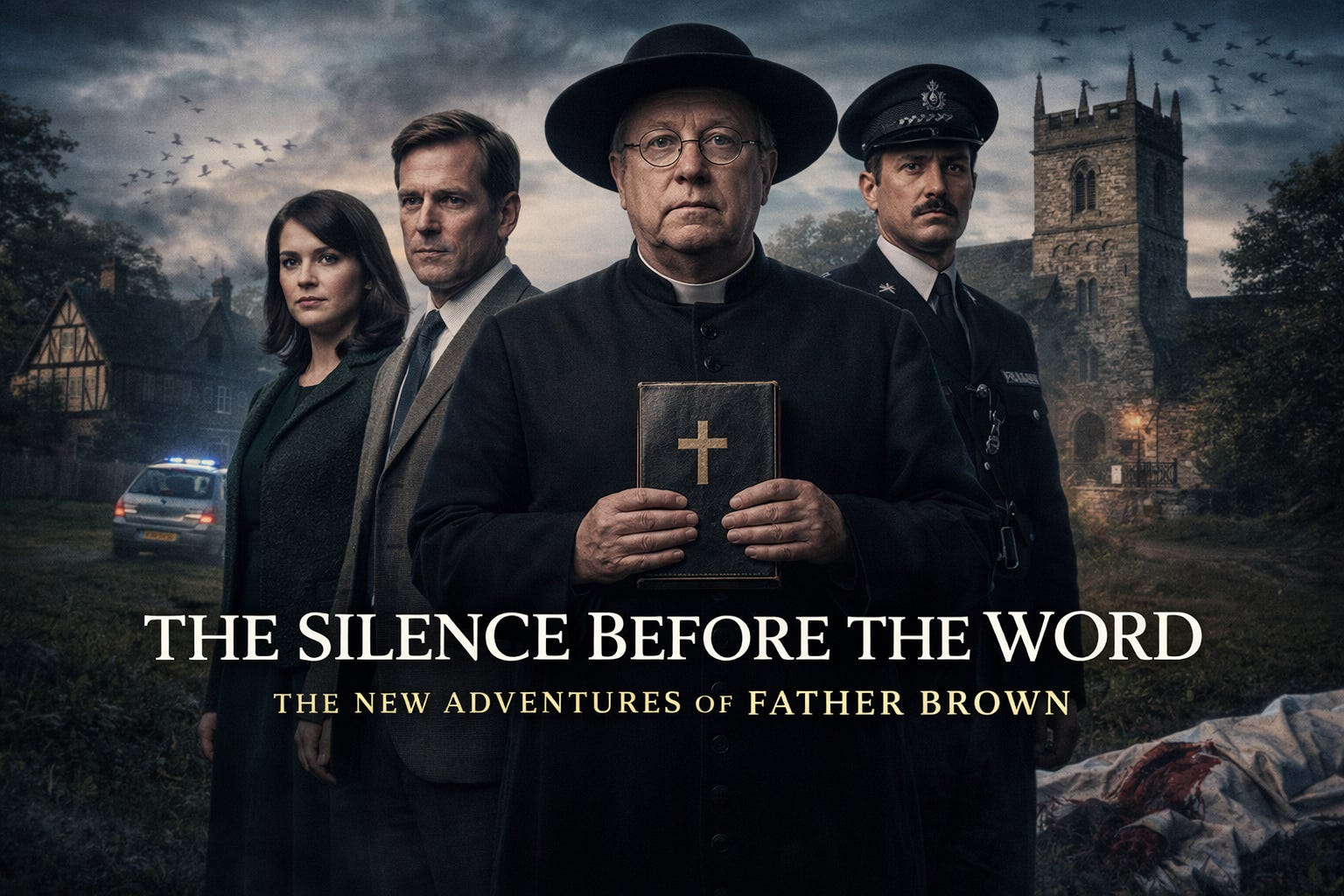
✦ ACT I — THE QUESTION
There are towns that bustle, and there are towns that sleep—but there are also towns that wait.
St. Aldhelm’s Hollow was one of the latter.
It did not wait for anything in particular. That was precisely the problem.
It waited the way a held breath waits—not knowing whether it will become a sigh or a scream.
Father Brown noticed it at once.
“You feel it too, don’t you?” said Inspector Mallory, as they stepped down from the small country train.
“I feel many things,” said Father Brown. “Most of them are wrong. But this one feels… deliberate.”
They stood for a moment on the platform. No one greeted them. No porter hurried forward. Even the stationmaster seemed to move with a certain hesitation, as though he had forgotten what came next.
“It’s the silence,” said Mallory. “Not the absence of noise—the presence of it.”
Father Brown nodded.
“Yes. The sort of silence that comes just before someone speaks.”
✦ The Dead Man
Dr. Lionel Harrow had been found that morning.
He was not well loved, but he was well known. A scholar, a critic, a man who had spent his life dissecting ideas and leaving them in neat intellectual fragments.
“He wrote about everything,” said Mallory as they walked. “Religion, philosophy, morality. Always with the same conclusion.”
“And what was that?” asked Father Brown.
“That nothing should be accepted without resistance.”
Father Brown smiled faintly.
“That is a very exhausting way to live.”
✦ The Study
The house stood slightly apart from the village, as though it too had chosen to withhold itself.
Inside, everything was precise.
Too precise.
Books arranged not for reading, but for argument. Papers stacked not for use, but for control. Even the fire in the grate seemed to have been measured before it was lit.
And at the center of it all—Dr. Harrow.
Still.
Composed.
Finished.
Mallory gestured.
“No sign of entry. No sign of violence. No poison we can detect. He simply… died.”
Father Brown stepped closer.
He did not look at the body first.
He looked at the room.
Then the desk.
Then the paper.
Fiat. Not mine.
Father Brown closed his eyes briefly.
✦ The First Clue
“Do you know what that means?” asked Mallory.
“Yes,” said Father Brown.
“And?”
“It means he lost an argument.”
Mallory frowned.
“With whom?”
Father Brown looked at the still figure.
“With himself.”
✦ ACT II — THE REFUSAL
✦ Miss Vane
Miss Eliza Vane did not seem surprised.
That was the first suspicious thing about her.
The second was that she did not seem guilty.
She received them with the composure of someone who had already answered a question long before it was asked.
“I wondered when it would happen,” she said.
“You expected his death?” said Mallory sharply.
“I expected his crisis,” she replied. “The rest follows.”
Father Brown leaned forward slightly.
“You spoke with him often?”
“Yes.”
“About what?”
She smiled.
“About surrender.”
✦ The Argument
It became clear that Dr. Harrow had been writing his final work.
A book that would dismantle what he called “the mythology of obedience.”
“He hated the idea,” said Miss Vane, “that the turning point of history should depend on a girl saying yes.”
“And what did you tell him?” asked Father Brown.
“That it always does.”
She paused.
“Not history, perhaps. But salvation.”
✦ The Witnesses
The village provided its fragments.
A housemaid who had heard voices the night before—but only one voice.
A postman who had delivered no letters—but noticed the door was open.
A child who had seen a light in the upstairs window long after midnight.
“It was like morning,” the child said. “But only in that one room.”
Mallory shook his head.
“This is getting ridiculous.”
“No,” said Father Brown quietly. “It is getting precise.”
✦ The Fear
They returned to the study.
Father Brown stood very still.
“You see,” he said, “most men fear being forced.”
Mallory nodded.
“That’s reasonable.”
“But a few men,” Father Brown continued, “fear being invited.”
Mallory frowned.
“That makes no sense.”
“Oh, it makes perfect sense,” said Father Brown. “Because an invitation can be refused—and a refusal can reveal who you are.”
✦ ACT III — THE ANSWER
✦ The Moment
Father Brown sat down in the dead man’s chair.
He folded his hands.
He looked at the paper.
“Imagine it,” he said softly.
“A man who has built his entire life upon saying no. No to belief. No to authority. No to surrender.”
Mallory listened despite himself.
“And then—just once—he is asked.”
“Asked what?”
Father Brown looked up.
“To say yes.”
✦ The Truth
Mallory exhaled.
“And he refused.”
“Yes,” said Father Brown.
“And that killed him?”
Father Brown shook his head.
“No. What killed him was that, for one terrible moment… he wanted to say yes.”
✦ The Realization
The room seemed smaller now.
The air heavier.
“You’re saying,” said Mallory slowly, “that this man died because he couldn’t reconcile himself with… an idea?”
Father Brown smiled sadly.
“No. He died because he encountered a reality.”
✦ The Final Line
Father Brown stood.
He looked once more at the paper.
Fiat. Not mine.
“That is the saddest sentence in the world,” he said.
“Why?” asked Mallory.
“Because it means he understood… and still refused.”
✦ ACT IV — THE CONFESSION OF SILENCE
Miss Vane was waiting when they returned.
“You know now,” she said.
“Yes,” said Father Brown.
“And?”
“And it is not a crime,” he said.
“No,” she replied. “It is worse.”
Mallory stepped forward.
“Miss Vane, I must insist—”
But Father Brown raised a hand.
“She is not the murderer,” he said. “She is the witness.”
✦ Her Secret
Miss Vane turned to the window.
“He asked me once,” she said, “what I would do… if I were asked.”
“Asked what?” said Mallory.
She did not turn.
“To give up everything.”
“And what did you say?”
“I said yes.”
Silence.
✦ The Hidden Fear
“He laughed,” she continued. “Not cruelly. Just… confidently. He said that such obedience was weakness.”
“And you disagreed?” said Father Brown.
“I told him it was the only strength that mattered.”
✦ ACT V — THE PATTERN OF ALL MEN
Father Brown walked alone that evening.
The village had grown quieter still.
But now he knew why.
It was not waiting.
It had already been asked.
✦ ACT VI — THE OTHER WOMAN
The next morning broke with that pallid clearness which belongs only to late March: a light not warm enough to comfort, but bright enough to accuse.
Father Brown was standing in the churchyard when Inspector Mallory found him. The little priest had one hand on the old stone wall and was gazing at the yews, which seemed, like all evergreens in English churchyards, to be remembering something no one else could recall.
“You have that look again,” said Mallory.
“What look?”
“The one that means you’ve found something infuriatingly invisible.”
Father Brown sighed.
“I have found that there are too few people in this story.”
Mallory blinked. “Too few?”
“Yes. A dead scholar, a calm woman, a frightened village, and a note with Latin on it. That is not a mystery. It is a symbol. Real life is always more clumsy than symbols. It trips over furniture. It misses trains. It has a second cousin who asks to borrow money. There is somebody else.”
Mallory stared at him. “That is your evidence?”
“It is my experience,” said Father Brown. “The devil writes neat allegories. God writes sprawling novels.”
Before Mallory could reply, the church gate clicked behind them.
A woman entered whom neither of them had yet seen.
She was not young, though there was something severe and preserved about her that made age difficult to estimate. She wore mourning clothes not fresh enough for a funeral and not old enough for habit. Her features were handsome in the way an old house is handsome: by symmetry, dignity, and a slight menace.
“That,” said Mallory quietly, “would appear to be your missing furniture.”
She approached without haste.
“Inspector Mallory?” she said.
“Yes.”
“I am Mrs. Constance Harrow.”
Mallory’s eyebrows lifted. “Harrow? The widow?”
“The estranged wife,” she corrected. “The law loves precision, and marriage, when dead, is still annoyingly grammatical.”
Father Brown bowed. “Father Brown.”
She inclined her head. “I know.”
That reply might have sounded merely civil in another mouth. In hers it sounded like a declaration that she knew rather too much in general.
“I was told,” she said, “that Lionel was dead.”
The way she said his name—without grief, without hatred, almost without ownership—was more chilling than tears.
“I came as soon as I could.”
“From where?” asked Mallory.
“Bath,” she said. “Though not, I think, from peace.”
✦ The Marriage That Was Not Murder
They spoke in the vicarage parlor because it seemed indecent to conduct a reunion with death in the dead man’s study.
Mrs. Harrow sat very upright and accepted tea as if it were an ancient sacrament of British endurance. She did not drink it.
“You were separated from your husband?” asked Mallory.
“For twelve years.”
“And yet you came immediately.”
“Yes.”
“Why?”
She looked at him with something like amusement.
“Because he wrote to me.”
Mallory straightened. “When?”
“Three days ago.”
Father Brown, who had been staring into the fire, looked up sharply.
“Do you have the letter?”
She withdrew it from her bag and handed it over.
The handwriting was angular and exact, like a man trying to write with a ruler.
Constance,
I find myself upon the edge of a conclusion I once thought impossible. You once accused me of mistaking negation for strength. It is intolerable to discover that one’s enemies may have been one’s prophets. I should like to speak with you before I settle the matter finally.
L.H.
Mallory took the letter. “Settle what matter?”
Mrs. Harrow gave a thin smile. “If I knew that, Inspector, I should either be less surprised or more frightened.”
Father Brown held out his hand. Mallory gave him the note.
The priest read it once, then again.
“He did not summon you from affection,” he said.
“No,” said Mrs. Harrow. “Lionel would sooner have invited a thunderstorm out of nostalgia.”
“He summoned you as a witness,” said Father Brown.
Her eyes narrowed. “To what?”
“To a judgment.”
✦ Constance Harrow
Constance Harrow was a more difficult woman than Eliza Vane, because she was a more worldly one. Eliza had the dangerous clarity of simplicity. Constance had the dangerous polish of intelligence that had suffered and learned not to complain.
She spoke plainly enough.
“My husband married me because I admired him,” she said. “He left me because admiration, once consumed, provides very little fuel.”
Mallory shifted in his chair.
Father Brown said quietly, “What was the real quarrel?”
She gave him a sharp look, then, perhaps surprisingly, answered at once.
“Children.”
The word hung in the room.
Lionel, she explained, would not have them. At first from scholarly ambition, then from philosophical conviction, and at last from what she called “the sort of coldness that begins as a theory and ends as a temperament.”
“He considered parenthood an act of servitude to biology,” she said. “He liked abstractions because abstractions do not cry at night.”
“And you?” asked Father Brown.
“I considered it an act of participation in God,” she said. “At the time I was fashionable enough to say ‘nature,’ but I knew what I meant.”
Mallory cleared his throat. “Was that why you separated?”
“In part. Also because he preferred being right to being loved.”
Father Brown nodded, almost sadly. “Many marriages perish that way. A home cannot be built upon footnotes.”
Mrs. Harrow’s expression changed almost imperceptibly, as though the simple sentence had struck closer than analysis.
“He had changed recently,” she said.
“How?” asked Mallory.
“He had become… agitated.”
Father Brown looked interested. “Not frightened?”
“No,” she said after a pause. “Something worse. Serious.”
✦ ACT VII — THE MAN WHO SAW THE LIGHT
That afternoon Father Brown went back to Harrow House alone.
He did not announce himself. He had the habit, common to very courteous men, of entering places as if apologizing to them.
The study was still under watch, but the constable on duty had quickly learned that Father Brown, though absent-minded, was generally on the side of legality, and let him pass with only a puzzled salute.
The room seemed altered in daylight.
At night it had been theatrical. In morning it was merely bare.
There are rooms which wear intellect as some men wear velvet: richly but honestly. This room wore intellect like armor. Even its books seemed defensive. The shelves on theology were opposite the shelves on classical philosophy, as if arranged for permanent combat. There were no novels. No family photographs. No signs of hobbies, foolishness, pets, or remembered holidays. Nothing that admitted a man might once have laughed for reasons other than superiority.
Father Brown began opening drawers.
He did this with extraordinary meekness, like a mouse committing burglary for the sake of justice.
At length he found what he had half expected: a leather portfolio containing notes for Harrow’s unfinished book.
The title, crossed out several times, had evolved through many versions.
Obedience and Myth
then
The Cult of Submission
then
Against the Sanctification of Consent
And at last, in smaller and shakier lettering:
Fiat
Father Brown sat down.
He began reading.
At first the pages were what one might expect: brilliant, bitter, and wrong. Harrow treated the Annunciation not as revelation but as one of those infuriatingly persistent religious images that civilized people are forever trying to outgrow and somehow never do. He attacked the idea that consent could be noble unless it originated wholly in the self. He described the Christian notion of obedience as “the elegant enthronement of passivity.”
Then the notes shifted.
The handwriting grew less rigid. The arguments grew less sure.
Margin notes appeared:
No — this is false if freedom is relational.
Why is coercion absent?
The scandal is not submission but invitation.
She is not overpowered. That is the point.
Could receptivity be stronger than assertion?
And finally, scrawled across one page almost violently:
What if saying yes is the act by which the self becomes itself?
Father Brown leaned back in the chair.
“There you are,” he murmured.
Mallory, coming in at that moment, heard only the end.
“Where is who?”
“The dead man,” said Father Brown. “For the first time.”
✦ The Handwriting in the Margin
Mallory took the pages and frowned his way through them with the expression of a practical policeman required to audit metaphysics.
“I dislike it when corpses change their minds,” he said.
“All conversion is untidy,” said Father Brown.
“Is this conversion?”
“No,” said the priest. “This is combat.”
He tapped the pages.
“Your scholar was not suddenly pious. He was cornered. He had reached a thought that threatened the architecture of his life. That sort of thing is more alarming than burglars.”
Mallory kept reading.
“What does this mean?” he said, pointing.
In the margin beside a section on the Virgin Mary there appeared a single sentence:
Constance was right about children.
Father Brown’s eyes grew grave.
“Ah.”
Mallory looked from the page to the priest. “That matters?”
“It matters very much.”
✦ The Physician
By evening another piece entered the puzzle.
The village doctor, a decent and flurried man named Dr. Henshaw, came to report that the postmortem had produced no sensational answer. There was no poison in the common sense, no trauma, no sign of attack.
“What did kill him, then?” said Mallory.
The doctor tugged at his collar.
“Well… the heart failed.”
“That is not an explanation,” said Mallory.
“It is the explanation in all deaths,” said Father Brown mildly.
“Yes, yes, quite,” Henshaw stammered. “But in this case it appears to have been some form of acute seizure. Stress, perhaps. Severe shock. The body may collapse under enough strain without any external violence. It is uncommon, but not impossible.”
“Could a quarrel do it?” asked Mallory.
“In the right man, yes.”
“Could terror do it?”
The doctor hesitated.
“Yes.”
“Could joy?” asked Father Brown.
Both men looked at him.
Dr. Henshaw blinked. “Joy?”
“Yes,” said Father Brown. “A very large joy in a very small room.”
The doctor looked as if he regretted studying medicine in a universe containing priests.
✦ ACT VIII — THE CHILD IN THE LANE
There was, as Father Brown had predicted, something more clumsy than the allegory.
It came in the form of a boy with muddy boots.
His name was Toby Creel, son of the wheelwright, and he had been the child who said he saw a light in Harrow’s upper room. Mallory had dismissed the statement as the usual village embroidery that attaches itself to any death before the second kettle boils.
Father Brown did not dismiss children.
Children, he reflected, are frequently inaccurate about facts and nearly infallible about astonishment.
Toby stood in the lane outside the church, looking determinedly guilty in the way only the innocent can manage.
“You wanted to tell us something else?” asked Father Brown.
The boy shuffled. “I didn’t know if I ought.”
“That usually means you ought,” said Father Brown.
Toby looked relieved and alarmed at once.
“I was there because of the cat,” he said.
Mallory groaned softly.
“The cat?”
“Not ours. His. Well—not his exactly. Miss Vane’s cat. It chases things. It had gone under the hedge. I followed it round the back of Dr. Harrow’s house.”
“And then?” said Father Brown.
“I heard talking.”
“Two voices?”
The boy shook his head. “No, Father. That’s the queer bit. Only his. But like he was answering someone.”
Mallory opened his mouth, but Father Brown gestured for silence.
“What did he say?”
The boy frowned with concentration.
“He said, ‘No, because then it all changes.’ Then later he said, ‘That is sentiment.’ Then later he shouted, ‘I will not be remade against my will.’”
Mallory stared.
“Anything else?”
The boy swallowed.
“Yes, Father.”
He lowered his voice, though there was no one about.
“After that, he went quiet for a bit. Then he said, very different-like… ‘I do will it.’”
Neither Mallory nor Father Brown spoke.
The boy rushed on. “Then there was a sort of cry—not loud, but like when someone’s breath goes funny—and the room got all bright. That’s when I ran.”
Father Brown put a hand on the boy’s shoulder.
“You have been very brave,” he said.
Mallory waited until the child had gone.
“Well?” he said.
“Well,” said Father Brown, “our dead man told the truth after all.”
✦ The Meaning of the Note
Back in the vicarage study, Father Brown laid Harrow’s final note beside the manuscript pages.
Fiat. Not mine.
“Earlier,” he said, “I took this to mean a refusal. ‘Let it be — but not my will.’ A tragic parody.”
“And now?” asked Mallory.
“Now I think it is unfinished.”
Mallory frowned.
Father Brown took up a pen and wrote slowly beneath it on a scrap of paper:
Fiat. Non mea voluntas… sed tua.
Let it be. Not my will… but thine.
Mallory’s face changed.
“You think he began the prayer.”
“Yes,” said Father Brown. “And died in the middle of saying yes.”
✦ ACT IX — THE FALSE SUSPECT
Yet the story required its earthly untidiness. The police could not close a case with “metaphysical seizure during conversion.”
And there remained, still, the practical question of whether anyone had hastened the matter.
For that reason Mallory pursued the obvious suspect at last: Miss Eliza Vane.
Her influence on Harrow had been considerable. She alone had debated with him openly. She had expected a crisis. She had not seemed shocked by his death.
Taken all together, it was enough to justify inquiry.
Eliza received the suspicion with almost comic calm.
“I wondered when you would arrive at me,” she said. “The village had done so before breakfast.”
“Where were you last night between ten and midnight?” asked Mallory.
“In my cottage,” she said. “Reading the prophet Isaiah badly and a detective novel worse.”
“Can anyone confirm that?”
“No. Solitude rarely produces witnesses.”
Mallory paced.
“You admit to repeated arguments with Dr. Harrow?”
“I do.”
“You admit that he was unsettled by them?”
“I hope so.”
“You admit that he summoned conflict?”
“He lived on it.”
Mallory stopped. “Did you love him?”
The question startled even Father Brown.
Eliza did not blush. She looked, for the first time, tired.
“No,” she said. “I pitied him too much.”
“That is not the same as no,” said Mallory.
“It is exactly the same,” she replied.
Father Brown watched her thoughtfully.
At length he said, “You did not poison him.”
“No.”
“You did not threaten him.”
“No.”
“But you did tell him something yesterday afternoon that mattered.”
At that she hesitated.
“Yes.”
“What?”
“I told him I was leaving the village.”
Mallory stared. “Why did that matter?”
“Because he had grown used to arguing with me,” she said. “And because—I think—he had begun to need an audience for whatever was happening to him.”
Father Brown nodded.
“And why were you leaving?”
She looked straight at him.
“Because I am going to have a child.”
There was a short silence.
“Ah,” said Father Brown softly.
Mallory blinked at both of them as if the plot had changed genre without official permission.
“Eliza,” said Father Brown, “did you tell Dr. Harrow that yesterday?”
“Yes.”
“And did you tell him you were not married?”
“Yes.”
Mallory looked horrified in the ordinary social sense. Father Brown looked grave in the cosmic one.
“What did he say?” asked the priest.
Eliza’s eyes were very clear now.
“He said it was a tragedy.”
“And what did you say?”
“I said it was an annunciation.”
✦ The Wrong Scandal
Mallory ran a hand over his face.
“This village is intolerable.”
“It is merely Christian,” said Father Brown.
Eliza went on quietly.
“I expected rebuke. I got… anger. But not the anger I thought. He was furious not because he believed too much, but because he had begun to believe too little of himself. He said that children alter the map of a life. That they abolish theories. That they demand hospitality from the future.”
She looked away toward the window.
“Then he said, ‘Perhaps that is why God began there.’”
Father Brown’s eyes closed briefly.
“Yes,” he murmured. “Yes.”
Mallory said, “Who is the father?”
Eliza gave him a cool glance.
“A man who is absent, ashamed, and probably reformable. But happily, Inspector, not homicidal.”
✦ ACT X — CONSTANCE AND ELIZA
That evening Father Brown did what many detectives fail to do because they are too busy solving mysteries: he introduced the women to one another.
It happened in the church, under the pretext of quiet, which was accurate enough. The nave was empty. The lamps before the side altar burned softly like watchful eyes.
Constance Harrow and Eliza Vane stood facing each other with the instinctive reserve of women who have each understood the same man differently and perhaps better than he deserved.
Father Brown began with no diplomacy at all.
“You were both right about Lionel Harrow,” he said.
Constance gave a short laugh. “That is impossible.”
“It is womanly,” said Father Brown. “Women often share truths the way men share cigars: in opposition.”
Eliza almost smiled.
Constance said, “And what truth did I have?”
“That love must make room for life.”
He turned to Eliza.
“And yours was that obedience is not surrender to annihilation, but consent to creation.”
Neither answered.
Father Brown looked toward the Lady altar.
“Harrow thought all receptivity was weakness. He could not see that the strongest thing in the world is a thing that receives without being destroyed. A mother knows this. So does the Church. So did the Virgin.”
Constance spoke quietly now.
“Why did he write to me?”
“Because he was beginning to repent of a sterile life,” said Father Brown. “And he could not repent abstractly. He needed the concrete persons against whom he had sinned. You represented the child he would not welcome. Miss Vane represented the child he could no longer dismiss. The Annunciation had become intolerably practical.”
Eliza said, “Then he died because of me.”
“No,” said Father Brown with sudden firmness. “He died because grace came in the shape he hated most: dependence, vulnerability, beginning.”
Constance looked at Eliza. “You are with child.”
“Yes.”
“And afraid?”
“Yes.”
Constance was silent a long moment.
Then she said, with a kind of regal plainness, “Good. Fear means you have understood the magnitude. Courage will come next.”
Eliza stared at her, and for the first time seemed young.
✦ ACT XI — THE LAST APPOINTMENT
The final earthly element appeared through something as humble as the village clockmaker.
Old Mr. Breck, who repaired watches and distrusted philosophy because it could not be lubricated, brought word that Dr. Harrow had asked him to call late on the night of the death to repair the library clock, which had stopped.
“But when I got there,” said Breck, “the front door was ajar and I heard him talking up above, so I thought I’d better not intrude. Sounded private. Then the church struck eleven and he gave a sort of shout, so I went in after all.”
“What did you find?” said Mallory.
“Nothing in the hall. No one on the stairs. But from the study there was light under the door—bright as a furnace, near enough—and then it went dim. By the time I opened it, he was in the chair.”
“You touched nothing?”
“I’m not a fool,” said Breck indignantly. “I’m a tradesman.”
Father Brown leaned forward.
“The clock had stopped, you say?”
“Yes. At ten-forty.”
“Had it truly stopped then, or was that merely when he noticed it?”
Breck scratched his head.
“Well, now. Funny thing. It had not run down naturally. The pendulum had been caught by something—a scrap of paper, as it happened.”
“Do you still have it?”
Breck produced it from his waistcoat pocket with offended pride. Tradesmen, unlike poets, keep evidence because it might prove the mechanism was not their fault.
It was a torn strip from Harrow’s manuscript.
On it were only a few words:
…the world remade by welcome…
Father Brown bowed his head.
✦ The Clock That Stopped
When they were alone Mallory said, “What does that add?”
Father Brown looked up.
“It tells us he interrupted himself.”
Mallory spread his hands. “He interrupted many things.”
“No,” said the priest. “I mean quite literally. He was writing. He tore out the page. He crossed the room. He stopped the clock.”
“Why would a man stop a clock?”
Father Brown’s round face grew unexpectedly stern.
“Because he had reached a moment he wanted to hold still. Or because he had reached one he feared to enter. Either way, he marked the threshold.”
Mallory said slowly, “Ten-forty.”
“Yes.”
“And then he died around eleven.”
“After forty minutes,” said Father Brown. “An oddly biblical interval.”
Mallory stared.
“You are not suggesting—”
“I am suggesting only that some men wrestle all night and some men only forty minutes,” said Father Brown. “It depends how much of themselves there is left to fight.”
✦ ACT XII — FATHER BROWN’S EXPLANATION
Inspector Mallory insisted, with the stubborn dignity proper to police, that all principal persons be assembled for a final explanation. This was fortunate, because detectives, priests, and villagers all secretly enjoy the ceremony of truth once someone else has paid for it.
So they gathered in the drawing room of Harrow House: Constance Harrow, Eliza Vane, Dr. Henshaw, old Breck the clockmaker, the constable, and Mallory himself. Rain fretted faintly at the windows. The room smelled of extinguished fire and old paper.
Father Brown stood by the desk where Lionel Harrow had died.
“You all wish to know who killed Dr. Harrow,” he said.
“Yes,” said Mallory.
Father Brown looked around.
“No one did.”
Breck muttered as if this confirmed all clerical unreliability.
Father Brown raised a hand.
“That is not the same as saying nothing happened. On the contrary, too much happened.”
He touched the manuscript pages.
“This man spent his life confusing freedom with refusal. He believed that strength consisted in not being moved, not being claimed, not being obliged. He saw the Annunciation—that scene in which the Virgin receives God’s invitation—not as the crowning dignity of human freedom, but as its defeat.”
Eliza lowered her eyes.
“Then two things happened,” Father Brown went on. “First, he encountered Miss Vane, who defended obedience not as servility but as consent. Second, he learned she was carrying a child. That fact is not scandalous because it is irregular. It is scandalous because it is real. A child abolishes theory. One cannot debate an infant in the abstract. One must welcome, protect, provide, change.”
Constance watched him intently.
“Dr. Harrow began to see that he had built his life around barrenness and called it autonomy. He began to see that the Christian story begins, quite intolerably for proud men, with hospitality: a woman makes room in herself, and the world is remade by welcome.”
He held up the torn strip from the clock.
“Those were his own words.”
No one moved.
“He wrote to his estranged wife because she represented the child he had refused. He clung to Miss Vane because she represented the child he could not dismiss. He was, perhaps for the first time in his life, in honest moral danger—not the danger of being wrong, which he had often survived, but of being changed.”
Mallory said, “And on the night he died?”
Father Brown turned to the window, as though seeing again that upper room filled with impossible brightness.
“On the night he died, he argued aloud because the argument had become interior. He insisted he would not be remade against his will. Then, at last, he discovered the central Christian paradox: that grace does not remake us against our will, but through it. The child heard him say, ‘I do will it.’ I believe that was the truth. He began the prayer. He wrote the note. He may even have understood joy.”
Dr. Henshaw shifted uneasily. “But the death?”
“The death,” said Father Brown, “was natural in the medical sense and supernatural only in the moral one. Dr. Harrow suffered a violent shock to the entire structure by which he had lived. Some men die of fear. Some die of rage. A few die because the soul, having at last admitted too much light, leaves the body no graceful way to proceed.”
Breck muttered, “That’s not evidence.”
“No,” said Father Brown. “It is explanation. The evidence is all practical enough. No poison. No intruder. No struggle. A manuscript of inward reversal. A note unfinished in prayer. A stopped clock at the threshold of decision. Witnesses hearing one man argue, then consent. A physician confirming collapse by strain. It is not a murder mystery, Mr. Breck. It is a conversion story that arrived late.”
Constance spoke, very quietly.
“Did he repent?”
Father Brown looked at the note on the desk.
“I think he began to,” he said. “And God, who is faster than we are, may have finished the sentence.”
✦ ACT XIII — THE MERCY OF THE UNFINISHED
The matter was closed officially with language less mystical than Father Brown’s and more embarrassing than anyone desired. Dr. Lionel Harrow was recorded as having died from sudden cardiac failure under conditions of acute mental strain. The English legal system, while not always poetic, is at least tactful when baffled.
But the true ending of the story occurred not in paperwork but in small acts of aftermath.
Constance Harrow did not return at once to Bath. She remained in the village three days, during which she sorted Lionel’s papers with the briskness of a woman unwilling to be sentimental and the tenderness of one failing at it.
Many manuscripts she burned.
A few she sealed.
One she took to Eliza Vane’s cottage.
Father Brown, passing the lane at dusk, happened by chance—or by that providence which only looks accidental to the proud—to see the two women talking at the garden gate.
Constance handed over a packet.
“It is the only page worth preserving,” she said.
Eliza opened it and read. Her eyes filled.
“What is it?” asked Father Brown later.
“The first honest page he ever wrote,” said Constance.
“And what did it say?”
She looked toward the cottage where the lamp had just been lit.
“It said, ‘There are truths too large to be conquered and can only be conceived.’”
Father Brown removed his hat.
“Yes,” he said. “That would do.”
✦ The Child and the Church
Eliza’s future remained untidy, as Christian futures often do. There was no miraculous instant by which shame vanished, or fear, or practical difficulty. The absent father was located eventually and proved to be less villainous than merely weak, which is harder to dramatize and more common to forgive.
There were conversations.
There were letters.
There was, after some months, a marriage—not romantic in the popular sense, but real in the sacramental one, which is often better.
Constance Harrow stood as witness.
Mallory, informed of this development much later, declared he preferred murder.
Father Brown said that was because murder contains fewer christenings.
✦ ACT XIV — THE SERMON NOBODY EXPECTED
On the following Sunday the church at St. Aldhelm’s Hollow was fuller than usual.
Villages attend scandal with enthusiasm and theology by accident, but grace has ways of using the wrong motives for the right harvest.
Father Brown preached.
He was not a spectacular preacher. He did not strike attitudes or clang conclusions. He merely said things that seemed small until people discovered, too late, that they had carried them home.
“This week,” he said, “we have all been reminded that the world does not only turn on power. It turns on permission. God is omnipotent, but He likes doors. He made us with wills, and so He chooses to come where He is welcomed. That is why the greatest thing that ever happened in history did not begin with a trumpet, but with an answer.”
A baby cried in the back.
Father Brown smiled slightly.
“Many modern people think obedience means the destruction of the self. But the opposite is nearer the truth. Pride is what destroys the self, because pride will not open the windows. The self suffocates in its own airtight importance. Obedience to God is not becoming less oneself. It is becoming finally breathable.”
The congregation listened in that uneasy way people listen when a sermon has inexplicably become personal.
“There are only two final spiritual attitudes,” he said. “One is, ‘My will be done.’ The other is, ‘Thy will be done.’ Everything else is decoration.”
He paused.
“And the odd thing—the wonderful thing—is that those who say the second at last discover, to their amazement, that their own will has not been erased, but redeemed.”
Afterward old Breck the clockmaker said it was almost a pity the priest had not made a profession of public speaking. This was his highest compliment and nearly caused a schism.
✦ ACT XV — THE CLOCK RUNS AGAIN
Before leaving the village Father Brown paid one last visit to Harrow House.
The study had already begun to look less like a battlefield and more like a room. This is one of death’s small ironies: once a man is gone, his furniture ceases defending him.
Old Breck was on a ladder repairing the library clock.
“Got it going again,” he said proudly.
The pendulum moved with patient authority.
Father Brown watched it for a while.
“Do you know,” said Breck, “I think he stopped it because he wanted time to stand still.”
Father Brown smiled. “Yes. Most of us do, at the wrong moments.”
Breck climbed down.
“Begging your pardon, Father, but do you really think that fellow saw… anything?”
Father Brown looked at the desk, the chair, the window where late light fell cleanly.
“Yes,” he said. “Enough.”
“Enough for what?”
“Enough to be frightened. Enough to be glad. Enough to begin.”
Breck snorted. “A beginning’s not much.”
“It is all any of us are given,” said Father Brown.
✦ ACT XVI — THE ENDING THAT WAS A BEGINNING
At the station Mallory was waiting.
He had the expression of a man who has been made to travel far into theological country and is eager to return to roads with signposts.
“I still don’t like it,” he said.
“No,” said Father Brown. “But you understand it.”
Mallory considered.
“I understand that your scholar was proud.”
“Yes.”
“I understand he was shaken by Miss Vane’s child, by his wife, by that whole business of welcome and obedience.”
“Yes.”
“I understand he changed his mind.”
Father Brown tilted his head.
“He changed more than that.”
Mallory sighed. “Very well. I understand that he changed his soul, and his body could not keep up.”
“That is rather well put,” said Father Brown.
Mallory looked down the line where the train would soon appear.
“Do you think people like that get much time?”
“People like what?”
“People who begin very late.”
Father Brown’s face became suddenly simple and old and full of kindness.
“My dear Inspector,” he said, “everyone begins late.”
The train whistle sounded far off.
Mallory said, “You make everything sound hopeful.”
“No,” said Father Brown. “Hope makes everything sound true.”
He climbed into the carriage.
As the train pulled out, the village receded into gray gold distance: the church tower, the lane, the dark shoulder of Harrow House among the trees. It no longer looked like a place waiting with dread. It looked like a place that had heard something and was still deciding how to answer.
Father Brown settled into the corner and closed his eyes.
He was thinking, not of death, but of the Annunciation; not of the scholar who had died resisting grace, but of the girl who had lived by receiving it. He reflected that the world had never really recovered from that moment and never should. Every child, every conversion, every act of hospitality, every brave consent, every forgiveness, every vocation, every vow, every altar, every cradle, every confessional, every sacrament was really only the same shock retold in smaller rooms.
The trouble with pride, he thought, is not merely that it says no. It is that it calls the no itself.
The glory of sainthood, by contrast, is not that it ceases to be personal. It is that it becomes personal enough to answer.
The train rattled on.
And far behind, in the study of the man who had died, the clock kept time again—not because time had been conquered, but because time had been admitted into mercy.
✦ EPILOGUE — FOR BROADCAST CLOSE
There are murders committed with knives and murders committed with lies.
There are murders of ambition, greed, jealousy, and fear.
But there is another kind of death, more silent and more terrible: the death that comes when a man has spent his whole life refusing reality and reality, at last, arrives as love.
On the day when the Church remembers a maiden saying yes, one proud scholar discovered too late that consent is not the collapse of freedom but its coronation.
He had built a life on negation.
He found, at the end, a child in the lane, a woman with hope in her fear, an estranged wife carrying the memory of refused fruitfulness, and beyond them all the oldest and most dangerous invitation in the world:
Let it be.
And because he finally began to answer, perhaps Heaven, in mercy, completed what the earth heard only in fragments.
For the world is not saved by force.
It is saved by welcome.
And the mightiest act in history still begins, in every age, in every soul, with the quietest consent:
Yes.
🎙️ Chesterton Radio
The New Adventures of Father Brown
The Silence Before the Word
Listener-supported mysteries of grace, paradox, and truth.