

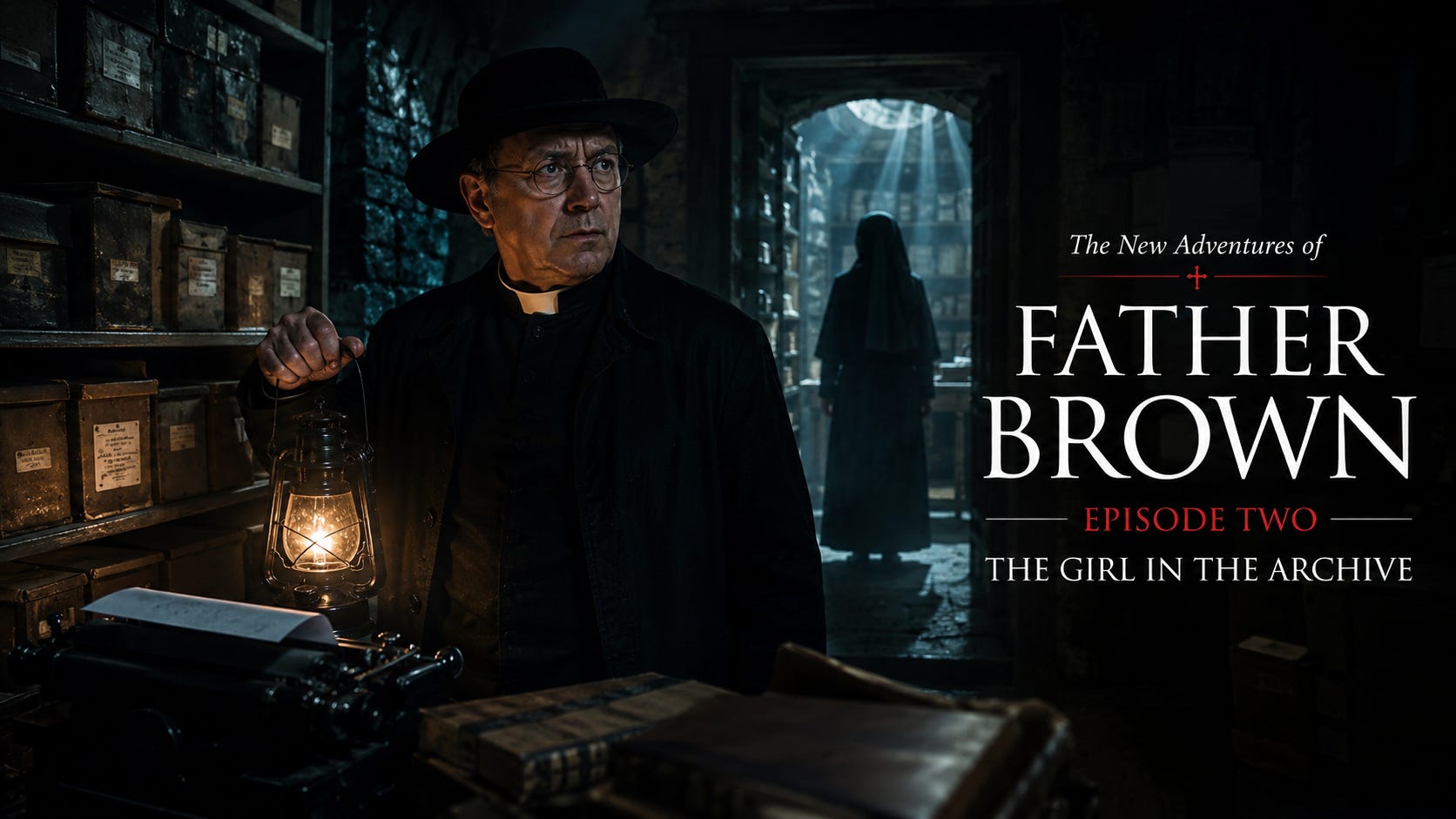
The impossible timeline surrounding Sebastian Vale’s death begins to unravel as Father Brown descends into the hidden archive rooms beneath St. Anselm’s. But the deeper he goes, the less the mystery resembles murder and the more it resembles confession.
The storm remained over St. Anselm’s through the small hours of the morning, not moving across the valley so much as settling upon it like a dark encampment. The rain no longer fell in violent bursts, but steadily and almost thoughtfully, as though the night had abandoned anger for endurance. Water streamed from the stone gutters of the college buildings and gathered in the cloisters where the lamps burned dimly behind curtains of silver rain. The abbey bells had long since ceased, but their memory still seemed to hang somewhere above the roofs and chimneys, suspended invisibly in the wet air.
Inside the college, no one slept.
The guests remaining from the banquet had gathered uneasily in the great hall, where coffee circulated with the solemn persistence of sacramental wine. Professors attempted conversations which died almost immediately after beginning. A trustee with an immense white mustache kept explaining to everyone that he had once met a murderer socially in Chicago, though no one seemed comforted by the information. Several younger faculty members whispered together near the fire with the nervous intensity of men trying to decide whether scandal belonged to theology or public relations.
At the far end of the room Inspector Bellamy stood beneath a portrait of the college founder reviewing witness statements with increasing dissatisfaction. The inspector was not a romantic man. He preferred facts because they did not usually become metaphysical in the middle of the night. Yet St. Anselm’s appeared determined to transform every practical question into a philosophical one.
A wealthy man had died in a locked tower.
Several witnesses claimed to have spoken with him afterward.
And Father Brown, instead of clarifying matters, persisted in making them sound older and stranger.
Bellamy closed his notebook sharply and crossed the room toward the priest, who sat near the fireplace studying Sebastian Vale’s untouched coffee cup with the grave attention another man might have devoted to a sacred relic.
“I have seen men poisoned,” said Bellamy, lowering himself heavily into the chair opposite him, “and I have seen men stabbed, shot, strangled, and occasionally dropped into machinery. But I have never before encountered a corpse with a social schedule after death.”
Father Brown looked up mildly.
“That is because most dead men lose influence rather quickly.”
“You think this one didn’t?”
“I think,” said the priest, “that Mr. Vale may have arranged his life in such a way that people continued obeying him even after he ceased to exist.”
The inspector frowned.
“That sounds poetic.”
“It is actually quite practical. Tyrants generally survive longer in the minds of their victims than in their graves.”
Bellamy leaned back irritably. “Then someone is lying.”
“Almost certainly,” said Father Brown. “But lying and falsehood are not always the same thing. A frightened man may tell an untruth merely because the truth would expose something he cannot bear to have seen plainly.”
The inspector was about to answer when Dean Harrow entered hurriedly from the library corridor. The dean’s composure, which earlier in the evening had resembled polished academic furniture, now appeared to have suffered structural damage.
“Inspector,” he said quietly, “Miss Copley has discovered something beneath the archives.”
Bellamy rose at once. “What sort of something?”
“That,” replied the dean with visible reluctance, “is difficult to explain.”
Father Brown sighed faintly and stood up. “Those are generally the most exhausting kinds.”
The lower archive passages beneath St. Anselm’s belonged to an older period of the institution, when monasteries had still expected both plague and scholarship to last indefinitely. The ceilings were low and barrel-vaulted, the walls damp in places with ancient seepage from the hillside above. Miss Copley led them downward carrying an oil lamp because the electric fixtures in this portion of the building had ceased functioning several years earlier and apparently no one had possessed either the money or the courage to repair them.
“The original abbey records were once stored here,” she explained nervously as they descended. “During the influenza epidemic portions of the cellar were converted into infirmary rooms, though afterward most of it was simply abandoned.”
“Civilization,” murmured Father Brown, “is largely the process of abandoning rooms full of important papers.”
The archivist gave him a puzzled look but continued downward.
At the end of the passage stood a narrow iron-bound door concealed behind movable shelving. Miss Copley unlocked it with trembling fingers, and they entered a small chamber lined with old ledgers and document cases. The air smelled faintly of dust, candle wax, and wet stone.
But what immediately arrested everyone’s attention was not the room itself.
At the center table stood a typewriter, and in the machine remained a single unfinished sheet.
Inspector Bellamy stepped forward and read aloud:
HE KNEW THEY WOULD NEVER LEAVE HIM.
The sentence ended there abruptly, as though interrupted either by fear or discovery.
Bellamy examined the ribbon. “Fresh.”
“Yes,” said a calm voice from behind them. “Because it was used tonight.”
Sister Miriam stood in the doorway.
The young Dominican sister seemed less frightened than exhausted, as though she had spent many months carrying something heavy and had suddenly realized it might now crush several other people besides herself.
Bellamy turned sharply. “You know this room?”
“I supervise portions of the college archive.”
“And this machine?”
“It belongs here.”
“Who used it tonight?”
“I do not know.”
The inspector regarded her steadily. “You came here this evening?”
“Yes.”
“What for?”
She hesitated long enough for everyone present to understand the importance of the hesitation.
“To retrieve correspondence.”
“What correspondence?”
“Letters connected with Mr. Vale.”
Dean Harrow closed his eyes briefly.
Bellamy’s voice hardened. “What sort of letters?”
Sister Miriam looked not at the inspector but at Father Brown.
“Private letters,” she answered quietly. “Letters people believed would remain confidential.”
“Confessions?” asked Father Brown gently.
The sister gave a faint nod.
Bellamy looked between them impatiently. “I’m afraid you’ll both need to explain this in English.”
Father Brown folded his hands into his sleeves. “There are some men,” he said, “who collect influence the way misers collect coins. They discover weaknesses, sorrows, indiscretions, humiliations, and then convince others that survival depends upon remaining within their protection. Such men often appear generous because frightened people mistake dependency for gratitude.”
The inspector looked toward the table again. “You are suggesting blackmail.”
“No,” said Sister Miriam suddenly, with more force than before. “Not blackmail.”
“Then what?”
For the first time uncertainty entered her expression.
“He wished to become necessary.”
The words lingered strangely in the dim cellar.
Even Bellamy seemed unsettled by them, though he would not have admitted why.
Thomas Reed, who had followed them silently into the archive chamber, spoke now from near the doorway.
“That’s exactly what he did.”
Everyone turned.
The young journalist’s anger had cooled into something more dangerous than rage: moral certainty. Father Brown distrusted moral certainty in the young because it often arrived before mercy had developed sufficiently to accompany it.
“You investigated him?” asked Bellamy.
“Yes.”
“And found what?”
“Payments. Quiet settlements. Tuition assistance. Medical bills covered anonymously. Faculty debts erased.” Reed laughed bitterly. “Everyone called him charitable. Nobody noticed how carefully he chose people who would never afterward be free to oppose him.”
Dean Harrow spoke wearily. “You are describing benefaction as though it were corruption.”
“No,” replied Reed. “I’m describing corruption that learned how to dress like benefaction.”
Father Brown looked at the young man thoughtfully.
“That is very nearly true,” he said. “Which makes it especially dangerous.”
Bellamy walked slowly around the room, studying shelves and corners with growing irritation. “And where are these letters now?”
Sister Miriam remained silent.
“Madam,” said Bellamy, “a man has been murdered.”
“Yes,” she answered softly. “That is why I removed them.”
The inspector stared at her. “You concealed evidence?”
“I protected souls.”
“You may instead be protecting a killer.”
Before she could answer, Miss Copley suddenly gasped.
At the rear of the chamber, partly hidden behind a stack of archive boxes, stood another door — small, iron-bound, and ancient enough to appear less constructed than buried.
Bellamy crossed to it immediately.
Locked.
“Where does this lead?”
“No one uses it now,” said the dean uneasily.
“That wasn’t my question.”
Harrow hesitated. “An older section of the foundation passages beneath the original monastery.”
Bellamy examined the lock. Fresh scratches marked the iron around the keyhole.
“Someone opened this recently.”
Nobody answered.
Then Father Brown crouched silently near the floor.
“What is it now?” asked Bellamy.
The priest pointed downward.
Across the thin film of dust upon the stones ran several faint impressions left by wet feet.
Not shoes.
Bare feet.
The inspector stared at them.
“No one came through this storm barefoot.”
“No,” said Father Brown quietly.
The priest’s eyes lifted slowly toward Sister Miriam.
The young nun had gone pale, though not with fear. It was the expression of someone recognizing a grief she had hoped never to see exposed publicly.
Bellamy noticed it immediately.
“You know something about this.”
After a long silence she answered.
“I know who believed those footprints belonged to a saint.”
The words sounded so absurd in the cellar that no one replied at once.
Rainwater dripped faintly somewhere behind the walls.
At last Bellamy said flatly, “This college grows less sane by the hour.”
But Father Brown had not moved. His expression had become unexpectedly sorrowful.
“Yes,” he said softly. “Because sanctity and vanity are very near neighbors. And when a man confuses one for the other, terrible things can happen.”
The inspector turned sharply. “You think this has something to do with the murder?”
“I think,” replied Father Brown, rising slowly, “that Sebastian Vale may have discovered the one thing more dangerous than corruption.”
“What is that?”
“A good man who secretly wishes to be admired for being good.”
No one spoke.
Then suddenly the lights above flickered.
Once.
Twice.
And went out entirely.
The archive chamber vanished into darkness.
Miss Copley cried out. Someone overturned a chair. Bellamy cursed under his breath and reached instinctively for his pocket flashlight, but before he could switch it on there came from beyond the little iron door a sound so faint that at first Father Brown thought it might merely be water moving through pipes.
Then it came again.
A footstep.
Bare.
And slow
The storm has not yet passed over St. Anselm’s.
Somewhere beneath the old college, beyond locked archive doors and forgotten stone passages, someone walked barefoot through the darkness tonight. And Father Brown has begun to suspect that Sebastian Vale’s murder is bound to a secret far older — and far more dangerous — than money or scandal.
Tomorrow, the mystery deepens in Part Three:
The Bell at Midnight
Inspector Bellamy believes the case is finally beginning to make sense.
Father Brown believes the exact opposite.
Join us tomorrow for another installment of this brand-new five-part Father Brown mystery event from Chesterton Radio — written in the spirit of the great classic radio serials, with the suspense of Yours Truly, Johnny Dollar and the moral mysteries only Father Brown could solve.
Because at St. Anselm’s, the dead are no longer the only ones keeping secrets.