

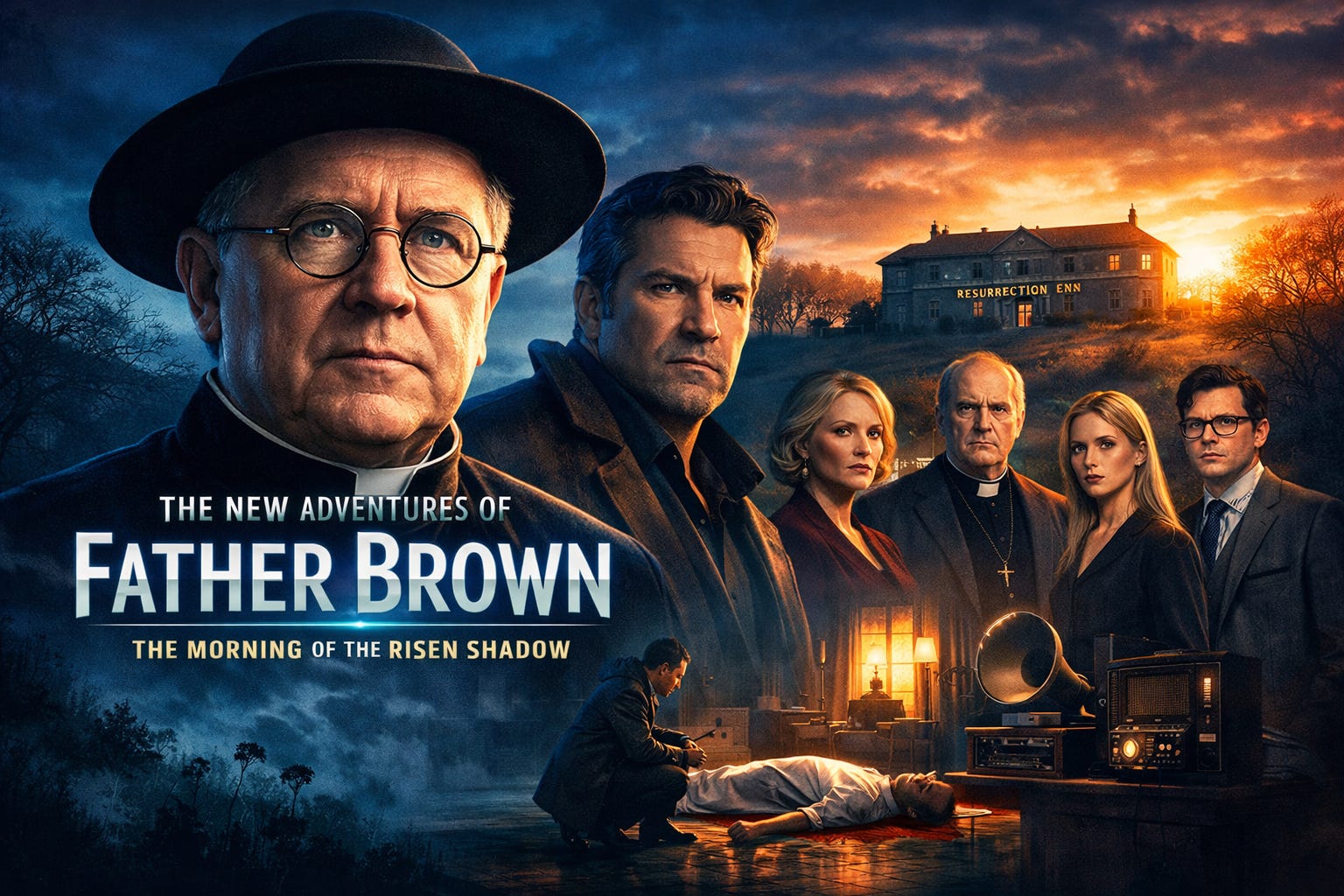
PART I — At Daybreak, Be Merciful to Me
The first light had not yet conquered the hills.
It merely suggested them.
That is the peculiar nature of dawn—that it is not so much a victory of light over darkness as a negotiation. The shadows do not vanish; they withdraw. They do not surrender; they pretend to.
Father Brown, walking slowly along the damp country road, considered this with mild satisfaction. He had always thought that sunrise was a theological event disguised as a natural one.
The hedgerows shimmered with dew. A faint mist clung to the low fields like a memory reluctant to leave. Somewhere in the distance, a bell rang—not loudly, but persistently, as though it believed in its own importance even if no one else did.
Beside him strode Flambeau, large as ever, but now wrapped in an overcoat that suggested both dignity and discomfort.
“You know,” said Flambeau, “I don’t think criminals should be allowed to wake up this early. It gives them too much time to prepare.”
Father Brown smiled faintly.
“My dear Flambeau,” he said, “most criminals do not wake early. They stay up late.”
“That’s worse,” said Flambeau. “That means they’re thinking.”
“They’re always thinking,” said Father Brown. “The trouble is—so are we. And we are worse at it.”
They walked in silence for a moment.
Then Flambeau added, “You still haven’t told me why we were summoned at such an hour.”
Father Brown glanced toward the rising pale edge of the sky.
“Because,” he said, “the man who sent for us believes something has happened that only makes sense at dawn.”
I. The House Called Resurrection End
The house stood on a hill that was not quite a hill.
It rose just enough above the surrounding fields to seem deliberate. Its long, low façade stretched like a tired aristocrat across the landscape, with windows that reflected nothing and everything.
Above the door was carved a name in stone:
RESURRECTION END
Flambeau stopped.
“Well,” he said, “that is either the most hopeful name in England—or the most ominous.”
“Names are always both,” said Father Brown. “That is why they are so dangerous.”
A thin man awaited them at the entrance.
He had the appearance of someone who had been stretched—physically, morally, and perhaps financially—beyond his natural limits. His eyes were bright, but not with joy; they were bright with the peculiar fever of someone who has not slept because he is afraid to.
“Father Brown?” he said.
“Yes.”
“And Monsieur Flambeau?”
Flambeau inclined his head.
“I am Dr. Adrian Bell,” said the man. “Thank you for coming. I fear—”
He stopped.
“—that something has gone very wrong.”
Father Brown nodded gently.
“That is usually why we are invited,” he said.
II. The Dead Man Who Spoke
They were led into a long, narrow room that seemed designed more for observation than comfort.
At the far end lay a body.
It was covered.
Flambeau sighed softly.
“Well,” he said, “that part at least is straightforward.”
Dr. Bell turned sharply.
“No,” he said. “No, it isn’t.”
Father Brown stepped forward.
“May I?” he asked.
Dr. Bell hesitated—then nodded.
Father Brown lifted the sheet.
The man beneath was pale, composed, and unmistakably dead.
He was also smiling.
Not peacefully. Not serenely.
But knowingly.
Flambeau frowned.
“I don’t like that,” he said.
“No,” said Father Brown quietly. “Nor do I.”
Dr. Bell spoke rapidly.
“His name was Sir Lionel Harbury. Wealthy, eccentric, obsessed with theology—though not, I think, in the orthodox sense. He invited several of us here for what he called ‘a demonstration.’”
“What kind of demonstration?” asked Flambeau.
Dr. Bell swallowed.
“A resurrection.”
Flambeau stared.
“Oh, good,” he said. “One of those.”
Dr. Bell continued.
“He insisted that death was merely a threshold—and that he had discovered a way to return from it.”
“And did he?” asked Father Brown gently.
Dr. Bell’s voice dropped.
“He died at midnight.”
Silence filled the room like a second presence.
“And?” said Flambeau.
Dr. Bell’s hands trembled.
“And at dawn,” he whispered, “he spoke.”
III. The Voice at Dawn
Flambeau laughed—loudly, sharply, almost with relief.
“My dear doctor,” he said, “dead men do not speak.”
“That is precisely the problem,” said Dr. Bell.
Father Brown did not laugh.
“What did he say?” he asked.
Dr. Bell hesitated.
“He said—”
He looked toward the body, as though afraid it might hear him.
“—‘They have sought my soul in vain.’”
Father Brown’s eyes flickered.
Flambeau frowned.
“That sounds like Scripture.”
“It is,” said Father Brown softly. “From the morning psalm.”
Dr. Bell nodded.
“Yes. And then he said—”
He stopped again.
“—‘The mouth is stopped of them that speak wicked things.’”
The silence that followed was not empty.
It was listening.
IV. The Living Suspects
They were gathered in the drawing room—a curious assortment of people united only by their discomfort.
There was Lady Harbury, the widow, who wore grief like an accessory she had not yet decided whether to keep.
There was Mr. Crispin Hale, a journalist with a face like a question mark.
There was Reverend Samuel Kline, whose collar seemed tighter than necessary, as though it were holding something in.
And there was Miss Eleanor Vane—a young woman whose calm was so complete it bordered on defiance.
Flambeau leaned toward Father Brown.
“Well,” he murmured, “we have our cast.”
“Yes,” said Father Brown. “But we do not yet have our play.”
Dr. Bell addressed them.
“Ladies and gentlemen, Father Brown has kindly agreed to assist us in understanding—”
“In understanding what?” interrupted Hale. “Whether Sir Lionel has returned from the dead?”
Lady Harbury spoke coldly.
“My husband believed many things,” she said. “Most of them inconvenient.”
Miss Vane said nothing.
Reverend Kline cleared his throat.
“The Church,” he began, “has always been cautious about—”
“Yes,” said Flambeau. “The Church has always been cautious about everything except the truth.”
Father Brown raised a hand gently.
“Let us begin,” he said, “with something simpler than resurrection.”
They all turned to him.
“Let us begin,” he said, “with murder.”
V. The First Paradox
Flambeau smiled.
“Ah,” he said. “Now we are on familiar ground.”
Father Brown shook his head.
“No,” he said. “We are not.”
He walked slowly to the window, where the first true light of morning had begun to settle over the fields.
“The trouble with murder,” he said, “is that it always pretends to be something else.”
“Such as?” asked Hale.
“Justice,” said Father Brown.
He turned.
“Or truth.”
Reverend Kline stiffened.
“Surely you do not suggest—”
“I suggest nothing,” said Father Brown. “I observe.”
Miss Vane spoke for the first time.
“And what do you observe?” she asked.
Father Brown looked at her.
“I observe,” he said, “that a man who wished to prove resurrection is now dead—and yet his first act upon ‘returning’ was not to proclaim life…”
He paused.
“…but to accuse.”
VI. The Second Body
A scream echoed through the house.
It came from upstairs.
Flambeau was already moving before the sound had fully faded.
They reached the corridor in seconds.
The door at the far end stood open.
Inside—
another body.
Reverend Kline stood frozen in the doorway.
On the floor lay Mr. Crispin Hale.
Dead.
This time there was no smile.
Only terror.
Dr. Bell staggered back.
“This—this is impossible—”
“No,” said Father Brown quietly.
“It is very possible.”
Flambeau knelt beside the body.
“Poison,” he said after a moment. “Fast-acting.”
He looked up.
“And recent.”
Father Brown nodded.
“Yes,” he said. “Very recent.”
Miss Vane stood in the doorway.
“You mean,” she said calmly, “that the killer is still among us.”
Father Brown looked at her.
“Yes,” he said.
“And worse than that—”
He glanced toward the rising sun.
“—he is in a hurry.”
VII. The Hidden Pattern
They returned to the drawing room, but the room had changed.
It had become smaller.
Or perhaps the people in it had.
Flambeau spoke first.
“Two deaths,” he said. “One at midnight, one at dawn. Both connected to this absurd ‘resurrection’ scheme.”
He turned to Father Brown.
“Well?”
Father Brown sat quietly.
Then he said:
“The first man died to prove a theory.”
“Yes,” said Flambeau.
“The second died to hide one.”
Silence.
Dr. Bell whispered, “What theory?”
Father Brown looked at him.
“That the dead man did not speak,” he said.
VIII. The Voice That Was Not
Flambeau frowned.
“But you heard the doctor—the words were spoken.”
“Yes,” said Father Brown.
“But not by the dead.”
Miss Vane’s eyes narrowed.
“Then by whom?”
Father Brown smiled faintly.
“By the living,” he said.
“And the living,” he added gently, “are far more dangerous.”
Part II — The Mouth Is Stopped
The sun had now fully risen—but it did not seem to illuminate the house so much as accuse it.
The name Resurrection End stood out in sharper relief than before, as though daylight had decided to underline the irony.
Inside, the air was no longer tense—it was compressed. The people within seemed not merely gathered, but contained, like something volatile that might ignite if given space.
Father Brown sat quietly in a high-backed chair that did not suit him. It made him appear smaller than he was, which was saying something. His hat rested on his knee; his fingers tapped it absently, like a man keeping time with a tune only he could hear.
Flambeau stood by the mantel, arms folded, eyes moving from one face to another like a general surveying a battlefield he had not yet decided to enter.
Dr. Bell hovered near the door, as if he might escape through it if things became sufficiently unreal.
Miss Eleanor Vane sat upright, composed as ever.
Lady Harbury reclined, not in comfort but in control.
Reverend Samuel Kline stood.
He had been standing for some time.
I. The Question of the Voice
“It is impossible,” said Dr. Bell again, though less confidently than before.
“Yes,” said Father Brown mildly. “That is why it has happened.”
Flambeau sighed.
“Please do not begin like that,” he said. “We have two bodies and one house. Let us try to keep at least one of those things simple.”
Father Brown nodded.
“Very well,” he said. “Let us begin with the voice.”
He turned to Dr. Bell.
“You said that Sir Lionel spoke at dawn.”
“Yes.”
“And you heard him?”
“Yes.”
“And you were certain it was his voice?”
Dr. Bell hesitated.
“I—yes. I believe so.”
Father Brown smiled faintly.
“Belief is a very interesting thing,” he said. “It often sounds like certainty, but it rarely behaves like it.”
Miss Vane leaned forward slightly.
“You are suggesting we were deceived.”
“I am suggesting,” said Father Brown, “that someone wanted you to be.”
II. The Problem of Resurrection
Reverend Kline spoke suddenly.
“This is blasphemy,” he said.
Everyone turned.
“To pretend that a man has risen from the dead—”
“No,” said Father Brown gently. “That is not blasphemy.”
Kline blinked.
“It is not?”
“No,” said Father Brown. “It is merely foolish.”
He paused.
“What is blasphemy,” he continued, “is to use the language of resurrection to conceal a lie.”
The room went still.
Flambeau nodded slowly.
“Yes,” he said. “That sounds more like murder.”
III. The Machine Behind the Miracle
Father Brown rose.
“May I see the room again?” he asked.
Dr. Bell nodded quickly.
They returned to the long narrow chamber where Sir Lionel lay.
The body had not moved.
But something else had.
Father Brown walked slowly around the room, his eyes not on the corpse, but on the walls.
On the furnishings.
On the spaces between things.
Flambeau watched him.
“You see something,” he said.
“Yes,” said Father Brown.
He stopped beside a narrow cabinet.
“Dr. Bell,” he said, “did Sir Lionel have any interest in mechanical devices?”
Dr. Bell frowned.
“He—yes, in a way. He had a fascination with communication—voice projection, acoustic experiments—rather eccentric, really.”
Father Brown nodded.
“Yes,” he said. “Eccentricity is often just a mask for something very precise.”
He opened the cabinet.
Inside was a small apparatus—wires, a speaker, and a recording cylinder.
Flambeau let out a low whistle.
“Well,” he said, “there is your resurrection.”
Father Brown shook his head.
“No,” he said. “There is your imitation.”
He turned.
“Sir Lionel did not speak,” he said. “He was made to speak.”
IV. The Second Death Explained
They returned once more to the drawing room.
Flambeau spoke first.
“All right,” he said. “So someone used a recording device to simulate the dead man speaking. That explains the ‘resurrection.’”
He looked around.
“But it does not explain the second death.”
Father Brown nodded.
“No,” he said. “That requires a different kind of voice.”
Miss Vane’s eyes narrowed.
“What do you mean?”
Father Brown looked at her.
“I mean,” he said, “the voice of conscience.”
V. The Man Who Knew
He turned to the empty chair where Mr. Hale had sat.
“The journalist,” he said. “He was not here by accident.”
Lady Harbury spoke sharply.
“He was invited.”
“Yes,” said Father Brown. “Because he was curious.”
He paused.
“And because he was dangerous.”
Dr. Bell frowned.
“Dangerous?”
Father Brown nodded.
“Journalists,” he said, “are dangerous when they begin to suspect the truth before it is ready to be told.”
Flambeau smiled faintly.
“That is a polite way of saying he was about to expose something.”
“Yes,” said Father Brown.
“And someone exposed him first.”
VI. The Poison of Certainty
Reverend Kline shifted.
“This is all speculation,” he said. “We have no proof.”
Father Brown looked at him kindly.
“On the contrary,” he said. “We have too much proof.”
Kline frowned.
“That makes no sense.”
“It rarely does,” said Father Brown. “That is why it is convincing.”
He stepped closer.
“The poison used on Mr. Hale was fast-acting,” he said. “But it required proximity. Trust.”
He paused.
“Or authority.”
Kline stiffened.
“You cannot mean—”
“I do not mean anything,” said Father Brown. “I observe.”
He leaned slightly forward.
“And I observe that you are the only person in this room who can speak of death with absolute certainty—and be believed.”
VII. The Theology of Murder
The room seemed to contract.
Kline’s voice was tight.
“You accuse me of murder?”
Father Brown shook his head.
“No,” he said. “I accuse you of something far more dangerous.”
Silence.
“I accuse you,” he said, “of believing you were right.”
Flambeau exhaled slowly.
“Yes,” he said. “That is always the worst motive.”
Kline’s face flushed.
“I acted—” he began, then stopped.
Father Brown waited.
Kline tried again.
“I acted to prevent a greater evil,” he said.
Father Brown nodded.
“Yes,” he said. “You killed a man who pretended to rise from the dead—because you believed he was mocking the truth.”
Kline said nothing.
“And when another man discovered that the miracle was false,” Father Brown continued, “you killed him too—because you believed he would destroy faith by exposing the lie.”
Kline’s hands trembled.
“You don’t understand—”
“No,” said Father Brown gently. “I understand perfectly.”
VIII. The Final Paradox
Father Brown stepped back.
“The strange thing about resurrection,” he said, “is that it does not need defending.”
He looked around the room.
“It is not a theory to be proved,” he said. “It is a truth that survives being denied.”
He turned to Kline.
“But when a man believes he must protect it with murder—he has already lost it.”
Kline sank into a chair.
“I could not allow him to deceive people,” he whispered.
Father Brown nodded.
“Yes,” he said. “So you chose a greater deception.”
IX. The Stopping of the Mouth
Flambeau spoke quietly.
“And the voice?” he said. “Why those words?”
Father Brown smiled faintly.
“Because,” he said, “they were not meant to convince.”
He looked at the others.
“They were meant to accuse.”
He gestured toward the window, where the morning light now flooded the room.
“‘The mouth is stopped of them that speak wicked things,’” he said softly.
He turned back to Kline.
“You thought you were silencing evil,” he said.
“But in the end—”
He paused.
“—you only silenced yourself.”
X. The Mercy of Morning
There was a long silence.
Not the silence of fear.
The silence of recognition.
Kline bowed his head.
“I did not believe,” he said quietly, “that truth could survive being mocked.”
Father Brown sat again.
“It cannot,” he said.
Kline looked up.
“Then I was right.”
Father Brown shook his head.
“No,” he said. “You misunderstood the truth.”
He smiled gently.
“The truth does not survive because it is not mocked.”
He glanced toward the light.
“It survives because it is risen.”
XI. The End That Is Not an End
Later, as they walked away from the house, Flambeau spoke.
“Well,” he said, “that was a cheerful morning.”
Father Brown chuckled softly.
“It was a true one,” he said.
Flambeau glanced back at the distant house.
“Do you think he will be forgiven?”
Father Brown considered.
“Yes,” he said.
“Eventually.”
He paused.
“That is the trouble with mercy,” he added.
“It rises.”
EPILOGUE — At Dawn, He Shall Stand
The fields were bright now.
The mist had gone.
But Father Brown did not look at the light.
He looked at the shadows.
Because he knew they had not been defeated.
Only postponed.
And that was enough.