

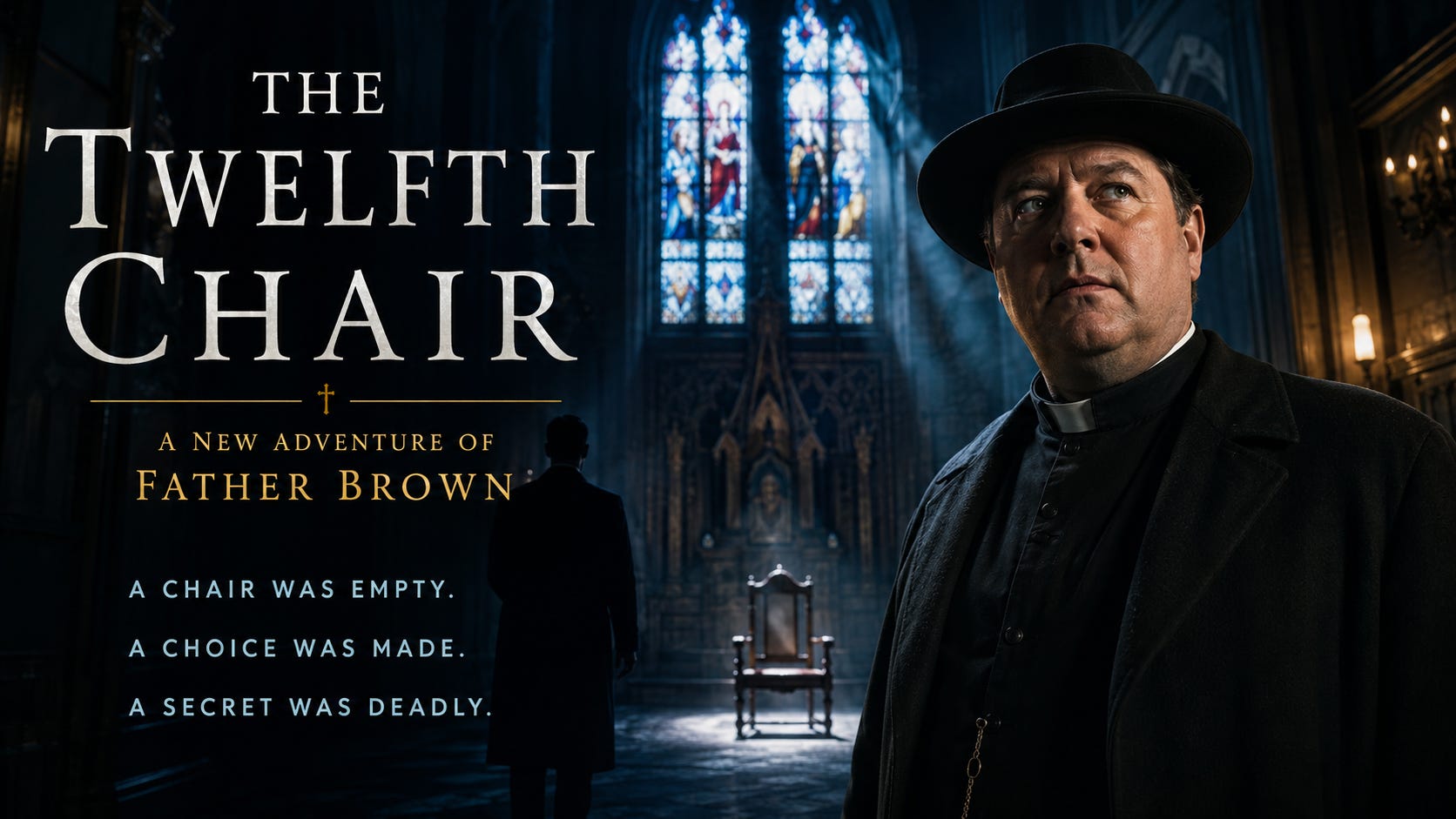
There are some silences which are empty, and some which are crowded. The silence in the chapel of Saint Anselm’s College, on the morning of the Feast of Saint Matthias, was of the second sort. It was crowded with carved saints and cold candles; with the dark smell of wax and wet stone; with the little stirrings of men who are trying to be still, and with the larger movement of something invisible which is always moving when men are trying to be still.
The chapel stood on a hill above the river, a blunt, grey, collegiate building with a square tower and an ambition to be older than it was. Its stones had been imported from a ruined priory in the north; its benches from a dissolved chapel in the south; its lectern from a bankrupt nobleman; and its habits from all the dead ages of England. The result was not antiquity, but something better for the purposes of a detective story: the appearance of antiquity. For appearances, when they are sufficiently devout, are often more misleading than lies.
Father Brown was kneeling near the back, because he had a preference for back rows which was not merely humility. He liked to see the whole of a place at once, especially when the whole of the place was trying not to be seen. He looked very much like a small parcel left behind by an elderly aunt: round, brown, harmless, and rather badly tied together. His umbrella was propped against the pew in front of him like a second, thinner priest.
At the front of the chapel, in the choir stalls, sat eleven men.
This would not have been remarkable in itself, had not the college possessed exactly twelve Fellows of the Order of Saint Matthias. That was the little scholarly society, half academic and half religious, which governed Saint Anselm’s in the old way; or at least in a way which called itself old because it disliked being called obsolete. The twelve Fellows wore black gowns with narrow crimson piping, and on solemn occasions sat in twelve high oak chairs under the painted figures of the Apostles.
But that morning one chair was empty.
It was the twelfth chair, the last on the south side, directly beneath a painted panel of Saint Matthias holding an axe and a book. There was nothing in the chair except a square of pale morning light, slanting through the clerestory and lying there like a white envelope.
The Warden, Dr. Septimus Vale, read the lesson from the Acts of the Apostles in a voice as dry and elegant as parchment.
“Thou, Lord, who knowest the hearts of all men, shew whether of these two thou hast chosen, to take the place of this ministry and apostleship, from which Judas hath by transgression fallen.”
As he read the name of Judas, a gust of wind passed over the chapel roof with a sound like a suppressed whisper. One or two of the Fellows looked up. Father Brown did not. He was looking at the empty chair.
The Warden continued.
“And they gave them lots, and the lot fell upon Matthias, and he was numbered with the eleven apostles.”
At that precise moment there came from somewhere in the college a single metallic cry.
It was not loud enough to be thunderous, nor long enough to be a scream. It was simply the sound of a bell struck once, sharply and unexpectedly; the kind of sound that makes all the nerves in a building stand upright.
Everyone in the chapel froze.
The Warden lowered the book.
“That,” he said, after a pause, “is the bell of the muniment room.”
Nobody moved for another second. Then everything moved at once.
The eleven Fellows rose in a black flutter. The verger dropped a candle-snuffer. A boy in the front pew made a small strangled noise. Father Brown, with much less haste than the others and rather more success, collected his umbrella and followed the procession out through the side door, across the cloister, and into the older wing of the college.
The muniment room was a narrow chamber on the first floor, reached by a stone stair and guarded by a door of black oak studded with iron. It contained the college charters, a silver reliquary of doubtful provenance, some Jacobite letters of genuine historical importance, and a small iron safe built into the wall. The room had only one window, and that window opened over a sheer drop into the herb garden, where rosemary and lavender grew in square beds like little green coffins.
When they reached the door, it was locked.
The Warden produced a key from a chain at his waist. His hands were steady, but his face had changed. It was not pale, exactly. It had become official. Official faces are often more alarming than pale ones.
He unlocked the door.
Inside, the room was full of sunlight and dust.
On the floor, beside the iron safe, lay Mr. Adrian Fells, the missing twelfth Fellow.
He lay on his back with one arm flung outward, as though he had tried to point at the window and had died of the effort. He was a tall, spare man with silver hair and a long, sensitive mouth which even in death seemed to be disapproving of something in bad taste. His black gown was twisted beneath him. On his chest lay a little wooden box, open and empty.
The bell rope hung from the ceiling near the safe. The bell itself was in the turret above, and had been installed long ago so that a custodian trapped in the muniment room by fire or thieves could summon help. The rope now dangled within a foot of the dead man’s hand.
On the table near the window lay a sheet of college notepaper. It bore, in Mr. Fells’s careful handwriting, a single line:
The lot has fallen.
The Warden said nothing.
A younger man behind him, broad-shouldered and clean-shaven, made a movement forward.
“Don’t touch anything,” said Father Brown mildly.
The young man stopped and looked down at him with surprise. He had the handsome, healthy expression of a man accustomed to being obeyed by horses and contradicted by women. His name was Philip Marr, and he was not yet a Fellow of Saint Anselm’s; but everyone knew he wished to be one. Indeed, he had returned from London only the day before for the election that would almost certainly make him the successor to old Canon Vane, who had died in February.
“I was only going to see whether he was alive,” said Marr.
“I know,” said Father Brown. “That is one of the dangerous things about good impulses. They often arrive just in time to destroy evidence.”
Dr. Vale turned sharply.
“Evidence?”
Father Brown blinked at him through his round spectacles.
“Well,” he said, “a man is dead in a locked room, holding or almost holding an alarm bell, with a note about lots, on the feast of the Apostle chosen by lot. It may turn out to be indigestion, of course. But it seems at least impolite not to consider evidence.”
The college doctor, a lean, nervous man named Harper, pushed his way in and knelt by the body. After a minute he looked up.
“He is dead,” he said. “Very recently. I should say within the last half hour.”
“During Morning Prayer,” said one of the Fellows.
There was something in the way he said it that made the phrase sound less like a liturgical observation than an alibi.
Father Brown looked about the room.
The safe stood open. It had not been forced. Inside were bundles of papers, a velvet pouch, two deed boxes, and an oblong space in the dust where something had been removed. The small wooden box on the dead man’s chest looked old, but not ancient. It was made of dark polished olive wood and lined with faded blue silk. On the inside of the lid was painted a tiny shield: a silver axe on a red field.
“What was in the box?” asked Father Brown.
The Warden hesitated.
“The Lots of Saint Matthias,” he said.
No one laughed; which proved that it was a college and not a railway carriage.
“They are not relics in the strict sense,” continued Dr. Vale, with the precision of a man correcting an encyclopedia while standing over a corpse. “They are two small ivory tablets, probably medieval, traditionally used in the election of Fellows before the Reformation. One is marked Electus, the other Non electus. Chosen and not chosen. They have not been used for centuries.”
“But they were in the safe yesterday?” asked Father Brown.
“Yes.”
“And now they are gone.”
“Yes.”
The doctor rose and wiped his hands.
“There is a wound,” he said. “At the back of the head. He struck something or was struck. I cannot say more until—”
“Until the police say less,” murmured Father Brown.
Dr. Harper stared.
“It was a manner of speaking,” said Father Brown apologetically.
The Warden gave orders. The police were summoned from the town. The room was sealed. The Fellows withdrew in agitated clusters. Father Brown remained for a moment in the doorway, looking again at the dead man, the bell rope, the open safe, the empty box, the window, and the note.
Then he turned and asked a question so foolish that everyone remembered it afterwards.
“Who dusts this room?”
I. The College of Twelve
The Inspector who arrived from the town was named Mallow, and he had the grave, suspicious face of an honest man who has been insulted by facts. He did not like locked rooms. They seemed to him an affectation, like foreign sauces or modern poetry. In his experience, rooms were locked because somebody had a key, and people were dead because somebody had killed them. He had built a career on that principle, and was not inclined to let a college of medieval-minded gentlemen spoil it.
He accepted Father Brown’s presence with the weary tolerance of a policeman accepting weather.
“I know you,” he said. “You were mixed up in the matter of the glass angel at Stowmarket.”
“I was mixed up in it before it was mixed up,” said Father Brown. “After that, I think it became rather clear.”
Inspector Mallow grunted.
“Then perhaps you can tell me how a man gets murdered in a locked room while eleven suspects are singing psalms.”
“They were not singing psalms,” said Father Brown. “They were listening to the lesson.”
“I doubt the distinction will hang anyone.”
“It might save someone,” said the priest.
The Inspector looked at him more sharply than before.
They stood in the quadrangle while the police photographer unpacked his apparatus upstairs. The morning had turned bright after rain. The old stones shone like wet bones. Beyond the archway, the college lawns sloped down toward the river, where a boatman was shouting at invisible boys.
“Tell me about the dead man,” said Mallow.
Father Brown glanced toward the group of Fellows gathered near the cloister.
“I should rather hear them tell you,” he said. “But I can tell you what everybody will tell you. Mr. Adrian Fells was learned, upright, severe, and widely disliked by people who had not the courage to call dislike by its proper name. Therefore they called him principled.”
Mallow snorted.
“And was he principled?”
“Oh, yes,” said Father Brown. “That was the trouble.”
The Inspector opened his notebook.
The twelve Fellows, or rather the eleven now remaining, were an odd company, as such companies usually are. Dr. Septimus Vale, the Warden, was a thin, silver-bearded classicist with the manners of a bishop and the eyes of a banker. Canon Andrew Pike, the chaplain, had a heavy, compassionate face and a voice that seemed always on the verge of forgiving someone. Professor Lionel Quist, the chemist, was small and acid and smelled faintly of tobacco and laboratories. Mr. Horace Bly, the bursar, was plump, anxious, and perpetually polishing his spectacles as if finance were a fog. Dr. Marcus Raven, the historian, had a mane of black hair and the tragic air of a man who has discovered that the Middle Ages were more interesting than himself.
There were others: old Mr. Tredgold, almost deaf; young Mr. Somers, who taught mathematics and blushed when spoken to; Dr. Pell, a philosopher who believed everything except what was in front of him; and two elderly brothers, the Dacre twins, whose chief distinction was that neither of them had ever agreed with the other in public, though no one had detected any private difference between them.
And then there was the candidate.
Philip Marr was not a Fellow, but he had been a student of the college, then a soldier, then a barrister, then something vague in a government office, and had lately become a public advocate for restoring the ancient dignity of Christian education. He spoke well, wrote vigorously, and looked admirable in photographs. To many of the Fellows he seemed precisely the sort of man the college needed: young enough to attract attention, old enough to have opinions, and worldly enough to call worldliness policy.
To Adrian Fells, however, he had seemed something else.
This fact emerged gradually as Inspector Mallow interviewed the college.
Fells had opposed Marr’s election. Fells had discovered, or claimed to have discovered, irregularities in the funds of a small educational charity administered years before by Marr. Fells had intended to raise the matter at the election meeting that afternoon. Fells had been seen arguing with Marr the previous evening in the cloister after Compline. Fells had carried the key to the muniment room for one week each quarter as part of a rota. Fells had been due to hand the key back to the Warden that morning.
“But the Warden opened the door,” said Mallow.
“With his own master key,” said Bly the bursar. “There are three keys. The Warden’s, the custodian’s, and the duplicate in the bank.”
“Who had the custodian’s key?”
“Mr. Fells.”
“Where is it?”
“In his pocket,” said the constable who had searched the body.
“And the window?”
“Fastened from within.”
“Chimney?”
“No fireplace.”
“Secret passage?”
Professor Quist laughed shortly.
“This is a college, Inspector, not a Christmas annual.”
“I have seen both contain surprises,” said Mallow.
But there was no secret passage. The walls were thick, the floor solid, the window high above the herb garden, the door locked, the key in the dead man’s pocket, and the alarm bell rung from inside. A locked room could hardly have been more locked if it had been designed by a maniac locksmith in a monastery.
The obvious suspect was Philip Marr. The obvious difficulty was that Philip Marr had been seen in the chapel throughout Morning Prayer, seated in the second pew beside Lady Helena Brand, a benefactress of the college. Several witnesses confirmed it. He had entered before the Invitatory and left only when the bell rang.
“Then he did not do it,” said Mallow.
“Not with his hands,” said Father Brown.
Mallow frowned.
“That is the sort of remark which makes simple things difficult.”
“I have generally found,” said Father Brown, “that sin is what makes simple things difficult. Remarks only reveal it.”
II. The Man Who Wanted to Be Chosen
Philip Marr received the Inspector in the Fellows’ guest room, where portraits of former Wardens looked down with the serene expression of men who had died before being investigated. Marr stood by the mantelpiece, one elbow resting on it, like a man in a political cartoon about constitutional crisis.
“This is monstrous,” he said. “Poor Fells and I differed, yes. We differed strongly. But I admired him.”
“Did he admire you?” asked Inspector Mallow.
Marr smiled faintly.
“Mr. Fells admired very few people. He regarded admiration as a leak in the intellect.”
“He was going to oppose your election.”
“So I understand.”
“On grounds connected with a charity.”
Marr’s face hardened.
“On grounds connected with a misunderstanding. Years ago I helped administer a scholarship fund for boys from industrial towns. Some money was transferred between accounts during a period of reorganization. Fells, with his genius for suspicion, imagined scandal where there was only untidiness.”
“Could he prove anything?”
“No.”
“But he might have stopped your election.”
“He might have delayed it.”
“Was that important?”
Marr turned from the fire.
“Inspector, Saint Anselm’s is dying of pious caution. It needs men who can speak to the modern world. If I wanted the fellowship, it was because I could serve the college.”
Father Brown, who had been examining a carved owl on the end of a bookshelf, said softly, “It is odd how often the modern world is served by men who first make sure they are appointed to comfortable chairs.”
Marr looked at him with a flash of irritation.
“You think ambition is a crime, Father?”
“No,” said Father Brown. “Only a very old disguise.”
“For what?”
“For fear, usually.”
Marr gave a short laugh.
“I am not afraid of anything in this college.”
“That,” said Father Brown, “would frighten me very much if I were you.”
The Inspector asked where he had been before Morning Prayer. Marr said he had breakfasted with Lady Helena in the south parlour, walked with her through the cloister, and entered the chapel at five minutes before eight. Lady Helena confirmed this. She was a tall, elegantly dressed widow with iron-grey hair and an expression which suggested that she had funded many good works and forgiven none of them for being badly managed.
“Mr. Marr was with me,” she said. “He could not have killed poor Mr. Fells.”
“Poor?” repeated Father Brown.
Lady Helena looked down at him.
“Is that the wrong adjective for the dead?”
“No,” said the priest. “Only sometimes the first true one.”
Lady Helena’s eyes narrowed.
“I do not understand you.”
“That is often my fault,” said Father Brown.
The Inspector was less interested in adjectives. He was interested in the stolen lots. Their disappearance gave the crime a theatrical and perhaps symbolic air, and Inspector Mallow distrusted symbolism even more than locked rooms. Symbolism, he felt, was evidence wearing a mask.
The lots were small ivory tablets, each about the size of a visiting card, kept in the olive-wood box. They were valuable historically, though not enormously valuable financially. Their theft made no sense unless connected with the election.
At noon, the Fellows met in emergency session in the long room. The election was postponed. This announcement produced exactly the kind of disappointment that everyone pretended not to feel. Philip Marr accepted the decision with noble restraint. Dr. Vale regretted the necessity in polished phrases. Mr. Bly worried about newspaper publicity. Professor Quist called the whole thing superstition complicated by murder.
Father Brown sat near the window, listening.
Through the glass he could see the herb garden below the muniment room. A gardener in a flat cap was trimming the rosemary. Beyond him, the wall rose sheer to the single window. There were no marks on the wall, no ladder, no ivy, no drainpipe. The window might as well have opened onto the moon.
After the meeting, Father Brown went into the garden.
The gardener touched his cap.
“Morning, Father.”
“Good morning,” said Father Brown. “Do you grow rue?”
The gardener stared.
“Not much call for it, Father.”
“I suppose not. It is a melancholy herb. What is directly under that window?”
“Lavender bed.”
“Has anyone stepped in it?”
“No, Father. Inspector looked. Not a stem broken.”
Father Brown nodded. Then he bent with surprising difficulty and picked something from the gravel path beside the bed. It was a tiny curved shaving of pale material, almost translucent.
“What’s that?” asked the gardener.
“I don’t know,” said Father Brown. “That is why it is interesting.”
He wrapped it in a scrap of paper and put it in his pocket.
III. Chosen and Not Chosen
The dead man’s rooms were as severe as his reputation. They contained books, papers, a crucifix, an iron bedstead, and one small watercolor of a lake under rain. There was no photograph, no comfortable chair, and no visible concession to the theory that human beings are animals who occasionally require cushions.
On his desk lay a file marked Marr Charity Matter.
Inspector Mallow opened it with satisfaction. The satisfaction faded as he read. There were bank statements, letters, memoranda, and a draft speech for the Fellows’ meeting. It was all meticulous and faintly disappointing. Philip Marr had indeed been careless with funds. Whether he had been dishonest was less clear. Money had moved from one account to another; expenses had been poorly recorded; a loan had been repaid late. It was the sort of scandal that could ruin a reputation without proving a crime.
“He had enough here to block Marr,” said Mallow.
“Yes,” said Father Brown.
“Then Marr had motive.”
“Yes.”
“But Marr had an alibi.”
“Yes.”
“You are very agreeable today.”
“I am often agreeable when I am puzzled,” said Father Brown. “It saves energy for the puzzle.”
On the mantelpiece stood a small framed text in Latin: Tu Domine qui corda nosti omnium. Thou, Lord, who knowest the hearts of all men.
Father Brown looked at it for some time.
“Fells was severe,” he said at last. “But I wonder whether he was severe because he knew other people’s hearts, or because he knew his own.”
Inspector Mallow had no patience with the hearts of dead dons unless they contained bullets.
“What killed him?” he said.
The doctor had given a preliminary opinion. Fells died from a blow to the back of the head, delivered with a small hard object or caused by impact against a sharp corner. There was bruising on one hand, as if he had clutched something violently. There were no signs of poison. No weapon had been found.
“Could he have fallen?” asked Father Brown.
“Against what?” said Mallow. “The safe door? The table? Perhaps. But why was the safe open? Why were the lots gone? Why the note? Why ring the bell?”
“Why indeed,” said Father Brown.
They returned to the muniment room in the afternoon. The body had been removed. The room looked less dramatic and more sinister, as rooms often do after the dead have left them. Death at least explains something; absence explains nothing.
Father Brown examined the bell rope. It was a plain cord, slightly frayed near the bottom. He tugged it gently. Far above, the bell gave a faint, reluctant note.
“It rings easily,” said Mallow.
“Yes,” said Father Brown. “Too easily to need a dying man’s last strength.”
He looked at the open safe. The dust inside still showed the oblong space where the wooden box had rested. He looked at the table. The note lay under glass now, protected by police caution. The words were plain:
The lot has fallen.
“His handwriting?”
“Yes,” said Mallow. “Several Fellows confirm it.”
“When was it written?”
“Impossible to say precisely.”
“Not impossible,” said Father Brown. “Only not yet possible.”
He turned to the window. It was fastened by an old iron latch. The latch was stiff. The sill inside was dusty except for two narrow marks, as if something had rested there. Outside, nothing but air.
Father Brown opened the window and looked down.
The herb garden lay quiet below. The lavender bed, the gravel path, the gardener’s shed, the little stone basin for rainwater. On the far side of the garden was a low door into the cloister passage.
“Could anything have been lowered?” asked Mallow.
“Yes,” said Father Brown. “Many things can be lowered. The difficulty is raising them again without leaving the string.”
He closed the window and turned back. Something about the room was worrying him with the persistent delicacy of a gnat.
Then he saw it.
The bell rope hung near the safe, not near the door. Its lower end was frayed; but on the floor below it there were no corresponding fibers. A frayed rope sheds little hairs, and dust remembers them. The floor remembered nothing.
“Inspector,” said Father Brown, “may I borrow one of your constables for a foolish experiment?”
“Most of my constables are experienced in foolish experiments,” said Mallow. “What do you want?”
“A chair, a string, and someone willing to ring a bell without being in the room.”
Mallow’s eyes brightened reluctantly.
Within ten minutes they had arranged a cord through the window and around the bell rope. By pulling from the garden below at a certain angle, a man could make the bell ring. But he could not then remove the cord without leaving it caught, unless the cord were of some material that could be broken, dissolved, or pulled away cleanly.
“Fishing line?” suggested Mallow.
“Would leave marks,” said Father Brown.
“Thread?”
“Would perhaps break.”
“Then what?”
Father Brown took from his pocket the little curved shaving he had found in the garden.
“Something,” he said, “that used to be alive.”
IV. The Ivory Splinter
Professor Quist identified the shaving under a lens in his laboratory, which smelled of chemicals, stale smoke, and intellectual impatience.
“Ivory,” he said. “Or bone. Thin shaving. Where did you get it?”
“Under the window.”
“Then your thief dropped part of the stolen lots.”
“Perhaps,” said Father Brown. “But I think it is more likely the thief dropped part of his plan.”
Quist peered at him.
“You mean the tablets were damaged?”
“I mean ivory was used because ivory had a reputation in the story.”
“Father, you speak like a man describing a dream to a committee.”
“That is very like being a priest,” said Father Brown.
Quist put the shaving aside.
“I can tell you another thing. This was recently cut. See the edge? Fresh. Not broken from an ancient tablet by accident. Cut. Shaved. With a very sharp knife.”
Mallow’s pencil stopped.
“Could it be from the stolen lot?”
“Possibly. But if the lots are medieval, shaving them would be an act of vandalism.”
“Murderers are often careless about museum standards,” said Mallow.
Father Brown looked at the professor’s shelves. They were full of bottles, instruments, balances, burners, tubes, and boxes of specimens. On one shelf lay several coils of fine translucent filament.
“What is that?” asked the priest.
“Animal membrane,” said Quist. “Prepared gut. Used in certain laboratory demonstrations. Also in old surgical ligatures. Why?”
“Because a thing that used to be alive may become almost invisible when stretched,” said Father Brown. “And may be made to snap or shrivel or vanish with moisture or heat.”
Quist stared, then burst out laughing.
“My dear Father, you are constructing a murder out of sausage skin.”
“Not the murder,” said Father Brown. “Only the bell.”
The experiment that followed was not dignified, but it was illuminating. A length of prepared gut, stretched from the garden through the window around the bell rope and back down, could ring the bell when pulled. If cut sharply, most of it fell outside, but a tiny fragment could remain inside or outside depending on the angle. If wetted and rubbed, it became nearly invisible among the garden refuse. If attached to a thin sliver of ivory or bone as a weight, it could be thrown or guided more easily.
“But that only proves the bell could be rung from outside,” said Mallow. “It does not prove who killed him.”
“No,” said Father Brown. “It proves something stranger. It proves that someone wanted us to think he rang the bell while dying.”
“Why?”
“To fix the time of death.”
Mallow looked at him.
“The doctor said he died within the half hour.”
“Doctors,” said Father Brown, “are excellent witnesses to death and rather poor witnesses to drama.”
They returned to Dr. Harper. Under pressure, he admitted that his estimate was approximate. Fells might have died somewhat earlier, perhaps before Morning Prayer began, especially in the cold room. The ringing of the bell during the lesson had created the impression of a death occurring at that moment.
“And if he died before prayers,” said Mallow slowly, “then Marr’s alibi may be worthless.”
“Or someone else’s alibi becomes too valuable,” said Father Brown.
The Inspector glared at him.
“You mean the murderer may have been in chapel when the bell rang, because he arranged for someone outside to ring it?”
“Or something outside,” said Father Brown.
“What thing?”
“A person is still the most common thing outside a window,” said Father Brown. “But not always the guilty one.”
V. Lady Helena’s Alms
The first clear break in the case came, as clear breaks often do, in the form of a dirty little complication.
A college servant named Molly Crane admitted, after tears and contradictions, that she had gone into the herb garden during Morning Prayer. She had been sent, she said, by Lady Helena Brand to fetch a sprig of rosemary for a headache. This explanation had the disadvantage of sounding absurd, which sometimes means it is true.
Lady Helena confirmed part of it.
“I asked for rosemary,” she said. “Not during Morning Prayer, before it. The girl must have delayed.”
Molly insisted she had gone when the service had begun, because Lady Helena had asked her just before entering the chapel. She had crossed the herb garden, found the rosemary, and heard the bell ring above her. She had seen no one.
“Did you touch anything under the window?” asked Father Brown.
“No, Father.”
“Did anything fall?”
The girl hesitated.
“I thought a bird dropped something. Like a little white chip. I didn’t look.”
Father Brown and Mallow exchanged a glance.
Lady Helena was questioned again. She was offended with an aristocratic thoroughness that seemed almost a profession.
“I did not send the girl during the lesson. I was in chapel with Mr. Marr.”
“Precisely,” said Father Brown.
She looked at him coldly.
“What does that mean?”
“It means you were in a very good place to be seen not doing anything.”
Lady Helena’s face flushed.
“Do you accuse me?”
“No,” said Father Brown. “I am afraid I accuse almost everyone until I know which accusation belongs to which person.”
Inspector Mallow was more practical.
“Why did you ask for rosemary?”
“I had a headache.”
“Rosemary cures headaches?”
“It has symbolic associations with remembrance.”
“I am investigating murder, not poetry.”
“Then you are unlikely to understand either,” said Lady Helena.
The Inspector reddened, but Father Brown intervened.
“Lady Helena,” he said gently, “did you want the girl in the garden when the bell rang?”
For the first time, something like fear passed over her face. It was gone at once.
“No.”
“Did Mr. Marr?”
She stood.
“This interview is over.”
Outside, Mallow said, “She knows something.”
“Most educated people do,” said Father Brown sadly. “It is one of the reasons they are so unhappy.”
VI. The Humble Candidate
That evening, after Vespers, Father Brown found Canon Pike in the chapel, arranging hymn books with the air of a man putting his conscience into straight rows.
The chapel was almost dark. Only the sanctuary lamp burned near the tabernacle, a small red star in an indoor night.
“Father,” said the canon, “do you believe in lots?”
“I believe in God,” said Father Brown. “Lots are one of the many small doors through which men have tried to let Him in. Sometimes He enters by them. Sometimes only chance enters. Sometimes the devil holds the door open and pretends to be the butler.”
Canon Pike smiled faintly.
“Poor Matthias. Always remembered because he was chosen by lot.”
“And forgotten because he was faithful before it,” said Father Brown.
The canon looked at him.
“Yes. That is the better point.”
There was a silence.
“Did Mr. Fells ever speak to you about Mr. Marr?” asked Father Brown.
“Yes.”
“And about the charity money?”
“Yes.”
“Did he intend to ruin him?”
Canon Pike shook his head.
“No. That is what no one understood about Adrian. He could be hard, but he was not cruel. He intended to force Marr to withdraw quietly. He said the college must not choose a man who wished too much to be chosen.”
Father Brown nodded.
“That sounds like him.”
“There was another candidate, you know.”
The priest looked up.
“For the fellowship?”
“Yes. Mr. Thomas Lyle. He teaches at a poor school in the town. Brilliant man. Former student here. No money, no influence, no polish. Adrian admired him. He wanted Lyle chosen instead of Marr.”
“Where is Mr. Lyle?”
“In the town, I suppose. He was invited for the election, but he did not come this morning. He sent a note withdrawing.”
“When?”
“Yesterday evening.”
Father Brown’s eyes behind his spectacles seemed to become very still.
“Who received the note?”
“I did. It was left at the porter’s lodge.”
“May I see it?”
Canon Pike hesitated.
“It is in my room.”
The note was brief.
Dear Canon Pike,
After prayer and consideration, I must withdraw my name from election. I am not fitted for such a place and cannot consent to be put forward. Please forgive the inconvenience.
Thomas Lyle.
Father Brown read it twice.
“Very humble,” he said.
“He is a humble man.”
“Yes,” said Father Brown. “But humble men do not usually say they are not fitted. They usually say they are not worthy. Pride talks of fitness; humility talks of mercy.”
Canon Pike stared.
“You think he did not write it?”
“I think someone wrote a humble note who had never been humble in his life.”
VII. The Schoolmaster
Thomas Lyle lived in two rooms above a baker’s shop in the old part of town. Father Brown went there with Inspector Mallow the next morning. The baker’s wife said Mr. Lyle had gone out before dawn and had not returned. His rooms were unlocked.
They were poor rooms but not miserable. There were books stacked on chairs, a cracked teapot, a crucifix made of dark wood, and piles of exercise papers covered with small, careful handwriting. On the wall hung a drawing of Saint Anselm’s College made in pencil by a child.
On the desk lay a sheet of paper covered with copied lines:
You have not chosen me: but I have chosen you.
You have not chosen me: but I have chosen you.
You have not chosen me: but I have chosen you.
The line had been written over and over, not like a penance, but like a man trying to believe something more wonderful than ambition.
Mallow searched the room and found no weapon, no ivory tablets, no bloodstained clothes. But he found one thing of interest: a letter from Adrian Fells, dated two days earlier.
My dear Lyle,
You must not withdraw. The question is not whether you desire the fellowship, but whether the college requires the service you can give. There is an old error which calls ambition courage and obedience cowardice. Do not commit the opposite error by calling cowardice humility. Come on Thursday. I shall speak before the vote.
A.F.
“Well,” said Mallow, “that makes Lyle important.”
“It makes him absent,” said Father Brown.
“Same thing in my profession.”
They found Lyle an hour later in the parish church, sitting in the last pew. He was a thin man with tired eyes and ink on his fingers. He looked less like a criminal than like a man who had been apologizing since birth.
When he saw Father Brown, he rose awkwardly.
“I was coming to the college,” he said. “I could not make myself go yesterday.”
“Did you write this?” asked Mallow, showing him the withdrawal note.
Lyle looked at it.
“No.”
“You did not withdraw?”
“No. I intended to. I wanted to. But Mr. Fells came to see me yesterday afternoon and bullied me into courage.”
“What time?”
“About four.”
“Did he mention Marr?”
“He said Mr. Marr was unfit.”
“Did he mention evidence?”
“Yes.”
Lyle sat down again and covered his face.
“I hated it,” he said. “I hated the whole business. I did not want to be chosen because another man was disgraced.”
“But you came this morning?”
“I came as far as the gate. Then I saw Mr. Marr speaking with Lady Helena, and I lost heart. I went away. Later I heard of Mr. Fells.”
Mallow looked disappointed. Lyle was clearly wretched, but not evasive. His misery had the simplicity of truth.
Father Brown sat beside him.
“Mr. Lyle,” he said, “do you want the fellowship?”
“No.”
“Good,” said Father Brown.
The schoolmaster looked startled.
“Then you may be fit for it.”
VIII. The Man Who Knew Hearts
The case now had too many clues, which is often more confusing than having none. There was Marr with motive and alibi. Lady Helena with influence and concealment. Molly Crane in the garden. Thomas Lyle falsely withdrawn. The stolen lots. The artificial bell. The locked room. The note in Fells’s hand. The missing weapon.
Inspector Mallow put it neatly.
“Someone killed Fells before prayers, locked the room, took his key or used another, arranged the bell to ring during the lesson, stole the lots, forged Lyle’s withdrawal, and perhaps did it all to get Marr elected.”
“Yes,” said Father Brown. “That is one possibility.”
“What is the other?”
“That someone did some of those things for a different reason, and someone else did the rest.”
Mallow groaned.
“The two-criminal theory. I hate the two-criminal theory.”
“It is not a theory,” said Father Brown. “It is often a crowd.”
That afternoon, Father Brown asked to see the college chapel again. He walked slowly along the choir stalls and stopped before the empty twelfth chair. It had belonged to Fells. Above it, Saint Matthias stood painted in bright medieval colors, holding his axe and book. The saint looked less like an apostle than like a carpenter who had been surprised into sanctity.
Father Brown touched the arm of the chair.
There was a small nick in the oak, fresh and pale against the dark polish.
“What is it?” asked Mallow.
“Nothing,” said Father Brown. “Only a wound in a chair.”
He knelt and looked beneath the seat. Something had been stuck there with wax: a single hair-thin fiber, almost invisible.
The Inspector bent close.
“More gut?”
“No,” said Father Brown. “Thread. Ordinary black thread.”
“What does that mean?”
“It means the chapel has been part of the crime from the beginning.”
He stood and looked across at the other chairs.
“Inspector, when the Fellows entered for Morning Prayer yesterday, did each sit in his usual chair?”
“Yes, according to the verger.”
“And Mr. Fells’s chair was empty.”
“Yes.”
“Was anything placed on it?”
“No.”
“Not visibly,” said Father Brown.
He asked for the verger, an elderly man named Pobb, who had the offended expression of one who believes that murder is untidy.
“Did you prepare the stalls yesterday morning?” asked Father Brown.
“I did, Father.”
“Anything unusual?”
“No, Father.”
“Were the kneelers in place?”
“Yes, Father.”
“Books?”
“Yes, Father.”
“Any papers?”
“No, Father.”
“Did you dust the stalls?”
The verger drew himself up.
“I dust them every morning, Father.”
“Who dusts the muniment room?”
“I do on Mondays. Molly does the passage. Mr. Fells did not like us touching the papers.”
Father Brown nodded.
There it was again: dust.
He walked from the chapel to the muniment room, tracing in his mind the path from prayer to death, from the empty chair to the empty box. When they reached the room, he asked Mallow to close the door and stand where the body had lain.
“Now,” said Father Brown, “suppose Mr. Fells came here before Morning Prayer. He opens the safe. He takes out the box of lots. He writes the note. Then someone strikes him from behind.”
“With what?”
“Perhaps with the box?”
“The box was on his chest.”
“Yes. Empty.”
Mallow frowned.
“You think the ivory tablets were the weapon?”
“No,” said Father Brown. “I think the weapon was something everyone has seen and no one has noticed because it looked like a symbol.”
He went to the safe and looked inside once more. Then he turned back to the table.
“Inspector, where is the college seal?”
The Warden, summoned with some irritation, explained that the great seal of the college was kept in the safe, in a velvet pouch. It was a heavy bronze matrix used on formal documents. The pouch was still there.
But when opened, it contained only a round piece of lead pipe wrapped in cloth.
The great seal was gone.
IX. The Great Seal
The discovery of the missing seal changed the atmosphere of the college more than the discovery of the corpse. A man may be murdered anywhere, but a corporate seal belongs to the mysterious religion of institutions, and institutions are often more shocked by sacrilege than by bloodshed.
The seal was a bronze disk with a handle, heavy enough to crush a skull if swung sharply. It bore the college arms: an axe, a book, and twelve stars. It had been in the safe beside the lots.
“Now we have a weapon,” said Mallow.
“Or another relic,” said Father Brown.
“Why take it?”
“To hide it.”
“Obviously.”
“Not obviously enough,” said Father Brown. “A murderer hides a weapon because it is incriminating. But this murderer hid the weapon and displayed the empty lots box. He wished us to notice one absence and not another.”
Mallow considered.
“So the theft of the lots was a distraction from the theft of the seal?”
“Perhaps. Or the other way around. Symbols are like mirrors in a barber’s shop; they reflect each other until one forgets which face is real.”
The search for the seal began at once. Rooms were inspected, cupboards opened, gardens probed, drains examined. Nothing was found.
Meanwhile, Father Brown disappeared.
This annoyed Inspector Mallow, who disliked the priest’s habit of vanishing at precisely the moment when he became useful. After an hour, Mallow found him in the kitchen courtyard, talking to Molly Crane beside a pile of potato sacks.
The girl was crying.
“I didn’t know it was wicked, Father. I swear I didn’t. Lady Helena said it was only a college trick.”
“What trick?” demanded Mallow.
Molly started and looked terrified.
Father Brown patted her hand.
“Tell him what you told me.”
Lady Helena, it emerged, had asked Molly to go to the herb garden during Morning Prayer and pull a thread that would be hanging near the rosemary bush. She said it was part of a harmless surprise connected with the old ceremony of lots. Molly was to pull when she heard Dr. Vale reading the lesson from Acts. She did so. The bell rang. The thread snapped. She saw a little pale chip fall but thought nothing of it.
“What kind of thread?” asked Mallow.
“Not thread. Like fiddle string, Father said. Curly and clear-like.”
“Did Lady Helena give it to you?”
“No, sir. It was already there. She just said to pull it.”
“Did she say who arranged it?”
“She said Mr. Marr wanted the old ways remembered.”
Mallow swore under his breath.
Molly dissolved into fresh sobs.
Father Brown looked not triumphant but unhappy.
“You see,” he said, “she thought she was ringing an old bell for a pageant. She was really ringing down a false time over a dead man.”
Mallow hurried to Lady Helena’s rooms.
She did not deny it. Her pride was too great for denial once concealment had failed.
“Yes,” she said. “Philip asked me to have the bell rung during the reading. He said it would create a dramatic revival of the ancient custom before the election. The Fellows were becoming timid. He wished to remind them that Saint Anselm’s was built on bold symbols.”
“Did he tell you Fells would be dead upstairs?”
“No.”
“Did you ask why the bell had to be rung from the garden instead of openly?”
Lady Helena’s lips tightened.
“He said Dr. Vale would forbid it if asked.”
“And you believed him?”
“I wanted to believe him.”
It was the first humble sentence she had spoken.
Father Brown looked at her sadly.
“That is how most lies enter the world, my lady. Not because they are credible, but because they are convenient to our affections.”
X. The Apostle of Opportunity
Philip Marr was arrested that evening.
He accepted it splendidly, which did not impress Father Brown at all. Splendid acceptance is sometimes merely vanity changing costumes.
“This is absurd,” Marr said. “Yes, I arranged the bell. It was foolish theatricality, nothing more. Fells was alive when I last saw him.”
“When was that?” asked Mallow.
“After Compline, in the cloister.”
“You argued.”
“He insulted me.”
“You forged Thomas Lyle’s withdrawal.”
“No.”
“You stole the lots.”
“No.”
“You killed Fells with the college seal.”
“No.”
The denials were firm, perhaps too firm. But Father Brown noticed something odd. Marr denied the forgery with anger, the theft with impatience, and the murder with something like astonishment. A liar may counterfeit honesty, but he often forgets to counterfeit the same kind of honesty for every lie.
Mallow laid out the case. Marr had motive. He feared exposure. He had arranged the false bell to create a time of death during chapel. He had used Lady Helena and Molly Crane as unwitting accomplices. He could have killed Fells before Morning Prayer, locked the room with Fells’s key, returned the key to the dead man’s pocket, and gone to chapel. He had stolen the lots to make the death look connected to the feast and election.
“It is neat,” said Father Brown afterward.
“Thank you,” said Mallow.
“I did not mean it as a compliment.”
Mallow stopped.
“What is wrong with it?”
“It explains the bell. It explains the motive. It explains the locked room if Marr had time. But it does not explain the note.”
“The lot has fallen? Marr wrote it in Fells’s hand or forced Fells to write it.”
“Why?”
“To fit the symbolism.”
“But the bell already supplied the symbolism. The stolen lots supplied it. The feast supplied it. A murderer arranging so much theatre does not need one more sentence unless the sentence matters.”
“It says the lot has fallen.”
“Yes,” said Father Brown. “And perhaps it means exactly that.”
Mallow was silent.
Father Brown continued, “It is a strange thing about obvious metaphors. We assume they must be metaphors because they are obvious. But sometimes a man writes ‘the lot has fallen’ because a lot has actually fallen.”
“From where?”
“From a chair,” said Father Brown.
XI. The Lottery in the Chapel
The next morning, Father Brown asked the Fellows to assemble in the chapel. Inspector Mallow objected, then agreed, then pretended the idea had been his because it involved official chairs.
The eleven Fellows sat in their stalls. Philip Marr, under guard but not yet formally removed from the proceedings of suspicion, stood near the door. Thomas Lyle sat in the last pew, looking profoundly uncomfortable. Lady Helena was present in black, her face composed but older.
Father Brown stood before the empty twelfth chair.
“I am sorry,” he said, “to trouble you with a sermon when you expected a solution. The two things are unfortunately related. A murder is nearly always a sermon preached backwards. It begins with death and works back toward the doctrine that caused it.”
Professor Quist muttered something about clerical theatrics.
Father Brown smiled faintly.
“Quite so. We have had too many theatrics already. Mr. Marr arranged one with a bell. Lady Helena assisted because she loved Mr. Marr’s version of Saint Anselm’s more than she loved the truth. Molly Crane pulled the cord. That explains the bell. It does not explain the murder.”
Marr looked up sharply.
“The murder,” said Father Brown, “was committed earlier than the bell. But not by the man who arranged the bell. Mr. Marr is guilty of vanity, deceit, and perhaps other things which may interest lawyers. But he did not kill Adrian Fells.”
The chapel stirred.
Inspector Mallow stared at the priest with the expression of a man watching his case walk off a cliff.
“The murderer,” Father Brown continued, “needed the bell after the murder only by accident. Indeed, the murderer was fortunate in Mr. Marr’s folly. Sin often cooperates without meeting. One man lights a fire for vanity; another warms his hands at it after murder.”
He turned toward the Fellows.
“Mr. Fells knew the hearts of men better than most men liked. He knew Mr. Marr’s ambition. He also knew the weakness of another man: a man who did not want Mr. Marr elected, but did not want Mr. Lyle elected either. A man who wished the twelfth chair to remain under his own control.”
Dr. Vale’s face did not move.
Father Brown looked at him.
“Warden, you had decided that if Marr were disgraced and Lyle withdrew, the fellowship would not be filled this year. That would give you another year of control over the college council. Mr. Fells opposed you. He believed the college needed the poor schoolmaster. You could tolerate Marr’s ambition because you could manage it. You could not tolerate Lyle’s humility, because it might become courage.”
Dr. Vale rose very slowly.
“This is outrageous.”
“Yes,” said Father Brown. “Murder usually is.”
The Warden’s voice became cold.
“You have no evidence.”
“I have a chair,” said Father Brown.
He placed his hand on the empty stall.
“Mr. Fells planned to revive the ancient lots in a private way. Not as superstition, but as a rebuke. He knew the election was being corrupted by ambition and influence. He wrote ‘The lot has fallen’ because he had placed the two ivory lots somewhere in the chapel, intending that the Fellows should find them during prayer. One beneath Mr. Marr’s place, marked Non electus. One beneath Mr. Lyle’s letter or name, marked Electus. It was a dramatic act, severe and perhaps foolish. But it was his act.”
Quist barked, “Absurd. Where are they?”
“One fell,” said Father Brown. “That is why he wrote it. One of the lots fell from beneath this chair when the verger dusted or moved the kneeler. It was found by someone before chapel. That someone understood that Fells meant to expose not only Marr, but the Warden’s manipulation of the election.”
Dr. Vale said nothing.
Father Brown reached beneath the arm of the twelfth chair and touched the fresh nick.
“There was wax here, and black thread. Something had been fixed beneath the chair and torn away. The nick was made by the edge of a hard little ivory tablet. The note upstairs was not a suicide note, not a murderer’s motto, but a memorandum. Fells had seen that his little sign had fallen too soon.”
Mallow whispered, “Then he went to the muniment room—”
“To secure the other lot and the college seal,” said Father Brown. “Perhaps to abandon the theatrical gesture. Perhaps to confront the Warden. But the Warden came to him there.”
Dr. Vale laughed once, softly.
“You are constructing fantasy.”
“No,” said Father Brown. “I am reconstructing pride. It is a much more common material.”
The priest turned to the Inspector.
“The Warden had a master key. He entered the muniment room before prayers. He found Fells with the box open. They argued. He struck him with the great seal, perhaps not intending death at first. Then he saw an opportunity. He took the lots and the seal. He locked the door. He went to chapel. Mr. Marr’s bell, which the Warden may not even have known about beforehand, gave him a perfect false time of death.”
Mallow said, “But the seal was not found.”
“No,” said Father Brown. “Because it is here.”
There was a sharp silence.
Father Brown lifted his umbrella and pointed, not at the Warden, but above him.
The painted panel of Saint Matthias gleamed in the morning light. In the saint’s hand was an axe and a book, and above the book was a round golden halo or disk, newly bright.
“The college seal,” said Father Brown, “has been fastened into the painting as a halo. It was the one place where a symbol could hide inside a symbol. The Warden is a scholar. Scholars sometimes forget that polish looks different from paint.”
Inspector Mallow strode to the panel. A constable brought a ladder. Within moments, the bronze seal was pried loose from the painting. On its edge, dark in the crevices of the old design, was blood.
Dr. Vale sat down.
He did not collapse. He did not protest. His official face returned for a moment, then cracked like thin ice.
“He would have destroyed the college,” he said.
“No,” said Father Brown. “He would have embarrassed it. You destroyed it to avoid embarrassment. That is a very old bargain, and always a bad one.”
“I gave my life to Saint Anselm’s.”
“Yes,” said Father Brown. “But you forgot to give it away. You kept it in the safe with the seal.”
XII. The Fruit That Remains
The confession, when it came, was less dramatic than the exposure. Dr. Vale admitted the killing after the seal was found. He had discovered Fells’s plan the night before. He had forged Lyle’s withdrawal note, hoping to remove the schoolmaster quietly and avoid a public fight over Marr. But Fells had refused to yield. On the morning of the feast, the Warden went to the muniment room before prayer to compel him to silence. Fells had opened the safe and taken out the lots and seal for the meeting later that day. There had been harsh words. The Warden seized the seal and struck.
He had not known of Marr’s arranged bell until it rang during the lesson. At that moment, as he sat in chapel and heard the alarm, he realized Providence or the devil had supplied him with an alibi. Father Brown later remarked that the devil is very punctual when men have already made the appointment.
The lots were found in the Warden’s desk, wrapped in a page torn from an old commentary on Acts. One was marked Electus. The other Non electus. They were smaller than everyone had imagined. Most famous things are.
Philip Marr was not elected. He left Saint Anselm’s before sunset, making a statement about misunderstanding, vindication, and future service which satisfied no one but himself. Lady Helena withdrew a large promised donation and replaced it, months later, with an anonymous gift to Thomas Lyle’s school. Molly Crane was not dismissed. Canon Pike insisted that enough innocent people had already been sacrificed to the dignity of the college.
As for Thomas Lyle, he was chosen Fellow of Saint Anselm’s by unanimous vote after a delay of three weeks. He tried twice to refuse and was overruled both times, which Father Brown considered a promising beginning.
On the evening after the arrest, Father Brown walked alone in the herb garden. The lavender had recovered from being part of a murder. Herbs are sensible things; they do not brood over human symbolism. Above him, the muniment room window was dark. Beyond it, the chapel bell began to ring for Compline.
Canon Pike came down the path beside him.
“You solved it, Father.”
“No,” said Father Brown. “It solved itself when everybody had finished trying to be chosen.”
The canon smiled.
“You are severe tonight.”
“I am frightened tonight,” said Father Brown.
“Of what?”
“Of how easily a man can love an institution more than the truth, or a mission more than God, or his own usefulness more than his own soul. The Warden wanted to save the college. Marr wanted to serve it. Lady Helena wanted to adorn it. Fells wanted to purify it. Even poor Lyle wanted to escape it. And all the while, Christ was saying the one thing none of them quite wanted to hear.”
“What was that?”
Father Brown looked up at the darkening window, then toward the chapel where the twelfth chair stood empty no longer.
“You have not chosen me,” he said. “But I have chosen you.”
The bell went on ringing, no longer as an alarm, but as a summons. And in the garden below Saint Matthias’s window, the rosemary stirred in the evening wind, remembering nothing and everything.