

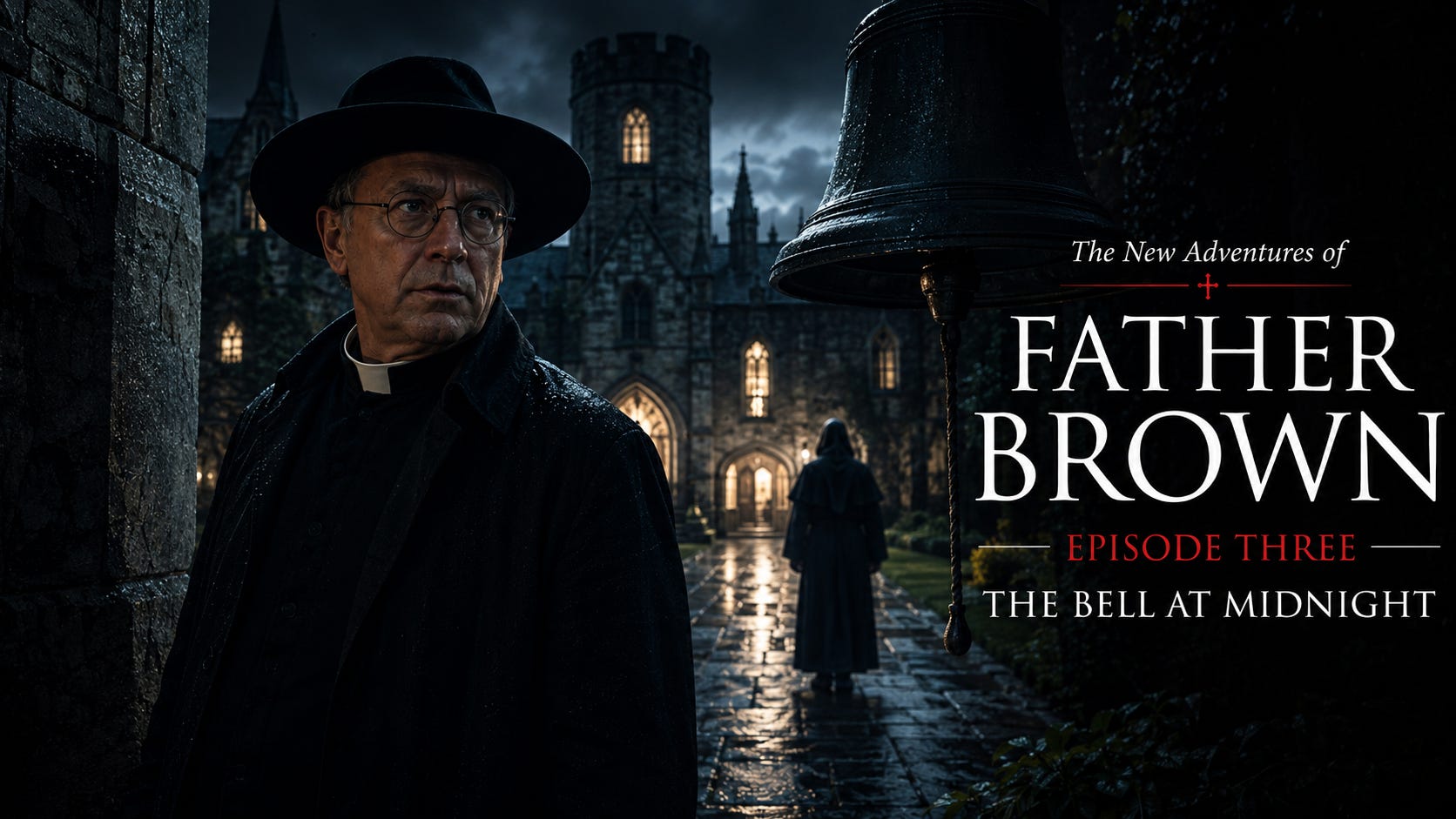
A barefoot figure in the archive passages, a locked tower, and two witnesses who swear they saw a dead man walking: the mystery at St. Anselm’s seems at last to have a solution. But Father Brown has begun to suspect that the most convincing evidence is convincing for exactly the wrong reason.
The darkness in the archive room lasted less than a minute, though afterward several persons remembered it as though it had lasted for an hour. There is a peculiar power in darkness when it comes suddenly upon frightened people. It does not merely remove lamps and outlines; it removes habits. Men who have spent a lifetime cultivating composure discover with some surprise that civilization is largely dependent upon switches, candles, and the presumption that no one is breathing behind them.
Inspector Bellamy found his pocket flashlight and struck its beam across the room in a wide, white arc. It caught Miss Copley pressed against a shelf of ledgers, Dean Harrow with one hand upon the table, Thomas Reed standing rigid near the doorway, and Sister Miriam motionless beside the old typewriter. Father Brown was not where Bellamy had last seen him. This fact annoyed the inspector even before it alarmed him.
“Father?” he called.
“I am here,” said the priest’s voice, from much nearer the little iron door than Bellamy liked.
The flashlight swung toward him. Father Brown was crouched beside the threshold, holding one finger against the stones as though testing whether the earth itself had a pulse.
“You will oblige me,” said Bellamy, “by not wandering toward suspicious noises in the dark.”
“I am sorry,” said Father Brown. “I did not wander very far.”
“That is not the point.”
“No,” said Father Brown thoughtfully. “It generally isn’t.”
Bellamy pushed past him and tried the little door. It did not yield. The old iron lock sat obstinately in the wood, scratched but secure. From beyond it came no further sound. If there had been footsteps, they had withdrawn into whatever unseen passage lay behind the wall.
“Who has the key?” demanded the inspector.
Dean Harrow answered after a visible struggle. “There may be one in the bursar’s office. I am not certain. That portion of the foundation has been closed for decades.”
“Closed things,” said Bellamy, “have a remarkably active night at this college.”
A runner was sent for tools and keys, and until he returned Bellamy ordered everyone back into the corridor. He did not enjoy being underground with a murdered man above him, frightened witnesses around him, and a possible intruder beneath the college foundations. He enjoyed it still less because the priest seemed calmer than any sane person had a right to be.
When they reached the upper library again, the storm had lessened but not ceased. Rain still tapped steadily against the high windows, though now it seemed farther away, as if the weather itself had grown tired of its own violence. A few lamps had been lit in the reading room. Their glow fell upon shelves of old books, dark portraits, and the broken tower door, where a constable stood looking as though he would have preferred arresting thieves in a railway yard to guarding supernatural architecture in a Catholic college.
The doctor had arrived during their absence: Dr. Ambrose Keane, an elderly physician whose face suggested that he had spent fifty years diagnosing both illness and nonsense, and had come to prefer illness. He had examined the body in the tower and now stood cleaning his spectacles with maddening thoroughness.
“Well?” asked Bellamy.
Dr. Keane replaced his spectacles and looked toward the tower stair. “Mr. Vale has been dead rather longer than the witnesses suppose.”
Bellamy’s expression sharpened. “How long?”
“I will not give you theatrical precision in a library at two in the morning. But I should say death occurred no later than eleven o’clock, and possibly earlier.”
Dean Harrow made a small sound.
Thomas Reed turned white.
Sister Miriam lowered her eyes.
Bellamy looked at Father Brown, who only blinked sadly, as if he had been told that rain was wet.
“That means,” said the inspector slowly, “that Reed and Sister Miriam could not have seen him alive at quarter to twelve.”
“No,” said the doctor. “They could not.”
Reed broke in with sudden desperation. “I saw him. I spoke to him.”
“You saw someone,” said Bellamy.
The student’s face hardened. “You think I imagined it?”
“I think,” replied Bellamy, “that a dead man was sitting in a locked tower while someone walked about the college in his coat.”
This was the first plain theory the night had produced, and like many plain theories it had the immediate advantage of making everyone feel less helpless. The murderer, then, had killed Sebastian Vale before eleven, locked him in the tower, disguised himself as Vale, allowed certain people to see him afterward, and thereby confused the time of death. Later he returned somehow, rang the bell, and staged the final discovery.
Bellamy began to feel better. He distrusted impossible mysteries but approved of disguised murderers. They belonged to the proper criminal classes.
“Who,” he said, “had access to Vale’s clothing?”
No one answered.
Father Brown, who had moved to the dead man’s chair in the library and was warming his hands at the edge of the fire, said mildly, “That is a very useful question, but perhaps not the first one.”
Bellamy exhaled. “Then what is the first one?”
“Why did the impersonator choose the two people least likely to mistake Mr. Vale?”
Reed stared at him.
The priest continued gently. “Mr. Reed hated him and had studied him closely. Sister Miriam feared him, or at least feared something connected with him, and fear is quite as observant as hatred. If one wishes to pass as a man after his death, one should appear to strangers, servants, or elderly trustees who have dined too well. One should not appear to the very persons whose nerves have been tuned to his presence.”
Bellamy paused.
It was a reasonable objection, and he disliked it accordingly.
“Unless,” he said, “they are lying.”
“Yes,” said Father Brown. “That is possible.”
“You don’t think they are?”
“I think they are telling the truth about something that was not true.”
The inspector put his notebook away with unnecessary firmness.
“That sentence is exactly why policemen drink.”
Before Father Brown could reply, the constable from the hall entered with a wet envelope in his hand. It had been found beneath the cloakroom bench, where Thomas Reed had thrown his coat earlier in the evening. The envelope was addressed to Reed in Sebastian Vale’s firm, elegant hand.
Bellamy opened it carefully and removed a single sheet.
He read it once, then again.
“What is it?” asked Reed.
Bellamy handed it to him.
The student read the first line and seemed to stop breathing.
Father Brown watched him with compassion.
The letter was short.
Mr. Reed,
You are in possession of stolen private correspondence belonging to the Vale Foundation and to several individuals whose reputations you are eager to destroy in the name of truth. If you publish, I will not answer you publicly. I will answer your mother privately. I know her circumstances, and I know yours. You are clever enough to understand me. Come to the tower tonight after dinner. Come alone.
S. Vale
Reed crumpled slightly around the page.
Bellamy’s voice was level. “Did you go to the tower?”
“No.”
“Did you receive this letter before the banquet?”
Reed said nothing.
“Mr. Reed.”
“Yes.”
“And you concealed it.”
“Yes.”
“Why?”
The young man’s expression twisted. “Because he was threatening my mother.”
“What circumstances?”
Reed looked as if he might refuse, then suddenly all the defiance went out of him.
“My father left debts. Medical debts. Vale paid them through one of his foundations. My mother thought it was charity. I thought it was charity. Then when I began asking questions, he sent that.”
Bellamy watched him closely. “So you went to confront him.”
“I went after dinner. I got as far as the library door and turned back.”
“Why?”
“Because I was afraid I would kill him.”
It was an honest answer, and for that reason it damaged him far more than a lie would have done.
Bellamy took the letter back.
“You later claimed you saw him in the cloister at twenty minutes to twelve.”
“I did see him.”
“After refusing to go to the tower?”
“Yes.”
“Convenient.”
Reed flushed. “It wasn’t convenient. It was horrible.”
Father Brown spoke for the first time. “What was he wearing?”
Reed blinked.
“His coat. The dark one with the fur collar. He had his hat pulled down because of the rain.”
“Did he turn toward you?”
“Yes.”
“Did you see his face clearly?”
Reed hesitated.
The hesitation was enough.
Bellamy gave a short laugh. “There we are.”
“I heard his voice,” said Reed angrily.
“Many men can imitate a voice.”
“Not that voice.”
Father Brown’s eyes sharpened slightly. “What do you mean by that?”
Reed looked confused by the question. “I mean it was his. Cold. Amused. As if he already knew what you were ashamed of before you knew it yourself.”
The little priest nodded, but not as though reassured.
Bellamy had Reed taken aside under guard, though not yet formally arrested. Then he requested Sister Miriam’s full statement.
They moved to a smaller reading room adjoining the library because the great hall had begun to hum with rumor. Dawn was still several hours away, but the night had already aged everyone in it. Sister Miriam sat by the window, her hands folded calmly upon her rosary. The rain behind her turned the glass into black water.
Bellamy placed Vale’s letter to Reed on the table.
“Did Mr. Vale also write to you?”
“No.”
“Did he threaten you?”
She considered this.
“Not in the way you mean.”
“How did he threaten you?”
“He threatened to tell the truth badly.”
Father Brown looked up.
Bellamy’s patience thinned. “Truth does not usually require adjectives.”
“Oh, it almost always does,” said Father Brown. “There is a truth told by a friend, a truth told by a judge, and a truth told by an enemy. They may contain the same facts and produce three entirely different falsehoods.”
Sister Miriam gave him a grateful glance, then continued. “Years ago a young man connected with the college was thought by some to possess unusual holiness. There were stories of prayer, penance, cures, perhaps even miracles. Most of it was foolishness, but not all of it was false. Mr. Vale became interested.”
“Interested how?”
“He wished to promote the story.”
“As a saint?”
“As an emblem. A cause. A banner for the new institute.”
Bellamy stared. “You’re telling me Sebastian Vale was murdered over a publicity campaign for a saint?”
“No,” said Father Brown softly. “She is telling you that a human being was in danger of being turned into an argument.”
Sister Miriam’s face trembled almost imperceptibly. “The young man did not want attention. He feared it. He believed the admiration would destroy him. Mr. Vale believed humility was merely a more marketable form of greatness.”
“Name,” said Bellamy.
The sister hesitated.
“Name,” he repeated.
“Brother Anselm.”
Dean Harrow, who had been standing near the door, spoke sharply. “He left years ago.”
“Where is he now?” asked Bellamy.
“We do not know.”
Sister Miriam said, “He may have returned.”
Bellamy leaned forward. “You think the barefoot prints belonged to him?”
“I think someone wished me to think so.”
That answer caused even Father Brown to glance at her with interest.
Bellamy said, “Explain.”
The sister took a breath. “Brother Anselm sometimes walked barefoot as a penance. It became one of the stories people told about him. Too many stories were told about him. That was part of the harm. The prints in the archive were too deliberate, too visible, too theatrical. Whoever left them knew the legend.”
The inspector was silent a moment.
Then he said, “And you did not mention any of this because?”
“Because reverence can become a kind of cruelty when exposed to curiosity.”
Bellamy looked as though he would have preferred another hidden door to that sentence.
At half past two, the bursar’s keys were finally located, though none opened the little iron door below the archives. Tools were brought. The lock was forced. Bellamy, Father Brown, Dean Harrow, and two constables descended again with lanterns and electric torches.
The door opened into a narrow stone passage sloping beneath the old foundation. The air was colder there. It carried the smell of earth and standing water. Along one side ran rusted pipes; along the other, old niches in the masonry suggested a time when the passage had been used for storage, or burial, or both. The floor showed patches of damp dust disturbed by bare feet.
They followed the prints for perhaps twenty yards.
Then they ended.
Not faded.
Not mingled with other marks.
Ended.
Bellamy stood staring down at the last footprint, which lay clearly in a patch of pale dust. Beyond it the floor was undisturbed.
“That,” he said, “is impossible.”
Father Brown looked around the passage, then lifted his lantern toward the wall. There, just above shoulder height, a line of moisture darkened the stones. He touched it and smelled his fingers.
“Soap,” he said.
Bellamy frowned. “What?”
“Or something near it. A cleaning solution, perhaps.”
The inspector shone his light farther down the passage. Nothing moved.
Behind them, one of the constables called out.
They returned to find, tucked into a niche in the wall, a black coat with a fur collar and a felt hat. Both were wet. Both belonged to Sebastian Vale.
Inside the coat pocket was a second sheet of stationery.
Bellamy unfolded it.
The message was written in block capitals:
BROTHER ANSELM HAS COME HOME.
For a moment the inspector simply stared at it. Then the practical machinery of his mind, relieved at last to have a suspect with a name, began to turn rapidly.
A disgraced holy man returns. Vale threatens to expose or exploit him. Brother Anselm kills Vale before eleven, dons his coat, impersonates him in the cloister, stages the locked-room mystery, retreats through the old passages, and leaves traces to suggest both sanctity and madness. It was strange, certainly, but no longer shapeless.
When they returned to the library, Bellamy ordered a search of the grounds, the chapel, the dormitories, and the unused monastery buildings.
By three o’clock, they found Brother Anselm in the old sacristy.
He was kneeling before an empty altar.
He was barefoot.
He was not old, though sorrow had given him the air of age. His beard was untrimmed, his clothes poor, and his hands clasped so tightly that the knuckles shone white in the candlelight. When Bellamy entered, he did not run. He did not even turn.
“Brother Anselm?” said Bellamy.
The man bowed his head.
“I have been expecting you.”
“For the murder of Sebastian Vale?”
Brother Anselm closed his eyes.
“For whatever God permits men to think of me.”
Bellamy searched the small room. Beneath a bench they found a damp cloth, a pair of ordinary shoes, and a key that opened the tower door.
That was enough.
Thomas Reed had motive, certainly; Sister Miriam had concealments; Dean Harrow had fear. But Brother Anselm had legend, access, costume, bare feet, and the key to the locked tower.
At four o’clock, Inspector Bellamy formally arrested him.
The storm had ended by then, leaving the college in that strange, washed silence that follows a violent night. Grey light gathered slowly behind the library windows. Birds began making tentative remarks in the gutters.
Bellamy found Father Brown in the cloister looking at the wet stones.
“You look disappointed,” said the inspector.
“I am.”
“You should be pleased. We have the man.”
“Yes,” said Father Brown. “That is why I am disappointed.”
Bellamy folded his arms. “He had the key.”
“Yes.”
“He had the bare feet.”
“Yes.”
“He had motive.”
“Possibly.”
“He had Vale’s coat hidden in the passage.”
“Yes.”
“And he was found praying in an empty sacristy like a man waiting for judgment.”
Father Brown looked at him with mild surprise. “My dear inspector, innocent men often wait for judgment. Guilty men generally prefer lawyers.”
Bellamy stared at him in disbelief.
“You think he did not kill Vale?”
“I think,” said Father Brown, “that Brother Anselm is the one man in St. Anselm’s who could not have committed this murder.”
“Why?”
“Because he is guilty of something much worse in his own mind.”
Bellamy opened his mouth and closed it again.
Father Brown pointed with his umbrella toward the cloister stones, where rainwater had collected in shallow seams.
“You see, Inspector, the murderer wished very much to seem like a saint pretending to be a sinner. But Brother Anselm is something far more troublesome. He is a sinner terrified that others will mistake him for a saint.”
“That distinction,” said Bellamy, “will not survive in court.”
“No,” said Father Brown sadly. “But it may survive in confession.”
At that moment a constable hurried toward them from the library, holding something wrapped in a handkerchief.
It was the brass bell from the tower.
The constable’s face was pale.
“We found this in Brother Anselm’s cell, sir.”
Bellamy turned triumphantly, but Father Brown did not look at the bell.
He looked at the handkerchief.
Then at the constable’s hands.
Then, very quietly, he said, “That is unfortunate.”
“For Brother Anselm?” asked Bellamy.
“No,” said Father Brown.
The priest looked back toward the tower, where the first light of dawn touched the wet stones like a warning.
“For the murderer.”