

Intro
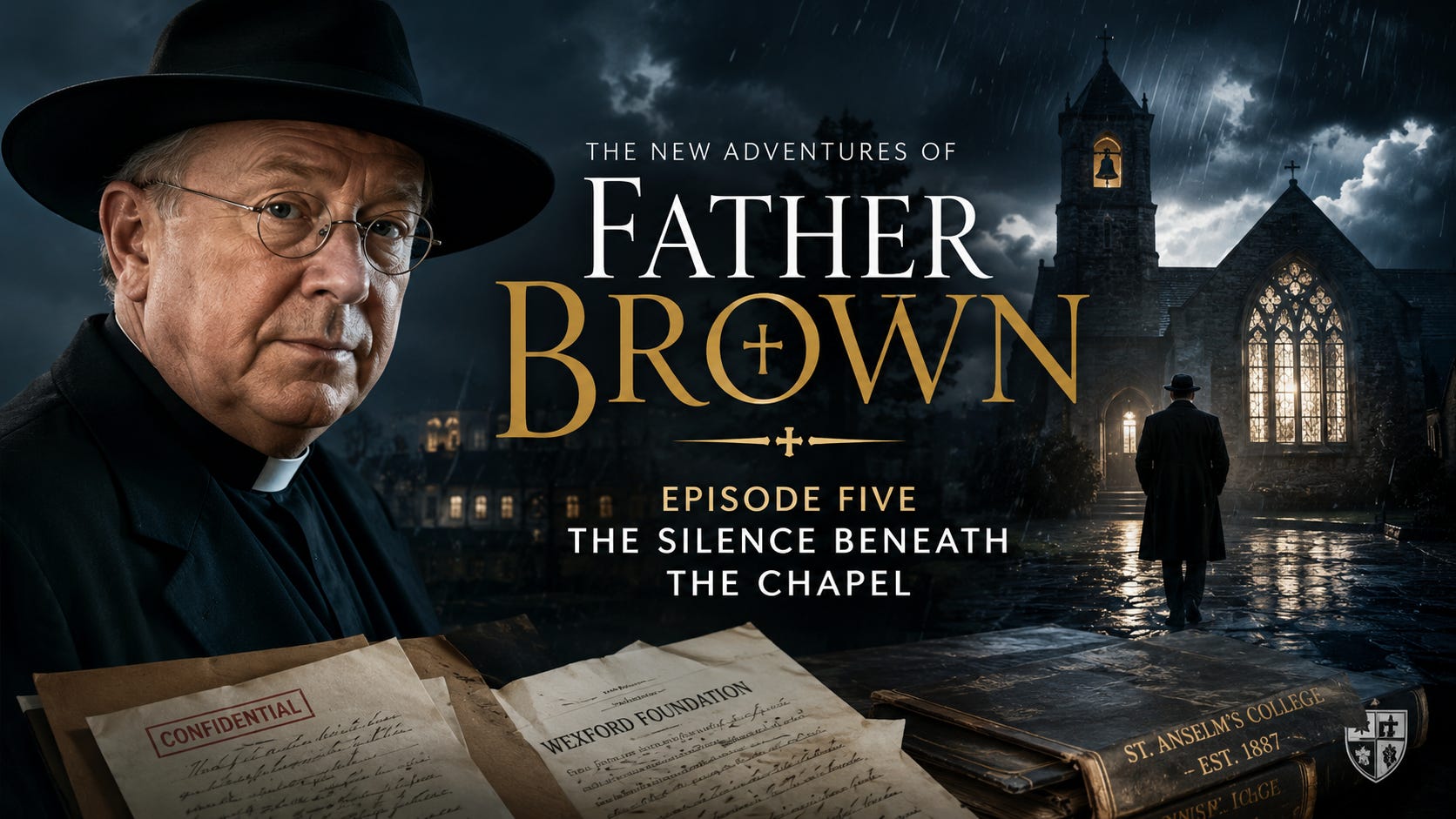
The rain had not stopped for three days at St. Anselm’s.
The old college stood above the river like a dark ship stranded against the storm — its chapel bells carrying across empty courtyards, its stone corridors whispering with rumors no one wished to repeat aloud. Sebastian Vale was dead. Brother Anselm sat imprisoned. And yet Father Brown remained quietly certain that the true crime had not yet been discovered.
For murder is often simpler than the lies respectable men tell themselves.
In this fifth episode of The New Adventures of Father Brown, the beloved priest-detective descends beneath the ancient chapel foundations of St. Anselm’s College, uncovering forgotten archives, buried scandals, and a terrifying question:
What if the greatest danger to a good institution is not wickedness… but the desperate fear of losing its good name?
Tonight’s mystery is not merely about death.
It is about the silence that respectable men mistake for virtue.
Welcome once again to the shadows of St. Anselm’s.
The rain had returned to St. Anselm’s in a gentler form.
Not the violent storm that had shaken the college on the night Sebastian Vale died, but a slow and persistent rain that seemed less like weather than memory. It whispered continually against the old stone walls, drifted through the bare branches along the cloister paths, and turned the river below the college into a sheet of dark moving glass.
Father Brown stood beneath the covered arcade overlooking the lower quadrangle with his umbrella folded beneath one arm. He had remained motionless there for nearly ten minutes, watching the chapel bell tower disappear and reappear inside drifting curtains of rain.
Behind him came the sound of approaching footsteps.
Inspector Bellamy emerged from the corridor fastening his gloves with visible irritation.
“You’ve chosen a remarkable time for reflection,” he said. “Half the county believes we arrested the wrong man, the bishop’s office telephones every hour, and the newspapers are already speaking of conspiracies.”
Father Brown nodded faintly.
“Yes,” he said. “Newspapers are very fond of conspiracies. They make ordinary sins sound much grander than they are.”
Bellamy stared at him.
“You still believe Brother Anselm is innocent.”
“Yes.”
“You say that with extraordinary certainty for a man who cannot explain the evidence.”
Father Brown turned slowly toward him.
“Oh, I can explain the evidence perfectly well. What I cannot explain is the soul behind it.”
Bellamy removed his gloves again with restrained annoyance.
“I’m afraid that distinction means very little in a criminal investigation.”
“It means everything,” said Father Brown softly. “Evidence tells us what happened. Sin tells us why.”
The inspector exhaled sharply.
“Then perhaps you might finally explain why a monk’s fingerprints were found on the murder weapon.”
Father Brown looked again toward the bell tower.
“Because Brother Anselm discovered the body first.”
Bellamy frowned.
“That still leaves motive.”
“No,” said Father Brown quietly. “It leaves only scandal.”
The inspector folded his arms.
“You continue to speak in riddles.”
“I speak plainly enough,” said Father Brown. “But modern people prefer complicated lies to simple truths.”
A gust of damp wind moved through the arcade.
Far below, the river rolled darkly through the valley.
Then Father Brown said, almost absently:
“Tell me, Inspector… did you ever notice how frightened respectable institutions are of embarrassment?”
Bellamy stared.
“I should imagine most institutions dislike embarrassment.”
“Yes,” said Father Brown. “But only certain kinds are willing to commit mortal sins to avoid it.”
The college dining hall had become unnaturally quiet since the arrest.
Students spoke in whispers. Priests avoided one another’s eyes. The servants crossed corridors as though afraid sound itself might awaken some sleeping thing beneath the old foundations.
Father Brown sat alone near the back of the refectory stirring tea that had long since gone cold.
At the far end of the hall Dean Harrow stood speaking in hushed tones with two diocesan officials recently arrived from Kansas City.
The dean’s face looked thinner now.
Not guilty.
Not murderous.
Simply exhausted.
Father Brown watched him carefully.
A man burdened by guilt behaves one way.
A man burdened by fear behaves another.
And Harrow, Father Brown thought, looked profoundly afraid.
The young priest beside him finally noticed Father Brown observing them. Their conversation ended immediately.
That, too, Father Brown noticed.
Moments later Dean Harrow crossed the room.
“You wished to speak with me?”
Father Brown smiled pleasantly.
“Oh no. But I believe you wish very much to speak with me.”
The dean hesitated before sitting opposite him.
For several seconds neither spoke.
Then Harrow said quietly:
“You think I’m hiding something.”
“My dear Dean,” said Father Brown gently, “everyone at St. Anselm’s is hiding something.”
Rain tapped softly against the stained glass windows.
At last Harrow leaned forward.
“You don’t understand what this place means.”
“No,” said Father Brown. “I understand exactly what it means. That is why I am worried.”
The dean’s voice lowered further.
“If this college collapses, hundreds of boys lose their education. The seminary closes. The scholarship foundation disappears. The parish schools tied to our funding—”
“Yes,” said Father Brown calmly. “And that is exactly how good men become dangerous.”
Harrow’s eyes narrowed.
“You think we killed Vale to preserve the college?”
“No,” said Father Brown. “I think someone killed him because he intended to stop preserving it.”
That sentence seemed to strike the dean physically.
He looked away at once.
And Father Brown knew.
Not the murderer.
But the truth.
That evening Father Brown descended alone into the lower archive chambers beneath the chapel.
The stairway was narrow and ancient, built from uneven limestone darkened by generations of candle smoke and moisture. Few students even knew the passages existed anymore. Most had been sealed decades earlier during renovations.
Father Brown carried only a lantern.
The deeper chambers smelled of wet stone, old paper, and forgotten years.
He moved slowly along rusted shelving and abandoned record cabinets until he reached a heavy wooden door swollen with age.
The lock had already been broken.
Recently.
Father Brown paused.
Then entered.
Inside lay boxes of financial ledgers, correspondence, and donation records dating back nearly forty years.
Many had been disturbed.
One cabinet stood open entirely.
And on the floor beside it lay a torn envelope bearing a familiar name.
ALISTAIR WEXFORD.
Father Brown frowned.
The great benefactor of St. Anselm’s.
The man whose donations had supposedly saved the college during its financial crisis decades earlier.
The beloved legend.
The miracle benefactor.
Father Brown knelt slowly and opened the envelope.
Inside were letters.
Not charitable pledges.
Threats.
Demands.
Accounts of fraudulent land transfers and concealed debts.
And one final letter written in Sebastian Vale’s own hand only three weeks earlier.
The truth cannot remain buried forever. If the board refuses disclosure, I shall make the matter public myself.
Father Brown closed his eyes.
There it was.
Not greed.
Not revenge.
Not hatred.
Fear.
A terrible fear disguised as loyalty.
Behind him, somewhere in the darkness of the corridor, came the faint sound of footsteps.
Then silence.
Father Brown did not turn around.
Instead he said quietly:
“You know, the curious thing about lies is that they are usually told for very noble reasons.”
Nothing answered.
“But murder,” Father Brown continued gently, “is almost always committed for ordinary ones.”
A shadow shifted near the doorway.
Still Father Brown did not look up.
“You loved this place too much.”
The figure stepped partially into the lantern light.
Dean Harrow.
Rainwater glistened faintly across his coat shoulders.
His face had gone pale.
“You shouldn’t have come down here,” he whispered.
Father Brown sighed softly.
“My dear friend… neither should you.”
The dean sat heavily against the old records table.
For a long time he said nothing.
Then at last:
“You have no idea what those years were like.”
Father Brown remained silent.
“The college was dying,” Harrow said. “Enrollment collapsing. Debt everywhere. The bishop ready to shut us down entirely.”
His voice shook now.
“Wexford arrived like providence itself. Donations. Land. Scholarships. Expansion money. Everyone believed he saved St. Anselm’s.”
Father Brown nodded slowly.
“But he caused the collapse in the first place.”
Harrow lowered his head.
“Yes.”
The rain above the chapel roof sounded suddenly louder.
“He manipulated the debt markets through shell companies,” Harrow continued weakly. “Created panic. Forced the board into desperation. Then rescued us publicly.”
“And became a saint.”
“Yes.”
The dean’s hands trembled visibly.
“Only three people ever knew the truth. Wexford himself. Father Ignatius. And later Sebastian Vale.”
Father Brown said quietly:
“And Vale decided the lie had gone on long enough.”
“Yes.”
The word barely escaped him.
“He said institutions built on falsehood eventually destroy themselves anyway. He wanted full disclosure. Public confession. Financial transparency.”
Harrow laughed bitterly.
“You know what would have happened? The lawsuits alone would have destroyed us. Every scholarship fund. Every parish program. Everything.”
“So you killed him.”
The dean closed his eyes.
“I only wanted to stop him talking.”
His voice cracked completely now.
“We argued in the library. He accused me of worshipping the institution instead of the truth. Said I had mistaken preservation for virtue.”
Father Brown said nothing.
“He turned to leave,” Harrow whispered. “And then the bell rang.”
Father Brown looked up.
“The chapel bell.”
Harrow nodded faintly.
“It startled him. The storm shook the tower. The sound echoed through the library. And suddenly I—I struck him.”
Silence filled the chamber.
Then Harrow whispered:
“I didn’t even know I had done it until he fell.”
The priest buried his face in his hands.
“I loved this college.”
Father Brown’s expression became unbearably sad.
“Yes,” he said softly. “That was the problem.”
The procession began just after Compline.
Students and clergy moved silently through candlelit chapel aisles while rain battered the stained glass above them.
Father Brown stood near the rear as Dean Harrow slowly approached the altar to surrender himself publicly.
The college would survive.
But differently now.
Smaller perhaps.
Poorer certainly.
Yet cleaner.
And therefore stronger.
As Harrow passed him, he stopped briefly.
“I thought I was saving St. Anselm’s.”
Father Brown nodded sadly.
“Most terrible things are done by people who think they are saving something.”
The dean’s eyes filled.
“And Brother Anselm?”
“He’ll forgive you,” said Father Brown quietly. “Monks are very inconvenient that way.”
For the first time in days, Harrow almost smiled.
Then he continued forward alone.
Father Brown remained near the shadows beneath the side chapel.
Above him the great bell began once more to ring through the storm.
But now its sound no longer resembled accusation.
Only truth.
And somewhere beneath the ancient stones of St. Anselm’s, buried beneath decades of fear and silence, something imprisoned at last had been set free.
Outro / Postscript
Thank you for visiting St. Anselm’s once more.
The New Adventures of Father Brown continues as an original Chesterton Radio mystery series inspired by the spiritual paradoxes, moral mysteries, and deeply human vision of G.K. Chesterton.
If you enjoyed this episode, you’ll find many more worlds waiting beyond the chapel doors:
— original mystery serials
— literary fiction in the spirit of classic radio drama
— BBC-style theatrical storytelling
— deep dives into forgotten books and old-time radio
— daily reflections, essays, and broadcasts from the world of Chesterton Radio
The signal continues day and night at:
And at the ever-open live stream:
If these stories matter to you — if you believe there is still room in the modern world for mystery, wonder, goodness, and intelligent storytelling — consider becoming a subscriber or sharing Chesterton Radio with another listener.
Because somewhere beyond the storm…
the bells are still ringing.