

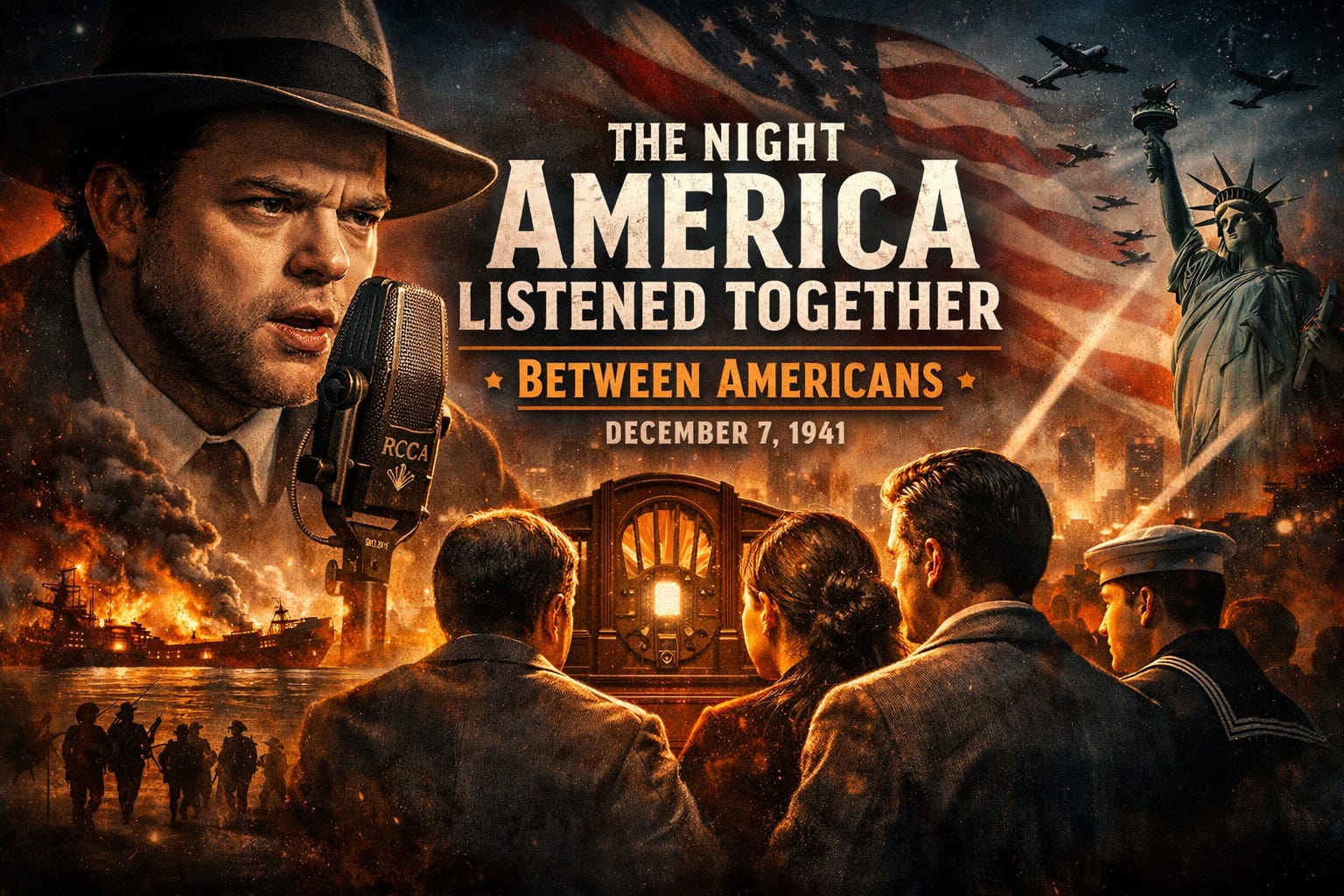
On the evening of December 7, 1941, the American people did something almost forgotten in our age of perpetual noise: they listened.
They had awakened to a quiet Sunday. They went to church. They visited family. They read the paper. And by late afternoon the name of a distant harbor—Attack on Pearl Harbor—had struck the republic like a thunderclap in a clear sky.
That night, before the long war had acquired statistics, before ration books and casualty lists, before victory gardens and gold stars in windows, there was simply shock. And into that shock stepped a man with a pen and a microphone: Norman Corwin.
The result was Between Americans.
And if ever there was a moment when radio proved itself not merely an entertainment but a kind of national hearth, it was that night.
Not a Story — But a Gathering
Between Americans is not a drama in the usual sense. There is no detective, no villain, no twist ending. There is instead a conversation—sometimes whispered, sometimes ringing—between citizens suddenly conscious of their shared fate.
Corwin did not dramatize the explosions in Hawaii. He dramatized the echo in the American heart.
Voices speak across distance. Ordinary Americans are invoked. The tone moves from stunned quiet to sober resolve. The script is at once poetic and practical—less a speech than a weaving together of threads.
And guiding this tapestry is the unmistakable voice of Orson Welles.
Welles does not thunder. He steadies.
His presence is not theatrical excess but moral ballast. The voice that once sent Martians striding across New Jersey now anchors a republic reeling from real fire.
What Americans Heard That Night
Imagine the scene.
In farmhouses and city apartments, in boarding rooms and living rooms, Americans gathered around wooden radio cabinets. The lights were dim. The air was tense. Newspapers lay half-folded on coffee tables.
There were no push notifications. No scrolling feeds. Only a dial.
And then came words.
Not shrill denunciations. Not hysteria. Not propaganda disguised as fury.
Instead, Corwin offered something far rarer: a meditation on what it means to be American when being American suddenly costs something.
He spoke of:
Unity without uniformity
Courage without cruelty
Anger disciplined into purpose
Democracy as a living compact between neighbors
It was, in short, a defense of the American idea at the very moment it was tested.
Between Fear and Hatred
The genius of Between Americans is in its title.
Corwin understood that the most dangerous space in wartime is not between nations—it is between citizens.
The temptation in such moments is to let fear curdle into suspicion, and suspicion into hatred—not merely of enemies abroad, but of neighbors at home.
Corwin’s script refuses this descent.
He does not deny the seriousness of the attack. He does not soften the blow. But he insists that the American response must be moral before it is military.
This is not a call to vengeance. It is a call to responsibility.
There is a Chestertonian paradox here: the nation grows strongest not by shouting the loudest, but by remembering who it is.
The Sound of a Republic
We speak today of “viral moments.” But on December 7, 1941, there was something more profound than virality: simultaneity.
Millions heard the same words at the same time.
In that hour, America was not a scattered archipelago of opinions—it was a single listening body.
Radio, in its golden age, was not merely a device. It was a commons.
Corwin belonged to that remarkable generation of radio craftsmen who understood that microphones could carry not just sound, but conscience. In the company of innovators like William N. Robson, he used entertainment—even light entertainment—to explore grave questions. Later writers from Rod Serling to Norman Lear would inherit that seriousness of purpose.
But on this night, the purpose was immediate.
The republic had been struck.
And radio answered.
Why It Still Matters
We know, with the cruel hindsight of history, what followed.
We know the beaches, the battles, the names engraved on monuments. We know that the United States would enter the great conflagration of the Second World War.
But those listeners did not know any of that.
They knew only that the world had shifted beneath their feet.
Between Americans preserves the emotional pivot point between innocence and endurance.
It captures the precise moment when grief becomes resolve.
That is why this broadcast matters. Not as nostalgia. Not as museum glass.
But as a living artifact of national character under strain.
Listening Again — Together
When we present Between Americans on Chesterton Radio, we are not merely replaying an old file. We are reopening a room.
We are stepping back into the evening when Americans chose to listen—carefully, soberly, together.
In an age of endless shouting, there is something almost revolutionary about that.
So I invite you:
Sit. Dim the lights. Imagine the dial turning.
Hear Corwin’s words. Hear Welles’ voice.
And consider whether we might yet recover something of that quiet strength—the strength of citizens who know that the truest battle is not only on distant shores, but in the space between Americans.
🎙 Listen to the full broadcast here:
http://BetweenAmericans.ChestertonRadio.com
Chesterton Radio is listener-supported. If you believe timeless voices still matter—if you believe that drama can steady a nation and stories can fortify the soul—consider joining our Listener’s Club on Substack.
Stories that stir the mind.
Drama that feeds the soul.
Welcome back to the theatre of the mind.