

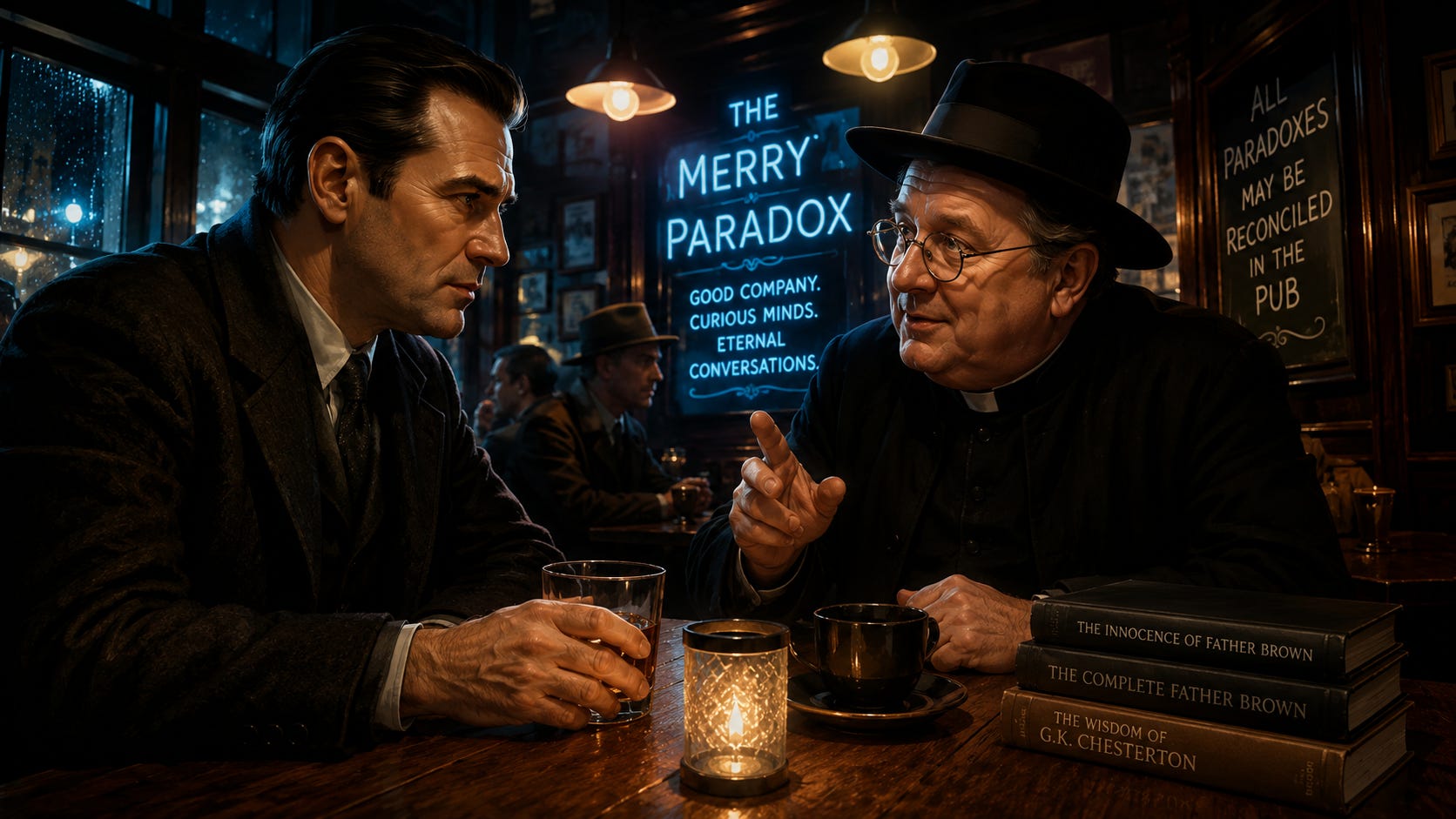
There are some who insist that The Merry Paradox cannot be found.
Others insist that it can only be found accidentally.
A few maintain that it appears only to those who have become lost while searching for something else entirely.
The regulars, for their part, have little patience with such speculation. They merely note that the pub has stood where it stands for longer than anyone can remember, that the fire is always warm, that the ale is always excellent, and that one should not inquire too closely into the geography of places that seem determined to remain mysterious.
The Merry Paradox occupies a narrow corner of a street that does not appear on any map. Outside, gas lamps glow in a perpetual twilight. The fog drifts lazily along the cobblestones. No clock within the establishment has ever been known to agree with another, yet nobody has ever arrived late.
On a certain evening, the sort of evening when rain seemed undecided whether to fall or merely threaten, the pub was unusually quiet.
A broad-shouldered man occupied a table near the hearth.
His black hat rested on the bench beside him.
A walking stick leaned against the wall.
His waistcoat strained heroically against proportions that would have defeated lesser tailoring.
He was studying a frothing mug of ale with the concentration of a scientist examining a newly discovered species.
The man was Gilbert Keith Chesterton.
He appeared perfectly content.
This was hardly surprising.
Chesterton possessed the remarkable ability to become delighted by almost anything.
A lamppost.
A loaf of bread.
A button.
A cloud.
A contradiction.
Especially a contradiction.
To Chesterton, the universe was not a machine that required explanation but a miracle that required gratitude.
He raised his mug, regarded it thoughtfully, and smiled.
“The great weakness of modern philosophy,” he murmured to nobody in particular, “is that it spends so much time asking why beer exists and so little time thanking God that it does.”
The door opened.
A cold gust of air entered.
Behind it came a tall, lean gentleman in a dark coat.
His face was sharp.
His eyes were sharper.
Everything about him seemed arranged with mathematical precision.
He paused only briefly before surveying the room.
His gaze moved across the bar.
Across the fireplace.
Across the scattered patrons.
Across Chesterton.
Then returned immediately to Chesterton.
The newcomer removed his gloves.
“I observe,” he said, “that you have recently returned from a train journey.”
Chesterton blinked.
“My dear fellow,” he said, “I haven’t even introduced myself yet.”
“No.”
“And yet you know where I have been.”
“Quite.”
“That is either remarkably clever or exceptionally rude.”
The man allowed the faintest suggestion of a smile.
“Sherlock Holmes.”
Chesterton’s eyes widened with delight.
Not surprise.
Delight.
The difference mattered.
Most men meeting Sherlock Holmes experienced intimidation.
Chesterton reacted as though a favorite character had stepped out of a book.
“My dear Mr. Holmes!”
Holmes sat opposite him.
“I had hoped to meet you eventually.”
“And I had hoped,” said Holmes dryly, “to determine whether the stories were exaggerated.”
“Which stories?”
“All of them.”
Chesterton laughed.
The sound rolled through the pub like distant thunder.
“I assure you they are.”
“Good.”
“Unfortunately, they are exaggerated in both directions simultaneously.”
The waiter arrived.
Holmes ordered tea.
Chesterton looked momentarily heartbroken.
“You have entered a pub and ordered tea.”
“It sharpens the mind.”
“Ale sharpens the soul.”
“I shall reserve judgment.”
“You see?” Chesterton said happily. “We are already disagreeing.”
For several moments they sat in comfortable silence.
The fire crackled.
Rain tapped gently against the windows.
The other patrons sensed something unusual was unfolding and discreetly shifted closer.
Not obviously.
Just enough.
The way people edge nearer to a fireplace during winter.
Finally Holmes folded his hands.
“You interest me, Mr. Chesterton.”
“I am relieved. Most people merely tolerate me.”
“You believe things.”
“I try to.”
“Extraordinary things.”
“Reality is extraordinary.”
Holmes leaned forward.
“That is precisely where we differ.”
Chesterton nodded.
“Please continue.”
“Reality is not extraordinary.”
Holmes gestured toward the room.
“It is governed by laws.”
His voice carried the confidence of a man who had spent a lifetime observing patterns.
“Every event has a cause. Every mystery has an explanation. Every apparent miracle is simply a fact whose mechanism remains undiscovered.”
Chesterton listened attentively.
He did not interrupt.
He never feared ideas.
Only the absence of them.
Holmes continued.
“The universe is intelligible because it is orderly.”
“And therefore?”
“And therefore miracles do not occur.”
Chesterton considered this carefully.
Then he took a long drink.
When he lowered the mug, his eyes were twinkling.
“My dear Holmes.”
“Yes?”
“You have just described a miracle.”
Holmes frowned.
“I have done no such thing.”
“Oh, but you have.”
Chesterton spread his hands.
“You say the universe possesses order.”
“It does.”
“You say it possesses laws.”
“It does.”
“You say it possesses reason.”
“It does.”
“Then why?”
Holmes paused.
The pause was slight.
But it existed.
Chesterton saw it immediately.
Most men would not have noticed.
They would have mistaken Holmes’s confidence for certainty.
Chesterton knew the difference.
“The extraordinary thing,” Chesterton continued gently, “is not that miracles happen. The extraordinary thing is that anything happens at all.”
Holmes remained silent.
“The real mystery is not that water occasionally becomes wine.”
Chesterton pointed toward the window.
“The mystery is that water exists.”
The fire popped loudly.
Several patrons exchanged glances.
Chesterton’s voice grew softer.
“Every morning we awaken inside a universe that did not have to exist.”
He smiled.
“And yet modern men insist upon treating this fact as ordinary.”
Holmes studied him.
For the first time he seemed uncertain whether he was debating a journalist, a philosopher, or a madman.
Possibly all three.
“You reverse the argument,” Holmes said.
“Frequently.”
“Intentionally?”
“Always.”
A faint smile appeared on Holmes’s face.
“I begin to understand why people find you dangerous.”
Chesterton laughed again.
“Only dangerous to boredom.”
The conversation continued for hours.
They debated reason.
They debated faith.
They debated crime.
They debated whether human beings were fundamentally rational.
Holmes maintained that reason was mankind’s greatest tool.
Chesterton agreed.
Then insisted that reason alone was insufficient.
“A ladder is a magnificent invention,” he said.
“But one should remember that its purpose is to climb somewhere.”
At one point Holmes delivered an elegant explanation of how human behavior could often be predicted through observation.
Chesterton applauded sincerely.
Then asked why human beings continually behaved against their own interests.
Holmes admitted that they did.
Chesterton asked why.
Holmes admitted he did not know.
The debate wandered through philosophy, theology, detective fiction, London weather, pipe tobacco, criminal psychology, and the proper preparation of eggs.
The eggs occupied nearly twenty minutes.
Toward midnight the rain ceased.
The pub had grown quieter.
Many patrons had departed.
The remaining few listened openly now.
The pretense of privacy had become impossible.
Holmes stared thoughtfully into the dying fire.
“You know,” he said at last, “there is something peculiar about your philosophy.”
“There are several things peculiar about my philosophy.”
“One in particular.”
Chesterton nodded encouragingly.
“You seem convinced that wonder increases when things are explained.”
Chesterton smiled.
“Yes.”
“Most men assume the opposite.”
“Most men are mistaken.”
Holmes considered this.
“When I identify the solution to a mystery, the mystery ends.”
Chesterton shook his head.
“No.”
“No?”
“The little mystery ends.”
“And the larger?”
“The larger mystery begins.”
Holmes waited.
Chesterton pointed toward the flames.
“You discover who committed a crime.”
“Yes.”
“But not why human beings can choose evil.”
Holmes nodded reluctantly.
“You identify a footprint.”
“Yes.”
“But not why there are persons capable of leaving footprints.”
The smile returned.
“You solve the puzzle.”
“Naturally.”
“But the universe remains unsolved.”
For a long moment neither man spoke.
The fire settled into glowing embers.
Outside, the fog drifted past the windows like a silent tide.
Finally Holmes rose.
“I confess something.”
Chesterton looked delighted.
Confessions were among his favorite things.
“I expected to dislike you.”
“And?”
“I was mistaken.”
Chesterton stood as well.
“A rare occurrence, I am told.”
“A very rare occurrence.”
They shook hands.
Not as opponents.
Not even as rivals.
As explorers who had discovered they were mapping different regions of the same territory.
Holmes gathered his coat.
At the door he paused.
“There is one thing I still cannot determine.”
Chesterton’s eyes brightened.
“What is that?”
Holmes gestured toward the pub.
“This place.”
“The Merry Paradox?”
“Precisely.”
“I wondered when you would ask.”
“Who owns it?”
Chesterton smiled.
“Nobody.”
“Impossible.”
“Quite possible.”
“Who built it?”
“No one knows.”
“Where does it exist?”
Chesterton looked around the room.
At the fire.
At the lamps.
At the old wood beams.
At the faces of the patrons.
At the impossible comfort of the place.
Then he shrugged.
“I suspect,” he said, “that it exists wherever people still enjoy being wrong before they discover they are right.”
Holmes stared at him.
Then he laughed.
It was not a loud laugh.
It was not even a long laugh.
But it was genuine.
Perhaps the rarest sound in the room.
The detective opened the door and stepped into the fog.
The door closed behind him.
The room grew quiet again.
Chesterton returned to his table.
The waiter approached.
“Another ale, sir?”
Chesterton looked toward the door through which Holmes had vanished.
Then he smiled.
“Yes.”
He lifted the empty mug.
“And perhaps a cup of tea.”
For the first time that evening, the entire pub burst into laughter.
Outside, somewhere beyond the fog, Sherlock Holmes was smiling too.
The Merry Paradox
Episode Two: Father Brown, Sam Spade, and the Price of a Soul
The following Thursday—or perhaps the Thursday before that, or the Thursday fifty years from now; time being an unusually flexible commodity at The Merry Paradox—the pub was crowded enough to be cheerful but not crowded enough to be noisy.
This was a distinction the regulars appreciated.
There are establishments where conversation must struggle against noise. There are others where silence hangs over the room like an obligation. The Merry Paradox managed the rare achievement of encouraging both. Men argued there without quarreling. They reflected there without becoming solemn. They disagreed there without becoming enemies.
The fire burned brightly against the damp chill beyond the windows. Lamps cast warm pools of amber light upon polished wood. Somewhere near the far wall a group was engaged in an animated discussion about whether pirates were fundamentally more romantic than cowboys. Neither side appeared willing to surrender.
At a corner table sat Father Brown.
Unlike Chesterton, who seemed capable of filling any room simply by entering it, Father Brown possessed the opposite gift. One could look directly at him and somehow fail to notice him. He was small, round-faced, quietly dressed, and entirely unremarkable until he began speaking.
Then one discovered that beneath the appearance of an absent-minded parish priest was one of the keenest observers of the human heart ever to walk the earth.
He sat with a modest meal before him and a book that appeared to be losing an argument with age.
Father Brown was reading.
Or perhaps praying.
With him it was often difficult to distinguish between the two.
The door opened.
A gust of cold air swept through the room.
The newcomer wore a dark suit and a darker expression.
His hat was tilted slightly forward.
His eyes carried the permanent fatigue of a man who had spent too many years discovering unpleasant truths about human nature.
He paused inside the doorway, surveyed the room, and looked immediately as though he regretted entering.
Which, for Sam Spade, was often a promising beginning.
The private detective removed his hat and approached the bar.
“A whiskey.”
The bartender nodded.
Spade accepted the glass and turned to inspect the room once more.
His gaze stopped at Father Brown.
The priest appeared harmless.
Which was suspicious.
Everyone else in the room seemed to be engaged in conversation. The little priest appeared perfectly content to sit alone.
Spade had spent his life learning that appearances lied.
The harmless ones were often the dangerous ones.
The dangerous ones were occasionally harmless.
The trick was figuring out which was which before somebody got killed.
He carried his whiskey to Father Brown’s table.
“Mind if I sit down?”
Father Brown looked up and smiled.
“Not at all.”
Spade lowered himself into the chair.
For a moment neither man spoke.
The priest returned to his book.
The detective studied the priest.
The detective lost.
Father Brown closed the book.
“I suspect,” he said pleasantly, “that you are not accustomed to meeting priests.”
Spade blinked.
“No.”
“You looked disappointed.”
“I wasn’t disappointed.”
“A little disappointed.”
The detective took a sip of whiskey.
“Most priests I’ve met spend five minutes telling me what I ought to do.”
Father Brown nodded.
“That sounds exhausting.”
“It usually is.”
The priest smiled.
“I promise not to begin.”
“Good.”
“At least not for another ten minutes.”
The detective surprised himself by laughing.
Not much.
Just enough.
The priest noticed.
The priest noticed everything.
“You are Mr. Spade, I believe.”
The detective narrowed his eyes.
“How do you know that?”
Father Brown considered the question.
“Mr. Holmes would have some wonderfully complicated explanation involving tobacco ash and shoe leather.”
“And you?”
“You look like a man who has spent his life expecting disappointment and continues to hope anyway.”
Spade stared.
The answer irritated him because it felt uncomfortably accurate.
“That’s your deduction?”
“More of an observation.”
“From one look?”
Father Brown folded his hands.
“Oh no. From many years.”
The detective leaned back.
“I don’t think I understand.”
“Human beings repeat themselves.”
The priest’s voice remained gentle.
“The faces change. The names change. The fashions change. But people remain surprisingly similar.”
He nodded toward the detective.
“I have met men like you before.”
“Private detectives?”
“No.”
The answer arrived so quickly that it startled Spade.
“Good men trying not to become cynical.”
The detective looked away.
Outside the windows the fog drifted along the street.
Inside, the fire crackled softly.
For several moments neither man spoke.
Finally Spade shook his head.
“You’ve got me confused with somebody else.”
Father Brown smiled.
“No.”
“People aren’t good.”
The priest waited.
“They want things.”
Still the priest waited.
“They lie.”
He waited.
“They cheat.”
Still nothing.
“They betray each other.”
Father Brown nodded.
“Yes.”
Spade frowned.
“That’s all you’ve got?”
“Isn’t it enough?”
The detective looked annoyed.
“Most people would argue.”
“About what?”
“About whether I’m right.”
The priest folded his hands.
“You are right.”
Spade stared.
For perhaps the first time in years someone had agreed with him without qualification.
It was unexpectedly unsettling.
“People do lie.”
“Yes.”
“They do cheat.”
“Certainly.”
“They do betray each other.”
“Frequently.”
The detective leaned forward.
“Then what exactly are you disagreeing with?”
The priest’s eyes remained calm.
“Nothing.”
Spade frowned.
“That makes no sense.”
“It makes perfect sense.”
Father Brown reached for his tea.
“The mistake is not in your observations.”
“Then where is it?”
The priest looked into the cup.
“Asking whether human beings are sinners is like asking whether the sea is wet.”
Spade blinked.
“Then we’re agreed.”
“No.”
Father Brown smiled again.
“The mistake is believing that sin is the most important thing about them.”
The detective was silent.
The priest continued.
“You spend your life investigating crimes.”
“That’s the job.”
“Indeed.”
“You see enough of them and eventually you learn what people are.”
Father Brown shook his head.
“No.”
“No?”
“You learn what people are capable of.”
The detective considered this.
The distinction sounded subtle.
Perhaps too subtle.
Yet something about it lingered.
The priest set down his cup.
“Suppose a doctor spent every day studying disease.”
“All right.”
“He would learn a great deal about illness.”
“Sure.”
“But would he therefore understand health?”
Spade frowned.
“Not necessarily.”
“Exactly.”
Father Brown leaned back.
“You have spent years studying humanity’s wounds.”
The priest’s voice softened.
“But wounds are not the same thing as persons.”
The room seemed quieter now.
Not because fewer people were present.
Because fewer people were speaking.
Nearby conversations had begun to fade.
Several patrons were listening openly.
Spade noticed.
He ignored it.
“What you’re saying sounds nice.”
Father Brown nodded.
“Many true things do.”
The detective laughed despite himself.
“That’s not an argument.”
“No.”
The priest smiled.
“It is merely encouragement.”
Spade stared into his whiskey.
He thought of dead clients.
Broken marriages.
Greedy partners.
Double-crosses.
Murders.
Frauds.
Disappearances.
The endless parade of selfishness he had spent years documenting.
The priest waited patiently.
Finally Spade spoke.
“You know what I’ve learned?”
“What?”
“Everybody has a price.”
The words hung in the air.
The detective seemed almost relieved to have spoken them aloud.
Not because he enjoyed believing them.
Because he did.
Father Brown studied him for a long moment.
Then he nodded.
“Perhaps.”
The detective looked surprised.
“You agree?”
“Perhaps everyone does have a price.”
The priest’s eyes remained fixed upon him.
“But that is not the interesting question.”
Spade frowned.
“Then what is?”
Father Brown’s smile was very small.
Very gentle.
Very dangerous.
“The interesting question is what they are willing to pay.”
The detective stared.
Something shifted.
Only slightly.
Like the first crack appearing in a wall one had assumed was solid.
The priest leaned forward.
“We spend so much time discussing what people want.”
His voice had become almost conversational.
“We rarely discuss what people are willing to sacrifice for it.”
The firelight danced across the room.
Somewhere a glass clinked softly.
Outside, the fog pressed against the windows.
Inside, Father Brown continued.
“And that is where the soul reveals itself.”
The detective said nothing.
For the first time all evening, he looked less like a man arguing and more like a man listening.
The conversation was only beginning.
The detective remained silent long after Father Brown’s last words had faded into the warm air of the pub.
Around them, The Merry Paradox continued its ordinary miracles. Glasses were refilled. Chairs creaked. The fire settled deeper into glowing embers. Somewhere near the front window, two elderly gentlemen had become engaged in a vigorous disagreement concerning whether civilization had improved or declined after the invention of the umbrella. Neither appeared likely to surrender before dawn.
Yet at the corner table, the atmosphere had changed.
Sam Spade had spent most of his adult life asking one question.
Who did it?
The question had fed him, employed him, frustrated him, and occasionally endangered him. It had led him through hotel lobbies, police stations, dark alleys, cheap apartments, expensive mansions, and every variety of human deception in between. It was a practical question. A useful question. Often an important question.
But Father Brown seemed interested in a different question entirely.
Why?
Not why a crime occurred. Detectives asked that every day.
Why a man would betray his friend for money.
Why a woman would sacrifice her future for someone she loved.
Why one person would commit an act of cruelty and another, under nearly identical circumstances, would choose mercy.
Why two human beings could stand before the same temptation and make entirely different decisions.
Those questions were more troublesome.
They did not fit neatly into police reports.
They could not be filed away with evidence tags.
They did not stay solved.
Spade stared into the amber liquid in his glass.
“You know what bothers me about priests?”
Father Brown smiled.
“I suspect there are several possibilities.”
“You always act like people can change.”
The priest nodded.
“They can.”
“There it is.”
Spade pointed accusingly.
“That’s exactly what I mean.”
The priest looked amused.
“I am guilty as charged.”
The detective shook his head.
“No. You don’t understand.”
His voice had lost some of its earlier sharpness.
“I’ve watched the same people make the same mistakes over and over again.”
Father Brown listened.
“I’ve seen drunks swear they’re finished drinking.”
The priest nodded.
“I’ve seen gamblers swear they’re done betting.”
Another nod.
“I’ve seen crooks promise they’ll go straight.”
The priest remained silent.
“And six months later they’re right back where they started.”
Spade leaned back.
“So forgive me if I don’t get excited about redemption.”
The words were not angry.
They sounded tired.
That, Father Brown noticed immediately, was the more serious condition.
Anger often burns itself out.
Weariness can last for years.
The priest folded his hands.
“My dear Mr. Spade, redemption would be a very unimpressive thing if it were easy.”
The detective frowned.
Father Brown continued.
“If a man could simply decide to become virtuous and accomplish it by Tuesday afternoon, Christianity would hardly be necessary.”
Several nearby listeners chuckled.
The priest smiled.
“Most of us spend our lives fighting the same battles.”
Spade nodded immediately.
“Exactly.”
“No.”
Father Brown lifted a finger.
“Not exactly.”
The detective sighed.
“Here we go.”
“The remarkable thing is not that we fight the same battles.”
The priest’s eyes twinkled.
“The remarkable thing is that we continue fighting them.”
Spade stared.
Father Brown pointed gently toward the fire.
“Consider a man struggling against greed.”
“All right.”
“He fails.”
“Frequently.”
“He fails again.”
“Naturally.”
“And again.”
“You’re proving my point.”
Father Brown shook his head.
“No. You are missing mine.”
The priest leaned forward slightly.
“The question is not whether he falls.”
Spade waited.
“The question is whether he stands up.”
For a moment the detective said nothing.
Father Brown’s voice remained calm.
“I have known saints who spent years losing the same battle.”
Spade looked skeptical.
“I thought saints were supposed to win.”
The priest laughed softly.
“That is because most people imagine saints as statues.”
The detective raised an eyebrow.
“Aren’t they?”
“Oh no.”
Father Brown smiled.
“Saints are usually people who refuse to quit.”
The words settled over the table.
Simple words.
Yet they carried an unusual weight.
Spade found himself thinking about people he had known.
Not the villains.
The heroes.
Or at least the nearest thing to heroes that his profession produced.
The honest policeman who continued doing his duty despite corruption around him.
The widow who worked two jobs to support her family.
The businessman who refused a dishonest opportunity even though it would have made him rich.
None of them had been perfect.
Not one.
Yet there had been something admirable about them nonetheless.
Something stubborn.
Something resilient.
Something that continued standing after it had every excuse to collapse.
Father Brown seemed to sense the direction of his thoughts.
“Human beings have a strange habit.”
“What’s that?”
“They keep surprising us.”
Spade laughed.
“Usually in bad ways.”
“Sometimes.”
The priest’s expression grew thoughtful.
“But not always.”
He glanced around the room.
“There is a tendency among intelligent people to believe that disappointment proves wisdom.”
The detective nodded immediately.
“Because it does.”
Father Brown smiled.
“No.”
“No?”
“It proves experience.”
The priest lifted his cup.
“Wisdom is something else.”
Spade waited.
“Wisdom is remembering all the reasons to despair and choosing hope anyway.”
The detective looked unconvinced.
The priest noticed.
“Let me put it differently.”
“Please do.”
“When you investigate a crime, what are you looking for?”
“The truth.”
“Why?”
Spade frowned.
“What kind of question is that?”
“A serious one.”
The detective thought for a moment.
“Because somebody has to find it.”
Father Brown nodded.
“Why?”
“Because justice matters.”
The answer emerged almost automatically.
The detective seemed surprised to hear himself say it.
The priest smiled.
“There.”
“What?”
“That.”
Father Brown pointed gently toward him.
“You have spent the last hour arguing that people are selfish, corrupt, dishonest, and hopeless.”
“Many are.”
“And yet your entire profession is built upon the assumption that justice matters.”
Spade opened his mouth.
Then closed it.
The priest continued.
“You investigate crimes because you believe wrongdoing should be exposed.”
“Of course.”
“You pursue truth because you believe truth is better than lies.”
“Naturally.”
“You become angry when innocent people suffer because you believe innocence matters.”
Spade said nothing.
Father Brown’s voice softened.
“My dear friend, you are far more optimistic than you realize.”
A ripple of laughter moved through the room.
Even Spade smiled reluctantly.
“That’s ridiculous.”
“Is it?”
“Completely.”
The priest tilted his head.
“If you truly believed humanity was hopeless, you would not investigate crimes.”
The detective frowned.
“Why not?”
“Because there would be no point.”
The words landed harder than Father Brown intended.
Or perhaps exactly as hard as he intended.
The priest continued gently.
“A man who genuinely believes justice does not exist does not spend his life searching for it.”
The room grew quiet.
The fire crackled softly.
Outside, the fog drifted past the windows like smoke from some invisible sea.
Spade stared into his glass again.
But this time he was not studying the whiskey.
He was studying himself.
An uncomfortable occupation.
One he generally avoided.
Father Brown waited patiently.
He had learned long ago that truth rarely enters through force.
It arrives more often through silence.
Finally the detective spoke.
“Suppose you’re right.”
The priest smiled.
“It happens occasionally.”
“Suppose I do believe in justice.”
“You do.”
“Suppose I believe people can sometimes do the right thing.”
“You do.”
Spade looked directly at him.
“Then why does evil seem so much easier?”
The smile disappeared from Father Brown’s face.
Not because the question was difficult.
Because it was important.
The little priest sat quietly for several moments before answering.
When he finally spoke, his voice was softer than before.
“Because evil is usually the path of least resistance.”
The detective listened.
“It asks less of us.”
Father Brown’s gaze drifted toward the fire.
“It demands less courage.”
The room seemed to lean closer.
“It requires less sacrifice.”
He looked back at Spade.
“And because goodness is expensive.”
The detective frowned.
“Expensive?”
The priest nodded.
“Very.”
His eyes reflected the dancing firelight.
“Truth costs something.”
A pause.
“Loyalty costs something.”
Another pause.
“Forgiveness costs something.”
The priest folded his hands.
“And love costs more than all the rest.”
No one in the room spoke.
Not even the men arguing about umbrellas.
For a moment it seemed as though the entire pub had fallen silent.
Because everyone recognized that Father Brown had finally arrived at the real subject of the evening.
Not crime.
Not justice.
Not cynicism.
The price of a soul.
And whether anyone was willing to pay it.
For a long moment after Father Brown spoke, neither man moved.
The silence that settled over the corner table was not the awkward silence of a conversation running out of things to say. It was the rarer kind. The silence that arrives when a conversation has finally reached the thing it was truly about.
Throughout the evening they had spoken of criminals, detectives, justice, corruption, disappointment, and hope. Yet all of those subjects now seemed like roads leading toward a single destination.
The price of a soul.
Outside, the fog pressed softly against the windows of The Merry Paradox. The gas lamps along the cobbled street glowed like distant stars. Somewhere far beyond the glass, a church bell sounded the hour, though no one in the pub would have trusted it to be correct. Time, after all, behaved strangely here. The conversations mattered more than the clocks.
Sam Spade sat with his whiskey untouched before him.
Father Brown sat with his tea growing cold.
The fire continued its patient work.
At length the detective spoke.
“I once knew a man.”
Father Brown said nothing.
The priest had spent years hearing confessions. He understood the difference between conversation and disclosure. When someone begins with those four words, it is usually best not to interrupt.
Spade kept his eyes fixed upon the glass in front of him.
“He wasn’t a bad man.”
The detective paused.
“At least not at first.”
Father Brown nodded slightly.
The story was already familiar.
Not the details.
The shape.
Human tragedy repeats itself with endless variations, but the structure remains remarkably consistent.
There is almost always a compromise.
Almost always a justification.
Almost always a moment when someone explains to himself why this one exception does not really count.
The detective continued.
“He got into trouble. Nothing dramatic. Nothing you’d read about in the papers. Just enough debt to make him nervous.”
The priest listened.
“So somebody offered him a shortcut.”
Spade laughed bitterly.
“A small shortcut.”
The words lingered in the air.
“A harmless shortcut.”
Father Brown’s expression remained calm.
“A temporary shortcut.”
The detective smiled without humor.
“A profitable shortcut.”
The priest nodded.
He knew what was coming.
Not because he knew the man.
Because he knew mankind.
“And once he’d taken the first step,” Spade continued, “the second one wasn’t nearly as hard.”
The detective looked toward the fire.
“Funny thing about compromises.”
Father Brown waited.
“They always arrive disguised as practical decisions.”
The priest smiled sadly.
“Yes.”
Spade glanced up.
“You’ve seen it before.”
“Oh, many times.”
The detective shook his head.
“He kept telling himself he’d stop.”
Father Brown nodded.
“Most people do.”
“He meant it.”
“I believe he did.”
“He wasn’t lying.”
“No.”
The priest’s voice was gentle.
“He was bargaining.”
The detective stared.
The answer struck him with unexpected force.
Bargaining.
Not lying.
Not deceiving others.
Deceiving himself.
That was worse.
Far worse.
Because it was harder to recognize.
The detective leaned back.
“Eventually he crossed a line.”
Father Brown remained silent.
“And by the time he noticed he’d crossed it, he couldn’t remember where it had been.”
The priest closed his eyes briefly.
Not in judgment.
In recognition.
There are few tragedies more common than that.
Not sudden evil.
Gradual surrender.
Not dramatic corruption.
Incremental compromise.
Not the fall.
The drift.
Spade’s voice had become quieter now.
Almost reflective.
“He didn’t sell his soul all at once.”
Father Brown looked at him.
“No one does.”
The detective nodded.
The priest’s answer had come too quickly.
Too certainly.
Too truthfully.
“No one does,” Father Brown repeated.
The firelight danced across the lenses of a gentleman’s spectacles at a nearby table.
Elsewhere, someone quietly refilled an empty glass.
The entire pub seemed to be listening now.
Not because the detective was speaking loudly.
Because he was speaking honestly.
And honest conversations attract attention the way fires attract travelers.
The priest folded his hands.
“People imagine dramatic choices.”
Spade glanced up.
“What do you mean?”
“They imagine a man standing at a crossroads.”
Father Brown’s voice remained soft.
“A sign pointing toward virtue.”
Another pause.
“A sign pointing toward wickedness.”
The detective nodded.
“That isn’t how it happens?”
The priest smiled sadly.
“Rarely.”
He looked toward the window.
“Usually the road bends so gradually that one does not realize he has changed direction.”
The detective absorbed this.
Father Brown continued.
“The most dangerous sins are not the ones that appear monstrous.”
“No?”
“They are the ones that appear reasonable.”
Several patrons exchanged glances.
The priest was speaking from experience now.
Not personal guilt.
Pastoral experience.
The accumulated wisdom of thousands of conversations.
Thousands of confessions.
Thousands of wounded hearts.
“The devil,” Father Brown continued quietly, “rarely asks us to become villains.”
The room had become utterly silent.
“He merely asks us to become practical.”
The words settled heavily upon the air.
A man near the fireplace stared into his drink.
An elderly woman near the bar lowered her eyes.
Even the bartender paused for a moment.
Because everyone recognized the temptation.
Not wickedness.
Practicality.
The small compromise.
The justified shortcut.
The harmless exception.
The temporary departure from principle.
Father Brown looked directly at Spade.
“Every soul is priceless.”
The detective nodded.
“That’s what priests say.”
The priest smiled.
“It is also what detectives say.”
Spade frowned.
“No, it isn’t.”
Father Brown raised an eyebrow.
“Isn’t it?”
The detective looked puzzled.
The priest continued.
“If souls are not valuable, why do crimes matter?”
Spade opened his mouth.
Then stopped.
Father Brown leaned forward.
“If human beings possess no worth, then murder is merely chemistry.”
The detective listened.
“Fraud is merely arithmetic.”
A pause.
“Betrayal is merely inconvenience.”
The room remained perfectly still.
“But you do not believe that.”
The priest’s voice had become almost whisper-soft.
“No one truly believes that.”
Spade stared at him.
Father Brown continued.
“The reason crime matters is because people matter.”
The detective said nothing.
“The reason justice matters is because people matter.”
Still silence.
“The reason sacrifice matters is because people matter.”
Father Brown smiled.
“And the reason redemption matters is because people matter.”
The detective lowered his gaze.
Somewhere deep inside him, old certainties were beginning to crack.
Not the useful certainties.
The cynical ones.
The protective ones.
The certainties that had allowed him to move through a difficult world without being wounded by it.
Or so he had believed.
The priest studied him carefully.
Then, after several moments, he asked a question.
It was a simple question.
The sort that seems harmless until one attempts to answer it.
“Tell me something, Mr. Spade.”
The detective looked up.
“All right.”
Father Brown’s eyes were kind.
Dangerously kind.
“What is the bravest thing you have ever seen?”
The detective blinked.
Of all the questions he expected, that had not been one of them.
He frowned.
“Bravest?”
“Yes.”
The room waited.
The detective looked into the fire.
For a long time he said nothing.
Then, very slowly, a memory surfaced.
Not a gunfight.
Not an arrest.
Not a dramatic confrontation.
Something else.
Something smaller.
Something stranger.
And somehow far more important.
When he finally began to speak, his voice carried none of its earlier sarcasm.
None of its cynicism.
None of its defenses.
Only memory.
And perhaps, though he would never have admitted it aloud, something that looked remarkably like reverence.
The answer, Father Brown sensed, was about to change the entire conversation.
For several moments Sam Spade did not answer.
The patrons of The Merry Paradox waited with the peculiar patience that meaningful stories seem to inspire. No one urged him forward. No one filled the silence. Even the fire appeared to burn more quietly, as though reluctant to interrupt.
The detective stared into the glowing embers.
He was not looking at the fire.
He was looking through it.
Looking backward.
Far backward.
Toward a memory he had not visited in years.
Perhaps decades.
Finally he spoke.
“It wasn’t a detective.”
Father Brown smiled faintly.
“Most acts of courage are performed by people who do not consider themselves courageous.”
Spade nodded.
“This was a woman.”
The priest remained silent.
The detective took a slow breath.
“Her husband had gotten himself mixed up in something ugly.”
The statement was delivered in the flat tone detectives often use when describing events too complicated to summarize neatly.
“He owed money.”
Father Brown nodded.
“There were threats.”
Another nod.
“There was pressure.”
The priest folded his hands.
“And eventually there was a crime.”
Spade glanced at him.
“How did you know?”
Father Brown smiled gently.
“Because there usually is.”
The detective gave a reluctant laugh.
“Fair enough.”
He looked back toward the fire.
“The husband decided he could fix everything.”
The priest’s expression darkened slightly.
“Those are dangerous words.”
“They usually are.”
The detective continued.
“He stole something.”
A pause.
“Not a fortune.”
Another pause.
“Just enough.”
Father Brown sighed softly.
“Always just enough.”
The detective nodded.
“That’s the thing. He wasn’t trying to become rich.”
The bitterness in Spade’s voice surprised even him.
“He was trying to avoid consequences.”
The priest remained silent.
“The theft was discovered.”
The detective stared into the flames.
“The police got involved.”
A pause.
“The wrong person became the primary suspect.”
Father Brown’s face grew solemn.
He knew where this road often led.
The detective continued.
“The husband panicked.”
The priest nodded.
“Of course.”
“He kept telling himself he’d confess tomorrow.”
The priest closed his eyes briefly.
“Tomorrow is one of the devil’s favorite words.”
The detective laughed quietly.
“That sounds like something you’d say.”
“It sounds like something I’ve learned.”
The fire crackled.
Outside, the fog shifted against the windows.
Inside, every ear remained fixed upon the corner table.
“The woman knew.”
Father Brown opened his eyes.
“She knew her husband was guilty.”
“Yes.”
“And she knew another man was being blamed.”
“Yes.”
The priest said nothing.
He was beginning to understand why this memory had remained with the detective.
“The husband begged her to stay quiet.”
Father Brown nodded.
“He promised he’d make it right.”
Another nod.
“He promised he’d confess.”
The priest’s face remained expressionless.
“He promised a great many things.”
The detective looked at him.
“You’ve heard this story before.”
“No.”
Father Brown shook his head.
“I’ve simply heard many versions of it.”
Spade stared at the fire again.
“The next morning she walked into the police station.”
The room had become completely silent now.
The detective’s voice seemed louder than before despite barely rising above a conversational tone.
“She sat down.”
A pause.
“She told them everything.”
Father Brown nodded.
The detective continued.
“She knew exactly what would happen.”
The priest listened carefully.
“She knew her husband would go to prison.”
Another pause.
“She knew it would destroy their finances.”
A longer pause.
“She knew her friends would judge her.”
The priest lowered his gaze.
“She knew her children would suffer.”
No one in the room moved.
The detective’s voice softened.
“She knew she was going to lose almost everything.”
The fire popped sharply.
Somewhere near the bar, someone quietly set down a glass.
Still no one spoke.
“Yet she did it anyway.”
Father Brown waited.
Spade stared into the flames.
“The innocent man was cleared.”
A pause.
“The husband was arrested.”
Another pause.
“The family struggled.”
The detective swallowed.
“But she told the truth.”
The words hung in the air.
Simple words.
Ordinary words.
The sort of words that never make headlines.
Yet somehow they carried more weight than stories involving gunfights or car chases or criminal masterminds.
Father Brown smiled.
Not triumphantly.
Not knowingly.
Simply with gratitude.
“Yes.”
The detective looked at him.
“That’s the bravest thing I’ve ever seen.”
The priest nodded.
“I believe you.”
Spade frowned.
“Most people wouldn’t.”
“No?”
“They’d say bravery is charging into danger.”
Father Brown considered this.
“Sometimes.”
“They’d say bravery is facing a gun.”
“Sometimes.”
“They’d say bravery is risking your life.”
“Sometimes.”
The priest leaned forward.
“But there is another kind of courage.”
The detective listened.
“The courage to lose.”
The room remained silent.
Father Brown’s voice grew softer.
“That woman understood something most people never learn.”
Spade waited.
“The purpose of courage is not winning.”
The detective frowned.
“No?”
“It is doing what is right regardless of the outcome.”
The priest looked toward the fire.
“The world admires successful heroes.”
A pause.
“Heaven admires faithful ones.”
Those words seemed to settle upon the room like snow.
No one challenged them.
No one laughed.
No one rolled their eyes.
Because everyone present had known someone like that woman.
A parent.
A spouse.
A friend.
A teacher.
Someone who had quietly chosen truth when lying would have been easier.
Someone who had chosen loyalty when betrayal would have been profitable.
Someone who had chosen sacrifice when selfishness would have been safer.
Father Brown looked directly at Spade.
“You see, my dear detective, that is why souls matter.”
The detective said nothing.
The priest continued.
“If human beings are merely collections of appetites, her decision makes no sense.”
Spade listened.
“If life is merely about comfort, she was a fool.”
A pause.
“If survival is the highest good, she acted irrationally.”
The priest smiled.
“And yet every person in this room knows she did the right thing.”
The detective slowly nodded.
Father Brown’s eyes twinkled.
“That is because we all possess a knowledge deeper than cynicism.”
The detective stared at him.
“Do we?”
“Yes.”
The priest’s answer came immediately.
“We know goodness when we see it.”
The room remained utterly still.
“We may ignore it.”
A pause.
“We may mock it.”
Another pause.
“We may even betray it.”
The priest folded his hands.
“But we recognize it.”
Spade leaned back.
For the first time all evening he looked tired in a different way.
Not weary.
Not defeated.
Relieved.
As though he had spent years carrying a burden he could not quite identify and had suddenly discovered its name.
Father Brown seemed to notice.
Of course he noticed.
He always noticed.
The priest smiled gently.
“Mr. Spade.”
The detective looked up.
“You have spent your life hunting criminals.”
The detective nodded.
“Yes.”
“A worthy profession.”
Spade raised an eyebrow.
“Coming from a priest?”
“Certainly.”
The priest smiled.
“Someone must.”
A ripple of laughter moved through the room.
Then Father Brown’s expression grew thoughtful.
“But I think there is something else you’ve been hunting as well.”
The detective frowned.
“What’s that?”
The priest’s eyes reflected the firelight.
The answer came quietly.
“So far, you’ve mistaken it for justice.”
The detective stared.
Father Brown continued.
“But I believe what you’ve really been searching for is proof.”
The room seemed to lean closer.
“Proof of what?”
The priest smiled.
The smile carried both kindness and mischief.
“That goodness is real.”
The detective opened his mouth.
Then stopped.
Because for the first time all evening, Father Brown had said something that felt less like an observation and more like a revelation.
And the uncomfortable thing about revelations is that they often arrive carrying the unmistakable sound of truth.
For perhaps the first time since entering The Merry Paradox, Sam Spade found himself entirely without a response.
Not because Father Brown had cornered him.
Not because he had lost an argument.
The detective had lost arguments before. He had won arguments before. Neither experience particularly troubled him.
What unsettled him was something else.
The little priest had described him more accurately than he had described himself.
That was a rare and uncomfortable experience.
Spade had spent years cultivating a reputation for seeing through people. It was part of the profession. Detectives who failed to understand human nature generally found themselves unemployed, deceived, or dead.
Yet Father Brown possessed a peculiar talent.
He did not merely see through people.
He seemed capable of seeing past them.
Past their defenses.
Past their habits.
Past the stories they told others and the stories they told themselves.
The priest had somehow looked beneath decades of cynicism and discovered something Spade had carefully avoided examining.
The possibility that cynicism itself might be a form of disappointment.
The detective stared into the fire.
Father Brown waited.
The priest understood that certain truths must be approached the way one approaches a frightened animal.
Too quickly and they flee.
Too forcefully and they hide.
Patience was often more effective than persuasion.
Finally Spade spoke.
“Let’s assume you’re right.”
Father Brown smiled.
“I often do.”
A ripple of laughter moved through the room.
The detective shook his head.
“You priests never miss an opportunity, do you?”
“We consider it poor stewardship.”
Spade smiled despite himself.
Then his expression grew serious again.
“Let’s assume you’re right.”
The priest nodded.
“Very well.”
“Let’s assume I’ve spent my life looking for proof that goodness exists.”
Father Brown folded his hands.
“All right.”
“What if I haven’t found enough of it?”
The question emerged quietly.
More quietly than anything Spade had said all evening.
The room became still.
Not because the question was dramatic.
Because it was universal.
Every person present understood it.
The question belonged not merely to detectives.
It belonged to parents.
To teachers.
To soldiers.
To priests.
To widows.
To exhausted workers.
To anyone who had ever watched the news too long.
To anyone who had ever buried someone they loved.
To anyone who had ever wondered whether goodness could truly withstand the weight of the world.
Father Brown regarded him thoughtfully.
Then he smiled.
Not a triumphant smile.
Not even an encouraging one.
A sympathetic smile.
The smile of a man who had asked the same question himself.
“My dear Mr. Spade,” he said softly, “I suspect you have found far more evidence than you realize.”
The detective frowned.
“I’ve spent thirty years looking at humanity’s worst moments.”
“Exactly.”
The answer arrived so quickly that Spade blinked.
Father Brown continued.
“You have seen murders.”
“Yes.”
“You have seen betrayals.”
“Yes.”
“You have seen greed.”
“Yes.”
The priest nodded.
“Then surely you have also seen courage.”
The detective hesitated.
“Sometimes.”
“Loyalty.”
“Occasionally.”
“Sacrifice.”
A pause.
“Yes.”
The priest leaned back.
“That is precisely my point.”
Spade frowned.
“I don’t follow.”
Father Brown gestured toward the room.
“Imagine a newspaper.”
The detective waited.
“If the headline reads ‘Thousands of Fathers Went to Work Today and Supported Their Families,’ no one buys the paper.”
Several patrons laughed knowingly.
“If the headline reads ‘Neighbor Helps Neighbor During Difficult Time,’ it is unlikely to dominate public discussion.”
More laughter.
The priest smiled.
“But if one man commits a terrible crime...”
The room nodded collectively.
“Everyone notices.”
Spade stared at him.
Father Brown’s eyes twinkled.
“Evil is noisy.”
The detective listened.
“Goodness is often quiet.”
The priest folded his hands.
“Evil makes headlines because it is exceptional.”
A pause.
“Goodness sustains civilization because it is ordinary.”
The room became silent again.
The idea settled gradually.
Like snow accumulating upon rooftops.
Father Brown continued.
“Consider this pub.”
Spade looked around.
The priest pointed toward the bartender.
“Has he poisoned anyone this evening?”
The bartender looked mildly offended.
“No.”
“Has he robbed anyone?”
“No.”
“Has he assaulted anyone?”
“Certainly not.”
Father Brown nodded.
“Then he has quietly contributed to the preservation of civilization.”
Laughter rolled across the room.
Even the bartender smiled.
The priest pointed elsewhere.
“The gentleman by the fire.”
An elderly patron looked up.
“Have you committed any major crimes tonight?”
The gentleman appeared thoughtful.
“Not yet.”
The room erupted with laughter.
Father Brown grinned.
“Excellent.”
Then he turned back toward Spade.
“My point remains.”
The priest’s expression softened.
“The world continues because millions of people perform ordinary acts of decency every day.”
The detective considered this.
Father Brown continued.
“Parents care for children.”
A pause.
“Friends remain loyal.”
Another pause.
“Workers do honest labor.”
A third pause.
“Neighbors help one another.”
The priest spread his hands.
“The newspapers rarely celebrate these things because they happen constantly.”
The detective stared into the fire.
The idea felt strangely obvious.
Which is often how truth feels when one finally notices it.
Father Brown watched him carefully.
Then he asked another question.
“Tell me, Mr. Spade.”
The detective looked up.
“In all your years as a detective, how many truly evil people have you encountered?”
The question surprised him.
He thought for a moment.
Then another.
Then another.
Finally he shrugged.
“Not many.”
The room became very still.
Father Brown nodded.
“Interesting.”
Spade frowned.
“I’ve met plenty of criminals.”
“That was not the question.”
The priest’s eyes remained fixed upon him.
“I asked how many truly evil people you have met.”
The detective considered it again.
Faces appeared in memory.
Crooks.
Frauds.
Thieves.
Blackmailers.
Killers.
Yet somehow the answer remained unchanged.
“Not many.”
Father Brown smiled.
“Exactly.”
The detective stared.
The priest continued.
“Most people are not monsters.”
“No.”
“They are merely confused.”
A pause.
“Afraid.”
Another pause.
“Selfish.”
The detective nodded slowly.
“Broken.”
The priest’s voice softened.
“And occasionally foolish.”
The room chuckled.
Father Brown leaned forward.
“The great mistake of cynicism is not that it notices evil.”
Spade listened carefully.
“The great mistake of cynicism is that it exaggerates evil.”
The detective said nothing.
The priest continued.
“Cynicism sees a crooked tree and concludes the forest is dying.”
A pause.
“Hope sees the forest.”
The words hung in the warm air.
No one moved.
No one spoke.
Outside, the fog drifted past the windows.
Inside, the fire glowed steadily.
Father Brown’s eyes reflected its light.
“You know what I find most fascinating about detectives?”
The question seemed almost playful.
Spade raised an eyebrow.
“What?”
“They are professional witnesses.”
The detective looked puzzled.
The priest smiled.
“You spend your life observing what happens when people betray goodness.”
A pause.
“You notice its absence because you already know what its presence looks like.”
The room grew quiet once more.
Father Brown folded his hands.
“A man cannot recognize counterfeit money unless he possesses some idea of genuine money.”
Spade nodded.
“Fair enough.”
“A man cannot recognize injustice unless he possesses some idea of justice.”
The detective nodded again.
“And a man cannot recognize corruption unless he possesses some idea of goodness.”
The priest smiled.
“There, my dear detective, is the secret.”
Spade waited.
Father Brown’s voice became almost a whisper.
“The reason evil disturbs you is because goodness still governs your heart.”
For a long moment neither man spoke.
The detective stared into the fire.
Not as a detective.
Not as a cynic.
Not even as a skeptic.
But as a man standing before a truth he had spent years avoiding.
And somewhere in the quiet warmth of The Merry Paradox, with rain no longer falling and the fog pressing gently against the windows, Sam Spade began to suspect that Father Brown’s greatest mystery was not how he solved crimes.
It was how he continued believing in humanity after seeing so much of its darkness.
And that question, perhaps, was even more important than the one they had been discussing all evening.
Postscript: Last Call at The Merry Paradox
The conversation continued long after most of the patrons had gone home.
Or perhaps they had not gone home at all.
The geography of The Merry Paradox remains uncertain, and its relationship with time is even less reliable. It is entirely possible that some of its guests departed for London in 1895, Chicago in 1947, New York in 1939, or a village that exists only in the pages of a novel. The pub has never been particularly interested in chronology.
What is known is that the fire burned low.
The lamps glowed softly.
The fog remained outside where it belonged.
And two unlikely companions sat together long after midnight.
One was a detective who had spent his life searching for truth in the darkest corners of human nature.
The other was a priest who had spent his life searching for grace in exactly the same places.
Perhaps that is why they understood each other better than either expected.
When the hour finally came for departure, Sam Spade rose first.
The whiskey glass stood empty.
The fire had settled into a bed of glowing embers.
The room felt quieter now.
Not because fewer people were present.
Because everyone sensed the evening had arrived at its proper conclusion.
Spade gathered his coat and hat.
For a moment he stood looking toward the window where the fog drifted lazily through the gaslight beyond the glass.
Then he turned toward Father Brown.
“You know something?”
The priest looked up.
“What is that?”
The detective hesitated.
The hesitation itself seemed unusual.
Men like Sam Spade generally preferred certainty.
“I still think you’re wrong about a lot of things.”
A smile appeared on Father Brown’s face.
“That is very reassuring.”
The detective laughed.
“No. I mean it.”
“So do I.”
Spade shook his head.
“You’re impossible.”
“Frequently.”
The detective stood quietly for a moment.
Then his expression softened.
Not dramatically.
Not enough that most people would have noticed.
But enough.
“You know what bothers me?”
Father Brown folded his hands.
“Several possibilities come to mind.”
“The world.”
The answer came more quickly than expected.
“The whole thing.”
The priest nodded.
“A reasonable concern.”
Spade looked toward the fire.
“I’ve spent years thinking that if I looked closely enough, eventually I’d stop being disappointed.”
Father Brown said nothing.
The detective continued.
“Instead I just found more reasons.”
The room remained silent.
The priest listened.
“More corruption.”
A pause.
“More greed.”
Another pause.
“More foolishness.”
The detective smiled faintly.
“An astonishing amount of foolishness.”
A ripple of laughter moved through the room.
Even Father Brown joined in.
Then the detective grew serious once more.
“But tonight I’ve been thinking about something.”
The priest waited.
Spade looked directly at him.
“If people are really as bad as I sometimes claim...”
He stopped.
The question seemed to surprise him as it emerged.
“If they’re really that bad...”
Father Brown nodded encouragingly.
“Then why am I still disappointed?”
The room became perfectly still.
The detective appeared not to realize what he had done.
But Father Brown did.
The little priest smiled.
Not because he had won.
Not because he had persuaded.
But because a man had stumbled into the truth under his own power.
And truths discovered are always more valuable than truths delivered.
“You see?”
Father Brown said quietly.
Spade frowned.
“See what?”
The priest’s eyes twinkled.
“The disappointment.”
The detective stared.
Father Brown’s voice remained gentle.
“My dear Mr. Spade, disappointment is the shadow cast by hope.”
No one spoke.
The priest continued.
“A man cannot be disappointed by a thing he never expected.”
The detective listened.
“He cannot feel betrayed by justice unless he first believed in justice.”
A pause.
“He cannot mourn goodness unless he first loved goodness.”
The fire crackled softly.
Outside, the fog drifted past the windows.
Inside, every eye remained fixed upon the little priest.
“Cynics like to imagine they have abandoned hope.”
Father Brown smiled.
“But they have merely hidden it.”
The detective looked away.
For perhaps the first time all evening, he had nothing to argue with.
Not because the statement was clever.
Because it was true.
Father Brown stood and gathered his coat.
The two men walked together toward the door.
The remaining patrons watched in silence.
At the threshold they paused.
Beyond the glass, the street stretched into mist and lamplight.
A road leading everywhere and nowhere.
A road leading back into their respective worlds.
Spade settled his hat upon his head.
Father Brown adjusted his scarf.
For a moment neither moved.
Then the detective extended his hand.
The priest shook it.
“Will I see you again?” Spade asked.
Father Brown glanced back toward the warm room behind them.
Toward the fire.
Toward the laughter.
Toward the impossible little pub that somehow stood outside history while remaining intimately connected to every age.
Then he smiled.
“My experience has been that everyone eventually finds their way back to The Merry Paradox.”
The detective laughed.
“I was afraid you’d say something like that.”
“I am a priest. We are issued these lines at seminary.”
Spade shook his head.
The two men stepped into the fog.
The door closed behind them.
For a moment the room stood empty of conversation.
Then life resumed.
Glasses clinked.
Chairs shifted.
Someone ordered another round.
Near the fireplace, a fresh argument began concerning whether dragons would prefer tea or ale.
The matter showed every sign of lasting until dawn.
And behind the bar, the old landlord smiled to himself as he polished a glass.
He had seen evenings like this before.
The names changed.
The centuries changed.
The questions changed.
Yet somehow the conversations remained the same.
Men arrived believing they were searching for answers.
More often than not, they discovered they were searching for reasons to continue asking the questions.
Which may be the same thing.
That, at least, is the sort of paradox The Merry Paradox specializes in serving.
Along with excellent ale.
And so another evening ended.
Or perhaps began.
It is difficult to say.
The clocks disagreed.
The fog concealed the evidence.
And the regulars, being wise in the ways of mystery, saw no reason to investigate further.
After all, some questions are best solved.
Others are best shared.
And if there is a lesson to be learned from Father Brown and Sam Spade, it may be this:
The world is indeed full of darkness.
Any honest man can see that.
But the truly remarkable thing is not that darkness exists.
The remarkable thing is that, after all these years, so many people continue carrying light.
Thank you for spending another evening at The Merry Paradox.
Pull up a chair.
The fire is still warm.
And next Thursday, someone else will come through the door.
Next Time at The Merry Paradox:
The Night G.K. Chesterton and Sherlock Holmes Argued About Miracles
A detective who believed every mystery had an explanation.
A journalist who believed existence itself was the greatest mystery of all.
And an evening that may leave both men wondering whether the universe is far stranger—and far more delightful—than either imagined.