

✨ INTRODUCTION
In the Spirit of a Free Company
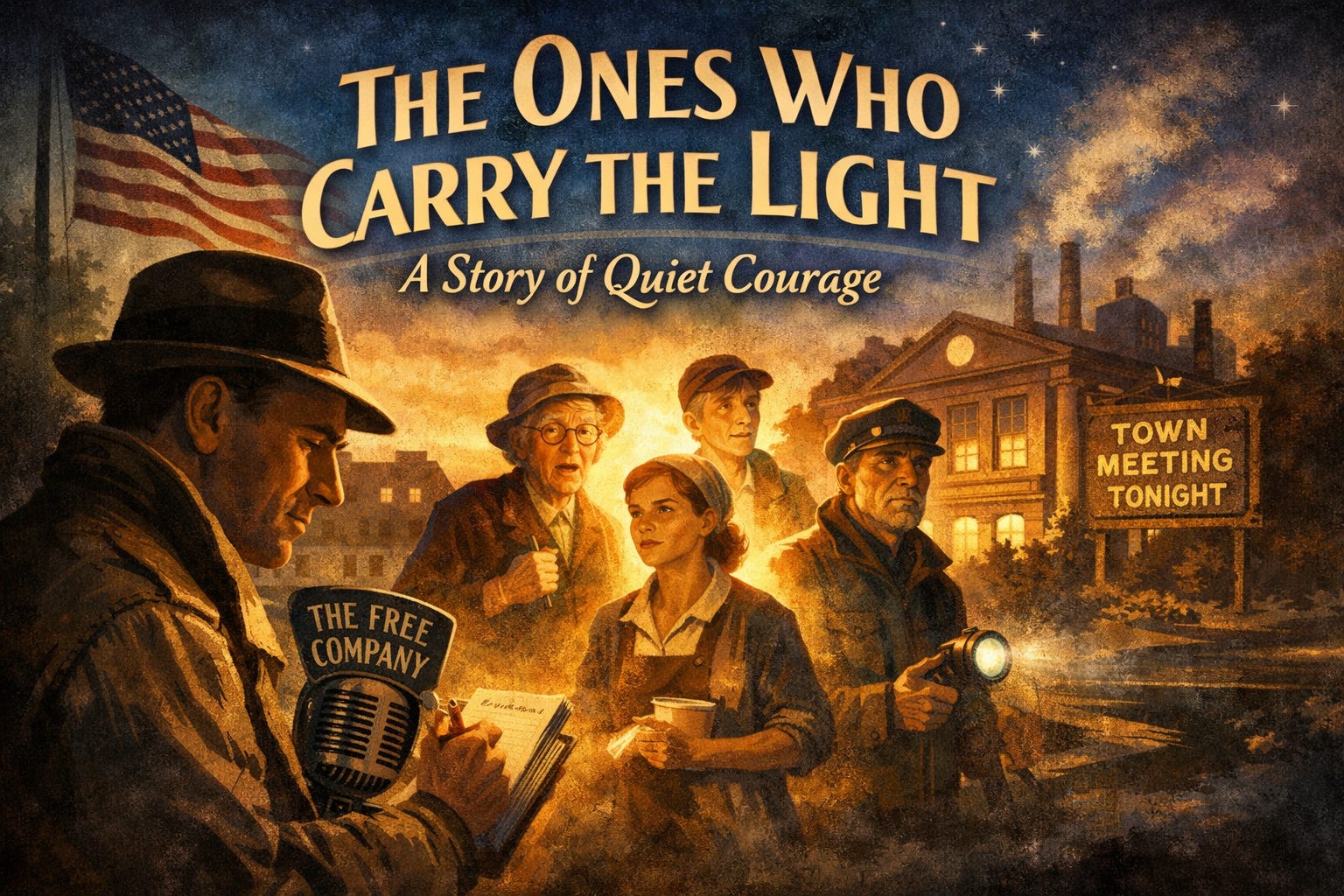
In the early days of American radio, long before ratings ruled the airwaves, a group of writers, actors, and thinkers including nine Pulitzer Prize winners, gathered to create something unusual. They called themselves The Free Company. They were unpaid, unsponsored, and gloriously unconcerned with commercial approval. Their aim was not to sell soap or cigarettes, but to explore — through drama — the fragile, luminous things that make a people free.
Their plays did not shout. They did not preach. They simply held up ordinary human choices to the light and asked listeners to look carefully.
The Ones Who Carry the Light is written in that same spirit.
This story imagines a town not unlike many in history — a place under strain, tempted by fear, offered safety at the quiet price of liberty. No tyrants march through its streets. No grand heroes stride across the stage. Instead, we meet a seamstress, a boy, a widow, a watchman, and a tired newspaperman.
Their weapon is not force.
Their banner is not loud.
Their power is the simple, stubborn act of choosing what is right when it would be easier not to.
In the old Free Company dramas, freedom was never treated as an abstraction. It lived in kitchens, sidewalks, schoolyards, and town halls. It flickered in the conscience of ordinary people who refused to let fear do their thinking for them.
This story asks the same quiet question:
What if the real guardians of liberty are not the loudest voices — but the people who, in small unseen moments, decide to shine?
The Ones Who Carry the Light
Tom Hale had covered so many meetings about public safety that he no longer felt particularly safe in the presence of the words.
He was a reporter for The Evening Ledger, a paper printed on gray stock that left ink on your fingers and a faint pessimism on your soul. Every morning the presses coughed up columns about shortages, speeches, new regulations, and solemn men promising that if everyone would only give up a little more now, everything would be better later.
Tom had once believed in “later.”
Lately, he believed in coffee.
It was on a Tuesday night, walking home past the rail yard, that he saw the first one.
A stray dog limped across the street, one paw lifted like a broken thought. Tom noticed because a man in a watchman’s cap stepped out from the shadow of the municipal building and knelt down in the gutter.
“Easy now,” the man murmured, as though speaking to a nervous child. “No hurry in the world worth more than a hurting creature.”
Tom slowed. It wasn’t the kindness that stopped him. Kindness still happened, in small, unprofitable quantities. It was what happened next.
For a moment — no longer than a breath — the man seemed lit from within. Not bright. Not dazzling. Just a soft, steady glow, like lamplight through thin curtains. It traced the lines of his face and hands and faded almost before Tom could decide whether he had imagined it.
The watchman looked up. “Evening.”
“Evening,” Tom said. He wanted to ask if the man had recently swallowed a lightbulb, but reporters were trained to keep their strangest thoughts for print.
“Dog’ll be all right,” the watchman said. “Just needs rest.”
“Everyone does,” Tom replied.
He walked home wondering if exhaustion could make a man see things.
The next day, the mayor’s voice came over the radio in Delaney’s Diner, thin and confident.
“Freedom is precious,” Mayor Kendrick said, “but survival is essential. These temporary civic measures will ensure order in uncertain times.”
Tom stirred his coffee. “Temporary” had become the longest word in the language.
At the counter, Maria Santos stood with a pot of refills and a tired smile. She had come to the country ten years earlier with a suitcase and a brother who wrote letters home every Sunday. Now she worked two jobs and still spoke of the future as if it were a guest she expected for dinner.
A man in a fedora leaned toward her. “You heard they’re asking folks to report suspicious neighbors? Couple houses down from you, ain’t it?”
Maria’s hand paused over the cup. “I mind my own business,” she said gently.
“Could help the town.”
“Maybe,” she said. “But it might hurt someone first.”
Tom saw it again.
Not around her whole body. Just her hands, wrapped in a faint radiance as she poured coffee she could not afford to spill. It was there and gone like breath on glass.
He set down his spoon with a clink.
“You all right, Mr. Hale?” Maria asked.
“Fine,” he said. “Just… seeing things.”
She smiled. “That’s your job.”
Tom began to notice it everywhere.
A schoolboy named Eddie returned a leather wallet so stuffed with bills it barely folded. The owner counted the money twice, then looked at the boy as if honesty were a foreign language.
“You could’ve kept it,” the man said.
Eddie shrugged. “My ma says if you keep what ain’t yours, it keeps you.”
Sunlight struck his hair, and for an instant the boy seemed to shine brighter than the day deserved.
An elderly widow, Mrs. Whitcomb, argued with a clerk at the ration office on behalf of a stranger who had lost his paperwork.
“He’s got a face,” she snapped. “He’s not a form.”
Her small frame burned with a fierce, quiet glow that made the fluorescent lights look tired.
Each time, the light appeared at the moment someone chose difficulty over ease, conscience over comfort. No speeches. No banners. Just decisions, made quietly and paid for privately.
Tom tried not to think about it.
Then the notices went up about the town meeting.
City Hall filled with the smell of damp wool and nervousness. The mayor stood at the front, sleeves rolled, voice warm as fresh bread.
“These emergency authorities,” he said, “will allow us to act swiftly. Only those with something to hide need worry.”
Tom scribbled in his notebook. He had written that sentence, or ones like it, so many times he could have done it blind.
The mayor asked for comments.
No one moved.
Silence can be the loudest vote of all.
Then a cane tapped the floor.
Mrs. Whitcomb stood, hat pinned like a declaration of independence.
“Mayor,” she said, “I buried a husband who fought so you wouldn’t talk that way.”
A murmur rolled through the room.
“Safety without liberty,” she continued, “is just a padded cell. Comfortable, perhaps. Still a cell.”
She shone.
Tom did not question it now. The light gathered around her like memory made visible.
Maria rose next. “I came here for freedom,” she said softly. “I don’t want to lose it by being afraid of each other.”
Glow.
A man in the back — the watchman — cleared his throat. “Order is good,” he said. “But it must answer to something better.”
Glow again, steady and calm.
One by one, others stood. A mechanic. A teacher. Eddie’s mother, who trembled but spoke anyway.
The room did not grow brighter to the eye. The bulbs hummed as before. The walls stayed their bureaucratic beige.
But Tom felt as though dawn had entered the building without asking permission.
The mayor looked out at them, at the faces he had counted on to remain politely seated. His certainty flickered. He shuffled his papers.
The vote failed.
The next morning the town looked unchanged. Smoke rose from the factories. Headlines complained about the weather and the price of steel.
Tom walked past the rail yard again.
The watchman was there, sweeping.
“Morning,” he said.
“Morning,” Tom replied. He hesitated. “Do you ever notice… people shining?”
The watchman leaned on his broom. “Most days,” he said.
“Why?”
The man smiled, not surprised. “Because sometimes,” he said, “a person remembers he has a soul — and uses it.”
Tom looked down the street. A woman helped an old man with his parcels. A boy held a door. Someone laughed in the cold.
No halos. No miracles. Just choices.
Still, the town seemed brighter than it had any right to be.
Tom took out his notebook.
For once, he knew exactly what the story was about.
🌅 OUTRO
The Light That Keeps a Nation Free
The dramas of The Free Company often ended not with spectacle, but with recognition — the realization that freedom survives not because it is declared, but because it is practiced.
The Ones Who Carry the Light offers the same gentle reminder.
No law can manufacture virtue. No policy can substitute for conscience. A free society is not held together by fear of punishment, but by millions of quiet decisions made when no one is watching.
The “light” in this story is not magic. It is the radiance of moral choice — the glow that appears whenever a person refuses to surrender dignity, compassion, or courage for the sake of comfort or approval.
Such light does not always win quickly.
It does not always look impressive.
But history shows it endures.
The Free Company believed that drama could awaken citizens to their own responsibility for liberty. Not by scolding them, but by reminding them who they already were.
That is the hope of this story as well.
Because in every generation, the question returns:
When the moment comes —
when the room grows quiet —
when fear offers an easy answer —
will we choose to shine?