

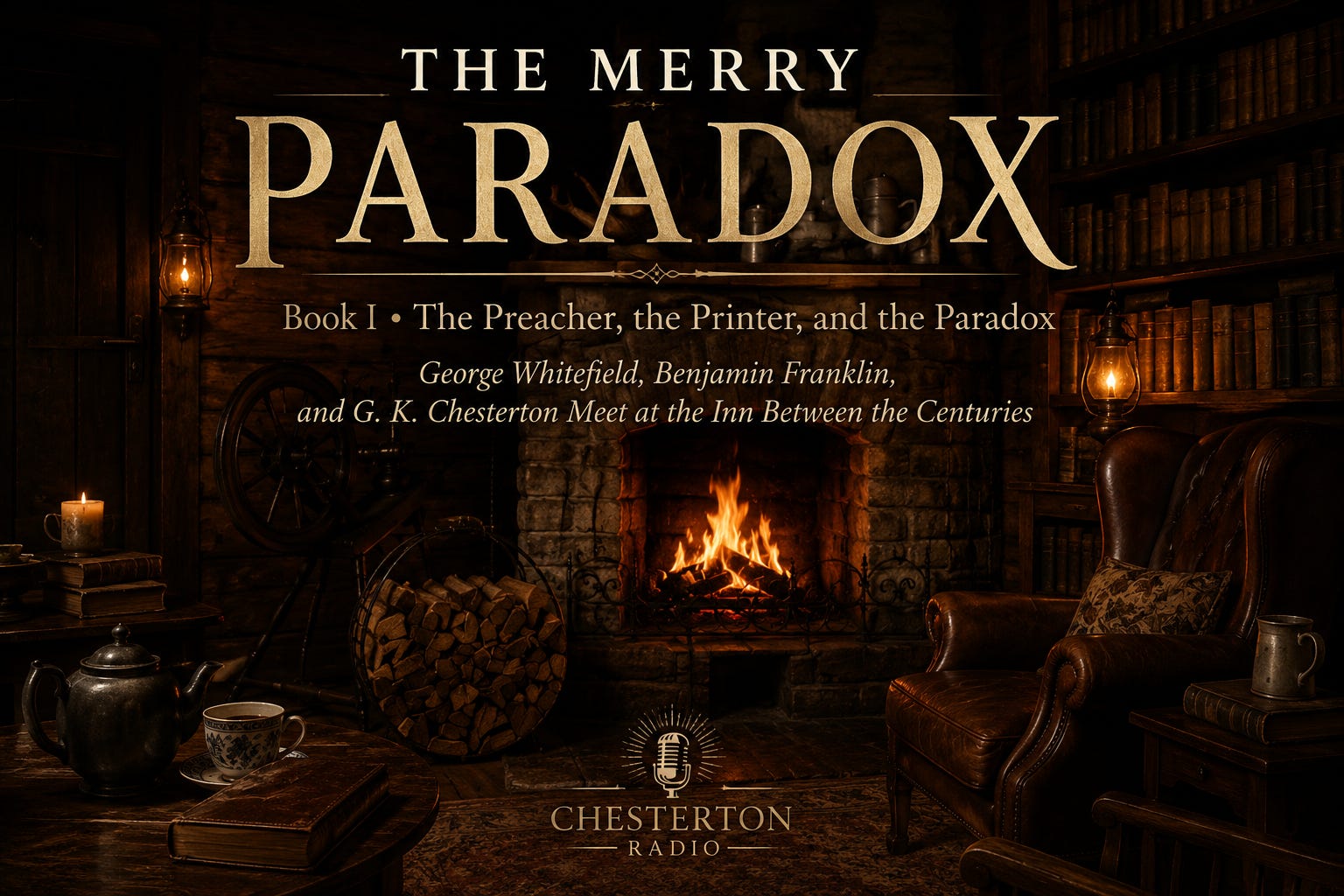
Chapter I — The Fire Is Lit
There was no road to The Merry Paradox, though many travelers arrived there.
This was one of the first things a sensible person noticed, and one of the last things a wise person troubled himself about. Roads belong to maps, and maps belong to places that intend to be found by surveyors, postmen, invading armies, and people in a hurry. The Merry Paradox had never shown much interest in any of these.
It stood where it had always stood, which is to say nowhere in particular and exactly where it was needed.
On certain evenings, when the rain came down softly and the world seemed weary of its own cleverness, a traveler might look up from a muddy lane and see a warm square of light beneath a swinging sign. The sign bore no written name, only a tankard, a lion, and an upside-down question mark. Those who had been there before knew what it meant. Those who had not usually pushed open the door anyway.
For the light was inviting.
So was the smell of bread.
The Innkeeper was polishing a pewter mug when the evening began, though no one inside the inn would have said it had ever entirely not begun. The fire had been burning for hours. Perhaps years. It filled the great common room with a steady golden life, throwing light along the oak beams overhead and into the darker corners where books leaned in disorderly abundance upon shelves, benches, windowsills, and occasionally one another.
A hound slept under the largest table.
No one knew whose hound it was.
This troubled no one, least of all the hound.
Beyond the leaded windows, rain moved gently across the night. It was English rain, mostly, though now and then it contained a little of New England, a little of Rome, and something that might have fallen once upon the road to Canterbury. The Innkeeper had long ago ceased sorting weather by century.
A young monk in a brown habit sat near the door, eating soup with solemn gratitude. At the far end of the room, a woman in a dark traveling cloak was reading Virgil by candlelight and occasionally smiling to herself. Near the hearth, in the chair that was somehow always too small for him and yet always occupied by him, sat Gilbert Keith Chesterton.
He had a book open upon his knee and another face down beside him, in the unfortunate condition books suffer when abandoned by enthusiastic readers. A glass stood at his elbow. His hat rested upon the floor, unless it had been placed there by gravity after losing patience with the back of the chair.
The Innkeeper glanced at it.
“Your hat has migrated again.”
Chesterton looked down with surprise.
“My dear fellow, it is a hopeful hat. It believes in pilgrimage.”
“It believes in being stepped on.”
“Then it has achieved a kind of martyrdom denied to many better men.”
The Innkeeper smiled and returned the mug to its shelf.
Chesterton closed the book halfway, which with him meant not that he had finished it, but that he had begun arguing with it internally.
“What are you reading tonight?” the Innkeeper asked.
“A sermon.”
“That sounds dangerous.”
“It is. Sermons are among the most dangerous things in the world when they are good, and among the dullest when they are not.”
“And this one?”
Chesterton tapped the page.
“This one is not dull.”
The Innkeeper looked toward the window. Rain trembled in the panes.
“No,” he said quietly. “I thought tonight might not be dull.”
Chesterton followed his gaze and brightened.
“Ah. That tone.”
“What tone?”
“The tone of a man who has already placed an extra chair near the fire.”
The Innkeeper said nothing, which was one of his more eloquent habits.
He crossed the room and adjusted the chair opposite Chesterton, though there seemed nothing wrong with it. Then he went to the sideboard and laid out another cup, a clean napkin, and a small plate.
The hound opened one eye.
“Not for you,” said the Innkeeper.
The hound closed the eye again, having heard such things before and having no intention of treating them as final.
A gust of wind moved against the door.
Not violently.
Only enough to make the latch tremble once.
The room grew no quieter, and yet the room seemed to notice.
The Innkeeper set down the napkin and went to the door.
When he opened it, rain and cold air stepped in first. Behind them stood a man in a dark coat, travel-worn and wet at the shoulders. He carried his hat in one hand. His face was young in some lights and older in others, marked by labor, earnestness, and that peculiar brightness found in men who have spent themselves and not regretted the expense.
The Innkeeper bowed his head slightly.
“Good evening, Mr. Whitefield.”
George Whitefield smiled with the relief of a traveler who has not merely found shelter, but welcome.
“Good evening.”
“You have come through weather.”
“I have preached in worse.”
“I don’t doubt it. But tonight you may sit by the fire.”
Whitefield entered, and the door closed behind him with a soft wooden sound that seemed to leave the storm outside without insulting it.
The Innkeeper took his coat and hat. No one stared. A few patrons glanced up, recognized him perhaps, or perhaps only recognized that he had come a long way, then returned to their books, bowls, and conversations. This was one of the mercies of The Merry Paradox. Fame entered there as rain did—noticed, received, and not allowed to flood the room.
Chesterton rose at once, scattering a paper, nearly stepping on his hat, and rescuing both with equal ceremony.
“Mr. Whitefield,” he said, extending both hands. “I am delighted. I had hoped the sermon might produce the preacher, though one must be careful with such wishes. I once read a tax bill and feared the same principle.”
Whitefield laughed, and the laugh changed his face. The preacher whom crowds had strained to hear became suddenly a cheerful guest in wet shoes.
“Mr. Chesterton, I have heard of you.”
“Then I beg you to forgive the source.”
“I heard you were fond of paradox.”
“Only because paradox is fond of truth. Truth, being alive, refuses to lie flat.”
Whitefield accepted this as naturally as another man might accept help with a chair. He seated himself near the fire, stretching his hands toward the warmth with evident gratitude. The Innkeeper brought tea first, then a small cup of something darker, then thought better of deciding and left both.
“You have traveled far?” Chesterton asked.
Whitefield smiled.
“That depends upon how distance is reckoned here.”
“Badly, I hope.”
“Then yes.”
“Excellent. The best inns are those in which a man has arrived from farther than geography can explain.”
Whitefield took the tea. Steam rose against his face.
“I have known many inns,” he said. “Some friendly. Some merely necessary. A few where one thanked God for the roof and prayed not to meet the landlord again.”
Chesterton laughed.
“A useful distinction. Hospitality is one of the tests of civilization. A barbarian may build a palace for himself. It takes something better to keep a clean bed for a stranger.”
Whitefield looked around the room. His eyes moved from the fire to the shelves, from the tables to the faces, from the sleeping hound to the candlelit woman reading Virgil.
“This is a strange house.”
“Profoundly.”
“And yet peaceful.”
“Still more profoundly.”
Whitefield sipped his tea. For a moment he said nothing. The firelight moved over his features, softening the lines of zeal into the quieter lines of weariness. Not defeat. Not sadness. Only the fatigue of one who had spoken often because he believed silence would have been disobedience.
“There is mercy,” he said at last, “in a place where no one immediately asks a man to speak.”
Chesterton’s expression grew gentle.
“You were asked often.”
“Yes.”
“And you answered.”
“I tried.”
The Innkeeper appeared with bread, butter, and a little dish of honey. Whitefield looked up and thanked him with such sincerity that the Innkeeper paused.
“You are welcome,” he said.
Whitefield broke the bread slowly.
“I used to think,” he said, “that travel consisted chiefly in miles. Then I learned it consists in departures. There are men who cross oceans and never leave themselves. Others take one step toward obedience and find themselves in a new world.”
Chesterton leaned back, delighted.
“My dear sir, you have smuggled a sermon into the bread course.”
“I beg your pardon.”
“Do not. I admire contraband theology, provided it comes with butter.”
Whitefield laughed again.
The sound pleased the Innkeeper, who had returned to the bar and was now polishing another mug that required no polishing whatever.
For a while, they spoke of roads.
Not of revivals, or doctrines, or crowds, but roads. Whitefield described rutted lanes in England, hard winter passages in Scotland, muddy colonial tracks where horses knew more about perseverance than many bishops. Chesterton maintained that every road possessed a moral character. Some roads were honest and admitted they were taking you uphill. Others pretended to be level while plotting exhaustion.
Whitefield said he had known preachers of both kinds.
Chesterton nearly spilled his drink laughing.
They spoke of inns. Whitefield had once slept in a room above a stable where the horse below objected to Methodism at regular intervals throughout the night. Chesterton declared that the animal was probably a critic and should have been given a column in a London paper. Whitefield admitted that the horse had at least been punctual.
They spoke of books. Whitefield rose to examine the shelves and seemed moved to find Bunyan there, and Baxter, and Augustine, and a Bible with margins worn soft by hands that had turned to it often. He touched the spine but did not remove it.
“A well-used Bible,” he said quietly, “is a kind of map.”
“Indeed,” Chesterton replied. “Though unlike most maps, it tells us where we are before it tells us where to go.”
Whitefield looked back at him with pleasure.
“You do understand sermons.”
“I understand that I need them, which is not the same thing but may be better.”
The fire settled. A log broke inward with a sigh and sent sparks briefly up the chimney. Outside, rain thickened on the windows, making the inn feel still more inward, more securely itself.
Whitefield returned to his chair. The hound, having reconsidered his earlier exclusion from the bread, placed his head upon the preacher’s shoe.
Whitefield looked down and smiled.
“I have gained a congregation.”
“A small but attentive one,” Chesterton said.
“Has he a name?”
“Several, I imagine. He answers to none.”
“That may be wisdom.”
“It is certainly independence.”
Whitefield gave the hound a small piece of bread. The Innkeeper saw this and pretended not to, another ancient practice of hospitality.
The door opened again later than anyone expected and earlier than it might have done elsewhere.
A gentleman entered briskly, closing his umbrella with the practiced annoyance of one who respected useful devices but disliked being defeated by them. He wore plain but well-made clothes. Spectacles sat upon his nose. Rain gleamed upon his shoulders. His eyes took in the room quickly: fire, books, exits, company, bread, likely quality of ale, and the large man by the hearth whose hat lay imperiled near the feet of a sleeping dog.
The Innkeeper greeted him exactly as he had greeted the preacher.
“Good evening, Dr. Franklin.”
Benjamin Franklin handed over his wet outer coat.
“Good evening. I must compliment your sign. It is either nonsense or philosophy, and possibly both.”
“The best signs are.”
Franklin smiled.
His gaze moved to the hearth.
Whitefield had already risen.
For a moment neither man spoke.
No trumpet of history sounded. No narrator announced that the great evangelist and the American printer were meeting again beyond the reach of time. They simply looked at one another as old friends do when years, arguments, letters, disappointments, admiration, and affection all arrive at the same instant and are too many to be spoken aloud.
Then Franklin’s face warmed.
“George.”
Whitefield stepped forward.
“Benjamin.”
They clasped hands.
Not quickly.
Franklin studied him with a smile that seemed half amusement and half gratitude.
“You are looking well.”
Whitefield replied, “And you are still observing before speaking.”
“A habit too profitable to abandon.”
“And too persistent to repent of?”
“Let us say I have not yet found repentance useful in that particular.”
Whitefield laughed, and Franklin laughed with him.
Chesterton watched them with extraordinary satisfaction, as though someone had just proved a theorem in friendship for which he had long possessed only the intuition.
“My dear Doctor,” he said, “you arrive as all philosophers should: wet, witty, and slightly suspicious.”
Franklin turned.
“Mr. Chesterton, I presume.”
“With dangerous confidence.”
“I have heard much of you.”
“Then we are both victims of rumor.”
Franklin took the offered hand. “A printer learns to respect rumor. It often arrives before fact, though not always in better clothes.”
Chesterton beamed.
“Sit down. We have bread, tea, something stronger, and a dog of uncertain theology.”
Franklin looked down at the hound, who had raised his head just enough to consider the newcomer.
“The dog appears practical.”
“He is waiting to see whether you drop anything.”
“A philosopher, then.”
“Of the empirical school.”
Franklin seated himself, and the Innkeeper brought another plate without being asked. He also brought a glass, paused, and placed beside it a cup of tea.
Franklin observed this with approval.
“You are a cautious man.”
“No,” said the Innkeeper. “Only experienced.”
“A better thing.”
For a while, no one spoke of religion.
This was not avoidance. It was courtesy. Great questions are like guests of high rank; they should not be dragged in through the kitchen before supper. They arrive most properly after bread has been broken, after chairs have settled into place, after laughter has assured everyone that no one present mistakes seriousness for severity.
Franklin praised the bread. Whitefield praised the fire. Chesterton praised the entire institution of supper, which he claimed had saved more souls from despair than half the philosophers who wrote about the problem of evil.
Franklin asked whether the inn had a library catalog.
The Innkeeper said it had tried one once.
“What became of it?”
“It got shelved under fiction.”
Chesterton laughed so loudly that the hound left the hearth in protest and settled under Franklin’s chair instead.
“That,” Franklin said, “is the first evidence I have seen tonight of sound judgment.”
Whitefield smiled at the ease between them.
The meal arrived slowly, as proper meals do. A stew fragrant with herbs. A loaf dark-crusted and steaming within. Cheese. Apples. A pot of coffee for Franklin, more tea for Whitefield, and for Chesterton a plate large enough to suggest the Innkeeper understood him not as a customer but as a category.
Rain continued at the windows. Candlelight trembled upon pewter. Somewhere in the room a patron turned a page. Somewhere else two quiet voices debated whether courage was more difficult before battle or after defeat.
Franklin told a story of a printing apprentice who had set a line so badly that it improved the author. Whitefield told of a Welsh innkeeper who insisted he could not understand a sermon unless the preacher first understood horses. Chesterton declared the Welshman almost certainly correct, since horses had carried more saints than most universities.
The conversation wandered, and because it wandered, it deepened.
Whitefield asked Franklin whether he still rose early.
Franklin admitted the intention had long outlived perfect execution.
Franklin asked Whitefield whether he still preached too often.
Whitefield admitted the accusation had frequently been true.
Chesterton observed that saints and statesmen seemed united by the inability to rest when rest would make them more useful.
Whitefield looked into the fire.
“There was always another town.”
Franklin answered softly, “There was always another improvement.”
“And,” Chesterton added, “always another reason to postpone being merely human.”
The words did not darken the table, but they settled upon it.
Franklin turned his glass slowly.
“Perhaps that is why inns are necessary.”
Whitefield nodded.
“A man cannot be useful every hour.”
“No,” said the Innkeeper, passing behind them with a fresh candle. “Only loved.”
He said it quietly and continued on.
Franklin watched him go.
“That man has a dangerous habit of speaking in conclusions.”
Chesterton smiled.
“He saves time by omitting the argument.”
Whitefield was still looking after the Innkeeper.
“Only loved,” he repeated.
The fire gave a small collapse inward, and shadows rose along the beams before settling again.
For the first time that evening, the three men fell into a silence that was not merely pleasant but expectant. The ordinary subjects had done their work. Weather, roads, books, bread, dogs, and the weariness of men who had labored in public had brought them, without force, to the edge of something larger.
Chesterton seemed to feel it.
He looked from Whitefield to Franklin and back again. His face held no mischief now, though warmth remained.
“My friends,” he said, “there is a question I have long wished to ask the two of you.”
Franklin leaned back, alert but unguarded.
Whitefield folded his hands, the firelight catching the worn edges of his cuffs.
The Innkeeper, across the room, lowered the flame of one lamp and left the others burning.
Chesterton did not ask the question yet.
He merely sat with them before the fire while the rain continued softly against the windows, and the meal steamed upon the table, and the old inn gathered the three of them into its keeping.
The evening had truly begun.
Chapter II — The Question by the Fire
The fire had a way of making men honest.
Not immediately, of course. Nothing worth having arrives immediately, except perhaps bad news and indigestion. Honesty came slowly, like warmth into old bones. It entered first through the hands, then through the face, and only much later through the tongue. A man might sit before a fire for an hour speaking lightly of roads and weather, and then discover, to his surprise, that the flame had been drawing the truth out of him all along.
The Innkeeper knew this.
That was why the chairs at The Merry Paradox were placed not in rows, as in lecture halls, nor opposite one another, as in courts of law, but in a generous half-circle around the hearth. No one there was forced to confront another man too directly before he was ready. The fire stood between them first, giving each guest something harmless and ancient to look upon while the greater matters gathered themselves.
At the table nearest the hearth, supper had settled into its quiet afterlife.
The stew was nearly gone. The bread had been broken and broken again until only a heel remained. Franklin had praised the coffee with the seriousness of a man who had performed public service in many forms and considered good coffee among the nobler ones. Whitefield had taken tea, though he had accepted a little of the Innkeeper’s darker drink afterward when Chesterton insisted that a preacher who had addressed coal miners outdoors could not plausibly be considered delicate.
The hound had returned beneath Whitefield’s chair, having judged the preacher generous and the printer cautious.
Across the room, the woman in the dark cloak closed Virgil and listened without seeming to listen. The young monk by the door had finished his soup and was mending a sandal with the patience of one who had long ago ceased resenting small difficulties. A sailor in a coat from no navy presently known to history dozed with his hat over his eyes.
Nobody hurried.
The rain went on at the windows, patient as memory.
Chesterton leaned forward at last, his great hands resting near the firelight’s edge.
“My friends,” he said, “I have been delaying the question because questions, like puddings, may be spoiled by serving them too soon.”
Franklin smiled. “I approve the principle, though I have known many questions improved by postponement until they disappeared altogether.”
“That is because you are a practical man.”
“I have been accused of it.”
“And practical men have a just suspicion of questions that do not lead to bridges, stoves, libraries, constitutions, or at least a better arrangement of chimneys.”
Franklin’s eyes warmed. “You make practicality sound almost poetic.”
“My dear Doctor, practicality is poetic. A bridge is a lyric composed in stone by men who did not wish to get wet.”
Whitefield laughed softly. “Then an inn is a hymn.”
Chesterton turned to him with delight.
“Exactly! A hymn with beds in it.”
Franklin raised his cup. “And a bill at the end.”
“The bill,” said Chesterton solemnly, “is the moral instruction.”
The laughter moved gently around the table and then faded, not because it had failed, but because it had done its work. The room seemed ready now. Even the fire lowered itself into a steadier burn, as though flames, too, could become attentive.
Chesterton looked first at Whitefield.
Then at Franklin.
“You are both famous men,” he said. “This is unfortunate for you, and sometimes convenient for the rest of us. Fame preserves a man’s name and misplaces the man. It remembers the sermon and forgets the sore feet. It remembers the experiment and forgets the cold breakfast. It remembers the statue and forgets whether the fellow laughed when his chair collapsed.”
Franklin chuckled. “I should like to know which details have been preserved in my case.”
“Enough,” said Chesterton, “to make you respectable, which is always dangerous.”
“And George?”
“Enough to make him solemn, which is worse.”
Whitefield smiled at that, but there was gratitude in his expression. Men who have been much admired are often relieved when someone remembers they were also human.
Chesterton continued more quietly.
“The histories tell us that you knew one another. That you corresponded. That Dr. Franklin printed Mr. Whitefield’s sermons. That he observed the reach of Mr. Whitefield’s voice. That Mr. Whitefield prayed for Dr. Franklin. That you disagreed about the largest questions and yet remained friends.”
The fire shifted.
Outside, a gust pressed rain softly against the leaded glass.
Chesterton’s voice lost all trace of jest.
“What I wish to ask is this: How can two men disagree about the most important thing in the universe and yet remain genuine friends?”
No one answered.
The question did not strike the room like thunder.
It entered more quietly than that.
It entered like a guest who had been expected but not announced.
Whitefield lowered his eyes. Franklin turned his cup slowly in his hands. The Innkeeper, standing at the far end of the bar, ceased polishing the mug he had been polishing for the past quarter hour, though the mug had achieved a brilliance no earthly pewter required.
The silence lengthened.
At last Franklin said, “George should answer first.”
Whitefield looked up with a faint smile. “Why?”
“Because you are accustomed to beginning with ultimate things.”
“And you?”
“I prefer to arrive at them after examining the road.”
Chesterton leaned back happily. “Already we have geography.”
Whitefield did not hurry. He looked at Franklin, and there was no opponent in his gaze. There was memory there. And sorrow. And affection. And something like prayer, though not performed ostentatiously enough to embarrass anyone.
“I do not know that friendship survives such disagreement by argument,” he said at last. “I think it survives by love.”
Franklin smiled slightly. “That is a preacher’s answer.”
“Yes.”
“Brief.”
“Sometimes.”
“Unprovable.”
Whitefield’s smile deepened. “Not unlivable.”
Franklin accepted the point with a small bow of the head.
Chesterton watched them with great satisfaction. “I must say, Doctor, that if you meant to set a trap, you have found yourself in it.”
“I have spent a lifetime escaping traps by inspecting them first.”
“And yet,” Whitefield said gently, “you did not escape friendship.”
Franklin’s expression changed, just slightly.
“No,” he said. “I did not.”
The Innkeeper came then with fresh water for the tea and more coffee for Franklin. He placed them quietly upon the table, but before withdrawing he looked at the three men as one might look at a fire that had begun to catch properly.
“A hard question,” he said.
Chesterton turned. “Have you an answer?”
The Innkeeper smiled. “If I did, I would trust it less.”
Franklin laughed. “An excellent policy.”
The Innkeeper returned to the bar.
Whitefield took up his cup. “When I first knew Benjamin, I did not think of him as a problem to be solved.”
Franklin looked amused. “That is kind. Many have thought of me precisely so.”
“I thought of him as a man.”
Chesterton nodded slowly.
“That is becoming a lost art,” he said.
Whitefield continued. “There were those who admired him chiefly for his usefulness. There were others who distrusted him for his doubts. But I found in him a mind alive to the world, a heart not easily moved by cant, and a generosity that frequently exceeded his creed.”
Franklin looked down at the table.
“My generosity has been exaggerated.”
“Not by me,” Whitefield said.
Franklin did not reply.
The preacher’s voice remained quiet. “I desired his conversion. I will not pretend otherwise. To love a man and believe Christ is life is to desire Christ for him. Anything less would have been indifference dressed as courtesy.”
Franklin looked at him then. “And yet you did not reduce me to that desire.”
“No.”
“Why?”
“Because God had not reduced you to it.”
The fire crackled. The young monk near the door looked up from his sandal.
Whitefield seemed almost unaware that anyone else existed.
“You were Benjamin,” he said. “Printer. Wit. Friend. Citizen. Inquirer. Benefactor of causes. Lover of practical improvements. A man capable of laughing at folly, including his own, though perhaps not always quickly enough.”
Franklin smiled. “A fair reservation.”
“You were not merely an unbeliever.”
The words were spoken plainly, without accusation and without apology.
Franklin received them in the same spirit.
“No,” he said. “And you were not merely an enthusiast.”
Whitefield laughed softly. “That word followed me often.”
“It was not always meant kindly.”
“No.”
“I did not always mean it unkindly.”
“I know.”
Franklin leaned back and looked toward the fire.
“Enthusiasm,” he said, “has destroyed many sensible things. It has overturned furniture, churches, governments, and occasionally good manners. I have been wary of it.”
“As you should be,” Whitefield said.
Franklin turned toward him, surprised by the ease of the answer.
Whitefield smiled. “Zeal is not holiness merely because it is hot.”
Chesterton slapped the arm of his chair in delight.
“My dear sir, if that sentence had been posted over half the pulpits of Europe, history might have been less noisy.”
Whitefield looked almost embarrassed.
“I speak as one who has needed the warning.”
Franklin’s eyes narrowed with interest.
“Did you fear your own zeal?”
“Often.”
That answer seemed to matter to Franklin. He did not speak at once.
Whitefield went on. “There is a dangerous sweetness in being heard. When thousands gather, when they weep, when they speak your name as though the sound itself might bless them, a man must either tremble or become a fool.”
“And you trembled?”
“Not always soon enough.”
The room received the confession tenderly. No one seized upon it. No one improved it. There are confessions that should be answered only by believing them.
Chesterton said quietly, “Humility is the only door through which truth may enter without becoming an idol.”
Franklin considered that.
“Then perhaps humility was the bridge between us.”
Whitefield looked at him.
Franklin tapped one finger lightly against his cup. “Not that either of us possessed enough of it. I make no extravagant claims. But I think we each believed, in some corner of the mind, that we might be wrong about something.”
Whitefield smiled. “About something, yes.”
“Not everything.”
“No.”
Franklin looked pleased. “Good. A friendship in which both men must pretend not to know anything would be intolerable.”
“Agreed,” said Whitefield.
Chesterton laughed. “There is the second pillar: humility without cowardice. A man must admit he may be wrong without pretending that truth is unknowable. Otherwise conversation becomes merely the clinking of empty cups.”
Franklin lifted his own. “Mine, at least, is not empty.”
“Then civilization remains possible.”
For a while the conversation drifted backward into memory, as rivers do when they widen.
Whitefield spoke of Philadelphia as he had first known it: crowded, alert, full of printers, merchants, Quakers, apprentices, wagons, church bells, arguments, and the smell of fresh ink. He remembered the pressrooms, the way paper stacked in clean piles seemed to promise that words might travel where feet could not. Franklin listened with half-closed eyes, sometimes correcting a detail, sometimes adding one, sometimes smiling at a recollection only he could see clearly.
“You made me into printed matter,” Whitefield said.
“I made your sermons portable,” Franklin replied.
“That is a kinder phrase.”
“It was also profitable.”
Whitefield laughed. “I never doubted that.”
“I should hope not. I have always disliked hypocrisy in accounts.”
Chesterton looked delighted. “It is one of the marvels of Providence that the Gospel has often traveled by means of men who noticed the invoice.”
Franklin’s laughter came warmly.
Whitefield shook his head, but affectionately. “Benjamin printed my sermons though he did not accept all they contained.”
“All?” Franklin said. “You are generous.”
“Some, then.”
“I accepted their sincerity.”
“That is not the same.”
“No. But it is not nothing.”
Whitefield’s face softened. “No. It is not nothing.”
Franklin took another sip of coffee. “I will say this. Your words had force. Not merely volume, though heaven knows you possessed that. They carried conviction. A printer learns to distinguish between words written to fill a page and words that have first filled a man.”
Whitefield looked down.
“That is a great compliment.”
“I intended it as one.”
“I receive it as one.”
Chesterton said, “And there we find another pillar.”
Franklin smiled. “We are constructing quite a building.”
“Friendship is architecture,” Chesterton replied. “It requires foundation, proportion, and the occasional repair of a leaky roof.”
“What pillar have we found now?”
“Admiration,” Chesterton said. “The ability to see and praise the good in a man even when the good does not lead him where one wishes.”
Franklin thought about this.
Whitefield said, “Yes.”
The answer came with the weight of memory.
“I admired Benjamin’s industry,” Whitefield continued. “His public spirit. His curiosity. His desire to improve the conditions of ordinary people. He did not merely speak of usefulness. He practiced it.”
Franklin waved this off. “Usefulness is often only vanity with its sleeves rolled up.”
“Sometimes,” Whitefield said. “But not always.”
The printer smiled at that.
“And I admired George,” Franklin said, turning toward Chesterton now, perhaps because it was easier than addressing the preacher directly, “because he spent himself. That is not a small thing. Many men hold opinions. Fewer rise in the cold, travel in discomfort, endure criticism, and give themselves repeatedly to work from which they expect no worldly rest.”
Whitefield’s eyes glistened slightly.
Franklin continued, more softly, “I did not share all his conclusions. But I could not deny that he lived as though they were true.”
No one spoke.
The fire made a small cave of light around them.
Beyond it, the common room continued in quiet fragments. A spoon touched a bowl. A chair moved gently against stone. Somewhere a page turned. The hound sighed deeply beneath Whitefield’s chair, as though troubled by nothing in any century.
At last Whitefield said, “I prayed for you.”
Franklin nodded.
“I know.”
“I prayed often.”
“I know that too.”
“I prayed not to win an argument.”
Franklin looked at him. “No.”
“I prayed because I loved you.”
The words were simple enough to survive sentimentality.
Franklin rested his cup upon the table and studied it. When he spoke, his voice was light, but not careless.
“My dear George, there were times when your prayers made me uncomfortable.”
Whitefield smiled sadly. “I do not doubt it.”
“But not offended.”
“That is something.”
“It is more than something.”
Franklin looked up.
“I knew the difference between a man who wants to conquer me and a man who wants what he believes is my good.”
Chesterton leaned forward, but did not speak.
Franklin continued, “The first uses concern as a weapon. The second bears concern as a burden. You belonged to the second kind.”
Whitefield swallowed.
“Then I am grateful.”
“You were not always tactful.”
“No.”
“You were sometimes too urgent.”
“Yes.”
“You occasionally mistook persistence for persuasion.”
Whitefield laughed through the seriousness. “Yes.”
“But you did not despise me.”
“Never.”
Franklin nodded. “That was decisive.”
Chesterton’s face had become still with attention. “There,” he said quietly. “There is a thing our age must hear.”
Franklin looked toward him.
“To disagree without contempt,” Chesterton said. “To desire another man’s good without reducing him to a project. To pray for a friend without ceasing to enjoy him. To admire virtue where one cannot approve error. My friends, this is not merely courtesy. It is civilization with a soul.”
The Innkeeper, who had come near enough to replenish the fire, placed another log upon it.
The sparks rose briefly, then vanished into the chimney.
“Civilization with a soul,” Franklin repeated.
“A useful phrase,” said the Innkeeper.
Chesterton looked pleased.
“Will you put it on the sign?”
“No,” said the Innkeeper. “The sign is full.”
Franklin smiled. “The upside-down question mark does occupy considerable space.”
“It has earned its place.”
Whitefield looked toward the sign, though it could not be seen from where he sat.
“Why upside down?” he asked.
The Innkeeper considered this as if no one had ever asked before, though perhaps everyone had.
“Because most questions have to be turned over before they can be answered.”
Then he went back to the bar.
Chesterton watched him go. “I sometimes suspect our Innkeeper could end all philosophical disputes if he were not too polite to begin them.”
Franklin said, “Or too wise.”
Whitefield nodded. “Wisdom does not always answer.”
“No,” Chesterton said. “Sometimes it sets the table.”
The hour had deepened. The rain slackened, though drops still clung to the windows like beads of dark glass. The fire burned steadily. Supper had become memory. The question, once asked, had not been answered so much as entered.
Franklin looked across at Whitefield.
“George, tell me truly. Did my unbelief ever anger you?”
Whitefield did not answer quickly.
“It grieved me.”
“But did it anger you?”
“At times,” he said. “Yes.”
Franklin nodded, satisfied by the honesty.
“Why did you not show it more?”
Whitefield looked toward the fire.
“Because anger is a poor physician for blindness.”
Franklin was silent.
Then he said, “You thought me blind.”
“In some things.”
“And yourself?”
“In many.”
Franklin smiled slowly.
“That answer preserves the friendship.”
Whitefield smiled back.
Chesterton laughed softly, not at them, but with the joy of seeing something true step into lamplight.
The fire settled again.
No one hurried toward the next thought.
There would be time.
At The Merry Paradox there was always time for the thing that mattered, which was perhaps why travelers from so many centuries eventually found their way there.
The hound shifted in his sleep.
The monk by the door tied off his sandal and held it up with satisfaction.
The woman in the dark cloak opened Virgil again but did not read.
And by the hearth, three men sat with the first great question of the evening between them, not solved, not dismissed, but made welcome.
That, for the moment, was enough.
Chapter III — The Printer and the Preacher
By the time the rain had softened to a mist, the common room of The Merry Paradox had grown deeper rather than darker.
There is a darkness that hides things, and another that gives them permission to glow. The inn knew the second kind. The corners had withdrawn into shadow, but the candles shone more bravely for it. The fire no longer leapt as it had earlier in the evening, but burned with a steady inward strength, red at the heart and gold at the edges. The long tables held the peaceful disorder of a good supper: crumbs, folded napkins, empty bowls, half-finished cups, and one apple that had rolled near Chesterton’s elbow and remained there as though waiting to be included in the conversation.
Franklin noticed it first.
“Mr. Chesterton,” he said, “your apple appears to be listening.”
Chesterton looked down with satisfaction.
“Then it is already superior to many critics.”
Whitefield smiled.
Franklin picked it up and turned it in his hand.
“A useful fruit. Portable, nourishing, pleasing to the eye, and capable of improving both pies and moral instruction.”
“My dear Doctor,” said Chesterton, “you have just summarized civilization.”
Franklin laughed and set the apple back where it had been, though he moved it slightly nearer the fire, perhaps out of charity.
The Innkeeper passed behind them carrying a tray of small glasses. He paused just long enough to look at the apple.
“That one came from an orchard that only bears fruit in October.”
Franklin glanced toward the window, where spring rain, autumn mist, and something like winter cold had all taken turns at the glass since evening began.
“And what month is it now?”
The Innkeeper considered.
“Here?”
“Yes.”
“That depends on which door you came through.”
Franklin opened his mouth, thought better of the question, and closed it again.
Chesterton watched him with delight.
“There are moments, Doctor, when not asking the question is the highest form of philosophy.”
“I am learning restraint.”
“Then the evening has already justified itself.”
The Innkeeper continued on, leaving behind three small glasses of a dark cordial that smelled faintly of cherries, old wood, and good intentions. Whitefield looked at his with hesitation.
Chesterton noticed.
“It is medicinal,” he said.
Franklin lifted his glass. “That is the oldest defense of pleasure.”
“And one of the soundest.”
Whitefield smiled and tasted it.
“Well?”
The preacher looked surprised.
“It is very good.”
The hound, who had been sleeping near his feet, opened one eye hopefully.
“No,” Whitefield said.
The hound closed the eye, but not with conviction.
For a little while, they allowed the conversation to wander again. At The Merry Paradox, no serious matter was ever improved by being chased. The best thoughts had a way of returning if the fire was kept bright and no one slammed the door.
Franklin spoke of printing presses.
It began because Chesterton had asked whether ink possessed a smell of its own or merely borrowed the scent of the shop around it. Franklin, pleased by the practical nature of the question, described the pressroom in Philadelphia with a warmth that surprised even himself. He spoke of type cases, formes, ink balls, apprentices, paper hung to dry, the slow discipline of setting letters one by one, and the peculiar satisfaction of seeing a clean impression lifted from the press.
“A printed page,” he said, “is a small republic. Every letter must keep its place, and none may claim importance apart from the line.”
Chesterton nearly spilled his cordial.
“That is magnificent.”
“It is also practical.”
“The best metaphors are practical. Bad metaphors are always trying to be clouds. Good ones are usually tools.”
Franklin nodded approvingly. “Then a printer is a maker of tools.”
“Or weapons,” Whitefield said quietly.
Franklin turned toward him.
“Yes,” he said. “That also.”
Whitefield looked into the fire.
“When you printed my sermons, Benjamin, did you ever fear what they might do?”
Franklin did not answer at once.
It was the sort of question that might have become accusation in another room. Here, by the fire, it remained inquiry.
“I feared many things I printed,” Franklin said at last. “Not always enough, perhaps. A printer learns that words do not remain where he leaves them. They travel into kitchens, shops, taverns, churches, assemblies, ships, prisons, sickrooms. A page may lie unnoticed for months and then strike a man like a bell.”
Whitefield listened with deep attention.
“And your sermons,” Franklin continued, “were not quiet things.”
“No.”
“They had motion in them before they reached my press. I did not give them force. I gave them copies.”
“That is no small matter.”
“No,” Franklin said. “It is not.”
Chesterton looked from one to the other.
“There is a curious partnership there. The preacher trusts the spoken word. The printer trusts the word made portable. One sends the voice across the field. The other sends it across the sea.”
Franklin smiled. “And both blame the reader if misunderstood.”
Whitefield laughed, then shook his head.
“I fear I have often been understood clearly enough.”
The line settled more heavily than he had intended.
Franklin turned toward him.
“You regret some things?”
Whitefield’s face remained open and unguarded.
“Yes.”
The answer was simple, and because it was simple, it invited no interruption.
“I regret harshness where tenderness might have served better. I regret haste where patience was required. I regret loving the thunder of public work when the stillness of private obedience was nearer at hand.”
Chesterton’s expression softened.
“But you do not regret preaching.”
Whitefield lifted his eyes.
“No.”
The word was quiet, but it had iron in it.
“I cannot regret calling men to Christ. I may regret the pride of the messenger, the weakness of the vessel, the impatience of the servant. But not the message.”
Franklin leaned back.
“That distinction mattered to you.”
“It saved me from despair.”
No one spoke for a moment.
The woman in the dark cloak across the room turned a page without looking at it. The monk by the door had fallen asleep with his repaired sandal beside him. The hound shifted closer to Whitefield, as though detecting sadness and offering the only theology dogs possess, which is presence.
Franklin looked at the preacher with something like tenderness.
“George, I sometimes thought your certainty must be a burden.”
Whitefield gave a small smile.
“It was also a mercy.”
“To be certain?”
“To have Someone greater than myself to obey.”
Franklin accepted this thoughtfully.
“I have obeyed many things. Reason. Prudence. Public necessity. Curiosity. Occasionally vanity.”
“That last master pays poorly,” Chesterton said.
“And demands long hours,” Franklin replied.
Whitefield smiled, but his gaze remained fixed on Franklin.
“Did reason ever comfort you?”
Franklin seemed surprised by the question.
“Comfort?”
“Yes.”
Franklin took off his spectacles and held them in his hand.
“It clarified. It corrected. It often protected me from folly.”
“But comforted?”
Franklin looked toward the fire.
“Not often.”
Whitefield did not seize upon the admission. He merely received it.
“That is an honest answer.”
“It is an incomplete one,” Franklin said. “There were comforts in useful work. A street better lit. A stove that warmed a room with less wood. A library where a young tradesman might educate himself. A hospital. A fire company. These things comforted me because they were improvements, and improvement is a cheerful doctrine.”
Chesterton nodded.
“A cheerful doctrine, yes. But perhaps not quite a creed.”
Franklin glanced toward him.
“You distinguish them?”
“I try to. A doctrine may tell a man how to mend his roof. A creed tells him why there should be a home beneath it.”
Franklin smiled faintly.
“You make theology difficult to avoid.”
“Only because life does.”
Whitefield watched them both with a quiet delight. Their minds moved differently, yet each seemed pleased by the other’s motion. Franklin inspected truth as though it were a device he might disassemble and improve. Chesterton approached it as a child approaches a locked garden gate, convinced the mystery beyond must be large, green, and full of laughter. Whitefield knelt before it, not because he wished to stop thinking, but because he believed worship was thought finally made whole.
The Innkeeper returned to replenish the fire.
He placed another log upon the embers, and the flames climbed slowly around it, blue at first, then orange.
“Words are traveling tonight,” he said.
Franklin smiled. “Do they often?”
“Always.”
“And where do they go?”
The Innkeeper looked toward the chimney.
“Farther than voices.”
Then he went back to the bar.
Franklin looked after him.
“That man answers as if every sentence has already lived several lives.”
Chesterton said, “At this inn, I suspect most sentences have.”
Franklin replaced his spectacles.
“Then perhaps I should choose mine carefully.”
Whitefield laughed. “You have always done so.”
“Not always.”
“Often enough to be dangerous.”
Franklin lifted his cordial in acknowledgment.
The conversation returned to Philadelphia, though now with a new gravity beneath it.
Whitefield remembered the crowds.
He did not describe them boastfully. In fact, he seemed almost reluctant to speak of their number. But the images came despite him: streets packed with listeners, open fields filled with faces, people leaning from windows, apprentices leaving work, skeptics crossing their arms only to find themselves strangely attentive, children lifted onto barrels, elderly women weeping silently, men who had come to laugh standing motionless long after the sermon ended.
Franklin listened with the look of one who had seen it too.
“You drew a crowd,” he said.
Whitefield shook his head.
“The Gospel drew them.”
Franklin’s eyes twinkled. “George, if another man had preached the same text in the same field, the same number might not have come.”
“Perhaps.”
“Certainly.”
Whitefield looked uncomfortable.
Chesterton intervened gently.
“There is no vanity in admitting one has been given a gift, provided one remembers it was given.”
Whitefield considered this and nodded.
“Yes. That is true.”
Franklin leaned forward.
“I was not converted by your preaching, as you know well.”
“I know.”
“But I was astonished by it. More than astonished. I was instructed by it.”
Whitefield looked up.
“In what way?”
Franklin folded his hands.
“I saw that speech could create a public where none had existed. A crowd came as individuals. They left knowing that others had heard what they had heard. That changes people.”
Chesterton’s eyes brightened.
“Ah.”
Franklin continued, warming to the thought.
“A man listening alone may doubt his own response. A man listening among thousands discovers that his private stirring has become a public fact. He looks to his left and right and sees that the cobbler, merchant, widow, sailor, and magistrate are all under the same voice. Distinctions remain, of course. But something has happened beneath them.”
Whitefield listened intently.
“I preached that all men stood alike before God.”
“Yes,” Franklin said. “And even those who doubted the doctrine felt the force of the arrangement.”
Whitefield was silent.
Chesterton said softly, “The field became a cathedral without walls.”
Whitefield turned toward him, moved.
“Yes.”
Franklin nodded.
“And in a cathedral without walls, no man owns the best pew.”
Chesterton beamed.
“My dear Doctor, you are becoming dangerously poetic.”
“I shall recover.”
“I hope not.”
Whitefield’s expression had grown thoughtful, almost troubled.
“I did not seek to make men restless against earthly authority.”
“No,” Franklin said. “I do not believe you did.”
“I sought to make them restless for God.”
“That is the difficulty.”
Whitefield looked at him.
Franklin chose his words carefully.
“A man restless for God may become less easily satisfied with pretenses in men.”
Chesterton leaned back slowly.
There it was again: the bridge between awakening and liberty, between the voice in the field and the question in the assembly, between the soul that hears itself summoned and the citizen who begins to wonder by what right he is dismissed.
Whitefield looked at Franklin with both concern and interest.
“Do you say the Awakening helped make the Revolution?”
Franklin shook his head.
“I say history is seldom honest when reduced to a single cause. Taxes mattered. Trade mattered. Charters mattered. Distance mattered. English liberties mattered. Imperial arrogance mattered. Colonial pride mattered. Printers mattered more than some governors suspected.”
Chesterton murmured, “A confession disguised as a list.”
Franklin smiled but continued.
“But before men resist authority, they must first imagine themselves addressed by something higher than authority. Your preaching did that, whether you intended it politically or not.”
Whitefield looked into the fire.
“I intended eternity.”
“Eternity is difficult to keep out of politics,” Chesterton said.
Whitefield sighed.
“That is what frightens me.”
Franklin’s expression softened.
“I do not accuse you.”
“No. But I accuse myself enough without assistance.”
The words were plain, but the sorrow behind them was not theatrical. It was the sorrow of a man who had lived long enough to see that good seed may fall in tangled fields.
Chesterton waited.
Then he said, “Every true word is dangerous.”
Whitefield looked at him.
“False words are dangerous because they deceive. True words are dangerous because they awaken. A man who speaks the truth must accept that he is ringing a bell he cannot unring.”
Franklin nodded.
“That is well put.”
“But,” Chesterton continued, “the answer cannot be to leave the bell silent. Silence has its own dangers, and they are generally worse governed.”
Whitefield sat quietly.
Franklin reached for the apple and cut it with a small knife, dividing it neatly into three portions. He handed one to Whitefield, one to Chesterton, and kept one for himself.
Chesterton received his slice with reverence.
“The sacrament of reasonable proportions.”
Franklin said, “A practical act.”
Whitefield took his piece with a grateful smile.
For a while they ate in silence.
It was a small thing, that apple. Nothing in the histories would remember it. No inscription would mark it. No sermon would cite it. No almanack would note that on a rainy evening outside ordinary time, Benjamin Franklin had divided an apple among a preacher, a journalist, and himself.
Yet The Merry Paradox seemed built for such forgotten moments.
Indeed, it may have existed chiefly to preserve them.
Franklin spoke first.
“George, do you know what impressed me most about your preaching?”
Whitefield smiled.
“The volume?”
“No.”
“The tears?”
“No.”
“The size of the gatherings?”
“No.”
“What then?”
Franklin looked at him steadily.
“That you believed the poorest listener before you was involved in matters as immense as any king.”
Whitefield’s face changed.
Franklin continued, “A statesman may say such a thing. A philosopher may write it. But you spoke as if you saw it. That is rarer.”
Whitefield lowered his eyes.
“I tried to see souls.”
“And I tried to see citizens,” Franklin said. “Perhaps that is why we understood one another as much as we did.”
Chesterton looked at them both.
“The soul and the citizen,” he said. “There is a paradox worthy of an inn sign.”
Franklin smiled.
“Would you turn the question mark upside down?”
“Certainly. It is the only proper direction for modern assumptions.”
The fire settled lower.
The Innkeeper, noticing without appearing to notice, came again with a taper and lit two candles near their table. The candlelight altered the room. Fire is communal; candlelight is intimate. The conversation, which had ranged through fields and cities, presses and crowds, now drew closer to the faces around the table.
Whitefield looked at Franklin.
“Benjamin, when you measured my voice, what did you hope to discover?”
Franklin smiled, but not flippantly.
“The truth.”
“About my voice?”
“Yes.”
“And nothing more?”
Franklin hesitated.
“Perhaps also about testimony.”
Whitefield tilted his head slightly.
Franklin continued. “People made claims about the multitudes who heard you. Your friends exaggerated from admiration. Your enemies dismissed from irritation. I wished to know what could be known. So I walked away from you until I could no longer distinguish the words. Then I estimated the space, the density of the crowd, the number likely to hear.”
Chesterton’s face was alive with pleasure.
“A man walks away from the sermon in order to prove how far it reaches.”
Franklin laughed softly.
“You make even skepticism sound devotional.”
“Perhaps some skepticism is.”
Whitefield looked up quickly.
Chesterton turned toward him.
“I mean only that there is a kind of doubt which despises truth, and another which honors truth so much that it refuses counterfeit substitutes. The first is a locked door. The second may be a lantern.”
Franklin was quiet.
Whitefield looked at him.
“I often hoped yours was the second.”
Franklin met his gaze.
“I tried to make it so.”
The answer was not conversion.
It was not surrender.
But it was honest.
Whitefield received it without triumph and without disappointment.
“That is no small thing,” he said.
Chesterton, who had spent his life defending the miracle of small things, nodded with great satisfaction.
The candles burned steadily.
The hound, having abandoned all expectation of further apple, returned to sleep.
The young monk by the door woke briefly, looked at the three men near the fire, smiled as if recognizing the shape of their conversation, and then closed his eyes again.
Franklin leaned back.
“I still maintain,” he said, “that what can be measured should be measured.”
“Agreed,” Whitefield said.
“And what cannot be measured should not be treated as if it had thereby been disproven.”
Franklin looked at him.
Whitefield smiled.
“I have learned a little from you too.”
Chesterton laughed with open joy.
“There! The preacher has stolen the philosopher’s purse and found charity inside.”
Franklin raised his glass.
“To thefts of that kind.”
Whitefield raised his tea.
“To charity.”
Chesterton lifted the apple slice, having forgotten to eat it.
“To voices that carry farther than expected.”
They drank, and Chesterton finally ate the apple.
The rain had ceased. But drops still gathered and fell from the eaves beyond the leaded windows, each one catching firelight before disappearing into the dark.
Franklin looked toward the glass.
“I measured the distance your voice traveled,” he said quietly. “I could not measure what it did after it arrived.”
“No,” Whitefield said.
“Nor could you.”
“No.”
This seemed to comfort them both.
For a few minutes, no one spoke.
The room continued around them in its quiet way. A spoon set down. A chair creaked. The Innkeeper moved along the bar. The fire breathed. Somewhere outside, unseen water dripped from the roof to the stones below.
Then Chesterton said, almost to himself, “Perhaps every great conversation begins when men stop pretending they can measure everything that matters.”
Franklin turned from the window.
“And yet continue measuring what they can.”
“Precisely.”
Whitefield smiled.
“And praying for what they cannot.”
Chesterton looked from one to the other, his face radiant with the delight of a man who has seen two roads meet without either ceasing to be itself.
“Yes,” he said.
The single word rested warmly among them.
The evening had not solved the mystery of faith and reason, nor had it tried. It had done something quieter and perhaps better. It had allowed a preacher, a printer, and a lover of paradox to sit before the same fire and discover that even their differences could become gifts when received with humility.
The Innkeeper, from across the room, looked up as though he had heard that thought without anyone saying it.
He took down another mug.
The night, it seemed, was not yet finished.
Chapter IV — A Liberty Larger Than Politics
The night had reached the hour when the fire became the truest clock in the room.
Its flames no longer leapt with the cheerful impatience of early evening. They had settled into a slower wisdom, a deep red glow beneath the ash, brightening now and then when a hidden vein of wood surrendered itself to light. The candles nearest the table had burned low, leaving little pools of wax upon their brass holders. Beyond the leaded windows, the rain had stopped entirely, but the world outside still shone with its memory.
At The Merry Paradox, weather rarely ended all at once.
It lingered in coats hung by the door.
In damp boots near the hearth.
In the scent of wool, smoke, bread, and wet stone.
In the quiet gratitude of travelers who had arrived before the storm grew worse.
Franklin sat with his chair angled slightly toward the fire, one hand resting upon the arm, the other turning his spectacles absently between thumb and finger. Whitefield sat opposite him, his hands folded, his face touched by that calm seriousness which often comes over men who have remembered more than they meant to say. Chesterton occupied the chair between them, or rather overflowed it amiably, with the air of a man who had discovered that the universe was even more interesting than he had suspected that morning.
The apple had vanished.
The cordial glasses were empty.
The hound dreamed beneath the table, his paws twitching in pursuit of some rabbit belonging to no known century.
For a while, the three men said nothing.
The Innkeeper moved quietly through the room, collecting plates, trimming candles, setting a blanket over the young monk who had fallen asleep beside the door. He passed near their table but did not interrupt. Some silences are only pauses. Others are rooms within rooms. This was the second kind, and he respected it.
At last Franklin replaced his spectacles and looked at Whitefield.
“You said earlier that you intended eternity.”
Whitefield nodded.
“I did.”
“And I said eternity is difficult to keep out of politics.”
Chesterton smiled faintly.
“A line which deserves to be either celebrated or feared.”
Franklin glanced toward him.
“Perhaps both.”
“Most true lines do.”
Whitefield looked into the fire.
“I have never wished men to confuse the kingdom of God with any earthly nation.”
“No,” Franklin said. “I believe that.”
“And yet I have seen men do it.”
“As have I.”
Whitefield’s voice remained gentle, but something troubled moved beneath it.
“When men feel the power of eternal things, they sometimes become impatient with temporal things. Some impatience may be holy. Much is merely pride that has learned religious language.”
Chesterton nodded slowly.
“There is no tyrant quite so intolerable as a man who believes God has authorized his bad temper.”
Franklin laughed, though not lightly.
“I have met several.”
“So have I,” Whitefield said.
“And perhaps,” Chesterton added, “we have each been one, if only for an afternoon.”
Whitefield lowered his eyes.
Franklin did not protest.
The Innkeeper, passing behind them with a tray, murmured, “Afternoons can do great damage.”
Chesterton turned in delight.
“There speaks a man who has seen history from the pantry.”
The Innkeeper smiled and continued on.
Franklin leaned forward, the practical citizen returning to the surface of the philosopher.
“I do not think liberty can survive upon indignation alone.”
“Nor do I,” said Whitefield.
“Yet indignation often begins the work.”
Whitefield considered.
“Against cruelty, yes. Against injustice, yes. Against hypocrisy, perhaps. But indignation is a horse that must be bridled quickly.”
“By what?”
“Charity.”
Franklin’s brows lifted.
“Not law?”
“Law may restrain the hand. It cannot purify the desire.”
Franklin smiled.
“You answer as a preacher.”
“I am a preacher.”
“Then I shall answer as a printer. Law, poorly made, multiplies mischief. Law, wisely made, gives ordinary men some defense against extraordinary sinners.”
“Agreed,” Whitefield said.
Franklin looked almost suspicious.
“You agree too readily tonight.”
Whitefield smiled.
“Perhaps because you are right.”
Chesterton slapped his knee.
“My dear Doctor, beware. Nothing disarms a reasonable man more dangerously than being agreed with.”
Franklin laughed.
“It is true. I had prepared a reply.”
“Save it,” said Chesterton. “Replies are like umbrellas. One should always keep a spare.”
The laughter softened the room, but the question beneath it remained.
Franklin looked again toward the fire.
“In my time,” he said, “we spoke often of liberty. Sometimes too often, perhaps. A noble word suffers when everyone wishes to rent it for his own purpose.”
Chesterton’s eyes gleamed.
“Like democracy.”
“Precisely.”
“Or progress.”
“Most certainly.”
“Or reform.”
Franklin pointed at him.
“There you touch a sore place.”
Whitefield listened.
Franklin continued. “Liberty, to many men, means that no one shall prevent them from doing what appetite already desires. That is not liberty. It is merely appetite without interruption.”
Chesterton raised his glass, discovered it empty, and raised it anyway.
“Excellent.”
Whitefield said quietly, “True liberty is the freedom to do what one ought.”
Franklin turned to him.
“That definition has often been abused.”
“Yes,” Whitefield said. “Because men disagree over who may define the ought.”
Franklin nodded.
“There lies the danger.”
“And yet,” Whitefield replied, “without the ought, liberty devours itself.”
For a moment Franklin said nothing.
Then he smiled.
“George, you have become almost political.”
“No. Only pastoral.”
Chesterton leaned toward Franklin.
“He has touched the same reality by a different road. You are concerned with the citizen who must not be enslaved by tyrants. He is concerned with the soul that must not be enslaved by sin. The modern world assumes these are separate subjects. They are not. A man who cannot govern himself will soon invite others to govern him.”
Franklin gave this the respect of silence.
Whitefield looked at Chesterton, not triumphantly, but gratefully.
The fire collapsed inward with a quiet sigh, sending a brief golden swarm upward.
The Innkeeper came and placed another log upon the hearth. It caught slowly, smoke first, then a thin blue flame, then the warmer orange that began almost shyly before finding confidence.
“There are freedoms,” the Innkeeper said, “that begin as doors and end as chains.”
Franklin looked up.
“And chains that begin as duties?”
The Innkeeper smiled.
“Some become vows.”
Then he returned to the bar.
Franklin watched him go.
“That man is intolerable.”
Chesterton beamed.
“Because he is vague?”
“No. Because he is concise.”
Whitefield laughed.
The conversation paused while the new log settled into the fire. Across the room, two travelers who had been murmuring over a chessboard abandoned the game without resolving it, which was considered perfectly respectable at The Merry Paradox. A tall man in an old cloak entered from a side door carrying a violin case, nodded to the Innkeeper, noticed the seriousness near the hearth, and chose a seat in the shadows instead. The inn seemed always to be filling and emptying without becoming more crowded or less complete.
Franklin rested his spectacles on his nose and folded his hands.
“I must confess something, George.”
Whitefield looked toward him.
“I admired the moral effects of religion before I could accept its doctrines.”
“That was plain.”
“You thought that insufficient.”
“I did.”
“And yet, from the perspective of public life, moral effects are not nothing.”
“No,” Whitefield said. “They are not nothing.”
Franklin seemed pleased by the admission.
“I saw men become sober who had been drunkards. Industrious who had been idle. Generous who had been selfish. I saw families repaired, debts paid, habits amended. A practical man must take notice of such things.”
Whitefield’s face warmed.
“Yes.”
“But I also saw religious excitement fade.”
“So did I.”
“I saw men weep on Sunday and cheat on Monday.”
“So did I.”
“I saw others use holy language to secure ordinary influence.”
Whitefield closed his eyes briefly.
“Yes.”
Franklin’s tone was not accusing. That made it harder to answer quickly.
“I do not say these things to wound you.”
“I know.”
“I say them because they made me cautious.”
“They made me cautious too,” Whitefield replied.
Franklin looked surprised again.
Whitefield continued, “There were times when I feared the Awakening might be mistaken for noise, or numbers, or tears, or novelty. I feared that some would remember the sensation and not the Savior. I feared that some would love the feeling of repentance more than repentance itself.”
Chesterton was very still.
Whitefield’s words came now with the weary honesty of a man who had stood before multitudes and afterwards stood before God.
“I rejoiced in every true conversion. But I trembled at anything false in myself, or shallow in the hearers, or merely fashionable in the crowds. A movement of God may become a fashion among men, and when that happens the world has found a way to compliment the truth while avoiding it.”
Franklin nodded slowly.
“That is a sharp observation.”
“It was a painful one.”
Chesterton said softly, “The devil does not always persecute a truth. Sometimes he merely popularizes it badly.”
Whitefield looked at him.
“Yes.”
Franklin smiled faintly.
“I see that theologians and printers share at least one anxiety.”
“What is that?” Whitefield asked.
“That the thing sent out into the world may return in a form its maker hardly recognizes.”
Whitefield’s smile was sad.
“Yes.”
The Innkeeper set another candle near them.
“Things sent out in love travel better,” he said.
Franklin turned at once.
“Always?”
The Innkeeper considered.
“No. But farther.”
Then he was gone.
Franklin shook his head.
“I shall have to begin writing down his remarks before they evaporate.”
Chesterton laughed.
“My dear Doctor, that is how all Scripture begins.”
Whitefield looked mildly startled, and Franklin laughed all the more.
Outside, a wind began to move where the rain had been. It pressed softly against the windows, not trying to enter, only reminding the inn that there was still a world beyond warmth. That was the trouble with inns, Chesterton thought. Their very comfort reminded a man that many were still outside. Hospitality did not abolish the storm; it made one morally aware of it.
Perhaps nations were like that too.
A good home did not justify forgetting the homeless.
A good republic did not justify forgetting the unfree.
A good church did not justify forgetting the lost.
He said some of this aloud, though less neatly than he thought it, and Franklin listened with interest.
“Public virtue,” Franklin said, “requires institutions.”
“Yes,” Whitefield replied. “But institutions require souls.”
“And souls,” Franklin said, “require formation.”
Whitefield’s eyes brightened.
“Yes.”
Franklin smiled. “You see? I can approach the pulpit by way of the schoolhouse.”
“And the print shop,” Chesterton added.
“And the library.”
“And the fire brigade.”
“And the hospital.”
Whitefield looked from one to the other.
“These are works of mercy.”
Franklin nodded.
“Some would call them civic improvements.”
“Why not both?” Chesterton asked.
Franklin considered this and seemed genuinely pleased.
“Why not indeed?”
The conversation became lighter for a time, though not less meaningful. Franklin described the founding of subscription libraries and how ordinary tradesmen might elevate themselves through shared books. Chesterton insisted that a library card was one of the noblest badges of citizenship, since it proved a man was willing to admit he did not already know everything. Whitefield spoke of children learning letters so they might read Scripture for themselves, and Franklin responded that literacy had a habit of making men troublesome to tyrants and advertisers alike.
“Advertisers?” Whitefield asked.
“Another class of preacher,” Franklin said. “Often less honest.”
Chesterton roared.
The hound woke, disapproved, and slept again.
At some point the Innkeeper brought a dish of roasted apples dusted with spice, and Chesterton received this as evidence that the moral arc of the universe bent toward dessert. Franklin cautioned against drawing cosmic conclusions from pastry. Whitefield, tasting one, confessed that in this case Chesterton might have evidence.
It was after this laughter that the conversation turned again, as conversations do when laughter has cleared the path.
Franklin said, “A nation may begin with liberty and end in license if its people lack virtue. I grant that. But how shall virtue be encouraged without compulsion?”
Whitefield answered carefully.
“By example. By teaching. By worship. By family. By friendship. By the preaching of truth.”
“And if men reject the truth?”
“Then we suffer.”
Franklin looked at him.
Whitefield did not look away.
“We suffer their rejection without ceasing to love them, and without pretending rejection is wisdom.”
Franklin was quiet.
Chesterton murmured, “There is the shape of the Cross even in conversation.”
Whitefield bowed his head slightly.
Franklin’s face was thoughtful, not offended.
“I have always preferred persuasion to coercion,” Franklin said.
“As have I.”
“You have sometimes persuaded loudly.”
Whitefield laughed.
“That is true.”
“Very loudly.”
“So you measured.”
“I did.”
Whitefield leaned forward, smiling now.
“And what did you discover?”
“That your voice carried farther than some cannon.”
Chesterton nearly upset his plate.
“That,” he declared, “is the finest advertisement for a sermon ever composed.”
Franklin continued, “But unlike a cannon, it did not compel the listener.”
Whitefield’s expression grew serious.
“No.”
“He could leave.”
“Yes.”
“He could disagree.”
“Yes.”
“He could return the next day.”
“Yes.”
Franklin nodded slowly.
“That, I think, is liberty.”
Whitefield considered the words.
“To hear and not be compelled?”
“To be addressed as responsible.”
The preacher’s face changed.
Chesterton saw it and understood that Franklin had touched something near the heart of Whitefield’s own preaching, though by another road.
Whitefield said quietly, “Yes. Responsible before God.”
Franklin added, “And before conscience.”
“And before neighbor,” Chesterton said.
The three statements stood together, not identical, not opposed, but like three candles lit from the same fire.
The Innkeeper, watching from across the room, smiled to himself.
The evening had reached one of those moments for which the inn seemed built. No one had won. No one had surrendered. Yet something had been clarified. The air itself felt more breathable.
Whitefield looked at Franklin.
“Benjamin, did you ever think America could be virtuous enough for liberty?”
Franklin’s smile was small and tired.
“On certain mornings, yes.”
“And on others?”
“I read the newspapers.”
Chesterton laughed with such sympathy that even Franklin joined him.
Then Franklin continued, more soberly.
“No republic is safe merely because it has clever arrangements. Constitutions are necessary. Laws are necessary. Balance of powers, elections, assemblies, courts—necessary. But parchment cannot make dishonest men honest.”
Whitefield nodded.
“And sermons cannot make unwilling men willing.”
“No.”
“Yet both must be written and preached.”
Franklin smiled.
“Yes.”
Chesterton looked between them.
“Then perhaps liberty is always an act of hope.”
Franklin considered.
“Hope disciplined by prudence.”
Whitefield added, “And sustained by grace.”
Chesterton lifted his hands.
“There is our paradox. Hope, prudence, grace. A nation needs all three and is forever tempted to settle for one.”
The fire burned low again, but no one rose to tend it. The embers glowed with a heat that did not need display. The common room had quieted. Even the shadowed patrons seemed to be listening now, though no one appeared rude enough to admit it.
Franklin looked into the coals.
“I do not know,” he said, “whether nations have souls.”
Whitefield answered softly, “They are made of persons who do.”
Franklin looked toward him.
“That is a preacher’s answer.”
“It is also true.”
The printer smiled.
“I did not say otherwise.”
Chesterton leaned back with satisfaction.
“There,” he said. “The evening improves. We have reached the point at which a printer accuses a preacher of truth.”
Whitefield laughed. Franklin laughed. The room laughed with them, not loudly, but in the quiet communal way of people pleased to discover that seriousness has not banished joy.
The Innkeeper came one final time before the hour changed. He placed fresh wood beside the hearth but did not put it on.
“Later,” he said.
“For the fire?” Chesterton asked.
“For the next part of the conversation.”
Franklin looked at the wood.
“And when is that?”
The Innkeeper smiled.
“When someone grows cold.”
He returned to the bar.
For a few moments, the three men watched the embers.
No one spoke of revolution.
No one spoke of empire.
No one spoke of parties, assemblies, churches, or crowns.
And yet all of it was there, gathered quietly beneath the larger question: whether a man could be free without being good, and whether he could be good without receiving goodness as a gift.
At last Whitefield said, almost in a whisper, “Liberty is a fearful blessing.”
Franklin nodded.
“Yes.”
Chesterton looked into the fire.
“And therefore a very great one.”
The wind moved softly outside the inn.
Inside, the old room held them close, as if it knew the evening had not yet given up its deepest secret.
Chapter V — The Friendship That Remained
The fire was fed again when no one was looking.
That was often the way at The Merry Paradox. A man might look down to butter his bread, or turn aside to answer a question, or spend a moment considering whether he had been more honest than comfortable, and when he looked back the hearth had brightened. No one had seen the Innkeeper cross the room. No one had heard the wood laid upon the coals. Yet there it was: flame rising again where embers had seemed nearly finished.
Franklin noticed first.
“I begin to suspect,” he said, “that this inn is managed by providence disguised as good service.”
Chesterton looked toward the bar, where the Innkeeper was calmly wiping a glass.
“My dear Doctor, I have long held that providence generally prefers good service. It is the devil who likes spectacle.”
Whitefield smiled at that, but his eyes remained on the renewed fire.
“A flame needs tending.”
“So does a republic,” Franklin said.
“So does a soul,” Whitefield replied.
“And so,” Chesterton added, “does a friendship.”
The last word entered the room quietly.
They had spoken of faith and reason, of public virtue, of liberty and conscience, of voices that traveled farther than any man could measure. Yet beneath every subject, like the grain beneath polished wood, lay the simpler and stranger fact that had brought them there: two men who had not resolved their deepest disagreement had nevertheless not allowed it to devour their affection.
For a while, none of them seemed eager to disturb that fact by explaining it.
The Innkeeper brought a small dish of cheese, a few late pears, and another loaf not quite so dark as the first. He set them upon the table and looked at the three men.
“There are things,” he said, “that last longer if they are not handled too roughly.”
Franklin leaned back.
“Friendship?”
“Pears,” said the Innkeeper.
Chesterton laughed until the hound lifted his head, considered the possibility that laughter meant food, and then lowered it again when experience advised caution.
The Innkeeper smiled and went away.
Franklin took one of the pears and turned it in his hand.
“He is either the simplest man here or the most dangerous.”
“Those are often the same man,” Chesterton said.
Whitefield accepted a small piece of cheese.
“In friendship,” he said slowly, “one must learn when not to press.”
Franklin looked at him.
“You learned that?”
“Not quickly.”
“No,” Franklin said, though kindly. “Not always quickly.”
Whitefield did not flinch from the truth.
“I was young when first I preached to great crowds. Younger than I knew. Zeal makes a man feel older than he is, and success makes him feel appointed to speak even where silence might have served better.”
Franklin listened with an attention that had lost every trace of amusement.
Whitefield continued, “I do not repent of urgency where souls were concerned. How could I? If a house is burning, a man does not whisper from the road. But I have sometimes wondered whether I mistook every candle for a fire.”
The image rested between them.
Franklin’s face softened.
“My dear George, you did not whisper. That is certain.”
Whitefield laughed quietly.
“No.”
“But I never believed you cried out because you enjoyed alarm.”
The preacher looked at him with gratitude.
“That is a generous distinction.”
“It is an important one.”
Chesterton reached for a pear, considered it, and set it down again as though postponing a philosophical commitment.
“The trouble with many disputes,” he said, “is that men judge one another’s conclusions without first discerning one another’s loves. A man may be wrong because he hates the truth. He may also be wrong because he loves a lesser truth too much, or fears losing some fragment of truth he has already found.”
Franklin nodded.
“That is well observed.”
Whitefield looked toward Franklin.
“And what did you fear losing?”
The question was gentle.
Franklin did not answer immediately.
Across the room, the woman in the dark cloak had put aside Virgil and was now mending a tear in her glove. A man with the violin case had begun playing very softly in the far corner, not a tune exactly, but a few notes held together by longing. The sound barely entered the conversation, yet it altered the silence around it.
Franklin placed the pear beside his cup.
“I feared losing honesty,” he said.
Whitefield waited.
“I had seen men profess certainty too cheaply. I had seen religion used as ornament, as leverage, as habit, as party badge, as ladder. I had seen men speak of eternity while treating their neighbors badly in time. And I concluded, perhaps too readily, that I would rather stand outside a temple than kneel in one falsely.”
Whitefield’s eyes lowered.
“That is not a small fear.”
“No.”
“Nor an unworthy one.”
Franklin looked up, surprised.
Whitefield’s expression was earnest.
“God is not honored by false kneeling.”
Chesterton leaned back with deep pleasure.
“There we are,” he said softly. “A sentence large enough for both doubt and faith.”
Franklin seemed moved, though he concealed it by adjusting his spectacles.
“You were not always so patient with me.”
“No.”
“Nor I with you.”
“No.”
They smiled.
The years between them, if years could be said to exist in that place, seemed to sit for a while beside the fire as a fourth guest.
Franklin broke the silence.
“You once urged me very plainly to consider my eternal state.”
Whitefield looked almost pained.
“I did.”
“More than once.”
“Yes.”
“You will be relieved to know that I did consider it.”
Whitefield drew a quiet breath.
“I am relieved.”
“I did not always consider it as you wished.”
“I know.”
“But I did not dismiss it.”
Whitefield looked at him.
Franklin’s voice remained steady. “There were nights when your words returned. Not always when I welcomed them. Occasionally when I was occupied with something else entirely. A ledger. A letter. An experiment. Some public annoyance. A man prefers his thoughts to arrive in orderly fashion, but sermons have no respect for appointment books.”
Chesterton’s eyes shone.
“No true thing does.”
Whitefield’s face had softened with feeling.
“I did not know.”
“No,” Franklin said. “I did not tell you.”
“Why?”
Franklin smiled faintly.
“Pride, perhaps.”
Whitefield nodded.
“Perhaps.”
“And also because I feared encouraging you.”
At that Whitefield laughed, and the laughter had relief in it.
“That was a reasonable fear.”
“You were not easily discouraged.”
“I was discouraged often. I simply continued.”
Franklin looked at him.
“That may be the best definition of faith I have heard.”
Whitefield did not answer quickly.
“Perhaps it is one of them.”
Chesterton picked up the pear again.
“Faith,” he said, “is often described as certainty, which it sometimes is. But in ordinary life it is more often fidelity. The mother who rises again for the crying child. The friend who writes again after no answer. The preacher who prays again after disappointment. The printer who keeps seeking truth, though every answer brings three more questions.”
Franklin looked at him with a half smile.
“You include me generously.”
“I include you accurately.”
Whitefield nodded. “Yes.”
The violin in the corner had become almost a song now. No one spoke while it continued. It was a simple melody, or seemed simple at first, though now and then it turned unexpectedly, like a road discovering a hill. The hound slept through it. The monk near the door woke long enough to listen and then smiled himself back into sleep.
When the music ended, the room did not applaud. It merely became quiet in a way that thanked the player more deeply.
Franklin said, “Friendship, then, requires patience.”
“Yes,” said Whitefield.
“And admiration.”
“Yes.”
“And humility.”
“Yes.”
“And a willingness not to make oneself the measure of the other man.”
Whitefield smiled.
“Yes.”
Franklin turned toward Chesterton.
“You see what he is doing? He has brought me to a sermon by agreement.”
Chesterton laughed.
“My dear Doctor, all roads at this inn lead either to a sermon or a supper. Sometimes both.”
Whitefield said, “I have never wished you to agree with me merely to please me.”
“No,” Franklin replied. “That is why I could listen.”
Chesterton pointed gently toward him.
“There is another part of the answer.”
Franklin looked at him.
“A man cannot hear truth from someone who does not respect his conscience.”
Whitefield was very still.
Franklin looked toward the fire.
“Yes,” he said. “That is so.”
Whitefield spoke with quiet intensity.
“But conscience must also be instructed.”
“Certainly.”
“And it may err.”
“Often.”
“And if I believe a friend’s conscience errs gravely, am I silent?”
Franklin turned back to him.
“No.”
“Then what am I to do?”
“Speak,” Franklin said. “But speak as if he still possesses one.”
The answer came so simply that even Franklin seemed surprised by it.
Whitefield lowered his eyes.
Chesterton did not move.
The Innkeeper, from the bar, looked briefly toward them and then back to the glass in his hand.
“Speak as if he still possesses one,” Whitefield repeated.
“Yes,” Franklin said. “That is the difference. Some men rebuke another as if he were no longer capable of truth. Others rebuke him as if truth may yet find him. You were mostly of the latter kind.”
“Mostly,” Whitefield said.
“We are speaking among friends.”
“Then mostly must stand.”
Franklin smiled.
Chesterton’s face had become full of that delighted seriousness peculiar to him.
“My friends,” he said, “you have just described the lost art of admonition.”
Franklin raised an eyebrow.
“Is it lost?”
“Nearly. It has been replaced by accusation on one side and flattery on the other. We either condemn a man entirely or assure him he is perfect as he is. Both methods are forms of despair.”
Whitefield nodded.
“To correct a man lovingly is to hope for him.”
“And to receive correction humbly,” Franklin added, “is to hope for oneself.”
Chesterton set the pear down again, still uneaten.
“The pear is becoming symbolic,” Franklin said.
“It is resisting me,” Chesterton replied.
“You have been holding it for half an hour.”
“I am allowing it to ripen philosophically.”
Whitefield laughed.
Franklin took it from him, cut it neatly with his small knife, and handed a piece back.
“There. Philosophy assisted by industry.”
Chesterton accepted the slice.
“This is why republics need printers.”
“And preachers?” Whitefield asked.
“Republics need preachers,” Franklin said, “to remind printers they are not sufficient.”
Whitefield looked at him with surprise.
Franklin ate his pear calmly, as though he had said nothing remarkable.
Chesterton watched the preacher’s face and felt, with sudden clarity, that the deepest moments of friendship are rarely declarations. They are small concessions offered without trumpet, small recognitions laid quietly on the table like bread.
Whitefield said softly, “Thank you.”
Franklin nodded.
The Innkeeper came then, not to bring anything, but to tend a candle that had begun to gutter near the window. He shielded the flame with one hand until it steadied.
“Little lights,” he said, “need protection from large drafts.”
Franklin smiled.
“You are speaking of candles?”
“For the moment.”
The Innkeeper moved on.
Chesterton ate the pear at last and seemed pleased both with the fruit and with himself for having reached it by such a long road.
Franklin looked at Whitefield.
“Tell me something honestly.”
“If I can.”
“Did you ever feel that my friendship was dangerous to you?”
Whitefield seemed puzzled.
“Dangerous?”
“Yes. I did not share your doctrine. I was known publicly. I had influence. I admired you, but I also questioned you. Did you never fear that friendship with me might compromise you?”
Whitefield considered carefully.
“There were those who would have thought so.”
“I am sure there were.”
“I did not.”
“Why?”
Whitefield looked directly at him.
“Because our Lord was called a friend of publicans and sinners.”
Franklin laughed softly.
“I am uncertain whether to be honored or categorized.”
“Both, perhaps.”
Chesterton nearly choked on his pear.
Whitefield continued, smiling now.
“I do not mean the comparison lightly. I mean that holiness is not preserved by refusing affection. It is preserved by loving rightly.”
Franklin looked thoughtful.
“And did you love me rightly?”
Whitefield’s smile faded into humility.
“Not always.”
Franklin seemed to value the answer.
“But you tried.”
“Yes.”
“And I,” Franklin said, “tried to admire you without surrendering judgment.”
Whitefield nodded.
“That is fair.”
“I did not always succeed.”
“No.”
Franklin smiled. “You answer more swiftly when agreeing to my faults.”
“Only because you list them accurately.”
Chesterton burst into laughter again, and this time the hound joined with a single startled bark, which caused several patrons to look up and one old gentleman near the stairs to mutter that even the dogs had taken to debate.
The laughter faded into warmth.
The hour grew late, but no one seemed tired. Or rather, they were tired in the way travelers are tired when they have reached shelter and need no longer pretend strength. The Merry Paradox had a genius for revealing fatigue without shaming it.
Whitefield leaned back in his chair.
“I think friendship survived between us because Benjamin never demanded that I make light of what I believed.”
Franklin nodded slowly.
“And because George never demanded that I pretend belief I did not possess.”
Chesterton said nothing.
There are moments when even he knew better than to add ornament.
Whitefield continued, “I could pray for him because I loved him. He could object to me because he respected me.”
Franklin added, “And we could laugh because neither of us wished the other erased.”
The fire burned steadily.
The Innkeeper, hearing that sentence as he heard most true things, allowed it to remain untouched.
Chesterton finally spoke.
“Then friendship is not the denial of difference.”
“No,” Franklin said.
“Nor the triumph of difference.”
“No,” Whitefield said.
“But the placing of difference within something larger.”
Franklin looked toward Whitefield.
“Affection.”
Whitefield nodded.
“Charity.”
Chesterton smiled.
“Gratitude.”
The three words did not compete.
They sat together.
Outside, the wind moved through trees that did not belong to any particular county. The rain had washed the night clean, and through the leaded panes a few stars had appeared, though whether they belonged to England, Pennsylvania, or some older sky, no one could have said.
The Innkeeper took down three small cups and filled them with something golden.
He brought them to the table and set one before each guest.
“What is this?” Franklin asked.
“A cordial for travelers who have come far.”
“And where was it made?”
The Innkeeper smiled.
“Where all good cordials are made.”
Chesterton lifted his cup.
“In monasteries?”
“In patience,” said the Innkeeper.
Whitefield laughed quietly.
Franklin said, “That answer is both evasive and satisfactory.”
“The best answers often are.”
The Innkeeper stepped back.
Chesterton raised his glass a little higher.
“To friendship,” he said.
Whitefield lifted his.
“To charity.”
Franklin looked at them both, then raised his own.
“To honest disagreement, mercifully governed.”
Chesterton’s eyes gleamed.
“Doctor, you have improved the toast.”
They drank.
The cordial was warm, though the cup had not been. It tasted faintly of honey, spice, and some fruit no botanist had yet named. It went down gently and seemed to settle not in the stomach but somewhere nearer memory.
The conversation did not end, but it grew quieter.
They spoke now of letters. Of handwriting. Of the odd permanence of ink compared to the ungovernable life of speech. Franklin confessed that he had sometimes written more carefully to Whitefield than to men with whom he agreed, because disagreement made care necessary. Whitefield admitted that he had often prayed before replying, not because he wished to sound pious, but because he feared sounding merely himself.
Chesterton said that letters are the only conversation in which a man may repent before speaking.
Franklin liked that very much.
Whitefield liked it more.
The fire lowered again, though this time the Innkeeper did not immediately tend it. Perhaps he knew the embers suited the hour.
At last Franklin said, “George, I do not know whether I have answered your prayers.”
Whitefield looked at him with great gentleness.
“You were never required to answer them to me.”
Franklin absorbed this.
“No. I suppose not.”
“They were addressed elsewhere.”
Chesterton looked into the embers.
“And perhaps,” he said, “all true prayers are larger than the thing we think we ask.”
Whitefield nodded.
“Yes.”
Franklin did not speak.
The inn held him kindly in his silence.
And by the hearth, beneath old beams and candle smoke, the preacher and the printer sat not as problem and solution, nor as believer and skeptic, nor as victory and failure, but as two men who had carried one another across the difficult country of disagreement and found, at the far side, that affection had not died on the road.
The Innkeeper lowered one lamp.
The room grew softer.
The night had not ended.
But it had deepened into blessing.
Chapter VI — The Road Out of the Inn
The hour had grown late enough that no one in The Merry Paradox cared to name it.
Clocks are useful things in railway stations, courtrooms, kitchens, and schools. They tell men when to arrive, when to depart, when to speak, when to cease speaking, and when they have already lingered longer than custom permits. But there are places where clocks are wisely ignored, and The Merry Paradox was one of them.
The fire had settled low again, not dying, but speaking now in embers rather than flames. The great room had quieted. The monk near the door slept beneath the blanket the Innkeeper had placed over his shoulders. The woman in the dark cloak had vanished sometime during the conversation, leaving behind only the faint scent of lavender and a folded scrap of paper marking her place in Virgil. The hound had moved from Whitefield’s feet to Franklin’s, having discovered that skepticism did not prevent a man from dropping cheese.
At the hearth, three friends remained.
That was the word now, and none of them needed to say it.
Franklin sat with his spectacles folded in one hand. Whitefield’s Bible lay closed beside his cup. Chesterton had at last abandoned every pretense of managing his hat, which rested beneath his chair like a defeated argument.
For a time they spoke of nothing urgent.
Franklin remembered a boyhood errand in Boston and a loaf of bread carried awkwardly beneath his arm. Whitefield remembered walking through Bristol before dawn, hearing the city stir before the sermon did. Chesterton told a story about losing a debate because he had stopped midway to admire the shape of a cloud, and Franklin remarked that this was not losing a debate so much as changing the subject to something older.
The laughter was quieter now.
Not weaker.
Only gentler.
At last Franklin looked across the low fire toward Whitefield.
“George,” he said, “I have wondered tonight whether friendship is perhaps easier when both men know that neither owns the other.”
Whitefield looked up.
“That is wisely said.”
“I did not always manage it.”
“Nor I.”
“I liked to persuade.”
Whitefield smiled. “So did I.”
“You wished to persuade men of eternity.”
“And you wished to persuade them of libraries, stoves, fire companies, public virtue, and the usefulness of lightning rods.”
Franklin smiled. “A modest list.”
Chesterton leaned forward. “My dear Doctor, no man who has drawn lightning from the clouds may call his list modest.”
“I drew it down only to understand it.”
“Exactly. That is what makes the matter more astonishing. Most men, when they do not understand heaven, merely deny it. You attempted to conduct a portion of it through a key.”
Franklin laughed softly.
Whitefield smiled too, but after a moment his expression became tender.
“Benjamin, you once measured how far my voice could carry.”
“I did.”
“I have thought tonight that perhaps I spent too much of my life wondering how far words carried, and not enough wondering how deeply love had to go before words could be received.”
Franklin did not answer quickly.
The hound shifted against his shoe.
“I received more than you knew,” he said.
Whitefield grew still.
“Not all that you wished me to receive,” Franklin added, gently. “I will not pretend here, of all places. But I received more than I told you.”
Whitefield bowed his head.
“That is enough for gratitude.”
“Is it?”
“For me, yes.”
Franklin looked at him, searching his face.
“You are kinder than many of your followers.”
Whitefield’s eyes darkened for a moment, not with anger but with sorrow.
“May God forgive what was hard in us.”
“And in me,” Franklin said.
Whitefield looked surprised.
Franklin smiled faintly.
“I do not intend to leave you all the humility.”
Chesterton laughed, and the old beams seemed to enjoy the sound.
The Innkeeper came then, carrying no tray, no candle, no bread. He came simply because the evening had reached that point when a host knows that guests are beginning to hear the road again. He stood near the fire and looked at each man in turn.
“There will be breakfast,” he said.
Chesterton brightened. “A theological promise.”
“For those who remain until morning.”
Franklin looked toward the darkened windows.
“And for those who do not?”
The Innkeeper smiled.
“The road generally provides something.”
“That is not as reassuring.”
“No,” said the Innkeeper. “But it is often true.”
Whitefield rose first.
Not abruptly. Not solemnly. Simply as a traveler rises when he knows the hour has come. He took up his Bible and held it for a moment in both hands. Franklin rose after him, slower, as though some part of him wished to remain seated by the fire and continue indefinitely.
Chesterton stood last, discovering his hat by stepping upon it.
“Ah,” he said. “There you are. I wondered whether you had gone ahead to secure lodgings.”
Franklin retrieved it for him and smoothed the brim.
“A hat that travels beneath its owner has chosen a difficult philosophy.”
“It is a democratic hat,” Chesterton replied. “It prefers the lower place.”
Whitefield laughed.
The Innkeeper helped them with their coats. Whitefield’s was plain and worn at the cuffs. Franklin’s had the damp heaviness of recent rain. Chesterton’s appeared to contain several books no one had seen him place inside it.
When they reached the door, Franklin paused.
The common room behind them glowed with firelight and candle ends. The tables had been cleared, the chairs drawn in. Somewhere a kettle muttered softly to itself. The inn looked less like a public house now than a heart still awake after the body has gone to sleep.
Franklin turned to the Innkeeper.
“Does everyone find this place again?”
“No.”
“Why not?”
“Some stop looking for doors.”
Franklin considered that.
Whitefield touched his arm gently.
“Benjamin.”
The printer turned.
The preacher’s face was bright with feeling, but peaceful.
“I am grateful for tonight.”
“So am I.”
“And for many years before it.”
Franklin nodded.
“As am I.”
There was no need to settle more.
Not there.
Not then.
Chesterton watched them, and for once even he seemed reluctant to improve the moment with words. At last, because he could not be silent forever and because silence itself sometimes asks to be translated, he said quietly:
“Perhaps the greatest friendships are not those in which men walk the same road, but those in which they bless one another at the crossroads.”
Franklin looked at him.
Whitefield looked at him.
The Innkeeper opened the door.
The rain had stopped. Outside lay no single country that could be named. There were wet stones beneath the threshold, and beyond them a lane silvered by moonlight. To one side it appeared to bend toward fields. To the other, toward a town where a printer’s lamp might still be burning. Above, the clouds had broken, and the stars looked older than astronomy.
Whitefield stepped out first.
Franklin followed.
For a few moments they stood together beneath the sign of the tankard, the lion, and the upside-down question mark.
Then they walked down the lane side by side, still talking.
Their voices soon grew too soft to distinguish.
But their companionship remained visible a little longer.
Chesterton stood in the doorway until they were gone.
The Innkeeper did not hurry him.
At last Chesterton turned back inside.
“I should like to know,” he said, “whether the conversation continues.”
The Innkeeper began lowering the lamps.
“It usually does.”
“Where?”
He smiled.
“Wherever honest friends are willing to keep speaking.”
Chesterton considered this and nodded.
“A large country.”
“Larger than most maps.”
The Innkeeper crossed to the hearth and stirred the embers once. A small flame appeared, lifted itself briefly, and then settled again into red.
Only then did he notice what had been left behind.
On the table near Franklin’s empty cup lay a small printer’s composing stick, worn smooth by years of use. Beside Whitefield’s chair rested a folded scrap of paper, marked only with a line from Scripture in a firm hand: Charity never faileth.
The Innkeeper picked up the composing stick first. Then the paper. He carried both to the shelf near the hearth and placed them together between a volume of Whitefield’s sermons and a worn copy of Poor Richard’s Almanack.
Chesterton watched.
“A good arrangement.”
“The books will know what to do with them.”
“They generally do.”
The hound came and sat beside the Innkeeper, looking toward the closed door.
“No,” the Innkeeper said. “You may not follow.”
The hound sighed, as though friendship itself had been denied him.
Chesterton put on his hat.
“Will there be others tomorrow?”
“There are always others.”
“Kings?”
“Sometimes.”
“Beggars?”
“Often.”
“Poets?”
“Too often.”
“Saints?”
The Innkeeper smiled.
“They rarely announce themselves.”
Chesterton laughed softly.
“Quite right.”
The last lamp near the window was lowered. Outside, the lane beyond the glass had already become only darkness and starlight. The sign creaked once in the night wind.
The Merry Paradox settled into quiet.
Not emptiness.
Never that.
Only the quiet of a place that has received a conversation and kept it safe.
The Innkeeper stood for a moment beside the hearth, looking at the shelf where the preacher’s note and the printer’s tool now rested together. Then he banked the fire, not to extinguish it, but to preserve it for morning.
For somewhere, in some century, another traveler was already on the road.
And when he arrived cold, hungry, proud, weary, skeptical, hopeful, brilliant, foolish, or lost, the door would open.
The Innkeeper would look up.
The fire would be stirred.
A chair would be found.
And The Merry Paradox would begin again.
After the Fire
The last lamp has been turned down now.
The chairs have been drawn back beneath the tables, though one remains ever so slightly out of place. Someone always forgets to push in a chair. The Innkeeper has long since stopped correcting such things. It reminds him that conversations are seldom finished simply because the room has grown quiet.
The fire still glows beneath its blanket of ash.
Not brightly.
Just enough.
Enough that tomorrow evening it will not need to begin again from cold.
People sometimes ask whether places like The Merry Paradox truly exist.
The Innkeeper never answers that question directly.
Instead, he asks another.
Have you ever spent an evening with a friend after disagreeing about something important, and found that you loved one another more at the end than at the beginning?
If so, then perhaps you have already visited.
The conversation you have just shared is imagined.
The friendship is not.
George Whitefield and Benjamin Franklin really were friends for many years. Franklin printed Whitefield’s sermons. He admired the preacher’s extraordinary voice and famously estimated how many thousands could hear him in the open air. Whitefield, in turn, prayed faithfully for Franklin and never ceased hoping they might one day share the same convictions.
History records no final reconciliation of their theological differences.
It records something rarer.
It records enduring affection.
Perhaps our own age, so quick to divide itself into opposing camps, has forgotten that friendship is not built upon thinking alike. It is built upon seeing another person as someone worth loving, worth listening to, and worth telling the truth.
That is the paradox at the heart of this little inn.
Around these tables, no one is asked to surrender conviction.
Neither is anyone permitted to surrender charity.
Truth is spoken plainly.
Questions are welcomed honestly.
Laughter is never considered disrespectful.
And every traveler, whether saint or skeptic, poet or printer, king or child, is offered the same warm fire and the same fresh loaf of bread.
If this evening has left you wishing you could pull your chair a little closer to the hearth, then perhaps you will return.
There are always other travelers making their way toward the inn.
Some are well known to history.
Many are not.
All have stories worth hearing.
Until then, the fire will be kept.
The kettle will be ready.
The books will wait patiently upon their shelves.
And somewhere beyond the reach of maps, where good questions are more valuable than quick answers, the sign of The Merry Paradox will continue to swing gently in the evening wind.
Thank you for spending this evening with us.
We’ll leave a place for you at the table.
Published by Chesterton Radio, where timeless stories, thoughtful conversation, and the riches of the past are shared with a new generation of readers and listeners. If you enjoyed your visit to The Merry Paradox, consider subscribing, becoming a supporting member, and inviting a friend to join you. Every shared story helps keep the fire burning a little brighter.