

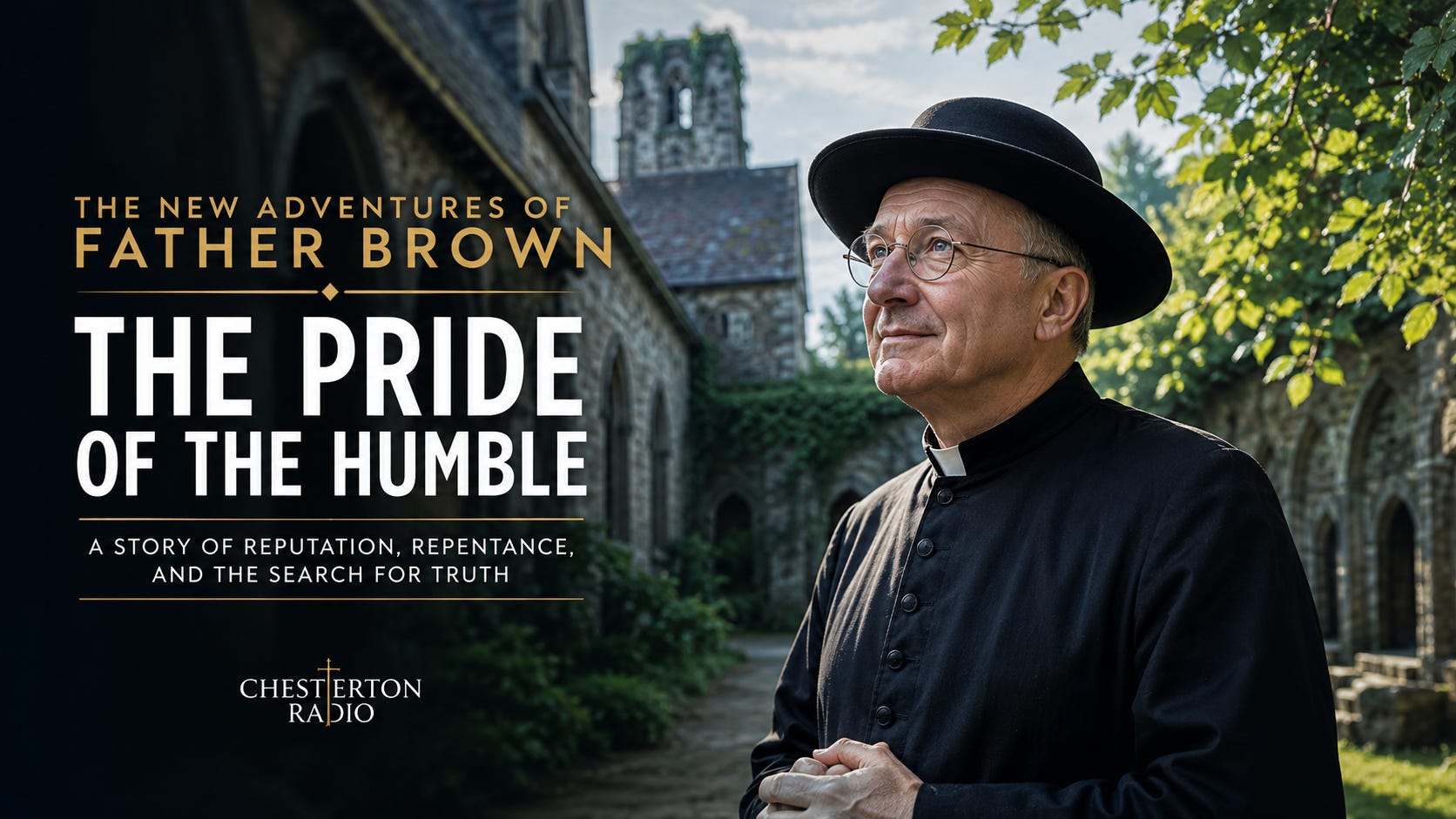
Part I — The Abbey of Quiet Men
There are certain places in England where silence is not merely the absence of noise, but a positive thing, like the fragrance of lavender or the color of old stone. One may hear birds, bells, distant sheep, or even the cheerful complaints of rooks among the elms; yet the silence remains, as the sea remains beneath its waves. Such a silence belonged to the Abbey of Saint Anselm, standing upon a green rise above a winding river, where the gray walls had looked patiently upon nearly eight centuries of English weather.
The road that climbed toward the abbey was bordered by ancient beeches whose branches met overhead like the arches of a cathedral. Father Brown walked beneath them with the unhurried step of a man who had long ago discovered that most destinations were improved by arriving five minutes later than expected. He carried a weathered umbrella beneath one arm, although the July sky was bright enough to encourage optimism in almost anyone except an English farmer.
A wagon loaded with hay passed him slowly.
The farmer touched his cap.
“Going up to the abbey, Father?”
“I generally find monasteries at the tops of hills,” Father Brown replied pleasantly. “It’s only public houses that have the good sense to settle in the valleys.”
The farmer laughed.
“Aye, Father. Though I sometimes think they’ve got the better bargain.”
He drove on, still smiling.
Father Brown watched the wagon disappear around a bend before continuing his climb. It had always amused him that people imagined priests spent their lives thinking about heaven, when in truth they spent a remarkable amount of time noticing horses, weather, boots, and the peculiar ways in which honest men scratched their heads while telling perfectly truthful stories.
The great oak gate stood open.
A lay brother greeted him with the sort of smile one rarely encounters outside monasteries and very small villages.
“Welcome, Father Brown. The Abbot has been expecting you.”
“I hope he has not been expecting me for too long,” said Father Brown. “Expectations improve with age much less reliably than cheese.”
The brother chuckled as he took the visitor’s small carpetbag.
“You’ve arrived at a fortunate time. Tomorrow we celebrate Brother Matthew’s Jubilee.”
“Indeed?”
“Fifty years in the monastery.”
“That is a long conversation with God.”
“It has made him a saint.”
The words were spoken so simply that another man might have accepted them without reflection.
Father Brown merely nodded.
“Then I shall be very careful what I say in his presence.”
The brother looked puzzled.
“Why, Father?”
“Oh,” said Father Brown mildly, “because saints generally make one wish to become better.”
The lay brother seemed satisfied by the answer, though Father Brown himself was not.
As he crossed the cloister garth, he noticed the familiar order of monastic life unfolding around him. One monk pruned roses with almost mathematical precision. Another repaired a wheelbarrow whose chief defect appeared to be that it had survived several generations of wheelbarrows. Two novices hurried across the grass carrying books much too large for their arms and much too important, they imagined, for anyone else’s.
Nothing could have appeared more peaceful.
Yet Father Brown had learned that peace and perfection were not the same thing.
Perfect places made him nervous.
Peaceful ones did not.
The Abbot received him in a study lined from floor to ceiling with books whose bindings had acquired that mellow dignity possessed only by volumes frequently read and rarely dusted. The windows stood open toward an orchard where bees hummed among old apple trees.
Abbot Gregory was a large man with kind eyes and hands that suggested he had spent as much of his life lifting sacks of grain as lifting theological arguments.
“Father Brown!” he exclaimed warmly. “You honor us.”
“I suspect the honor belongs to your cook,” Father Brown answered. “I’ve heard Benedictines have always regarded hospitality as an extension of theology.”
“We consider soup an argument for Providence.”
“Then I am already half converted.”
They laughed together with the ease of men who had met only twice before but shared enough convictions to make formal acquaintance unnecessary.
After tea had been served, the Abbot leaned back.
“I confess I had another reason for inviting you.”
Father Brown looked up over the rim of his teacup.
“Most invitations contain at least two reasons.”
“We shall celebrate Brother Matthew tomorrow.”
“So I have heard.”
“He dislikes attention.”
“That sounds promising.”
“But the attention insists upon him.”
The Abbot smiled affectionately.
“You will see. He has spent fifty years choosing the lowest task before anyone else can volunteer. He rises before the bell. He mends everyone’s boots. He knows every widow in the valley by name. The villagers speak of him almost... reverently.”
Father Brown stirred his tea without drinking it.
“Do they?”
“You sound doubtful.”
“Oh, not doubtful.”
“What then?”
Father Brown looked toward the open window, where a swallow darted across the orchard.
“I have sometimes thought that admiration is rather like ivy.”
“Ivy?”
“It can make an old building look beautiful.”
The Abbot nodded.
“And yet?”
“And yet it may also hide cracks that ought to be repaired.”
The Abbot laughed gently.
“You have not met Brother Matthew.”
“No.”
“You shall like him.”
“I very much hope so.”
There followed a comfortable silence, during which neither man felt obliged to improve upon the conversation.
Evening bells began to ring across the cloister.
Their sound rolled slowly over the fields like invisible waves.
The Abbot rose.
“Come. Vespers.”
The chapel glowed with the amber light of late afternoon passing through old glass. The monks entered two by two, their black habits moving with the quiet rhythm of long practice.
Father Brown knelt near the back.
During the chanting he scarcely looked up.
Only once.
A lay brother entered almost unnoticed through a side door.
He carried a basket of candles beneath one arm and quietly replaced those that had nearly burned away.
No one seemed to observe him.
Or rather, Father Brown noticed, everyone observed him without appearing to do so.
Several monks smiled almost imperceptibly as he passed.
One novice straightened instinctively.
An elderly monk bowed his head a little lower.
The man himself acknowledged none of it.
He moved with complete simplicity, lit the last candle, and disappeared again through the side door before the final psalm had ended.
Father Brown leaned ever so slightly toward the monk kneeling beside him.
“Brother Matthew?”
The monk whispered without turning his head.
“Yes.”
Father Brown faced the altar once more.
After a long silence he murmured almost to himself,
“It is a curious thing...”
“What is, Father?”
“...how difficult it is to notice a truly humble man.”
The chant continued beneath the ancient stone arches.
But Father Brown’s eyes rested, for only a moment, upon the small side door through which Brother Matthew had vanished.
And for reasons he could not yet have explained, he found himself praying not only for the monks of Saint Anselm’s...
...but especially for the one whom everyone already believed to be a saint.
The Pride of the Humble
Part II — A Reputation for Sanctity
Morning came softly to Saint Anselm’s Abbey. There are places where dawn arrives like the opening of a curtain, and others where it steals into the world as quietly as a monk entering a chapel. At Saint Anselm’s it was the latter. The first light touched the upper branches of the elms long before it ventured into the cloister, and the bells seemed less to awaken the valley than to remind it that it had already been awake in the sight of God.
Father Brown had always liked monasteries in the morning. They possessed the curious cheerfulness of places where no one expected to become important before breakfast.
After Lauds and a modest meal of porridge, fresh bread, and honey gathered from the abbey’s own hives, the community dispersed to its various labors. The Abbot invited Father Brown to walk through the grounds before the preparations for the Jubilee Mass began.
“You wished to meet Brother Matthew,” he said.
“If Providence permits.”
“It usually does.”
They found the lay brother in the workshop behind the stable, seated on a low stool with an old boot between his knees. Around him were scattered tools so polished by use that they seemed almost ornamental. He was stitching a worn sole with the patient concentration of a man who regarded every task as worthy of his full attention.
He rose at once when he saw the visitors.
“Father.”
His voice was gentle, though roughened by years spent more often in labor than conversation.
“This is Father Brown,” said the Abbot. “Our guest.”
Brother Matthew inclined his head.
“I’ve heard of you.”
“I hope not too much,” Father Brown replied.
A faint smile crossed the lay brother’s face.
“It is always dangerous to hear too much about anyone.”
“Especially oneself.”
The smile remained for only a moment before Brother Matthew returned to his work.
Father Brown noticed his hands. They were broad, scarred, and permanently stained with the dyes used in repairing leather. They were not the hands of a mystic painted by an artist. They were the hands of a man who had spent fifty years mending what other people had worn out.
“You repair everyone’s boots?” Father Brown asked.
“And occasionally their umbrellas.”
“Then you possess two trades that may keep civilization alive.”
Brother Matthew laughed quietly.
“I doubt either claim.”
“No,” Father Brown answered, “that is precisely why I almost believe it.”
The conversation wandered naturally to weather, harvests, and the unfortunate tendency of village children to wear through good shoes in astonishingly short periods of time.
There was nothing remarkable about the man.
Indeed, Father Brown found himself wondering why everyone insisted upon remarking about him.
When they had gone some distance from the workshop, the Abbot looked almost triumphantly at his guest.
“Well?”
“He seems very kind.”
“I told you so.”
“And very ordinary.”
The Abbot stopped.
“Ordinary?”
Father Brown nodded.
“I should be disappointed if holiness looked unusual.”
The Abbot smiled.
“You have a gift for disappointing people’s expectations.”
“So has God.”
They continued toward the old library, a long stone room whose narrow windows admitted shafts of golden light thick with drifting dust. Shelves climbed almost to the ceiling, burdened with manuscripts, parish records, forgotten sermons, and chronicles whose authors had doubtless imagined that all Christendom would one day consult them.
A visitor stood upon a ladder examining one such volume.
He descended carefully as the Abbot approached.
“Father Brown, may I present Dr. Julian Harcourt.”
The gentleman bowed politely. He possessed the appearance common among historians: spectacles forever slipping down the nose, absent-minded courtesy, and the curious ability to become more excited by a faded margin note than by most living events.
“You are studying the abbey archives?” asked Father Brown.
“With the Abbot’s generous permission.”
“For a history?”
“In part.”
Dr. Harcourt hesitated.
“I’ve long been interested in the quiet lives that never enter history.”
“Then you have chosen the proper building.”
The historian smiled.
“I sometimes think anonymous people built civilization.”
“They certainly keep it repaired,” Father Brown answered.
The remark seemed to please Brother Matthew, who had entered unnoticed carrying a small stack of ledgers. He placed them upon the table for Dr. Harcourt with an almost apologetic nod.
“I found the account books from the old infirmary.”
“You’ve saved me another day’s searching,” the historian exclaimed.
Brother Matthew merely shrugged.
“They were where they belonged.”
“Everything here seems to be where it belongs.”
“For that,” said the lay brother, “you must thank Saint Benedict, not me.”
He quietly withdrew.
Dr. Harcourt watched him leave.
“There goes one of the truly remarkable men of our age.”
Father Brown looked thoughtfully toward the closing door.
“Perhaps.”
“You sound uncertain.”
“I am only cautious.”
“Cautious of what?”
“Crowds.”
The historian laughed.
“There are scarcely crowds inside a monastery.”
“There can be crowds inside opinions.”
The remark puzzled both the Abbot and Dr. Harcourt, though neither pressed him.
As the afternoon wore on, visitors from neighboring villages began arriving for the Jubilee celebration. They spoke warmly of Brother Matthew. One remembered how he had rebuilt a collapsed bridge after the great floods. Another recalled receiving bread from the monastery during the hard winters. A widow described how he had walked six miles through snow simply to repair the roof of her cottage.
Each story was plainly true.
Each story increased the legend.
By evening Father Brown had heard enough praise to satisfy the ambitions of an emperor.
He had yet to hear Brother Matthew speak of himself at all.
That evening, as the monks gathered once more for Vespers, Father Brown remained for a few moments alone in the cloister. The sun had fallen behind the western hills, leaving the old stones glowing with the last warmth of the day.
He heard footsteps behind him.
It was Dr. Harcourt carrying a leather notebook beneath his arm.
“A beautiful place,” the historian said.
“Beautiful places sometimes conceal surprising truths.”
“I’ve discovered one already.”
Father Brown looked at him with mild interest.
“Have you?”
Dr. Harcourt smiled to himself.
“Oh, nothing scandalous.”
He tapped the notebook.
“Only one of those tiny historical puzzles that delight scholars and bore everyone else.”
“What sort of puzzle?”
“A very small inconsistency.”
Father Brown waited.
But the historian merely slipped the notebook back beneath his arm.
“I ought not to speak until I’ve confirmed it.”
“Quite right.”
“I’m certain it is nothing.”
“Most important things begin by appearing to be nothing.”
The bell for Vespers interrupted them.
As they entered the chapel together, Father Brown glanced once toward the notebook in the historian’s hand.
Then he looked toward Brother Matthew, kneeling alone in the last choir stall.
Everyone else seemed to be praying.
Brother Matthew certainly was.
Yet Father Brown found himself thinking, not for the first time, that there is a subtle danger in becoming the sort of man whom everyone else believes incapable of temptation.
For temptation has a curious habit of waiting until no one believes it can still find the door.
The Pride of the Humble
Part III — The Death in the Library
The Jubilee of Brother Matthew began with sunshine.
It seemed almost an extravagance in an English summer, and the villagers accepted it with the gratitude of people who know that weather is one of the few things no government has yet learned to regulate. Long before the Abbey bell announced the principal Mass, families were already making their way up the winding road carrying baskets, walking sticks, children, and the cheerful determination to spend the better part of the day outdoors.
The monks, for their part, appeared faintly embarrassed by so much attention. They welcomed the visitors with bread and tea beneath canvas awnings in the orchard, while the novices hurried from table to table discovering, as novices have for centuries, that hospitality always requires more chairs than anyone had imagined.
Brother Matthew seemed to vanish.
Indeed, the more the guests looked for him, the less they found him. Whenever someone wished to congratulate him, he had somehow wandered into the bakehouse, disappeared into the garden, or been discovered carrying sacks of flour where no celebration could conveniently follow him.
Father Brown watched this with quiet amusement.
“It is rather like chasing a shadow,” remarked Flambeau, who had unexpectedly appeared just before the Mass, claiming that an old friend deserved at least one surprise on a feast day.
Father Brown smiled.
“No. Shadows remain where the light leaves them. Brother Matthew keeps walking into the light and somehow disappears.”
Flambeau surveyed the bustling grounds.
“I’ve heard nothing but praises since I arrived.”
“So have I.”
“You sound troubled.”
“I am only remembering something.”
“What?”
“A saint once said that compliments should be treated as perfume.”
Flambeau waited.
“You may smell them,” Father Brown continued, “but it is unwise to swallow them.”
The great bell interrupted further conversation.
The Mass was celebrated with the restrained solemnity peculiar to Benedictines, who seem to regard grandeur as something best expressed quietly. The ancient chants filled the stone church without effort, as though they had never entirely left its walls during the preceding eight hundred years.
Brother Matthew knelt in his accustomed place.
He appeared no more conscious of being honored than one of the carved saints upon the pillars.
Afterward came the modest feast.
There were speeches.
Brother Matthew attempted to escape them.
The Abbot prevented it with gentle firmness.
One elderly villager recalled how the lay brother had rebuilt his barn after a fire.
Another remembered receiving food during the terrible winter of forty-seven.
A former novice—now gray-haired himself—described arriving at the monastery frightened and homesick, only to find a kindly brother waiting with hot soup and repaired boots before anyone else had learned his name.
Each recollection was greeted with affectionate laughter.
Brother Matthew lowered his head a little farther after each one.
At last he was persuaded to speak.
He rose awkwardly.
“My friends...”
He paused.
“I have done very little.”
A murmur of affectionate disagreement passed through the gathering.
“No,” Brother Matthew continued quietly. “What little good you remember was God’s kindness.”
He looked toward the Abbot.
“If you wish to honor anyone today, thank the brothers who taught me patience... and the Lord, who has had to teach me everything else.”
Then he sat down.
The applause seemed almost unavoidable.
Father Brown did not join it.
Not because he disagreed with the words.
But because he was watching the speaker’s face.
For the briefest instant...
before the applause began...
he thought he had seen something stranger than pride.
Relief.
As though the speech had ended without some danger he alone had expected.
The impression vanished almost immediately.
Father Brown wondered whether he had imagined it.
Late in the afternoon, after the visitors had begun their slow descent toward the village, the abbey settled once more into its familiar rhythm.
Father Brown wandered into the library.
The long room stood empty except for Dr. Julian Harcourt, who sat surrounded by ledgers and parish registers.
The historian looked unusually pleased.
“I believe I’ve solved it.”
Father Brown removed his hat.
“The history of England?”
“Oh, nothing so ambitious.”
Dr. Harcourt lifted a worn leather notebook.
“Only one tiny puzzle.”
“The inconsistency?”
“Yes.”
He hesitated.
“It proves to be rather charming.”
“I am glad of that.”
“I had feared some forgotten scandal.”
“And instead?”
“A misunderstanding.”
Father Brown waited.
Dr. Harcourt smiled almost boyishly.
“I should like another day to verify everything before discussing it.”
“A wise historian always gives yesterday another chance to explain itself.”
The scholar laughed.
“You understand archives better than most priests.”
“I understand people.”
“Which is probably the harder subject.”
They spoke for several minutes about old parish records, fading ink, and the melancholy tendency of mice to appreciate medieval manuscripts chiefly as nesting material.
When Father Brown finally excused himself for a walk before Vespers, Dr. Harcourt remained at his table, writing steadily in his notebook.
It was the last time anyone knowingly saw him alive.
Evening settled over Saint Anselm’s with unusual stillness.
Clouds drifted across the western sky, muting the sunset until the abbey seemed wrapped in silver rather than gold.
The first bell for Vespers rang.
One monk was absent.
Then another noticed the library remained unlocked.
Brother Matthew, passing through the cloister with a basket of folded linens, quietly offered to look.
He returned only moments later.
His face had become very pale.
“The doctor...”
The Abbot hurried past him.
Father Brown followed.
Dr. Harcourt remained seated at the great oak table.
One hand still rested upon an open manuscript.
The other had fallen loosely toward the floor.
His spectacles lay beside an extinguished candle.
The Abbey physician, an elderly monk whose former practice in London had long ago been exchanged for monastic peace, examined the body with practiced gentleness.
After several silent minutes he looked up.
“I fear his heart has failed.”
The room remained still.
No one questioned the verdict.
Dr. Harcourt had spoken more than once of occasional weakness brought on by years of overwork.
The physician crossed himself.
“A sad end.”
The monks bowed their heads.
The Abbot quietly began the prayers for the dead.
Only Father Brown continued looking around the room.
Not searching.
Simply noticing.
The open manuscript.
The extinguished candle.
The ink, still wet upon the final page.
The empty chair opposite.
The slightly open window through which the evening breeze stirred loose papers.
And then...
something that made him lower his eyes.
Very gently he bent beside the table.
When he rose again, nothing in his expression had changed.
Flambeau, standing near the doorway, caught his eye.
“What is it?”
Father Brown answered so softly that only his old friend could hear.
“I was speaking with him scarcely an hour ago.”
“Yes?”
“He carried a little leather notebook.”
Flambeau glanced about the room.
“I don’t see it.”
“No.”
Father Brown looked once more at the dead historian.
“Neither do I.”
Outside, the bell continued calling the monks to Vespers.
Its solemn notes rolled across the valley with the same peaceful certainty they had known for centuries.
Yet to Father Brown they sounded, for the first time since his arrival, not like the close of another ordinary day...
but like the opening words of a mystery.
The Pride of the Humble
Part IV — The Weight of a Small Legend
The morning after Dr. Harcourt’s death broke beneath a low sky of drifting gray cloud. The rain had not yet begun, though it seemed already to inhabit the air, as an apology sometimes enters a room before the man who must offer it.
Saint Anselm’s had resumed its accustomed order, but it was the order of a family speaking softly after a funeral. The bells rang at their appointed hours, the brothers went to their work, and prayers rose from the chapel with their ancient serenity; yet every conversation seemed to end a little sooner than usual.
The historian’s body was to be taken to the village later that afternoon.
The Abbey physician remained convinced that the cause had been natural.
“The heart is an obedient servant,” he remarked sadly to Father Brown over breakfast. “It performs miracles for years, and then one day simply declines to continue.”
“It often resembles its owner,” Father Brown answered.
The physician smiled.
“You suspect something else?”
“I suspect very little.”
“Then why do you seem so thoughtful?”
Father Brown buttered a piece of bread with almost exaggerated care.
“Because I dislike missing things.”
“You mean the notebook?”
“I mean the notebook.”
The physician shrugged.
“A scholar may misplace a notebook more easily than most men misplace a hat.”
“Quite true.”
“And someone may find it after we’ve all forgotten about it.”
“That,” said Father Brown quietly, “is exactly what troubles me.”
After breakfast Father Brown wandered into the cloister garden.
Brother Matthew was kneeling beside a bed of white lilies, removing weeds with such patient care that he appeared to apologize to each flower before disturbing the earth around it.
“Good morning,” Father Brown said.
Brother Matthew looked up with his familiar smile.
“A peaceful one, despite everything.”
“I hope so.”
They worked together in silence for several minutes.
Father Brown had often found that silence reveals more about a man than questions.
At length he asked almost casually,
“Did you know Dr. Harcourt well?”
“Only these past few days.”
“He seemed to enjoy your company.”
Brother Matthew looked faintly surprised.
“He was kind enough to ask about the Abbey’s older records.”
“Did he discover anything interesting?”
The lay brother returned his attention to the flowers.
“I believe historians always discover something interesting.”
“You sound uncertain.”
“I never understood old documents very well.”
“No?”
“I’ve always preferred repairing boots.”
There was nothing evasive in the reply.
Nothing hurried.
Nothing nervous.
Yet Father Brown noticed something else.
For the first time since arriving at Saint Anselm’s, Brother Matthew had not met his eyes.
Flambeau joined him later beneath the old yew tree overlooking the river.
“I’ve been asking questions,” the larger man announced.
“So have I.”
“I’ve accomplished very little.”
“So have I.”
Flambeau laughed.
“You’ve learned something.”
Father Brown considered.
“I’ve learned that everyone admired Brother Matthew long before they knew him.”
“What does that mean?”
“It means reputations sometimes arrive before introductions.”
“You think his reputation is false?”
“No.”
Father Brown looked thoughtfully across the valley.
“I think it may be too complete.”
Flambeau frowned.
“I don’t understand.”
“Neither do I.”
After a pause he added,
“That is why I am still listening.”
The Abbot invited Father Brown into the library after None.
The long room had been tidied with monastic efficiency. Dr. Harcourt’s books had been carefully stacked. His spectacles rested in a small wooden box awaiting his family.
Everything had been restored.
Everything except the notebook.
“I have searched everywhere,” the Abbot admitted.
“So have several of the brothers.”
“And?”
“Nothing.”
The Abbot folded his hands.
“Father Brown...”
“Yes?”
“I must ask plainly.”
“You think Dr. Harcourt was murdered.”
Father Brown shook his head.
“No.”
The Abbot looked relieved.
“I think someone wishes us to believe he died naturally.”
The words settled into the room like dust falling through sunlight.
“You see a difference?”
“A very great difference.”
The Abbot sat quietly.
“What leads you to that conclusion?”
Father Brown walked slowly toward the historian’s table.
He rested one hand upon the polished oak.
“I asked myself a very simple question.”
“What question?”
“If a scholar dies naturally...”
“Yes?”
“...who steals his notebook?”
That evening the rain finally came.
The monks gathered for Vespers while drops tapped gently against the ancient windows.
The chanting seemed lower than before, as though the Abbey itself were praying for the stranger who had died within its walls.
Father Brown remained kneeling long after the others had departed.
When at last he rose, he found Brother Matthew standing alone near the side chapel, extinguishing candles one by one.
The lay brother smiled.
“A beautiful office tonight.”
“It always is.”
Brother Matthew paused before the final candle.
“I have been praying for Dr. Harcourt.”
“As have I.”
“I wish I had known him longer.”
Father Brown looked steadily at the little flame.
“He wished he had known you longer as well.”
Brother Matthew’s hand stopped.
Only for an instant.
Then the candle was quietly extinguished.
Darkness settled gently across the side chapel.
The two men stood without speaking.
Finally Brother Matthew said,
“He was a good man.”
“Yes.”
“And very thorough.”
“Yes.”
“He seemed to enjoy small discoveries.”
Father Brown nodded.
“Small discoveries are often the important ones.”
Brother Matthew inclined his head almost imperceptibly.
“I suppose they are.”
He turned to leave.
As he reached the doorway, Father Brown spoke with the same mildness he might have used in asking for another cup of tea.
“Brother Matthew.”
The lay brother looked back.
“If a man discovered that everyone had misunderstood one small event from many years ago...”
“Yes, Father?”
“...would it matter?”
Brother Matthew answered almost at once.
“Truth always matters.”
“Indeed it does.”
He gave a courteous bow and disappeared into the cloister.
Father Brown remained where he was.
A few moments later Flambeau entered the chapel.
“You’ve found something.”
Father Brown did not answer immediately.
Instead he looked toward the single candle still burning before the Blessed Sacrament.
“Not yet.”
“But you’re close.”
Father Brown sighed.
“I think I have finally discovered what this mystery is about.”
“What is it about?”
“It isn’t about a dead historian.”
“No?”
“It isn’t even about a missing notebook.”
He watched the little flame tremble in the silence.
“It is about the terrible weight a good man may place upon his own reputation...”
“...until he mistakes protecting that reputation for protecting the truth itself.”
Outside, the rain fell softly upon the Abbey roof, while somewhere in the darkness beyond the cloister walls, a single nightingale continued to sing as though no human soul had ever invented either praise... or pride.
The Pride of the Humble
Part V — The Secret of Brother Matthew
The rain continued through the night, washing the old stones of Saint Anselm’s until they shone beneath the morning light like ancient silver. Small streams wandered through the cloister garden, and every leaf seemed greener than it had been the day before. Father Brown had often thought that England looked most honest after rain. Dust could disguise many things. Rain seldom did.
The Abbey had become quieter still.
Dr. Harcourt had been laid to rest in the village churchyard until his family could make further arrangements, and the monks had returned to their accustomed rhythm. Yet an invisible burden remained. It was not fear. Monasteries have lived too long beside death to fear it in the ordinary sense.
It was uncertainty.
The sort that enters a house without opening the door.
After Prime, Father Brown asked permission to examine the library once more.
The Abbot accompanied him.
“You believe the answer is still here?”
“I believe the question is.”
The Abbot smiled faintly.
“You have always preferred questions.”
“They are usually more truthful.”
The long room seemed unchanged.
The same shelves.
The same oak table.
The same morning light entering through the narrow windows.
Father Brown stood where Dr. Harcourt had last been seen alive.
He looked, not at the books, but toward the doorway.
Then toward the window.
Then toward the opposite chair.
Finally he closed his eyes.
“What do you see?” asked the Abbot.
“A conversation.”
“With whom?”
“With a man who had just learned something he had not expected to learn.”
The Abbot waited.
Father Brown continued almost as though speaking to himself.
“Dr. Harcourt was delighted, not alarmed. He believed he had discovered a harmless correction to history.”
“The misunderstanding.”
“Yes.”
“He intended no harm.”
“None whatever.”
The priest opened his eyes.
“He thought he was polishing a window.”
“And instead?”
“He accidentally touched a mirror.”
Later that morning Father Brown found Brother Matthew repairing a child’s toy cart in the carpenter’s shed. One wheel had broken away, and the old lay brother was patiently fitting a new wooden axle.
He looked up with his customary warmth.
“Good morning, Father.”
“May I interrupt?”
“A priest may interrupt almost anything.”
Father Brown smiled.
“I hope not breakfast.”
“Certainly not breakfast.”
They both laughed.
For several minutes they worked together in silence.
Brother Matthew sanded the new axle smooth.
Father Brown turned the little wheel between his fingers.
“It belonged to one of the village children?”
“Thomas Reed.”
“The blacksmith’s grandson?”
Brother Matthew looked surprised.
“You remember names well.”
“No.”
Father Brown shook his head.
“I remember affection.”
The lay brother looked down again.
“That is kinder.”
“No.”
“It is merely easier.”
The cart was nearly finished.
Brother Matthew tested the wheels upon the stone floor.
They rolled perfectly.
“There,” he said with quiet satisfaction.
“It is remarkable,” Father Brown observed, “how much happiness may depend upon one small thing being straight.”
Brother Matthew nodded.
“Most work is like that.”
“So is conscience.”
The lay brother’s hands stopped.
Only for an instant.
Then they resumed polishing the little toy.
At last Father Brown spoke.
“Dr. Harcourt discovered something.”
“Yes.”
“I think you know what it was.”
Brother Matthew remained silent.
“It concerned you.”
Still no answer.
“It was not a crime.”
The old monk laid down the toy.
“No.”
“It was not even a serious fault.”
“No.”
“It was simply... a mistake.”
Brother Matthew’s shoulders seemed to grow older.
“A very small one.”
“Many years ago?”
“Nearly forty.”
The shed was quiet except for rainwater dripping from the eaves.
Father Brown spoke almost gently enough to be mistaken for prayer.
“You told a story.”
Brother Matthew closed his eyes.
“I never intended to deceive anyone.”
“I know.”
“It happened differently than I remembered.”
“I know.”
“People repeated it.”
“I know.”
“I tried to correct them.”
Father Brown waited.
Brother Matthew opened his eyes again.
“Only once.”
Silence.
“They would not believe me.”
“No.”
“They preferred the better story.”
“Yes.”
The old lay brother’s voice had become scarcely audible.
“And after a while...”
He stopped.
Father Brown finished the sentence.
“...you became afraid to disappoint them.”
A tear appeared in the corner of Brother Matthew’s eye.
“I told myself it did not matter.”
“No.”
“I told myself the story encouraged people.”
“Yes.”
“I told myself correcting it would only create confusion.”
Father Brown looked at him with infinite sadness.
“And gradually you ceased protecting the truth...”
“...and began protecting the story.”
Brother Matthew lowered his head.
Neither man spoke for several minutes.
Outside, the Abbey bell announced Terce.
Its familiar notes floated across the wet gardens.
Finally Brother Matthew whispered,
“When Dr. Harcourt showed me the old ledger...”
Father Brown said nothing.
“I knew immediately.”
“He had found the original record.”
“Yes.”
“And he was delighted.”
“He thought it amusing.”
“He believed you would laugh with him.”
Brother Matthew covered his face with both hands.
“He said...”
His voice broke.
“He said the real story was even more beautiful.”
Father Brown closed his eyes.
“Was it?”
“Yes.”
Another silence.
“I had spent forty years fearing the truth...”
“...when the truth was lovelier than the legend.”
The words seemed almost unbearable.
Father Brown knew then exactly what had happened.
Not every movement.
Not every physical detail.
Those scarcely mattered.
He saw instead the movement of a soul.
A good man.
A holy man.
A man who had sincerely fled comfort, praise, and honor.
Until one day he had discovered that he had not fled them quite far enough.
For there remained one possession he could not surrender.
The image others held of him.
Brother Matthew looked up.
His face seemed emptied of every defense.
“What must I do?”
Father Brown answered without hesitation.
“Tell the truth.”
“And then?”
“Accept whatever follows.”
“I have destroyed everything.”
Father Brown shook his head.
“No.”
“I have killed a man.”
“Yes.”
“And ruined fifty years.”
“No.”
The priest’s voice remained calm.
“Sin can destroy innocence in a moment.”
Brother Matthew trembled.
“But repentance is measured by another clock.”
The old monk looked at him with desperate hope.
“Is there still mercy?”
Father Brown answered as simply as though reciting the Creed.
“There has never been anything else.”
At that moment footsteps approached the shed.
Flambeau’s familiar figure appeared in the doorway.
He stopped at once, sensing the solemnity of the moment.
Father Brown turned toward him.
“Would you ask the Abbot to come?”
Flambeau nodded without a word.
As he disappeared into the rain, Father Brown placed one hand gently upon Brother Matthew’s shoulder.
“The hardest part is over.”
Brother Matthew looked at him in astonishment.
“I have not confessed.”
“No,” said Father Brown quietly.
“But at last...”
“...you have stopped defending yourself.”
The Pride of the Humble
Part VI — The Quiet Light
The Abbot came without haste.
Years spent governing souls had taught him that there are moments when urgency accomplishes less than peace. Flambeau followed a few steps behind, removing his hat as he entered the carpenter’s shed. Neither man spoke.
Brother Matthew remained seated upon the low workbench.
His hands, which had repaired thousands of broken things over half a century, rested quietly upon his knees.
At length he looked up.
“Father Abbot...”
His voice was steady.
“I have something to confess.”
The Abbot did not ask what it was.
He merely nodded toward the chapel.
“Come.”
The rain had ceased.
Drops still clung to the cloister arches, falling now and then into the garden with the soft patience of time itself.
Father Brown and Flambeau remained outside while the Abbot and Brother Matthew entered the chapel.
For a long while neither friend spoke.
At last Flambeau broke the silence.
“You knew.”
“I knew enough.”
“But not everything.”
“No.”
“You never asked how he did it.”
Father Brown smiled faintly.
“I imagined it.”
“You imagined it?”
“The old ledger corrected the famous story. Dr. Harcourt believed Brother Matthew would be delighted to restore the truth. Instead, for one terrible instant, Brother Matthew believed his whole life was collapsing.”
Flambeau waited.
“He saw the notebook.”
“Yes.”
“He begged the historian to delay.”
“I think so.”
“And when Dr. Harcourt refused?”
Father Brown looked across the rain-washed garden.
“The poor man suffered the very weakness the physician had mentioned.”
“The heart?”
“Yes.”
“There was an attack.”
Flambeau’s eyes widened.
“And Brother Matthew...”
“...did what fear often persuades otherwise good people to do.”
Father Brown spoke without bitterness.
“He hesitated.”
Only one word.
Yet it carried the weight of an entire tragedy.
“He might have summoned help immediately.”
Flambeau’s face grew grave.
“But instead he stood between two voices.”
Father Brown nodded.
“One voice cried, ‘Save the man.’”
“And the other?”
“’Save the legend.’”
The larger man lowered his head.
“He chose wrongly.”
“For less than a minute.”
Father Brown’s voice was almost a whisper.
“Sometimes eternity enters through a single minute.”
“And afterward?”
“He called for help.”
“But it was too late.”
Flambeau reflected for a long time.
“So he did not strike him.”
“No.”
“He did not poison him.”
“No.”
“He simply failed to love him quickly enough.”
Father Brown closed his eyes.
“That is sometimes the saddest crime.”
An hour later the Abbot emerged from the chapel.
His face was lined with sorrow.
But beneath the sorrow rested something quieter.
Hope.
“Brother Matthew has confessed everything.”
Father Brown bowed his head.
“He wishes the authorities to be informed.”
“They shall be.”
“And the notebook?”
The Abbot opened his hand.
Within it lay the small leather volume.
“He had hidden it beneath the loose floorboard in the workshop.”
Flambeau looked toward the chapel door.
“I scarcely recognize the man.”
Father Brown answered gently.
“Nor does he.”
The inquiry that followed was conducted with dignity rather than spectacle.
The village constable came.
Statements were given.
The physician amended his original opinion.
Dr. Harcourt had indeed suffered a sudden cardiac seizure.
Medical aid, summoned immediately, might well have saved him.
Brother Matthew admitted, with heartbreaking simplicity, that he had delayed.
Then, in blind panic, he had concealed the notebook before finally raising the alarm.
The law judged him.
The Abbey mourned him.
No one hated him.
Least of all the family of Dr. Harcourt, who read the historian’s unfinished notes and discovered, just as Brother Matthew had said, that the truth was gentler than the legend.
The famous tale had never been false.
Only embellished.
The younger Brother Matthew had not carried a dying pilgrim three miles through a winter storm.
He had walked beside him.
The old shepherd had insisted on walking the final mile himself, laughing at every offer of assistance.
“It seems,” Dr. Harcourt had written in his last completed page, “that the real story is happier than the heroic one, because it tells us not of one saint carrying another man, but of two ordinary Christians helping one another home.”
Father Brown smiled sadly when he read those words.
“It was exactly the sort of thing Brother Matthew should have loved.”
Several weeks later Father Brown and Flambeau walked down the beech-lined road that led away from Saint Anselm’s Abbey.
The harvest fields had already begun to turn from green to gold.
Behind them the bells rang for Vespers.
Flambeau broke the silence.
“I still cannot understand how such a little mistake became such a terrible sin.”
Father Brown walked for several moments before replying.
“It was never the mistake.”
“No?”
“No.”
“The mistake was forgotten almost immediately.”
“What remained?”
“The admiration.”
Flambeau nodded slowly.
“And the admiration became...”
“A possession.”
They walked on.
“The curious thing about possessions,” Father Brown continued, “is that we imagine we own them.”
“But we do not?”
“They begin owning us.”
The road curved beneath the old beeches where Father Brown had first approached the Abbey.
The same farmer was gathering hay in a nearby field.
He lifted his cap once again.
“Good day, Father!”
“And to you.”
The wagon rolled on.
Flambeau smiled.
“You notice everyone.”
“I try.”
After another hundred yards he asked quietly,
“What shall become of Brother Matthew?”
Father Brown looked back toward the distant tower of Saint Anselm’s, rising above the trees.
“I think he will become humble.”
Flambeau stared.
“He wasn’t humble before?”
“Oh, he wished to be.”
Father Brown’s eyes rested upon the Abbey for one last moment.
“But humility is not thinking badly of oneself.”
“No?”
“It is not thinking about oneself very much at all.”
The bells continued across the valley.
Father Brown removed his hat.
For a little while neither man spoke.
At last the priest said, almost as though finishing a prayer,
“The saints are not those who never fall. They are those who stop defending themselves when the truth calls their name. Pride asks to be remembered. Humility is content to be forgotten, provided that God is remembered.”
The evening breeze stirred the leaves above them, and the bells slowly faded into the quiet countryside.
It seemed to Father Brown that the Abbey had lost a legend that week.
But it had recovered something infinitely greater.
The truth.
And where truth is welcomed with repentance, even sorrow becomes the beginning of grace.
Postscript
If you enjoyed this new Father Brown mystery, you’ll find many more journeys into mystery, faith, history, and the golden age of radio here at Chesterton Radio.
Our mission is simple: to preserve what is good, recover what has been forgotten, and create new stories that reflect truth, beauty, and the enduring wisdom of the Christian imagination.
Every day you’ll discover Morning Prayer, original mysteries, classic radio dramas, thoughtful essays, and conversations that remind us the world is far more mysterious—and far more hopeful—than it first appears.
If this story encouraged you, consider becoming a subscriber or sharing Chesterton Radio with a friend. Your support helps us continue creating original works like The New Adventures of Father Brown while preserving the rich heritage of classic radio and great literature for new generations.
Until next time, may your days be filled with good books, memorable stories, and the quiet confidence that even the deepest mysteries are never beyond the reach of truth—and never beyond the mercy of God.
The Open Door is always on.
The Pride of the Humble | A Chesterton Radio Deep Dive into a New Father Brown Mystery

What happens when the greatest danger to a holy man is not greed, ambition, or hatred—but the desire to preserve a reputation for holiness?