

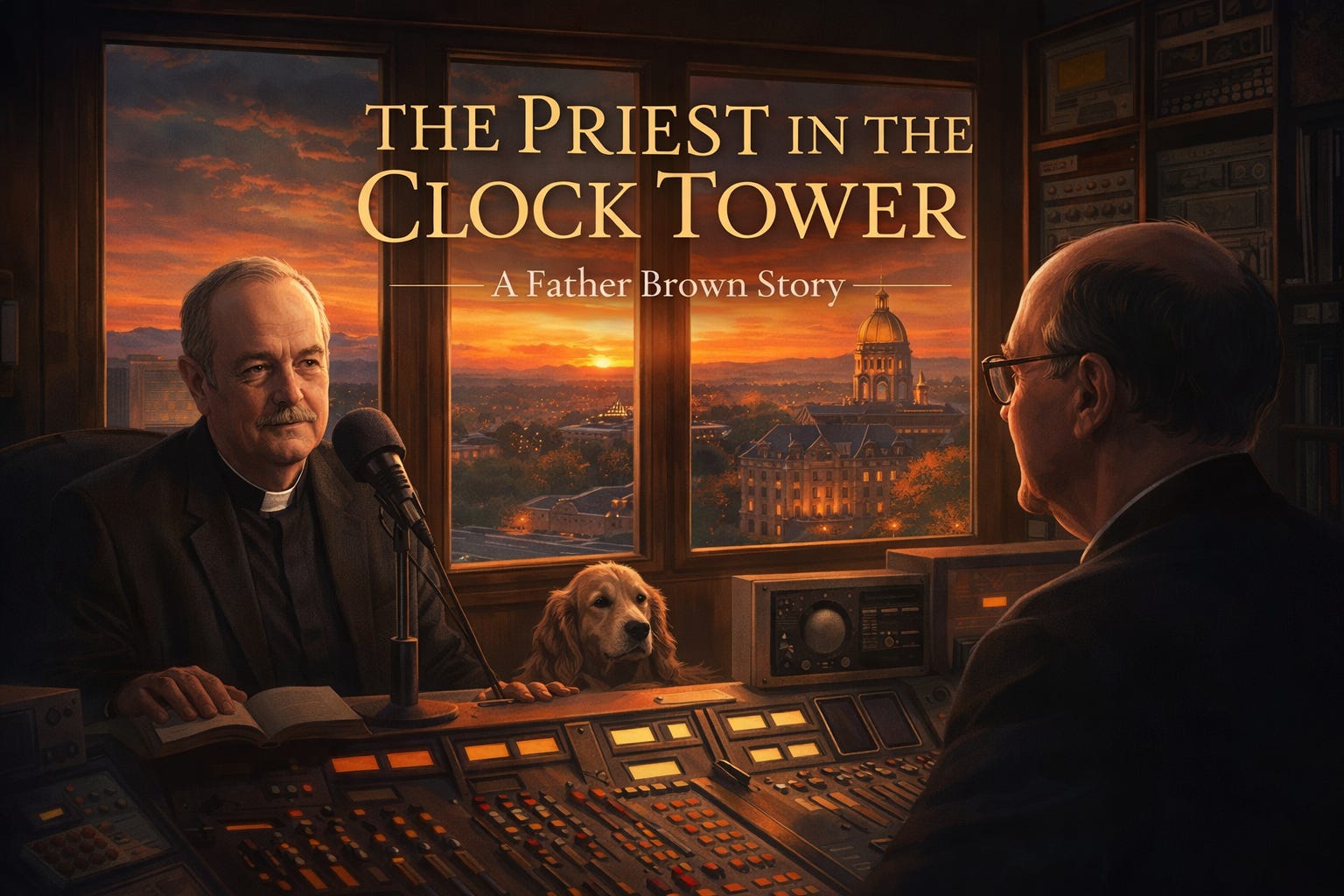
The Priest in the Clock Tower
A Father Brown story — an imaginative meeting at Notre Dame
Editor’s Note (Chesterton Radio): The following is an imagined tale — a reverent “what if” — placing Father Brown beside a real priest beloved by Notre Dame students. It is offered as fiction, in gratitude for the kinds of quiet ministries that rarely make headlines.
Father Brown disliked heights for the same reason he disliked headlines: they made ordinary things look smaller than they were.
Yet he found himself, by a chain of invitations and misunderstandings common to universities and railways, climbing into a clock tower.
The building was dedicated to Arts and Letters, which is another way of saying it was dedicated to the two things that make men most dangerous: beautiful speech and beautiful ideas. But it also contained, in its uppermost chambers, the humbler machinery of sound—wires, boards, meters, and the small miracle by which a human voice becomes a presence in a stranger’s room.
He had been brought there by a young man—an earnest seminarian of sorts, though not in Holy Orders—who spoke in the modern manner about “student engagement,” “community presence,” and other phrases which meant, when translated into Christian, simply that lonely people needed to be less lonely.
“Father,” the young man said, pointing as if to a relic, “this is the station.”
It was not a station in the railway sense, though it had much of the same bustle, the same smell of heated metal, the same feeling that time was arriving and departing even when no one noticed.
A narrow room opened like a confessional into glass: a pane of windows in front of the board looked out across the campus. The morning light lay on the quads with a kind of innocent confidence, as if the world had never known weariness. Students moved below like punctuation—commas crossing lawns, semicolons pausing near doors.
Inside, a man was arranging books.
He was not arranging them like a scholar, with the severity of a librarian. He was arranging them like a host, with the instinct of someone setting chairs before guests arrive.
He looked up.
His hair was a little unruly, his face more kind than handsome, the kind of face you would trust with secrets before you had decided to. In his hands was a battered volume that had plainly survived more than one decade of student life.
He smiled as if Father Brown had been expected all along.
“Welcome,” the man said. “You look as though you’ve been brought to the top of the world against your will.”
“I prefer my theology nearer the ground,” Father Brown replied.
“Then you’ll like radio,” the man said. “It reaches the ground without needing to climb down.”
He set the book on the table. On the cover, faded gold letters insisted on being read: The House at Pooh Corner.
The priest’s eyes moved to Father Brown’s collar, then back to his face.
“Ah,” he said, softly. “A brother priest.”
“In a manner of speaking,” Father Brown said. “I am—well, I have been known to misplace myself into odd corners of the world.”
“You’ll find you are not alone,” the man replied. “I’m Father Griffin.”
Father Brown felt that curious sensation he sometimes felt when he met a man who was not merely good, but good in a particular way—like a craftsman. This was not the goodness of a man who never struggled, but the goodness of a man who had chosen, repeatedly, to be available.
The young man who had guided Father Brown to the tower brightened.
“Father Griffin is the chaplain,” he said, as if announcing a saint. “He does the Saturday show. The Children’s Hour.”
“Children’s Hour?” Father Brown repeated, looking at the Pooh book.
“Yes,” Father Griffin said. “Though it is a secret only children know: the hour is for adults.”
He nodded toward the board where a student sat—an older student, perhaps, with the quiet posture of someone who had been “behind the glass” long enough to stop being impressed by it. His hands rested near the sliders without fidgeting, as if he had learned that the true art of sound was restraint.
Father Griffin followed Father Brown’s gaze.
“That’s Paul,” he said. “He runs the board.”
Paul nodded politely, not rising, not interrupting the ritual of readiness. He was, Father Brown observed, the only one in the room who treated the whole event with the seriousness of an engineer and the humility of a servant.
“We are nearly on,” Paul said quietly.
Father Griffin’s manner changed at once—not into theatrical solemnity, but into a kind of gentle attentiveness. It was the attentiveness of a priest about to begin Mass in a small chapel at dawn: not grand, but exact.
He stepped toward the microphone.
Father Brown, uninvited but welcomed, sat in a chair beside the wall. Through the windows the campus looked almost unreal, like a painted stage. But the voice that would soon go out would be more real than the campus. Father Brown had long ago learned that men often meet truth more honestly through stories than through speeches.
Paul flicked a switch. A small light glowed.
Father Griffin leaned toward the microphone and spoke as though he were speaking to one person.
“Good morning,” he said. “If you are awake too early, or asleep too late, you are in the right place. This is The Children’s Hour, where we admit the terrible fact that children’s stories are often the last refuge of grown-up sanity.”
His voice had the peculiar warmth that suggests a smile not at the listener, but with the listener—two conspirators caught in the same gentle plot.
“This morning,” he continued, “we’re visiting an old friend. Winnie-the-Pooh is not a bear so much as a theology. He is what happens when innocence refuses to become foolishness.”
Father Brown watched Paul’s hands. They moved with economy. He made no show of competence. He simply kept the voice steady, as if stability itself were an act of charity.
Father Griffin read.
And it was, Father Brown found, not merely a reading. It was a kind of pastoral care disguised as a children’s book. The pauses were not random. They were deliberate, like the pauses in prayer when a man leaves room for someone else to breathe.
He read of Christopher Robin and Pooh, of the inevitable leaving, of the certain sadness that is only painful because it is true. The words went out across dormitories, kitchens, empty roads, early-morning study desks.
At last he reached the final paragraph. He did not rush it. He did not dramatize it. He simply allowed it to be what it was: a farewell that is only bearable because it is wrapped in love.
Paul lowered the level slightly at a certain line, as if protecting it from the world’s noise.
Father Griffin closed the book softly, as if he were putting a child to bed.
Then he spoke again.
“When I was young,” he said, “I believed adulthood was something you achieved. Now I suspect it is something that happens to you while you are looking the other way. We become tall without becoming wise. And then—if we are lucky—we find a story that makes us small in the right way.”
He paused. Father Brown heard in that pause something rarer than eloquence: tenderness without sentimentality.
“If you are graduating,” Father Griffin said, “I will tell you a secret. You will not be brave because you are leaving. You will be brave because you once belonged. The world is full of people who have never belonged anywhere, and therefore cannot bear to depart.”
He cleared his throat gently, as if apologizing to the microphone for being too honest.
“And if you are lonely,” he added, “do not imagine that loneliness is a sign you have failed. Loneliness is sometimes the sound the soul makes when it is calling out for something real. Not noise. Not distraction. Something real.”
Paul’s eyes flicked once to Father Griffin, and then back to the board, as if to say: I understand.
Father Griffin smiled faintly, and somehow that smile went out through the radio as well.
“And now,” he said, “we will let the silence do the rest.”
Paul faded the mic.
A small click, a needle settling, a room returning to ordinary air.
Father Brown exhaled as though he had been holding his breath.
“That,” he said quietly, “was not a broadcast.”
Father Griffin turned, and the friendliness returned to his face like morning light.
“No?” he asked.
“That was a sacrament,” Father Brown said. “You gave them something they cannot buy.”
Father Griffin’s expression became amused.
“Well,” he said, “I did not charge for it.”
“I meant you gave them something the modern world is terrified of,” Father Brown replied. “A story that admits we must part—without pretending parting is meaningless.”
Father Griffin leaned back against the table.
“You’re Father Brown,” he said, with sudden certainty.
Father Brown blinked.
“I have met many priests,” Father Griffin explained. “And a few detectives. You are the only man who looks as though he has forgiven the world for existing.”
Father Brown smiled.
“And you,” he said, “are the only man I’ve met who makes an FM station sound like a chapel.”
Father Griffin laughed softly.
“That is because it is a chapel,” he said. “Only the pews are scattered. The altar is a microphone. And the congregation is the lonely.”
He glanced toward the window, to the campus below.
“I’ve found,” he continued, “that universities are full of a particular species of loneliness. It is the loneliness of being surrounded by thousands and still thinking you are unworthy of friendship.”
Father Brown nodded.
“Yes,” he said. “That is the modern curse: crowds without communion.”
Father Griffin’s eyes moved toward Paul again, and Father Brown followed them.
“And then,” Father Griffin said, “there are men like Paul.”
Paul pretended not to hear. Engineers, Father Brown knew, have an instinctive allergy to praise.
“He keeps the signal alive,” Father Griffin went on. “Not just the radio signal. The other one.”
“What other one?” Father Brown asked.
“The signal between souls,” Father Griffin said simply. “The invisible thing that says: I’m here. People think priests do that by talking. But sometimes it’s done by being reliable.”
Paul’s mouth tightened slightly, but it might have been a smile.
Father Brown looked at the board with new respect.
“Do you enjoy this work?” Father Brown asked Paul.
Paul shrugged.
“I like that it matters,” he said. “I’m an engineer. I’m usually around people who think stories are… optional.”
Father Griffin made a face of exaggerated protest.
“Stories are not optional,” he said. “Stories are the only way most people can bear the truth.”
Father Brown chuckled.
“Sometimes,” he said, “a story is the only way to say the truth without stabbing someone with it.”
Father Griffin nodded as if relieved.
“Yes,” he said. “Exactly. That’s why I read children’s books. Adults have armor. Children’s stories go around the armor.”
A small movement at the door interrupted them.
A cocker spaniel entered as if he owned the tower.
He was not a grand dog, but he had the gravity of someone who has been loved properly. He trotted to Father Griffin and sat, looking up with patient confidence.
Father Griffin bent down and scratched the dog’s ears.
“Darby,” he said. “You’re late.”
Darby blinked slowly, as if time was an invention of anxious people.
Father Brown stared at the dog, then at Father Griffin.
“I see,” he said. “You have an assistant.”
“This is my best assistant,” Father Griffin said. “He listens better than most students, and he never interrupts.”
Father Brown leaned down awkwardly and let the dog sniff his hand.
Darby’s tail thumped once, a decisive judgment.
Father Brown felt, unexpectedly, a tightness in his throat.
“I understand,” he said softly.
“What do you understand?” Father Griffin asked.
“Why people approach you,” Father Brown said. “They can talk to the dog first.”
Father Griffin’s eyes softened.
“Yes,” he said. “Darby is a door.”
“A door?” Father Brown repeated.
“A door for the shy,” Father Griffin said. “A door for the wounded. A door for the proud who don’t know how to ask for help.”
Darby yawned, as if agreeing that this was obvious.
Father Brown straightened.
“And where,” he asked, “do you keep this door open?”
Father Griffin smiled.
“In the basement of the student center,” he said. “Overnight.”
Father Brown raised his eyebrows.
“Overnight?” he asked.
Father Griffin shrugged.
“That’s when the lonely come,” he said. “Not at noon. Not at the pep rally. Not at the lecture on ‘Human Flourishing.’ They come at one in the morning when they can’t sleep and they’re afraid to tell anyone why.”
He looked out the window again.
“I call it Darby’s Place,” he added. “A coffee shop, officially. A refuge, unofficially. A confession booth that smells like burnt coffee.”
Father Brown sat down again, slowly.
“And you sit there?” he asked.
“I sit there,” Father Griffin said. “And I let them talk. Or not talk. Sometimes a student will come down just to be near other breathing human beings. Sometimes they cry. Sometimes they argue with God. Sometimes they tell me things they would never tell anyone.”
Father Brown nodded.
“And do you ever solve crimes?” he asked mildly.
Father Griffin laughed.
“I solve smaller ones,” he said. “The crime of self-hatred. The theft of hope. The vandalism of cynicism.”
Father Brown looked at him with approval.
“Those are the worst crimes,” Father Brown said. “Because the victims do not call the police.”
They were quiet for a moment, listening to the hum of the tower.
Below, campus life continued as though nothing extraordinary had happened. But Father Brown knew that something extraordinary had happened. A man had read Pooh into the air, and another man had kept the levels steady, and somewhere in some dorm room a frightened student had stopped feeling quite so alone.
Father Griffin broke the silence.
“Will you come to Darby’s Place tonight?” he asked.
Father Brown hesitated. He had plans, in the way that wandering priests always have plans that are really appointments with Providence. But he felt a tug.
“I will come,” he said.
Father Griffin looked pleased, not because he had acquired a guest, but because he had acquired a witness.
“And will you,” Father Griffin said, turning to Paul, “come down later?”
Paul hesitated.
“I always do,” he said, with the mild defensiveness of someone who knows he belongs but still feels he must justify it.
Father Griffin’s smile widened.
“Good,” he said. “Because I want you to meet Father Brown properly.”
Paul’s eyebrows rose.
“Properly?” he asked.
“Yes,” Father Griffin said. “In the place where people are honest. Not in the tower where everyone tries to sound clever.”
Father Brown laughed.
“I should warn you,” he said, “that I become even less clever after midnight.”
“Excellent,” Father Griffin said. “So do the students.”
Darby stood, stretched, and trotted to the door as if the meeting were concluded.
Father Griffin followed him.
Before leaving, he turned back toward the board and the windows.
“You know,” he said, softly, almost to himself, “there are men who climb roofs in ice storms to restore a cable.”
Paul stiffened slightly, surprised.
“And there are men,” Father Griffin continued, “who will never know that someone did that for them. They will only know that, on a Saturday morning, a voice arrived in their room.”
He looked at Paul.
“Thank you,” he said.
Paul looked down at the board.
“You’re welcome,” he muttered, and his voice had the careful flatness of someone who didn’t want gratitude to become a fuss.
Father Brown watched the exchange and felt something in it that was, again, more than kindness: it was the recognition that hidden labor is still holy.
As they descended the stairs of the tower, Father Brown put a hand on the rail and looked once more through a high window at the campus.
“Time,” he said quietly, “is a strange thing.”
Father Griffin nodded.
“Yes,” he said. “That is why the station is in a clock tower.”
“And why,” Father Brown added, “you read the last chapter of Pooh at graduation.”
Father Griffin looked at him, surprised.
Father Brown smiled.
“It is the kindest way to teach them that leaving is real,” Father Brown said, “and that love is realer.”
Father Griffin’s eyes shone briefly.
“You’re a dangerous priest,” he said.
“I’m a small one,” Father Brown replied.
They reached the bottom landing. The sounds of the building returned—doors, footsteps, laughter.
Father Griffin touched Darby’s head, and Darby leaned into the hand as though into a blessing.
“Come tonight,” Father Griffin said again, and his tone made it less an invitation than a promise: that the door would be open.
Father Brown nodded.
“I will,” he said.
And as Father Griffin walked away with Darby at his heel, Father Brown thought, not for the first time, that the world is held together less by laws than by people who keep certain rooms open.
Chesterton Radio Outro
If you enjoyed this imagined meeting of Father Brown and a priest in a clock tower, consider supporting the real work of keeping stories alive.
Chesterton Radio is listener-supported. New fiction and reflections are on Substack, and you can listen to most posts aloud right in your browser (Edge “Read aloud,” iOS speak-screen, and other built-in tools).
And if you ever find yourself awake too early—or asleep too late—may you find a door left open, a light left on, and a story that tells the truth gently.
An interesting story!
I don't know when sliding switches were introduced, they used to use rheostats at first. The broadcasting term is potentiometers, or "pots", a rather unfortunate but innocent piece of slang.