

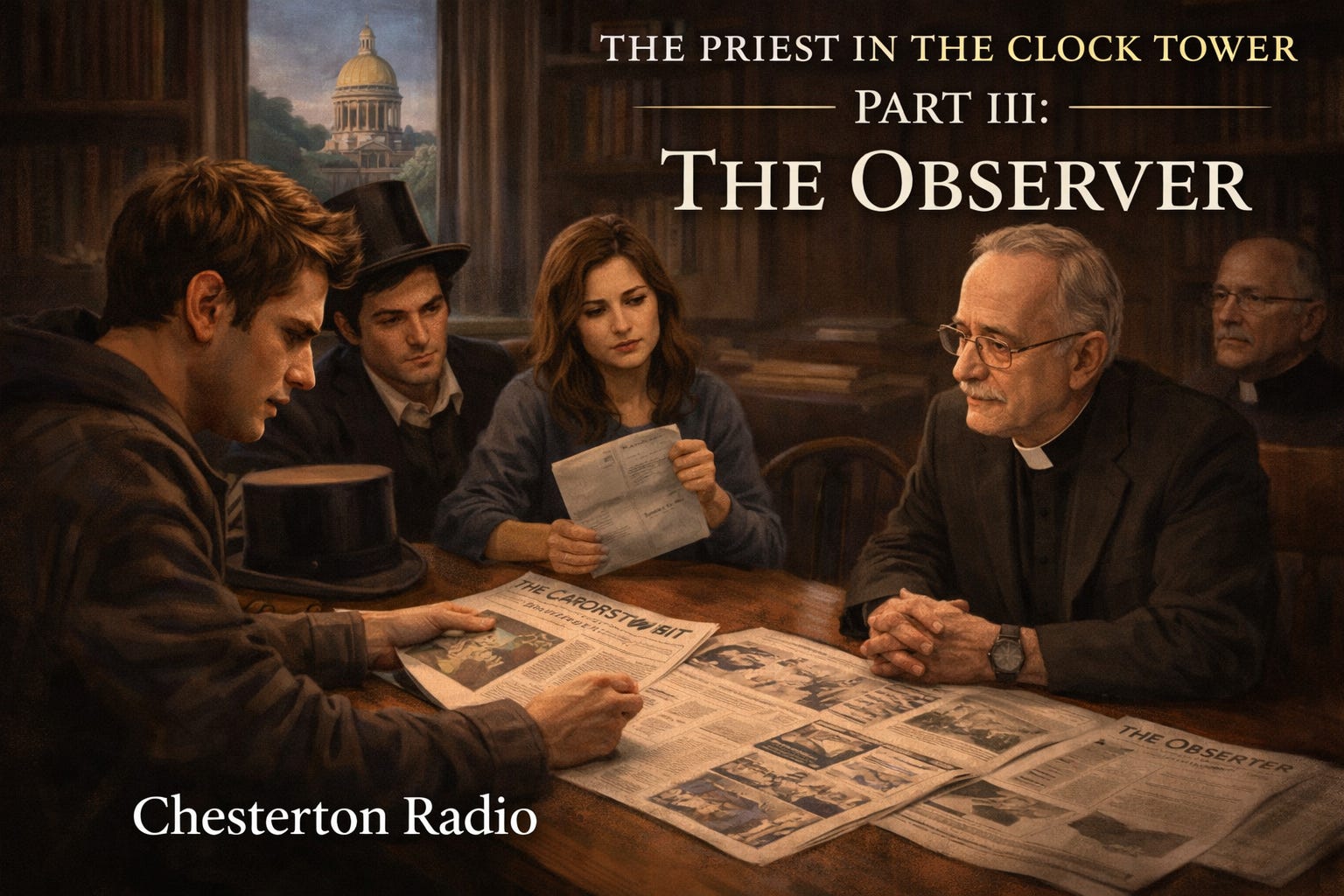
The Observer did not arrive quietly.
It arrived with trays.
At noon, stacks of it appeared at the entrances of North and South Dining Hall — fanned out beside saltshakers and napkin dispensers, half journalism, half ritual. Students grabbed copies between pizza slices and philosophy.
Michael stood near the milk dispensers pretending not to watch.
But he watched.The top panel of Molarity drew immediate laughter.
A conveyor belt beneath the Dome.
Students entering labeled “Uncertain.”
Students exiting labeled “Confident.”
Someone across the room barked a laugh.
“That’s accurate.”
Another voice called out:
“Four years and we get processed!”
Good. That was the safe laugh.
But then trays slowed.
Students noticed the lower panel.
The basement.
Darby at the door.
A priest pouring coffee.
Students talking.
A small square in the upper corner — three tall windows and a silhouette at a board.
Caption:
Processing Above. Presence Below.
The laughter changed tone.
Not gone — just thinner.
Someone said:
“Is that Darby’s Place?”
Someone else muttered:
“That’s sentimental.”
Another voice, quieter:
“That’s true.”
Michael felt heat crawl up his neck.
A girl from his architecture studio approached.
“You’re losing your edge,” she said lightly. “Since when do you do hope?”
He shrugged.
“Since I noticed cynicism wasn’t load-bearing.”
She stared at him for a moment — not mocking, but evaluating — and walked away without replying.
Across the room, a philosophy major folded the paper carefully instead of discarding it.
That frightened Michael more than criticism.
He slipped out of the dining hall without finishing his lunch.
That evening, Darby’s Place filled earlier than usual.
News travels differently on campus. Not by announcement, but by mood.
Joe arrived animated.
“You’ve polarized the dining hall,” he declared. “That’s very avant-garde.”
Michael dropped into a chair.
“They think I’ve gone soft.”
Joe removed his hat and set it down gently.
“That’s because satire is applauded when it wounds others. It’s suspicious when it heals.”
Christina arrived quietly, envelope still tucked inside her coat pocket.
She had read the strip at lunch.
She had watched reactions.
She had seen Michael’s jaw tighten.
“You did something brave,” she said simply.
Michael looked up.
“I drew a basement.”
“You drew mercy,” she replied.
He looked unconvinced.
“I don’t know if mercy fits in a comic strip.”
Father Griffin, polishing a mug that did not need polishing, spoke.
“Mercy fits everywhere,” he said. “We just don’t give it much space.”
Father Brown, seated near the door, observed Christina carefully.
“You have a letter in your pocket,” he said mildly.
She froze.
“How did you—?”
“You keep touching it as though it might disappear,” he replied.
Joe leaned forward.
“Letter?”
She exhaled.
“I was accepted.”
The room erupted — cheers, mock applause, Joe banging his cane on the floor.
She did not smile.
Father Griffin noticed.
“And yet,” he said gently.
“And yet,” she echoed, “I feel as though something is ending.”
Joe tilted his head.
“Undergraduate poverty?”
“No,” she said quietly. “Undergraduate permission.”
That landed.
She looked around the room.
“Here, I can question everything. In law school, I must defend something.”
Father Brown leaned forward.
“Then choose what you will defend.”
She shook her head.
“It’s not that simple. The law becomes you.”
Michael nodded.
“Architecture does too.”
Joe added:
“So does theatre.”
Paul, who had slipped in unnoticed and taken his usual seat near the wall, spoke quietly.
“So does engineering.”
Christina turned to him.
“And what does engineering become?”
He considered.
“Structure,” he said. “And sometimes silence.”
She studied him.
“You’re leaving, aren’t you?”
The room went still.
Paul hesitated.
“I think so.”
Joe stared.
“You can’t.”
“I can,” Paul said calmly. “Systems survive.”
Father Griffin did not interrupt.
Christina leaned back slowly.
“You climb towers,” she said. “And you fix cables in ice storms. And you think it doesn’t matter.”
Paul gave a small shrug.
“It’s infrastructure.”
Father Brown’s eyes sharpened gently.
“Infrastructure,” he said, “is what prevents collapse.”
Michael looked down at his folded newspapers in his bag.
“And satire,” he murmured, “is what reveals cracks.”
Joe looked between them.
“And theatre?” he asked.
Father Griffin smiled faintly.
“Theatre,” he said, “reminds us the cracks are human.”
Darby shifted positions and laid his head across Father Brown’s shoe.
The room softened.
Christina removed the envelope from her coat and placed it on the table.
“I am afraid,” she said, “that if I succeed, I will lose something.”
Father Brown nodded.
“You will,” he said simply.
She looked startled.
“Then why go?”
“Because growth always costs something,” he replied. “The question is not whether you will lose innocence. The question is whether you will keep mercy.”
She stared at the envelope again.
Michael leaned forward.
“My fear,” he said, “is that if I stop cutting, I will stop being noticed.”
Joe replied quietly,
“And my fear is that if I stop performing, I will stop being loved.”
Paul added,
“My fear is that when I leave, nothing will change.”
Father Griffin finally set the mug down.
“You are all confusing visibility with value,” he said.
The room fell into silence.
“Visibility is applause,” he continued. “Value is endurance.”
He looked at Paul.
“The board will glow after you leave. But it will glow because you learned how to keep it steady.”
He looked at Michael.
“Your strip may be criticized. But the students who needed that basement will remember it.”
He looked at Christina.
“You will argue cases. But the clients you protect will never know the nights you doubted. And that will not make your doubt wasted.”
He looked at Joe.
“You may perform without the hat. And someone in the audience will see you, not the costume.”
He paused.
“This place,” he said softly, “is not meant to keep you. It is meant to form you.”
Father Brown closed his eyes briefly.
Becoming.
That was the mystery here.
Not murder.
Not deception.
But the slow, terrifying process of becoming someone who leaves.
Outside, the first hints of spring softened the air.
Inside, beneath the dining hall trays and the comic strip debates and the unopened letters, something steadier was taking shape.
Graduation was approaching.
And with it, farewell.